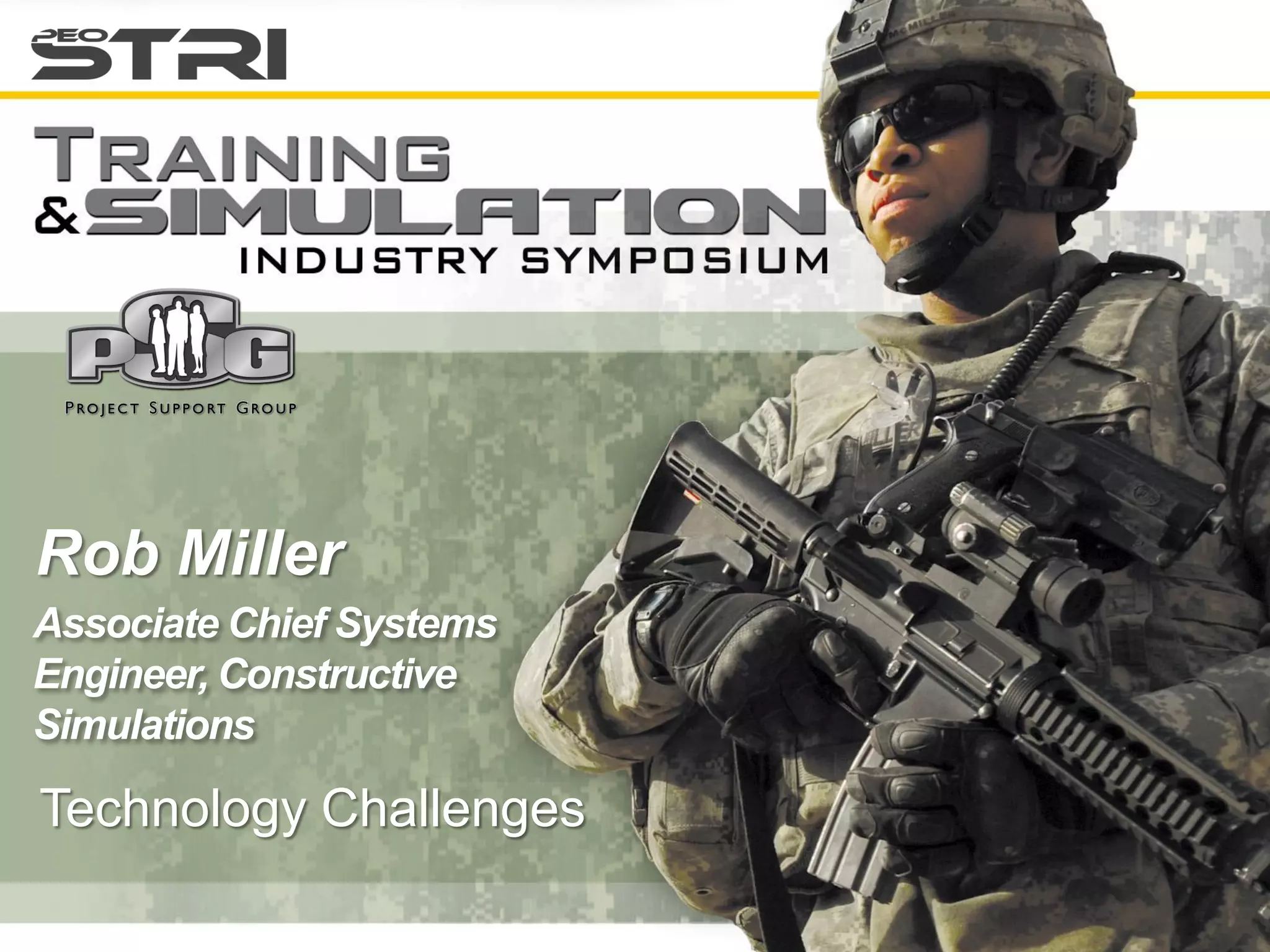
Rob Miller
Associate Chief Systems
Engineer, Constructive
Simulations

Technology Challenges
PEO STRI Technology Challenges

‭ Virtualization Strategies
  Constructive simulations, tools and interface
   applications are often poorly matched to their host
   hardware platforms. Some applications use very little
   of‭the‭platform’s‭available‭computing‭power‭and‭
   memory while others demand more resources than a
   typical platform can provide. Yet each may still run
   on its own single platform.

  Platform virtualization is a potential strategy that can
   be used to pool computing resources of several
   applications within a federation for higher efficiency.

  Delivery of a simulation service from centrally located
   regional simulation hubs.
PEO STRI Technology Challenges


• Human Intelligence Collection Operations
  modeling

  – Modeling and simulation of the complex Human
    Intelligence process of collection and reporting.

  – Simulation of human sources with unpredictable and
    sometimes unrealistic results.

  – Modeling unpredictable human intelligence sources to
    produce more realistic results.
PEO STRI Technology Challenges


• Biometric authentication for simulation operators,
  role players, technicians

  – Incorporation of biometrics to replace the current user
    authentication method (username and password) for
    access to multiuser role player workstations
    (hardware) on large distributed system

  – Authentication must support emerging information
    assurance requirements
PEO STRI Technology Challenges


• Automated feature extraction from imagery
  (Satellite/LIDAR)

  – Automated methods to extract critical features from
    large terrain areas

  – Feature extraction from imagery at the Geotile level

  – Includes automated merging of this extracted data with
    existing VMAP1 data to fill in missing VMAP
    information
PEO STRI Technology Challenges


• Intelligent Role-Player/Operator Assistant
  Technologies

  – Development and integration of intelligent role player
    assistant technologies that can provide the role player
    a wider span of control and more timely situational
    awareness of widely dispersed (geographically) forces
    under his control.

  – Investigate technologies and techniques that have
    been proven efficient for streamlining workstation
    operator workload allowing a broader span of control
    without sacrificing ability to control a lager number of
    subordinate units/entities.
PEO STRI Technology Challenges

• AVATAR Support for Human Intelligence
  Interrogation

  – Ability to produce custom characters, animations, and
    detailed features to help create realistic avatars for close
    human interaction.
  – Morphing of subjects to support lip synching and
    corresponding facial features.
  – Automatic lip synching, eye movement, facial gestures from
    computer generated speech.
  – Unique 3D Character models with flexible bone structure
    allowing different height characters and different genders.
  – Skeleton structure that allows for complex facial animations
    and/or detailed moving of the mouth. Including independent
    eye movement.
  – Import/export of custom animations.
PEO STRI Technology Challenges

‭ Voice Recognition Over Cluttered Radio
  Frequencies
  - Voice recognition technology that can isolate a
    speaker in a cluttered RF environment.

‭ Processing Unstructured Human Language
  in a Tactical Environment
  Technology that allows an unstructured description of
   terrain or targets to be understood by a virtual human.
  The ability to command a virtual person to take an
   action and/or make a decision based on information
   passed verbally.
PEO STRI Technology Challenges


‭ Immersive Technologies
  • Autonomous CGF characters that can have
    meaningful interactions with a trainee
  • Seamless ability to grab control CGF
  • Improved HMD
     • 110 deg horizontal field of view, low cost, 1280 x 1024, rugged
  • Improved locomotion devices
  • Low cost, wireless hand and arm sensors
  • Low cost haptic vest/suit
PEO STRI Technology Challenges

• Accurate and Affordable High Fidelity Weapon
  Orientation Sensor
   – High fidelity weapon orientation
       • High fidelity pointing vectors for weapons within their
         operational environments (i.e., ferrous metals)
       • Accuracy: < .1 degrees
       • Small form/fit, SWaP-C, Non-obtrusive to player/weapon
       • Simple calibration method

• Accurate and Affordable Geo-location/Situational
  Awareness capabilities for indoor and GPS-denied
  environments
   – A high fidelity position/location system for real-time tracking
     soldiers in an indoor/urban or GPS-denied environment
       • “Best”‭technologies?
           – UWB, RF, GPS, Acoustic, IR, Video, magnetic, etc.
       • Accuracy: 6-8 inches/15-17 cm (T); 3-4 inches/10 cm (O)
       • Low impacts to both soldier and infrastructure
PEO STRI Technology Challenges


• Highly scalable and mobile multimedia wireless
  networks
   • Capable of providing seamless exercise movement across
     vast training/testing areas
   • Capable of transmitting high throughput LOS and NLOS
     application data from player units with QoS to exercise
     controller
   • Able to provide MANET, multi-hop and point to multipoint
     connectivity with low latency
   • Integrating spectral efficient software defined radio
     technology capable of transmitting multiple waveforms
   • Migrating to converge legacy voice, video and data networks
     into a single IP based multimedia network
   • Interoperable across live testing and training communities
   • Utilizing the best technologies, protocols and open standards
       • Ex: IEEE, 3GPP, Best PAN standards; DARPA WNaN
PEO STRI Technology Challenges

• Software Defined Radios (SDR)/Cognitive Radios/Dynamic
  Spectrum Assess (DSA) technologies
   • Affordable approach to support test/training applications
   • Configurable multi-spectrum SDR/Cognitive radios
   • Frequency agility via dynamic baseband filtering
   • Small form/fit footprint which makes extensive use of COTS or
     Military radios.
   • Supports multiple waveforms

• Waveform
   • Spectral efficient waveform and applications (MIMO, DSA)
   • Power efficient player units
   • Waveforms: JTRS SRW, JTRS WNW, OT TES OFDM/HYNET,
     Secured commercial 4G: LTE and 802.16e/j
   • Waveform components being able to coexist in LT2 as software
     components
   • MAN/WAN/WLAN/PAN applications
PEO STRI Technology Challenges

‭ Adaptive Behavior Targets
  • Provide an autonomous behavior target
     • Asymmetric and reactive threat
     • SAF emotion engine using sensor inputs
  • Inter-target communication
     • All targets share event data
     • Reactions to events on other targets
  • Provide enhanced realism
     • Realistic thermal/IR signature
     • Improved mobility (track-less)
     • Bi-directional voice capabilities
  • Support live fire with minimal failures/high RAM
PEO STRI Technology Challenges

‭ Non-Contact Hit Sensor
  • Create a sensor field/zone for an area/target of
    interest
     • Non-gated operation
     • 2 or 3 dimensional areas of interest
  • Provide accurate identification of penetration point
  • Identification of objects entering field/zone
     • By caliber
     • Munitions vs debris
  • Must support both super and sub sonic munitions
  • Support live fire with minimal failures/high RAM
PEO STRI Technology Challenges

‭   Fuel Cells/Batteries – Lighter, smaller, low cost
‭   Wireless Communications
    - Real time ray tracing communications model of 30k+ entities OFDM for
      4G wireless internet
    - More mature narrow band OFDM on small form factors
    - Transmission of classified data from remote instrumentation
‭   Physics/effects modeling of Digital Radio Freq Memory (DRFM)
    waveforms in M&S and injection for electronic attack
    simulators.
‭   Low cost sophisticated remote target control – Technology
    has yet to drive down costs of complex target control systems.
    (UAVs)
‭   Target remote control in GPS denied environment.
‭   Cognitive Evaluation - Advanced sensors and algorithms for
    EEG, ECG, EMG, EG, CBT. Etc.
Simulation Technology Challenges

Simulation Technology Challenges

  • 1.
    Rob Miller Associate ChiefSystems Engineer, Constructive Simulations Technology Challenges
  • 2.
    PEO STRI TechnologyChallenges ‭ Virtualization Strategies Constructive simulations, tools and interface applications are often poorly matched to their host hardware platforms. Some applications use very little of‭the‭platform’s‭available‭computing‭power‭and‭ memory while others demand more resources than a typical platform can provide. Yet each may still run on its own single platform. Platform virtualization is a potential strategy that can be used to pool computing resources of several applications within a federation for higher efficiency. Delivery of a simulation service from centrally located regional simulation hubs.
  • 3.
    PEO STRI TechnologyChallenges • Human Intelligence Collection Operations modeling – Modeling and simulation of the complex Human Intelligence process of collection and reporting. – Simulation of human sources with unpredictable and sometimes unrealistic results. – Modeling unpredictable human intelligence sources to produce more realistic results.
  • 4.
    PEO STRI TechnologyChallenges • Biometric authentication for simulation operators, role players, technicians – Incorporation of biometrics to replace the current user authentication method (username and password) for access to multiuser role player workstations (hardware) on large distributed system – Authentication must support emerging information assurance requirements
  • 5.
    PEO STRI TechnologyChallenges • Automated feature extraction from imagery (Satellite/LIDAR) – Automated methods to extract critical features from large terrain areas – Feature extraction from imagery at the Geotile level – Includes automated merging of this extracted data with existing VMAP1 data to fill in missing VMAP information
  • 6.
    PEO STRI TechnologyChallenges • Intelligent Role-Player/Operator Assistant Technologies – Development and integration of intelligent role player assistant technologies that can provide the role player a wider span of control and more timely situational awareness of widely dispersed (geographically) forces under his control. – Investigate technologies and techniques that have been proven efficient for streamlining workstation operator workload allowing a broader span of control without sacrificing ability to control a lager number of subordinate units/entities.
  • 7.
    PEO STRI TechnologyChallenges • AVATAR Support for Human Intelligence Interrogation – Ability to produce custom characters, animations, and detailed features to help create realistic avatars for close human interaction. – Morphing of subjects to support lip synching and corresponding facial features. – Automatic lip synching, eye movement, facial gestures from computer generated speech. – Unique 3D Character models with flexible bone structure allowing different height characters and different genders. – Skeleton structure that allows for complex facial animations and/or detailed moving of the mouth. Including independent eye movement. – Import/export of custom animations.
  • 8.
    PEO STRI TechnologyChallenges ‭ Voice Recognition Over Cluttered Radio Frequencies - Voice recognition technology that can isolate a speaker in a cluttered RF environment. ‭ Processing Unstructured Human Language in a Tactical Environment Technology that allows an unstructured description of terrain or targets to be understood by a virtual human. The ability to command a virtual person to take an action and/or make a decision based on information passed verbally.
  • 9.
    PEO STRI TechnologyChallenges ‭ Immersive Technologies • Autonomous CGF characters that can have meaningful interactions with a trainee • Seamless ability to grab control CGF • Improved HMD • 110 deg horizontal field of view, low cost, 1280 x 1024, rugged • Improved locomotion devices • Low cost, wireless hand and arm sensors • Low cost haptic vest/suit
  • 10.
    PEO STRI TechnologyChallenges • Accurate and Affordable High Fidelity Weapon Orientation Sensor – High fidelity weapon orientation • High fidelity pointing vectors for weapons within their operational environments (i.e., ferrous metals) • Accuracy: < .1 degrees • Small form/fit, SWaP-C, Non-obtrusive to player/weapon • Simple calibration method • Accurate and Affordable Geo-location/Situational Awareness capabilities for indoor and GPS-denied environments – A high fidelity position/location system for real-time tracking soldiers in an indoor/urban or GPS-denied environment • “Best”‭technologies? – UWB, RF, GPS, Acoustic, IR, Video, magnetic, etc. • Accuracy: 6-8 inches/15-17 cm (T); 3-4 inches/10 cm (O) • Low impacts to both soldier and infrastructure
  • 11.
    PEO STRI TechnologyChallenges • Highly scalable and mobile multimedia wireless networks • Capable of providing seamless exercise movement across vast training/testing areas • Capable of transmitting high throughput LOS and NLOS application data from player units with QoS to exercise controller • Able to provide MANET, multi-hop and point to multipoint connectivity with low latency • Integrating spectral efficient software defined radio technology capable of transmitting multiple waveforms • Migrating to converge legacy voice, video and data networks into a single IP based multimedia network • Interoperable across live testing and training communities • Utilizing the best technologies, protocols and open standards • Ex: IEEE, 3GPP, Best PAN standards; DARPA WNaN
  • 12.
    PEO STRI TechnologyChallenges • Software Defined Radios (SDR)/Cognitive Radios/Dynamic Spectrum Assess (DSA) technologies • Affordable approach to support test/training applications • Configurable multi-spectrum SDR/Cognitive radios • Frequency agility via dynamic baseband filtering • Small form/fit footprint which makes extensive use of COTS or Military radios. • Supports multiple waveforms • Waveform • Spectral efficient waveform and applications (MIMO, DSA) • Power efficient player units • Waveforms: JTRS SRW, JTRS WNW, OT TES OFDM/HYNET, Secured commercial 4G: LTE and 802.16e/j • Waveform components being able to coexist in LT2 as software components • MAN/WAN/WLAN/PAN applications
  • 13.
    PEO STRI TechnologyChallenges ‭ Adaptive Behavior Targets • Provide an autonomous behavior target • Asymmetric and reactive threat • SAF emotion engine using sensor inputs • Inter-target communication • All targets share event data • Reactions to events on other targets • Provide enhanced realism • Realistic thermal/IR signature • Improved mobility (track-less) • Bi-directional voice capabilities • Support live fire with minimal failures/high RAM
  • 14.
    PEO STRI TechnologyChallenges ‭ Non-Contact Hit Sensor • Create a sensor field/zone for an area/target of interest • Non-gated operation • 2 or 3 dimensional areas of interest • Provide accurate identification of penetration point • Identification of objects entering field/zone • By caliber • Munitions vs debris • Must support both super and sub sonic munitions • Support live fire with minimal failures/high RAM
  • 15.
    PEO STRI TechnologyChallenges ‭ Fuel Cells/Batteries – Lighter, smaller, low cost ‭ Wireless Communications - Real time ray tracing communications model of 30k+ entities OFDM for 4G wireless internet - More mature narrow band OFDM on small form factors - Transmission of classified data from remote instrumentation ‭ Physics/effects modeling of Digital Radio Freq Memory (DRFM) waveforms in M&S and injection for electronic attack simulators. ‭ Low cost sophisticated remote target control – Technology has yet to drive down costs of complex target control systems. (UAVs) ‭ Target remote control in GPS denied environment. ‭ Cognitive Evaluation - Advanced sensors and algorithms for EEG, ECG, EMG, EG, CBT. Etc.