IJRET: International Journal of Research in Engineering and Technology eISSN: 2319-1163 | pISSN: 2321-7308
_______________________________________________________________________________________
Volume: 04 Issue: 07 | July-2015, Available @ http://www.ijret.org 190
SIMULATION AND DESIGN OF SPLICE JOINT IN FUSELAGE
Vijayaraja L1
, A R Anwar Khan2
1
PG student, Department of Mechanical Engineering Ghousia College of Engineering, Ramanagaram, VTU-Belagavi,
Karnataka, India
2
HOD, Department of Mechanical Engineering, Ghousia College of Engineering, Ramanagaram, VTU-Belagavi,
Karnataka, India
Abstract
In present work the correlation of Z-Stringer splice join present in Aircraft fuselage skin with three combination, they are
metallic, composite and metallic and composite. The stringers are used in aircraft fuselage to avoid buckling of fuselage skin. The
stringer is assembled to fuselage skin by bolts. The stringers are connected end to end by splice joint. The 3D modelling of
stringer in ANSYS Workbench, by applying design condition for static structural for stress evaluation by finite element method for
these combinations is made.
Keywords: Aircraft, Fuselage, Stringers, Frames.
---------------------------------------------------------------------***-----------------------------------------------------------------
1. INTRODUCTION
Stringer is a little thin portion of material which is attached
to the skin of the air ship. In the fuselage, stringers are
connected to edges which are in the longitudinal heading of
the aircraft. The biggest single thing of the fuselage structure
is the skin and its stringer. It is additionally the most
discriminating structure since it conveys the greater part of
the essential loads because of fuselage twisting, shear,
torsion and internal compression. End to end of stringers is
connected by splice joint.
The investigations are carried out on splice joints for wing
skin of a stringer in aircraft to find maximum stress
concentration [1]. Fatigue life estimation [2], multi-site
damage [3] and light fly of aircraft fuselage using composite
material [4]-[5].
2. ANALYSIS USING ANSYS
1. The geometric construction of stringer is carried by using
sketcher tool with particular dimensions.
2. After Geometric modelling the model is meshed by giving
edge sizing for the model.
3. The Boundary conditions is applied for the meshed model
for evaluation of results.
4. The stress and Deformation results are evaluated for the
metallic and composite stringer.
3. GEOMETRIC MODELLING
Fig 1 Wireframe of Fuselage
The above Figure shows the Wireframe structure of the
Aircraft Fuselage, consists of stringer & frames.
Fig 2 Stringer
The above Figure shows the section of stringer and
Dimensions mentioned below.
IJRET: International Journal of Research in Engineering and Technology eISSN: 2319-1163 | pISSN: 2321-7308
_______________________________________________________________________________________
Volume: 04 Issue: 07 | July-2015, Available @ http://www.ijret.org 191
3.1 Geometry of Stringer
Fig 3 Modelled Stringer
The above Figure shows isometric and side view of
modelled stringer.
Table – 1: Dimensions of the Stringer
Sl.No. Name Dimension
1
Stringer height
(hstr)
35mm
2
Stringer width
(dstr)
20mm
3 Stringer length 80mm each
Splice is 30mm wide and 60mm long
Bolt diameter 4mm
3.2 FE model of Stringer
Fig 4 FE model
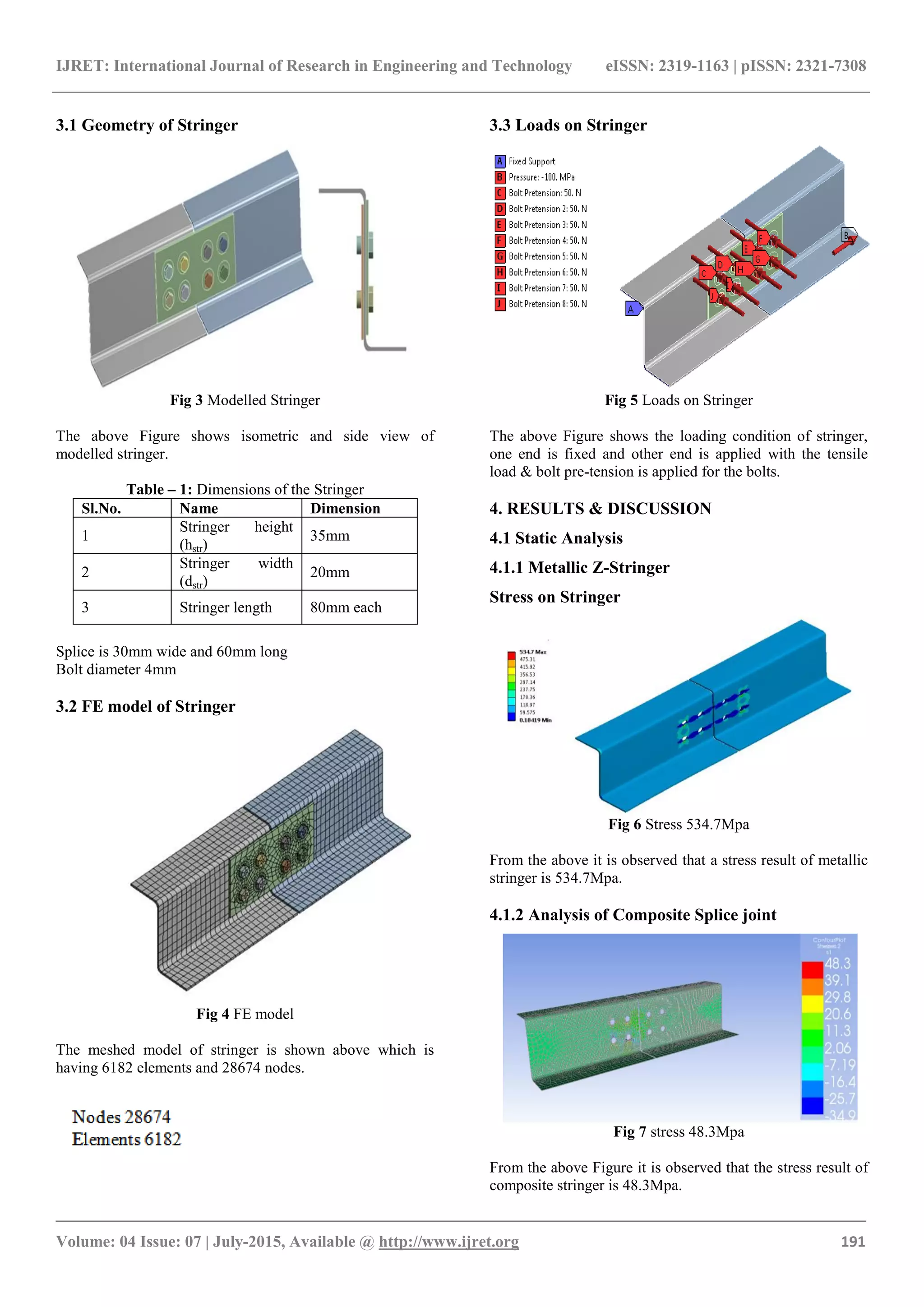
The meshed model of stringer is shown above which is
having 6182 elements and 28674 nodes.
3.3 Loads on Stringer
Fig 5 Loads on Stringer
The above Figure shows the loading condition of stringer,
one end is fixed and other end is applied with the tensile
load & bolt pre-tension is applied for the bolts.
4. RESULTS & DISCUSSION
4.1 Static Analysis
4.1.1 Metallic Z-Stringer
Stress on Stringer
Fig 6 Stress 534.7Mpa
From the above it is observed that a stress result of metallic
stringer is 534.7Mpa.
4.1.2 Analysis of Composite Splice joint
Fig 7 stress 48.3Mpa
From the above Figure it is observed that the stress result of
composite stringer is 48.3Mpa.
IJRET: International Journal of Research in Engineering and Technology eISSN: 2319-1163 | pISSN: 2321-7308
_______________________________________________________________________________________
Volume: 04 Issue: 07 | July-2015, Available @ http://www.ijret.org 192
4.2 Correlation of Metallic and Composite Stringer
Table – 2
Metallic Composite
Deformation 0.227mm 0.182mm
Stress 534Mpa 44Mpa
From the above comparison table it is clear that the stress
and deformation in composite stringer is low compares to
metallic stringer. Hence the composite stringer is preferable
over metallic stringer for aircraft fuselage.
5. CONCLUSION
The development of stress in two combination of stringer is
discussed. The static analysis is made to evaluate the stress
and deformation of metallic and composite stringers. The
metallic stringer will shows stress of 534Mpa and
deformation of 0.227mm and composite stringer will shows
stress of 44Mpa and deformation of 0.182mm. Finally
conclude that the behaviour of splice joint of stringer in an
aircraft fuselage structure composite stringer is more
efficient and preferable compared to conventional material.
REFERENCES
[1] Michel van Tooren and Lars Krakers Multi-
disciplinary Design of Aircraft Fuselage Structures,
Delft University of Technology, Netherland.
[2] Michael Chun-Yung Niu, Airframe Structural
Design. California U.S.A march 1988.
[3] E.F Bruhn, B.S, M.S.C.E, Dr. Engg, Analysis and
design of flight Vehicle Structures, 3rd Edition, June
1973.
[4] “Aircraft Accident Investigation Report Boeing747
SR-100”, Japan Airlines Company Limited, 1985.
BIOGRAPHIES
PG student, Machine Design, Department
of Mechanical Engineering Ghousia
College of Engineering, Ramanagaram,
VTU-Belagavi, Karnataka, India
Professor & HOD (Mechanical), Ghousia
College of Engineering, Ramanagaram,
VTU-Belagavi, Karnataka, India
Guiding: 5Phd
Publications: 30 journals published
In National & International

Simulation and design of splice joint in fuselage

  • 1.
    IJRET: International Journalof Research in Engineering and Technology eISSN: 2319-1163 | pISSN: 2321-7308 _______________________________________________________________________________________ Volume: 04 Issue: 07 | July-2015, Available @ http://www.ijret.org 190 SIMULATION AND DESIGN OF SPLICE JOINT IN FUSELAGE Vijayaraja L1 , A R Anwar Khan2 1 PG student, Department of Mechanical Engineering Ghousia College of Engineering, Ramanagaram, VTU-Belagavi, Karnataka, India 2 HOD, Department of Mechanical Engineering, Ghousia College of Engineering, Ramanagaram, VTU-Belagavi, Karnataka, India Abstract In present work the correlation of Z-Stringer splice join present in Aircraft fuselage skin with three combination, they are metallic, composite and metallic and composite. The stringers are used in aircraft fuselage to avoid buckling of fuselage skin. The stringer is assembled to fuselage skin by bolts. The stringers are connected end to end by splice joint. The 3D modelling of stringer in ANSYS Workbench, by applying design condition for static structural for stress evaluation by finite element method for these combinations is made. Keywords: Aircraft, Fuselage, Stringers, Frames. ---------------------------------------------------------------------***----------------------------------------------------------------- 1. INTRODUCTION Stringer is a little thin portion of material which is attached to the skin of the air ship. In the fuselage, stringers are connected to edges which are in the longitudinal heading of the aircraft. The biggest single thing of the fuselage structure is the skin and its stringer. It is additionally the most discriminating structure since it conveys the greater part of the essential loads because of fuselage twisting, shear, torsion and internal compression. End to end of stringers is connected by splice joint. The investigations are carried out on splice joints for wing skin of a stringer in aircraft to find maximum stress concentration [1]. Fatigue life estimation [2], multi-site damage [3] and light fly of aircraft fuselage using composite material [4]-[5]. 2. ANALYSIS USING ANSYS 1. The geometric construction of stringer is carried by using sketcher tool with particular dimensions. 2. After Geometric modelling the model is meshed by giving edge sizing for the model. 3. The Boundary conditions is applied for the meshed model for evaluation of results. 4. The stress and Deformation results are evaluated for the metallic and composite stringer. 3. GEOMETRIC MODELLING Fig 1 Wireframe of Fuselage The above Figure shows the Wireframe structure of the Aircraft Fuselage, consists of stringer & frames. Fig 2 Stringer The above Figure shows the section of stringer and Dimensions mentioned below.
  • 2.
    IJRET: International Journalof Research in Engineering and Technology eISSN: 2319-1163 | pISSN: 2321-7308 _______________________________________________________________________________________ Volume: 04 Issue: 07 | July-2015, Available @ http://www.ijret.org 191 3.1 Geometry of Stringer Fig 3 Modelled Stringer The above Figure shows isometric and side view of modelled stringer. Table – 1: Dimensions of the Stringer Sl.No. Name Dimension 1 Stringer height (hstr) 35mm 2 Stringer width (dstr) 20mm 3 Stringer length 80mm each Splice is 30mm wide and 60mm long Bolt diameter 4mm 3.2 FE model of Stringer Fig 4 FE model The meshed model of stringer is shown above which is having 6182 elements and 28674 nodes. 3.3 Loads on Stringer Fig 5 Loads on Stringer The above Figure shows the loading condition of stringer, one end is fixed and other end is applied with the tensile load & bolt pre-tension is applied for the bolts. 4. RESULTS & DISCUSSION 4.1 Static Analysis 4.1.1 Metallic Z-Stringer Stress on Stringer Fig 6 Stress 534.7Mpa From the above it is observed that a stress result of metallic stringer is 534.7Mpa. 4.1.2 Analysis of Composite Splice joint Fig 7 stress 48.3Mpa From the above Figure it is observed that the stress result of composite stringer is 48.3Mpa.
  • 3.
    IJRET: International Journalof Research in Engineering and Technology eISSN: 2319-1163 | pISSN: 2321-7308 _______________________________________________________________________________________ Volume: 04 Issue: 07 | July-2015, Available @ http://www.ijret.org 192 4.2 Correlation of Metallic and Composite Stringer Table – 2 Metallic Composite Deformation 0.227mm 0.182mm Stress 534Mpa 44Mpa From the above comparison table it is clear that the stress and deformation in composite stringer is low compares to metallic stringer. Hence the composite stringer is preferable over metallic stringer for aircraft fuselage. 5. CONCLUSION The development of stress in two combination of stringer is discussed. The static analysis is made to evaluate the stress and deformation of metallic and composite stringers. The metallic stringer will shows stress of 534Mpa and deformation of 0.227mm and composite stringer will shows stress of 44Mpa and deformation of 0.182mm. Finally conclude that the behaviour of splice joint of stringer in an aircraft fuselage structure composite stringer is more efficient and preferable compared to conventional material. REFERENCES [1] Michel van Tooren and Lars Krakers Multi- disciplinary Design of Aircraft Fuselage Structures, Delft University of Technology, Netherland. [2] Michael Chun-Yung Niu, Airframe Structural Design. California U.S.A march 1988. [3] E.F Bruhn, B.S, M.S.C.E, Dr. Engg, Analysis and design of flight Vehicle Structures, 3rd Edition, June 1973. [4] “Aircraft Accident Investigation Report Boeing747 SR-100”, Japan Airlines Company Limited, 1985. BIOGRAPHIES PG student, Machine Design, Department of Mechanical Engineering Ghousia College of Engineering, Ramanagaram, VTU-Belagavi, Karnataka, India Professor & HOD (Mechanical), Ghousia College of Engineering, Ramanagaram, VTU-Belagavi, Karnataka, India Guiding: 5Phd Publications: 30 journals published In National & International