Grammar Lesson
Tawil Duha
9th grade
Can you guess today’s tense?
~ Noor has become friends with Lia.
~ We’ve been here before, but this time feels different.
~ They have studied English since they were kids.
~ I have been a teacher for seven years.
1. Identify the verbs in the sentences.
2. What do you think the sentence
structure is?
Definition
The present perfect tense is an English verb tense used for past
actions that are related to or continue into the present. It’s easily
recognized by the auxiliary verbs (or helper verbs) have and has, as
in, “I have gone fishing since I was a child.”
Of all the English verb tenses, the present perfect is one of the most
complicated because there’s not always a direct translation in other
languages. So in this guide, we explain everything you need to know
to use it perfectly, including how and when to use it, with plenty of
present perfect tense examples.
Definition
The present perfect tense is one of the common verb tenses in
English, used to show an action that happened in the past that is
directly related to the present, such as actions that are still continuing
or that indicate a change over time.
E.g. I have been a teacher for seven years. That is to say that I
worked as a teacher seven years ago and still working as a teacher
until now.
Don’t let the name confuse you—even though the word present is
there, the present perfect tense deals with actions that happened or
started in the past.
1. First-person: I have come a long way.
2. Second person: You have come a long way.
3. Third-person plural: They have come a long way.
4. Third-person singular: He/she/it has come a long way.
The present perfect tense for statements
For general statements, the most common use of the
present perfect, use have or has plus the past
participle form of the main verb.
Subject + [have/has] + [past participle]
Noor has become friends with Lia.
present perfect - negatives
To use the present perfect tense in the negative,
simply add the negative word
(like not or never) after the auxiliary verb
but before the past participle.
Subject + [have/has] + [negative] + [past participle]
I have not slept well since exams started.
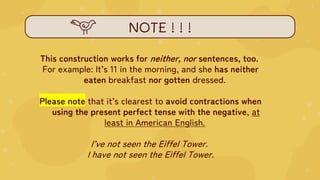
NOTE ! ! !
This construction works for neither, nor sentences, too.
For example: It’s 11 in the morning, and she has neither
eaten breakfast nor gotten dressed.
Please note that it’s clearest to avoid contractions when
using the present perfect tense with the negative, at
least in American English.
I’ve not seen the Eiffel Tower.
I have not seen the Eiffel Tower.
Present perfect - Questions
When asking a question in the present perfect tense, the auxiliary
verb comes first, followed by the subject, and then the past
participle of the main verb. This follows a similar construction as
questions with the auxiliary verb do, which also comes before the
subject.
[have/has] + [subject] + [past participle]
Have you eaten dinner yet?
Has the party started?
Its time to
practice!
https://www.liveworksheets.com/worksheets/
en/English_as_a_Second_Language_(ESL)/Pre
sent_perfect/Present_Perfect_Simple_-
_positive_and_negative_ia1390189uk
https://www.liveworksheets.com/w
orksheets/en/English_as_a_Second
_Language_(ESL)/Present_perfect/
Present_Perfect_with_FOR_and_SI
NCE_uf2589960jc
CREDITS: This presentation template was created by Slidesgo, and
includes icons by Flaticon, and infographics & images by Freepik
Thank you ☺
Tawil Duha

present perfect

  • 1.
  • 2.
    Can you guesstoday’s tense? ~ Noor has become friends with Lia. ~ We’ve been here before, but this time feels different. ~ They have studied English since they were kids. ~ I have been a teacher for seven years. 1. Identify the verbs in the sentences. 2. What do you think the sentence structure is?
  • 4.
    Definition The present perfecttense is an English verb tense used for past actions that are related to or continue into the present. It’s easily recognized by the auxiliary verbs (or helper verbs) have and has, as in, “I have gone fishing since I was a child.” Of all the English verb tenses, the present perfect is one of the most complicated because there’s not always a direct translation in other languages. So in this guide, we explain everything you need to know to use it perfectly, including how and when to use it, with plenty of present perfect tense examples.
  • 5.
    Definition The present perfecttense is one of the common verb tenses in English, used to show an action that happened in the past that is directly related to the present, such as actions that are still continuing or that indicate a change over time. E.g. I have been a teacher for seven years. That is to say that I worked as a teacher seven years ago and still working as a teacher until now. Don’t let the name confuse you—even though the word present is there, the present perfect tense deals with actions that happened or started in the past.
  • 6.
    1. First-person: Ihave come a long way. 2. Second person: You have come a long way. 3. Third-person plural: They have come a long way. 4. Third-person singular: He/she/it has come a long way.
  • 7.
    The present perfecttense for statements For general statements, the most common use of the present perfect, use have or has plus the past participle form of the main verb. Subject + [have/has] + [past participle] Noor has become friends with Lia.
  • 8.
    present perfect -negatives To use the present perfect tense in the negative, simply add the negative word (like not or never) after the auxiliary verb but before the past participle. Subject + [have/has] + [negative] + [past participle] I have not slept well since exams started.
  • 9.
    NOTE ! !! This construction works for neither, nor sentences, too. For example: It’s 11 in the morning, and she has neither eaten breakfast nor gotten dressed. Please note that it’s clearest to avoid contractions when using the present perfect tense with the negative, at least in American English. I’ve not seen the Eiffel Tower. I have not seen the Eiffel Tower.
  • 10.
    Present perfect -Questions When asking a question in the present perfect tense, the auxiliary verb comes first, followed by the subject, and then the past participle of the main verb. This follows a similar construction as questions with the auxiliary verb do, which also comes before the subject. [have/has] + [subject] + [past participle] Have you eaten dinner yet? Has the party started?
  • 11.
  • 12.
  • 14.
  • 15.
    CREDITS: This presentationtemplate was created by Slidesgo, and includes icons by Flaticon, and infographics & images by Freepik Thank you ☺ Tawil Duha