Leonardo Cedeño C.I 26.887.803
#46 Sección: 3B
 The Past Simple tense, also called the Simple Past, is used for past actions that
happened either at a specific time, which can either be given by a time phrase
(yesterday, last year, etc.) or understood from the context. Regular Verbs add -
ed to the base form, or -d if the verbs ends with -e. Irregular verbs can change in
many different ways. The verb form is the same for all persons.
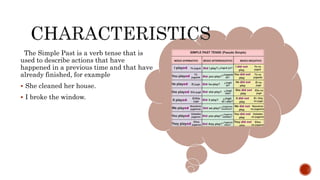
The Simple Past is a verb tense that is
used to describe actions that have
happened in a previous time and that have
already finished, for example
 She cleaned her house.
 I broke the window.
In both the interrogative and negative forms, DID is used as the auxiliary DID,
which is the past form of the verb "TO DO" and accompanies the main verb in its
infinitive form. In negations the contracted form of DID NOT or DID NOT can be
used. In the upper box, the verb To Play is used as an example
In order to form a sentence in past tense we must distinguish two types: REGULAR
VERBS and IRREGULAR VERBS.
In the first case they form their Simple Past adding the termination ED to the
infinitive, whereas the irregular ones receive that name for not following a certain
pattern and in this case they must be studied individually.
REGULAR VERBS
FORMATION OF "SIMPLE
PAST"
WITH REGULAR VERBS
Afirmativa
Sujeto + raíz + ed
I skipped.
Negativa
Sujeto + did not + infinitivo sin to
They didn't go.
Interrogativa
Did + sujeto + infinitivo sin to
Did she arrive?
Interrogativa negativa
Did not + sujeto + infinitivo sin to
Didn't you play?
 irregular verbs in English are those that, to form the simple past or the past
participle (compound times) do not follow any standard, simply its word changes
totally.
 A very clear example is the auxiliary verb "do", since in simple past it happens to
be "did" and in past participle "done".
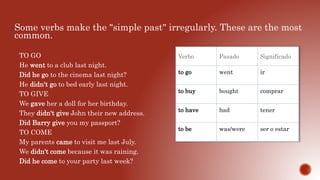
Some verbs make the "simple past" irregularly. These are the most
common.
 TO GO
 He went to a club last night.
 Did he go to the cinema last night?
 He didn't go to bed early last night.
 TO GIVE
 We gave her a doll for her birthday.
 They didn't give John their new address.
 Did Barry give you my passport?
 TO COME
 My parents came to visit me last July.
 We didn't come because it was raining.
 Did he come to your party last week?
Verbo Pasado Significado
to go went ir
to buy bought comprar
to have had tener
to be was/were ser o estar
1. You worked very hard last week.
2. She lived in Japan last year.
3. I married Kelly last year.
4. He studied for his English class.
5. She wanted to learn French.
6. You studied in my class last semester.
7. She wished to learn Italian.
8. She wanted to visit London.
9. He watched television until twelve o’clock last night.
10. I mentioned it to you many times.
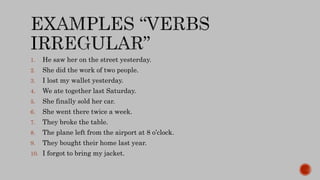
1. He saw her on the street yesterday.
2. She did the work of two people.
3. I lost my wallet yesterday.
4. We ate together last Saturday.
5. She finally sold her car.
6. She went there twice a week.
7. They broke the table.
8. The plane left from the airport at 8 o’clock.
9. They bought their home last year.
10. I forgot to bring my jacket.
Affirmatives :
1. Did you work very hard last week? Yes, I did.
2. Did she want to learn French? Yes, she wanted to learn French.
3. Did he live in Boston? Yes, he lived in Boston. Did they learn how to swim
two years ago? Yes, they did
4. Did he walk to school? Yes, he
5. Did she wish to learn Italian? Yes, she wished to learn Italian.
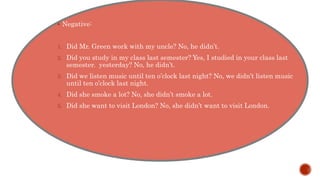
 Negative:
1. Did Mr. Green work with my uncle? No, he didn’t.
2. Did you study in my class last semester? Yes, I studied in your class last
semester. yesterday? No, he didn’t.
3. Did we listen music until ten o’clock last night? No, we didn’t listen music
until ten o’clock last night.
4. Did she smoke a lot? No, she didn’t smoke a lot.
5. Did she want to visit London? No, she didn’t want to visit London.
simple past
simple past
simple past

simple past

  • 1.
    Leonardo Cedeño C.I26.887.803 #46 Sección: 3B
  • 2.
     The PastSimple tense, also called the Simple Past, is used for past actions that happened either at a specific time, which can either be given by a time phrase (yesterday, last year, etc.) or understood from the context. Regular Verbs add - ed to the base form, or -d if the verbs ends with -e. Irregular verbs can change in many different ways. The verb form is the same for all persons.
  • 3.
    The Simple Pastis a verb tense that is used to describe actions that have happened in a previous time and that have already finished, for example  She cleaned her house.  I broke the window.
  • 4.
    In both theinterrogative and negative forms, DID is used as the auxiliary DID, which is the past form of the verb "TO DO" and accompanies the main verb in its infinitive form. In negations the contracted form of DID NOT or DID NOT can be used. In the upper box, the verb To Play is used as an example In order to form a sentence in past tense we must distinguish two types: REGULAR VERBS and IRREGULAR VERBS. In the first case they form their Simple Past adding the termination ED to the infinitive, whereas the irregular ones receive that name for not following a certain pattern and in this case they must be studied individually.
  • 6.
    REGULAR VERBS FORMATION OF"SIMPLE PAST" WITH REGULAR VERBS Afirmativa Sujeto + raíz + ed I skipped. Negativa Sujeto + did not + infinitivo sin to They didn't go. Interrogativa Did + sujeto + infinitivo sin to Did she arrive? Interrogativa negativa Did not + sujeto + infinitivo sin to Didn't you play?
  • 7.
     irregular verbsin English are those that, to form the simple past or the past participle (compound times) do not follow any standard, simply its word changes totally.  A very clear example is the auxiliary verb "do", since in simple past it happens to be "did" and in past participle "done".
  • 8.
    Some verbs makethe "simple past" irregularly. These are the most common.  TO GO  He went to a club last night.  Did he go to the cinema last night?  He didn't go to bed early last night.  TO GIVE  We gave her a doll for her birthday.  They didn't give John their new address.  Did Barry give you my passport?  TO COME  My parents came to visit me last July.  We didn't come because it was raining.  Did he come to your party last week? Verbo Pasado Significado to go went ir to buy bought comprar to have had tener to be was/were ser o estar
  • 9.
    1. You workedvery hard last week. 2. She lived in Japan last year. 3. I married Kelly last year. 4. He studied for his English class. 5. She wanted to learn French. 6. You studied in my class last semester. 7. She wished to learn Italian. 8. She wanted to visit London. 9. He watched television until twelve o’clock last night. 10. I mentioned it to you many times.
  • 10.
    1. He sawher on the street yesterday. 2. She did the work of two people. 3. I lost my wallet yesterday. 4. We ate together last Saturday. 5. She finally sold her car. 6. She went there twice a week. 7. They broke the table. 8. The plane left from the airport at 8 o’clock. 9. They bought their home last year. 10. I forgot to bring my jacket.
  • 11.
    Affirmatives : 1. Didyou work very hard last week? Yes, I did. 2. Did she want to learn French? Yes, she wanted to learn French. 3. Did he live in Boston? Yes, he lived in Boston. Did they learn how to swim two years ago? Yes, they did 4. Did he walk to school? Yes, he 5. Did she wish to learn Italian? Yes, she wished to learn Italian.
  • 12.
     Negative: 1. DidMr. Green work with my uncle? No, he didn’t. 2. Did you study in my class last semester? Yes, I studied in your class last semester. yesterday? No, he didn’t. 3. Did we listen music until ten o’clock last night? No, we didn’t listen music until ten o’clock last night. 4. Did she smoke a lot? No, she didn’t smoke a lot. 5. Did she want to visit London? No, she didn’t want to visit London.