BISBIS
Scheme ofScheme of
HallmarkingHallmarking
A K Purohit
Bureau of Indian Standards
Bhubaneswar
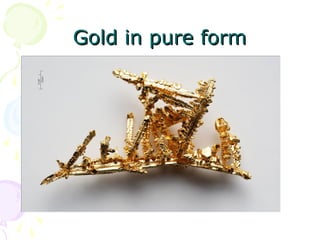
Gold in pure formGold in pure form
Properties of GoldProperties of Gold
• Gold resists attacks by individual
acids, but it can be dissolved by the
aqua regia (nitro-hydrochloric acid),
so named because it dissolves gold
• Gold also dissolves in alkaline
solutions of cyanide, which have
been used in mining
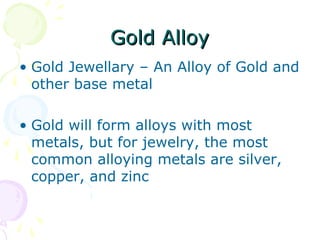
Gold AlloyGold Alloy
• Gold Jewellary – An Alloy of Gold and
other base metal
• Gold will form alloys with most
metals, but for jewelry, the most
common alloying metals are silver,
copper, and zinc
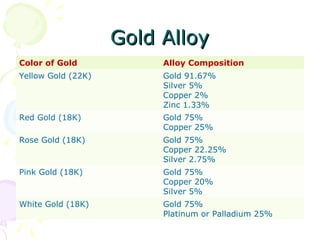
Gold AlloyGold Alloy
Color of Gold Alloy Composition
Yellow Gold (22K) Gold 91.67%
Silver 5%
Copper 2%
Zinc 1.33%
Red Gold (18K) Gold 75%
Copper 25%
Rose Gold (18K) Gold 75%
Copper 22.25%
Silver 2.75%
Pink Gold (18K) Gold 75%
Copper 20%
Silver 5%
White Gold (18K) Gold 75%
Platinum or Palladium 25%
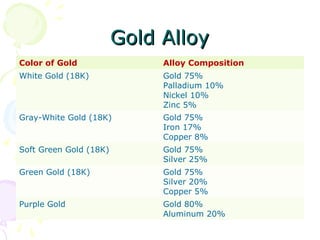
Gold AlloyGold Alloy
Color of Gold Alloy Composition
White Gold (18K) Gold 75%
Palladium 10%
Nickel 10%
Zinc 5%
Gray-White Gold (18K) Gold 75%
Iron 17%
Copper 8%
Soft Green Gold (18K) Gold 75%
Silver 25%
Green Gold (18K) Gold 75%
Silver 20%
Copper 5%
Purple Gold Gold 80%
Aluminum 20%
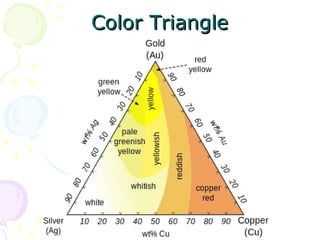
Color TriangleColor Triangle
Use of GoldUse of Gold
• Monetary exchange
• Investment
• Jewelry
• Medicine
• Food and drinks
• Industry
• Electronics
What is Hallmarking ?What is Hallmarking ?
• Hallmarking is the accurate
determination and official recording
of the proportionate content of
precious metal in gold
• Hallmarks are official marks used in
many countries as a guarantee of
purity
Hallmark vs Trade MarkHallmark vs Trade Mark
• Hallmarks are an official mark of
guaranteed metal content
• Trademarks are the mark of a
manufacturer to distinguish his
products from other manufacturers’
products.
History of HallmarkHistory of Hallmark
• The use of hallmarks, at first, on silver has
a long history dating back to the fourth
century AD and represents the oldest
known form of consumer protection
• Hallmarking in Britain dates from 1300; no
gold or silver could be sold until tested for
purity and struck with the king's mark.
• A "hallmark" was a mark made at
Goldsmith's Hall, London
Contd….Contd….
• The Hallmarking Act 1973 made Britain a
member of the Vienna Convention as well
as introducing marking for platinum, a
recognized metal under the Convention
• The Hallmarking Act of 1973 makes up the
bulk of modern law regarding the assaying
and hallmarking of metals in the
United Kingdom
• The Act made business transactions
involving unmarked metals illegal
All India Market SurveyAll India Market Survey
2001 on Gold2001 on Gold
• Sample failing – 88%
• Average shortage in purity – 11%
• Highest Shortage in Purity – 38%
Indian Standards on Gold JewlleryIndian Standards on Gold Jewllery
a) IS 1417 - Grades of gold and gold alloys,
Jewellery/Artefacts-Fineness and Marking
b) IS 1418 - Assaying of Gold in Gold Bullion, Gold alloys
and Gold Jewellery/ Artefacts - Cupellation (Fire Assay
Method)
c) IS 2790 - Guidelines for manufacture of 23,22,21,18,14
and 9 carat gold alloys
d) IS 3095 - Gold Solders for use in manufacture of
Jewellery
e) IS 15820 – General requirements competence of
assaying and Hallmarking Centre
IS 1417:1999 & ISIS 1417:1999 & IS
2112:2003 Requirements2112:2003 Requirements
• Gold jewellery/artefacts may be covered under
Hallmarking except as given below :
– Any gold article/ornament which fails to comply with
specified fineness/caratage.
– Any gold article/ornament which is not solid or which is made
with a hollow center and then filled with base metal, cement,
lac or other foreign substance thereby giving the article a
false or added weight or strength unless the weight of gold is
indicated on the article along with the jeweller’s/ sponsorer’s
logo.
– Gold article/ornament on which it is physically impossible to
stamp the mark.
IS 1417:1999 Gold and Gold alloys,IS 1417:1999 Gold and Gold alloys,
jewellery/ artefacts – Fineness andjewellery/ artefacts – Fineness and
Marking (Third Revision)Marking (Third Revision)
• First published in 1959First published in 1959
• Revised in 1971 & 1981Revised in 1971 & 1981
• Third revision is in force nowThird revision is in force now
• Amendment No. 1 issued in Dec 2004Amendment No. 1 issued in Dec 2004
• Amendment No. 2 issued in Dec 2007Amendment No. 2 issued in Dec 2007
• Amendment No. 3Amendment No. 3 issuedissued in June 2010in June 2010
• Amendment No. 4 finalized for printingAmendment No. 4 finalized for printing
• Amendment No. 5 Issued in Oct 2014Amendment No. 5 Issued in Oct 2014
Note : - Standard is under revisionNote : - Standard is under revision
SCOPESCOPE
This standard specifies nine grades of gold,
used in the manufacture of jewellery/artefacts
of gold, based on their gold content.
This standard also specifies the guidelines for
marking of purity and other details on tested
jewellery/artefacts.
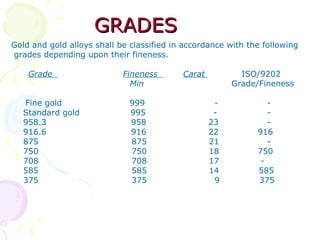
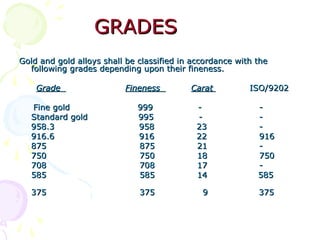
GRADESGRADES
Gold and gold alloys shall be classified in accordance with the following
grades depending upon their fineness.
Grade Fineness Carat ISO/9202
Min Grade/Fineness
Fine gold 999 - -
Standard gold 995 - -
958.3 958 23 -
916.6 916 22 916
875 875 21 -
750 750 18 750
708 708 17 -
585 585 14 585
375 375 9 375
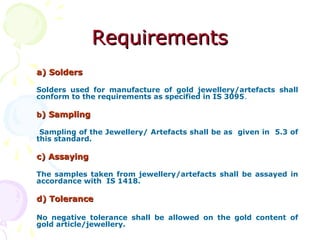
RequirementsRequirements
a) Soldersa) Solders
Solders used for manufacture of gold jewellery/artefacts shall
conform to the requirements as specified in IS 3095.
bb) Sampling) Sampling
Sampling of the Jewellery/ Artefacts shall be as given in 5.3 of
this standard.
c) Assayingc) Assaying
The samples taken from jewellery/artefacts shall be assayed in
accordance with IS 1418.
d) Toleranced) Tolerance
No negative tolerance shall be allowed on the gold content of
gold article/jewellery.
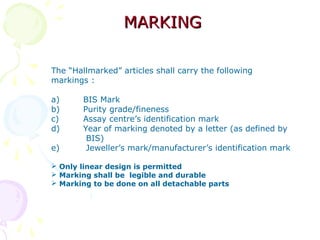
MARKINGMARKING
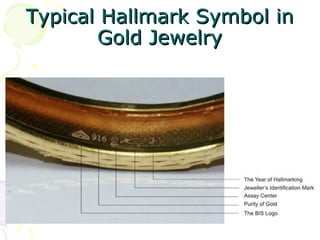
The “Hallmarked” articles shall carry the following
markings :
a) BIS Mark
b) Purity grade/fineness
c) Assay centre’s identification mark
d) Year of marking denoted by a letter (as defined by
BIS)
e) Jeweller’s mark/manufacturer’s identification mark
 Only linear design is permitted
 Marking shall be legible and durable
 Marking to be done on all detachable parts
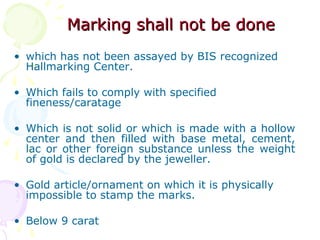
Marking shall not be doneMarking shall not be done
• which has not been assayed by BIS recognized
Hallmarking Center.
• Which fails to comply with specified
fineness/caratage
• Which is not solid or which is made with a hollow
center and then filled with base metal, cement,
lac or other foreign substance unless the weight
of gold is declared by the jeweller.
• Gold article/ornament on which it is physically
impossible to stamp the marks.
• Below 9 carat
IS 1418 DETERMINATION OF GOLD IN GOLDIS 1418 DETERMINATION OF GOLD IN GOLD
BULLION, GOLD ALLOYS AND GOLDBULLION, GOLD ALLOYS AND GOLD
JEWELLERY/ARTEFACTS-CUPELLATIONJEWELLERY/ARTEFACTS-CUPELLATION
(FIRE ASSAY) METHOD(FIRE ASSAY) METHOD
ScopeScope
• This standard prescribes the cupellation or
fire assay method for assaying of gold in
gold bullion,gold alloys and gold
jewellery/artefacts covered in IS 1417.
TERMINOLOGYTERMINOLOGY
The following definitions are used in
assaying.
Bullion
Cupellation
Fine Gold
Inquartation
Parting
ISIS 2112:20032112:2003 Silver and Silver Alloys,Silver and Silver Alloys,
Jewellery/Artefacts – Fineness andJewellery/Artefacts – Fineness and
MMarking – Specificationarking – Specification
((Second RevisionSecond Revision))
• Published in 1962 , 1981 &2003
• Draft Revision(Third Revision) is in wide
circulation
• Amendment no. 1 issued in Dec. 2003
• Amendment no. 2 issued in Jan. 2004
• Amendment no. 3 issued in Feb. 2006
• Amendment no. 4 issued in July 2008
SCOPESCOPE
• This standard specifies three grades of fine
silver and six grades of silver alloys used
in the manufacture of jewellery/artefact.
• This standard also specifies the guidelines
for marking of purity.
GRADESGRADES
– Grade Fineness Fineness
» (ISO 9202)
– 9999 ] 999.9 --
– 9995 ] Fine silver 999.5 --
– 999 ] 999.0
– 990 ] 990.0 --
– 970 ] 970.0 --
– 925 ] Silver alloys 925.0 925.0
– 900 ] for jewellery 900.0 --
– 835 ] artefacts 835.0 835.0
– 800 ] 800.0 800.0
–
Requirements(contd.)Requirements(contd.)
SOLDERSOLDER
• Solder of purity 750 silver minimum is
used for grades 900, 925, 970 and 990.
• Silver of purity 650 silver minimum is used
for grades 800 and 835.
Requirements(contd.)Requirements(contd.)
SamplingSampling
Sampling of the Jewellery/ Artefacts shall be as
given in 6.2 of this standard.
AssayingAssaying
The samples taken from jewellery/artefacts shall be
assayed in accordance with IS 2113.
ToleranceTolerance
No negative tolerance shall be allowed on the silver
content of silver article/jewellery.
MARKINGMARKING
• The silver and silver alloys, jewellery/artefacts shall be
stamp with standard mark in this case known as Hallmark.
• The Hallmarked article shall carry the following markings:
– BIS Mark
 Purity grade/fineness
 Assay centre’s identification mark
 Year of marking denoted by a letter symbol (as defined by
BIS)
 Jeweller’s mark/manufacturer’s identification mark
Marking (Contd.)Marking (Contd.)
Only linear design is permitted
Marking shall be legible and durable
Marking to be done on all detachable
parts
Marking shall not be doneMarking shall not be done
 which has not been assayed by BIS recognized Hallmarkingwhich has not been assayed by BIS recognized Hallmarking
Center.Center.
Which fails to comply with specified fineness/caratageWhich fails to comply with specified fineness/caratage
Which is not solid or which is made with a hollow center and thenWhich is not solid or which is made with a hollow center and then
filled with base metal, cement, lac or other foreign substance therebyfilled with base metal, cement, lac or other foreign substance thereby
giving the article a false or added weight.giving the article a false or added weight.
Silver article/ornament on which it is physically impossible to stampSilver article/ornament on which it is physically impossible to stamp
the marks.the marks.
Hallmarking in IndiaHallmarking in India
• Government of India' has
identified BIS a sole agency in
India to operate this scheme
• Scheme is voluntary in nature
started in year 2000
• BIS Hallmarking Scheme has
been aligned with International
criteria on hallmarking
Contd…Contd…
• Licence is granted to the jewellers by
BIS under Hallmarking Scheme
• BIS certified jewellers can get their
jewellery hallmarked from any of the
BIS recognized Assaying and
Hallmarking Centre
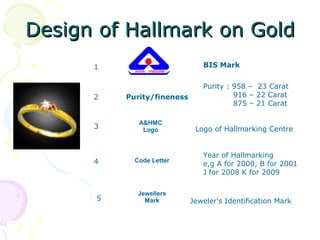
Design of Hallmark on GoldDesign of Hallmark on Gold
A&HMC
Logo
Jewellers
Mark
Purity/fineness
Purity : 958 – 23 Carat
916 – 22 Carat
875 – 21 Carat
Logo of Hallmarking Centre
Jeweler's Identification Mark
1
2
3
5
BIS Mark
Year of Hallmarking
e,g A for 2000, B for 2001
J for 2008 K for 2009
Code Letter4
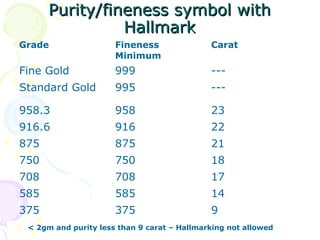
Purity/fineness symbol withPurity/fineness symbol with
HallmarkHallmark
Grade Fineness
Minimum
Carat
Fine Gold 999 ---
Standard Gold 995 ---
958.3 958 23
916.6 916 22
875 875 21
750 750 18
708 708 17
585 585 14
375 375 9
< 2gm and purity less than 9 carat – Hallmarking not allowed
GRADESGRADES
Gold and gold alloys shall be classified in accordance with theGold and gold alloys shall be classified in accordance with the
following grades depending upon their fineness.following grades depending upon their fineness.
GradeGrade FinenessFineness CaratCarat ISO/9202ISO/9202
Fine goldFine gold 999 -999 - --
Standard gold 995 -Standard gold 995 - --
958.3 958 23958.3 958 23 --
916.6 916 22916.6 916 22 916916
875 875 21875 875 21 --
750 750 18750 750 18 750750
708 708 17708 708 17 --
585 585 14585 585 14 585585
375 375 9375 375 9 375375
Typical Hallmark Symbol inTypical Hallmark Symbol in
Gold JewelryGold Jewelry
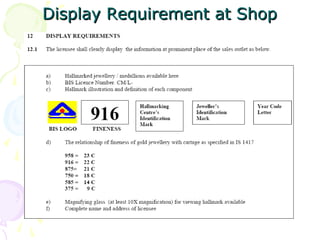
Display Requirement at ShopDisplay Requirement at Shop
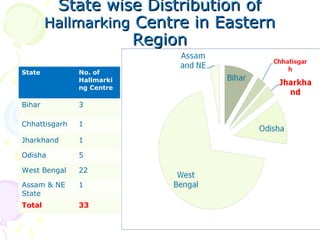
State wise Distribution ofState wise Distribution of
HallmarkingHallmarking Centre in EasternCentre in Eastern
RegionRegion
State No. of
Hallmarki
ng Centre
Bihar 3
Chhattisgarh 1
Jharkhand 1
Odisha 5
West Bengal 22
Assam & NE
State
1
Total 33
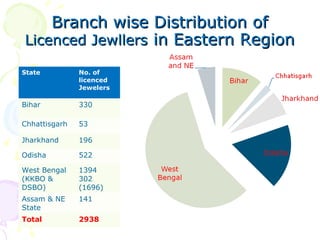
Branch wise Distribution ofBranch wise Distribution of
Licenced JewllersLicenced Jewllers in Eastern Regionin Eastern Region
State No. of
licenced
Jewelers
Bihar 330
Chhattisgarh 53
Jharkhand 196
Odisha 522
West Bengal
(KKBO &
DSBO)
1394
302
(1696)
Assam & NE
State
141
Total 2938
Objective of the SchemeObjective of the Scheme
• Protect Consumer against the
purchase of lesser purity of gold than
declared
• Develop export competitiveness
• Make India a leading gold market in
the world
Fire Assay (Cupellation)Fire Assay (Cupellation)
• This ancient technique is first referenced by the
Egyptians in a Cuneiform tablet dating back to
around 13 60 BC, and is based on a gold refining
technique.
• In its present form , it remains the most accurate
technique for gold assay and serves as the
standard technique against which all others are
com pared.
• It is covered by ISO standard ISO 11426:1993
and is the reference technique used by all the
Assay Offices world wide.
Principle of Fire AssayPrinciple of Fire Assay
• The principle is based on the removal of
all base metals from a small weighed
sample by oxidation in the cupellation
stage to leave a pure gold-silver alloy,
followed by removal of the silver by
dissolution in nitric acid
• The silver is added to dilute the gold
content to 25 % or less (known as
Inquartation)
PRINCIPLEPRINCIPLE
• The gold alloys are inquarted with silver,
compounded with lead and cupelled in a
cupellation furnace until a precious metal button
is obtained.
• After flattening and rolling, the silver is extracted
(parted) in nitric acid and the gold weighed.
• Possible systematic errors are eliminated by
assaying standard proof sample in parallel.
Steps in Assaying andSteps in Assaying and
HallmarkingHallmarking
• Receipt of Jewellery and its segregation
article wise
• Checking for homogeneity of the lot by XRF
• Sampling by Scraping/ Micro Drilling/
Cutting etc.
• Assaying of the composite sample as per IS
1418 by Fire Assay Method
• In case the sample passes , entire Jewellery
lot is hallmarked by laser marking and
returned to the Jeweller
• In case of failure in fire assay, Jewellery is
returned back without hallmarking
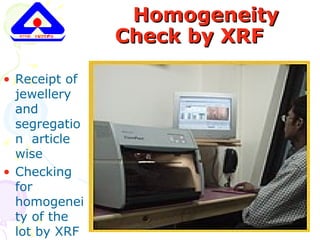
HomogeneityHomogeneity
Check by XRFCheck by XRF
• Receipt of
jewellery
and
segregatio
n article
wise
• Checking
for
homogenei
ty of the
lot by XRF
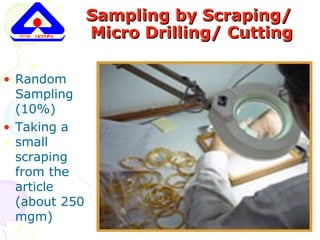
Sampling by Scraping/Sampling by Scraping/
Micro Drilling/ CuttingMicro Drilling/ Cutting
• Random
Sampling
(10%)
• Taking a
small
scraping
from the
article
(about 250
mgm)
WeighingWeighing
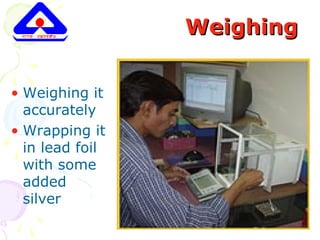
• Weighing it
accurately
• Wrapping it
in lead foil
with some
added
silver
Fire AssayingFire Assaying
(Cupellation)(Cupellation)
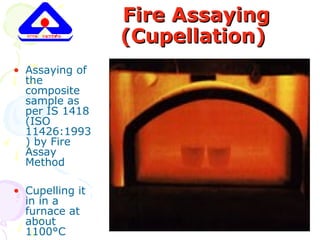
• Assaying of
the
composite
sample as
per IS 1418
(ISO
11426:1993
) by Fire
Assay
Method
• Cupelling it
in in a
furnace at
about
1100°C
Fire AssayingFire Assaying
(Cupellation)(Cupellation)
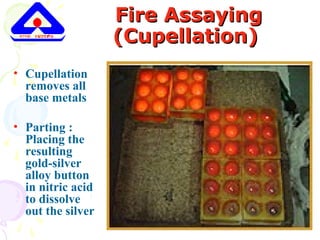
• Cupellation
removes all
base metals
• Parting :
Placing the
resulting
gold-silver
alloy button
in nitric acid
to dissolve
out the silver
WeighingWeighing
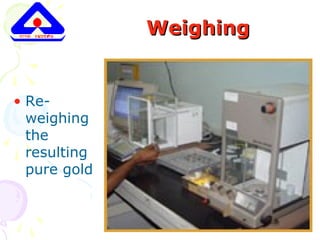
• Re-
weighing
the
resulting
pure gold
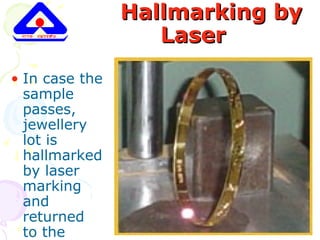
Hallmarking byHallmarking by
LaserLaser
• In case the
sample
passes,
jewellery
lot is
hallmarked
by laser
marking
and
returned
to the
MARKINGMARKING
The “Hallmarked” articles shall carry the followingThe “Hallmarked” articles shall carry the following
markings :markings :
a)a) BIS MarkBIS Mark
b)b) Purity grade/finenessPurity grade/fineness
c)c) Assay centre’s identification markAssay centre’s identification mark
d)d) Year of marking denoted by a letterYear of marking denoted by a letter (as defined by(as defined by
BIS)BIS)
e)e) Jeweller’s mark/manufacturer’sJeweller’s mark/manufacturer’s identification markidentification mark
 Only linear design is permittedOnly linear design is permitted
 Marking shall be legible and durableMarking shall be legible and durable
 Marking to be done on all detachable partsMarking to be done on all detachable parts
Marking shall not be doneMarking shall not be done
• which has not been assayed by BIS recognizedwhich has not been assayed by BIS recognized
Hallmarking Center.Hallmarking Center.
• Which fails to comply with specified fineness/caratageWhich fails to comply with specified fineness/caratage
• Which is not solid or which is made with a hollow centerWhich is not solid or which is made with a hollow center
and then filled with base metal, cement, lac or otherand then filled with base metal, cement, lac or other
foreign substance.foreign substance.
• Gold article/ornament on which it is physically impossible toGold article/ornament on which it is physically impossible to
stamp the marks.stamp the marks.
• Below 9 caratBelow 9 carat
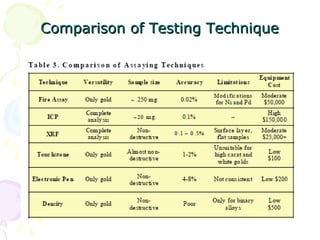
Comparison of Testing TechniqueComparison of Testing Technique
How to find a BIS HallmarkHow to find a BIS Hallmark
RetailerRetailer
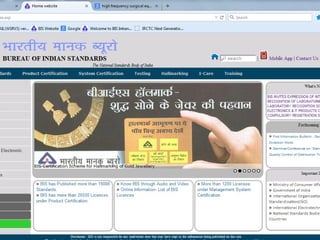
• More than 10,000 BIS Hallmark
jewellers in the country
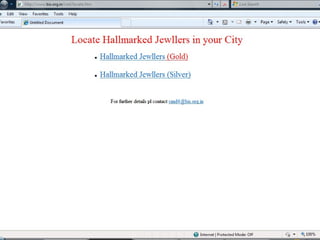
• Visit web site at www.bis.org.in
Advantage of PurchasingAdvantage of Purchasing
BIS Hallmark JewllearyBIS Hallmark Jewlleary
• Protect consumer against
victimization for lesser purity
• Provide third party assurance
• Right to Lodge Complaint
• RBI Circular to Banks for Preferential
treatment to Hallmarked Jewellery
while granting Advances against
Jewellery
While Purchasing….While Purchasing….
• Verify that the Shop is authorized to sell
BIS Hallmarked Jewellery
– Ask for Licence/documents issued by BIS
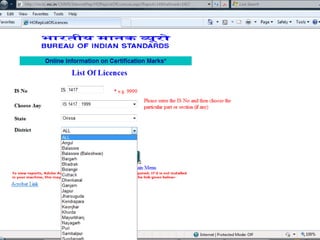
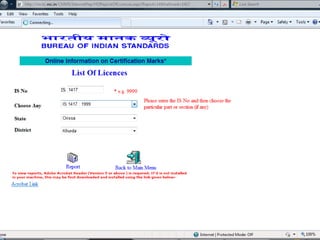
– Verify from BIS Web site (www.bis.org.in)
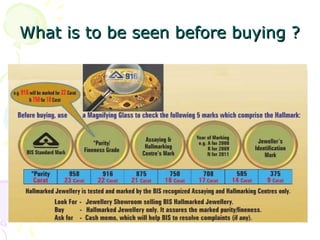
• Ask for Magnifying Glass to verify the
Hallmark Symbols in the jewellery
• Cash receipt with clear indication of
– BIS Hallmark
– Purity (example – fineness 916)
What is to be seen before buying ?What is to be seen before buying ?
Thank U….Thank U….

Presentation on BIS Hallmarking Scheme

  • 1.
    BISBIS Scheme ofScheme of HallmarkingHallmarking AK Purohit Bureau of Indian Standards Bhubaneswar
  • 2.
    Gold in pureformGold in pure form
  • 3.
    Properties of GoldPropertiesof Gold • Gold resists attacks by individual acids, but it can be dissolved by the aqua regia (nitro-hydrochloric acid), so named because it dissolves gold • Gold also dissolves in alkaline solutions of cyanide, which have been used in mining
  • 4.
    Gold AlloyGold Alloy •Gold Jewellary – An Alloy of Gold and other base metal • Gold will form alloys with most metals, but for jewelry, the most common alloying metals are silver, copper, and zinc
  • 5.
    Gold AlloyGold Alloy Colorof Gold Alloy Composition Yellow Gold (22K) Gold 91.67% Silver 5% Copper 2% Zinc 1.33% Red Gold (18K) Gold 75% Copper 25% Rose Gold (18K) Gold 75% Copper 22.25% Silver 2.75% Pink Gold (18K) Gold 75% Copper 20% Silver 5% White Gold (18K) Gold 75% Platinum or Palladium 25%
  • 6.
    Gold AlloyGold Alloy Colorof Gold Alloy Composition White Gold (18K) Gold 75% Palladium 10% Nickel 10% Zinc 5% Gray-White Gold (18K) Gold 75% Iron 17% Copper 8% Soft Green Gold (18K) Gold 75% Silver 25% Green Gold (18K) Gold 75% Silver 20% Copper 5% Purple Gold Gold 80% Aluminum 20%
  • 7.
  • 8.
    Use of GoldUseof Gold • Monetary exchange • Investment • Jewelry • Medicine • Food and drinks • Industry • Electronics
  • 9.
    What is Hallmarking?What is Hallmarking ? • Hallmarking is the accurate determination and official recording of the proportionate content of precious metal in gold • Hallmarks are official marks used in many countries as a guarantee of purity
  • 10.
    Hallmark vs TradeMarkHallmark vs Trade Mark • Hallmarks are an official mark of guaranteed metal content • Trademarks are the mark of a manufacturer to distinguish his products from other manufacturers’ products.
  • 11.
    History of HallmarkHistoryof Hallmark • The use of hallmarks, at first, on silver has a long history dating back to the fourth century AD and represents the oldest known form of consumer protection • Hallmarking in Britain dates from 1300; no gold or silver could be sold until tested for purity and struck with the king's mark. • A "hallmark" was a mark made at Goldsmith's Hall, London
  • 12.
    Contd….Contd…. • The HallmarkingAct 1973 made Britain a member of the Vienna Convention as well as introducing marking for platinum, a recognized metal under the Convention • The Hallmarking Act of 1973 makes up the bulk of modern law regarding the assaying and hallmarking of metals in the United Kingdom • The Act made business transactions involving unmarked metals illegal
  • 13.
    All India MarketSurveyAll India Market Survey 2001 on Gold2001 on Gold • Sample failing – 88% • Average shortage in purity – 11% • Highest Shortage in Purity – 38%
  • 14.
    Indian Standards onGold JewlleryIndian Standards on Gold Jewllery a) IS 1417 - Grades of gold and gold alloys, Jewellery/Artefacts-Fineness and Marking b) IS 1418 - Assaying of Gold in Gold Bullion, Gold alloys and Gold Jewellery/ Artefacts - Cupellation (Fire Assay Method) c) IS 2790 - Guidelines for manufacture of 23,22,21,18,14 and 9 carat gold alloys d) IS 3095 - Gold Solders for use in manufacture of Jewellery e) IS 15820 – General requirements competence of assaying and Hallmarking Centre
  • 15.
    IS 1417:1999 &ISIS 1417:1999 & IS 2112:2003 Requirements2112:2003 Requirements • Gold jewellery/artefacts may be covered under Hallmarking except as given below : – Any gold article/ornament which fails to comply with specified fineness/caratage. – Any gold article/ornament which is not solid or which is made with a hollow center and then filled with base metal, cement, lac or other foreign substance thereby giving the article a false or added weight or strength unless the weight of gold is indicated on the article along with the jeweller’s/ sponsorer’s logo. – Gold article/ornament on which it is physically impossible to stamp the mark.
  • 16.
    IS 1417:1999 Goldand Gold alloys,IS 1417:1999 Gold and Gold alloys, jewellery/ artefacts – Fineness andjewellery/ artefacts – Fineness and Marking (Third Revision)Marking (Third Revision) • First published in 1959First published in 1959 • Revised in 1971 & 1981Revised in 1971 & 1981 • Third revision is in force nowThird revision is in force now • Amendment No. 1 issued in Dec 2004Amendment No. 1 issued in Dec 2004 • Amendment No. 2 issued in Dec 2007Amendment No. 2 issued in Dec 2007 • Amendment No. 3Amendment No. 3 issuedissued in June 2010in June 2010 • Amendment No. 4 finalized for printingAmendment No. 4 finalized for printing • Amendment No. 5 Issued in Oct 2014Amendment No. 5 Issued in Oct 2014 Note : - Standard is under revisionNote : - Standard is under revision
  • 17.
    SCOPESCOPE This standard specifiesnine grades of gold, used in the manufacture of jewellery/artefacts of gold, based on their gold content. This standard also specifies the guidelines for marking of purity and other details on tested jewellery/artefacts.
  • 18.
    GRADESGRADES Gold and goldalloys shall be classified in accordance with the following grades depending upon their fineness. Grade Fineness Carat ISO/9202 Min Grade/Fineness Fine gold 999 - - Standard gold 995 - - 958.3 958 23 - 916.6 916 22 916 875 875 21 - 750 750 18 750 708 708 17 - 585 585 14 585 375 375 9 375
  • 19.
    RequirementsRequirements a) Soldersa) Solders Soldersused for manufacture of gold jewellery/artefacts shall conform to the requirements as specified in IS 3095. bb) Sampling) Sampling Sampling of the Jewellery/ Artefacts shall be as given in 5.3 of this standard. c) Assayingc) Assaying The samples taken from jewellery/artefacts shall be assayed in accordance with IS 1418. d) Toleranced) Tolerance No negative tolerance shall be allowed on the gold content of gold article/jewellery.
  • 20.
    MARKINGMARKING The “Hallmarked” articlesshall carry the following markings : a) BIS Mark b) Purity grade/fineness c) Assay centre’s identification mark d) Year of marking denoted by a letter (as defined by BIS) e) Jeweller’s mark/manufacturer’s identification mark  Only linear design is permitted  Marking shall be legible and durable  Marking to be done on all detachable parts
  • 21.
    Marking shall notbe doneMarking shall not be done • which has not been assayed by BIS recognized Hallmarking Center. • Which fails to comply with specified fineness/caratage • Which is not solid or which is made with a hollow center and then filled with base metal, cement, lac or other foreign substance unless the weight of gold is declared by the jeweller. • Gold article/ornament on which it is physically impossible to stamp the marks. • Below 9 carat
  • 22.
    IS 1418 DETERMINATIONOF GOLD IN GOLDIS 1418 DETERMINATION OF GOLD IN GOLD BULLION, GOLD ALLOYS AND GOLDBULLION, GOLD ALLOYS AND GOLD JEWELLERY/ARTEFACTS-CUPELLATIONJEWELLERY/ARTEFACTS-CUPELLATION (FIRE ASSAY) METHOD(FIRE ASSAY) METHOD ScopeScope • This standard prescribes the cupellation or fire assay method for assaying of gold in gold bullion,gold alloys and gold jewellery/artefacts covered in IS 1417.
  • 23.
    TERMINOLOGYTERMINOLOGY The following definitionsare used in assaying. Bullion Cupellation Fine Gold Inquartation Parting
  • 24.
    ISIS 2112:20032112:2003 Silverand Silver Alloys,Silver and Silver Alloys, Jewellery/Artefacts – Fineness andJewellery/Artefacts – Fineness and MMarking – Specificationarking – Specification ((Second RevisionSecond Revision)) • Published in 1962 , 1981 &2003 • Draft Revision(Third Revision) is in wide circulation • Amendment no. 1 issued in Dec. 2003 • Amendment no. 2 issued in Jan. 2004 • Amendment no. 3 issued in Feb. 2006 • Amendment no. 4 issued in July 2008
  • 25.
    SCOPESCOPE • This standardspecifies three grades of fine silver and six grades of silver alloys used in the manufacture of jewellery/artefact. • This standard also specifies the guidelines for marking of purity.
  • 26.
    GRADESGRADES – Grade FinenessFineness » (ISO 9202) – 9999 ] 999.9 -- – 9995 ] Fine silver 999.5 -- – 999 ] 999.0 – 990 ] 990.0 -- – 970 ] 970.0 -- – 925 ] Silver alloys 925.0 925.0 – 900 ] for jewellery 900.0 -- – 835 ] artefacts 835.0 835.0 – 800 ] 800.0 800.0 –
  • 27.
    Requirements(contd.)Requirements(contd.) SOLDERSOLDER • Solder ofpurity 750 silver minimum is used for grades 900, 925, 970 and 990. • Silver of purity 650 silver minimum is used for grades 800 and 835.
  • 28.
    Requirements(contd.)Requirements(contd.) SamplingSampling Sampling of theJewellery/ Artefacts shall be as given in 6.2 of this standard. AssayingAssaying The samples taken from jewellery/artefacts shall be assayed in accordance with IS 2113. ToleranceTolerance No negative tolerance shall be allowed on the silver content of silver article/jewellery.
  • 29.
    MARKINGMARKING • The silverand silver alloys, jewellery/artefacts shall be stamp with standard mark in this case known as Hallmark. • The Hallmarked article shall carry the following markings: – BIS Mark  Purity grade/fineness  Assay centre’s identification mark  Year of marking denoted by a letter symbol (as defined by BIS)  Jeweller’s mark/manufacturer’s identification mark
  • 30.
    Marking (Contd.)Marking (Contd.) Onlylinear design is permitted Marking shall be legible and durable Marking to be done on all detachable parts
  • 31.
    Marking shall notbe doneMarking shall not be done  which has not been assayed by BIS recognized Hallmarkingwhich has not been assayed by BIS recognized Hallmarking Center.Center. Which fails to comply with specified fineness/caratageWhich fails to comply with specified fineness/caratage Which is not solid or which is made with a hollow center and thenWhich is not solid or which is made with a hollow center and then filled with base metal, cement, lac or other foreign substance therebyfilled with base metal, cement, lac or other foreign substance thereby giving the article a false or added weight.giving the article a false or added weight. Silver article/ornament on which it is physically impossible to stampSilver article/ornament on which it is physically impossible to stamp the marks.the marks.
  • 32.
    Hallmarking in IndiaHallmarkingin India • Government of India' has identified BIS a sole agency in India to operate this scheme • Scheme is voluntary in nature started in year 2000 • BIS Hallmarking Scheme has been aligned with International criteria on hallmarking
  • 33.
    Contd…Contd… • Licence isgranted to the jewellers by BIS under Hallmarking Scheme • BIS certified jewellers can get their jewellery hallmarked from any of the BIS recognized Assaying and Hallmarking Centre
  • 34.
    Design of Hallmarkon GoldDesign of Hallmark on Gold A&HMC Logo Jewellers Mark Purity/fineness Purity : 958 – 23 Carat 916 – 22 Carat 875 – 21 Carat Logo of Hallmarking Centre Jeweler's Identification Mark 1 2 3 5 BIS Mark Year of Hallmarking e,g A for 2000, B for 2001 J for 2008 K for 2009 Code Letter4
  • 35.
    Purity/fineness symbol withPurity/finenesssymbol with HallmarkHallmark Grade Fineness Minimum Carat Fine Gold 999 --- Standard Gold 995 --- 958.3 958 23 916.6 916 22 875 875 21 750 750 18 708 708 17 585 585 14 375 375 9 < 2gm and purity less than 9 carat – Hallmarking not allowed
  • 36.
    GRADESGRADES Gold and goldalloys shall be classified in accordance with theGold and gold alloys shall be classified in accordance with the following grades depending upon their fineness.following grades depending upon their fineness. GradeGrade FinenessFineness CaratCarat ISO/9202ISO/9202 Fine goldFine gold 999 -999 - -- Standard gold 995 -Standard gold 995 - -- 958.3 958 23958.3 958 23 -- 916.6 916 22916.6 916 22 916916 875 875 21875 875 21 -- 750 750 18750 750 18 750750 708 708 17708 708 17 -- 585 585 14585 585 14 585585 375 375 9375 375 9 375375
  • 37.
    Typical Hallmark SymbolinTypical Hallmark Symbol in Gold JewelryGold Jewelry
  • 38.
    Display Requirement atShopDisplay Requirement at Shop
  • 39.
    State wise DistributionofState wise Distribution of HallmarkingHallmarking Centre in EasternCentre in Eastern RegionRegion State No. of Hallmarki ng Centre Bihar 3 Chhattisgarh 1 Jharkhand 1 Odisha 5 West Bengal 22 Assam & NE State 1 Total 33
  • 40.
    Branch wise DistributionofBranch wise Distribution of Licenced JewllersLicenced Jewllers in Eastern Regionin Eastern Region State No. of licenced Jewelers Bihar 330 Chhattisgarh 53 Jharkhand 196 Odisha 522 West Bengal (KKBO & DSBO) 1394 302 (1696) Assam & NE State 141 Total 2938
  • 41.
    Objective of theSchemeObjective of the Scheme • Protect Consumer against the purchase of lesser purity of gold than declared • Develop export competitiveness • Make India a leading gold market in the world
  • 42.
    Fire Assay (Cupellation)FireAssay (Cupellation) • This ancient technique is first referenced by the Egyptians in a Cuneiform tablet dating back to around 13 60 BC, and is based on a gold refining technique. • In its present form , it remains the most accurate technique for gold assay and serves as the standard technique against which all others are com pared. • It is covered by ISO standard ISO 11426:1993 and is the reference technique used by all the Assay Offices world wide.
  • 43.
    Principle of FireAssayPrinciple of Fire Assay • The principle is based on the removal of all base metals from a small weighed sample by oxidation in the cupellation stage to leave a pure gold-silver alloy, followed by removal of the silver by dissolution in nitric acid • The silver is added to dilute the gold content to 25 % or less (known as Inquartation)
  • 44.
    PRINCIPLEPRINCIPLE • The goldalloys are inquarted with silver, compounded with lead and cupelled in a cupellation furnace until a precious metal button is obtained. • After flattening and rolling, the silver is extracted (parted) in nitric acid and the gold weighed. • Possible systematic errors are eliminated by assaying standard proof sample in parallel.
  • 45.
    Steps in AssayingandSteps in Assaying and HallmarkingHallmarking • Receipt of Jewellery and its segregation article wise • Checking for homogeneity of the lot by XRF • Sampling by Scraping/ Micro Drilling/ Cutting etc. • Assaying of the composite sample as per IS 1418 by Fire Assay Method • In case the sample passes , entire Jewellery lot is hallmarked by laser marking and returned to the Jeweller • In case of failure in fire assay, Jewellery is returned back without hallmarking
  • 46.
    HomogeneityHomogeneity Check by XRFCheckby XRF • Receipt of jewellery and segregatio n article wise • Checking for homogenei ty of the lot by XRF
  • 47.
    Sampling by Scraping/Samplingby Scraping/ Micro Drilling/ CuttingMicro Drilling/ Cutting • Random Sampling (10%) • Taking a small scraping from the article (about 250 mgm)
  • 48.
    WeighingWeighing • Weighing it accurately •Wrapping it in lead foil with some added silver
  • 49.
    Fire AssayingFire Assaying (Cupellation)(Cupellation) •Assaying of the composite sample as per IS 1418 (ISO 11426:1993 ) by Fire Assay Method • Cupelling it in in a furnace at about 1100°C
  • 50.
    Fire AssayingFire Assaying (Cupellation)(Cupellation) •Cupellation removes all base metals • Parting : Placing the resulting gold-silver alloy button in nitric acid to dissolve out the silver
  • 51.
  • 52.
    Hallmarking byHallmarking by LaserLaser •In case the sample passes, jewellery lot is hallmarked by laser marking and returned to the
  • 53.
    MARKINGMARKING The “Hallmarked” articlesshall carry the followingThe “Hallmarked” articles shall carry the following markings :markings : a)a) BIS MarkBIS Mark b)b) Purity grade/finenessPurity grade/fineness c)c) Assay centre’s identification markAssay centre’s identification mark d)d) Year of marking denoted by a letterYear of marking denoted by a letter (as defined by(as defined by BIS)BIS) e)e) Jeweller’s mark/manufacturer’sJeweller’s mark/manufacturer’s identification markidentification mark  Only linear design is permittedOnly linear design is permitted  Marking shall be legible and durableMarking shall be legible and durable  Marking to be done on all detachable partsMarking to be done on all detachable parts
  • 54.
    Marking shall notbe doneMarking shall not be done • which has not been assayed by BIS recognizedwhich has not been assayed by BIS recognized Hallmarking Center.Hallmarking Center. • Which fails to comply with specified fineness/caratageWhich fails to comply with specified fineness/caratage • Which is not solid or which is made with a hollow centerWhich is not solid or which is made with a hollow center and then filled with base metal, cement, lac or otherand then filled with base metal, cement, lac or other foreign substance.foreign substance. • Gold article/ornament on which it is physically impossible toGold article/ornament on which it is physically impossible to stamp the marks.stamp the marks. • Below 9 caratBelow 9 carat
  • 55.
    Comparison of TestingTechniqueComparison of Testing Technique
  • 56.
    How to finda BIS HallmarkHow to find a BIS Hallmark RetailerRetailer • More than 10,000 BIS Hallmark jewellers in the country • Visit web site at www.bis.org.in
  • 61.
    Advantage of PurchasingAdvantageof Purchasing BIS Hallmark JewllearyBIS Hallmark Jewlleary • Protect consumer against victimization for lesser purity • Provide third party assurance • Right to Lodge Complaint • RBI Circular to Banks for Preferential treatment to Hallmarked Jewellery while granting Advances against Jewellery
  • 62.
    While Purchasing….While Purchasing…. •Verify that the Shop is authorized to sell BIS Hallmarked Jewellery – Ask for Licence/documents issued by BIS – Verify from BIS Web site (www.bis.org.in) • Ask for Magnifying Glass to verify the Hallmark Symbols in the jewellery • Cash receipt with clear indication of – BIS Hallmark – Purity (example – fineness 916)
  • 63.
    What is tobe seen before buying ?What is to be seen before buying ?
  • 64.