DIAMONDS
BY: KUNAL SULEKH
The term Diamond has been derived from the
Greek "adamas"--unconquerable.
Long known for hardest of naturally
occurring minerals, index 10 on Mohs scale of
hardness.
These are known to be among the oldest
minerals in the earth. (Richardson el al., 1984)
These are still weighed in the old unit known as
carats.
DIAMOND
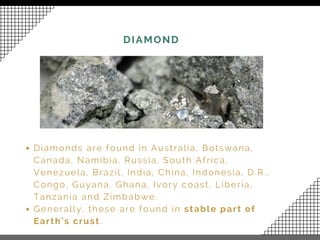
Diamonds are found in Australia, Botswana,
Canada, Namibia, Russia, South Africa,
Venezuela, Brazil, India, China, Indonesia, D.R.,
Congo, Guyana, Ghana, Ivory coast, Liberia,
Tanzania and Zimbabwe.
Generally, these are found in stable part of
Earth's crust.
DIAMOND
Primary and Secondary
Primary sources are the kimberlite and
lamproite pipes that raise diamonds from
Earth's mantle, where they originate. 
Secondary sources, created by erosion, include
such deposits as surface scatterings around a
pipe, For eg.: concentrations in river channels.
Total world production of natural diamonds is
about 97 Mct p.a.
TYPES OF DIAMOND DEPOSITS
India was the only source of diamond until
1725.
In 1725, Brazil diamond deposits (Minas Gerais
and Bahia) were discovered and were used for
about 150 years. 
At present, Australia has been the major
diamond deposit since 1986 (1/3 world
production annually). 
DIAMOND DEPOSITS
Kimberlite has traditionally been considered to
be the only important primary source of
diamond. (Scott Smith & Skinner, 1984)
Kimberlite may be defined as a potassic
ultrabasic hybrid igneous rock containing large
crsytals (megacrysts) of olivine, enstatite,
diopside in a fine-grained matrix.
Lamproites are defined as potash- and
magnesia-rich lamprophyric rocks of volcanic or
hypabyssal origin containing clinopyroxene,
amphibole, leucite and sanidine.
KIMBERLITE AND LAMPROITES
Lamproites have greater mineralogical and
textural variations than Kimberlites.
Lamproites craton are generally wider and
shallower than those of Kimberlites.
There are 2 period of diamond formation.
First about 3.3 Ga (Peridotitic minerals)
Second about 1580-990 Ma ago. (Eclogitic
minerals)
KIMBERLITES AND LAMPROITES
DIAMOND DEPOSITS
Diamonds were discovered in India by the 4th
century BCE. India yielded many legendary
diamonds, including the Koh-i-Noor, the Orlov,
the Hope, and the Sancy. 
The history of the stone which was eventually
named the Hope diamond was most likely from
the Kollur mine in Golconda, India. Its color was
described as a "beautiful violet." 
India was the world's only source until the
1730s. Most of India's deposits were alluvial, but
today the Majhgawan pipe, a primary source
near Panna, is the country's only producing
diamond source. 
INDIA
These are the 4 different ways by which
diamonds are evaluated
Cut
Color
Clarity (inclusions)
Carat Weight
THE 4 C'S
THANK YOU

Diamonds

  • 1.
  • 2.
    The term Diamondhas been derived from the Greek "adamas"--unconquerable. Long known for hardest of naturally occurring minerals, index 10 on Mohs scale of hardness. These are known to be among the oldest minerals in the earth. (Richardson el al., 1984) These are still weighed in the old unit known as carats. DIAMOND
  • 3.
    Diamonds are foundin Australia, Botswana, Canada, Namibia, Russia, South Africa, Venezuela, Brazil, India, China, Indonesia, D.R., Congo, Guyana, Ghana, Ivory coast, Liberia, Tanzania and Zimbabwe. Generally, these are found in stable part of Earth's crust. DIAMOND
  • 4.
    Primary and Secondary Primarysources are the kimberlite and lamproite pipes that raise diamonds from Earth's mantle, where they originate.  Secondary sources, created by erosion, include such deposits as surface scatterings around a pipe, For eg.: concentrations in river channels. Total world production of natural diamonds is about 97 Mct p.a. TYPES OF DIAMOND DEPOSITS
  • 5.
    India was theonly source of diamond until 1725. In 1725, Brazil diamond deposits (Minas Gerais and Bahia) were discovered and were used for about 150 years.  At present, Australia has been the major diamond deposit since 1986 (1/3 world production annually).  DIAMOND DEPOSITS
  • 7.
    Kimberlite has traditionallybeen considered to be the only important primary source of diamond. (Scott Smith & Skinner, 1984) Kimberlite may be defined as a potassic ultrabasic hybrid igneous rock containing large crsytals (megacrysts) of olivine, enstatite, diopside in a fine-grained matrix. Lamproites are defined as potash- and magnesia-rich lamprophyric rocks of volcanic or hypabyssal origin containing clinopyroxene, amphibole, leucite and sanidine. KIMBERLITE AND LAMPROITES
  • 8.
    Lamproites have greatermineralogical and textural variations than Kimberlites. Lamproites craton are generally wider and shallower than those of Kimberlites. There are 2 period of diamond formation. First about 3.3 Ga (Peridotitic minerals) Second about 1580-990 Ma ago. (Eclogitic minerals) KIMBERLITES AND LAMPROITES
  • 10.
  • 11.
    Diamonds were discoveredin India by the 4th century BCE. India yielded many legendary diamonds, including the Koh-i-Noor, the Orlov, the Hope, and the Sancy.  The history of the stone which was eventually named the Hope diamond was most likely from the Kollur mine in Golconda, India. Its color was described as a "beautiful violet."  India was the world's only source until the 1730s. Most of India's deposits were alluvial, but today the Majhgawan pipe, a primary source near Panna, is the country's only producing diamond source.  INDIA
  • 12.
    These are the4 different ways by which diamonds are evaluated Cut Color Clarity (inclusions) Carat Weight THE 4 C'S
  • 14.