UNIVERSITI UTARA MALAYSIA
                             UUM COLLEGE OF ARTS AND SCIENCES


COURSE CODE : STIJ3053
COURSE NAME: NETWORK DESIGN
PRE-REQUISITE: STIJ3023 COMPUTER NETWORKS


1.0   SYNOPSIS

      This course emphasizes on the procedures and principles in analysing, designing and
      implementing a typical data communications network. This course also stresses on system-
      oriented network development. Students will be given the necessary exposure related to
      network performance as well as related contemporary issues.

2.0   OBJECTIVE

      At the end of the course, student will be able to:

      2.1 understand the techniques involve in designing a network infrastructure.
      2.2 acquire the knowledge and skill to implement a network infrastructure.
      2.3 understand the concept of network design.
      2.4 Apply the knowledge to implement a network infrastructure.

3.0   LEARNING OUTCOME

      Upon completion of this course, students will be able to:

      3.1 Explain about issues, techniques and related technologies in planning, analysing,
            designing and implementing a network. (C1,P1,A1).
      3.2 Choose the appropriate technology to be implemented for an organization’s network
            infrastructure. (C3,P1,A1).
      3.3 Plan and analyse a typical network. (C4,P2,A1).
      3.4 Describe the concept and procedures involved in designing and configuring a network.
           (C4,P1,A1).
      3.5 Design and Implement a typical network. (C5,P3,A3).
      3.6 Analyse the network requirement for an organization and propose solution using a
           network design plan. ( C4, P5,A3)


                                                 1
4.0   REFERENCE

      Forouzan, B. A. (2007). Data Communications and Networking, (4th Edition), NY: McGraw-Hill

      Kurose, J.F. & Ross, K.W. (2008). Computer Networking: A Top-Down Approach (4th Edition).
              NY: Addison-Wesley.
      Meyers, M. (2004). Mike Meyers' Network+ Guide To Managing and Troubleshooting
              Networks, NY: McGraw-Hill/Irwin.

      Oppenheimer, P. (2004). Top-Down Network Design, (2nd Edition), Cisco Press.

      Stallings, W. (2007). Data & Computer Communications (8th Edition). NJ: Prentice Hall.

      Tittel, E., Robbins, M. (1997). Network Design Essentials, NY: Academic Press Professional.


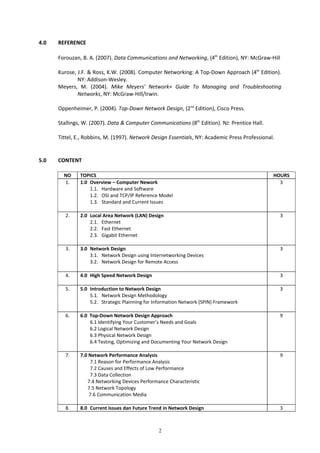
5.0   CONTENT

        NO     TOPICS                                                                           HOURS
        1.     1.0 Overview – Computer Nework                                                     3
                   1.1. Hardware and Software
                   1.2. OSI and TCP/IP Reference Model
                   1.3. Standard and Current Issues

         2.    2.0 Local Area Network (LAN) Design                                                  3
                   2.1. Ethernet
                   2.2. Fast Ethernet
                   2.3. Gigabit Ethernet

         3.    3.0 Network Design                                                                   3
                   3.1. Network Design using Internetworking Devices
                   3.2. Network Design for Remote Access

         4.    4.0 High Speed Network Design                                                        3

         5.    5.0 Introduction to Network Design                                                   3
                   5.1. Network Design Methodology
                   5.2. Strategic Plainning for Information Network (SPIN) Framework

         6.    6.0 Top-Down Network Design Approach                                                 9
                   6.1 Identifying Your Customer’s Needs and Goals
                   6.2 Logical Network Design
                   6.3 Physical Network Design
                   6.4 Testing, Optimizing and Documenting Your Network Design

         7.    7.0 Network Performance Analysis                                                     9
                   7.1 Reason for Performance Analysis
                   7.2 Causes and Effects of Low Performance
                   7.3 Data Collection
                  7.4 Networking Devices Performance Characteristic
                  7.5 Network Topology
                   7.6 Communication Media

         8.    8.0 Current Issues dan Future Trend in Network Design                                3


                                                 2
9.     9.0 Case Study 1 : Network Design Approach                    3

        10.    10.0    Case Study 2 : Network Performance Analysis           3

                                                                     TOTAL   42

6.0   TEACHING METHOD

      Lectures and discussions

7.0   ASSESSMENT

      Coursework              60%
      Final Exam              40%


                                               3

Silibus stij3053 - Network Design

  • 1.
    UNIVERSITI UTARA MALAYSIA UUM COLLEGE OF ARTS AND SCIENCES COURSE CODE : STIJ3053 COURSE NAME: NETWORK DESIGN PRE-REQUISITE: STIJ3023 COMPUTER NETWORKS 1.0 SYNOPSIS This course emphasizes on the procedures and principles in analysing, designing and implementing a typical data communications network. This course also stresses on system- oriented network development. Students will be given the necessary exposure related to network performance as well as related contemporary issues. 2.0 OBJECTIVE At the end of the course, student will be able to: 2.1 understand the techniques involve in designing a network infrastructure. 2.2 acquire the knowledge and skill to implement a network infrastructure. 2.3 understand the concept of network design. 2.4 Apply the knowledge to implement a network infrastructure. 3.0 LEARNING OUTCOME Upon completion of this course, students will be able to: 3.1 Explain about issues, techniques and related technologies in planning, analysing, designing and implementing a network. (C1,P1,A1). 3.2 Choose the appropriate technology to be implemented for an organization’s network infrastructure. (C3,P1,A1). 3.3 Plan and analyse a typical network. (C4,P2,A1). 3.4 Describe the concept and procedures involved in designing and configuring a network. (C4,P1,A1). 3.5 Design and Implement a typical network. (C5,P3,A3). 3.6 Analyse the network requirement for an organization and propose solution using a network design plan. ( C4, P5,A3) 1
  • 2.
    4.0 REFERENCE Forouzan, B. A. (2007). Data Communications and Networking, (4th Edition), NY: McGraw-Hill Kurose, J.F. & Ross, K.W. (2008). Computer Networking: A Top-Down Approach (4th Edition). NY: Addison-Wesley. Meyers, M. (2004). Mike Meyers' Network+ Guide To Managing and Troubleshooting Networks, NY: McGraw-Hill/Irwin. Oppenheimer, P. (2004). Top-Down Network Design, (2nd Edition), Cisco Press. Stallings, W. (2007). Data & Computer Communications (8th Edition). NJ: Prentice Hall. Tittel, E., Robbins, M. (1997). Network Design Essentials, NY: Academic Press Professional. 5.0 CONTENT NO TOPICS HOURS 1. 1.0 Overview – Computer Nework 3 1.1. Hardware and Software 1.2. OSI and TCP/IP Reference Model 1.3. Standard and Current Issues 2. 2.0 Local Area Network (LAN) Design 3 2.1. Ethernet 2.2. Fast Ethernet 2.3. Gigabit Ethernet 3. 3.0 Network Design 3 3.1. Network Design using Internetworking Devices 3.2. Network Design for Remote Access 4. 4.0 High Speed Network Design 3 5. 5.0 Introduction to Network Design 3 5.1. Network Design Methodology 5.2. Strategic Plainning for Information Network (SPIN) Framework 6. 6.0 Top-Down Network Design Approach 9 6.1 Identifying Your Customer’s Needs and Goals 6.2 Logical Network Design 6.3 Physical Network Design 6.4 Testing, Optimizing and Documenting Your Network Design 7. 7.0 Network Performance Analysis 9 7.1 Reason for Performance Analysis 7.2 Causes and Effects of Low Performance 7.3 Data Collection 7.4 Networking Devices Performance Characteristic 7.5 Network Topology 7.6 Communication Media 8. 8.0 Current Issues dan Future Trend in Network Design 3 2
  • 3.
    9. 9.0 Case Study 1 : Network Design Approach 3 10. 10.0 Case Study 2 : Network Performance Analysis 3 TOTAL 42 6.0 TEACHING METHOD Lectures and discussions 7.0 ASSESSMENT Coursework 60% Final Exam 40% 3