UNIVERSIDAD REGIONAL AUTÓNOMA DE LOS ANDES
UNIANDES
FACULTAD DE JURISPRUDENCIA
CARRERA DE DERECHO
SILABO: INGLÉS I
NAME OF THE SYLLABUS: INGLES I
CÓDIGO1
: NÚMERO DE CRÉDITOS:
TEÓRICOS PRÁCTICOS
DESCRIPCIÓN DEL CURSO2
:
Esta es una asignatura que pertenece al área de ciencias básicas y es de naturaleza teórico-
practico donde el estudiante podrá generar información personal, identificar expresiones
familiares diarias y frases básicas; así como dramatizar una situación usando información
preliminar, cuyo propósito es distinguir información personal y de sus compañeros.
Prerequisites Co requirements
Contenidos disciplinares que deben ser aprobadas
antes de cursar este contenido disciplinar.
CONTENIDO DISCIPLINAR (ASIGNATURA,
UNIDAD, CURSO, TALLER, OTROS)
CÓDIGO
None
.
Contenidos disciplinares que deben ser cursadas al mismo
tiempo que este contenido disciplinar.
CONTENIDO DISCIPLINAR (ASIGNATURA,
UNIDAD, CURSO, TALLER, OTROS)
CÓDIGO
Introducción al Derecho DER01IAD
Historia del Derecho DER01HDD
Ciencia de Estado DER01CE
Deontología Jurídica DER01DJ
Informática DER01I
TEXTO Y OTRAS REFERENCIAS REQUERIDAS PARA EL DICTADO DEL CURSO:
Libro principal de consulta3
:
AUTOR TÍTULO DEL LIBRO EDICIÓN AÑO PUBLICACIÓN EDITORIAL
McCARTHY, Michael;
McCARTEN Jeanne;
SANDIFORD Helen
TOUCHSTONE I 2008 2005 CAMBRIDGE
Referencias bibliográficas como complemento para el aprendizaje de los alumnos.
AUTOR TÍTULO DEL LIBRO EDICIÓN AÑO PUBLICACIÓN EDITORIAL
Raymond Murphy Essential grammar in Use 3th 2007 Cambridge
1
2
3
3 1
DER01II
OBJETIVOS GENERALES DEL CURSO4
: (resultados o logros del aprendizaje del curso)
OBJETIVO GENERAL:
By the end of this course, the students will be able to role play a daily situation with their classmates.
Cognitivos:
1 To identify new vocabulary
2 To describe familiar everyday situations using basic speaking skills
Habilidades (psicomotrices):
1 To mime different situations
2 To write personal and classmates information
Valores (afectivos):
1 To respect teacher and classmates
2 To present assignments on time
Hábitos mentales:
1 To recognize new gramar
2 To discover implicit vocabulary
TÓPICOS O TEMAS CUBIERTOS: (Lista el contenido o programa del curso indicando el número de horas por tema)
UNIT I ALL ABOUT YOU
UNIT II IN CLASS
UNIT III FAVORITE PEOPLE
UNIT IV EVERYDAY LIFE
UNIT V FREE TIME
UNIT VI NEIGHBORHOODS
4
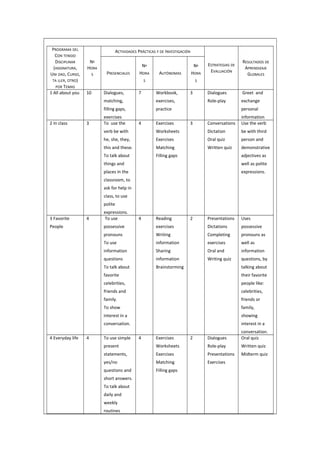
PROGRAMA DEL
CON TENIDO
DISCIPLINAR
(ASIGNATURA,
UNI DAD, CURSO,
TA LLER, OTRO)
POR TEMAS
Nº
HORA
S
ACTIVIDADES PRÁCTICAS Y DE INVESTIGACIÓN
ESTRATEGIAS DE
EVALUACIÓN
RESULTADOS DE
APRENDIZAJE
GLOBALESPRESENCIALES
Nº
HORA
S
AUTÓNOMAS
Nº
HORA
S
1 All about you 10 Dialogues,
matching,
filling gaps,
exercises
7 Workbook,
exercises,
practice
3 Dialogues
Role-play
Greet and
exchange
personal
information
2 In class 3 To use the
verb be with
he, she, they,
this and these.
To talk about
things and
places in the
classroom, to
ask for help in
class, to use
polite
expressions.
4 Exercises
Worksheets
Exercises
Matching
Filling gaps
3 Conversations
Dictation
Oral quiz
Written quiz
Use the verb
be with third
person and
demonstrative
adjectives as
well as polite
expressions.
3 Favorite
People
4 To use
possessive
pronouns
To use
information
questions
To talk about
favorite
celebrities,
friends and
family.
To show
interest in a
conversation.
4 Reading
exercises
Writing
information
Sharing
information
Brainstorming
2 Presentations
Dictations
Completing
exercises
Oral and
Writing quiz
Uses
possessive
pronouns as
well as
information
questions, by
talking about
their favorite
people like:
celebrities,
friends or
family,
showing
interest in a
conversation.
4 Everyday life 4 To use simple
present
statements,
yes/no
questions and
short answers.
To talk about
daily and
weekly
routines
4 Exercises
Worksheets
Exercises
Matching
Filling gaps
2 Dialogues
Role-play
Presentations
Exercises
Oral quiz
Written quiz
Midterm quiz
To answer
more than yes
or no to be
friendly.
To use “well”
to get time to
think.
5 Free time 3 To ask simple
present
information
questions
To say how
often you do
things
To talk about
free-time
activities and
TV shows
To ask
questions in
two ways
4 Taking
surveys
Unscrambling
sentences
Word puzzles
Listening
exercises
Discussing
questions
Presenting
informs
3 Written quiz
Oral quiz
Presentations
Exercises
Ask simple
present
information
questions,
expressing
how often
they do things,
talking about
free time
activities
asking
questions in
two ways.
6
Neighborhoods
3 To use there
is, there are
To use: some,
no, a lot of,
and a couple
of.
To talk about
neighborhood
and local
events
To ask for and
tell the time
To use “me
too” or “me
neither” to
show you are
like someone.
To agree by
using “ right”
and “ I know”.
3 Describing
pictures
Giving
directions
Dictation
exercises
Identifying
new
vocabulary
Describing
facilities
4 Writing
exercises
Reading
exercises
Completing
sentences
Filling gaps
Giving
directions
Use
demonstrative
pronouns, also
using quantity
expressions,
the students
will be able to
describe
facilities and
asking
questions
about their
neighborhood.
HORARIO DE CLASE/LABORATORIO:
HORAS / JORNADA LUNES MARTES MIÉRCOLES JUEVES VIERNES
1 1
NÚMERO DE SESIONES DE CLASES POR SEMANA:
ALL ABOUT YOU
DURACIÓN DE CADA SESIÓN PARA CUBRIR EL CONTENIDO TEÓRICO PARA CUBRIR LAS ACTIVIDADES PRACTICAS
2 horas 1 hora 1 hora
IN THE CLASSROOM
DURACIÓN DE CADA SESIÓN PARA CUBRIR EL CONTENIDO TEÓRICO PARA CUBRIR LAS ACTIVIDADES PRACTICAS
2 horas 1 hora 1 hora
FAVORITE PEOPLE
DURACIÓN DE CADA SESIÓN PARA CUBRIR EL CONTENIDO TEÓRICO PARA CUBRIR LAS ACTIVIDADES PRACTICAS
2 horas 1 hora 1 hora
EVERY DAY LIFE
DURACIÓN DE CADA SESIÓN PARA CUBRIR EL CONTENIDO TEÓRICO PARA CUBRIR LAS ACTIVIDADES PRACTICAS
2 horas 1 hora 1 hora
FREE TIME
DURACIÓN DE CADA SESIÓN PARA CUBRIR EL CONTENIDO TEÓRICO PARA CUBRIR LAS ACTIVIDADES PRACTICAS
2 horas 1 hora 1 hora
NEIGHBORHOODS
DURACIÓN DE CADA SESIÓN PARA CUBRIR EL CONTENIDO TEÓRICO PARA CUBRIR LAS ACTIVIDADES PRACTICAS
2 horas 1 hora 1 hora
CONTRIBUCIÓN DEL CURSO EN LA FORMACIÓN DE UN PROFESIONAL:
DESCRIBIR ¿CÓMO EL CONTENIDO DISCIPLINAR (ASIGNATURA, CURSO, TALLER) CONTRIBUYE PARA LA FORMACIÓN DEL
PROFESIONAL?:
This subject contributes to the integral formation of the students, giving them the tools to face a changing and
demanding world, that every time requires more and more preparation to get more opportunities in the labor
market.
DESTAQUE LA VINCULACIÓN O RELACIÓN CON OTROS CONTENIDOS DISCIPLINARES (ASIGNATURAS, CURSOS, TALLERES, OTROS) DEL
CURRÍCULUM:
When our students study English, they are getting ready to find out a world of information which contains
subjects related to their career whatever is this, since the last upgrades come in English, they are going to be
prepared to understand and receive the last information so that they will always will know what is going on in
their field.
INDIQUE EL TIPO DE FORMACIÓN (BÁSICA EN CIENCIAS, FUNDAMENTAL O ASPECTOS GENERALES COMPLEMENTARIOS) A QUE
CORRESPONDE LA MATERIA Y LA RELACIÓN CON LOS OBJETIVOS DE LA INSTITUCIÓN Y LA CARRERA:
THIS IS A BASIC SCIENCE SYLLABUS WHICH HAS A THEORY-PRACTICE NATURE RELATED TO THE WHOLE IMMEDIATE ENVIRONMENT
SINCE IS A GENERAL ONE IT WILL COVER THE NECESSITY FOR EVERY ONE OF THE STUDENTS WHO ARE TAKING ENGLISH 1.
RELACIÓN DEL CURSO CON EL CRITERIO RESULTADO DE APRENDIZAJE:
RESULTADOS DE APRENDIZAJE GLOBALES5
(PROPUESTOS POR EL CEAACES)
CONTRIBUCIÓN
(ALTA6
-MEDIA7
-BAJA8
)
RESULTADOS DE APRENDIZAJE DEL CURSO
(REDACTAR UTILIZANDO VERBOS DE ACCIÓN DE LA
TAXONOMÍA DE BLOOM Y DAVE):
A TO IDENTIFY NEW VOCABULARY Media At the end of the unit the student
will be able to greet, exchange
personal information and identify
new vocabulary.
B TO FIND DIFFERENT CLASSROOM ELEMENTS Baja At the end of this unit the student
will find different elements in the
classroom
C TO TALK ABOUT FAMILY AND FRIENDS Baja At the end of this unit the student
will talk about family and friends
D TO DESCRIBE DAILY ROUTINES Baja At the end of this unit the student
will describe daily routines
E TO DRAMATIZE HOBBIES AND FREE TIME
ACTIVITIES
Baja At the end of this unit the student
will dramatize hobbies and free
tome activities
F TO EXPLAIN THE DIFFERENT FACILITIES IN THE
NEIGHBORHOOD
Baja At the end of this unit the student
will explain the different facilities in
the neighborhood
G TO DIAGRAM FAMILY RELATIONSHIPS Baja At the end of this unit the student
will be able to draw a diagram
about family relationships
H TO COMPOSE A FAMOUS PERSON BIOGRAPHY Baja At the end of this unit the student
will compose a famous person
biography
I TO RE-WRITE SENTENCES ABOUT SPECIFIC TOPICS Baja At the end of this unit the student
will re-write sentences about
specific topics
J TO PREDICT WHAT COMES NEXT WHEN
EXPLAINING DAILY ROUTINES
Baja At the end of this unit the student
will predict what comes next when
explaining daily routines
K TO PRIORITIZE ACTIONS IN DAILY LIFE Baja At the end of this unit the student
will prioritize actions in daily life.
5
6
7
8
FORMAS DE EVALUACIÓN DEL CURSO (se debe indicar las políticas de evaluación de la materia, en los diferentes
períodos de evaluación que se realicen en la Carrera)
PRIMERA
EVALUACIÓN
SEGUNDA
EVALUACIÓN
TERCERA
EVALUACIÓN
N° EVALUACIÓN
EXÁMENES 45 % 45 % 45 % 45 %
LECCIONES 25% 25% 25% 25%
TAREAS 5% 5% 5% 5%
INFORMES 5% 5% 5% 5%
PARTICIPACIÓN EN CLASE 15% 15% 15% 15%
ACTIVIDADES DE TRABAJO
AUTÓNOMO
5% 5% 5% 5%
TOTAL 100% 100% 100% 100%
FORMAS DE EVALUACIÓN DEL CURSO (se debe indicar las políticas de evaluación de la materia, en los diferentes
períodos de evaluación que se realicen en la Carrera)
PRIMERA
EVALUACIÓN
SEGUNDA
EVALUACIÓN
TERCERA
EVALUACIÓN
N° EVALUACIÓN
EXÁMENES 45 % 45 % 45 % 45 %
LECCIONES 25% 25% 25% 25%
TAREAS 5% 5% 5% 5%
INFORMES 5% 5% 5% 5%
PARTICIPACIÓN EN CLASE 15% 15% 15% 15%
ACTIVIDADES DE TRABAJO
AUTÓNOMO
5% 5% 5% 5%
TOTAL 100% 100% 100% 100%

Silabo Ingles I

  • 1.
    UNIVERSIDAD REGIONAL AUTÓNOMADE LOS ANDES UNIANDES FACULTAD DE JURISPRUDENCIA CARRERA DE DERECHO SILABO: INGLÉS I
  • 2.
    NAME OF THESYLLABUS: INGLES I CÓDIGO1 : NÚMERO DE CRÉDITOS: TEÓRICOS PRÁCTICOS DESCRIPCIÓN DEL CURSO2 : Esta es una asignatura que pertenece al área de ciencias básicas y es de naturaleza teórico- practico donde el estudiante podrá generar información personal, identificar expresiones familiares diarias y frases básicas; así como dramatizar una situación usando información preliminar, cuyo propósito es distinguir información personal y de sus compañeros. Prerequisites Co requirements Contenidos disciplinares que deben ser aprobadas antes de cursar este contenido disciplinar. CONTENIDO DISCIPLINAR (ASIGNATURA, UNIDAD, CURSO, TALLER, OTROS) CÓDIGO None . Contenidos disciplinares que deben ser cursadas al mismo tiempo que este contenido disciplinar. CONTENIDO DISCIPLINAR (ASIGNATURA, UNIDAD, CURSO, TALLER, OTROS) CÓDIGO Introducción al Derecho DER01IAD Historia del Derecho DER01HDD Ciencia de Estado DER01CE Deontología Jurídica DER01DJ Informática DER01I TEXTO Y OTRAS REFERENCIAS REQUERIDAS PARA EL DICTADO DEL CURSO: Libro principal de consulta3 : AUTOR TÍTULO DEL LIBRO EDICIÓN AÑO PUBLICACIÓN EDITORIAL McCARTHY, Michael; McCARTEN Jeanne; SANDIFORD Helen TOUCHSTONE I 2008 2005 CAMBRIDGE Referencias bibliográficas como complemento para el aprendizaje de los alumnos. AUTOR TÍTULO DEL LIBRO EDICIÓN AÑO PUBLICACIÓN EDITORIAL Raymond Murphy Essential grammar in Use 3th 2007 Cambridge 1 2 3 3 1 DER01II
  • 3.
    OBJETIVOS GENERALES DELCURSO4 : (resultados o logros del aprendizaje del curso) OBJETIVO GENERAL: By the end of this course, the students will be able to role play a daily situation with their classmates. Cognitivos: 1 To identify new vocabulary 2 To describe familiar everyday situations using basic speaking skills Habilidades (psicomotrices): 1 To mime different situations 2 To write personal and classmates information Valores (afectivos): 1 To respect teacher and classmates 2 To present assignments on time Hábitos mentales: 1 To recognize new gramar 2 To discover implicit vocabulary TÓPICOS O TEMAS CUBIERTOS: (Lista el contenido o programa del curso indicando el número de horas por tema) UNIT I ALL ABOUT YOU UNIT II IN CLASS UNIT III FAVORITE PEOPLE UNIT IV EVERYDAY LIFE UNIT V FREE TIME UNIT VI NEIGHBORHOODS 4
  • 4.
    PROGRAMA DEL CON TENIDO DISCIPLINAR (ASIGNATURA, UNIDAD, CURSO, TA LLER, OTRO) POR TEMAS Nº HORA S ACTIVIDADES PRÁCTICAS Y DE INVESTIGACIÓN ESTRATEGIAS DE EVALUACIÓN RESULTADOS DE APRENDIZAJE GLOBALESPRESENCIALES Nº HORA S AUTÓNOMAS Nº HORA S 1 All about you 10 Dialogues, matching, filling gaps, exercises 7 Workbook, exercises, practice 3 Dialogues Role-play Greet and exchange personal information 2 In class 3 To use the verb be with he, she, they, this and these. To talk about things and places in the classroom, to ask for help in class, to use polite expressions. 4 Exercises Worksheets Exercises Matching Filling gaps 3 Conversations Dictation Oral quiz Written quiz Use the verb be with third person and demonstrative adjectives as well as polite expressions. 3 Favorite People 4 To use possessive pronouns To use information questions To talk about favorite celebrities, friends and family. To show interest in a conversation. 4 Reading exercises Writing information Sharing information Brainstorming 2 Presentations Dictations Completing exercises Oral and Writing quiz Uses possessive pronouns as well as information questions, by talking about their favorite people like: celebrities, friends or family, showing interest in a conversation. 4 Everyday life 4 To use simple present statements, yes/no questions and short answers. To talk about daily and weekly routines 4 Exercises Worksheets Exercises Matching Filling gaps 2 Dialogues Role-play Presentations Exercises Oral quiz Written quiz Midterm quiz
  • 5.
    To answer more thanyes or no to be friendly. To use “well” to get time to think. 5 Free time 3 To ask simple present information questions To say how often you do things To talk about free-time activities and TV shows To ask questions in two ways 4 Taking surveys Unscrambling sentences Word puzzles Listening exercises Discussing questions Presenting informs 3 Written quiz Oral quiz Presentations Exercises Ask simple present information questions, expressing how often they do things, talking about free time activities asking questions in two ways. 6 Neighborhoods 3 To use there is, there are To use: some, no, a lot of, and a couple of. To talk about neighborhood and local events To ask for and tell the time To use “me too” or “me neither” to show you are like someone. To agree by using “ right” and “ I know”. 3 Describing pictures Giving directions Dictation exercises Identifying new vocabulary Describing facilities 4 Writing exercises Reading exercises Completing sentences Filling gaps Giving directions Use demonstrative pronouns, also using quantity expressions, the students will be able to describe facilities and asking questions about their neighborhood.
  • 6.
    HORARIO DE CLASE/LABORATORIO: HORAS/ JORNADA LUNES MARTES MIÉRCOLES JUEVES VIERNES 1 1 NÚMERO DE SESIONES DE CLASES POR SEMANA: ALL ABOUT YOU DURACIÓN DE CADA SESIÓN PARA CUBRIR EL CONTENIDO TEÓRICO PARA CUBRIR LAS ACTIVIDADES PRACTICAS 2 horas 1 hora 1 hora 2 horas 1 hora 1 hora 2 horas 1 hora 1 hora 2 horas 1 hora 1 hora IN THE CLASSROOM DURACIÓN DE CADA SESIÓN PARA CUBRIR EL CONTENIDO TEÓRICO PARA CUBRIR LAS ACTIVIDADES PRACTICAS 2 horas 1 hora 1 hora 2 horas 1 hora 1 hora 2 horas 1 hora 1 hora 2 horas 1 hora 1 hora FAVORITE PEOPLE DURACIÓN DE CADA SESIÓN PARA CUBRIR EL CONTENIDO TEÓRICO PARA CUBRIR LAS ACTIVIDADES PRACTICAS 2 horas 1 hora 1 hora 2 horas 1 hora 1 hora 2 horas 1 hora 1 hora 2 horas 1 hora 1 hora EVERY DAY LIFE DURACIÓN DE CADA SESIÓN PARA CUBRIR EL CONTENIDO TEÓRICO PARA CUBRIR LAS ACTIVIDADES PRACTICAS 2 horas 1 hora 1 hora 2 horas 1 hora 1 hora 2 horas 1 hora 1 hora 2 horas 1 hora 1 hora FREE TIME DURACIÓN DE CADA SESIÓN PARA CUBRIR EL CONTENIDO TEÓRICO PARA CUBRIR LAS ACTIVIDADES PRACTICAS 2 horas 1 hora 1 hora 2 horas 1 hora 1 hora 2 horas 1 hora 1 hora 2 horas 1 hora 1 hora NEIGHBORHOODS DURACIÓN DE CADA SESIÓN PARA CUBRIR EL CONTENIDO TEÓRICO PARA CUBRIR LAS ACTIVIDADES PRACTICAS 2 horas 1 hora 1 hora 2 horas 1 hora 1 hora 2 horas 1 hora 1 hora 2 horas 1 hora 1 hora
  • 7.
    CONTRIBUCIÓN DEL CURSOEN LA FORMACIÓN DE UN PROFESIONAL: DESCRIBIR ¿CÓMO EL CONTENIDO DISCIPLINAR (ASIGNATURA, CURSO, TALLER) CONTRIBUYE PARA LA FORMACIÓN DEL PROFESIONAL?: This subject contributes to the integral formation of the students, giving them the tools to face a changing and demanding world, that every time requires more and more preparation to get more opportunities in the labor market. DESTAQUE LA VINCULACIÓN O RELACIÓN CON OTROS CONTENIDOS DISCIPLINARES (ASIGNATURAS, CURSOS, TALLERES, OTROS) DEL CURRÍCULUM: When our students study English, they are getting ready to find out a world of information which contains subjects related to their career whatever is this, since the last upgrades come in English, they are going to be prepared to understand and receive the last information so that they will always will know what is going on in their field. INDIQUE EL TIPO DE FORMACIÓN (BÁSICA EN CIENCIAS, FUNDAMENTAL O ASPECTOS GENERALES COMPLEMENTARIOS) A QUE CORRESPONDE LA MATERIA Y LA RELACIÓN CON LOS OBJETIVOS DE LA INSTITUCIÓN Y LA CARRERA: THIS IS A BASIC SCIENCE SYLLABUS WHICH HAS A THEORY-PRACTICE NATURE RELATED TO THE WHOLE IMMEDIATE ENVIRONMENT SINCE IS A GENERAL ONE IT WILL COVER THE NECESSITY FOR EVERY ONE OF THE STUDENTS WHO ARE TAKING ENGLISH 1.
  • 8.
    RELACIÓN DEL CURSOCON EL CRITERIO RESULTADO DE APRENDIZAJE: RESULTADOS DE APRENDIZAJE GLOBALES5 (PROPUESTOS POR EL CEAACES) CONTRIBUCIÓN (ALTA6 -MEDIA7 -BAJA8 ) RESULTADOS DE APRENDIZAJE DEL CURSO (REDACTAR UTILIZANDO VERBOS DE ACCIÓN DE LA TAXONOMÍA DE BLOOM Y DAVE): A TO IDENTIFY NEW VOCABULARY Media At the end of the unit the student will be able to greet, exchange personal information and identify new vocabulary. B TO FIND DIFFERENT CLASSROOM ELEMENTS Baja At the end of this unit the student will find different elements in the classroom C TO TALK ABOUT FAMILY AND FRIENDS Baja At the end of this unit the student will talk about family and friends D TO DESCRIBE DAILY ROUTINES Baja At the end of this unit the student will describe daily routines E TO DRAMATIZE HOBBIES AND FREE TIME ACTIVITIES Baja At the end of this unit the student will dramatize hobbies and free tome activities F TO EXPLAIN THE DIFFERENT FACILITIES IN THE NEIGHBORHOOD Baja At the end of this unit the student will explain the different facilities in the neighborhood G TO DIAGRAM FAMILY RELATIONSHIPS Baja At the end of this unit the student will be able to draw a diagram about family relationships H TO COMPOSE A FAMOUS PERSON BIOGRAPHY Baja At the end of this unit the student will compose a famous person biography I TO RE-WRITE SENTENCES ABOUT SPECIFIC TOPICS Baja At the end of this unit the student will re-write sentences about specific topics J TO PREDICT WHAT COMES NEXT WHEN EXPLAINING DAILY ROUTINES Baja At the end of this unit the student will predict what comes next when explaining daily routines K TO PRIORITIZE ACTIONS IN DAILY LIFE Baja At the end of this unit the student will prioritize actions in daily life. 5 6 7 8
  • 9.
    FORMAS DE EVALUACIÓNDEL CURSO (se debe indicar las políticas de evaluación de la materia, en los diferentes períodos de evaluación que se realicen en la Carrera) PRIMERA EVALUACIÓN SEGUNDA EVALUACIÓN TERCERA EVALUACIÓN N° EVALUACIÓN EXÁMENES 45 % 45 % 45 % 45 % LECCIONES 25% 25% 25% 25% TAREAS 5% 5% 5% 5% INFORMES 5% 5% 5% 5% PARTICIPACIÓN EN CLASE 15% 15% 15% 15% ACTIVIDADES DE TRABAJO AUTÓNOMO 5% 5% 5% 5% TOTAL 100% 100% 100% 100%
  • 10.
    FORMAS DE EVALUACIÓNDEL CURSO (se debe indicar las políticas de evaluación de la materia, en los diferentes períodos de evaluación que se realicen en la Carrera) PRIMERA EVALUACIÓN SEGUNDA EVALUACIÓN TERCERA EVALUACIÓN N° EVALUACIÓN EXÁMENES 45 % 45 % 45 % 45 % LECCIONES 25% 25% 25% 25% TAREAS 5% 5% 5% 5% INFORMES 5% 5% 5% 5% PARTICIPACIÓN EN CLASE 15% 15% 15% 15% ACTIVIDADES DE TRABAJO AUTÓNOMO 5% 5% 5% 5% TOTAL 100% 100% 100% 100%