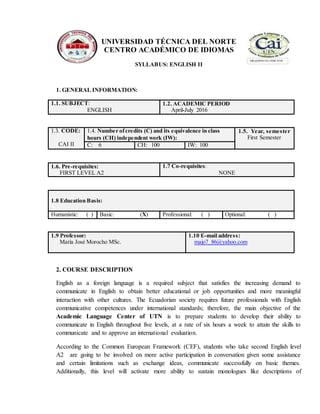
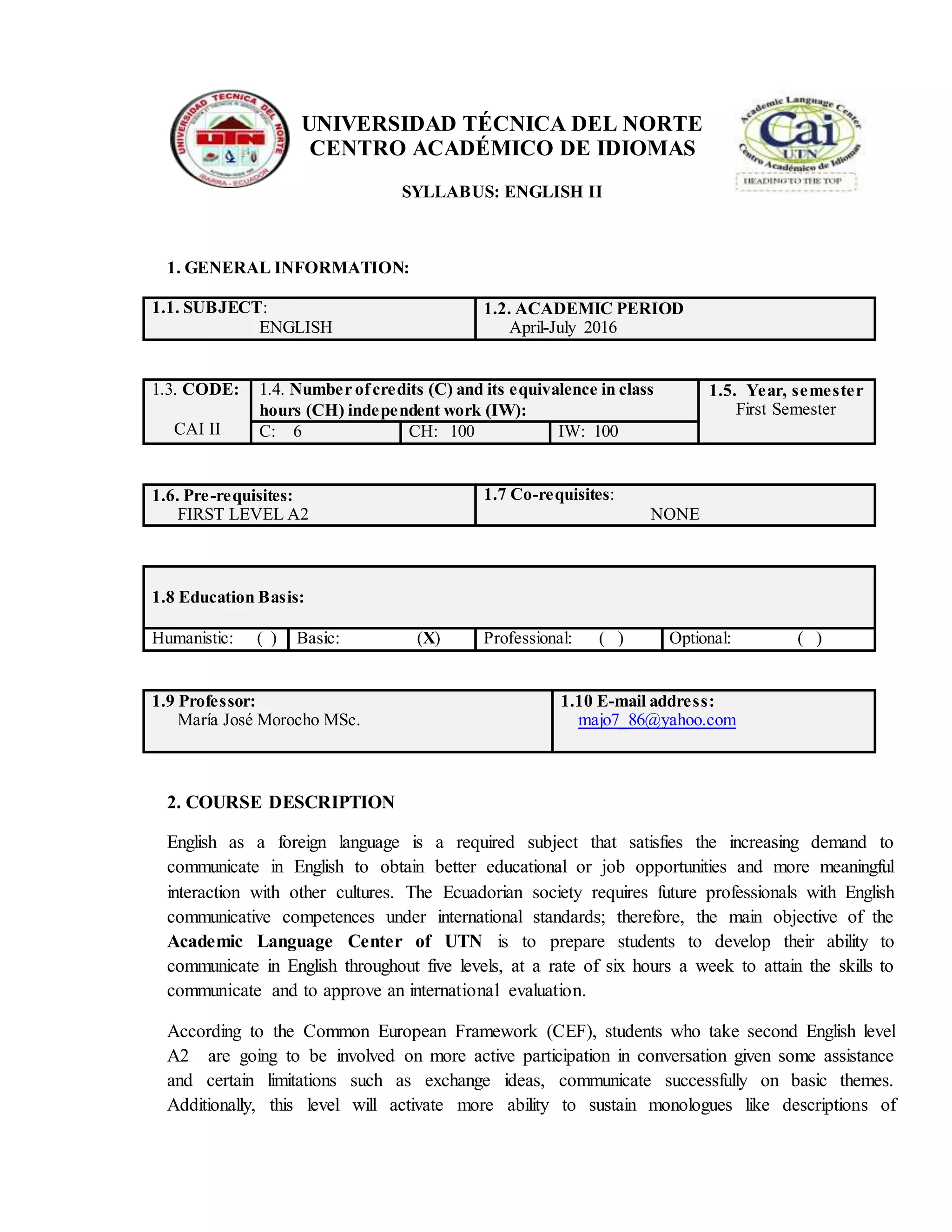
UNIVERSIDAD TÉCNICA DEL NORTE
CENTRO ACADÉMICO DE IDIOMAS
SYLLABUS: ENGLISH II
1. GENERAL INFORMATION:
1.1. SUBJECT:
ENGLISH
1.2. ACADEMIC PERIOD
April-July 2016
1.3. CODE:
CAI II
1.4. Number ofcredits (C) and its equivalence in class
hours (CH) independent work (IW):
1.5. Year, semester
First Semester
C: 6 CH: 100 IW: 100
1.6. Pre-requisites:
FIRST LEVEL A2
1.7 Co-requisites:
NONE
1.8 Education Basis:
Humanistic: ( ) Basic: (X) Professional: ( ) Optional: ( )
1.9 Professor:
María José Morocho MSc.
1.10 E-mail address:
majo7_86@yahoo.com
2. COURSE DESCRIPTION
English as a foreign language is a required subject that satisfies the increasing demand to
communicate in English to obtain better educational or job opportunities and more meaningful
interaction with other cultures. The Ecuadorian society requires future professionals with English
communicative competences under international standards; therefore, the main objective of the
Academic Language Center of UTN is to prepare students to develop their ability to
communicate in English throughout five levels, at a rate of six hours a week to attain the skills to
communicate and to approve an international evaluation.
According to the Common European Framework (CEF), students who take second English level
A2 are going to be involved on more active participation in conversation given some assistance
and certain limitations such as exchange ideas, communicate successfully on basic themes.
Additionally, this level will activate more ability to sustain monologues like descriptions of
everyday aspects, people, places, a job or study experience; personal experiences, past activities,
habits and routines, plans , arrangements, possessions, etc.
3. LEARNING OBJECTIVES
3.1 GENERAL :
To understand sentences and frequently used expressions related to areas of most
immediate relevance (e.g. very basic personal and family information, shopping,
local geography, employment) and communicate in simple and routine tasks requiring
a simple and direct exchange of information on familiar and routine matters. Also,
descriptions in simple terms aspects of his/her background, immediate environment and
matters in areas of immediate Basic need are used.
3. 2 SPECIFIC :
With the aim to communicate in English as a foreign language, each objective will cover a
receptive (Listening and Reading comprehension) or productive (Oral and written
communication) skills in which, by the end of first level, the student should be able to:
 LISTENING:
Understand enough to manage simple, routine exchanges without undue effort. Clearly
understand standard speech on familiar matters at him /her, provided she /he can ask for
repetition or reformulation from time to time and the identification of some simple structures
correctly, but still systematically makes basic mistakes-for example tends to mix up tenses and
forget to mark agreement, nevertheless it is usually clear what he/she is trying to say.
 SPEAKING:
Communicate in simple and routine tasks using simple phrases to ask for and provide things to
get simple information and to discuss what to do next. Additionally, they should be able to
produce brief everyday expressions in order to satisfy simple needs of a concrete type: personal
details, daily routines, wants and needs, requests for information using basic sentence patterns
for communicating with memorized phrases, groups of a few words about themselves and other
people, what they do, places, possessions etc.
 READING:
Understand short, simple texts on familiar matters of a concrete type which consist of high
frequency everyday or job-related language, including a proportion of shared international
vocabulary items.
 WRITING:
Write short, simple formulaic notes relating to matters in areas of immediate need. In addition,
Students can pick out and reproduce key words and phrases or short sentences from a short text
within the learner´s limited competence and experience.
4. COMMITMENTS:
English is an interactive class in which students will be actively involved in the learning process.
Student learning is a top priority. Students will work in groups or independently according to
the planned activities. The teacher will apply the most suitable model for learning using
communicative and cognitive approaches. Students are expected to come to class prepared and
attentive to ensure a productive learning environment. Students must show courtesy and respect
to their fellow students and to the teacher.
In order to participate actively in this class, please:
 Make sure you have completed the registration process to attend the class.
 Arrive on time.
 Attendance is required for each class session. Any sessions that are missed due to scheduling
issues will be resolved as long as a certificate is presented within the first 48 working hours.
 Be aware of the due dates for homework, presentations, projects.
 Be respectful and friendly (Keep a good learning environment).
 Use English as much as possible.
 Turn off cell phones, I-pods, laptops and headphones before you enter the classroom.
 Keep the classroom neat and tidy (Food or drinks are not allowed in class).
 Be honest on homework, class work, paperwork, assignments, projects, worksheets, quizzes,
diagnostic tests, progress tests, objectives tests, exit/achievement tests. In case of plagiarism
(cheating), you will be sanctioned according to the UTN internal regulations.
 Keep in mind the FIRST Registration is FREE! The SECOND Registration is 10% of the
minimum wage salary.
Class Participation and Freedom of Expression
We must be aware that in situations, which involve expression of opinion and critical thinking,
we are certain to have differences and may at times have strong opinions or views. Such
differences encourage interesting and challenging discussions. They provide us also with the
opportunity to practice listening skills. It is advisable to participate in class so that you do not
miss this learning experience. Absences and tardiness must be avoided.
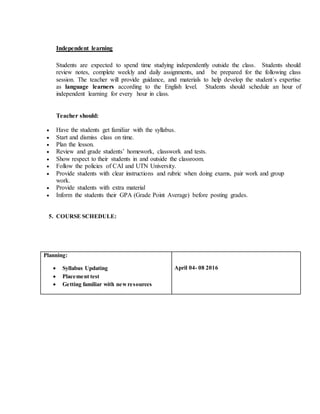
Independent learning
Students are expected to spend time studying independently outside the class. Students should
review notes, complete weekly and daily assignments, and be prepared for the following class
session. The teacher will provide guidance, and materials to help develop the student´s expertise
as language learners according to the English level. Students should schedule an hour of
independent learning for every hour in class.
Teacher should:
 Have the students get familiar with the syllabus.
 Start and dismiss class on time.
 Plan the lesson.
 Review and grade students’ homework, classwork and tests.
 Show respect to their students in and outside the classroom.
 Follow the policies of CAI and UTN University.
 Provide students with clear instructions and rubric when doing exams, pair work and group
work.
 Provide students with extra material
 Inform the students their GPA (Grade Point Average) before posting grades.
5. COURSE SCHEDULE:
Planning:
 Syllabus Updating
 Placement test
 Getting familiar with newresources
April 04- 08 2016
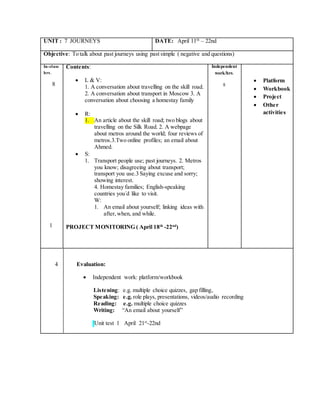
UNIT : 7 JOURNEYS DATE: April 11th
– 22nd
Objective: To talk about past journeys using past simple ( negative and questions)
In-class
hrs.
8
1
Contents:
 L & V:
1. A conversation about travelling on the skill road.
2. A conversation about transport in Moscow 3. A
conversation about choosing a homestay family
 R:
1. An article about the skill road; two blogs about
travelling on the Silk Road. 2. A webpage
about metros around the world; four reviews of
metros.3.Two online profiles; an email about
Ahmed.
 S:
1. Transport people use; past journeys. 2. Metros
you know; disagreeing about transport;
transport you use.3 Saying excuse and sorry;
showing interest.
4. Homestay families; English-speaking
countries you´d like to visit.
W:
1. An email about yourself; linking ideas with
after,when, and while.
PROJECT MONITORING ( April 18th
-22nd
)
Independent
work/hrs.
8
 Platform
 Workbook
 Project
 Other
activities
4 Evaluation:
 Independent work: platform/workbook
Listening: e.g. multiple choice quizzes, gap filling,
Speaking: e.g. role plays, presentations, videos/audio recording
Reading: e.g. multiple choice quizzes
Writing: “An email about yourself”
Unit test 1 April 21st
-22nd
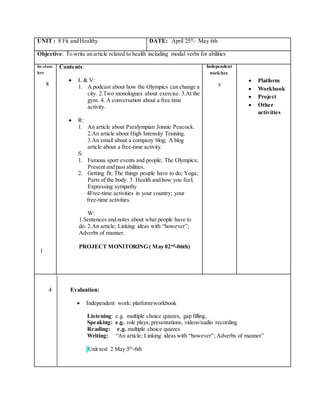
UNIT : 8 Fit and Healthy DATE: April 25th
- May 6th
Objective: To write an article related to health including modal verbs for abilities
In-class
hrs.
8
1
Contents:
 L & V:
1. A podcast about how the Olympics can change a
city. 2.Two monologues about exercise. 3.At the
gym. 4. A conversation about a free time
activity.
 R:
1. An article about Paralympian Jonnie Peacock.
2.An article about High Intensity Training.
3.An email about a company blog; A blog
article about a free-time activity.
S:
1. Famous sport events and people; The Olympics;
Present and past abilities.
2. Getting fit; The things people have to do; Yoga;
Parts of the body. 3. Health and how you feel;
Expressing sympathy
4Free-time activities in your country; your
free-time activities.
W:
1.Sentences and notes about what people have to
do. 2.An article; Linking ideas with “however”;
Adverbs of manner.
PROJECT MONITORING ( May 02nd
-06th)
Independent
work/hrs.
8
 Platform
 Workbook
 Project
 Other
activities
4 Evaluation:
 Independent work: platform/workbook
Listening: e.g. multiple choice quizzes, gap filling,
Speaking: e.g. role plays, presentations, videos/audio recording
Reading: e.g. multiple choice quizzes
Writing: “An article; Linking ideas with “however”; Adverbs of manner”
Unit test 2 May 5th
-6th
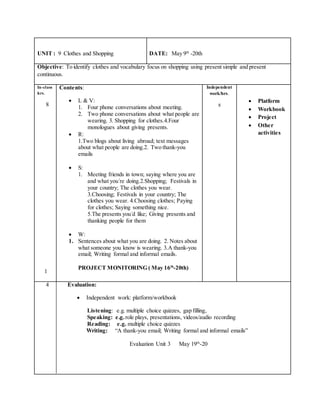
UNIT : 9 Clothes and Shopping DATE: May 9th
-20th
Objective: To identify clothes and vocabulary focus on shopping using present simple and present
continuous.
In-class
hrs.
8
1
Contents:
 L & V:
1. Four phone conversations about meeting.
2. Two phone conversations about what people are
wearing. 3. Shopping for clothes.4.Four
monologues about giving presents.
 R:
1.Two blogs about living abroad; text messages
about what people are doing.2. Two thank-you
emails
 S:
1. Meeting friends in town; saying where you are
and what you´re doing.2.Shopping; Festivals in
your country; The clothes you wear.
3.Choosing; Festivals in your country; The
clothes you wear. 4.Choosing clothes; Paying
for clothes; Saying something nice.
5.The presents you´d like; Giving presents and
thanking people for them
 W:
1. Sentences about what you are doing. 2. Notes about
what someone you know is wearing. 3.A thank-you
email; Writing formal and informal emails.
PROJECT MONITORING ( May 16th
-20th)
Independent
work/hrs.
8
 Platform
 Workbook
 Project
 Other
activities
4 Evaluation:
 Independent work: platform/workbook
Listening: e.g. multiple choice quizzes, gap filling,
Speaking: e.g. role plays, presentations, videos/audio recording
Reading: e.g. multiple choice quizzes
Writing: “A thank-you email; Writing formal and informal emails”
Evaluation Unit 3 May 19th
-20
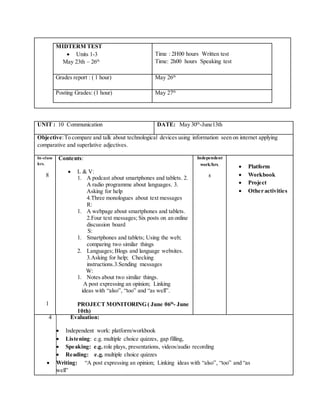
MIDTERM TEST
 Units 1-3
May 23th – 26th
Time : 2H00 hours Written test
Time: 2h00 hours Speaking test
Grades report : ( 1 hour) May 26th
Posting Grades: (1 hour) May 27th
UNIT : 10 Communication DATE: May 30th
-June13th
Objective:To compare and talk about technological devices using information seen on internet applying
comparative and superlative adjectives.
In-class
hrs.
8
1
Contents:
 L & V:
1. A podcast about smartphones and tablets. 2.
A radio programme about languages. 3.
Asking for help
4.Three monologues about text messages
R:
1. A webpage about smartphones and tablets.
2.Four text messages; Six posts on an online
discussion board
S:
1. Smartphones and tablets; Using the web;
comparing two similar things
2. Languages; Blogs and language websites.
3.Asking for help; Checking
instructions.3.Sending messages
W:
1. Notes about two similar things.
A post expressing an opinion; Linking
ideas with “also”, “too” and “as well”.
PROJECT MONITORING ( June 06th
- June
10th)
Independent
work/hrs.
8
 Platform
 Workbook
 Project
 Other activities
4 Evaluation:
 Independent work: platform/workbook
 Listening: e.g. multiple choice quizzes, gap filling,
 Speaking: e.g. role plays, presentations, videos/audio recording
 Reading: e.g. multiple choice quizzes
 Writing: “A post expressing an opinion; Linking ideas with “also”, “too” and “as
well”
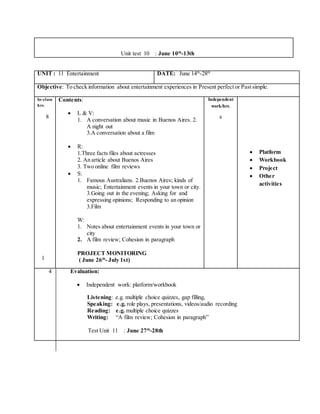
Unit test 10 : June 10th
-13th
UNIT : 11 Entertainment DATE: June 14th
-28th
Objective: To check information about entertainment experiences in Present perfect or Past simple.
In-class
hrs.
8
1
Contents:
 L & V:
1. A conversation about music in Buenos Aires. 2.
A night out
3.A conversation about a film
 R:
1.Three facts files about actresses
2. An article about Buenos Aires
3. Two online film reviews
 S:
1. Famous Australians. 2.Buenos Aires; kinds of
music; Entertainment events in your town or city.
3.Going out in the evening; Asking for and
expressing opinions; Responding to an opinion
3.Film
W:
1. Notes about entertainment events in your town or
city
2. A film review; Cohesion in paragraph
PROJECT MONITORING
( June 26th
- July 1st)
Independent
work/hrs.
8
 Platform
 Workbook
 Project
 Other
activities
4 Evaluation:
 Independent work: platform/workbook
Listening: e.g. multiple choice quizzes, gap filling,
Speaking: e.g. role plays, presentations, videos/audio recording
Reading: e.g. multiple choice quizzes
Writing: “A film review; Cohesion in paragraph”
Test Unit 11 : June 27th
-28th
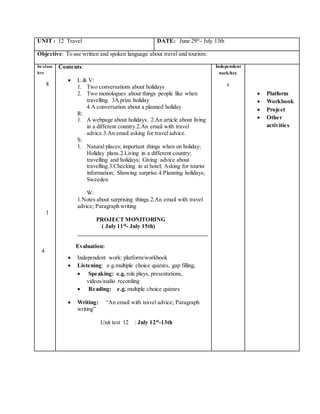
UNIT : 12 Travel DATE: June 29th
- July 13th
Objective: To use written and spoken language about travel and tourism.
In-class
hrs.
8
1
4
Contents:
 L & V:
1. Two conversations about holidays
2. Two monologues about things people like when
travelling. 3A prize holiday
4.A conversation about a planned holiday
R:
1. A webpage about holidays. 2.An article about living
in a different country.2.An email with travel
advice.3.An email asking for travel advice.
S:
1. Natural places; important things when on holiday;
Holiday plans.2.Living in a different country;
travelling and holidays; Giving advice about
travelling.3.Checking in at hotel; Asking for tourist
information; Showing surprise.4.Planning holidays;
Sweeden
W:
1.Notes about surprising things.2.An email with travel
advice; Paragraph writing
PROJECT MONITORING
( July 11th
- July 15th)
_____________________________________________
Evaluation:
 Independent work: platform/workbook
 Listening: e.g.multiple choice quizzes, gap filling,
 Speaking: e.g. role plays, presentations,
videos/audio recording
 Reading: e.g. multiple choice quizzes
 Writing: “An email with travel advice; Paragraph
writing”
Unit test 12 : July 12th
-13th
Independent
work/hrs.
8
 Platform
 Workbook
 Project
 Other
activities
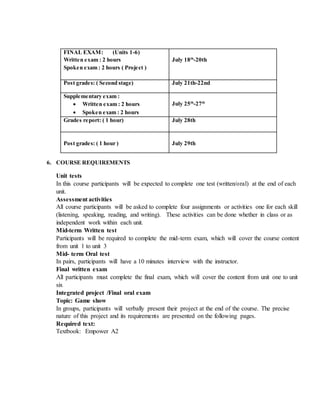
6. COURSE REQUIREMENTS
Unit tests
In this course participants will be expected to complete one test (written/oral) at the end of each
unit.
Assessment activities
All course participants will be asked to complete four assignments or activities one for each skill
(listening, speaking, reading, and writing). These activities can be done whether in class or as
independent work within each unit.
Mid-term Written test
Participants will be required to complete the mid-term exam, which will cover the course content
from unit 1 to unit 3
Mid- term Oral test
In pairs, participants will have a 10 minutes interview with the instructor.
Final written exam
All participants must complete the final exam, which will cover the content from unit one to unit
six
Integrated project /Final oral exam
Topic: Game show
In groups, participants will verbally present their project at the end of the course. The precise
nature of this project and its requirements are presented on the following pages.
Required text:
Textbook: Empower A2
FINAL EXAM: (Units 1-6)
Written exam : 2 hours
Spoken exam : 2 hours ( Project )
July 18th
-20th
Post grades: ( Second stage) July 21th-22nd
Supplementary exam :
 Written exam : 2 hours
 Spoken exam : 2 hours
July 25th
-27th
Grades report: ( 1 hour) July 28th
Post grades: ( 1 hour ) July 29th
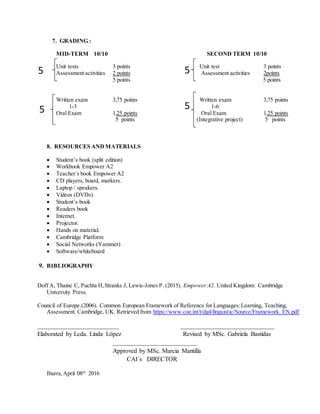
7. GRADING :
MID-TERM 10/10 SECOND TERM 10/10
Unit tests 3 points Unit test 3 points
Assessment activities 2 points Assessment activities 2points
5 points 5 points
Written exam 3,75 points Written exam 3,75 points
1-3 1-6
Oral Exam 1,25 points Oral Exam 1,25 points
5 points (Integrative project) 5 points
8. RESOURCES AND MATERIALS
 Student’s book (split edition)
 Workbook Empower A2
 Teacher´s book Empower A2
 CD players, board, markers.
 Laptop / speakers.
 Videos (DVDs).
 Student’s book
 Readers book
 Internet.
 Projector.
 Hands on material.
 Cambridge Platform
 Social Networks (Yammer)
 Software/whiteboard
9. BIBLIOGRAPHY
Doff A, Thaine C, Puchta H,Stranks J, Lewis-Jones P. (2015). Empower A2. United Kingdom: Cambridge
University Press.
Council of Europe.(2006). Common European Framework of Reference for Languages:Learning, Teaching,
Assessment. Cambridge, UK. Retrieved from https://www.coe.int/t/dg4/linguistic/Source/Framework_EN.pdf
__________________________ ______________________________
Elaborated by Lcda. Linda López Revised by MSc. Gabriela Bastidas
___________________________
Approved by MSc. Marcia Mantilla
CAI´s DIRECTOR
Ibarra,April 08th
2016
5
/
/
5
5
5

Syllabus second level

  • 1.
    UNIVERSIDAD TÉCNICA DELNORTE CENTRO ACADÉMICO DE IDIOMAS SYLLABUS: ENGLISH II 1. GENERAL INFORMATION: 1.1. SUBJECT: ENGLISH 1.2. ACADEMIC PERIOD April-July 2016 1.3. CODE: CAI II 1.4. Number ofcredits (C) and its equivalence in class hours (CH) independent work (IW): 1.5. Year, semester First Semester C: 6 CH: 100 IW: 100 1.6. Pre-requisites: FIRST LEVEL A2 1.7 Co-requisites: NONE 1.8 Education Basis: Humanistic: ( ) Basic: (X) Professional: ( ) Optional: ( ) 1.9 Professor: María José Morocho MSc. 1.10 E-mail address: majo7_86@yahoo.com 2. COURSE DESCRIPTION English as a foreign language is a required subject that satisfies the increasing demand to communicate in English to obtain better educational or job opportunities and more meaningful interaction with other cultures. The Ecuadorian society requires future professionals with English communicative competences under international standards; therefore, the main objective of the Academic Language Center of UTN is to prepare students to develop their ability to communicate in English throughout five levels, at a rate of six hours a week to attain the skills to communicate and to approve an international evaluation. According to the Common European Framework (CEF), students who take second English level A2 are going to be involved on more active participation in conversation given some assistance and certain limitations such as exchange ideas, communicate successfully on basic themes. Additionally, this level will activate more ability to sustain monologues like descriptions of
  • 2.
    everyday aspects, people,places, a job or study experience; personal experiences, past activities, habits and routines, plans , arrangements, possessions, etc. 3. LEARNING OBJECTIVES 3.1 GENERAL : To understand sentences and frequently used expressions related to areas of most immediate relevance (e.g. very basic personal and family information, shopping, local geography, employment) and communicate in simple and routine tasks requiring a simple and direct exchange of information on familiar and routine matters. Also, descriptions in simple terms aspects of his/her background, immediate environment and matters in areas of immediate Basic need are used. 3. 2 SPECIFIC : With the aim to communicate in English as a foreign language, each objective will cover a receptive (Listening and Reading comprehension) or productive (Oral and written communication) skills in which, by the end of first level, the student should be able to:  LISTENING: Understand enough to manage simple, routine exchanges without undue effort. Clearly understand standard speech on familiar matters at him /her, provided she /he can ask for repetition or reformulation from time to time and the identification of some simple structures correctly, but still systematically makes basic mistakes-for example tends to mix up tenses and forget to mark agreement, nevertheless it is usually clear what he/she is trying to say.  SPEAKING: Communicate in simple and routine tasks using simple phrases to ask for and provide things to get simple information and to discuss what to do next. Additionally, they should be able to produce brief everyday expressions in order to satisfy simple needs of a concrete type: personal details, daily routines, wants and needs, requests for information using basic sentence patterns for communicating with memorized phrases, groups of a few words about themselves and other people, what they do, places, possessions etc.  READING: Understand short, simple texts on familiar matters of a concrete type which consist of high frequency everyday or job-related language, including a proportion of shared international vocabulary items.
  • 3.
     WRITING: Write short,simple formulaic notes relating to matters in areas of immediate need. In addition, Students can pick out and reproduce key words and phrases or short sentences from a short text within the learner´s limited competence and experience. 4. COMMITMENTS: English is an interactive class in which students will be actively involved in the learning process. Student learning is a top priority. Students will work in groups or independently according to the planned activities. The teacher will apply the most suitable model for learning using communicative and cognitive approaches. Students are expected to come to class prepared and attentive to ensure a productive learning environment. Students must show courtesy and respect to their fellow students and to the teacher. In order to participate actively in this class, please:  Make sure you have completed the registration process to attend the class.  Arrive on time.  Attendance is required for each class session. Any sessions that are missed due to scheduling issues will be resolved as long as a certificate is presented within the first 48 working hours.  Be aware of the due dates for homework, presentations, projects.  Be respectful and friendly (Keep a good learning environment).  Use English as much as possible.  Turn off cell phones, I-pods, laptops and headphones before you enter the classroom.  Keep the classroom neat and tidy (Food or drinks are not allowed in class).  Be honest on homework, class work, paperwork, assignments, projects, worksheets, quizzes, diagnostic tests, progress tests, objectives tests, exit/achievement tests. In case of plagiarism (cheating), you will be sanctioned according to the UTN internal regulations.  Keep in mind the FIRST Registration is FREE! The SECOND Registration is 10% of the minimum wage salary. Class Participation and Freedom of Expression We must be aware that in situations, which involve expression of opinion and critical thinking, we are certain to have differences and may at times have strong opinions or views. Such differences encourage interesting and challenging discussions. They provide us also with the opportunity to practice listening skills. It is advisable to participate in class so that you do not miss this learning experience. Absences and tardiness must be avoided.
  • 4.
    Independent learning Students areexpected to spend time studying independently outside the class. Students should review notes, complete weekly and daily assignments, and be prepared for the following class session. The teacher will provide guidance, and materials to help develop the student´s expertise as language learners according to the English level. Students should schedule an hour of independent learning for every hour in class. Teacher should:  Have the students get familiar with the syllabus.  Start and dismiss class on time.  Plan the lesson.  Review and grade students’ homework, classwork and tests.  Show respect to their students in and outside the classroom.  Follow the policies of CAI and UTN University.  Provide students with clear instructions and rubric when doing exams, pair work and group work.  Provide students with extra material  Inform the students their GPA (Grade Point Average) before posting grades. 5. COURSE SCHEDULE: Planning:  Syllabus Updating  Placement test  Getting familiar with newresources April 04- 08 2016
  • 5.
    UNIT : 7JOURNEYS DATE: April 11th – 22nd Objective: To talk about past journeys using past simple ( negative and questions) In-class hrs. 8 1 Contents:  L & V: 1. A conversation about travelling on the skill road. 2. A conversation about transport in Moscow 3. A conversation about choosing a homestay family  R: 1. An article about the skill road; two blogs about travelling on the Silk Road. 2. A webpage about metros around the world; four reviews of metros.3.Two online profiles; an email about Ahmed.  S: 1. Transport people use; past journeys. 2. Metros you know; disagreeing about transport; transport you use.3 Saying excuse and sorry; showing interest. 4. Homestay families; English-speaking countries you´d like to visit. W: 1. An email about yourself; linking ideas with after,when, and while. PROJECT MONITORING ( April 18th -22nd ) Independent work/hrs. 8  Platform  Workbook  Project  Other activities 4 Evaluation:  Independent work: platform/workbook Listening: e.g. multiple choice quizzes, gap filling, Speaking: e.g. role plays, presentations, videos/audio recording Reading: e.g. multiple choice quizzes Writing: “An email about yourself” Unit test 1 April 21st -22nd
  • 6.
    UNIT : 8Fit and Healthy DATE: April 25th - May 6th Objective: To write an article related to health including modal verbs for abilities In-class hrs. 8 1 Contents:  L & V: 1. A podcast about how the Olympics can change a city. 2.Two monologues about exercise. 3.At the gym. 4. A conversation about a free time activity.  R: 1. An article about Paralympian Jonnie Peacock. 2.An article about High Intensity Training. 3.An email about a company blog; A blog article about a free-time activity. S: 1. Famous sport events and people; The Olympics; Present and past abilities. 2. Getting fit; The things people have to do; Yoga; Parts of the body. 3. Health and how you feel; Expressing sympathy 4Free-time activities in your country; your free-time activities. W: 1.Sentences and notes about what people have to do. 2.An article; Linking ideas with “however”; Adverbs of manner. PROJECT MONITORING ( May 02nd -06th) Independent work/hrs. 8  Platform  Workbook  Project  Other activities 4 Evaluation:  Independent work: platform/workbook Listening: e.g. multiple choice quizzes, gap filling, Speaking: e.g. role plays, presentations, videos/audio recording Reading: e.g. multiple choice quizzes Writing: “An article; Linking ideas with “however”; Adverbs of manner” Unit test 2 May 5th -6th
  • 7.
    UNIT : 9Clothes and Shopping DATE: May 9th -20th Objective: To identify clothes and vocabulary focus on shopping using present simple and present continuous. In-class hrs. 8 1 Contents:  L & V: 1. Four phone conversations about meeting. 2. Two phone conversations about what people are wearing. 3. Shopping for clothes.4.Four monologues about giving presents.  R: 1.Two blogs about living abroad; text messages about what people are doing.2. Two thank-you emails  S: 1. Meeting friends in town; saying where you are and what you´re doing.2.Shopping; Festivals in your country; The clothes you wear. 3.Choosing; Festivals in your country; The clothes you wear. 4.Choosing clothes; Paying for clothes; Saying something nice. 5.The presents you´d like; Giving presents and thanking people for them  W: 1. Sentences about what you are doing. 2. Notes about what someone you know is wearing. 3.A thank-you email; Writing formal and informal emails. PROJECT MONITORING ( May 16th -20th) Independent work/hrs. 8  Platform  Workbook  Project  Other activities 4 Evaluation:  Independent work: platform/workbook Listening: e.g. multiple choice quizzes, gap filling, Speaking: e.g. role plays, presentations, videos/audio recording Reading: e.g. multiple choice quizzes Writing: “A thank-you email; Writing formal and informal emails” Evaluation Unit 3 May 19th -20
  • 8.
    MIDTERM TEST  Units1-3 May 23th – 26th Time : 2H00 hours Written test Time: 2h00 hours Speaking test Grades report : ( 1 hour) May 26th Posting Grades: (1 hour) May 27th UNIT : 10 Communication DATE: May 30th -June13th Objective:To compare and talk about technological devices using information seen on internet applying comparative and superlative adjectives. In-class hrs. 8 1 Contents:  L & V: 1. A podcast about smartphones and tablets. 2. A radio programme about languages. 3. Asking for help 4.Three monologues about text messages R: 1. A webpage about smartphones and tablets. 2.Four text messages; Six posts on an online discussion board S: 1. Smartphones and tablets; Using the web; comparing two similar things 2. Languages; Blogs and language websites. 3.Asking for help; Checking instructions.3.Sending messages W: 1. Notes about two similar things. A post expressing an opinion; Linking ideas with “also”, “too” and “as well”. PROJECT MONITORING ( June 06th - June 10th) Independent work/hrs. 8  Platform  Workbook  Project  Other activities 4 Evaluation:  Independent work: platform/workbook  Listening: e.g. multiple choice quizzes, gap filling,  Speaking: e.g. role plays, presentations, videos/audio recording  Reading: e.g. multiple choice quizzes  Writing: “A post expressing an opinion; Linking ideas with “also”, “too” and “as well”
  • 9.
    Unit test 10: June 10th -13th UNIT : 11 Entertainment DATE: June 14th -28th Objective: To check information about entertainment experiences in Present perfect or Past simple. In-class hrs. 8 1 Contents:  L & V: 1. A conversation about music in Buenos Aires. 2. A night out 3.A conversation about a film  R: 1.Three facts files about actresses 2. An article about Buenos Aires 3. Two online film reviews  S: 1. Famous Australians. 2.Buenos Aires; kinds of music; Entertainment events in your town or city. 3.Going out in the evening; Asking for and expressing opinions; Responding to an opinion 3.Film W: 1. Notes about entertainment events in your town or city 2. A film review; Cohesion in paragraph PROJECT MONITORING ( June 26th - July 1st) Independent work/hrs. 8  Platform  Workbook  Project  Other activities 4 Evaluation:  Independent work: platform/workbook Listening: e.g. multiple choice quizzes, gap filling, Speaking: e.g. role plays, presentations, videos/audio recording Reading: e.g. multiple choice quizzes Writing: “A film review; Cohesion in paragraph” Test Unit 11 : June 27th -28th
  • 10.
    UNIT : 12Travel DATE: June 29th - July 13th Objective: To use written and spoken language about travel and tourism. In-class hrs. 8 1 4 Contents:  L & V: 1. Two conversations about holidays 2. Two monologues about things people like when travelling. 3A prize holiday 4.A conversation about a planned holiday R: 1. A webpage about holidays. 2.An article about living in a different country.2.An email with travel advice.3.An email asking for travel advice. S: 1. Natural places; important things when on holiday; Holiday plans.2.Living in a different country; travelling and holidays; Giving advice about travelling.3.Checking in at hotel; Asking for tourist information; Showing surprise.4.Planning holidays; Sweeden W: 1.Notes about surprising things.2.An email with travel advice; Paragraph writing PROJECT MONITORING ( July 11th - July 15th) _____________________________________________ Evaluation:  Independent work: platform/workbook  Listening: e.g.multiple choice quizzes, gap filling,  Speaking: e.g. role plays, presentations, videos/audio recording  Reading: e.g. multiple choice quizzes  Writing: “An email with travel advice; Paragraph writing” Unit test 12 : July 12th -13th Independent work/hrs. 8  Platform  Workbook  Project  Other activities
  • 11.
    6. COURSE REQUIREMENTS Unittests In this course participants will be expected to complete one test (written/oral) at the end of each unit. Assessment activities All course participants will be asked to complete four assignments or activities one for each skill (listening, speaking, reading, and writing). These activities can be done whether in class or as independent work within each unit. Mid-term Written test Participants will be required to complete the mid-term exam, which will cover the course content from unit 1 to unit 3 Mid- term Oral test In pairs, participants will have a 10 minutes interview with the instructor. Final written exam All participants must complete the final exam, which will cover the content from unit one to unit six Integrated project /Final oral exam Topic: Game show In groups, participants will verbally present their project at the end of the course. The precise nature of this project and its requirements are presented on the following pages. Required text: Textbook: Empower A2 FINAL EXAM: (Units 1-6) Written exam : 2 hours Spoken exam : 2 hours ( Project ) July 18th -20th Post grades: ( Second stage) July 21th-22nd Supplementary exam :  Written exam : 2 hours  Spoken exam : 2 hours July 25th -27th Grades report: ( 1 hour) July 28th Post grades: ( 1 hour ) July 29th
  • 12.
    7. GRADING : MID-TERM10/10 SECOND TERM 10/10 Unit tests 3 points Unit test 3 points Assessment activities 2 points Assessment activities 2points 5 points 5 points Written exam 3,75 points Written exam 3,75 points 1-3 1-6 Oral Exam 1,25 points Oral Exam 1,25 points 5 points (Integrative project) 5 points 8. RESOURCES AND MATERIALS  Student’s book (split edition)  Workbook Empower A2  Teacher´s book Empower A2  CD players, board, markers.  Laptop / speakers.  Videos (DVDs).  Student’s book  Readers book  Internet.  Projector.  Hands on material.  Cambridge Platform  Social Networks (Yammer)  Software/whiteboard 9. BIBLIOGRAPHY Doff A, Thaine C, Puchta H,Stranks J, Lewis-Jones P. (2015). Empower A2. United Kingdom: Cambridge University Press. Council of Europe.(2006). Common European Framework of Reference for Languages:Learning, Teaching, Assessment. Cambridge, UK. Retrieved from https://www.coe.int/t/dg4/linguistic/Source/Framework_EN.pdf __________________________ ______________________________ Elaborated by Lcda. Linda López Revised by MSc. Gabriela Bastidas ___________________________ Approved by MSc. Marcia Mantilla CAI´s DIRECTOR Ibarra,April 08th 2016 5 / / 5 5 5