Strategies to Accomplish Successful Design
                  Transfer to Manufacturing

               Siddharth Desai, Vice President, R&D
                                   Date: 06/27/2012
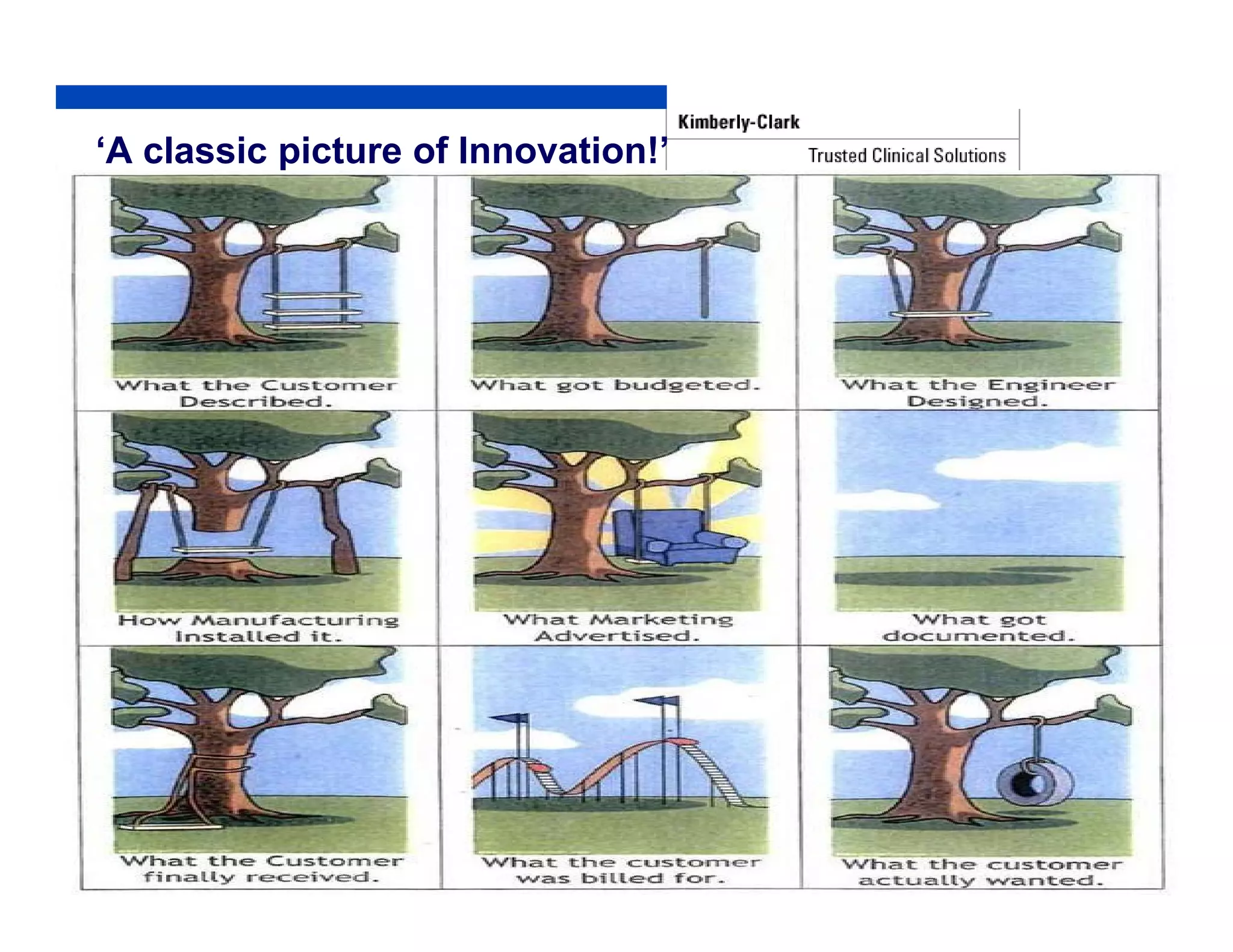
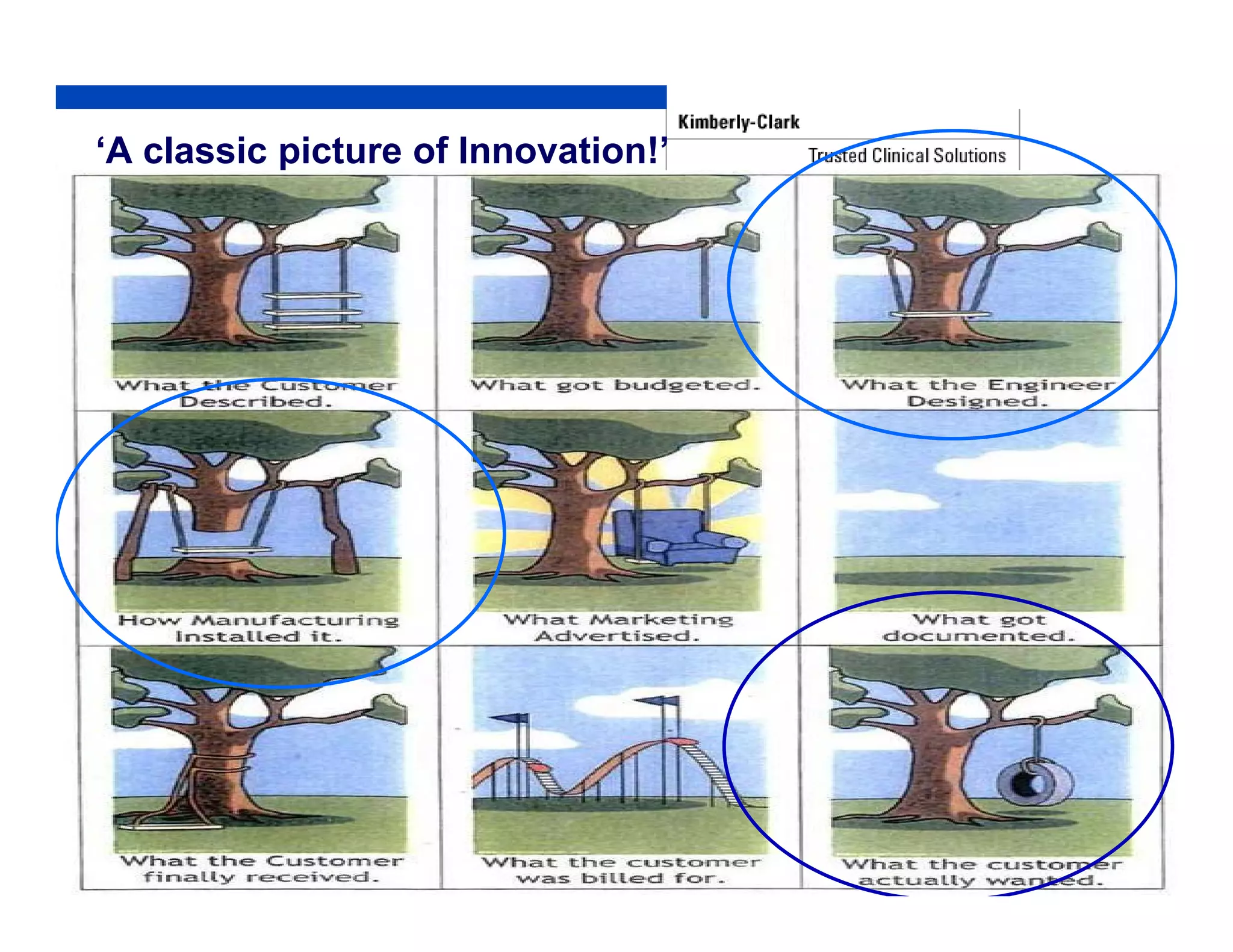
‘A classic picture of Innovation!’
Objectives
• What is the anatomy of innovation?
• H
  How i i
        is innovation tied with Manufacturing and R&D
                 ti ti d ith M      f t i       d
  in the innovation process?
• What are critical elements of a successful design
  transfer to manufacturing?
• Are there examples of great design transfer to
  manufacturing?
• How do we accomplish successful design
  transfers?
Objectives
• What is the anatomy of innovation?
• H
  How i i
        is innovation tied with Manufacturing and R&D
                 ti ti d ith M      f t i       d
  in the innovation process?
• What are critical elements of a successful design
  transfer to manufacturing?
• Are there examples of great design transfer to
  manufacturing?
• How do we accomplish successful design
  transfers?
I-Flow: Leader in infusion therapy
   I-Flow commences sales of medical devices in 1991
   • Loyal customer base
   • Trusted products in the field, pioneer
   • Pain Management leadership – ON-Q brand
   Key Product Lines
   • Homepump
   • ON-Q
   • Easypump
   Product used in different therapies
   • Pain Management
   • Antibiotics
   • Chemotherapy

I-Flow has a long history of delivering innovative therapeutic solutions over last 21 years!
R&D/Engineering Mission


 “Science Passion and Pursuit of Excellence ”
  Science,                       Excellence.


                                           7
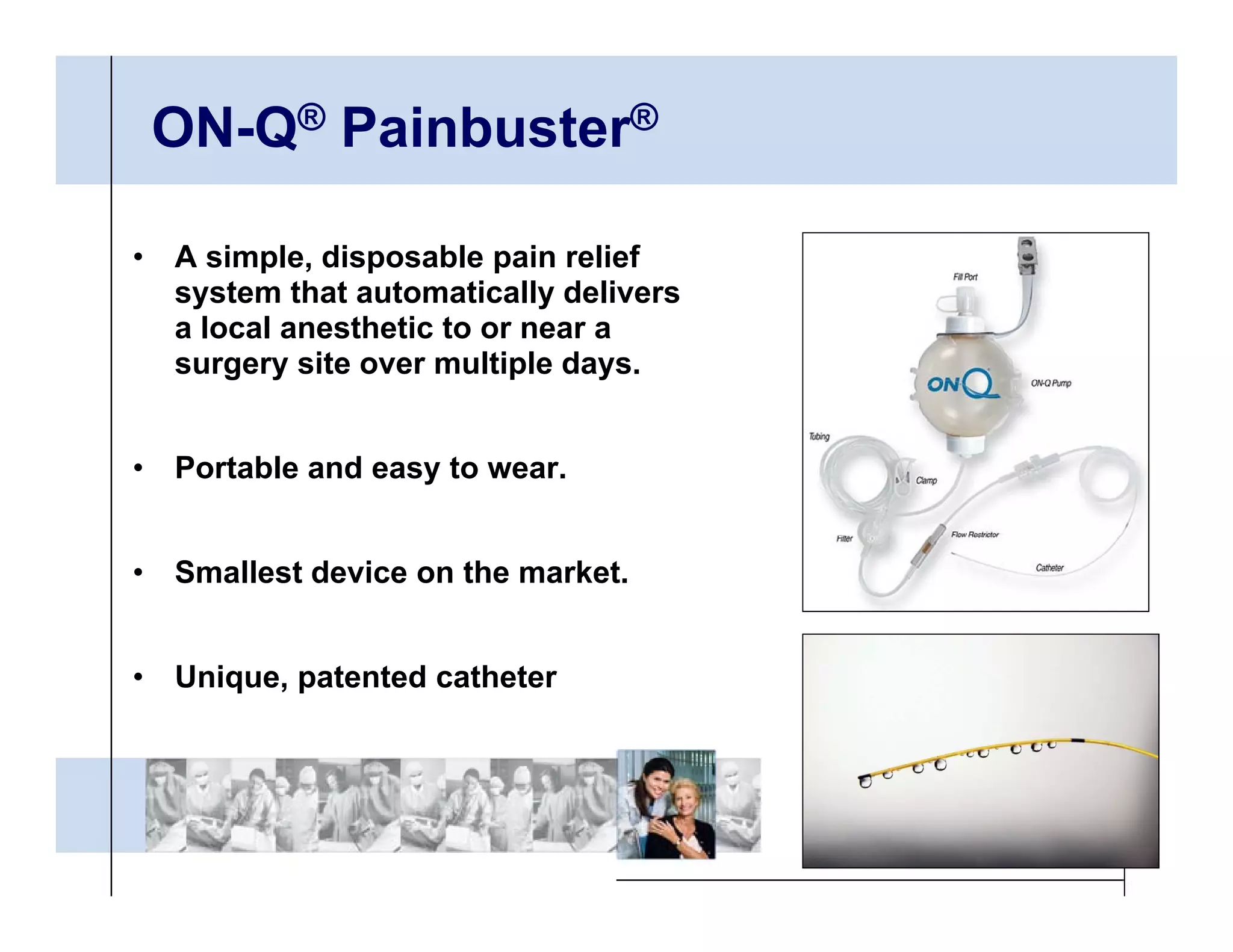
ON-Q® Painbuster®

•   A simple, disposable pain relief
    system that automatically delivers
    a local anesthetic to or near a
    surgery site over multiple days.


•   Portable and easy to wear.


•   Smallest device on the market.


•   Unique, patented catheter
Innovation:

   “Technically, "innovation" is defined merely as
   "introducing something new;" th
   "i t d i           thi        " there are no qualifiers of
                                                     lifi    f
   how ground-breaking or world-shattering that something
   needs to be—only that it needs to be better than what was
   there before. And that's where the trouble starts when an
   organization requests "innovation services" from a
                              innovation services
   consulting firm. Exactly what are they really requesting?
   The fact is, innovation means different things to different
   people.”
 -B i
  Businessweek, J
                k January 31 2006
                          31,

   Innovation has nothing to do with how many R&D dollars
   you h
       have... It' not about money. It' about th people you
               It's  t b t          It's b t the        l
   have, how you're led, and how much you get it. -Steve Jobs


                                                          9
What is innovation?
           “Innovation is dreams realized!’


• Innovation is Invention + Execution + Renewal!


• Innovation is Creating something new!


• Innovation is the journey that commences from Idea
  to Execution and to Renovation.


                                                   10
Examples of Manufacturing and R&D
    alignment leading to success:
       g            g
•    Medical Devices
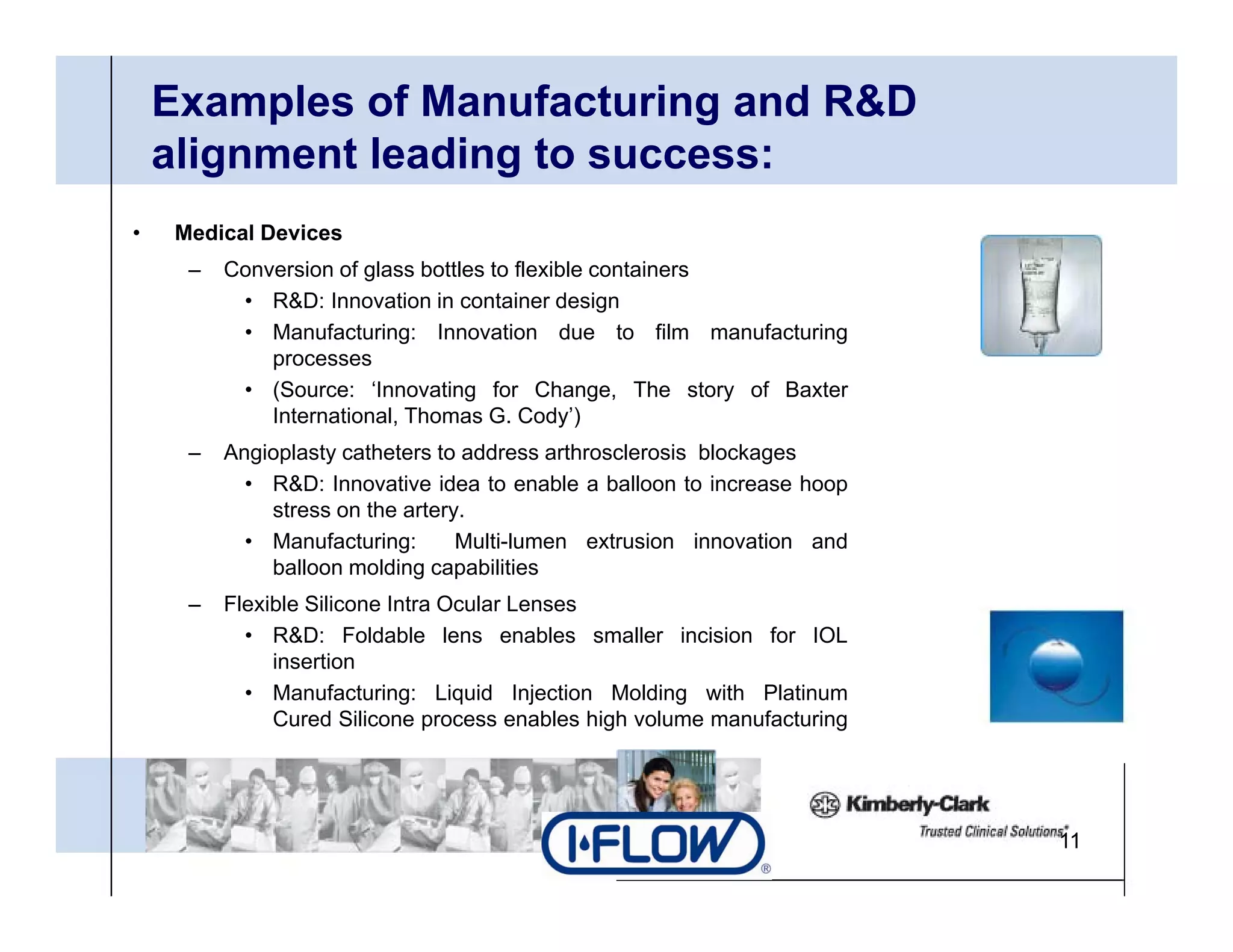
      –   Conversion of glass bottles to flexible containers
           • R&D I
              R&D: Innovation i container d i
                            ti in      t i    design
           • Manufacturing: Innovation due to film manufacturing
              processes
           • (Source: ‘Innovating for Change, The story of Baxter
              International,
              International Thomas G Cody’)
                                      G. Cody )
      –   Angioplasty catheters to address arthrosclerosis blockages
            • R&D: Innovative idea to enable a balloon to increase hoop
              stress on the artery.
            • M
              Manufacturing:
                    f t i         Multi-lumen extrusion i
                                  M lti l         t i      innovation and
                                                                 ti     d
              balloon molding capabilities
      –   Flexible Silicone Intra Ocular Lenses
            • R&D: Foldable lens enables smaller incision for IOL
               insertion
               i    ti
            • Manufacturing: Liquid Injection Molding with Platinum
               Cured Silicone process enables high volume manufacturing


                                                                            11
Examples of Manufacturing and R&D
    alignment leading to success:
       g            g
•    Medical Devices
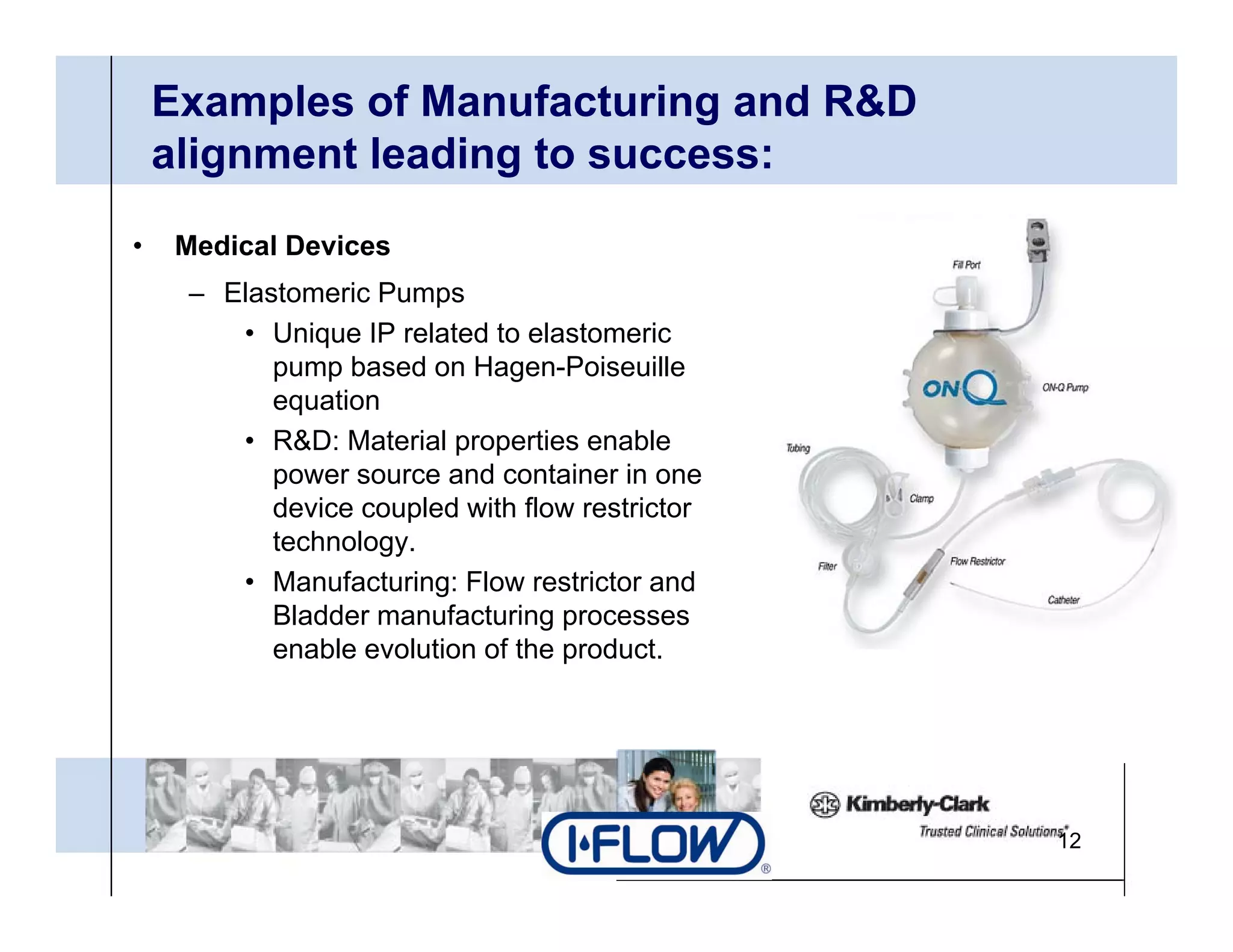
     – Elastomeric Pumps
        • Unique IP related to elastomeric
           pump based on Hagen-Poiseuille
           equation
        • R&D: Material properties enable
           power source and container in one
           device coupled with flow restrictor
           technology.
           t h l
        • Manufacturing: Flow restrictor and
           Bladder manufacturing processes
           enable evolution of the product.


                                                 12
Objectives
• What is the anatomy of innovation?
• H
  How i i
        is innovation tied with Manufacturing and R&D
                 ti ti d ith M      f t i       d
  in the innovation process?
• What are critical elements of a successful design
  transfer to manufacturing?
• Are there examples of great design transfer to
  manufacturing?
• How do we accomplish successful design
  transfers?
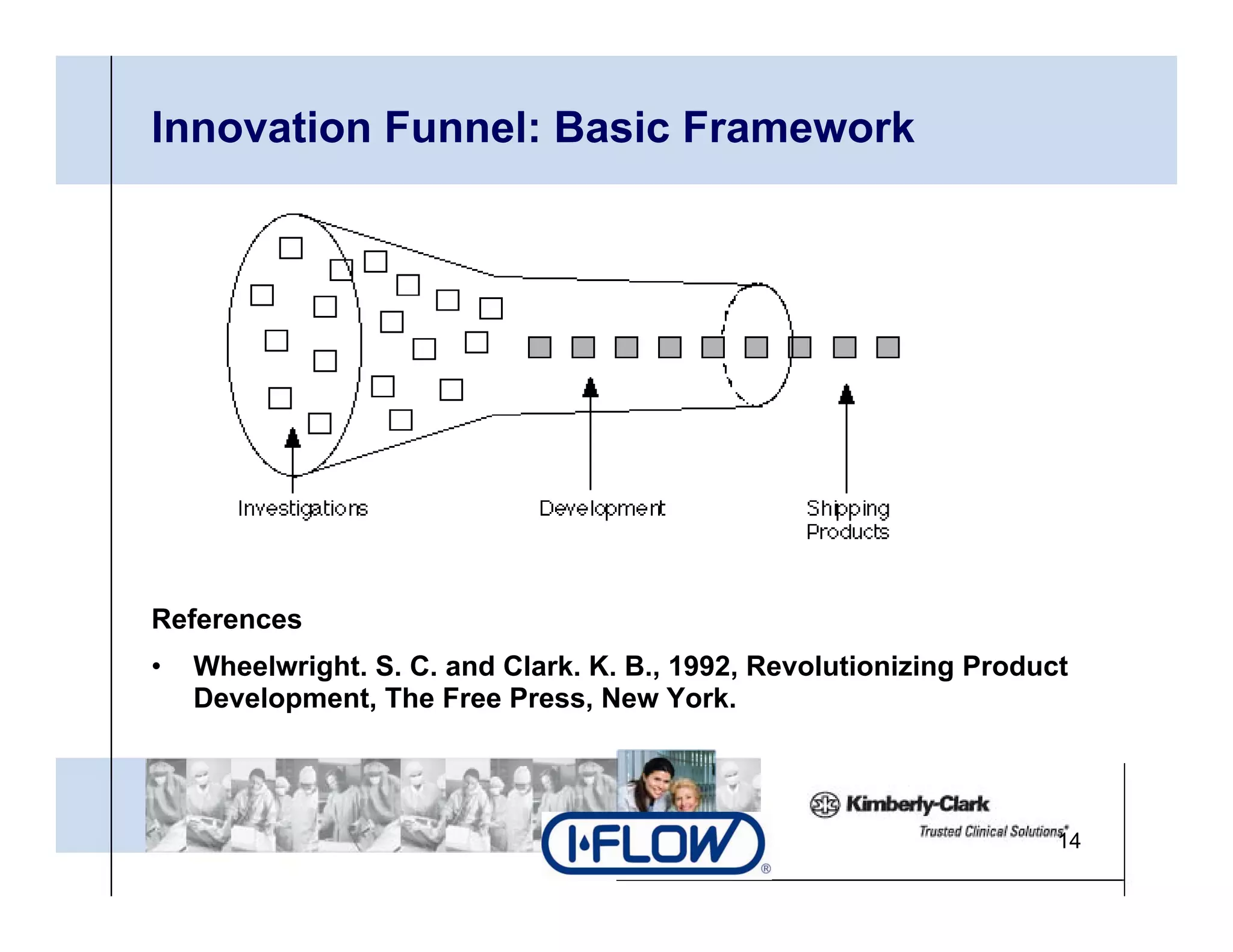
Innovation Funnel: Basic Framework


References
•   Wheelwright. S C
    Wh l i h S. C. and Clark. K. B., 1992, R
                       d Cl k K B 1992 Revolutionizing P d
                                             l i i i   Product
    Development, The Free Press, New York.


                                                             14
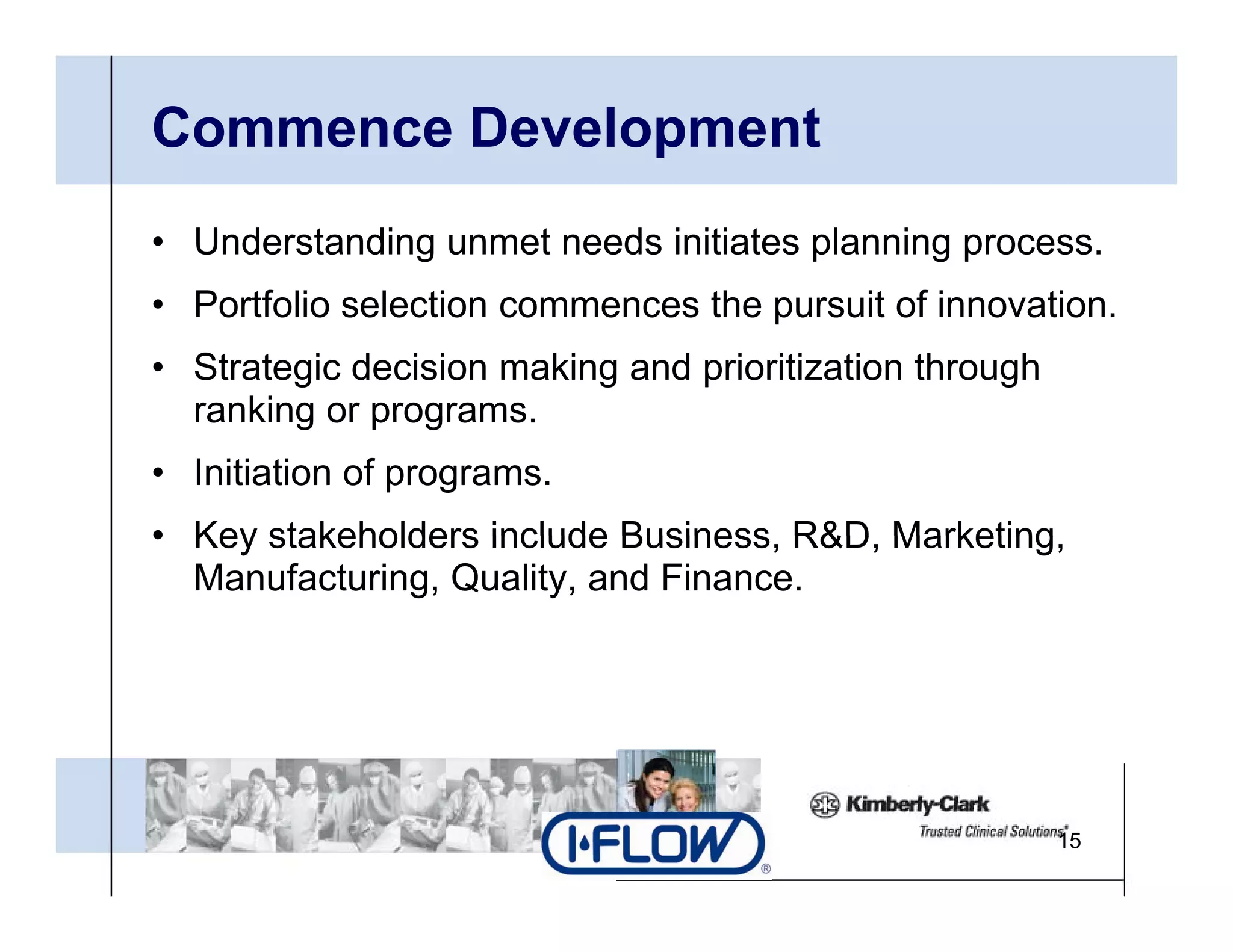
Commence Development
• Understanding unmet needs initiates planning process.
• P tf li selection commences th pursuit of i
  Portfolio l ti              the     it f innovation.
                                                 ti
• Strategic decision making and prioritization through
  ranking or programs
             programs.
• Initiation of programs.
• Key stakeholders include Business R&D Marketing
                            Business, R&D, Marketing,
  Manufacturing, Quality, and Finance.


                                                         15
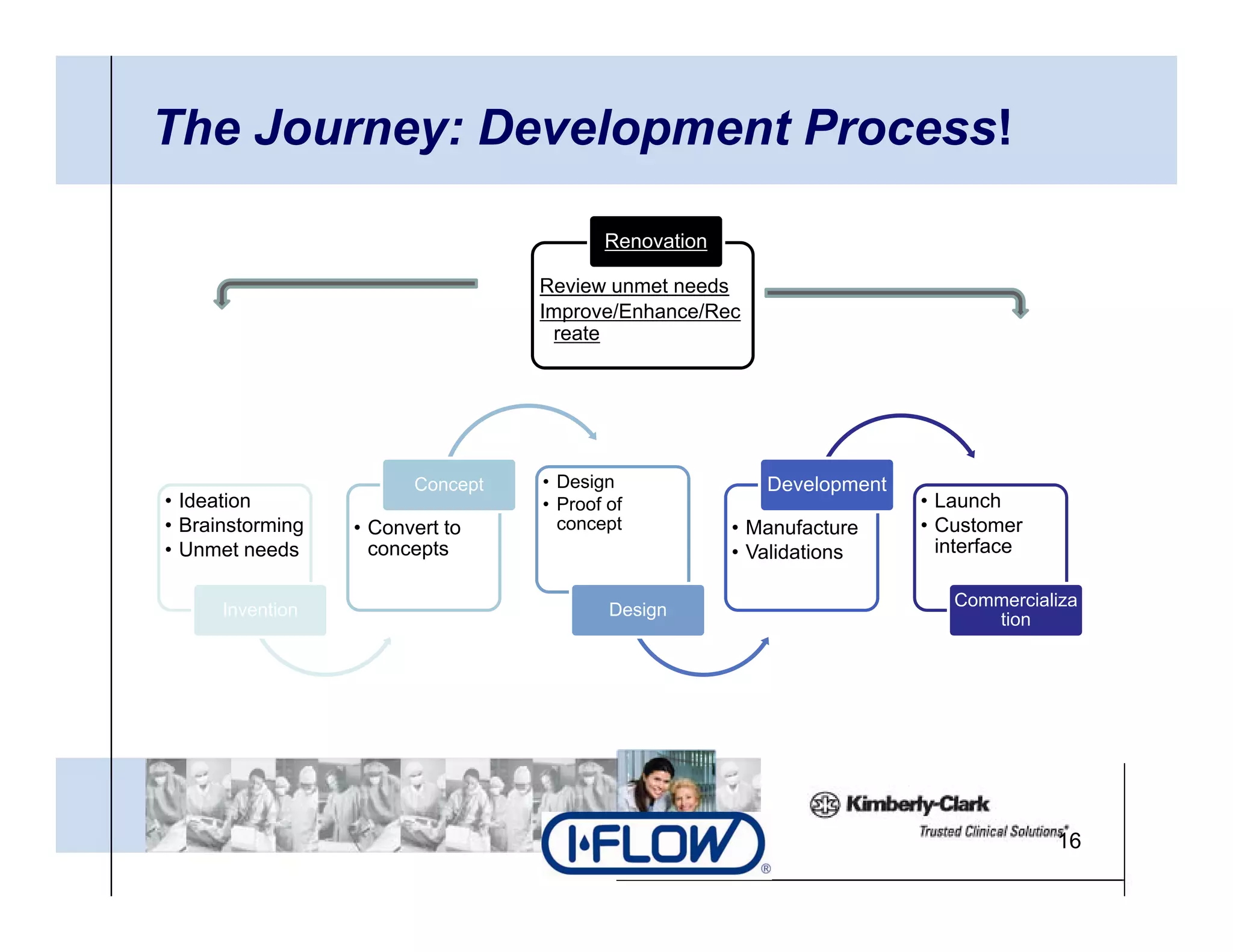
The Journey: Development Process!

                                         Renovation

                                  Review unmet needs
                                  Improve/Enhance/Rec
                                   reate


                        Concept   • Design               Development
• Ideation                        • Proof of                           • Launch
              g
• Brainstorming   • Convert to      concept           • Manufacture    • Customer
• Unmet needs       concepts                          • Validations      interface

                                                                          Commercializa
      Invention                           Design
                                                                             tion


                                                                                     16
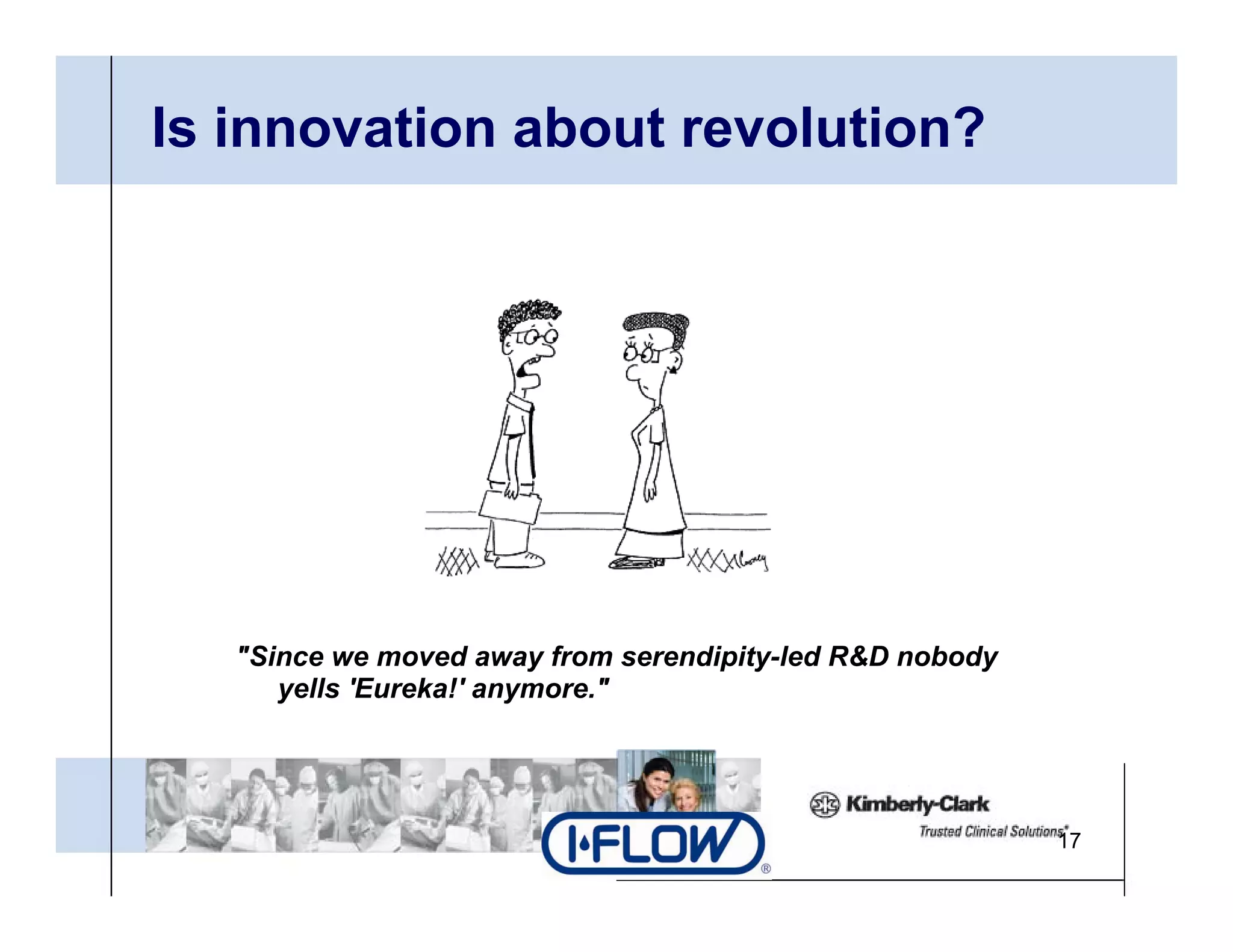
Is innovation about revolution?


   "Since we moved away from serendipity led R&D nobody
    Since                       serendipity-led
      yells 'Eureka!' anymore."


                                                          17
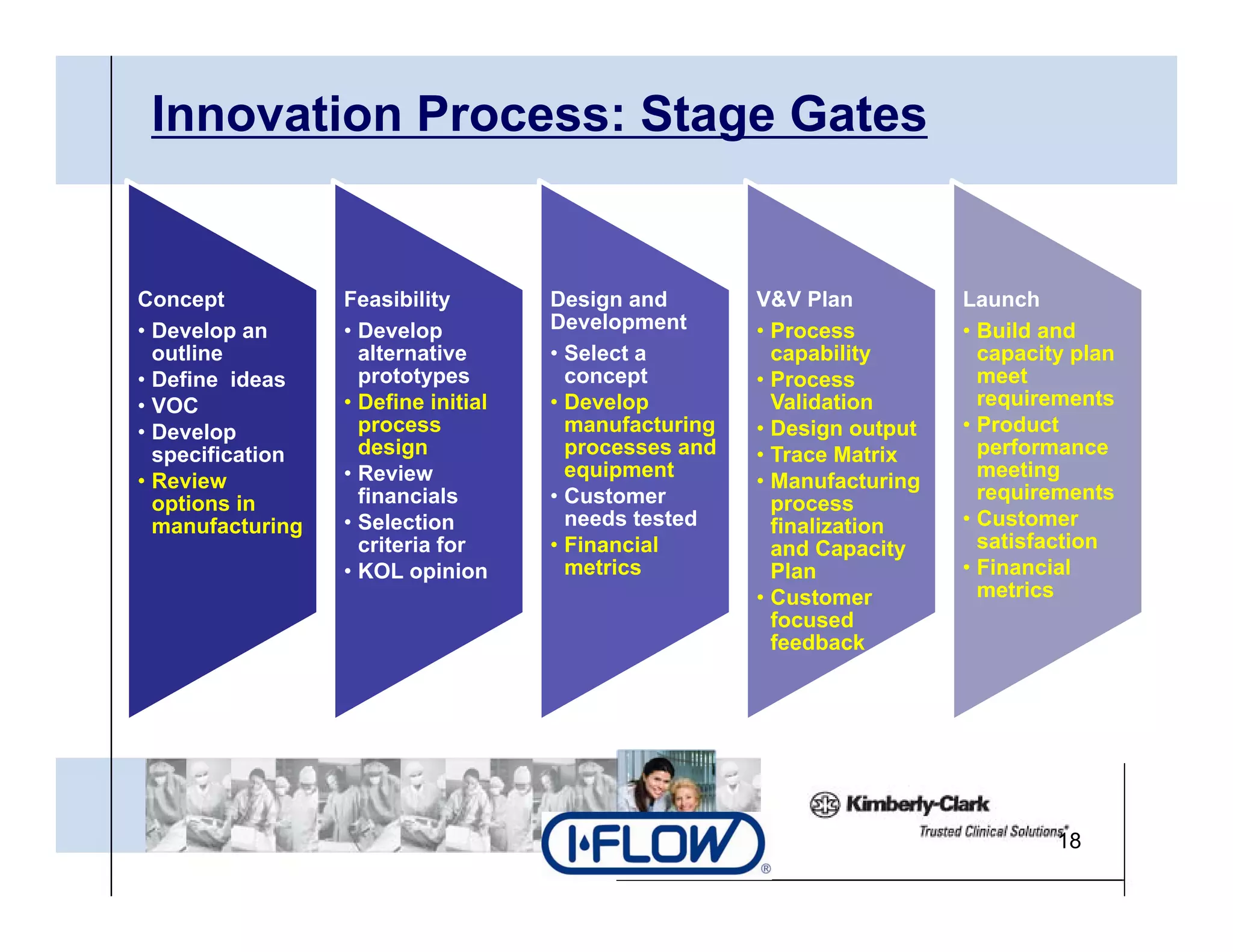
Innovation Process: Stage Gates


Concept             Feasibility        Design and        V&V Plan          Launch
• Develop an        • Develop          Development       • Process         • Build and
  outline             alternative      • Select a          capability        capacity plan
• Define ideas        prototypes         concept         • Process           meet
• VOC               • Define initial   • Develop           Validation        requirements
• Develop             process            manufacturing   • Design output   • Product
  specification       design             processes and   • Trace Matrix      performance
                    • Review             equipment                           meeting
• Review                                                 • Manufacturing
                      financials       • Customer                            requirements
  options in                                               process
  manufacturing g   • Selection          needs tested      finalization    • Customer
                      criteria for     • Financial         and Capacity      satisfaction
                                                                               ti f ti
                    • KOL opinion        metrics           Plan            • Financial
                                                         • Customer          metrics
                                                           focused
                                                           feedback


                                                                                    18
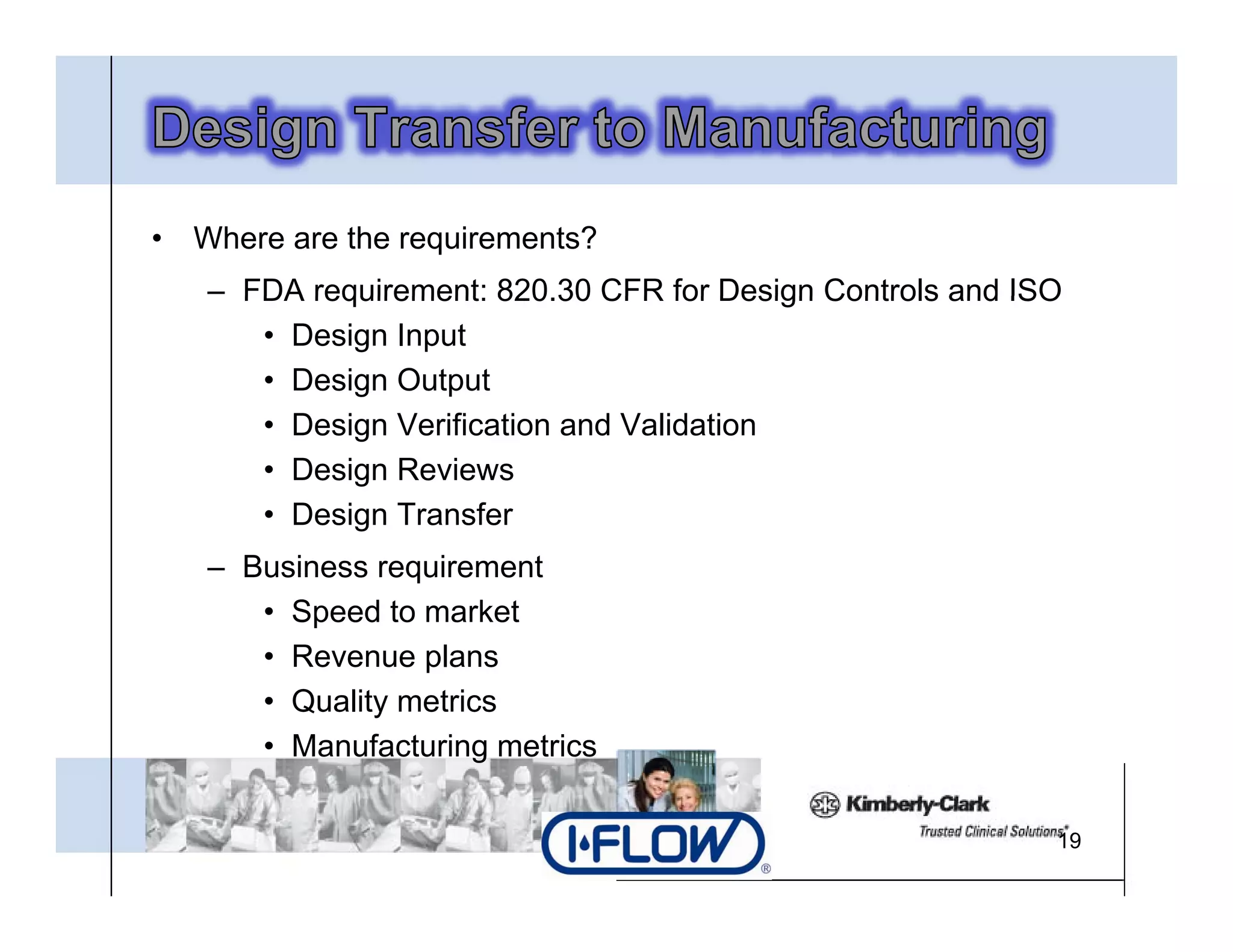
•   Where are the requirements?
    – FDA requirement: 820.30 CFR for Design Controls and ISO
                        820 30
       • Design Input
       • Design Output
       • D i V ifi ti and V lid ti
         Design Verification d Validation
       • Design Reviews
       • Design Transfer
    – Business requirement
       • Speed to market
       • Revenue plans
       • Quality metrics
       • Manufacturing metrics

                                                            19
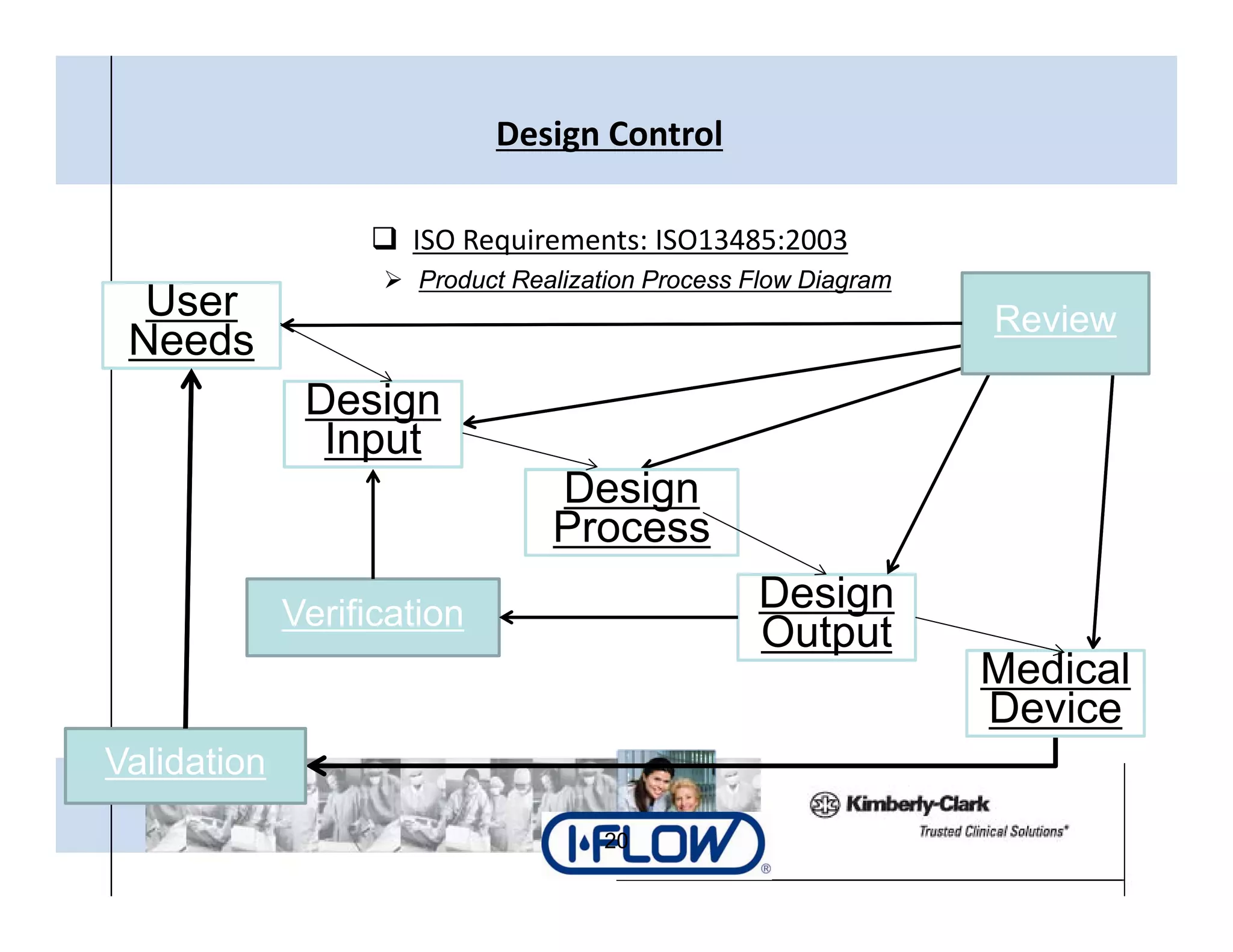
Design Control

                     ISO Requirements: ISO13485:2003
                     Product Realization Process Flow Diagram
  User                                                          Review
 Needs
              Design
                  g
               Input
                                Design
                                Process
             Verification                        Design
                                                 Output
                                                                Medical
                                                                M di l
                                                                Device
Validation
                                    20
Objectives
• What is the anatomy of innovation?
• H
  How i i
        is innovation tied with Manufacturing and R&D
                 ti ti d ith M      f t i       d
  in the innovation process?
• Why is successful design transfer to manufacturing
  critical?
• Are there examples of great design transfer to
  manufacturing?
• How do we accomplish successful design
  transfers?
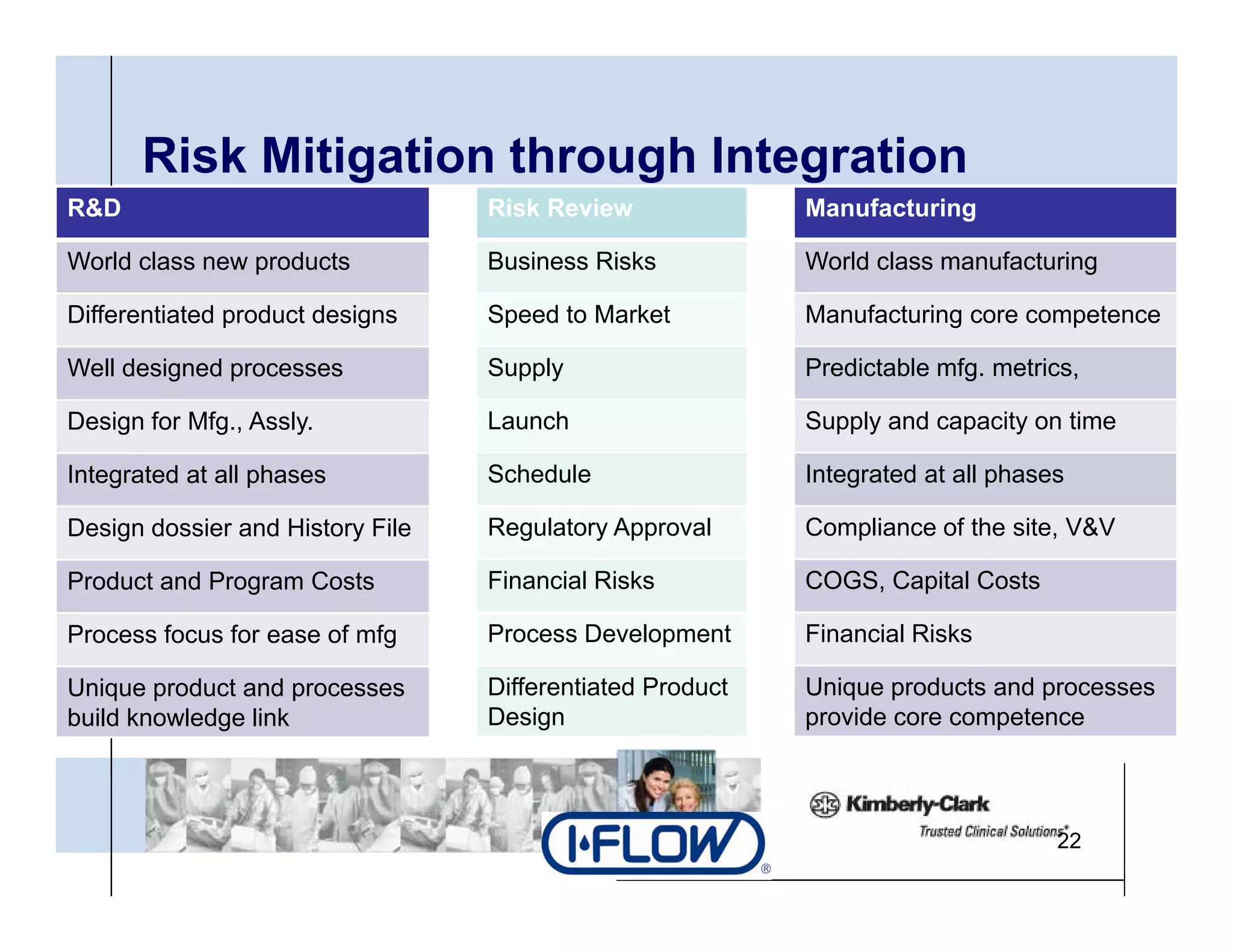
Risk Mitigation through Integration
               g           g      g
R&D                               Risk Review              Manufacturing

World class new products          Business Risks           World class manufacturing

Differentiated product designs    Speed to Market          Manufacturing core competence

Well designed processes           Supply                   Predictable mfg. metrics,

Design for Mf Assly.
D i f Mfg., A l                   Launch
                                  L    h                   Supply and capacity on ti
                                                           S   l    d      it     time

Integrated at all phases          Schedule                 Integrated at all phases

Design dossier and History File   Regulatory Approval
                                   egu ato y pp o a        Co p a ce o the site, &
                                                           Compliance of t e s te, V&V

Product and Program Costs         Financial Risks          COGS, Capital Costs

Process focus for ease of mfg     Process Development      Financial Risks

Unique product and processes      Differentiated Product   Unique products and processes
build knowledge link              Design                   provide core competence


                                                                                  22
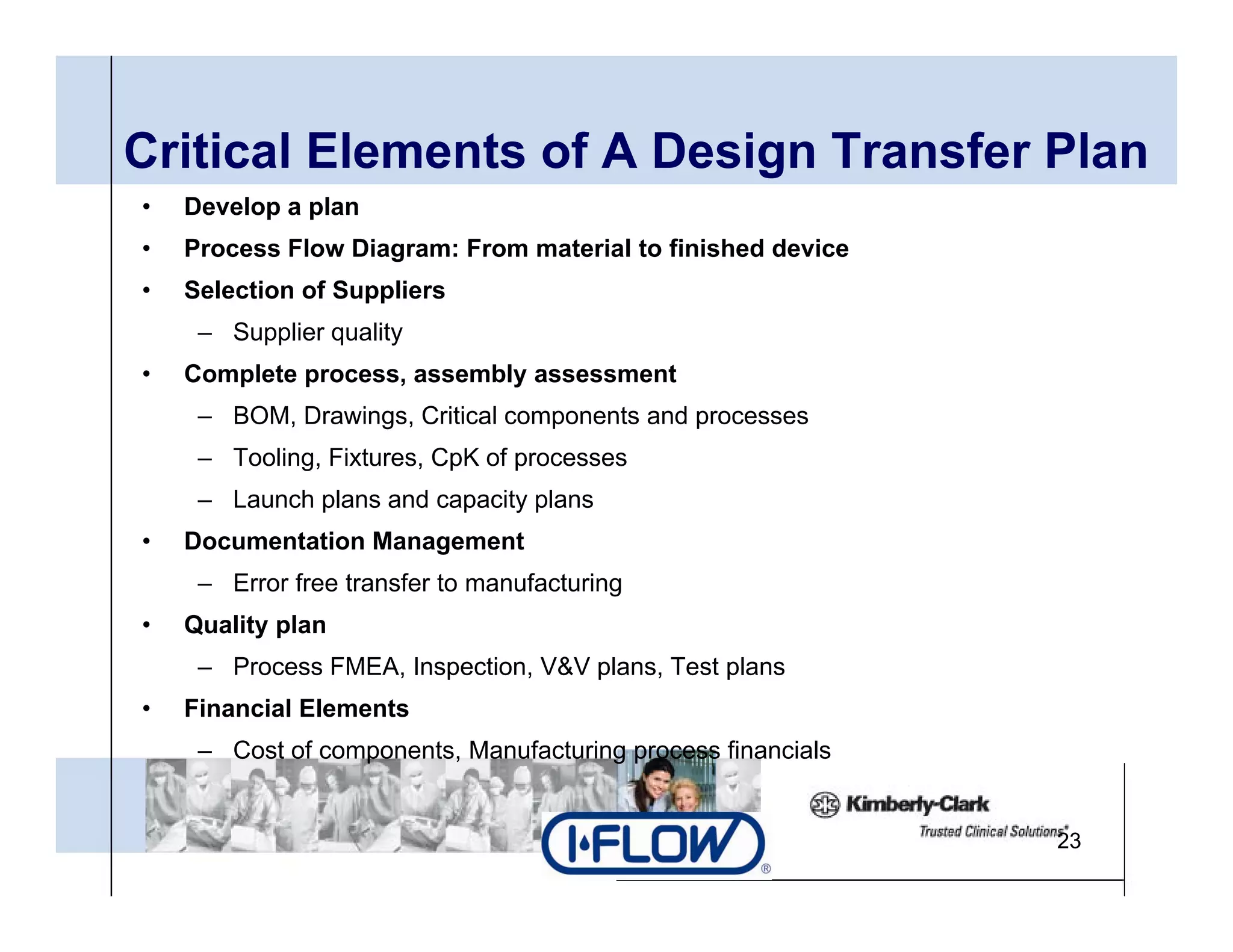
Critical Elements of A Design Transfer Plan
                           g
•   Develop a plan
•   Process Flow Diagram: From material to finished device
•   Selection of Suppliers
     – Supplier quality
•   Complete process, assembly assessment
     – BOM Drawings Critical components and processes
       BOM, Drawings,
     – Tooling, Fixtures, CpK of processes
     – Launch plans and capacity plans
•   Documentation M
    D      t ti Management
                         t
     – Error free transfer to manufacturing
•   Quality plan
     – Process FMEA, Inspection, V&V plans, Test plans
•   Financial Elements
     – Cost of components, Manufacturing process financials


                                                              23
Objectives
• What is the anatomy of innovation?
• H
  How i i
        is innovation tied with Manufacturing and R&D
                 ti ti d ith M      f t i       d
  in the innovation process?
• Why is successful design transfer to manufacturing
  critical?
• Are there examples of great design transfer to
  manufacturing?
• How do we accomplish successful design
  transfers?
Two Case Studies; Case 1
 Case 1: Multilayer Bladder Construction to a Single Layer
 Bladder Construction with Material Change


 Fundamental Business Objective
    Develop a Latex free and DEHP free product


 Manufacturing and R&D Objectives
    Improved consistency
    Improved flow rate accuracy
      p                       y


                                                             25
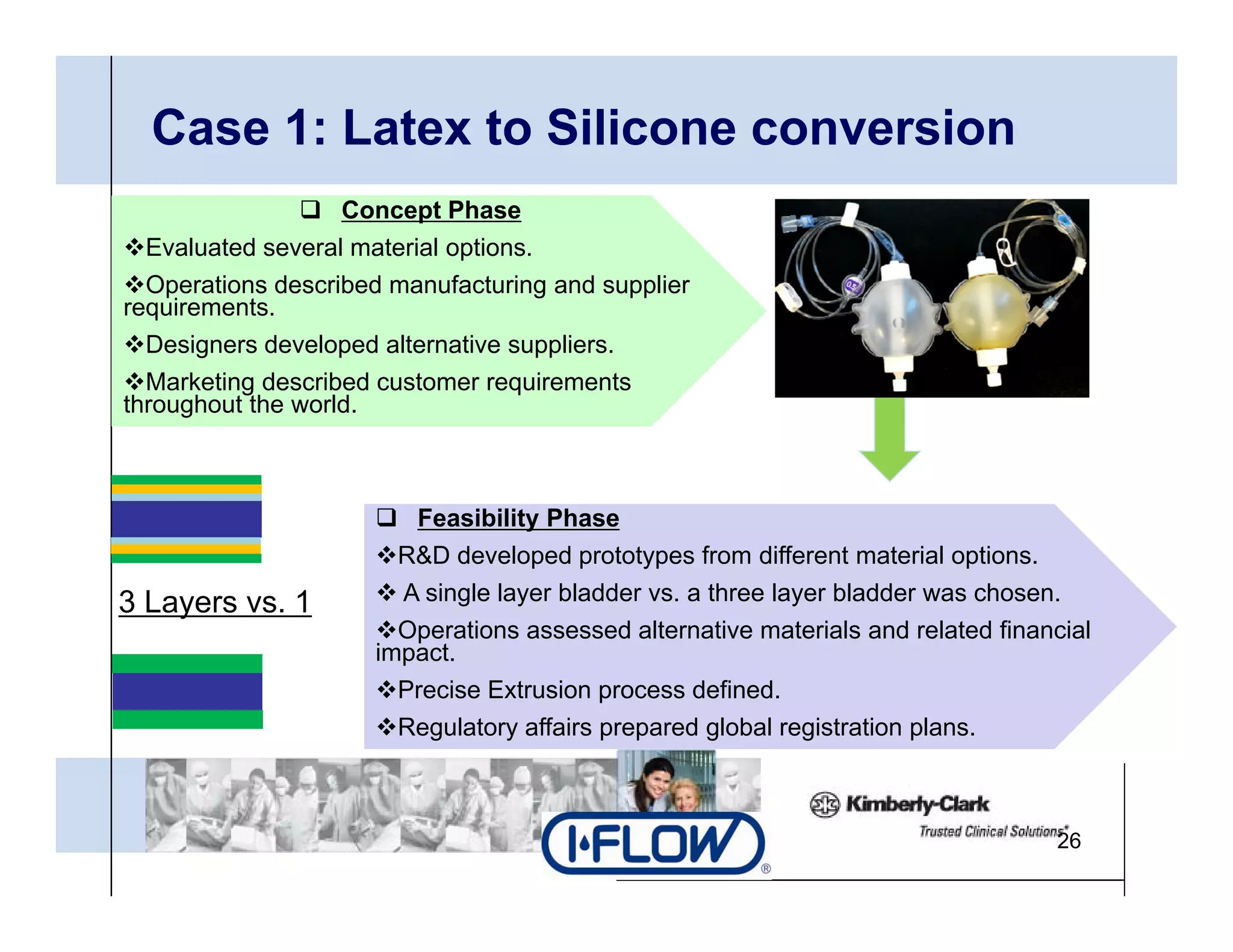
Case 1: Latex to Silicone conversion
                   Concept Phase
  Evaluated several material options.
  Operations described manufacturing and supplier
    p                                 g      pp
requirements.
  Designers developed alternative suppliers.
  Marketing described customer requirements
      g
throughout the world.


                        Feasibility Phase
                       R&D developed prototypes from different material options.
3 Layers vs. 1         A single layer bladder vs. a three layer bladder was chosen.
                       Operations assessed alternative materials and related financial
                     impact.
                     impact
                       Precise Extrusion process defined.
                       Regulatory affairs prepared global registration plans.


                                                                                  26
Case 1: Latex to Silicone conversion
                Design and Development Phase
  R&D optimized design. Bladder design was optimized for
stable modulus of elasticity.
  Operations led validation efforts in the plant.
  Complete assessment was carried out with regards to
process capability, cost of goods and ROI.
  Marketing p p
          g prepared launch p  plans.
  Complete trace matrix was developed.


                                                    Launch
                       Full launch occurred with marketing launch plans.
                       Sales dashboard metrics measured.
                       Follow up on post launch monitoring for fixes.


                                                                           27
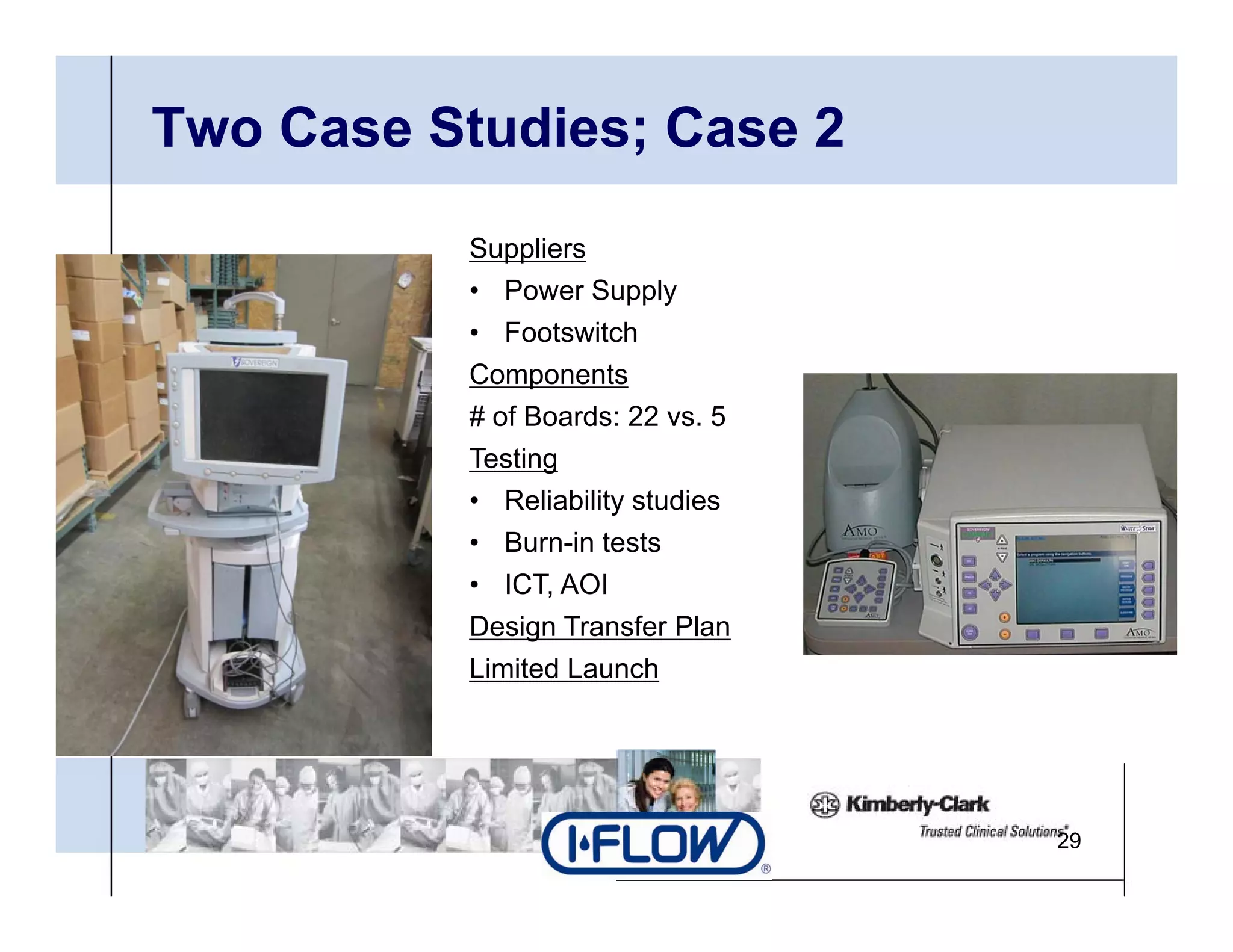
Two Case Studies; Case 2
 Case 1: A new Phacoemulsification equipment that is compact in
 size and more reliable in performance.


 Fundamental Business Objective
    Develop a compact electromechanical system that is more reliable
                                                            reliable.


 Manufacturing and R&D Objectives
    Prevent too many DOAs.
    Prevent several failures of modules during use.
    Ensure consistency in p
                     y performance.
    Develop critical success metrics.


                                                                   28
Two Case Studies; Case 2
          Suppliers
          • Power Supply
          • Footswitch
          Components
          # of Boards: 22 vs 5
                           vs.
          Testing
          • Reliability studies
          • BBurn-in t t
                  i tests
          • ICT, AOI
          Design Transfer Plan
          Limited Launch


                                  29
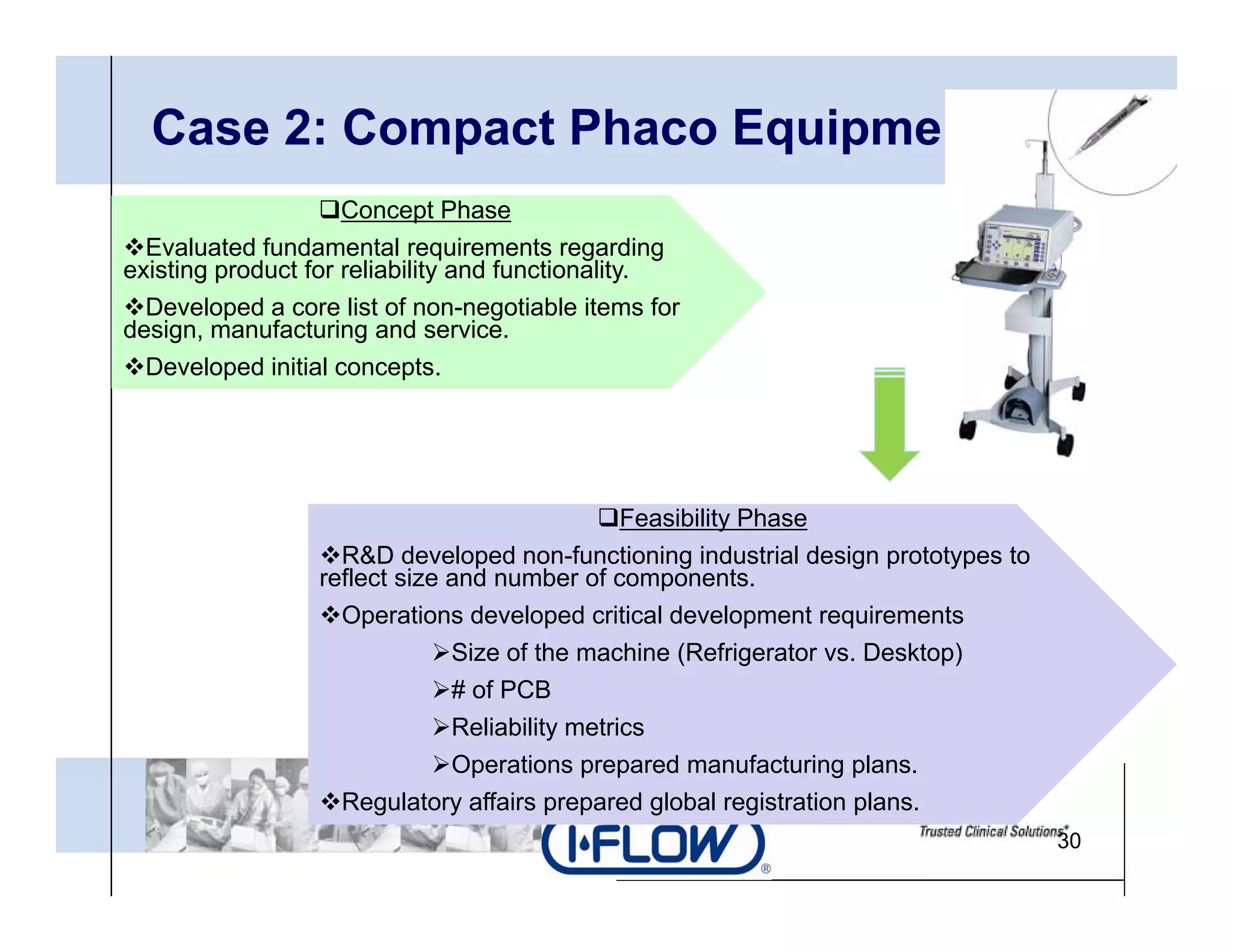
Case 2: Compact Phaco Equipment
                     Concept Phase
  Evaluated fundamental requirements regarding
existing product for reliability and functionality.
  Developed a core list of non-negotiable items for
design, manufacturing and service.
  Developed initial concepts.


                                               Feasibility Phase
                   R&D developed non-functioning industrial design prototypes to
                 reflect size and number of components.
                   Operations developed critical development requirements
                              Size of the machine (Refrigerator vs. Desktop)
                                                                 vs
                              # of PCB
                              Reliability metrics
                              Operations p p
                                p          prepared manufacturing p
                                                                  g plans.
                   Regulatory affairs prepared global registration plans.
                                                                                   30
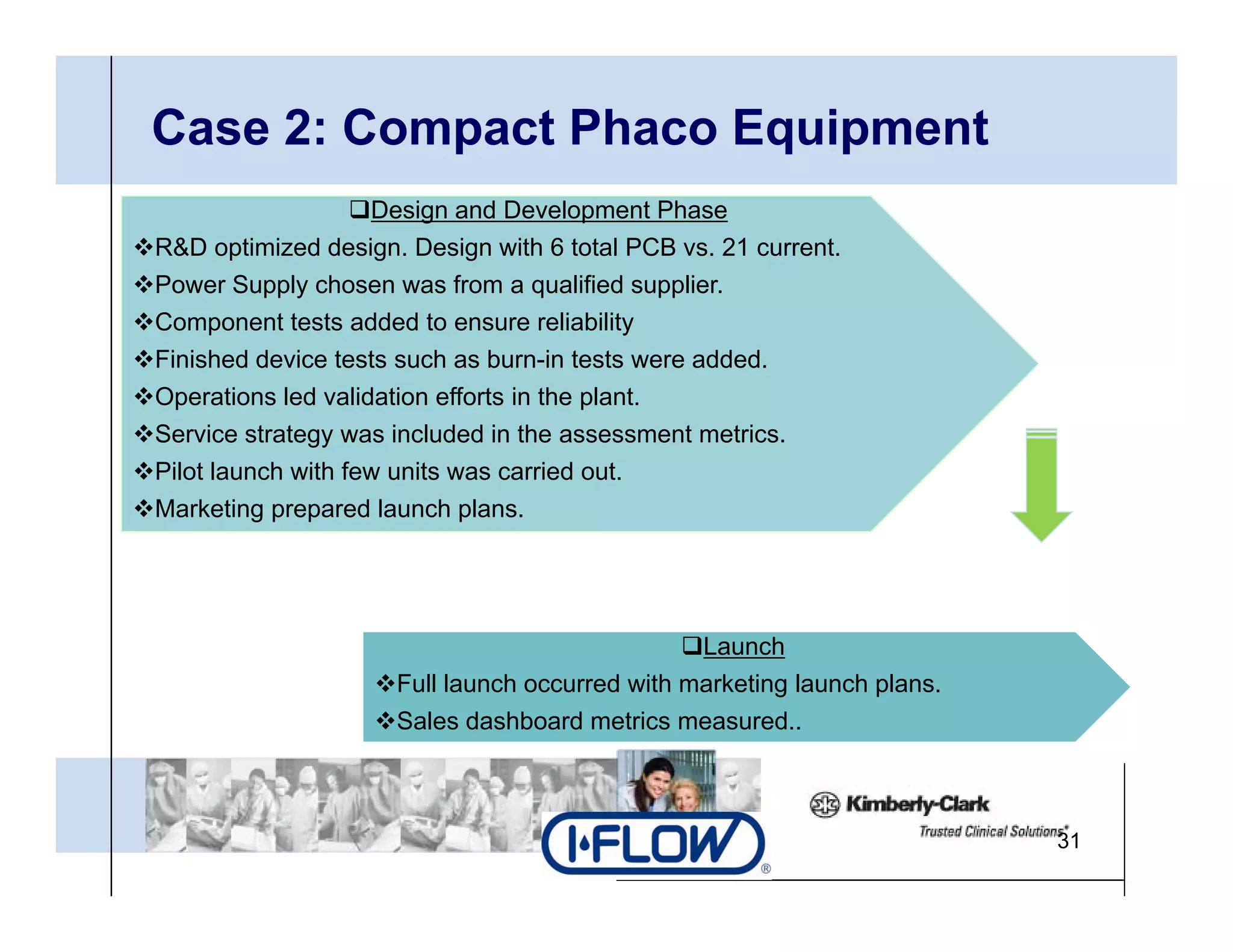
Case 2: Compact Phaco Equipment
                    Design and Development Phase
R&D optimized design. Design with 6 total PCB vs. 21 current.
Power Supply chosen was from a q
          pp y                      qualified supplier.
                                                pp
Component tests added to ensure reliability
Finished device tests such as burn-in tests were added.
Operations led validation efforts in the plant.
Service strategy was included in the assessment metrics.
Pilot launch with few units was carried out.
Marketing prepared launch plans.


                                                Launch
                     Full launch occurred with marketing launch plans.
                     Sales dashboard metrics measured..


                                                                         31
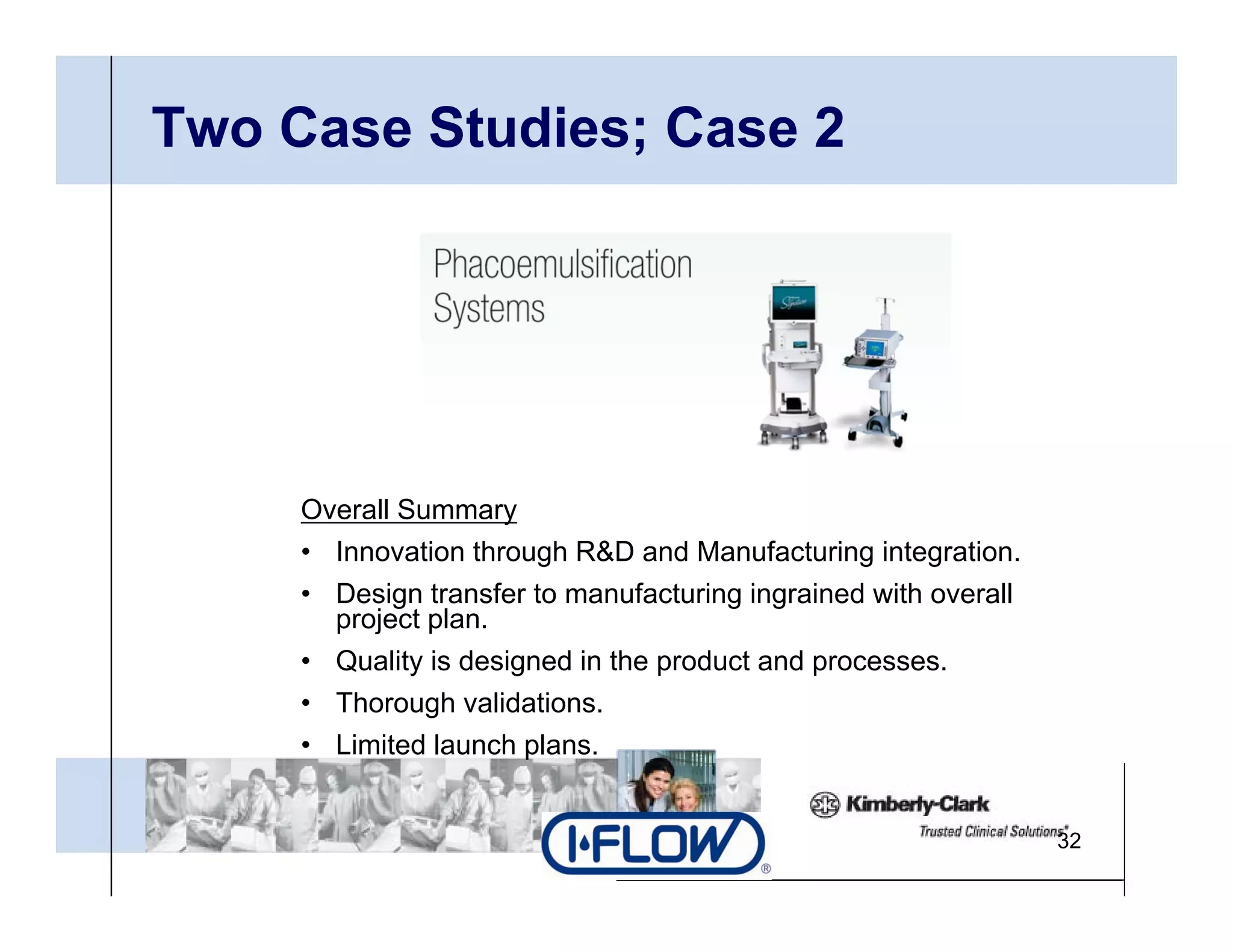
Two Case Studies; Case 2


     Overall Summary
     • Innovation through R&D and Manufacturing integration.
     • Design transfer to manufacturing ingrained with overall
       project plan.
     • Q alit is designed in the prod ct and processes
       Quality                   product     processes.
     • Thorough validations.
     • Limited launch plans.


                                                                 32
Objectives
• What is the anatomy of innovation?
• H
  How i i
        is innovation tied with Manufacturing and R&D
                 ti ti d ith M      f t i       d
  in the innovation process?
• Why is successful design transfer to manufacturing
  critical?
• Are there examples of great design transfer to
  manufacturing?
• How do we accomplish successful design
  transfers?
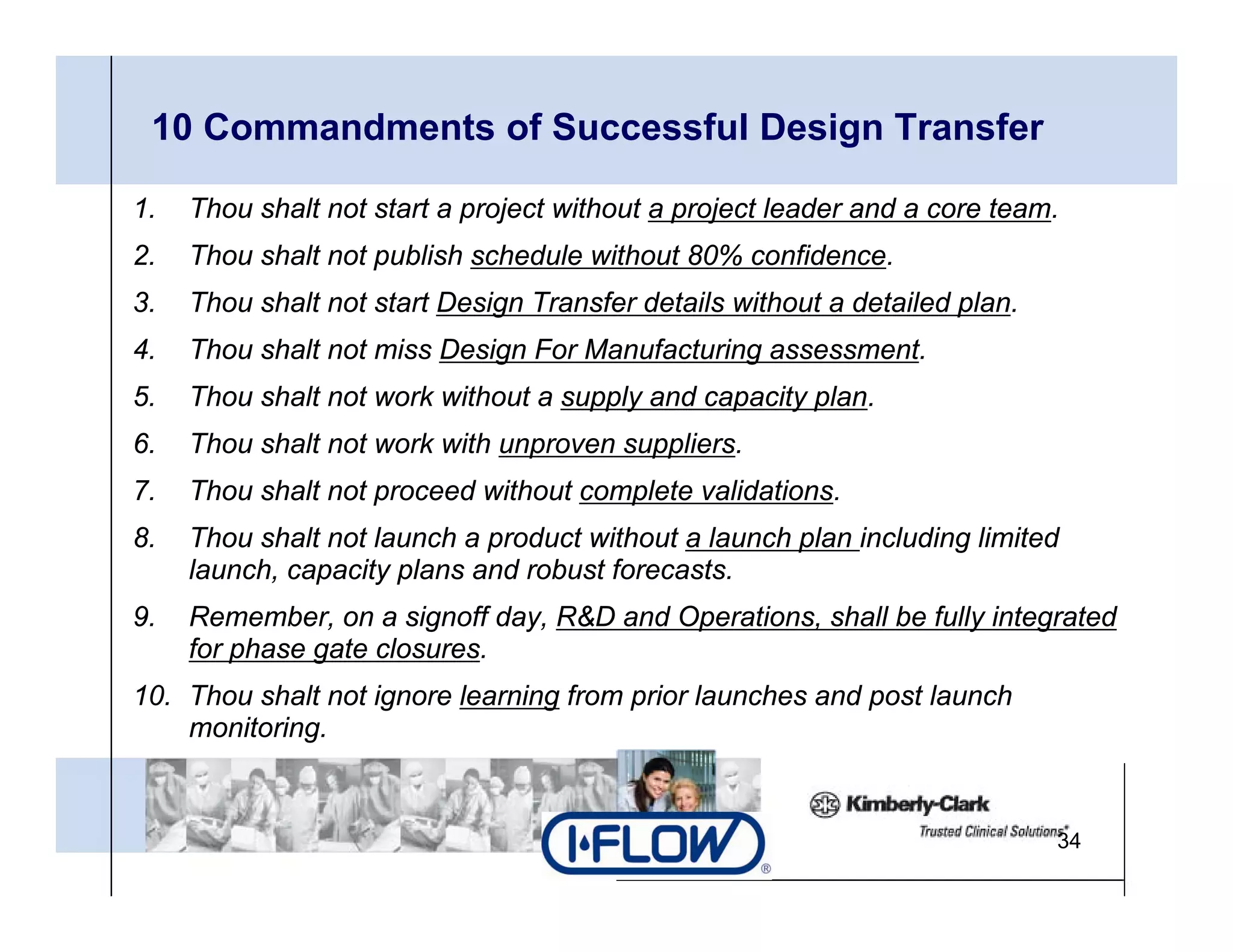
10 Commandments of Successful Design Transfer

1.   Thou shalt not start a project without a project leader and a core team.
2.   Thou shalt not publish schedule without 80% confidence.
3.
3    Thou h lt t t t Design Transfer d t il without a detailed plan.
     Th shalt not start D i T    f details ith t d t il d l
4.   Thou shalt not miss Design For Manufacturing assessment.
5.   Thou shalt not work without a supply and capacity plan.
6.   Thou shalt not work with unproven suppliers.
7.   Thou shalt not proceed without complete validations.
8.
8    Thou shalt not launch a product without a launch plan including limited
     launch, capacity plans and robust forecasts.
9.   Remember, on a signoff day, R&D and Operations, shall be fully integrated
     for phase gate closures.
10. Thou shalt not ignore learning from prior launches and post launch
    monitoring.


                                                                            34
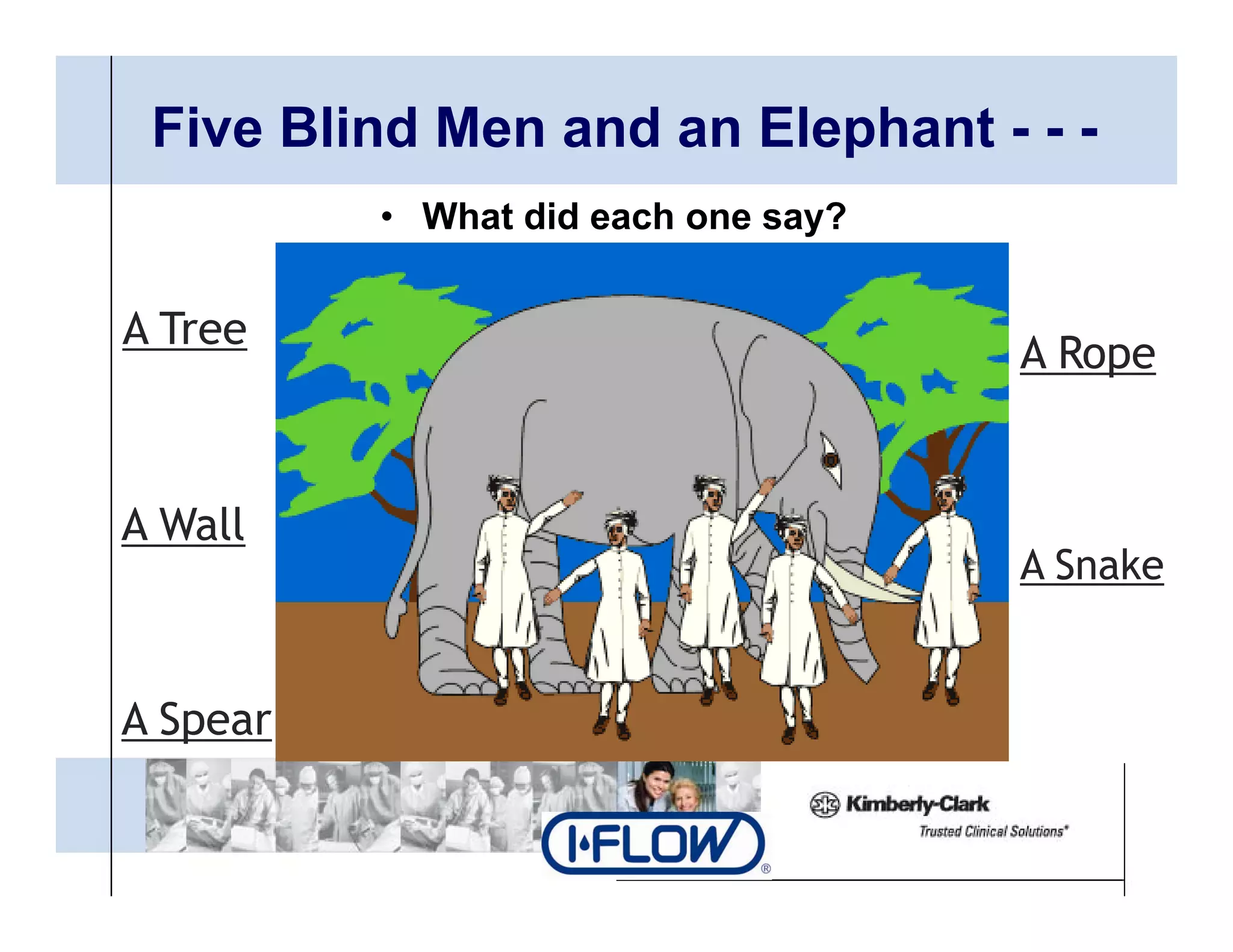
Five Blind Men and an Elephant - - -
          • What did each one say?


A Tree
                                     A Rope


A Wall
                                     A Snake


A Spear
Conclusion
A true Design Transfer to Manufacturing success comes from
execution excellence in all phases of Innovation Processes including:


          Project Management
          Customer Intimacy
          Design
          Manufacturing Processes
          Supply Chain
          Launch Planning
          Risk Assessment


                                                                 36

Key to Successful Design to Manufacturing - Siddharth Desai, I-Flow Corporation

  • 1.
    Strategies to AccomplishSuccessful Design Transfer to Manufacturing Siddharth Desai, Vice President, R&D Date: 06/27/2012
  • 2.
    ‘A classic pictureof Innovation!’
  • 3.
    ‘A classic pictureof Innovation!’
  • 4.
    Objectives • What isthe anatomy of innovation? • H How i i is innovation tied with Manufacturing and R&D ti ti d ith M f t i d in the innovation process? • What are critical elements of a successful design transfer to manufacturing? • Are there examples of great design transfer to manufacturing? • How do we accomplish successful design transfers?
  • 5.
    Objectives • What isthe anatomy of innovation? • H How i i is innovation tied with Manufacturing and R&D ti ti d ith M f t i d in the innovation process? • What are critical elements of a successful design transfer to manufacturing? • Are there examples of great design transfer to manufacturing? • How do we accomplish successful design transfers?
  • 6.
    I-Flow: Leader ininfusion therapy I-Flow commences sales of medical devices in 1991 • Loyal customer base • Trusted products in the field, pioneer • Pain Management leadership – ON-Q brand Key Product Lines • Homepump • ON-Q • Easypump Product used in different therapies • Pain Management • Antibiotics • Chemotherapy I-Flow has a long history of delivering innovative therapeutic solutions over last 21 years!
  • 7.
    R&D/Engineering Mission “SciencePassion and Pursuit of Excellence ” Science, Excellence. 7
  • 8.
    ON-Q® Painbuster® • A simple, disposable pain relief system that automatically delivers a local anesthetic to or near a surgery site over multiple days. • Portable and easy to wear. • Smallest device on the market. • Unique, patented catheter
  • 9.
    Innovation: “Technically, "innovation" is defined merely as "introducing something new;" th "i t d i thi " there are no qualifiers of lifi f how ground-breaking or world-shattering that something needs to be—only that it needs to be better than what was there before. And that's where the trouble starts when an organization requests "innovation services" from a innovation services consulting firm. Exactly what are they really requesting? The fact is, innovation means different things to different people.” -B i Businessweek, J k January 31 2006 31, Innovation has nothing to do with how many R&D dollars you h have... It' not about money. It' about th people you It's t b t It's b t the l have, how you're led, and how much you get it. -Steve Jobs 9
  • 10.
    What is innovation? “Innovation is dreams realized!’ • Innovation is Invention + Execution + Renewal! • Innovation is Creating something new! • Innovation is the journey that commences from Idea to Execution and to Renovation. 10
  • 11.
    Examples of Manufacturingand R&D alignment leading to success: g g • Medical Devices – Conversion of glass bottles to flexible containers • R&D I R&D: Innovation i container d i ti in t i design • Manufacturing: Innovation due to film manufacturing processes • (Source: ‘Innovating for Change, The story of Baxter International, International Thomas G Cody’) G. Cody ) – Angioplasty catheters to address arthrosclerosis blockages • R&D: Innovative idea to enable a balloon to increase hoop stress on the artery. • M Manufacturing: f t i Multi-lumen extrusion i M lti l t i innovation and ti d balloon molding capabilities – Flexible Silicone Intra Ocular Lenses • R&D: Foldable lens enables smaller incision for IOL insertion i ti • Manufacturing: Liquid Injection Molding with Platinum Cured Silicone process enables high volume manufacturing 11
  • 12.
    Examples of Manufacturingand R&D alignment leading to success: g g • Medical Devices – Elastomeric Pumps • Unique IP related to elastomeric pump based on Hagen-Poiseuille equation • R&D: Material properties enable power source and container in one device coupled with flow restrictor technology. t h l • Manufacturing: Flow restrictor and Bladder manufacturing processes enable evolution of the product. 12
  • 13.
    Objectives • What isthe anatomy of innovation? • H How i i is innovation tied with Manufacturing and R&D ti ti d ith M f t i d in the innovation process? • What are critical elements of a successful design transfer to manufacturing? • Are there examples of great design transfer to manufacturing? • How do we accomplish successful design transfers?
  • 14.
    Innovation Funnel: BasicFramework References • Wheelwright. S C Wh l i h S. C. and Clark. K. B., 1992, R d Cl k K B 1992 Revolutionizing P d l i i i Product Development, The Free Press, New York. 14
  • 15.
    Commence Development • Understandingunmet needs initiates planning process. • P tf li selection commences th pursuit of i Portfolio l ti the it f innovation. ti • Strategic decision making and prioritization through ranking or programs programs. • Initiation of programs. • Key stakeholders include Business R&D Marketing Business, R&D, Marketing, Manufacturing, Quality, and Finance. 15
  • 16.
    The Journey: DevelopmentProcess! Renovation Review unmet needs Improve/Enhance/Rec reate Concept • Design Development • Ideation • Proof of • Launch g • Brainstorming • Convert to concept • Manufacture • Customer • Unmet needs concepts • Validations interface Commercializa Invention Design tion 16
  • 17.
    Is innovation aboutrevolution? "Since we moved away from serendipity led R&D nobody Since serendipity-led yells 'Eureka!' anymore." 17
  • 18.
    Innovation Process: StageGates Concept Feasibility Design and V&V Plan Launch • Develop an • Develop Development • Process • Build and outline alternative • Select a capability capacity plan • Define ideas prototypes concept • Process meet • VOC • Define initial • Develop Validation requirements • Develop process manufacturing • Design output • Product specification design processes and • Trace Matrix performance • Review equipment meeting • Review • Manufacturing financials • Customer requirements options in process manufacturing g • Selection needs tested finalization • Customer criteria for • Financial and Capacity satisfaction ti f ti • KOL opinion metrics Plan • Financial • Customer metrics focused feedback 18
  • 19.
    Where are the requirements? – FDA requirement: 820.30 CFR for Design Controls and ISO 820 30 • Design Input • Design Output • D i V ifi ti and V lid ti Design Verification d Validation • Design Reviews • Design Transfer – Business requirement • Speed to market • Revenue plans • Quality metrics • Manufacturing metrics 19
  • 20.
    Design Control ISO Requirements: ISO13485:2003 Product Realization Process Flow Diagram User Review Needs Design g Input Design Process Verification Design Output Medical M di l Device Validation 20
  • 21.
    Objectives • What isthe anatomy of innovation? • H How i i is innovation tied with Manufacturing and R&D ti ti d ith M f t i d in the innovation process? • Why is successful design transfer to manufacturing critical? • Are there examples of great design transfer to manufacturing? • How do we accomplish successful design transfers?
  • 22.
    Risk Mitigation throughIntegration g g g R&D Risk Review Manufacturing World class new products Business Risks World class manufacturing Differentiated product designs Speed to Market Manufacturing core competence Well designed processes Supply Predictable mfg. metrics, Design for Mf Assly. D i f Mfg., A l Launch L h Supply and capacity on ti S l d it time Integrated at all phases Schedule Integrated at all phases Design dossier and History File Regulatory Approval egu ato y pp o a Co p a ce o the site, & Compliance of t e s te, V&V Product and Program Costs Financial Risks COGS, Capital Costs Process focus for ease of mfg Process Development Financial Risks Unique product and processes Differentiated Product Unique products and processes build knowledge link Design provide core competence 22
  • 23.
    Critical Elements ofA Design Transfer Plan g • Develop a plan • Process Flow Diagram: From material to finished device • Selection of Suppliers – Supplier quality • Complete process, assembly assessment – BOM Drawings Critical components and processes BOM, Drawings, – Tooling, Fixtures, CpK of processes – Launch plans and capacity plans • Documentation M D t ti Management t – Error free transfer to manufacturing • Quality plan – Process FMEA, Inspection, V&V plans, Test plans • Financial Elements – Cost of components, Manufacturing process financials 23
  • 24.
    Objectives • What isthe anatomy of innovation? • H How i i is innovation tied with Manufacturing and R&D ti ti d ith M f t i d in the innovation process? • Why is successful design transfer to manufacturing critical? • Are there examples of great design transfer to manufacturing? • How do we accomplish successful design transfers?
  • 25.
    Two Case Studies;Case 1 Case 1: Multilayer Bladder Construction to a Single Layer Bladder Construction with Material Change Fundamental Business Objective Develop a Latex free and DEHP free product Manufacturing and R&D Objectives Improved consistency Improved flow rate accuracy p y 25
  • 26.
    Case 1: Latexto Silicone conversion Concept Phase Evaluated several material options. Operations described manufacturing and supplier p g pp requirements. Designers developed alternative suppliers. Marketing described customer requirements g throughout the world. Feasibility Phase R&D developed prototypes from different material options. 3 Layers vs. 1 A single layer bladder vs. a three layer bladder was chosen. Operations assessed alternative materials and related financial impact. impact Precise Extrusion process defined. Regulatory affairs prepared global registration plans. 26
  • 27.
    Case 1: Latexto Silicone conversion Design and Development Phase R&D optimized design. Bladder design was optimized for stable modulus of elasticity. Operations led validation efforts in the plant. Complete assessment was carried out with regards to process capability, cost of goods and ROI. Marketing p p g prepared launch p plans. Complete trace matrix was developed. Launch Full launch occurred with marketing launch plans. Sales dashboard metrics measured. Follow up on post launch monitoring for fixes. 27
  • 28.
    Two Case Studies;Case 2 Case 1: A new Phacoemulsification equipment that is compact in size and more reliable in performance. Fundamental Business Objective Develop a compact electromechanical system that is more reliable reliable. Manufacturing and R&D Objectives Prevent too many DOAs. Prevent several failures of modules during use. Ensure consistency in p y performance. Develop critical success metrics. 28
  • 29.
    Two Case Studies;Case 2 Suppliers • Power Supply • Footswitch Components # of Boards: 22 vs 5 vs. Testing • Reliability studies • BBurn-in t t i tests • ICT, AOI Design Transfer Plan Limited Launch 29
  • 30.
    Case 2: CompactPhaco Equipment Concept Phase Evaluated fundamental requirements regarding existing product for reliability and functionality. Developed a core list of non-negotiable items for design, manufacturing and service. Developed initial concepts. Feasibility Phase R&D developed non-functioning industrial design prototypes to reflect size and number of components. Operations developed critical development requirements Size of the machine (Refrigerator vs. Desktop) vs # of PCB Reliability metrics Operations p p p prepared manufacturing p g plans. Regulatory affairs prepared global registration plans. 30
  • 31.
    Case 2: CompactPhaco Equipment Design and Development Phase R&D optimized design. Design with 6 total PCB vs. 21 current. Power Supply chosen was from a q pp y qualified supplier. pp Component tests added to ensure reliability Finished device tests such as burn-in tests were added. Operations led validation efforts in the plant. Service strategy was included in the assessment metrics. Pilot launch with few units was carried out. Marketing prepared launch plans. Launch Full launch occurred with marketing launch plans. Sales dashboard metrics measured.. 31
  • 32.
    Two Case Studies;Case 2 Overall Summary • Innovation through R&D and Manufacturing integration. • Design transfer to manufacturing ingrained with overall project plan. • Q alit is designed in the prod ct and processes Quality product processes. • Thorough validations. • Limited launch plans. 32
  • 33.
    Objectives • What isthe anatomy of innovation? • H How i i is innovation tied with Manufacturing and R&D ti ti d ith M f t i d in the innovation process? • Why is successful design transfer to manufacturing critical? • Are there examples of great design transfer to manufacturing? • How do we accomplish successful design transfers?
  • 34.
    10 Commandments ofSuccessful Design Transfer 1. Thou shalt not start a project without a project leader and a core team. 2. Thou shalt not publish schedule without 80% confidence. 3. 3 Thou h lt t t t Design Transfer d t il without a detailed plan. Th shalt not start D i T f details ith t d t il d l 4. Thou shalt not miss Design For Manufacturing assessment. 5. Thou shalt not work without a supply and capacity plan. 6. Thou shalt not work with unproven suppliers. 7. Thou shalt not proceed without complete validations. 8. 8 Thou shalt not launch a product without a launch plan including limited launch, capacity plans and robust forecasts. 9. Remember, on a signoff day, R&D and Operations, shall be fully integrated for phase gate closures. 10. Thou shalt not ignore learning from prior launches and post launch monitoring. 34
  • 35.
    Five Blind Menand an Elephant - - - • What did each one say? A Tree A Rope A Wall A Snake A Spear
  • 36.
    Conclusion A true DesignTransfer to Manufacturing success comes from execution excellence in all phases of Innovation Processes including: Project Management Customer Intimacy Design Manufacturing Processes Supply Chain Launch Planning Risk Assessment 36