ì	
  
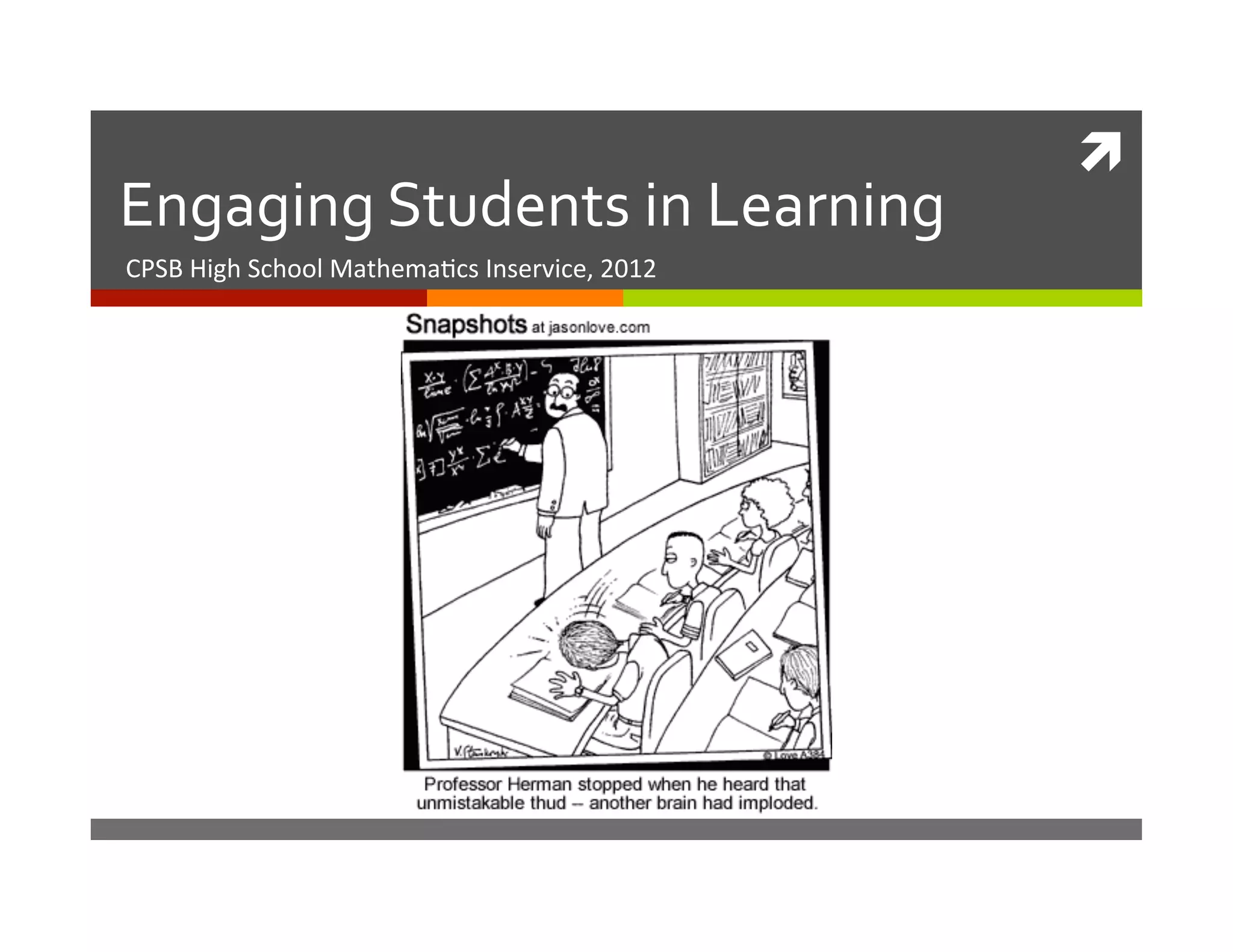
Engaging	
  Students	
  in	
  Learning	
  
CPSB	
  High	
  School	
  Mathema2cs	
  Inservice,	
  2012	
  
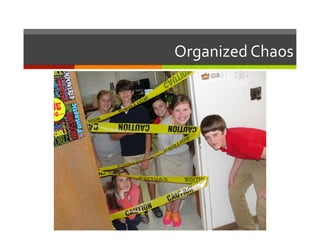
Organized	
  Chaos	
  
COMPASS	
  
«  Se#ng	
  Instruc-onal	
  Outcomes	
  (1c):	
  	
  Establishing	
  clear,	
  rigorous	
  	
  
    objec2ves	
  that	
  describe	
  what	
  students	
  will	
  learn.	


«  Managing	
  Classroom	
  Procedures	
  (2c):	
  Establishing	
  a	
  smoothly	
  
    func2oning	
  classroom	
  through	
  the	
  management	
  of	
  instruc2on	
  and	
  
    transi2ons	
  to	
  allow	
  for	
  maximum	
  learning	
  for	
  all	
  students.	
  

«  Using	
  Ques-oning	
  and	
  Discussion	
  (3b):	
  Strategically	
  using	
  a	
  varied	
  
    set	
  of	
  ques2ons	
  to	
  engage	
  all	
  students	
  in	
  discussion	
  around	
  rigorous	
  
    content.	
  

«  Engaging	
  Students	
  in	
  Learning	
  (3c):	
  Asking	
  all	
  students	
  to	
  do	
  work	
  
    that	
  is	
  rigorous	
  an	
  intellectually	
  challenging.	
  

«  Using	
  Assessment	
  in	
  Instruc-on	
  (3d):	
  Using	
  clear	
  assessment	
  criteria	
  
    to	
  drive	
  instruc2onal	
  choices	
  throughout	
  the	
  lesson	
  and	
  at	
  the	
  end.	
  
Standards	
  of	
  Mathematical	
  Practice	
  
«  Make	
  sense	
  of	
  problems	
  and	
  persevere	
  in	
  solving	
  them.	
  
«  Reason	
  abstractly	
  and	
  quan2ta2vely.	
  
«  Construct	
  viable	
  arguments	
  and	
  cri2que	
  the	
  reasoning	
  of	
  
    others.	
  
«  Model	
  with	
  mathema2cs.	
  
«  Use	
  appropriate	
  tools	
  strategically.	
  
«  ALend	
  to	
  precision.	
  
«  Look	
  for	
  and	
  make	
  use	
  of	
  structure.	
  
«  Look	
  for	
  and	
  express	
  regularity	
  in	
  repeated	
  reasoning.	
  
Attention	
  Getter	
  
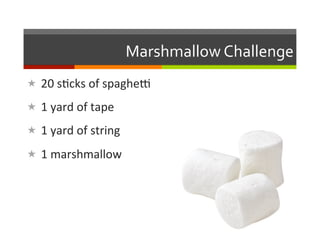
Marshmallow	
  Challenge	
  
«  20	
  s2cks	
  of	
  spagheN	
  

«  1	
  yard	
  of	
  tape	
  

«  1	
  yard	
  of	
  string	
  

«  1	
  marshmallow	
  
Marshmallow	
  Challenge	
  
«  The	
  winning	
  team	
  is	
  the	
  one	
  that	
  has	
  the	
  tallest	
  
    structure	
  measured	
  from	
  the	
  table	
  top	
  surface	
  
    to	
  the	
  top	
  of	
  the	
  marshmallow.	
  
«  The	
  en2re	
  marshmallow	
  must	
  be	
  on	
  top.	
  

«  Use	
  as	
  much	
  or	
  as	
  liLle	
  of	
  the	
  kit.	
  

«  Break	
  up	
  the	
  spagheN,	
  string,	
  or	
  tape.	
  

«  The	
  challenge	
  lasts	
  for	
  18	
  minutes.	
  
Marshmallow	
  Challenge	
  
Marshmallow	
  Challenge	
  
50	
  
40	
  
30	
  
20	
  
10	
  
                           Height	
  (Inches)	
  
  0	
  
Marshmallow	
  Challenge	
  
Marshmallow	
  Challenge	
  
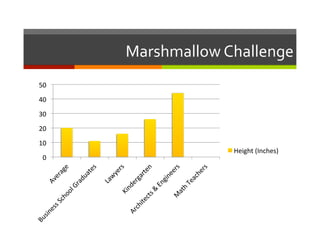
«  Why	
  do	
  kindergarteners	
  create	
  taller	
  and	
  more	
  
            interes2ng	
  structures	
  than	
  business	
  graduates?	
  
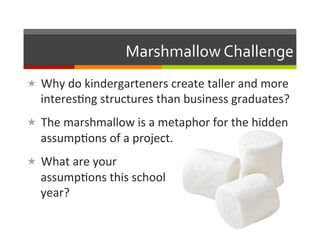
«  The	
  marshmallow	
  is	
  a	
  metaphor	
  for	
  the	
  hidden	
  
            assump2ons	
  of	
  a	
  project.	
  
«  What	
  are	
  your	


            assump2ons	
  this	
  school	


            year?	
  
Mix-­‐N-­‐Match	
  
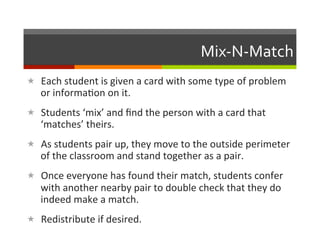
«  Each	
  student	
  is	
  given	
  a	
  card	
  with	
  some	
  type	
  of	
  problem	
  
    or	
  informa2on	
  on	
  it.	
  
«  Students	
  ‘mix’	
  and	
  find	
  the	
  person	
  with	
  a	
  card	
  that	
  
    ‘matches’	
  theirs.	
  
«  As	
  students	
  pair	
  up,	
  they	
  move	
  to	
  the	
  outside	
  perimeter	
  
    of	
  the	
  classroom	
  and	
  stand	
  together	
  as	
  a	
  pair.	
  
«  Once	
  everyone	
  has	
  found	
  their	
  match,	
  students	
  confer	
  
    with	
  another	
  nearby	
  pair	
  to	
  double	
  check	
  that	
  they	
  do	
  
    indeed	
  make	
  a	
  match.	
  
«  Redistribute	
  if	
  desired.	
  
Mix-­‐N-­‐Match	
  
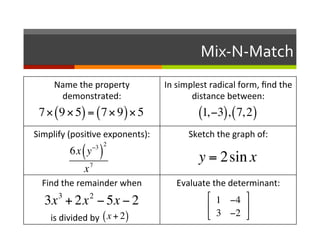
               Name	
  the	
  property	
                                                                                                   In	
  simplest	
  radical	
  form,	
  find	
  the	
  
                demonstrated:	
                                                                                                                      distance	
  between:	


             7! 9!5 = 7!9 !5
                         	
  
                               (                             ) (                                             )                                          (1, !3), ( 7, 2)
        Simplify	
  (posi2ve	
  exponents):	
                                                                                                       Sketch	
  the	
  graph	
  of:	
  
                          	
  !3 2
                     6x y
                          	
                                  ( )                                                                                       y = 2sin x
                                                                       7
                                                                x
                            Find	
  the	
  remainder	
  when	
                                                                                 Evaluate	
  the	
  determinant:	
  
                                                 3           	
  
                                                             2                                                                                        " 1 !4 %
                                 3x + 2x 	
   ! 5x ! 2                                                                                                $               '


  is	
  divided	
  by	
  	
  (	
  x	
  	
  +	
  	
  2	
  )	


                                                         # 3 !2 &
Line-­‐Ups	
  
«  Each	
  student	
  is	
  given	
  a	
  card	
  with	
  some	
  type	
  of	
  
    problem	
  on	
  it.	
  
«  Students	
  evaluate	
  the	
  answer	
  to	
  their	
  problem	
  
    and	
  then	
  line	
  up	
  in	
  order	
  from	
  least	
  to	
  greatest.	
  
«  Once	
  students	
  are	
  lined	
  up,	
  they	
  then	
  discuss	
  
    their	
  card	
  and	
  posi2on	
  with	
  a	
  nearby	
  partner.	
  
«  Partners	
  may	
  be	
  formed	
  by	
  pairing	
  up	
  or	
  by	
  
    ‘folding’	
  the	
  line	
  in	
  half.	
  
Line-­‐Ups	
  
«  Line	
  up	
  in	
  order	
  from	
  the	
  teacher	
  who	
  has	
  taught	
  
    the	
  most	
  years	
  to	
  the	
  teacher	
  who	
  has	
  taught	
  the	
  
    fewest.	
  
«  Fold	
  the	
  line.	
  
«  The	
  more	
  experienced	
  teacher	
  tells	
  the	
  less	
  
    experienced	
  about	
  their	
  most	
  embarrassing	
  
    teaching	
  moment.	
  
«  The	
  less	
  experienced	
  teacher	
  then	
  shares	
  with	
  the	
  
    more	
  experienced	
  how	
  that	
  situa2on	
  could	
  have	
  
    been	
  avoided.	
  
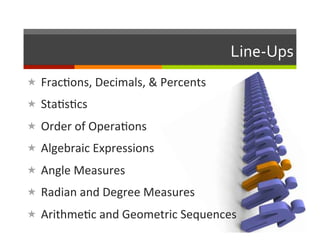
Line-­‐Ups	
  
«  Frac2ons,	
  Decimals,	
  &	
  Percents	
  
«  Sta2s2cs	
  
«  Order	
  of	
  Opera2ons	
  
«  Algebraic	
  Expressions	
  
«  Angle	
  Measures	
  
«  Radian	
  and	
  Degree	
  Measures	
  
«  Arithme2c	
  and	
  Geometric	
  Sequences	
  
Inside-­‐Outside	
  Circle	
  
«  Students	
  form	
  two	
  concentric	
  circles,	
  with	
  
    equal	
  numbers	
  of	
  students	
  in	
  each	
  circle.	
  
    Students	
  stand	
  face-­‐to-­‐face	
  with	
  a	
  partner,	
  one	
  
    person	
  from	
  the	
  inside	
  circle	
  and	
  one	
  from	
  the	
  
    outside.	
  
«  The	
  circles	
  rotate	
  according	
  to	
  the	
  teacher’s	
  
    instruc2ons.	
  
«  Partners	
  take	
  turn	
  asking	
  each	
  other	
  ques2ons,	
  
    quizzing	
  each	
  other	
  with	
  flashcards,	
  sharing	
  
    some	
  informa2on,	
  or	
  answering	
  ques2ons.	
  
Inside-­‐Outside	
  Circle	
  
«  Structure	
  works	
  best	
  when	
  the	
  problems	
  being	
  
    solved	
  do	
  not	
  require	
  lengthy	
  paper-­‐pencil	
  
    solu2ons.	
  
«  Structure	
  is	
  more	
  conducive	
  to	
  short-­‐answer	
  or	
  
    higher	
  level	
  thinking	
  ques2ons	
  that	
  can	
  be	
  
    answered	
  verbally.	
  
«  Any	
  ideas?	
  
Rally	
  Coach	
  
«  Students	
  pair	
  up	
  and	
  decide	
  who	
  is	
  Person	
  A	
  and	
  
    who	
  is	
  Person	
  B.	
  There	
  is	
  only	
  one	
  sheet	
  of	
  paper	
  
    and	
  one	
  pencil	
  for	
  each	
  student	
  pair.	
  
«  Teacher	
  poses	
  a	
  problem,	
  verbally	
  or	
  on	
  paper.	
  
«  Person	
  A	
  begins	
  contribu2ng	
  to	
  the	
  solu2on	
  of	
  the	
  
    problem	
  in	
  wri2ng	
  and	
  states	
  aloud	
  what	
  (s)he	
  is	
  
    doing.	
  
«  Meanwhile,	
  Person	
  B	
  watches,	
  listens,	
  and	
  
    coaches.	
  If	
  necessary,	
  Person	
  B	
  reteaches.	
  
«  Reverse	
  roles.	
  
Rally	
  Coach	
  
«  Mul2-­‐Step	
  problems	
  

«  Comple2ng	
  worksheets	
  

«  Genera2ng	
  lists	
  

«  Constructed	
  response	
  items	
  
Round	
  Table	
  
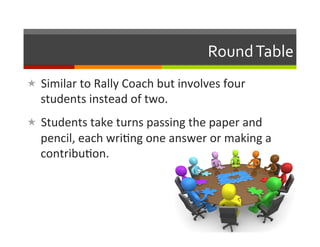
«  Similar	
  to	
  Rally	
  Coach	
  but	
  involves	
  four	
  
    students	
  instead	
  of	
  two.	
  
«  Students	
  take	
  turns	
  passing	
  the	
  paper	
  and	
  
    pencil,	
  each	
  wri2ng	
  one	
  answer	
  or	
  making	
  a	
  
    contribu2on.	
  
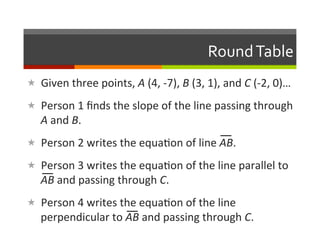
Round	
  Table	
  
«  Given	
  three	
  points,	
  A	
  (4,	
  -­‐7),	
  B	
  (3,	
  1),	
  and	
  C	
  (-­‐2,	
  0)…	
  

«  Person	
  1	
  finds	
  the	
  slope	
  of	
  the	
  line	
  passing	
  through	
  
     A	
  and	
  B.	
  
«  Person	
  2	
  writes	
  the	
  equa2on	
  of	
  line	
  AB.	
  

«  Person	
  3	
  writes	
  the	
  equa2on	
  of	
  the	
  line	
  parallel	
  to	
  
     AB	
  and	
  passing	
  through	
  C.	
  
«  Person	
  4	
  writes	
  the	
  equa2on	
  of	
  the	
  line	
  
     perpendicular	
  to	
  AB	
  and	
  passing	
  through	
  C.	
  
Mix	
  Pair	
  Rally	
  Coach	
  
«  Each	
  student	
  is	
  given	
  a	
  card	
  containing	
  some	
  
    informa2on.	
  
«  Students	
  ‘mix’	
  around	
  the	
  room	
  and	
  find	
  a	
  partner,	
  
    Person	
  A	
  and	
  Person	
  B.	
  
«  Person	
  A	
  solves	
  the	
  problem	
  on	
  his/her	
  card	
  while	
  
    Person	
  B	
  watches,	
  checks,	
  and	
  praises.	
  
«  Person	
  B	
  then	
  solve	
  the	
  problem	
  on	
  his/her	
  card	
  
    while	
  Person	
  A	
  watches,	
  checks,	
  and	
  praises.	
  
«  Partners	
  reteach	
  as	
  necessary.	
  
Showdown	
  
«  Teacher	
  selects	
  one	
  student	
  from	
  each	
  group	
  to	
  
   be	
  the	
  Showdown	
  Captain.	
  
«  The	
  Showdown	
  Captain	
  draws	
  the	
  first	
  card,	
  
   reads	
  the	
  ques2on,	
  and	
  provides	
  think	
  2me.	
  
«  Working	
  alone,	
  all	
  students,	
  including	
  the	
  
   Showdown	
  Captain,	
  write	
  their	
  answers.	
  
«  ‘Showdown’	
  is	
  called	
  and	
  teammates	
  share	
  and	
  
   discuss	
  their	
  answers.	
  
Showdown	
  
«  The	
  Showdown	
  Captain	
  leads	
  the	
  checking.	
  

«  If	
  correct,	
  the	
  team	
  celebrates;	
  if	
  not,	
  
    teammates	
  tutor,	
  then	
  celebrate.	
  
«  Repeat	
  with	
  a	
  new	
  captain.	
  

«  Modifica2ons—oral	
  ques2ons,	
  ques2ons	
  from	
  
    a	
  handout,	
  or	
  ques2ons	
  displayed	
  by	
  a	
  
    projector	
  
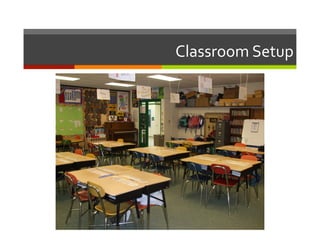
Classroom	
  Setup	
  
Stations	
  
«  Sta2on	
  1:	
  Students	
  will	
  be	
  given	
  eight	
  index	
  cards	
  
    with	
  func2ons	
  and	
  func2on	
  answers	
  on	
  them.	
  
    They	
  will	
  match	
  the	
  func2ons	
  with	
  the	
  appropriate	
  
    func2on	
  answers.	
  Then,	
  they	
  will	
  evaluate	
  
    func2ons.	
  
«  Sta2on	
  2:	
  Students	
  will	
  use	
  a	
  ruler	
  to	
  perform	
  the	
  
    ver2cal	
  line	
  test	
  on	
  graphs	
  of	
  rela2ons.	
  They	
  will	
  
    determine	
  if	
  the	
  rela2on	
  is	
  a	
  func2on.	
  They	
  will	
  
    construct	
  a	
  graph	
  that	
  is	
  a	
  func2on.	
  Then,	
  they	
  will	
  
    determine	
  if	
  a	
  rela2on	
  is	
  a	
  func2on	
  by	
  analyzing	
  
    coordinate	
  points.	
  
Stations	
  
«  Sta2on	
  3:	
  Students	
  will	
  be	
  given	
  a	
  calculator	
  to	
  
    help	
  them	
  solve	
  a	
  real-­‐world	
  linear	
  func2on.	
  
    They	
  will	
  write	
  and	
  solve	
  a	
  linear	
  func2on	
  based	
  
    on	
  two	
  data	
  points.	
  
«  Sta2on	
  4:	
  Students	
  will	
  be	
  given	
  a	
  number	
  
    cube.	
  They	
  roll	
  the	
  number	
  cube	
  to	
  populate	
  a	
  
    rela2on.	
  They	
  find	
  the	
  domain	
  and	
  range	
  of	
  the	
  
    rela2on	
  and	
  determine	
  if	
  it	
  is	
  a	
  func2on.	
  Then	
  
    for	
  given	
  rela2ons,	
  they	
  determine	
  the	
  domain,	
  
    range,	
  and	
  whether	
  or	
  not	
  it	
  is	
  a	
  func2on.	
  
Questions	
  
References	
  
«  Kushnir,	
  Dina.	
  (2001).	
  Coopera*ve	
  learning	
  and	
  
   mathema*cs:	
  High	
  school	
  ac*vi*es.	
  San	
  
   Clemente,	
  CA:	
  Kagan	
  Publishing.	
  
«  The	
  Marshmallow	
  Challenge:	
  
   hLp://marshmallowchallenge.com	
  

2012 CPSB High School Math Inservice

  • 1.
    ì   Engaging  Students  in  Learning   CPSB  High  School  Mathema2cs  Inservice,  2012  
  • 2.
  • 3.
    COMPASS   «  Se#ng  Instruc-onal  Outcomes  (1c):    Establishing  clear,  rigorous     objec2ves  that  describe  what  students  will  learn.     «  Managing  Classroom  Procedures  (2c):  Establishing  a  smoothly   func2oning  classroom  through  the  management  of  instruc2on  and   transi2ons  to  allow  for  maximum  learning  for  all  students.   «  Using  Ques-oning  and  Discussion  (3b):  Strategically  using  a  varied   set  of  ques2ons  to  engage  all  students  in  discussion  around  rigorous   content.   «  Engaging  Students  in  Learning  (3c):  Asking  all  students  to  do  work   that  is  rigorous  an  intellectually  challenging.   «  Using  Assessment  in  Instruc-on  (3d):  Using  clear  assessment  criteria   to  drive  instruc2onal  choices  throughout  the  lesson  and  at  the  end.  
  • 4.
    Standards  of  Mathematical  Practice   «  Make  sense  of  problems  and  persevere  in  solving  them.   «  Reason  abstractly  and  quan2ta2vely.   «  Construct  viable  arguments  and  cri2que  the  reasoning  of   others.   «  Model  with  mathema2cs.   «  Use  appropriate  tools  strategically.   «  ALend  to  precision.   «  Look  for  and  make  use  of  structure.   «  Look  for  and  express  regularity  in  repeated  reasoning.  
  • 5.
  • 6.
    Marshmallow  Challenge   « 20  s2cks  of  spagheN   «  1  yard  of  tape   «  1  yard  of  string   «  1  marshmallow  
  • 7.
    Marshmallow  Challenge   « The  winning  team  is  the  one  that  has  the  tallest   structure  measured  from  the  table  top  surface   to  the  top  of  the  marshmallow.   «  The  en2re  marshmallow  must  be  on  top.   «  Use  as  much  or  as  liLle  of  the  kit.   «  Break  up  the  spagheN,  string,  or  tape.   «  The  challenge  lasts  for  18  minutes.  
  • 8.
  • 9.
    Marshmallow  Challenge   50   40   30   20   10   Height  (Inches)   0  
  • 10.
  • 11.
    Marshmallow  Challenge   « Why  do  kindergarteners  create  taller  and  more   interes2ng  structures  than  business  graduates?   «  The  marshmallow  is  a  metaphor  for  the  hidden   assump2ons  of  a  project.   «  What  are  your                                                                                       assump2ons  this  school                                                                       year?  
  • 12.
    Mix-­‐N-­‐Match   «  Each  student  is  given  a  card  with  some  type  of  problem   or  informa2on  on  it.   «  Students  ‘mix’  and  find  the  person  with  a  card  that   ‘matches’  theirs.   «  As  students  pair  up,  they  move  to  the  outside  perimeter   of  the  classroom  and  stand  together  as  a  pair.   «  Once  everyone  has  found  their  match,  students  confer   with  another  nearby  pair  to  double  check  that  they  do   indeed  make  a  match.   «  Redistribute  if  desired.  
  • 13.
    Mix-­‐N-­‐Match   Name  the  property   In  simplest  radical  form,  find  the   demonstrated:   distance  between:     7! 9!5 = 7!9 !5   ( ) ( ) (1, !3), ( 7, 2) Simplify  (posi2ve  exponents):   Sketch  the  graph  of:    !3 2 6x y   ( ) y = 2sin x 7 x Find  the  remainder  when   Evaluate  the  determinant:   3   2 " 1 !4 % 3x + 2x   ! 5x ! 2 $ '                      is  divided  by    (  x    +    2  )                             # 3 !2 &
  • 14.
    Line-­‐Ups   «  Each  student  is  given  a  card  with  some  type  of   problem  on  it.   «  Students  evaluate  the  answer  to  their  problem   and  then  line  up  in  order  from  least  to  greatest.   «  Once  students  are  lined  up,  they  then  discuss   their  card  and  posi2on  with  a  nearby  partner.   «  Partners  may  be  formed  by  pairing  up  or  by   ‘folding’  the  line  in  half.  
  • 15.
    Line-­‐Ups   «  Line  up  in  order  from  the  teacher  who  has  taught   the  most  years  to  the  teacher  who  has  taught  the   fewest.   «  Fold  the  line.   «  The  more  experienced  teacher  tells  the  less   experienced  about  their  most  embarrassing   teaching  moment.   «  The  less  experienced  teacher  then  shares  with  the   more  experienced  how  that  situa2on  could  have   been  avoided.  
  • 16.
    Line-­‐Ups   «  Frac2ons,  Decimals,  &  Percents   «  Sta2s2cs   «  Order  of  Opera2ons   «  Algebraic  Expressions   «  Angle  Measures   «  Radian  and  Degree  Measures   «  Arithme2c  and  Geometric  Sequences  
  • 17.
    Inside-­‐Outside  Circle   « Students  form  two  concentric  circles,  with   equal  numbers  of  students  in  each  circle.   Students  stand  face-­‐to-­‐face  with  a  partner,  one   person  from  the  inside  circle  and  one  from  the   outside.   «  The  circles  rotate  according  to  the  teacher’s   instruc2ons.   «  Partners  take  turn  asking  each  other  ques2ons,   quizzing  each  other  with  flashcards,  sharing   some  informa2on,  or  answering  ques2ons.  
  • 18.
    Inside-­‐Outside  Circle   « Structure  works  best  when  the  problems  being   solved  do  not  require  lengthy  paper-­‐pencil   solu2ons.   «  Structure  is  more  conducive  to  short-­‐answer  or   higher  level  thinking  ques2ons  that  can  be   answered  verbally.   «  Any  ideas?  
  • 19.
    Rally  Coach   « Students  pair  up  and  decide  who  is  Person  A  and   who  is  Person  B.  There  is  only  one  sheet  of  paper   and  one  pencil  for  each  student  pair.   «  Teacher  poses  a  problem,  verbally  or  on  paper.   «  Person  A  begins  contribu2ng  to  the  solu2on  of  the   problem  in  wri2ng  and  states  aloud  what  (s)he  is   doing.   «  Meanwhile,  Person  B  watches,  listens,  and   coaches.  If  necessary,  Person  B  reteaches.   «  Reverse  roles.  
  • 20.
    Rally  Coach   « Mul2-­‐Step  problems   «  Comple2ng  worksheets   «  Genera2ng  lists   «  Constructed  response  items  
  • 21.
    Round  Table   « Similar  to  Rally  Coach  but  involves  four   students  instead  of  two.   «  Students  take  turns  passing  the  paper  and   pencil,  each  wri2ng  one  answer  or  making  a   contribu2on.  
  • 22.
    Round  Table   « Given  three  points,  A  (4,  -­‐7),  B  (3,  1),  and  C  (-­‐2,  0)…   «  Person  1  finds  the  slope  of  the  line  passing  through   A  and  B.   «  Person  2  writes  the  equa2on  of  line  AB.   «  Person  3  writes  the  equa2on  of  the  line  parallel  to   AB  and  passing  through  C.   «  Person  4  writes  the  equa2on  of  the  line   perpendicular  to  AB  and  passing  through  C.  
  • 23.
    Mix  Pair  Rally  Coach   «  Each  student  is  given  a  card  containing  some   informa2on.   «  Students  ‘mix’  around  the  room  and  find  a  partner,   Person  A  and  Person  B.   «  Person  A  solves  the  problem  on  his/her  card  while   Person  B  watches,  checks,  and  praises.   «  Person  B  then  solve  the  problem  on  his/her  card   while  Person  A  watches,  checks,  and  praises.   «  Partners  reteach  as  necessary.  
  • 24.
    Showdown   «  Teacher  selects  one  student  from  each  group  to   be  the  Showdown  Captain.   «  The  Showdown  Captain  draws  the  first  card,   reads  the  ques2on,  and  provides  think  2me.   «  Working  alone,  all  students,  including  the   Showdown  Captain,  write  their  answers.   «  ‘Showdown’  is  called  and  teammates  share  and   discuss  their  answers.  
  • 25.
    Showdown   «  The  Showdown  Captain  leads  the  checking.   «  If  correct,  the  team  celebrates;  if  not,   teammates  tutor,  then  celebrate.   «  Repeat  with  a  new  captain.   «  Modifica2ons—oral  ques2ons,  ques2ons  from   a  handout,  or  ques2ons  displayed  by  a   projector  
  • 26.
  • 27.
    Stations   «  Sta2on  1:  Students  will  be  given  eight  index  cards   with  func2ons  and  func2on  answers  on  them.   They  will  match  the  func2ons  with  the  appropriate   func2on  answers.  Then,  they  will  evaluate   func2ons.   «  Sta2on  2:  Students  will  use  a  ruler  to  perform  the   ver2cal  line  test  on  graphs  of  rela2ons.  They  will   determine  if  the  rela2on  is  a  func2on.  They  will   construct  a  graph  that  is  a  func2on.  Then,  they  will   determine  if  a  rela2on  is  a  func2on  by  analyzing   coordinate  points.  
  • 28.
    Stations   «  Sta2on  3:  Students  will  be  given  a  calculator  to   help  them  solve  a  real-­‐world  linear  func2on.   They  will  write  and  solve  a  linear  func2on  based   on  two  data  points.   «  Sta2on  4:  Students  will  be  given  a  number   cube.  They  roll  the  number  cube  to  populate  a   rela2on.  They  find  the  domain  and  range  of  the   rela2on  and  determine  if  it  is  a  func2on.  Then   for  given  rela2ons,  they  determine  the  domain,   range,  and  whether  or  not  it  is  a  func2on.  
  • 29.
  • 30.
    References   «  Kushnir,  Dina.  (2001).  Coopera*ve  learning  and   mathema*cs:  High  school  ac*vi*es.  San   Clemente,  CA:  Kagan  Publishing.   «  The  Marshmallow  Challenge:   hLp://marshmallowchallenge.com