3/13/2013 
Place-making 
SI 658 
Information Architecture 
Marti Gukeisen
Place-making 
Related Readings 
Pervasive Information Architecture 
Andrea Resmini & Luca Rosati 
ISBN 978-0-12-382094-5 
 Ch 4 Placemaking 
1/23/2013 
2 SI658 Information Architecture
Place-making 
3/13/2013 
creating the where in the digital ether 
3 SI658 Information Architecture
Place-making 
Cambridge UK 
3/13/2013 
4 SI658 Information Architecture
Place-making 
We are physical beings 
 space, embodiment 
3/13/2013 
 embodiment: the state of being representing in 
material form. 
 it’s all about how we perceive our reality 
 we grasp the abstract by means of the concrete 
5 SI658 Information Architecture
Place-making 
on the web 
you aren’t going anywhere 
 go to a site 
 exit a site 
 close a popup 
 open a link 
 scroll down the page 
3/13/2013 
6 SI658 Information Architecture
Place-making 
the domestication of time & space 
 gesture 
 speech 
 inhabitable space 
 it’s about embodiment, not geometry 
3/13/2013 
7 SI658 Information Architecture
Place-making 
Bollnow: Man and Space 
1. Space is heterogeneous 
2. Space is hodological 
3. Space has evolved 
3/13/2013 
8 SI658 Information Architecture
Place-making 
1. Space is heterogeneous 
 exists relative to a subjective point of view (yours 
for instance) 
 tension between known space and chaos 
3/13/2013 
9 SI658 Information Architecture
Place-making 
2. Space is hodological 
3/13/2013 
 human space is made up of paths, experience, 
what we perceive between point A and point B 
10 SI658 Information Architecture
Place-making 
3. Space is evolved 
 Space has not always been there (at least not the 
way we understand it now) 
 grūma – a surveyor's pole or measuring-rod, 
placed at the center of camp so as to divide the 
camp into four quarters by streets meeting at that 
point 
 architectural space is a compound of many layers: 
emotion, hodological, topolgoical, which brings us 
to: 
 existential space 
3/13/2013 
11 SI658 Information Architecture
Place-making 
Existential Space 
 space of relationships, personal, immediate, 
egocentric 
 made up of stable archetypes, vicinity, enclosed, 
separation, continuity, and time. 
 Space – the base experience of our embodiment 
 Space is objective, impersonal, undifferentiated 
 Space is not the same as place 
3/13/2013 
12 SI658 Information Architecture
Place-making 
Place 
 = the space where our life occurs 
 Dwelling > Shelter 
 Place involves presence 
 Place is physical space plus memories, 
experiences, and behavioral patterns. 
3/13/2013 
 Place is personal, subjective, and communitarian. 
 Place is rooted in common cultural understandings 
and behavioral framing 
13 SI658 Information Architecture
Place-making 
What is place-making? 
3/13/2013 
 How does place-making happen in the physical 
world? 
 How does place-making happen in literature? 
 How does place-making happen for your dog? 
14 SI658 Information Architecture
Place-making 
3/13/2013 
Kevin Lynch: The Image of the City 
We move through cities by forming mental maps 
 5 basic elements: 
paths (road, street) 
edges (walls, fences, borders, shore) 
nodes (destinations: work, home, bank, store) 
landmarks (physical markers noted for orienting) 
districts (blocks, areas with a defined meaning) 
15 SI658 Information Architecture
Place-making 
Way-finding 
3/13/2013 
 how people dynamically orient themselves in 
physical space and navigate from place to place 
 signs and other elements for navigating & orienting 
make up the grammar of that space 
 all this relates to actual, physical, real space 
16 SI658 Information Architecture
Place-making 
3/13/2013 
Way-finding in the digital world 
 IA’s stole this term from the concreteness of 
physical space and applied it to the abstractness 
of digital cyberspace 
 apply it to information seeking, navigation, user 
orientation 
17 SI658 Information Architecture
Place-making 
Cennydd Bowles – Way Finding 
advantages of nature: Salmon 
3/13/2013 
18 SI658 Information Architecture
Place-making 
Cennydd Bowles – Way Finding 
advantages of nature: Ants 
3/13/2013 
19 SI658 Information Architecture
Place-making 
People have to compensate 
3/13/2013 
 vision 
 spatial reasoning 
 mental models 
 explicit & implicit cues 
20 SI658 Information Architecture
Place-making 
survey knowledge 
 conceptualize a space as a 
whole 
 generally hierarchical 
 large general places (cities) 
 smaller sub-networks 
(neighborhoods) 
3/13/2013 
21 SI658 Information Architecture
Place-making 
procedural knowledge 
3/13/2013 
 a sequence of actions to follow a route from A to B 
(directions) 
22 SI658 Information Architecture
Place-making 
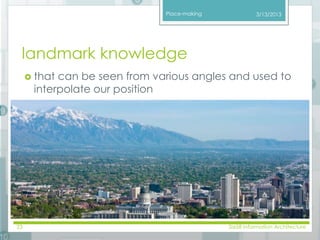
landmark knowledge 
3/13/2013 
 that can be seen from various angles and used to 
interpolate our position 
23 SI658 Information Architecture
Place-making 
assisting way-finding 
 maps 
 signposts 
 directions 
 reference points 
3/13/2013 
24 SI658 Information Architecture
Place-making 
types of way-finding tools 
 tools that display the user’s current position 
 tools that display the user’s orientation (compass) 
 tools that log movement 
 tools that show the user’s surroundings (map) 
 guided navigation systems (GPS, signage) 
3/13/2013 
25 SI658 Information Architecture
Place-making 
psychological space 
 can be measured like geographical space 
3/13/2013 
 shortest distance between spaces is the route 
requiring the least effort 
 ie. less activity, less engagement, less choice 
I say: seems boredom would increase the “psychological” 
space, so I’d posit it isn’t strictly a positive correlation between 
psychological space & level of engagement 
26 SI658 Information Architecture
Place-making 
elements of mental mapping 
in the digital space 
 paths (hyperlinks) 
 nodes (pages) 
 landmarks (logo links to homepage) 
 districts (global site sections = main districts) 
3/13/2013 
 edges (one site versus another—design & nav changes) 
27 SI658 Information Architecture
Place-making 
back to PLACE 
3/13/2013 
28 SI658 Information Architecture
Place-making 
PLACE-making in pervasive IA 
 reduce disorientation 
 increase legibility of spaces 
 support way-finding 
Where? 
 in digital spaces 
 physical spaces 
 across channels 
3/13/2013 
29 SI658 Information Architecture
Place-making 
3/13/2013 
structure all elements of the UX as part 
of a continuously flowing PLACE 
 a single, common, existential space 
 where users feel at home, in context in a PLACE 
 Particularly for processes that bridge different 
channels 
 Recognize that your users’ experience will bridge 
channels, even if your processes don’t 
30 SI658 Information Architecture
Place-making 
3/13/2013 
LAYERs. delicious, delicious layers 
“cyberspace is not a 
destination; rather, it is 
a layer tightly 
integrated into the 
world around us.” 
- Institute for the Future (2009) 
reality 
31 SI658 Information Architecture
Place-making 
3/13/2013 
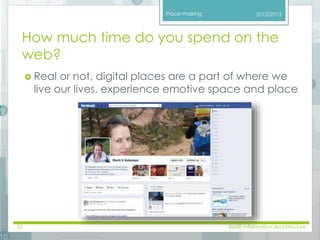
How much time do you spend on the 
web? 
 Real or not, digital places are a part of where we 
live our lives, experience emotive space and place 
32 SI658 Information Architecture
Place-making 
Place-making in the many channeled 
world 
Internal Place-making 
 a sense of place within a 
single channel 
 makes use of 
advantages, subject to 
limitations 
 more specific, articulate 
External Place-making 
 creating a sense of place 
that spans channels 
 spatial familiarity, 
comfort, continuity 
 vast reach, more 
profound 
3/13/2013 
33 SI658 Information Architecture
Place-making 
3/13/2013 
Know 
the difference between space and 
place 
 space: physical, objective, impersonal, stable 
 place: psychological, subjective, experiential, 
dynamic, hodological, existential 
 place is what we design in information space 
34 SI658 Information Architecture
Place-making 
Know 
place is layered 
relational layer archetypes of enclosure, vicinity, 
continuity, time 
emotional layer feelings, sensations ties to place 
behavioral layer interactions, movement 
3/13/2013 
35 SI658 Information Architecture
Place-making 
Know 
what place-making relies on 
place-making doesn’t rely on 
 technology or wow-factor 
place-making does rely on 
3/13/2013 
 an understanding of basic cognitive and 
psychological mechanisms that guide how we 
experience the world 
36 SI658 Information Architecture
Place-making 
Know 
your context 
 context is more than a project’s settings & 
constraints 
3/13/2013 
 context in pervasive processes is spatial & dynamic 
 context changes with the actors, environment, 
location, time 
37 SI658 Information Architecture
Place-making 
Do 
 build place not (just) space 
3/13/2013 
 support way-finding via paths, edges, nodes, 
landmarks, and districts 
 reduce effort (to reduce psychological distance) 
 make people feel at home, help them relate to 
the context 
 incorporate place-making both internally (within a 
channel) and externally (across channels) 
38 SI658 Information Architecture
Place-making 
Case Study: 
“but now we know everything!” 
3/13/2013 
39 SI658 Information Architecture
3/13/2013 
Project Time 
the part where you collaborate and teach each other 
40 SI658 Information Architecture
Place-making 
Get in your groups 
3/13/2013 
41 SI658 Information Architecture
Place-making 
group assignment 
 the user experience assessment is due TODAY (at 
11:59 pm) 
 last one (it’s a doosey): what you make of it 
 revised high level IA 
 revised homepage & (3) interior page wires 
 cross-channel assessment & recommendations 
 brief in ctools 
 due April 3 
3/13/2013 
42 SI658 Information Architecture
Place-making 
group project breakdown 
 assignment 1 – 100 pts 
 assignment 2 – 100 pts 
 assignment 3 – 100 pts 
 assignment 4 – 100 pts  you are here 
 presentation – 500 pts  April 17th 
3/13/2013 
 participation – 100 pts  you grading each other 
43 SI658 Information Architecture
Presentation 
Time 
the part where you teach 
3/13/2013 
44 SI658 Information Architecture
Wrap Up 
More stuff for you to do. 
3/13/2013 
45 SI658 Information Architecture
Place-making 
last week’s assignment: 
who drank out of a coconut? 
3/13/2013 
46 SI658 Information Architecture
Place-making 
next reading 
Due TUES Mar 19th at 11 pm. 
50-300 words responding to the following: 
3/13/2013 
PERVASIVE IA 
Ch 5 Consistency 
47 SI658 Information Architecture
3/13/2013 
Laters 
Questions? 
48 SI658 Information Architecture

Information Architecture class9 03 13

  • 1.
    3/13/2013 Place-making SI658 Information Architecture Marti Gukeisen
  • 2.
    Place-making Related Readings Pervasive Information Architecture Andrea Resmini & Luca Rosati ISBN 978-0-12-382094-5  Ch 4 Placemaking 1/23/2013 2 SI658 Information Architecture
  • 3.
    Place-making 3/13/2013 creatingthe where in the digital ether 3 SI658 Information Architecture
  • 4.
    Place-making Cambridge UK 3/13/2013 4 SI658 Information Architecture
  • 5.
    Place-making We arephysical beings  space, embodiment 3/13/2013  embodiment: the state of being representing in material form.  it’s all about how we perceive our reality  we grasp the abstract by means of the concrete 5 SI658 Information Architecture
  • 6.
    Place-making on theweb you aren’t going anywhere  go to a site  exit a site  close a popup  open a link  scroll down the page 3/13/2013 6 SI658 Information Architecture
  • 7.
    Place-making the domesticationof time & space  gesture  speech  inhabitable space  it’s about embodiment, not geometry 3/13/2013 7 SI658 Information Architecture
  • 8.
    Place-making Bollnow: Manand Space 1. Space is heterogeneous 2. Space is hodological 3. Space has evolved 3/13/2013 8 SI658 Information Architecture
  • 9.
    Place-making 1. Spaceis heterogeneous  exists relative to a subjective point of view (yours for instance)  tension between known space and chaos 3/13/2013 9 SI658 Information Architecture
  • 10.
    Place-making 2. Spaceis hodological 3/13/2013  human space is made up of paths, experience, what we perceive between point A and point B 10 SI658 Information Architecture
  • 11.
    Place-making 3. Spaceis evolved  Space has not always been there (at least not the way we understand it now)  grūma – a surveyor's pole or measuring-rod, placed at the center of camp so as to divide the camp into four quarters by streets meeting at that point  architectural space is a compound of many layers: emotion, hodological, topolgoical, which brings us to:  existential space 3/13/2013 11 SI658 Information Architecture
  • 12.
    Place-making Existential Space  space of relationships, personal, immediate, egocentric  made up of stable archetypes, vicinity, enclosed, separation, continuity, and time.  Space – the base experience of our embodiment  Space is objective, impersonal, undifferentiated  Space is not the same as place 3/13/2013 12 SI658 Information Architecture
  • 13.
    Place-making Place = the space where our life occurs  Dwelling > Shelter  Place involves presence  Place is physical space plus memories, experiences, and behavioral patterns. 3/13/2013  Place is personal, subjective, and communitarian.  Place is rooted in common cultural understandings and behavioral framing 13 SI658 Information Architecture
  • 14.
    Place-making What isplace-making? 3/13/2013  How does place-making happen in the physical world?  How does place-making happen in literature?  How does place-making happen for your dog? 14 SI658 Information Architecture
  • 15.
    Place-making 3/13/2013 KevinLynch: The Image of the City We move through cities by forming mental maps  5 basic elements: paths (road, street) edges (walls, fences, borders, shore) nodes (destinations: work, home, bank, store) landmarks (physical markers noted for orienting) districts (blocks, areas with a defined meaning) 15 SI658 Information Architecture
  • 16.
    Place-making Way-finding 3/13/2013  how people dynamically orient themselves in physical space and navigate from place to place  signs and other elements for navigating & orienting make up the grammar of that space  all this relates to actual, physical, real space 16 SI658 Information Architecture
  • 17.
    Place-making 3/13/2013 Way-findingin the digital world  IA’s stole this term from the concreteness of physical space and applied it to the abstractness of digital cyberspace  apply it to information seeking, navigation, user orientation 17 SI658 Information Architecture
  • 18.
    Place-making Cennydd Bowles– Way Finding advantages of nature: Salmon 3/13/2013 18 SI658 Information Architecture
  • 19.
    Place-making Cennydd Bowles– Way Finding advantages of nature: Ants 3/13/2013 19 SI658 Information Architecture
  • 20.
    Place-making People haveto compensate 3/13/2013  vision  spatial reasoning  mental models  explicit & implicit cues 20 SI658 Information Architecture
  • 21.
    Place-making survey knowledge  conceptualize a space as a whole  generally hierarchical  large general places (cities)  smaller sub-networks (neighborhoods) 3/13/2013 21 SI658 Information Architecture
  • 22.
    Place-making procedural knowledge 3/13/2013  a sequence of actions to follow a route from A to B (directions) 22 SI658 Information Architecture
  • 23.
    Place-making landmark knowledge 3/13/2013  that can be seen from various angles and used to interpolate our position 23 SI658 Information Architecture
  • 24.
    Place-making assisting way-finding  maps  signposts  directions  reference points 3/13/2013 24 SI658 Information Architecture
  • 25.
    Place-making types ofway-finding tools  tools that display the user’s current position  tools that display the user’s orientation (compass)  tools that log movement  tools that show the user’s surroundings (map)  guided navigation systems (GPS, signage) 3/13/2013 25 SI658 Information Architecture
  • 26.
    Place-making psychological space  can be measured like geographical space 3/13/2013  shortest distance between spaces is the route requiring the least effort  ie. less activity, less engagement, less choice I say: seems boredom would increase the “psychological” space, so I’d posit it isn’t strictly a positive correlation between psychological space & level of engagement 26 SI658 Information Architecture
  • 27.
    Place-making elements ofmental mapping in the digital space  paths (hyperlinks)  nodes (pages)  landmarks (logo links to homepage)  districts (global site sections = main districts) 3/13/2013  edges (one site versus another—design & nav changes) 27 SI658 Information Architecture
  • 28.
    Place-making back toPLACE 3/13/2013 28 SI658 Information Architecture
  • 29.
    Place-making PLACE-making inpervasive IA  reduce disorientation  increase legibility of spaces  support way-finding Where?  in digital spaces  physical spaces  across channels 3/13/2013 29 SI658 Information Architecture
  • 30.
    Place-making 3/13/2013 structureall elements of the UX as part of a continuously flowing PLACE  a single, common, existential space  where users feel at home, in context in a PLACE  Particularly for processes that bridge different channels  Recognize that your users’ experience will bridge channels, even if your processes don’t 30 SI658 Information Architecture
  • 31.
    Place-making 3/13/2013 LAYERs.delicious, delicious layers “cyberspace is not a destination; rather, it is a layer tightly integrated into the world around us.” - Institute for the Future (2009) reality 31 SI658 Information Architecture
  • 32.
    Place-making 3/13/2013 Howmuch time do you spend on the web?  Real or not, digital places are a part of where we live our lives, experience emotive space and place 32 SI658 Information Architecture
  • 33.
    Place-making Place-making inthe many channeled world Internal Place-making  a sense of place within a single channel  makes use of advantages, subject to limitations  more specific, articulate External Place-making  creating a sense of place that spans channels  spatial familiarity, comfort, continuity  vast reach, more profound 3/13/2013 33 SI658 Information Architecture
  • 34.
    Place-making 3/13/2013 Know the difference between space and place  space: physical, objective, impersonal, stable  place: psychological, subjective, experiential, dynamic, hodological, existential  place is what we design in information space 34 SI658 Information Architecture
  • 35.
    Place-making Know placeis layered relational layer archetypes of enclosure, vicinity, continuity, time emotional layer feelings, sensations ties to place behavioral layer interactions, movement 3/13/2013 35 SI658 Information Architecture
  • 36.
    Place-making Know whatplace-making relies on place-making doesn’t rely on  technology or wow-factor place-making does rely on 3/13/2013  an understanding of basic cognitive and psychological mechanisms that guide how we experience the world 36 SI658 Information Architecture
  • 37.
    Place-making Know yourcontext  context is more than a project’s settings & constraints 3/13/2013  context in pervasive processes is spatial & dynamic  context changes with the actors, environment, location, time 37 SI658 Information Architecture
  • 38.
    Place-making Do build place not (just) space 3/13/2013  support way-finding via paths, edges, nodes, landmarks, and districts  reduce effort (to reduce psychological distance)  make people feel at home, help them relate to the context  incorporate place-making both internally (within a channel) and externally (across channels) 38 SI658 Information Architecture
  • 39.
    Place-making Case Study: “but now we know everything!” 3/13/2013 39 SI658 Information Architecture
  • 40.
    3/13/2013 Project Time the part where you collaborate and teach each other 40 SI658 Information Architecture
  • 41.
    Place-making Get inyour groups 3/13/2013 41 SI658 Information Architecture
  • 42.
    Place-making group assignment  the user experience assessment is due TODAY (at 11:59 pm)  last one (it’s a doosey): what you make of it  revised high level IA  revised homepage & (3) interior page wires  cross-channel assessment & recommendations  brief in ctools  due April 3 3/13/2013 42 SI658 Information Architecture
  • 43.
    Place-making group projectbreakdown  assignment 1 – 100 pts  assignment 2 – 100 pts  assignment 3 – 100 pts  assignment 4 – 100 pts  you are here  presentation – 500 pts  April 17th 3/13/2013  participation – 100 pts  you grading each other 43 SI658 Information Architecture
  • 44.
    Presentation Time thepart where you teach 3/13/2013 44 SI658 Information Architecture
  • 45.
    Wrap Up Morestuff for you to do. 3/13/2013 45 SI658 Information Architecture
  • 46.
    Place-making last week’sassignment: who drank out of a coconut? 3/13/2013 46 SI658 Information Architecture
  • 47.
    Place-making next reading Due TUES Mar 19th at 11 pm. 50-300 words responding to the following: 3/13/2013 PERVASIVE IA Ch 5 Consistency 47 SI658 Information Architecture
  • 48.
    3/13/2013 Laters Questions? 48 SI658 Information Architecture

Editor's Notes

  • #5 North is East. Another example of breaking convention being a disruption. You better have a really great new way of doing things if you expect people to learn a new approach.
  • #32 http://www.roxanashomebaking.com/citrus-cranberry-layer-cake-recipe/
  • #46 “That’s a Wrap” sculpture by Jacques Vesery.