EXPLICIT
TEACHING
EXPLICIT TEACHING
At the end of the session, the participants should be able to:
1. Define and explain Explicit Teaching
2. Recognize the importance of Explicit Teaching in the teaching and
learning process
3. Describe the underlying principles of explicit teaching
4. Identify the different components of the Explicit Teaching framework
5. Present mini-demonstration lessons using explicit teaching
methodologies
Department of Education
Activity
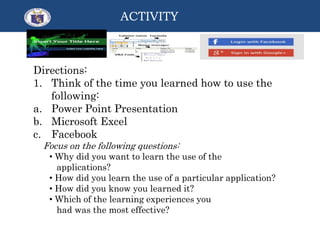
Directions:
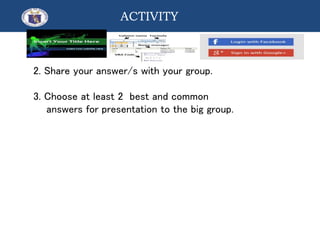
1. Think of the time you learned how to use the
following:
a. Power Point Presentation
b. Microsoft Excel
c. Facebook
Focus on the following questions:
• Why did you want to learn the use of the
applications?
• How did you learn the use of a particular application?
• How did you know you learned it?
• Which of the learning experiences you
had was the most effective?
ACTIVITY
2. Share your answer/s with your group.
3. Choose at least 2 best and common
answers for presentation to the big group.
ACTIVITY
EXPLICIT
TEACHING
National Training of Trainers for
K to 12 Grade 6 Curriculum
January , 2017
.
Explicit Teaching: The What’s, Why’s, How’s
EXPLICIT TEACHING
Department of Education
 is an instructional strategy that is direct,
engaging and success oriented.
 used by teachers to assist their learners
succeed in learning, mastery & application
of vital skills.
 absolutely necessary in teaching content
that students could not otherwise discover
(Archer & Hughes)
EXPLICIT TEACHING
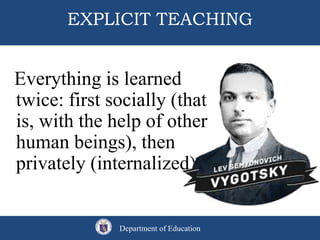
Everything is learned
twice: first socially (that
is, with the help of other
human beings), then
privately (internalized).
Department of Education
EXPLICIT TEACHING
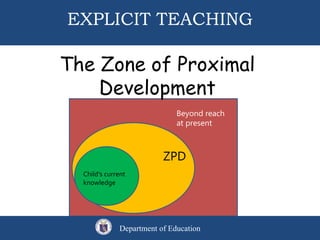
The Zone of Proximal
Development
Department of Education
Beyond reach
at present
ZPD
Child’s current
knowledge
EXPLICIT TEACHING
Department of Education
Beyond reach
at present
Explicit teaching is characterised by:
•a series of clear statements about the
purpose and rationale for learning the new
skill
•clear explanations and demonstrations of
instructional target
•and supported practice with feedback until
independent mastery has been achieved
Archer, A., & Hughes, C. (2011). Explicit Instruction: Effective and Efficient Teaching.
NY: Guilford Publications.
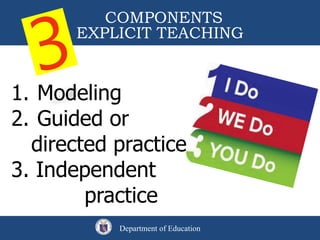
1. Modeling
2. Guided or
directed practice
3. Independent
practice
COMPONENTS
EXPLICIT TEACHING
Gauthier, Bissonnette and Richard (2013)
Department of Education
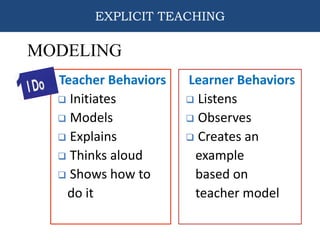
EXPLICIT TEACHING
Teacher Behaviors
 Initiates
 Models
 Explains
 Thinks aloud
 Shows how to
do it
Learner Behaviors
 Listens
 Observes
 Creates an
example
based on
teacher model
MODELING
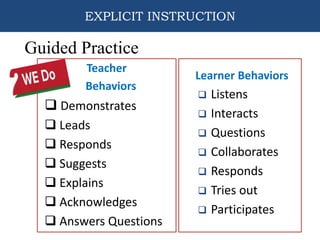
EXPLICIT INSTRUCTION
Learner Behaviors
 Listens
 Interacts
 Questions
 Collaborates
 Responds
 Tries out
 Participates
Guided Practice
Teacher
Behaviors
 Demonstrates
 Leads
 Responds
 Suggests
 Explains
 Acknowledges
 Answers Questions
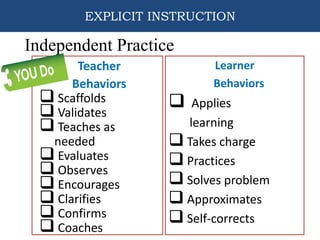
EXPLICIT INSTRUCTION
Teacher
Behaviors
 Scaffolds
 Validates
 Teaches as
needed
 Evaluates
 Observes
 Encourages
 Clarifies
 Confirms
 Coaches
Independent Practice
Learner
Behaviors
 Applies
learning
 Takes charge
 Practices
 Solves problem
 Approximates
 Self-corrects
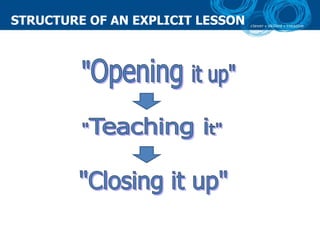
STRUCTURE OF AN EXPLICIT LESSON
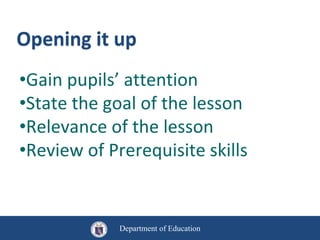
Opening it up
Department of Education
•Gain pupils’ attention
•State the goal of the lesson
•Relevance of the lesson
•Review of Prerequisite skills
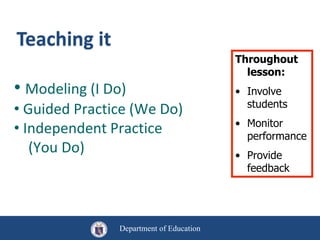
Teaching it
Department of Education
• Modeling (I Do)
• Guided Practice (We Do)
• Independent Practice
(You Do)
Throughout
lesson:
• Involve
students
• Monitor
performance
• Provide
feedback
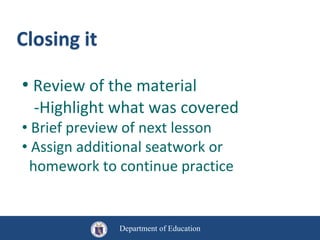
Closing it
Department of Education
• Review of the material
-Highlight what was covered
• Brief preview of next lesson
• Assign additional seatwork or
homework to continue practice
Department of Education
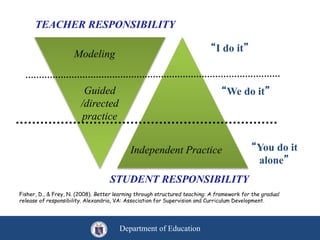
TEACHER RESPONSIBILITY
STUDENT RESPONSIBILITY
Modeling
Guided
/directed
practice
“I do it”
“We do it”
Independent Practice “You do it
alone”
Fisher, D., & Frey, N. (2008). Better learning through structured teaching: A framework for the gradual
release of responsibility. Alexandria, VA: Association for Supervision and Curriculum Development.
Department of Education
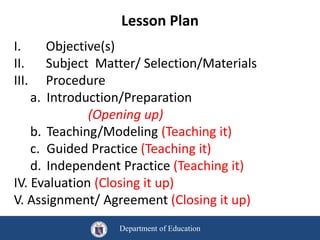
Lesson Plan
I. Objective(s)
II. Subject Matter/ Selection/Materials
III. Procedure
a. Introduction/Preparation
(Opening up)
b. Teaching/Modeling (Teaching it)
c. Guided Practice (Teaching it)
d. Independent Practice (Teaching it)
IV. Evaluation (Closing it up)
V. Assignment/ Agreement (Closing it up)
.
How well you teach =
How well they learn
Department of Education
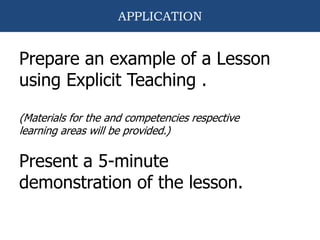
APPLICATION
Prepare an example of a Lesson
using Explicit Teaching .
(Materials for the and competencies respective
learning areas will be provided.)
Present a 5-minute
demonstration of the lesson.
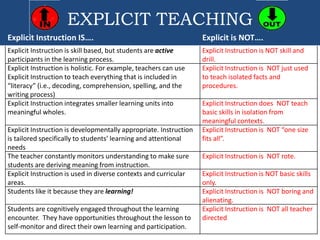
EXPLICIT TEACHING
Explicit Instruction IS…. Explicit is NOT….
Explicit Instruction is skill based, but students are active
participants in the learning process.
Explicit Instruction is NOT skill and
drill.
Explicit Instruction is holistic. For example, teachers can use
Explicit Instruction to teach everything that is included in
“literacy” (i.e., decoding, comprehension, spelling, and the
writing process)
Explicit Instruction is NOT just used
to teach isolated facts and
procedures.
Explicit Instruction integrates smaller learning units into
meaningful wholes.
Explicit Instruction does NOT teach
basic skills in isolation from
meaningful contexts.
Explicit Instruction is developmentally appropriate. Instruction
is tailored specifically to students’ learning and attentional
needs
Explicit Instruction is NOT “one size
fits all”.
The teacher constantly monitors understanding to make sure
students are deriving meaning from instruction.
Explicit Instruction is NOT rote.
Explicit Instruction is used in diverse contexts and curricular
areas.
Explicit Instruction is NOT basic skills
only.
Students like it because they are learning! Explicit Instruction is NOT boring and
alienating.
Students are cognitively engaged throughout the learning
encounter. They have opportunities throughout the lesson to
self-monitor and direct their own learning and participation.
Explicit Instruction is NOT all teacher
directed
EXPLICIT INSTRUCTION

SHS-Explicit-Teaching.pptx

  • 1.
  • 2.
    EXPLICIT TEACHING At theend of the session, the participants should be able to: 1. Define and explain Explicit Teaching 2. Recognize the importance of Explicit Teaching in the teaching and learning process 3. Describe the underlying principles of explicit teaching 4. Identify the different components of the Explicit Teaching framework 5. Present mini-demonstration lessons using explicit teaching methodologies Department of Education
  • 3.
  • 4.
    Directions: 1. Think ofthe time you learned how to use the following: a. Power Point Presentation b. Microsoft Excel c. Facebook Focus on the following questions: • Why did you want to learn the use of the applications? • How did you learn the use of a particular application? • How did you know you learned it? • Which of the learning experiences you had was the most effective? ACTIVITY
  • 5.
    2. Share youranswer/s with your group. 3. Choose at least 2 best and common answers for presentation to the big group. ACTIVITY
  • 6.
    EXPLICIT TEACHING National Training ofTrainers for K to 12 Grade 6 Curriculum January , 2017
  • 7.
    . Explicit Teaching: TheWhat’s, Why’s, How’s
  • 8.
    EXPLICIT TEACHING Department ofEducation  is an instructional strategy that is direct, engaging and success oriented.  used by teachers to assist their learners succeed in learning, mastery & application of vital skills.  absolutely necessary in teaching content that students could not otherwise discover (Archer & Hughes)
  • 9.
    EXPLICIT TEACHING Everything islearned twice: first socially (that is, with the help of other human beings), then privately (internalized). Department of Education
  • 10.
    EXPLICIT TEACHING The Zoneof Proximal Development Department of Education Beyond reach at present ZPD Child’s current knowledge
  • 11.
    EXPLICIT TEACHING Department ofEducation Beyond reach at present Explicit teaching is characterised by: •a series of clear statements about the purpose and rationale for learning the new skill •clear explanations and demonstrations of instructional target •and supported practice with feedback until independent mastery has been achieved Archer, A., & Hughes, C. (2011). Explicit Instruction: Effective and Efficient Teaching. NY: Guilford Publications.
  • 12.
    1. Modeling 2. Guidedor directed practice 3. Independent practice COMPONENTS EXPLICIT TEACHING Gauthier, Bissonnette and Richard (2013) Department of Education
  • 13.
    EXPLICIT TEACHING Teacher Behaviors Initiates  Models  Explains  Thinks aloud  Shows how to do it Learner Behaviors  Listens  Observes  Creates an example based on teacher model MODELING
  • 14.
    EXPLICIT INSTRUCTION Learner Behaviors Listens  Interacts  Questions  Collaborates  Responds  Tries out  Participates Guided Practice Teacher Behaviors  Demonstrates  Leads  Responds  Suggests  Explains  Acknowledges  Answers Questions
  • 15.
    EXPLICIT INSTRUCTION Teacher Behaviors  Scaffolds Validates  Teaches as needed  Evaluates  Observes  Encourages  Clarifies  Confirms  Coaches Independent Practice Learner Behaviors  Applies learning  Takes charge  Practices  Solves problem  Approximates  Self-corrects
  • 16.
    STRUCTURE OF ANEXPLICIT LESSON
  • 17.
    Opening it up Departmentof Education •Gain pupils’ attention •State the goal of the lesson •Relevance of the lesson •Review of Prerequisite skills
  • 18.
    Teaching it Department ofEducation • Modeling (I Do) • Guided Practice (We Do) • Independent Practice (You Do) Throughout lesson: • Involve students • Monitor performance • Provide feedback
  • 19.
    Closing it Department ofEducation • Review of the material -Highlight what was covered • Brief preview of next lesson • Assign additional seatwork or homework to continue practice
  • 20.
    Department of Education TEACHERRESPONSIBILITY STUDENT RESPONSIBILITY Modeling Guided /directed practice “I do it” “We do it” Independent Practice “You do it alone” Fisher, D., & Frey, N. (2008). Better learning through structured teaching: A framework for the gradual release of responsibility. Alexandria, VA: Association for Supervision and Curriculum Development.
  • 21.
    Department of Education LessonPlan I. Objective(s) II. Subject Matter/ Selection/Materials III. Procedure a. Introduction/Preparation (Opening up) b. Teaching/Modeling (Teaching it) c. Guided Practice (Teaching it) d. Independent Practice (Teaching it) IV. Evaluation (Closing it up) V. Assignment/ Agreement (Closing it up)
  • 22.
    . How well youteach = How well they learn Department of Education
  • 23.
    APPLICATION Prepare an exampleof a Lesson using Explicit Teaching . (Materials for the and competencies respective learning areas will be provided.) Present a 5-minute demonstration of the lesson.
  • 24.
    EXPLICIT TEACHING Explicit InstructionIS…. Explicit is NOT…. Explicit Instruction is skill based, but students are active participants in the learning process. Explicit Instruction is NOT skill and drill. Explicit Instruction is holistic. For example, teachers can use Explicit Instruction to teach everything that is included in “literacy” (i.e., decoding, comprehension, spelling, and the writing process) Explicit Instruction is NOT just used to teach isolated facts and procedures. Explicit Instruction integrates smaller learning units into meaningful wholes. Explicit Instruction does NOT teach basic skills in isolation from meaningful contexts. Explicit Instruction is developmentally appropriate. Instruction is tailored specifically to students’ learning and attentional needs Explicit Instruction is NOT “one size fits all”. The teacher constantly monitors understanding to make sure students are deriving meaning from instruction. Explicit Instruction is NOT rote. Explicit Instruction is used in diverse contexts and curricular areas. Explicit Instruction is NOT basic skills only. Students like it because they are learning! Explicit Instruction is NOT boring and alienating. Students are cognitively engaged throughout the learning encounter. They have opportunities throughout the lesson to self-monitor and direct their own learning and participation. Explicit Instruction is NOT all teacher directed
  • 25.