SHORT ANSWERS

Saying ‘Yes, I do. / No, I don’t’ in English is more polite than just Saying ‘Yes. /
No.’( Esméseducatdir‘Yes, I do. / No, I don’t’ quenomés Yes or No)

That’s why short answers are very commonly used.

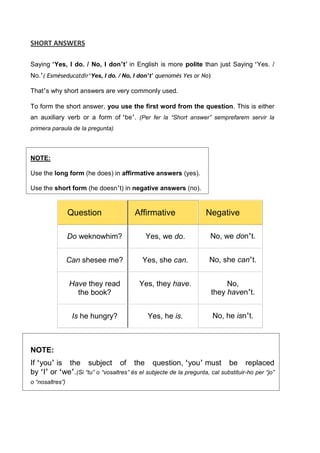
To form the short answer, you use the first word from the question. This is either
an auxiliary verb or a form of ‘be’. (Per fer la “Short answer” semprefarem servir la
primera paraula de la pregunta)


NOTE:

Use the long form (he does) in affirmative answers (yes).

Use the short form (he doesn’t) in negative answers (no).


                 Question               Affirmative                 Negative

                 Do weknowhim?              Yes, we do.               No, we don’t.


                 Can shesee me?            Yes, she can.             No, she can’t.


                 Have they read           Yes, they have.                  No,
                   the book?                                          they haven’t.


                  Is he hungry?              Yes, he is.              No, he isn’t.


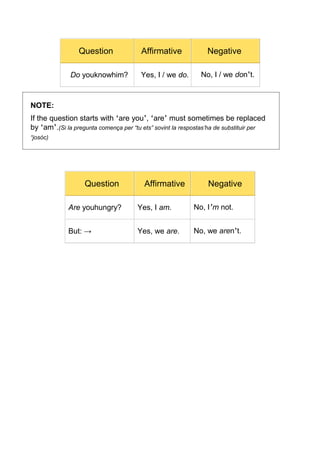
NOTE:
If ‘you’ is the subject of the question, ‘you’ must be replaced
by ‘I’ or ‘we’.(Si “tu” o “vosaltres” és el subjecte de la pregunta, cal substituir-ho per “jo”
o “nosaltres”)
Question               Affirmative             Negative

              Do youknowhim?           Yes, I / we do.       No, I / we don’t.


NOTE:
If the question starts with ‘are you’, ‘are’ must sometimes be replaced
by ‘am’.(Si la pregunta comença per “tu ets” sovint la respostas’ha de substituir per
“josóc)


                   Question              Affirmative            Negative

             Are youhungry?           Yes, I am.           No, I’m not.


             But: →                   Yes, we are.         No, we aren’t.

Short answers

  • 1.
    SHORT ANSWERS Saying ‘Yes,I do. / No, I don’t’ in English is more polite than just Saying ‘Yes. / No.’( Esméseducatdir‘Yes, I do. / No, I don’t’ quenomés Yes or No) That’s why short answers are very commonly used. To form the short answer, you use the first word from the question. This is either an auxiliary verb or a form of ‘be’. (Per fer la “Short answer” semprefarem servir la primera paraula de la pregunta) NOTE: Use the long form (he does) in affirmative answers (yes). Use the short form (he doesn’t) in negative answers (no). Question Affirmative Negative Do weknowhim? Yes, we do. No, we don’t. Can shesee me? Yes, she can. No, she can’t. Have they read Yes, they have. No, the book? they haven’t. Is he hungry? Yes, he is. No, he isn’t. NOTE: If ‘you’ is the subject of the question, ‘you’ must be replaced by ‘I’ or ‘we’.(Si “tu” o “vosaltres” és el subjecte de la pregunta, cal substituir-ho per “jo” o “nosaltres”)
  • 2.
    Question Affirmative Negative Do youknowhim? Yes, I / we do. No, I / we don’t. NOTE: If the question starts with ‘are you’, ‘are’ must sometimes be replaced by ‘am’.(Si la pregunta comença per “tu ets” sovint la respostas’ha de substituir per “josóc) Question Affirmative Negative Are youhungry? Yes, I am. No, I’m not. But: → Yes, we are. No, we aren’t.