
The value of a horse depends on his ability to perform work. To
this end, four sound feet are indispensable. Oddly enough, foot
troubles and the necessity for shoeing are largely manmade. The
wild horse seems to have been practically free from serious foot
trouble. But with domestication these troubles began to appear.
The horse was brought from soft pasture to hard roads; from self-
regulated exercise to enforced work; from healthy pasture to filthy
housing where he was often made to stand in his own feces and
urine or in mud; and from a light,self limiting maintenance ration
to the heavy, artificial diet necessary for work.
REASONS FOR SHOEING
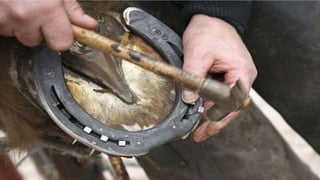
• Shoeing is a necessary evil. Nailing an iron plate to a horse's foot does
not make walking easier for him. The added weight of a shoe does not
make for agility. While the foot and leg are engineered to minimize shock
and road concussion, shoeing only increases them. Nail holes made in
attaching the shoe help to weaken the hoof wall and may provide entries
for infection or separation. Allowing a horse to wear the same shoes too
long also invites trouble. Since the hoof wall grows out perpendicularly to
the coronary band, the horse's base of support actually grows out from
under him if shoes are left on too long. This transfers excessive strain to
flexor tendons. Shoes worn too long grow thin and become loose, bend
dangerously and may shift, causin shoe-nail punctures or "corns."
• Shoes protect the hoof against excessive wear when unusual work is
required. They provide better traction under unfavorable conditions of
terrain, such as ice and mud. They help correct defects of stance or gait,
often
• making it possible for an unsound horse to render satisfactory service. Shoes may
be used to help cure disease or defective hooves (contracted heels, thrush,
divided tendons). They also may be used to afford relief from the pain of injured
parts (hoof-wall cracks, bruised soles, tendinitis). Shoe horses to be used on hard
surfaces to prevent the wall from wearing down to the sensitive tissues beneath. A
correctly shod horse is a more efficient performer. Shoes may be used to change
gaits and action, to correct faulty hoof structure or growth, and to protect the hoof
itself from such conditions as corns, contraction, or cracks. Racing "plates" are
used on running horses to aid in
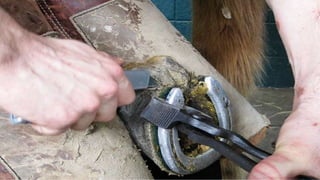
gripping the track. Shoeing always should be done by a farrier
who is thoroughly experienced in the art. Shoes should be made
to fit the foot, not the foot to fit the shoe. Reshoe or reset at
4- to 6-week intervals. If you leave shoes on too long the hoofs
grow out of proportion. This may throw the horse off balance.
SHOEING PROCEDURE
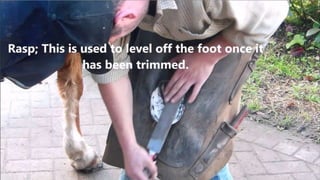
• Begin when foal is only a few months old. Keep feet well rounded.
Exercise foals on dry ground to allow natural wear. If kept in stall, rasp
down every 2 to 3 weeks. Clean soles and clefts of frog frequently. Do not
pare out sole, just clean. Do not trim away healthy frog unless there is
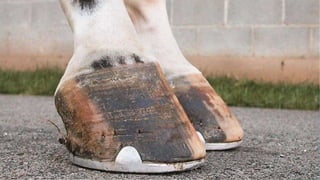
clearly an excess. (See illustration B.) Keep foot straight with angle of
short pastern. Front hoof-to-ground angle should be approximately 45°
(See illustration B.) Rear hoof-to-ground angle should be approximately
45° (See illustration B.) Rasp sharp edge of hoof wall to make bearing
surface approximately true thickness of wall. (See illustration C.) Do not
rasp outside wall. Always rasp in such a manner that the heel is included
in each stroke. (See illustration D.)
COMMON FAULTS CORRECTED BY TRIMMING
• Splayfoot (front toes turned out, heels turned in) can be helped or corrected by
trimming the outer half of the foot. Pigeon Toe (front toes turned in, heels turned
out opposite of splayfoot) can be helped or corrected by trimming the inner half
of the foot more than the outer half. Quarter Crack (a vertical crack on the side
of the hoof) usually can be corrected if the hoof is kept moist and the toes
shortened. Cocked Ankles (standing bent forward on the fetlocks-usually hind
fetlocks)
can be helped or corrected by lowering the heels. Cocked ankles will not occur if
foals are allowed to get ample exercise and are not overfed, and the foal's heels
are kept trimmed so that there is plenty of frog pressure. Contracted Heels (close
at heels) can be spread apart if the heels are lowered and the frog allowed to carry
more of the animal's weight
SHOEING PROCEDURE IN HORSES

SHOEING PROCEDURE IN HORSES

  • 3.
    The value ofa horse depends on his ability to perform work. To this end, four sound feet are indispensable. Oddly enough, foot troubles and the necessity for shoeing are largely manmade. The wild horse seems to have been practically free from serious foot trouble. But with domestication these troubles began to appear. The horse was brought from soft pasture to hard roads; from self- regulated exercise to enforced work; from healthy pasture to filthy housing where he was often made to stand in his own feces and urine or in mud; and from a light,self limiting maintenance ration to the heavy, artificial diet necessary for work.
  • 4.
    REASONS FOR SHOEING •Shoeing is a necessary evil. Nailing an iron plate to a horse's foot does not make walking easier for him. The added weight of a shoe does not make for agility. While the foot and leg are engineered to minimize shock and road concussion, shoeing only increases them. Nail holes made in attaching the shoe help to weaken the hoof wall and may provide entries for infection or separation. Allowing a horse to wear the same shoes too long also invites trouble. Since the hoof wall grows out perpendicularly to the coronary band, the horse's base of support actually grows out from under him if shoes are left on too long. This transfers excessive strain to flexor tendons. Shoes worn too long grow thin and become loose, bend dangerously and may shift, causin shoe-nail punctures or "corns." • Shoes protect the hoof against excessive wear when unusual work is required. They provide better traction under unfavorable conditions of terrain, such as ice and mud. They help correct defects of stance or gait, often
  • 5.
    • making itpossible for an unsound horse to render satisfactory service. Shoes may be used to help cure disease or defective hooves (contracted heels, thrush, divided tendons). They also may be used to afford relief from the pain of injured parts (hoof-wall cracks, bruised soles, tendinitis). Shoe horses to be used on hard surfaces to prevent the wall from wearing down to the sensitive tissues beneath. A correctly shod horse is a more efficient performer. Shoes may be used to change gaits and action, to correct faulty hoof structure or growth, and to protect the hoof itself from such conditions as corns, contraction, or cracks. Racing "plates" are used on running horses to aid in gripping the track. Shoeing always should be done by a farrier who is thoroughly experienced in the art. Shoes should be made to fit the foot, not the foot to fit the shoe. Reshoe or reset at 4- to 6-week intervals. If you leave shoes on too long the hoofs grow out of proportion. This may throw the horse off balance.
  • 6.
    SHOEING PROCEDURE • Beginwhen foal is only a few months old. Keep feet well rounded. Exercise foals on dry ground to allow natural wear. If kept in stall, rasp down every 2 to 3 weeks. Clean soles and clefts of frog frequently. Do not pare out sole, just clean. Do not trim away healthy frog unless there is clearly an excess. (See illustration B.) Keep foot straight with angle of short pastern. Front hoof-to-ground angle should be approximately 45° (See illustration B.) Rear hoof-to-ground angle should be approximately 45° (See illustration B.) Rasp sharp edge of hoof wall to make bearing surface approximately true thickness of wall. (See illustration C.) Do not rasp outside wall. Always rasp in such a manner that the heel is included in each stroke. (See illustration D.)
  • 14.
    COMMON FAULTS CORRECTEDBY TRIMMING • Splayfoot (front toes turned out, heels turned in) can be helped or corrected by trimming the outer half of the foot. Pigeon Toe (front toes turned in, heels turned out opposite of splayfoot) can be helped or corrected by trimming the inner half of the foot more than the outer half. Quarter Crack (a vertical crack on the side of the hoof) usually can be corrected if the hoof is kept moist and the toes shortened. Cocked Ankles (standing bent forward on the fetlocks-usually hind fetlocks) can be helped or corrected by lowering the heels. Cocked ankles will not occur if foals are allowed to get ample exercise and are not overfed, and the foal's heels are kept trimmed so that there is plenty of frog pressure. Contracted Heels (close at heels) can be spread apart if the heels are lowered and the frog allowed to carry more of the animal's weight