-: PRESENTED BY :-
ASSISTANT PROF. NATHANI ZEESHAN
MUNAF
DEPT. OF PHARMACOLOGY
SHOCK
PROF. RAVINDRA NIKAM COLLEGE OF PHARMACY
Morane – Gondur By-Pass Road, Near Punam Petrol Pump,
Gondur, Tal. dist. Dhule- 424001
10/7/2020Z.M.NATHANI 1
SHOCK
10/7/2020Z.M.NATHANI 2
CONTENTS
 SHOCK
 DIFFERENT TYPES OF SHOCK
 PATHOPHYSIOLOGY
 SIGN AND SYMPTOMS OF SHOCK
 DRUG THERAPY OF SHOCK
10/7/2020Z.M.NATHANI 3
 Shock is a state in which there is
inadequate blood flow to the tissues to
meet demand.
 Shock and hypotension often co-exist, BUT
a normal blood pressure DOES NOT
exclude the diagnosis of shock.
 There is a lack of blood flow that cause
the organ to failure.
SHOCK
10/7/2020Z.M.NATHANI 4
Different types of Shock:
1.Hypovolemic
2.Cardiogenic
3.Distributive
4.Obstructive 10/7/2020Z.M.NATHANI 5
1. Hypovolemic shock due to inadequate
circulating fluid volume
Causes:
 Divided to hemorrhagic or non-
hemorrhagic
 major burns; gastrointestinal losses:
vomiting, fistulas, urinary losses: diabetes,
diabetes insipid us; evaporative losses with
fever, abdominal surgery
10/7/2020Z.M.NATHANI 6
2. Cardiogenic shock due to cardiac pump
failure resulting from myocardial or valvular
failure
Causes:
 Acute coronary syndrome in this ICU with
CTS specialty we also encounter post-
cardiotomy syndrome
 Other causes: arrhythmia, myocardial
contusions post-trauma; myocarditis: acute
valvular dysfunction: cardiomyopathy echo is
very useful in reviewing the cause and
monitor 10/7/2020Z.M.NATHANI 7
3. Distributive shock due to peripheral vascular
dilation causes a fall in peripheral resistance.
Causes
Septic shock
 Anaphylaxis shock
 Neurogenic shock
10/7/2020Z.M.NATHANI 8
4. Obstructive shock due to obstruction of
great vessels or heart that implies the blood
flow.
Causes
Cardiac pneumothorax
Pulmonary embolism
10/7/2020Z.M.NATHANI 9
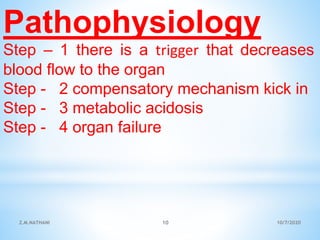
Pathophysiology
Step – 1 there is a trigger that decreases
blood flow to the organ
Step - 2 compensatory mechanism kick in
Step - 3 metabolic acidosis
Step - 4 organ failure
10/7/2020Z.M.NATHANI 10
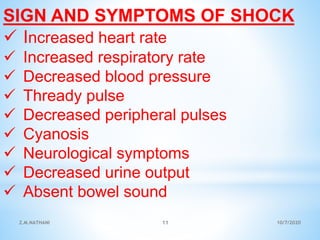
SIGN AND SYMPTOMS OF SHOCK
 Increased heart rate
 Increased respiratory rate
 Decreased blood pressure
 Thready pulse
 Decreased peripheral pulses
 Cyanosis
 Neurological symptoms
 Decreased urine output
 Absent bowel sound
10/7/2020Z.M.NATHANI 11
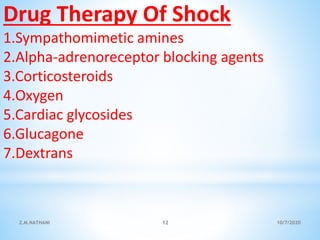
Drug Therapy Of Shock
1.Sympathomimetic amines
2.Alpha-adrenoreceptor blocking agents
3.Corticosteroids
4.Oxygen
5.Cardiac glycosides
6.Glucagone
7.Dextrans
10/7/2020Z.M.NATHANI 12
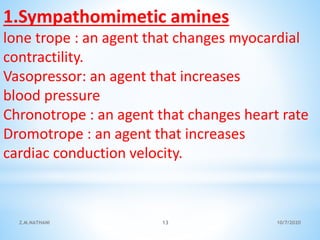
1.Sympathomimetic amines
lone trope : an agent that changes myocardial
contractility.
Vasopressor: an agent that increases
blood pressure
Chronotrope : an agent that changes heart rate
Dromotrope : an agent that increases
cardiac conduction velocity.
10/7/2020Z.M.NATHANI 13
NOREPINEPHRINE
Most widely used vasopressor Potent at agonist
causing vasoconstriction in tissue beds. Resultant
increase in SVR causes rise in blood pressure.
Standard dose : 4 mg in 50 ml (0.08 mg/ml)
EPINEPHRINE
Nature's vasopressor most commonly used
during resuscitation cardiac arrest and
anaphylaxis.
Alpha1: increases SVR
Beta1: increases HR and myocardial contractility.
Beta2: bronchial smooth muscle relaxation
Standard dose : 10 min 0.2mg/ml) 10/7/2020Z.M.NATHANI 14
DOPAMINE
It is a vasopressor agent.
It is use in cardiogenic & septic shock.
Receptor stimulation depend on dose given
Low dose :Beta1-renal perfusion
Medium dose :Beta1-CO
High dose: Alpha1 vasoconstriction, PVR
Standard dose : 0.2-1 mg/min
10/7/2020Z.M.NATHANI 15
DOBUTAMINE
A synthetic catecholamine.
Beta1stimulation: increase HR and increase
cardiac contractility.
Beta 2 mediated vasodilatation.
Reduction in MAP is common with dobutamine.
NE usually needed to offset vasodilatation,
Standard dose : 250mg in 50 ml(5mg/ml)
10/7/2020Z.M.NATHANI 16
2.Alpha-adrenoreceptorblocking agents
1. Pentolamine
2. Phenoxybenzamine
Advantages
1. The harmful effect of vasoconstriction on
microcirculation in tissues is avoided.
2. They permit rapid administration of
intravenous fluid without increasing central
venous pressure.
10/7/2020Z.M.NATHANI 17
Glucocorticoids
(Adrenal Cortex Hormones That Control Glucose
Metabolism).
Glucocorticoids are frequently given to patients
in severe shock for several
10/7/2020Z.M.NATHANI 18
Reasons:
(1) increase the strength of the heart in the
late stages of shock;
(2) glucocorticoids stabilize lysosomes in
tissue cells and thereby prevent release of
lysosome enzymes into the cytoplasm of
the cells, thus preventing deterioration from
this source; and
(3) glucocorticoids might aid in the
metabolism of glucose by their damaged
sells
10/7/2020Z.M.NATHANI 19
Oxygen Therapy.
major effect of shock is too little
delivery of oxygen to the tissues, giving
the patient oxygen to breathe can be of
benefit in many instances.
However, this frequently is far less
beneficial than one might expect,
because the problem in most
types of shock is not inadequate
oxygenation of the blood by the lungs
but inadequate transport of the blood
after it is oxygenated.
10/7/2020Z.M.NATHANI 20
CARDIAC GLYCOSIDES
Increases the myocardial contractility and raises
the cardiac output
Dose - 1-2mg IV.
Side effect - Nausea, vomiting and cardiac
arrhythmias
Increases the myocardial contractility Given in
reduced doses slowly to avoid
peripheral vasoconstrictive action.
GLUCAGON
10/7/2020Z.M.NATHANI 21
DEXTRANS
1. It reduces the viscosity of blood by
inducing a negative charge on the RBCs causing
them to repel each other.
2. Improves microcirculation.
1. Vasodilator drugs
2. Diuretics
3. Alkalizing agents
4. Heparin
10/7/2020Z.M.NATHANI 22
10/7/2020Z.M.NATHANI 23

Shock

  • 1.
    -: PRESENTED BY:- ASSISTANT PROF. NATHANI ZEESHAN MUNAF DEPT. OF PHARMACOLOGY SHOCK PROF. RAVINDRA NIKAM COLLEGE OF PHARMACY Morane – Gondur By-Pass Road, Near Punam Petrol Pump, Gondur, Tal. dist. Dhule- 424001 10/7/2020Z.M.NATHANI 1
  • 2.
  • 3.
    CONTENTS  SHOCK  DIFFERENTTYPES OF SHOCK  PATHOPHYSIOLOGY  SIGN AND SYMPTOMS OF SHOCK  DRUG THERAPY OF SHOCK 10/7/2020Z.M.NATHANI 3
  • 4.
     Shock isa state in which there is inadequate blood flow to the tissues to meet demand.  Shock and hypotension often co-exist, BUT a normal blood pressure DOES NOT exclude the diagnosis of shock.  There is a lack of blood flow that cause the organ to failure. SHOCK 10/7/2020Z.M.NATHANI 4
  • 5.
    Different types ofShock: 1.Hypovolemic 2.Cardiogenic 3.Distributive 4.Obstructive 10/7/2020Z.M.NATHANI 5
  • 6.
    1. Hypovolemic shockdue to inadequate circulating fluid volume Causes:  Divided to hemorrhagic or non- hemorrhagic  major burns; gastrointestinal losses: vomiting, fistulas, urinary losses: diabetes, diabetes insipid us; evaporative losses with fever, abdominal surgery 10/7/2020Z.M.NATHANI 6
  • 7.
    2. Cardiogenic shockdue to cardiac pump failure resulting from myocardial or valvular failure Causes:  Acute coronary syndrome in this ICU with CTS specialty we also encounter post- cardiotomy syndrome  Other causes: arrhythmia, myocardial contusions post-trauma; myocarditis: acute valvular dysfunction: cardiomyopathy echo is very useful in reviewing the cause and monitor 10/7/2020Z.M.NATHANI 7
  • 8.
    3. Distributive shockdue to peripheral vascular dilation causes a fall in peripheral resistance. Causes Septic shock  Anaphylaxis shock  Neurogenic shock 10/7/2020Z.M.NATHANI 8
  • 9.
    4. Obstructive shockdue to obstruction of great vessels or heart that implies the blood flow. Causes Cardiac pneumothorax Pulmonary embolism 10/7/2020Z.M.NATHANI 9
  • 10.
    Pathophysiology Step – 1there is a trigger that decreases blood flow to the organ Step - 2 compensatory mechanism kick in Step - 3 metabolic acidosis Step - 4 organ failure 10/7/2020Z.M.NATHANI 10
  • 11.
    SIGN AND SYMPTOMSOF SHOCK  Increased heart rate  Increased respiratory rate  Decreased blood pressure  Thready pulse  Decreased peripheral pulses  Cyanosis  Neurological symptoms  Decreased urine output  Absent bowel sound 10/7/2020Z.M.NATHANI 11
  • 12.
    Drug Therapy OfShock 1.Sympathomimetic amines 2.Alpha-adrenoreceptor blocking agents 3.Corticosteroids 4.Oxygen 5.Cardiac glycosides 6.Glucagone 7.Dextrans 10/7/2020Z.M.NATHANI 12
  • 13.
    1.Sympathomimetic amines lone trope: an agent that changes myocardial contractility. Vasopressor: an agent that increases blood pressure Chronotrope : an agent that changes heart rate Dromotrope : an agent that increases cardiac conduction velocity. 10/7/2020Z.M.NATHANI 13
  • 14.
    NOREPINEPHRINE Most widely usedvasopressor Potent at agonist causing vasoconstriction in tissue beds. Resultant increase in SVR causes rise in blood pressure. Standard dose : 4 mg in 50 ml (0.08 mg/ml) EPINEPHRINE Nature's vasopressor most commonly used during resuscitation cardiac arrest and anaphylaxis. Alpha1: increases SVR Beta1: increases HR and myocardial contractility. Beta2: bronchial smooth muscle relaxation Standard dose : 10 min 0.2mg/ml) 10/7/2020Z.M.NATHANI 14
  • 15.
    DOPAMINE It is avasopressor agent. It is use in cardiogenic & septic shock. Receptor stimulation depend on dose given Low dose :Beta1-renal perfusion Medium dose :Beta1-CO High dose: Alpha1 vasoconstriction, PVR Standard dose : 0.2-1 mg/min 10/7/2020Z.M.NATHANI 15
  • 16.
    DOBUTAMINE A synthetic catecholamine. Beta1stimulation:increase HR and increase cardiac contractility. Beta 2 mediated vasodilatation. Reduction in MAP is common with dobutamine. NE usually needed to offset vasodilatation, Standard dose : 250mg in 50 ml(5mg/ml) 10/7/2020Z.M.NATHANI 16
  • 17.
    2.Alpha-adrenoreceptorblocking agents 1. Pentolamine 2.Phenoxybenzamine Advantages 1. The harmful effect of vasoconstriction on microcirculation in tissues is avoided. 2. They permit rapid administration of intravenous fluid without increasing central venous pressure. 10/7/2020Z.M.NATHANI 17
  • 18.
    Glucocorticoids (Adrenal Cortex HormonesThat Control Glucose Metabolism). Glucocorticoids are frequently given to patients in severe shock for several 10/7/2020Z.M.NATHANI 18
  • 19.
    Reasons: (1) increase thestrength of the heart in the late stages of shock; (2) glucocorticoids stabilize lysosomes in tissue cells and thereby prevent release of lysosome enzymes into the cytoplasm of the cells, thus preventing deterioration from this source; and (3) glucocorticoids might aid in the metabolism of glucose by their damaged sells 10/7/2020Z.M.NATHANI 19
  • 20.
    Oxygen Therapy. major effectof shock is too little delivery of oxygen to the tissues, giving the patient oxygen to breathe can be of benefit in many instances. However, this frequently is far less beneficial than one might expect, because the problem in most types of shock is not inadequate oxygenation of the blood by the lungs but inadequate transport of the blood after it is oxygenated. 10/7/2020Z.M.NATHANI 20
  • 21.
    CARDIAC GLYCOSIDES Increases themyocardial contractility and raises the cardiac output Dose - 1-2mg IV. Side effect - Nausea, vomiting and cardiac arrhythmias Increases the myocardial contractility Given in reduced doses slowly to avoid peripheral vasoconstrictive action. GLUCAGON 10/7/2020Z.M.NATHANI 21
  • 22.
    DEXTRANS 1. It reducesthe viscosity of blood by inducing a negative charge on the RBCs causing them to repel each other. 2. Improves microcirculation. 1. Vasodilator drugs 2. Diuretics 3. Alkalizing agents 4. Heparin 10/7/2020Z.M.NATHANI 22
  • 23.