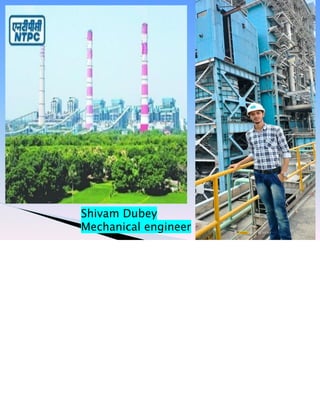
Shivam Dubey
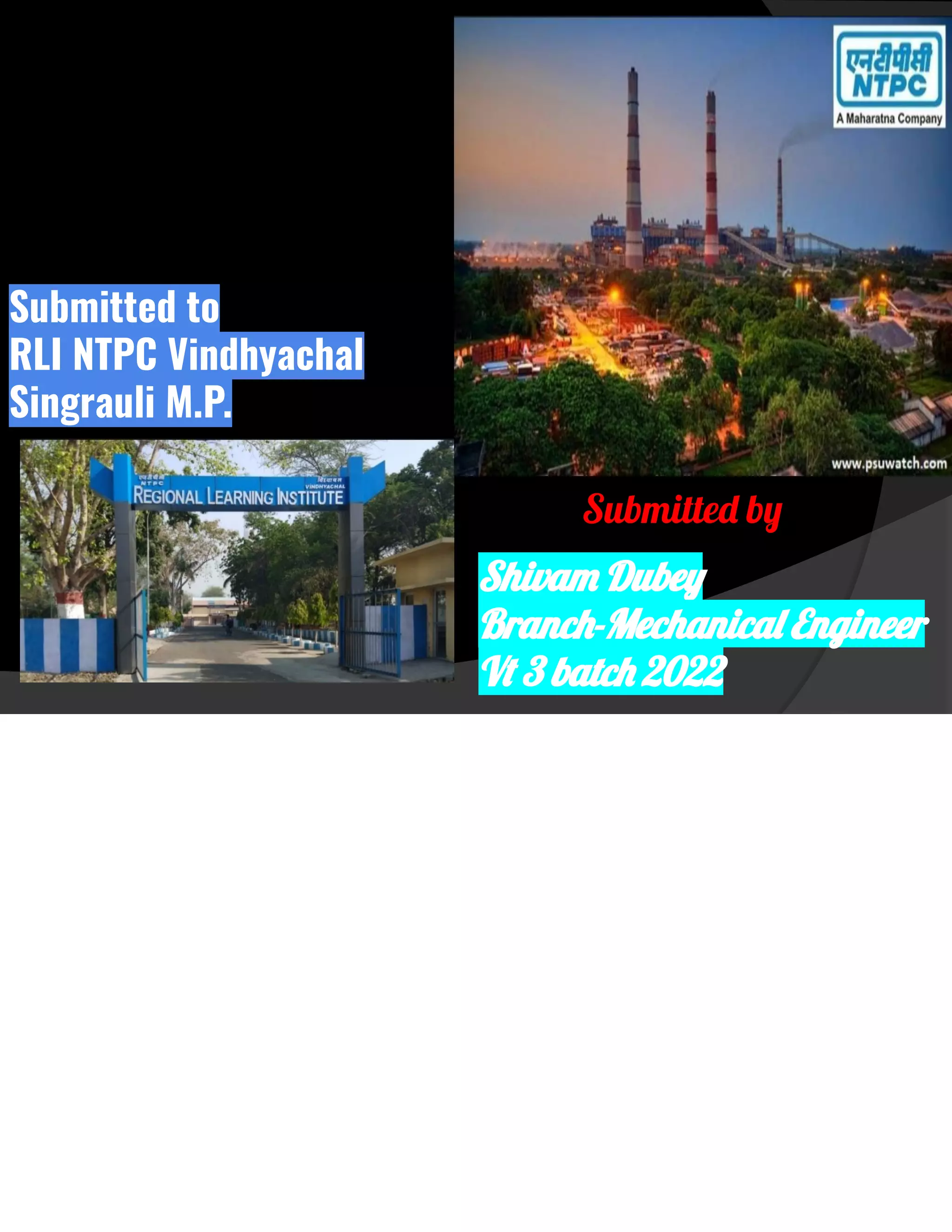
Branch-Mechanical Engineer
Vt 3 batch 2022
Submitted by
Submitted to
RLI NTPC Vindhyachal
Singrauli M.P.
NATIONAL THERMAL POWER
CORPORATION Ltd.
Shivam Dubey mechanical engineer
NATIONAL THERMAL POWER CORPORATION
LTD VINDHYACHAL (M.P)
3
VOCATIONAL TRAINING PRESENTATION
ON
“THERMAL POWER PLANT”
Presented by
Shivam Dubey
4
Content:-
❑ Introduction
❑ Coal Handling Plant(CHP) :-
1. Coal source
2. Crushing
3. Pulverization
4. Furnace ( burning step)
❑ Main Plant :- 1. Boiler
2. Steam Turbine
3. cooling tower
4. generator
5. electricity cable
6. step up transformer
❑ Ash handling plant (AHP)
❑ Safety
❑ Advantages
❑ Disadvantages
5
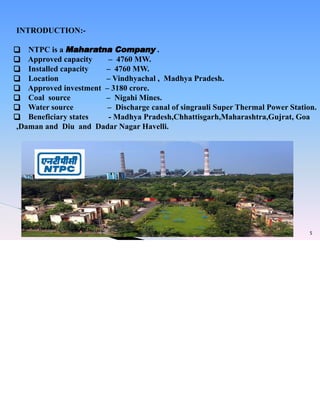
INTRODUCTION:-
❑ NTPC is a Maharatna Company .
❑ Approved capacity – 4760 MW.
❑ Installed capacity – 4760 MW.
❑ Location – Vindhyachal , Madhya Pradesh.
❑ Approved investment – 3180 crore.
❑ Coal source – Nigahi Mines.
❑ Water source – Discharge canal of singrauli Super Thermal Power Station.
❑ Beneficiary states - Madhya Pradesh,Chhattisgarh,Maharashtra,Gujrat, Goa
,Daman and Diu and Dadar Nagar Havelli.
6
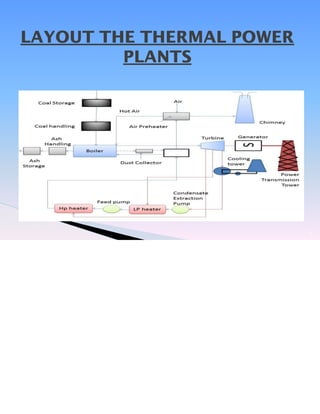
LAYOUT THE THERMAL POWER
PLANTS
❑ Sources of coal in NTPC - Kusmunda block & Gevra
mines.
❑ Resources of coal – By road and by trains.
❑ Coal size – 200mm approx.
7
COAL HANDLING PLANT
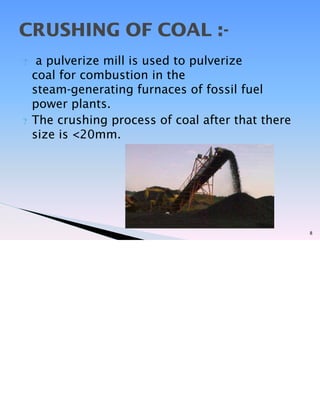
? a pulverize mill is used to pulverize
coal for combustion in the
steam-generating furnaces of fossil fuel
power plants.
? The crushing process of coal after that there
size is <20mm.
8
CRUSHING OF COAL :-
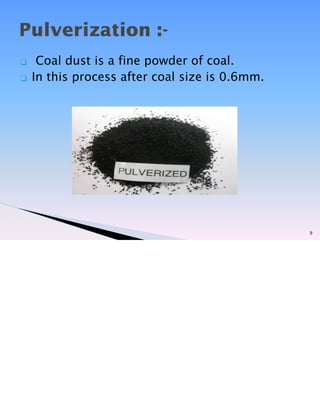
❑ Coal dust is a fine powder of coal.
❑ In this process after coal size is 0.6mm.
9
Pulverization :-
? A furnace is a device used for
high-temperature heating.
? The heat energy to fuel a furnace may be
supplied directly by fuel combustion, by
electricity such as the electric arc furnace, or
through induction heating in induction
furnaces.
10
Furnace (burning step) :-
? A boiler is a closed vessel in which water or
other fluid is heated.
? Boilers produce steam to be used
at saturation temperature.
11
BOILER :-
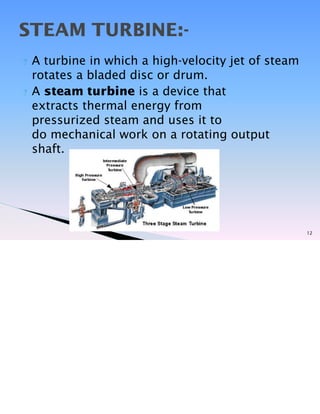
? A turbine in which a high-velocity jet of steam
rotates a bladed disc or drum.
? A steam turbine is a device that
extracts thermal energy from
pressurized steam and uses it to
do mechanical work on a rotating output
shaft.
12
STEAM TURBINE:-
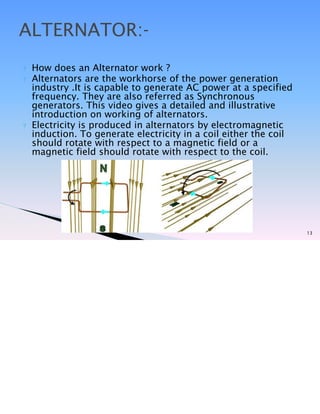
? How does an Alternator work ?
? Alternators are the workhorse of the power generation
industry .It is capable to generate AC power at a specified
frequency. They are also referred as Synchronous
generators. This video gives a detailed and illustrative
introduction on working of alternators.
? Electricity is produced in alternators by electromagnetic
induction. To generate electricity in a coil either the coil
should rotate with respect to a magnetic field or a
magnetic field should rotate with respect to the coil.
13
ALTERNATOR:-
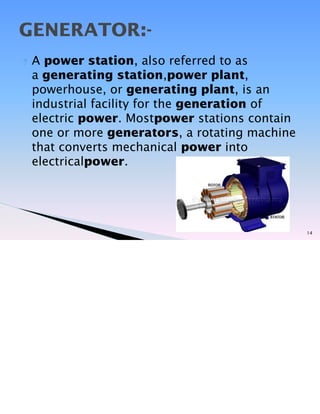
? A power station, also referred to as
a generating station,power plant,
powerhouse, or generating plant, is an
industrial facility for the generation of
electric power. Mostpower stations contain
one or more generators, a rotating machine
that converts mechanical power into
electricalpower.
14
GENERATOR:-
? The giant, jug-shaped cooling towers you see
at old power plants make the turbine more
efficient. Boiling hot water from the steam
turbine is cooled in a heat exchanger called a
condenser.
15
COOLING TOWER:-
? The electricity travels out of the generator to
a transformer nearby.
16
ELECTRICITY CABLE:-
? Electricity loses some of its energy as it
travels down wire cables, but high-voltage
electricity loses less energy than low-voltage
electricity. So the electricity generated in the
plant is stepped-up (boosted) to a very high
voltage as it leaves the power plant.
17
STEP-UP TRANSFORMER:-
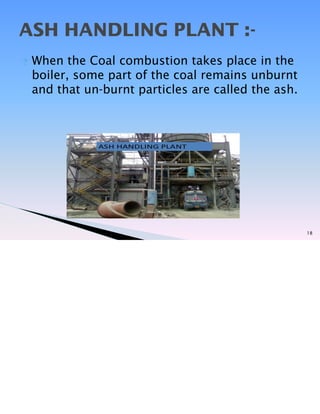
? When the Coal combustion takes place in the
boiler, some part of the coal remains unburnt
and that un-burnt particles are called the ash.
18
ASH HANDLING PLANT :-
19
SAFTEY
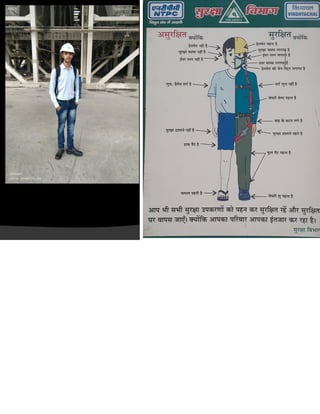
❑ Use of helmet
❑ Do not touch any equipment without permission
❑ Use of shoe when going to inside of plant
? Economical for low initial cost other than any
generating plant.
? Land required less than hydro power plant .
? Since coal is main fuel and its cost is quite cheap
than petrol/diesel so generation cost is
economical.
? There are easier maintenance.
? Thermal power plant can be installed in any
location where transportation & bulk of water are
available.
20
Advantages:
? The running cost for a thermal power station
is comparatively high due to fuel ,
maintenance etc.
? Large amount of smoke causes air pollution.
The thermal power station is responsible for
Global warming.
? The heated water that comes from thermal
power plant has an adverse effect on the lives
in the water and disturbs the ecology.
? Overall efficiency of thermal power plant is
low like less 30%.
21
DISADVANTAGE:-
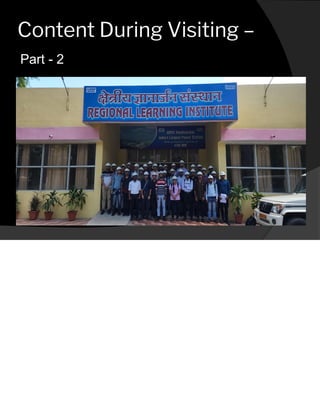
Content During Visiting –
Part - 2
PRESENTATION OUTLINE
1. About the Company
1. Evolution of NTPC
1. NTPC Today
1. NTPC Performance Highlights
1. Introduction To Thermal Power Plant
1. Functioning of Thermal Power Plant
1. Structure of Coal Power Plant
1. Operation
ABOUT THE COMPANY
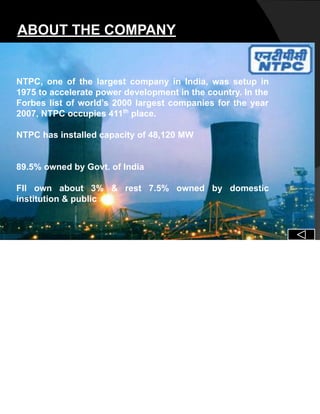
NTPC, one of the largest company in India, was setup in
1975 to accelerate power development in the country. In the
Forbes list of world’s 2000 largest companies for the year
2007, NTPC occupies 411th
place.
NTPC has installed capacity of 48,120 MW
89.5% owned by Govt. of India
FII own about 3% & rest 7.5% owned by domestic
institution & public
EVOLUTION OF NTPC
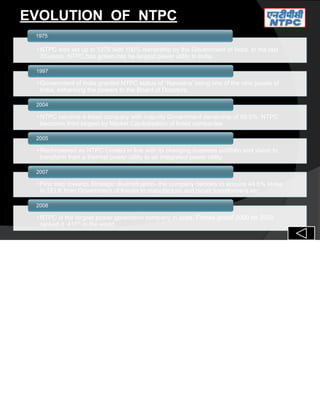
•NTPC was set up in 1975 with 100% ownership by the Government of India. In the last
30 years, NTPC has grown into he largest power utility in India.
1975
•Government of India granted NTPC status of “Navratna’ being one of the nine jewels of
India, enhancing the powers to the Board of Directors.
1997
•NTPC became a listed company with majority Government ownership of 89.5%. NTPC
becomes third largest by Market Capitalisation of listed companies
2004
•Rechristened as NTPC Limited in line with its changing business portfolio and vision to
transform from a thermal power utility to an integrated power utility.
2005
•First step towards Strategic diversification- the company decides to acquire 44.6% stake
in TELK from Government of Kerala to manufacture and repair transformers etc.
2007
•NTPC is the largest power generation company in India. Forbes global 2000 for 2008
ranked it 411th
in the world.
2008
INTRODUCTION
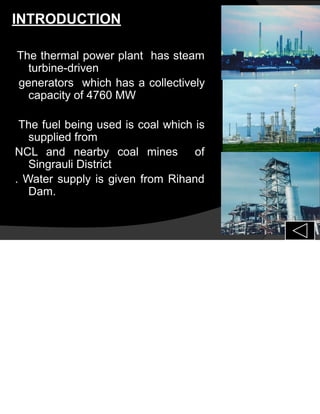
The thermal power plant has steam
turbine-driven
generators which has a collectively
capacity of 4760 MW
The fuel being used is coal which is
supplied from
NCL and nearby coal mines of
Singrauli District
. Water supply is given from Rihand
Dam.
Introduction To Thermal Power Plant
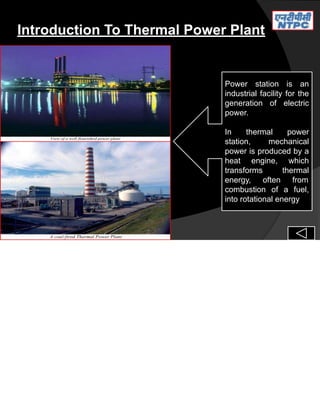
Power station is an
industrial facility for the
generation of electric
power.
In thermal power
station, mechanical
power is produced by a
heat engine, which
transforms thermal
energy, often from
combustion of a fuel,
into rotational energy
Functioning Of Thermal Power Plant
Process of a Thermal
Power Plant
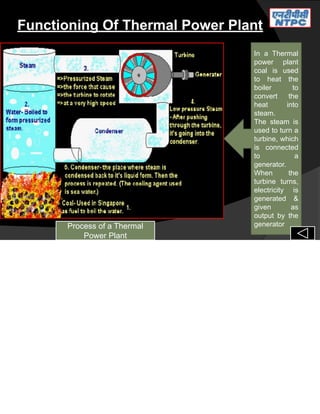
In a Thermal
power plant
coal is used
to heat the
boiler to
convert the
heat into
steam.
The steam is
used to turn a
turbine, which
is connected
to a
generator.
When the
turbine turns,
electricity is
generated &
given as
output by the
generator
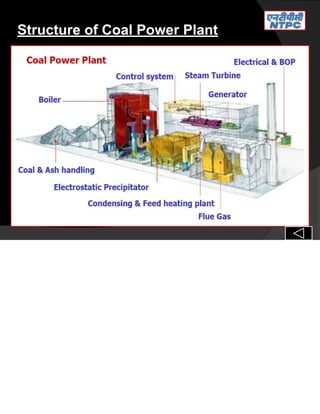
Structure of Coal Power Plant
OPERATION
• Introduction
• Control & Instrumentation (C & I)
• Electrical Maintenance Division II (EMD-II)
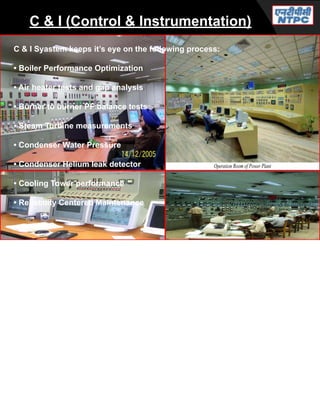
C & I (Control & Instrumentation)
C & I Syastem keeps it’s eye on the following process:
• Boiler Performance Optimization
• Air heater tests and gap analysis
• Burner to burner PF balance tests
• Steam Turbine measurements
• Condenser Water Pressure
• Condenser Helium leak detector
• Cooling Tower performance
• Reliability Centered Maintenance
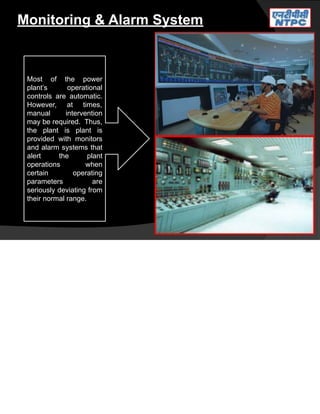
Monitoring & Alarm System
Most of the power
plant’s operational
controls are automatic.
However, at times,
manual intervention
may be required. Thus,
the plant is plant is
provided with monitors
and alarm systems that
alert the plant
operations when
certain operating
parameters are
seriously deviating from
their normal range.
Switchgear
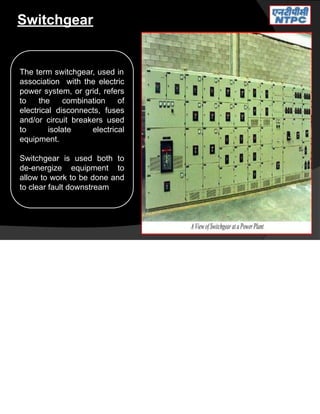
The term switchgear, used in
association with the electric
power system, or grid, refers
to the combination of
electrical disconnects, fuses
and/or circuit breakers used
to isolate electrical
equipment.
Switchgear is used both to
de-energize equipment to
allow to work to be done and
to clear fault downstream
Switchgear
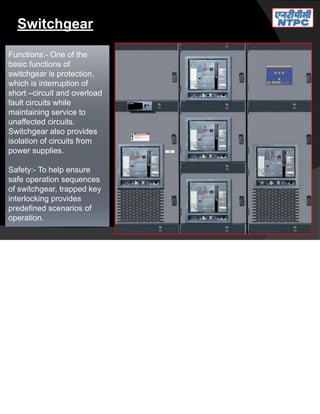
Functions:- One of the
basic functions of
switchgear is protection,
which is interruption of
short –circuit and overload
fault circuits while
maintaining service to
unaffected circuits.
Switchgear also provides
isolation of circuits from
power supplies.
Safety:- To help ensure
safe operation sequences
of switchgear, trapped key
interlocking provides
predefined scenarios of
operation.
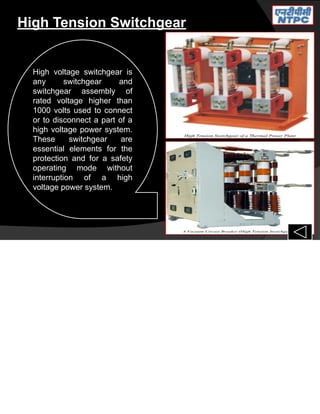
High Tension Switchgear
High voltage switchgear is
any switchgear and
switchgear assembly of
rated voltage higher than
1000 volts used to connect
or to disconnect a part of a
high voltage power system.
These switchgear are
essential elements for the
protection and for a safety
operating mode without
interruption of a high
voltage power system.
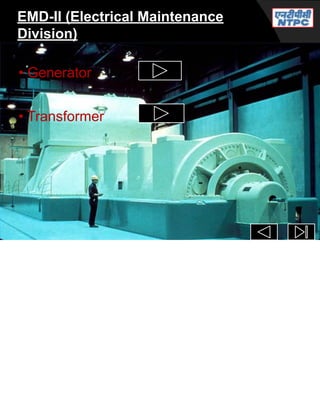
EMD-II (Electrical Maintenance
Division)
• Generator
• Transformer
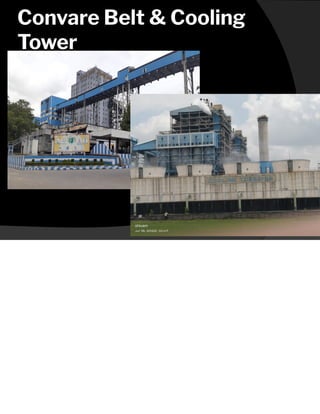
Convare Belt & Cooling
Tower
Generator
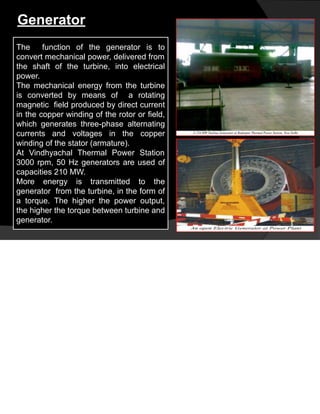
The function of the generator is to
convert mechanical power, delivered from
the shaft of the turbine, into electrical
power.
The mechanical energy from the turbine
is converted by means of a rotating
magnetic field produced by direct current
in the copper winding of the rotor or field,
which generates three-phase alternating
currents and voltages in the copper
winding of the stator (armature).
At Vindhyachal Thermal Power Station
3000 rpm, 50 Hz generators are used of
capacities 210 MW.
More energy is transmitted to the
generator from the turbine, in the form of
a torque. The higher the power output,
the higher the torque between turbine and
generator.
Stator & Rotor
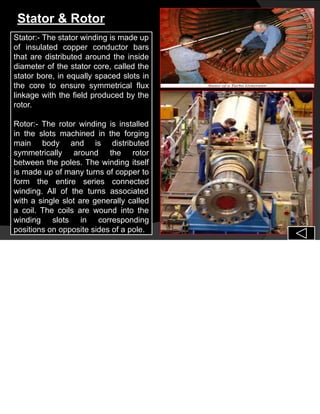
Stator:- The stator winding is made up
of insulated copper conductor bars
that are distributed around the inside
diameter of the stator core, called the
stator bore, in equally spaced slots in
the core to ensure symmetrical flux
linkage with the field produced by the
rotor.
Rotor:- The rotor winding is installed
in the slots machined in the forging
main body and is distributed
symmetrically around the rotor
between the poles. The winding itself
is made up of many turns of copper to
form the entire series connected
winding. All of the turns associated
with a single slot are generally called
a coil. The coils are wound into the
winding slots in corresponding
positions on opposite sides of a pole.
Transformer
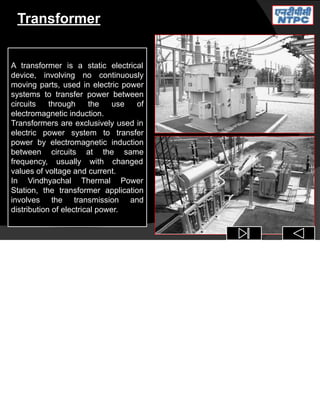
A transformer is a static electrical
device, involving no continuously
moving parts, used in electric power
systems to transfer power between
circuits through the use of
electromagnetic induction.
Transformers are exclusively used in
electric power system to transfer
power by electromagnetic induction
between circuits at the same
frequency, usually with changed
values of voltage and current.
In Vindhyachal Thermal Power
Station, the transformer application
involves the transmission and
distribution of electrical power.
Safety
43
Shivam Dubey
Mechanical engineer
Shivam Dubey trainees mechanical engineering NTPC ltd.Vindhyachal .pdf

Shivam Dubey trainees mechanical engineering NTPC ltd.Vindhyachal .pdf

  • 1.
    Shivam Dubey Branch-Mechanical Engineer Vt3 batch 2022 Submitted by Submitted to RLI NTPC Vindhyachal Singrauli M.P.
  • 2.
    NATIONAL THERMAL POWER CORPORATIONLtd. Shivam Dubey mechanical engineer
  • 3.
    NATIONAL THERMAL POWERCORPORATION LTD VINDHYACHAL (M.P) 3 VOCATIONAL TRAINING PRESENTATION ON “THERMAL POWER PLANT” Presented by Shivam Dubey
  • 4.
    4 Content:- ❑ Introduction ❑ CoalHandling Plant(CHP) :- 1. Coal source 2. Crushing 3. Pulverization 4. Furnace ( burning step) ❑ Main Plant :- 1. Boiler 2. Steam Turbine 3. cooling tower 4. generator 5. electricity cable 6. step up transformer ❑ Ash handling plant (AHP) ❑ Safety ❑ Advantages ❑ Disadvantages
  • 5.
    5 INTRODUCTION:- ❑ NTPC isa Maharatna Company . ❑ Approved capacity – 4760 MW. ❑ Installed capacity – 4760 MW. ❑ Location – Vindhyachal , Madhya Pradesh. ❑ Approved investment – 3180 crore. ❑ Coal source – Nigahi Mines. ❑ Water source – Discharge canal of singrauli Super Thermal Power Station. ❑ Beneficiary states - Madhya Pradesh,Chhattisgarh,Maharashtra,Gujrat, Goa ,Daman and Diu and Dadar Nagar Havelli.
  • 6.
  • 7.
    ❑ Sources ofcoal in NTPC - Kusmunda block & Gevra mines. ❑ Resources of coal – By road and by trains. ❑ Coal size – 200mm approx. 7 COAL HANDLING PLANT
  • 8.
    ? a pulverizemill is used to pulverize coal for combustion in the steam-generating furnaces of fossil fuel power plants. ? The crushing process of coal after that there size is <20mm. 8 CRUSHING OF COAL :-
  • 9.
    ❑ Coal dustis a fine powder of coal. ❑ In this process after coal size is 0.6mm. 9 Pulverization :-
  • 10.
    ? A furnaceis a device used for high-temperature heating. ? The heat energy to fuel a furnace may be supplied directly by fuel combustion, by electricity such as the electric arc furnace, or through induction heating in induction furnaces. 10 Furnace (burning step) :-
  • 11.
    ? A boileris a closed vessel in which water or other fluid is heated. ? Boilers produce steam to be used at saturation temperature. 11 BOILER :-
  • 12.
    ? A turbinein which a high-velocity jet of steam rotates a bladed disc or drum. ? A steam turbine is a device that extracts thermal energy from pressurized steam and uses it to do mechanical work on a rotating output shaft. 12 STEAM TURBINE:-
  • 13.
    ? How doesan Alternator work ? ? Alternators are the workhorse of the power generation industry .It is capable to generate AC power at a specified frequency. They are also referred as Synchronous generators. This video gives a detailed and illustrative introduction on working of alternators. ? Electricity is produced in alternators by electromagnetic induction. To generate electricity in a coil either the coil should rotate with respect to a magnetic field or a magnetic field should rotate with respect to the coil. 13 ALTERNATOR:-
  • 14.
    ? A powerstation, also referred to as a generating station,power plant, powerhouse, or generating plant, is an industrial facility for the generation of electric power. Mostpower stations contain one or more generators, a rotating machine that converts mechanical power into electricalpower. 14 GENERATOR:-
  • 15.
    ? The giant,jug-shaped cooling towers you see at old power plants make the turbine more efficient. Boiling hot water from the steam turbine is cooled in a heat exchanger called a condenser. 15 COOLING TOWER:-
  • 16.
    ? The electricitytravels out of the generator to a transformer nearby. 16 ELECTRICITY CABLE:-
  • 17.
    ? Electricity losessome of its energy as it travels down wire cables, but high-voltage electricity loses less energy than low-voltage electricity. So the electricity generated in the plant is stepped-up (boosted) to a very high voltage as it leaves the power plant. 17 STEP-UP TRANSFORMER:-
  • 18.
    ? When theCoal combustion takes place in the boiler, some part of the coal remains unburnt and that un-burnt particles are called the ash. 18 ASH HANDLING PLANT :-
  • 19.
    19 SAFTEY ❑ Use ofhelmet ❑ Do not touch any equipment without permission ❑ Use of shoe when going to inside of plant
  • 20.
    ? Economical forlow initial cost other than any generating plant. ? Land required less than hydro power plant . ? Since coal is main fuel and its cost is quite cheap than petrol/diesel so generation cost is economical. ? There are easier maintenance. ? Thermal power plant can be installed in any location where transportation & bulk of water are available. 20 Advantages:
  • 21.
    ? The runningcost for a thermal power station is comparatively high due to fuel , maintenance etc. ? Large amount of smoke causes air pollution. The thermal power station is responsible for Global warming. ? The heated water that comes from thermal power plant has an adverse effect on the lives in the water and disturbs the ecology. ? Overall efficiency of thermal power plant is low like less 30%. 21 DISADVANTAGE:-
  • 22.
  • 23.
    PRESENTATION OUTLINE 1. Aboutthe Company 1. Evolution of NTPC 1. NTPC Today 1. NTPC Performance Highlights 1. Introduction To Thermal Power Plant 1. Functioning of Thermal Power Plant 1. Structure of Coal Power Plant 1. Operation
  • 24.
    ABOUT THE COMPANY NTPC,one of the largest company in India, was setup in 1975 to accelerate power development in the country. In the Forbes list of world’s 2000 largest companies for the year 2007, NTPC occupies 411th place. NTPC has installed capacity of 48,120 MW 89.5% owned by Govt. of India FII own about 3% & rest 7.5% owned by domestic institution & public
  • 25.
    EVOLUTION OF NTPC •NTPCwas set up in 1975 with 100% ownership by the Government of India. In the last 30 years, NTPC has grown into he largest power utility in India. 1975 •Government of India granted NTPC status of “Navratna’ being one of the nine jewels of India, enhancing the powers to the Board of Directors. 1997 •NTPC became a listed company with majority Government ownership of 89.5%. NTPC becomes third largest by Market Capitalisation of listed companies 2004 •Rechristened as NTPC Limited in line with its changing business portfolio and vision to transform from a thermal power utility to an integrated power utility. 2005 •First step towards Strategic diversification- the company decides to acquire 44.6% stake in TELK from Government of Kerala to manufacture and repair transformers etc. 2007 •NTPC is the largest power generation company in India. Forbes global 2000 for 2008 ranked it 411th in the world. 2008
  • 26.
    INTRODUCTION The thermal powerplant has steam turbine-driven generators which has a collectively capacity of 4760 MW The fuel being used is coal which is supplied from NCL and nearby coal mines of Singrauli District . Water supply is given from Rihand Dam.
  • 27.
    Introduction To ThermalPower Plant Power station is an industrial facility for the generation of electric power. In thermal power station, mechanical power is produced by a heat engine, which transforms thermal energy, often from combustion of a fuel, into rotational energy
  • 28.
    Functioning Of ThermalPower Plant Process of a Thermal Power Plant In a Thermal power plant coal is used to heat the boiler to convert the heat into steam. The steam is used to turn a turbine, which is connected to a generator. When the turbine turns, electricity is generated & given as output by the generator
  • 29.
    Structure of CoalPower Plant
  • 30.
    OPERATION • Introduction • Control& Instrumentation (C & I) • Electrical Maintenance Division II (EMD-II)
  • 31.
    C & I(Control & Instrumentation) C & I Syastem keeps it’s eye on the following process: • Boiler Performance Optimization • Air heater tests and gap analysis • Burner to burner PF balance tests • Steam Turbine measurements • Condenser Water Pressure • Condenser Helium leak detector • Cooling Tower performance • Reliability Centered Maintenance
  • 33.
    Monitoring & AlarmSystem Most of the power plant’s operational controls are automatic. However, at times, manual intervention may be required. Thus, the plant is plant is provided with monitors and alarm systems that alert the plant operations when certain operating parameters are seriously deviating from their normal range.
  • 34.
    Switchgear The term switchgear,used in association with the electric power system, or grid, refers to the combination of electrical disconnects, fuses and/or circuit breakers used to isolate electrical equipment. Switchgear is used both to de-energize equipment to allow to work to be done and to clear fault downstream
  • 35.
    Switchgear Functions:- One ofthe basic functions of switchgear is protection, which is interruption of short –circuit and overload fault circuits while maintaining service to unaffected circuits. Switchgear also provides isolation of circuits from power supplies. Safety:- To help ensure safe operation sequences of switchgear, trapped key interlocking provides predefined scenarios of operation.
  • 36.
    High Tension Switchgear Highvoltage switchgear is any switchgear and switchgear assembly of rated voltage higher than 1000 volts used to connect or to disconnect a part of a high voltage power system. These switchgear are essential elements for the protection and for a safety operating mode without interruption of a high voltage power system.
  • 37.
  • 38.
    Convare Belt &Cooling Tower
  • 39.
    Generator The function ofthe generator is to convert mechanical power, delivered from the shaft of the turbine, into electrical power. The mechanical energy from the turbine is converted by means of a rotating magnetic field produced by direct current in the copper winding of the rotor or field, which generates three-phase alternating currents and voltages in the copper winding of the stator (armature). At Vindhyachal Thermal Power Station 3000 rpm, 50 Hz generators are used of capacities 210 MW. More energy is transmitted to the generator from the turbine, in the form of a torque. The higher the power output, the higher the torque between turbine and generator.
  • 40.
    Stator & Rotor Stator:-The stator winding is made up of insulated copper conductor bars that are distributed around the inside diameter of the stator core, called the stator bore, in equally spaced slots in the core to ensure symmetrical flux linkage with the field produced by the rotor. Rotor:- The rotor winding is installed in the slots machined in the forging main body and is distributed symmetrically around the rotor between the poles. The winding itself is made up of many turns of copper to form the entire series connected winding. All of the turns associated with a single slot are generally called a coil. The coils are wound into the winding slots in corresponding positions on opposite sides of a pole.
  • 41.
    Transformer A transformer isa static electrical device, involving no continuously moving parts, used in electric power systems to transfer power between circuits through the use of electromagnetic induction. Transformers are exclusively used in electric power system to transfer power by electromagnetic induction between circuits at the same frequency, usually with changed values of voltage and current. In Vindhyachal Thermal Power Station, the transformer application involves the transmission and distribution of electrical power.
  • 42.
  • 43.