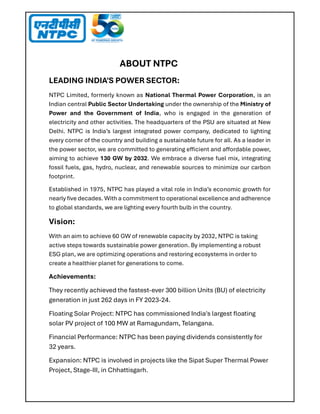
PROJECT REPORT
ON
ELECTRICITY GENERATION AND VIEWING
DIFFERENT COMPONENTS OF THE POWER PLANT
AT
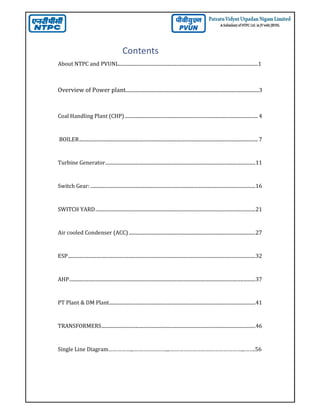
PATRATU VIDYUT UTPADAN NIGAM LIMITED (PVUNL)
SUBMITTED BY:
HEMANT KUMAR
B. TECH ELECTRICAL ENGINEERING
IITRAM, AHMEDABAD
GUIDED BY:
Mr. Satya Ranjan Rout
Deputy General Manager (DGM), NTPC
ACKNOWLEDGEMENT
First and foremost, I would like to express my sincere gratitude to NTPC
Patratu for granting me the opportunity to undergo industrial training at their
prestigious facility. I would especially like to thank Mr. Atul Chauhan, Senior
Engineer in the Civil Department, for giving me this opportunity and for his
valuable guidance throughout the training.
Iam especiallythankfulto my Training Guide Mr. Satya Ranjan Rout, deputy
General Manager (DGM), for his invaluable mentorship, consistent
guidance, and encouragement throughout the course of this training. His
depth of knowledge, supportive nature, and professional insights have been
truly inspiring. It was an honour and privilege to work under his supervision.
I also extend my heartfelt thanks to Mr. Ramesh Manda (Dy. Manager) and
all the sta and employees of NTPC Patratu for their warm reception, kind
cooperation, and the enriching learning environment they provided. Their
support played a crucial role in enhancing the overall training experience.
In addition, I am grateful to Institute of Infrastructure Technology
Research and Management (IITRAM) and the Department of Electrical
Engineering for organizing this training and o ering the necessary academic
and administrative support. This training has enabled me to connect
theoretical knowledge with real-world applications, enriching my technical
understanding and preparing me for future professional challenges.
Thanking you,
HEMANT KUMAR
Contents
About NTPC and PVUNL...................................................................................................................1
Overview of Power plant..............................................................................................................3
Coal Handling Plant (CHP) ........................................................................................................... 4
BOILER................................................................................................................................................ 7
Turbine Generator.........................................................................................................................11
Switch Gear: .....................................................................................................................................16
SWITCH YARD.................................................................................................................................21
Air cooled Condenser (ACC) ......................................................................................................27
ESP.......................................................................................................................................................32
AHP......................................................................................................................................................37
PT Plant & DM Plant......................................................................................................................41
TRANSFORMERS............................................................................................................................46
Single Line Diagram……………...…………………....…………………………………………...…….56
ABOUT NTPC
LEADING INDIA'S POWER SECTOR:
NTPC Limited, formerly known as National Thermal Power Corporation, is an
Indian central Public Sector Undertaking under the ownership of the Ministry of
Power and the Government of India, who is engaged in the generation of
electricity and other activities. The headquarters of the PSU are situated at New
Delhi. NTPC is India’s largest integrated power company, dedicated to lighting
every corner of the country and building a sustainable future for all. As a leader in
the power sector, we are committed to generating e icient and a ordable power,
aiming to achieve 130 GW by 2032. We embrace a diverse fuel mix, integrating
fossil fuels, gas, hydro, nuclear, and renewable sources to minimize our carbon
footprint.
Established in 1975, NTPC has played a vital role in India’s economic growth for
nearly five decades. With a commitment to operational excellence and adherence
to global standards, we are lighting every fourth bulb in the country.
Vision:
With an aim to achieve 60 GW of renewable capacity by 2032, NTPC is taking
active steps towards sustainable power generation. By implementing a robust
ESG plan, we are optimizing operations and restoring ecosystems in order to
create a healthier planet for generations to come.
Achievements:
They recently achieved the fastest-ever 300 billion Units (BU) of electricity
generation in just 262 days in FY 2023-24.
Floating Solar Project: NTPC has commissioned India's largest floating
solar PV project of 100 MW at Ramagundam, Telangana.
Financial Performance: NTPC has been paying dividends consistently for
32 years.
Expansion: NTPC is involved in projects like the Sipat Super Thermal Power
Project, Stage-III, in Chhattisgarh.
ABOUT PVUNL
The JV Company namely Patratu Vidyut Utpadan Nigam Limited (PVUN
Limited) was incorporated on 15.10.2015. It is a joint venture of a subsidiary
of NTPC Ltd with shareholding of 74% and Jharkhand Bijli Vitran Nigam
Limited (JBVNL) with shareholding of 26%.
The JV Company is formed to install 4000 MW coal based thermal power
plant consisting of 5 units of 800 MW each which is to be implemented in
two phases (Phase I : 3 x 800 MW and Phase II: 2 x 800 MW) .
Presently the JV Company is pursuing the Phase-I (3 x 800 MW) of Capacity
addition. The funding for the project is proposed at Debt / Equity Ratio of
75:25. The equity will be contributed by the JV partners, NTPC and JBVNL.
The debt funding has been tied up with Rural Electrification Corporation
(REC).
85% of 4000MW power from the project will be allocated to State of
Jharkhand. Banhardih captive coal block has been allocated to PVUN for
end use. Banhardih Coal Mine has a Reserve of about 956 MT with total area
of ~18 sq. KM. Ministry of Environment, Forest and Climate Change has
given final Environmental Clearance to the project. AAI has issued Civil
Aviation Clearance. Jharkhand Urja Utpadan Nigam Ltd has sanctioned 27
cusec waterforthe thermalproject which shall be drawn from Patratu Dam
reservoir.
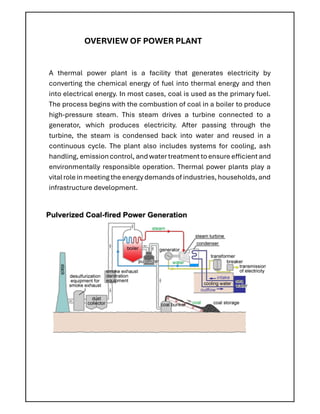
OVERVIEW OF POWER PLANT
A thermal power plant is a facility that generates electricity by
converting the chemical energy of fuel into thermal energy and then
into electrical energy. In most cases, coal is used as the primary fuel.
The process begins with the combustion of coal in a boiler to produce
high-pressure steam. This steam drives a turbine connected to a
generator, which produces electricity. After passing through the
turbine, the steam is condensed back into water and reused in a
continuous cycle. The plant also includes systems for cooling, ash
handling, emissioncontrol, and watertreatment toensure e icient and
environmentally responsible operation. Thermal power plants play a
vital role in meeting the energy demands of industries, households, and
infrastructure development.
Coal Handling Plant (CHP)
Introduction:
The Coal Handling Plant (CHP) in a thermal power plant is responsible for
receiving, storing, and processing coal for efficient boiler combustion. It unloads
coal from wagons or trucks, crushes it to the required size, and removes impurities
like metal and stones. Conveyors then transport the processed coal to storage
bunkers near the boiler. Overall, CHP ensures a continuous, clean, and reliable
supply of coal to support uninterrupted power generation.
There are many processes involved in a Coal Handling Plant (CHP):
 Receives Coal: Coal comes to the power plant from mines using trains
and trucks.
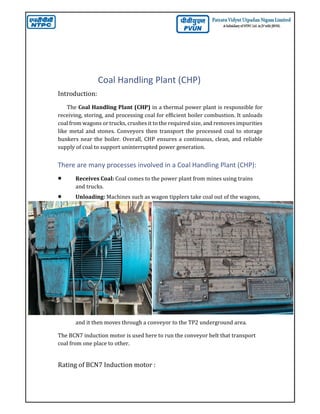
 Unloading: Machines such as wagon tipplers take coal out of the wagons,
and it then moves through a conveyor to the TP2 underground area.
The BCN7 induction motor is used here to run the conveyor belt that transport
coal from one place to other.
Rating of BCN7 Induction motor :
Voltage: 3.3 kV, Current (Rotor Amps): 80.8 A, Speed: 1500 RPM, Efficiency:
95.2%, Weight: 3350 kg, Protection: IP55(Ingress protection(Dust and Water)),
Cooling Type: IC 411, Bearing: 6224 C3, Temperature Rise: 70°C, Insulation Class:
F, Temperature Rise: 70°C and Gear rotor type.
 Crushing Process:
Crushers reduce big
pieces of coal into
smaller pieces. After
the crashing, sent to the
stacker (2 Stacker) via
conveyer belt.
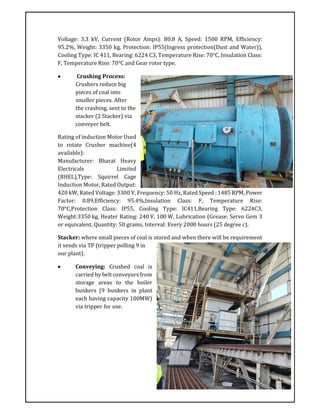
Rating of induction Motor Used
to rotate Crusher machine(4
available):
Manufacturer: Bharat Heavy
Electricals Limited
(BHEL),Type: Squirrel Cage
Induction Motor, Rated Output:
420 kW, Rated Voltage: 3300 V, Frequency: 50 Hz, Rated Speed : 1485 RPM, Power
Factor: 0.89,Efficiency: 95.4%,Insulation Class: F, Temperature Rise:
70°C,Protection Class: IP55, Cooling Type: IC411,Bearing Type: 6224C3,
Weight:3350 kg, Heater Rating: 240 V, 100 W, Lubrication (Grease: Servo Gem 3
or equivalent, Quantity: 50 grams, Interval: Every 2000 hours (25 degree c).
Stacker: where small pieces of coal is stored and when there will be requirement
it sends via TP (tripper polling 9 in
our plant).
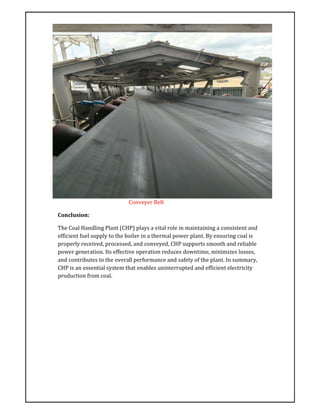
 Conveying: Crushed coal is
carried by belt conveyors from
storage areas to the boiler
bunkers (9 bunkers in plant
each having capacity 100MW)
via tripper for use.
Conveyer Belt
Conclusion:
The Coal Handling Plant (CHP) plays a vital role in maintaining a consistent and
efficient fuel supply to the boiler in a thermal power plant. By ensuring coal is
properly received, processed, and conveyed, CHP supports smooth and reliable
power generation. Its effective operation reduces downtime, minimizes losses,
and contributes to the overall performance and safety of the plant. In summary,
CHP is an essential system that enables uninterrupted and efficient electricity
production from coal.
BOILER
Introduction
A boiler in a thermal power plant is a closed vessel that uses the heat from burning coal
(or other fuels) to convert water into high-pressure steam. This steam is then used to
rotate a steam turbine, which drives a generator to produce electricity. The boiler plays
a vital role in the energy conversion process. It includes various parts like the furnace,
economizer, superheater, and water walls to improve efficiency and ensure safe
operation. Without the boiler, steam generation and thus electricity production would
not be possible in a thermal plant.
Working Principle
The working principle of a boiler is based on the conversion of chemical energy from
fuel into thermal energy, which is then used to heat water and produce steam. This
process takes place inside a closed, pressurized vessel and is governed by the principles
of thermodynamics and heat transfer. The steam generated is used for power generation,
heating, or various industrial processes.
Working of Boiler:
 Fuel Feeding (Coal Handling):
Coal is transported and crushed into fine powder using a pulveriser. This
fine coal is easier to burn.
 Air Preheating:
Before burning, the air required for combustion is passed through an air
preheater. This device uses hot flue gases to warm up the air, improving
combustion efficiency.
 Combustion in Furnace:
The preheated air and powdered coal are sent into the boiler furnace, where
the coal burns to produce heat. This creates hot flue gases.
 Water Heating in Boiler Tubes:
Water circulates through water wall tubes around the furnace. The heat from
the burning coal turns this water into steam.
 Economizer (Preheating Feedwater):
Before water enters the boiler drum, it passes through the economizer,
where it is preheated using the leftover heat from flue gases. This increases
boiler efficiency by reducing the energy needed to heat the water to steam.
 Steam Drum and Steam Separation:
The steam and water mixture enters the steam drum, where water and
steam are separated. The water is recirculated, and the steam moves
ahead.
 Superheater (Steam Heating): The
steam is then passed through the superheater tubes, where it is heated
further by the flue gases. This superheated steam has higher pressure
and temperature, ideal for turning the turbine.
 Turbine and Generator:
The superheated steam is sent to the steam turbine, where it spins the
blades connected to a generator. The generator produces electricity.
 Flue Gas Outlet (Chimney):
The remaining hot gases pass through the air preheater and then go out
through the chimney, after most of their heat is recovered.
Components of Boiler Section
 Boiler Drum: The boiler drum functions as a crucial steam-water
separator in the boiler system. It maintains the required pressure and
temporarily stores saturated steam before it is directed to the
superheater for further heating.
2. Water Walls/ Furnace Wall Tubes: Tubes lining the furnace walls where
water circulates and absorbs radiant heat to begin steam formation.
3. Superheater: Heat Saturated steam to superheated steam (dry, high
energy) for driving turbines more efficiently.
4. Reheater: Reheats partially expanded steam from the turbine and sends it
back to continue expansion, improving efficiency.
5. Economizer: Recovers heat from flue gases to preheat feedwater before it
enters the boiler, increasing efficiency.
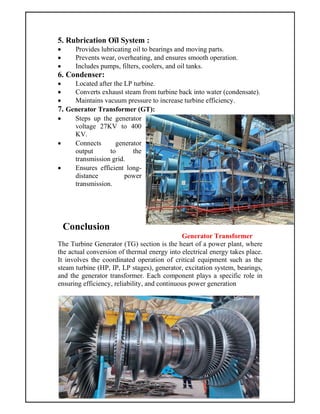
6. Air Preheater (APH): Uses exhaust flue gases to preheat the incoming
combustion air, improving combustion and saving fuel.
7. Burners: Inject and mix fuel and air into the furnace for efficient combustion.
8. Pulverizes (Mills): Crush coal into fine powder to improve burning efficiency
in the furnace.
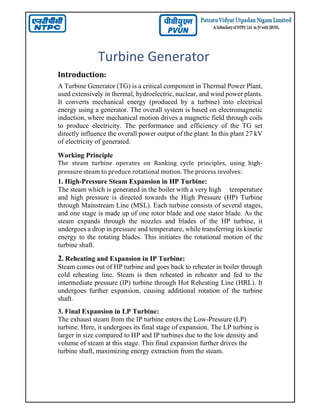
9. Forced Draft Fan (FD) Fan: Pushes fresh air into the boiler furnace for
combustion.
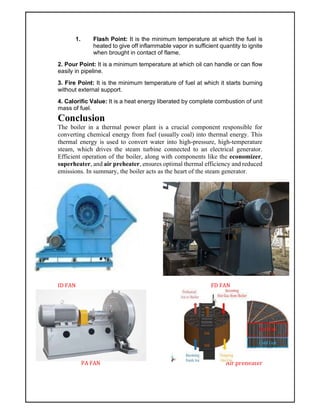
10. Induced Draft Fan (ID) Fan: Pulls flue gases out of the boiler and sends
them to the chimney.
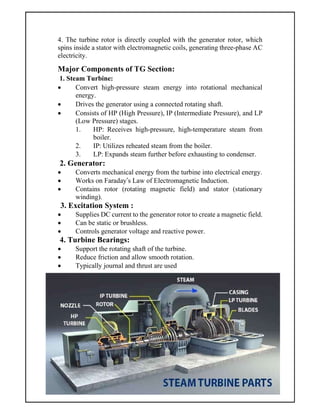
11. Primary Air Fan (PA) Fan: Supplies air to transport pulverized coal from
mills to burners and supports initial combustion.
12. Boiler Feed Pumps (BFP): Pumps high pressure feedwater into the boiler
drum or economizer.
13. Deaerator: Removes dissolved oxygen and Gases from feed water to
prevent corrosion.
14. Safety Valves: Automatically release steam if boiler pressure exceeds safe
limits, preventing corrosion.
15. Scoot Blowers: Clean ash / soot deposits from boiler tubes using high
pressure steam or air to maintain heat transfer.
16. Boiler Control System: Monitors and controls temperature, pressure, fuel-
air ratio, and water level for safe and efficient operation.
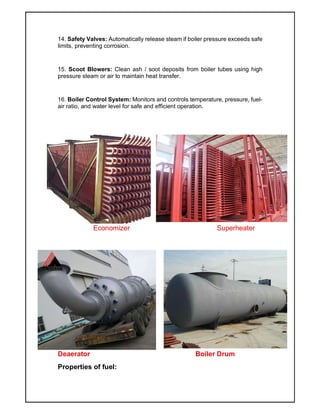
Economizer Superheater
Deaerator Boiler Drum
Properties of fuel:
1. Flash Point: It is the minimum temperature at which the fuel is
heated to give off inflammable vapor in sufficient quantity to ignite
when brought in contact of flame.
2. Pour Point: It is a minimum temperature at which oil can handle or can flow
easily in pipeline.
3. Fire Point: It is the minimum temperature of fuel at which it starts burning
without external support.
4. Calorific Value: It is a heat energy liberated by complete combustion of unit
mass of fuel.
Conclusion
The boiler in a thermal power plant is a crucial component responsible for
converting chemical energy from fuel (usually coal) into thermal energy. This
thermal energy is used to convert water into high-pressure, high-temperature
steam, which drives the steam turbine connected to an electrical generator.
Efficient operation of the boiler, along with components like the economizer,
superheater, and air preheater, ensures optimal thermal efficiency and reduced
emissions. In summary, the boiler acts as the heart of the steam generator.
ID FAN FD FAN
PA FAN Air preheater
Turbine Generator
Introduction:
A Turbine Generator (TG) is a critical component in Thermal Power Plant,
used extensively in thermal, hydroelectric, nuclear, and wind power plants.
It converts mechanical energy (produced by a turbine) into electrical
energy using a generator. The overall system is based on electromagnetic
induction, where mechanical motion drives a magnetic field through coils
to produce electricity. The performance and efficiency of the TG set
directly influence the overall power output of the plant. In this plant 27 kV
of electricity of generated.
Working Principle
The steam turbine operates on Ranking cycle principles, using high-
pressure steam to produce rotational motion. The process involves:
1. High-Pressure Steam Expansion in HP Turbine:
The steam which is generated in the boiler with a very high temperature
and high pressure is directed towards the High Pressure (HP) Turbine
through Mainstream Line (MSL). Each turbine consists of several stages,
and one stage is made up of one rotor blade and one stator blade. As the
steam expands through the nozzles and blades of the HP turbine, it
undergoes a drop in pressure and temperature, while transferring its kinetic
energy to the rotating blades. This initiates the rotational motion of the
turbine shaft.
2. Reheating and Expansion in IP Turbine:
Steam comes out of HP turbine and goes back to reheater in boiler through
cold reheating line. Steam is then reheated in reheater and fed to the
intermediate pressure (IP) turbine through Hot Reheating Line (HRL). It
undergoes further expansion, causing additional rotation of the turbine
shaft.
3. Final Expansion in LP Turbine:
The exhaust steam from the IP turbine enters the Low-Pressure (LP)
turbine. Here, it undergoes its final stage of expansion. The LP turbine is
larger in size compared to HP and IP turbines due to the low density and
volume of steam at this stage. This final expansion further drives the
turbine shaft, maximizing energy extraction from the steam.
4. The turbine rotor is directly coupled with the generator rotor, which
spins inside a stator with electromagnetic coils, generating three-phase AC
electricity.
Major Components of TG Section:
1. Steam Turbine:
 Convert high-pressure steam energy into rotational mechanical
energy.
 Drives the generator using a connected rotating shaft.
 Consists of HP (High Pressure), IP (Intermediate Pressure), and LP
(Low Pressure) stages.
1. HP: Receives high-pressure, high-temperature steam from
boiler.
2. IP: Utilizes reheated steam from the boiler.
3. LP: Expands steam further before exhausting to condenser.
2. Generator:
 Converts mechanical energy from the turbine into electrical energy.
 Works on Faraday’s Law of Electromagnetic Induction.
 Contains rotor (rotating magnetic field) and stator (stationary
winding).
3. Excitation System :
 Supplies DC current to the generator rotor to create a magnetic field.
 Can be static or brushless.
 Controls generator voltage and reactive power.
4. Turbine Bearings:
 Support the rotating shaft of the turbine.
 Reduce friction and allow smooth rotation.
 Typically journal and thrust are used
5. Rubrication Oïl System :
 Provides lubricating oil to bearings and moving parts.
 Prevents wear, overheating, and ensures smooth operation.
 Includes pumps, filters, coolers, and oil tanks.
6. Condenser:
 Located after the LP turbine.
 Converts exhaust steam from turbine back into water (condensate).
 Maintains vacuum pressure to increase turbine efficiency.
7. Generator Transformer (GT):
 Steps up the generator
voltage 27KV to 400
KV.
 Connects generator
output to the
transmission grid.
 Ensures efficient long-
distance power
transmission.
Conclusion
Generator Transformer
The Turbine Generator (TG) section is the heart of a power plant, where
the actual conversion of thermal energy into electrical energy takes place.
It involves the coordinated operation of critical equipment such as the
steam turbine (HP, IP, LP stages), generator, excitation system, bearings,
and the generator transformer. Each component plays a specific role in
ensuring efficiency, reliability, and continuous power generation
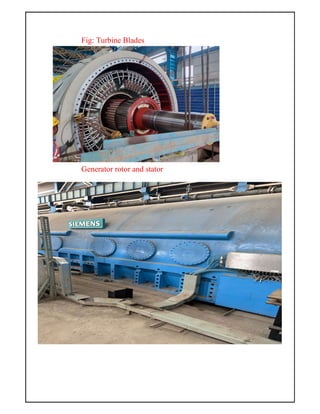
Fig: Turbine Blades
Generator rotor and stator
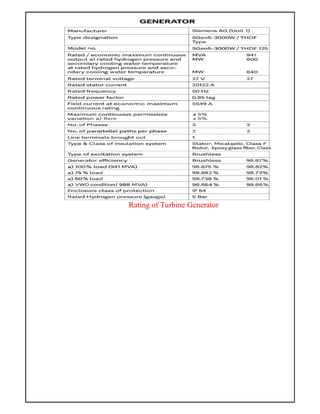
Rating of Turbine Generator
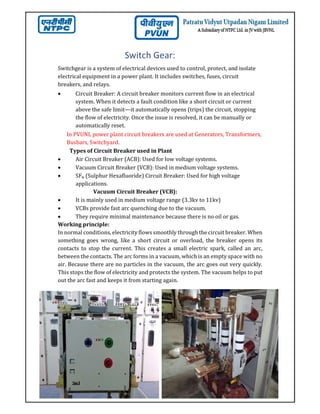
Switch Gear:
Switchgear is a system of electrical devices used to control, protect, and isolate
electrical equipment in a power plant. It includes switches, fuses, circuit
breakers, and relays.
 Circuit Breaker: A circuit breaker monitors current flow in an electrical
system. When it detects a fault condition like a short circuit or current
above the safe limit—it automatically opens (trips) the circuit, stopping
the flow of electricity. Once the issue is resolved, it can be manually or
automatically reset.
In PVUNL power plant circuit breakers are used at Generators, Transformers,
Busbars, Switchyard.
Types of Circuit Breaker used in Plant
 Air Circuit Breaker (ACB): Used for low voltage systems.
 Vacuum Circuit Breaker (VCB): Used in medium voltage systems.
 SF₆ (Sulphur Hexafluoride) Circuit Breaker: Used for high voltage
applications.
Vacuum Circuit Breaker (VCB):
 It is mainly used in medium voltage range (3.3kv to 11kv)
 VCBs provide fast arc quenching due to the vacuum.
 They require minimal maintenance because there is no oil or gas.
Working principle:
In normal conditions, electricity flows smoothly through the circuit breaker. When
something goes wrong, like a short circuit or overload, the breaker opens its
contacts to stop the current. This creates a small electric spark, called an arc,
between the contacts. The arc forms in a vacuum, which is an empty space with no
air. Because there are no particles in the vacuum, the arc goes out very quickly.
This stops the flow of electricity and protects the system. The vacuum helps to put
out the arc fast and keeps it from starting again.
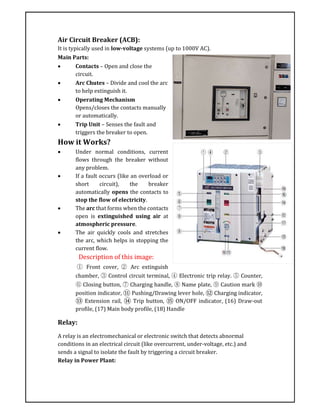
Air Circuit Breaker (ACB):
It is typically used in low-voltage systems (up to 1000V AC).
Main Parts:
 Contacts – Open and close the
circuit.
 Arc Chutes – Divide and cool the arc
to help extinguish it.
 Operating Mechanism
Opens/closes the contacts manually
or automatically.
 Trip Unit – Senses the fault and
triggers the breaker to open.
How it Works?
 Under normal conditions, current
flows through the breaker without
any problem.
 If a fault occurs (like an overload or
short circuit), the breaker
automatically opens the contacts to
stop the flow of electricity.
 The arc that forms when the contacts
open is extinguished using air at
atmospheric pressure.
 The air quickly cools and stretches
the arc, which helps in stopping the
current flow.
Description of this image:
① Front cover, ② Arc extinguish
chamber, ③ Control circuit terminal, ④ Electronic trip relay. ⑤ Counter,
⑥ Closing button, ⑦ Charging handle, ⑧ Name plate, ⑨ Caution mark ⑩
position indicator, ⑪ Pushing/Drawing lever hole, ⑫ Charging indicator,
⑬ Extension rail, ⑭ Trip button, ⑮ ON/OFF indicator, (16) Draw-out
profile, (17) Main body profile, (18) Handle
Relay:
A relay is an electromechanical or electronic switch that detects abnormal
conditions in an electrical circuit (like overcurrent, under-voltage, etc.) and
sends a signal to isolate the fault by triggering a circuit breaker.
Relay in Power Plant:
In a power plant, relays are essential for protection and automation of the
electrical system. They monitor equipment like generators, transformers, feeders,
motors, and busbars, ensuring they operate safely.
Why Relays Are Important in a Power Plant:
 Protect expensive equipment like generators and transformers
 Prevent blackouts by isolating faults quickly
 Improve reliability and efficiency of the power system
 Support remote monitoring and control
Types of relays used in Power Plant:
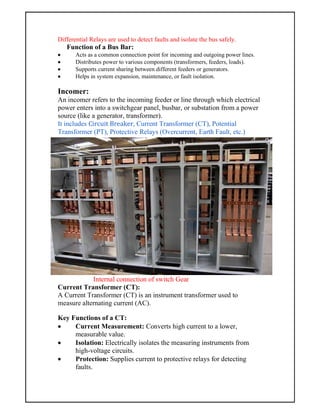
 Distance Relay – Used in Transmission line to protect line based on
resistance measurement.
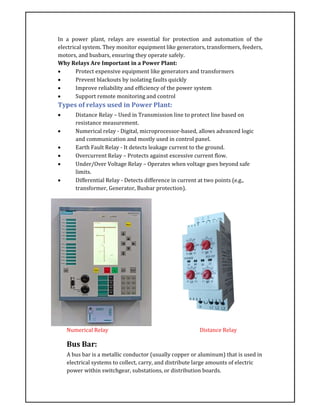
 Numerical relay - Digital, microprocessor-based, allows advanced logic
and communication and mostly used in control panel.
 Earth Fault Relay - It detects leakage current to the ground.
 Overcurrent Relay – Protects against excessive current flow.
 Under/Over Voltage Relay – Operates when voltage goes beyond safe
limits.
 Differential Relay - Detects difference in current at two points (e.g.,
transformer, Generator, Busbar protection).
Numerical Relay Distance Relay
Bus Bar:
A bus bar is a metallic conductor (usually copper or aluminum) that is used in
electrical systems to collect, carry, and distribute large amounts of electric
power within switchgear, substations, or distribution boards.
Differential Relays are used to detect faults and isolate the bus safely.
Function of a Bus Bar:
 Acts as a common connection point for incoming and outgoing power lines.
 Distributes power to various components (transformers, feeders, loads).
 Supports current sharing between different feeders or generators.
 Helps in system expansion, maintenance, or fault isolation.
Incomer:
An incomer refers to the incoming feeder or line through which electrical
power enters into a switchgear panel, busbar, or substation from a power
source (like a generator, transformer).
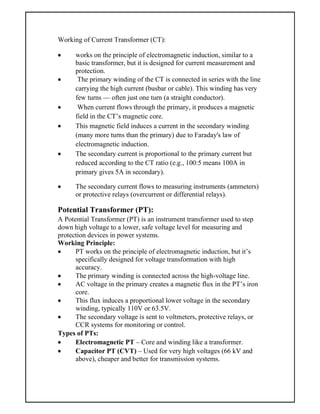
It includes Circuit Breaker, Current Transformer (CT), Potential
Transformer (PT), Protective Relays (Overcurrent, Earth Fault, etc.)
Internal connection of switch Gear
Current Transformer (CT):
A Current Transformer (CT) is an instrument transformer used to
measure alternating current (AC).
Key Functions of a CT:
 Current Measurement: Converts high current to a lower,
measurable value.
 Isolation: Electrically isolates the measuring instruments from
high-voltage circuits.
 Protection: Supplies current to protective relays for detecting
faults.
Working of Current Transformer (CT):
 works on the principle of electromagnetic induction, similar to a
basic transformer, but it is designed for current measurement and
protection.
 The primary winding of the CT is connected in series with the line
carrying the high current (busbar or cable). This winding has very
few turns — often just one turn (a straight conductor).
 When current flows through the primary, it produces a magnetic
field in the CT’s magnetic core.
 This magnetic field induces a current in the secondary winding
(many more turns than the primary) due to Faraday's law of
electromagnetic induction.
 The secondary current is proportional to the primary current but
reduced according to the CT ratio (e.g., 100:5 means 100A in
primary gives 5A in secondary).
 The secondary current flows to measuring instruments (ammeters)
or protective relays (overcurrent or differential relays).
Potential Transformer (PT):
A Potential Transformer (PT) is an instrument transformer used to step
down high voltage to a lower, safe voltage level for measuring and
protection devices in power systems.
Working Principle:
 PT works on the principle of electromagnetic induction, but it’s
specifically designed for voltage transformation with high
accuracy.
 The primary winding is connected across the high-voltage line.
 AC voltage in the primary creates a magnetic flux in the PT’s iron
core.
 This flux induces a proportional lower voltage in the secondary
winding, typically 110V or 63.5V.
 The secondary voltage is sent to voltmeters, protective relays, or
CCR systems for monitoring or control.
Types of PTs:
 Electromagnetic PT – Core and winding like a transformer.
 Capacitor PT (CVT) – Used for very high voltages (66 kV and
above), cheaper and better for transmission systems.
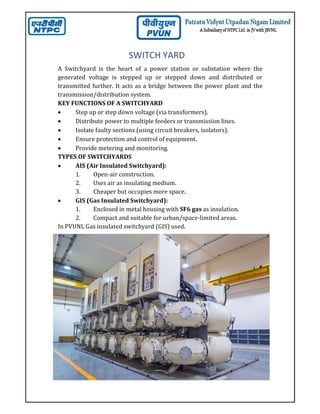
SWITCH YARD
A Switchyard is the heart of a power station or substation where the
generated voltage is stepped up or stepped down and distributed or
transmitted further. It acts as a bridge between the power plant and the
transmission/distribution system.
KEY FUNCTIONS OF A SWITCHYARD
 Step up or step down voltage (via transformers).
 Distribute power to multiple feeders or transmission lines.
 Isolate faulty sections (using circuit breakers, isolators).
 Ensure protection and control of equipment.
 Provide metering and monitoring.
TYPES OF SWITCHYARDS
 AIS (Air Insulated Switchyard):
1. Open-air construction.
2. Uses air as insulating medium.
3. Cheaper but occupies more space.
 GIS (Gas Insulated Switchyard):
1. Enclosed in metal housing with SF6 gas as insulation.
2. Compact and suitable for urban/space-limited areas.
In PVUNL Gas insulated switchyard (GIS) used.
Primary Components in GIS (Gas-Insulated Substation)
 Busbar:
Carries and distributes power inside the GIS. It is placed inside SF₆
gas for insulation.
 Circuit Breaker (CB):
Breaks the circuit during faults and also turns it on/off. SF₆ gas is
used to stop the arc.
 Disconnector (Isolator):
Used to fully disconnect a part of the system for safe maintenance.
Works only when there is no current.
 Earthing Switch:
Connects the disconnected part to the ground for safety. Some types
work very quickly (FAES).
 Current Transformer (CT):
Measures the current in the system and sends the signal to
protection and metering devices.
 Voltage Transformer (VT/PT):
Reduces high voltage to a lower level for measurement and
protection. Can be inductive or capacitive.
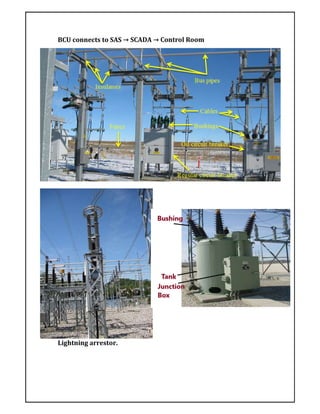
 Surge Arrester (LA):
Protects equipment from high voltage surges due to lightning or
switching by sending the surge to the ground.
 Gas-Insulated Transmission Line (GIL):
Joins the GIS with transformers or overhead lines. Filled with SF₆ or
SF₆-N₂ gas mixture.
# Auxiliary components in GIS:
 SF₆ Gas Handling System
Responsible for filling, recovery, filtration, and maintaining SF₆ gas
pressure and purity.
Ensures the gas remains dry and uncontaminated to maintain
insulation strength.
 Control and Relay Panel
Operates GIS circuit breakers, isolators, and earthing switches.
Houses protection relays, control logic, interlocks, and automation
systems.
Interfaces with SCADA for remote control and monitoring.
 Partial Discharge Monitoring (PDM)
Detects early-stage insulation deterioration or defects.
Uses sensors to continuously monitor partial discharge signals.
 Gas Density Monitor / Sensor
Monitors SF₆ gas pressure and temperature.
Triggers alarms and trips if pressure drops below safe levels.
 Manometers and Pressure Relief Devices
Manometers display gas pressure in compartments.
Pressure relief devices prevent internal overpressure damage.
 Local Control Cubicle (LCC)
Located near each bay or GIS panel.
Contains bay control units (BCUs), protection relays, and mimic
diagrams.
Used for local operation, control, and protection of individual bays.
 Grounding System
Ensures all metallic GIS parts are properly earthed.
Prevents electric shock hazards and ensures safe fault current
dissipation.
 Energy Meters
Measure how much electrical energy is used, mainly for billing and
checking energy usage.
 SCADA Integration (Remote Monitoring)
SCADA allows remote control of GIS. It monitors alarms, logs data,
and helps operate breakers and switches from a control room.
 Disturbance Recorders
These record faults or switching operations. The data helps in
analyzing problems in the system.
What is a Bus Reactor?
A bus reactor is a type of inductor connected between busbars in a
substation (either Air Insulated Substation or Gas Insulated
Substation).
Working of Bus Reactor:
 It works by opposing sudden changes in current using its
inductance.
 When load decreases suddenly, voltage can rise dangerously.
The bus reactor absorbs this excess voltage by storing energy
in its magnetic field.
 It also limits switching surges and controls overvoltage during
light-load or no-load conditions.
 It is used in Between bus sections to maintain voltage balance,
In GIS substations, enclosed in SF₆ gas chambers, at receiving
end of long transmission lines.
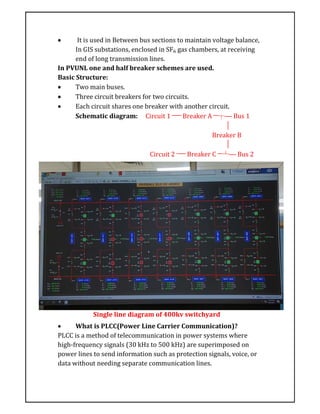
In PVUNL one and half breaker schemes are used.
Basic Structure:
 Two main buses.
 Three circuit breakers for two circuits.
 Each circuit shares one breaker with another circuit.
Schematic diagram: Circuit 1 ── Breaker A ─┬── Bus 1
│
Breaker B
│
Circuit 2 ── Breaker C ─┴── Bus 2
Single line diagram of 400kv switchyard
 What is PLCC(Power Line Carrier Communication)?
PLCC is a method of telecommunication in power systems where
high-frequency signals (30 kHz to 500 kHz) are superimposed on
power lines to send information such as protection signals, voice, or
data without needing separate communication lines.
What is Bay?
A bay in a substation or switchyard is a physical and functional
section that contains equipment for controlling, protecting, and
monitoring a specific part of the power system.
Each bay typically includes Circuit breaker, isolator and switch.
Combination of three bay between busbar1 to busbar2 is called Dia.
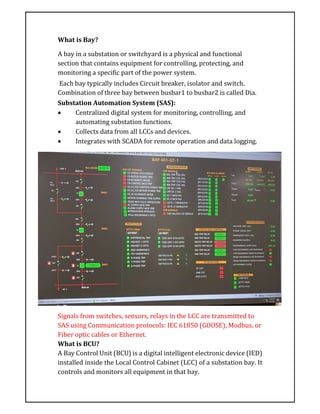
Substation Automation System (SAS):
 Centralized digital system for monitoring, controlling, and
automating substation functions.
 Collects data from all LCCs and devices.
 Integrates with SCADA for remote operation and data logging.
Signals from switches, sensors, relays in the LCC are transmitted to
SAS using Communication protocols: IEC 61850 (GOOSE), Modbus, or
Fiber optic cables or Ethernet.
What is BCU?
A Bay Control Unit (BCU) is a digital intelligent electronic device (IED)
installed inside the Local Control Cabinet (LCC) of a substation bay. It
controls and monitors all equipment in that bay.
BCU connects to SAS → SCADA → Control Room
Lightning arrestor.
Air Cooled Condenser
An Air-Cooled Condenser (ACC) is a type of heat exchanger used in
power plants and industrial systems to condense steam or vapor into
liquid using ambient air as cooling medium, instead of water.
Working Principle:
An Air-Cooled Condenser utilizes ambient air to remove heat out of
exhaust steam for thermal or biomass power plants. The method of
cooling is direct heat exchange. ACC can use natural draft or mechanical
draft for heat exchange.
Why ACC
●Air Cooled Condenser are
designed for areas where water
availability is low.
●Water requirement of ACC based
plant reduces up to 60-70%.
●A Typical 3X800 MW Plant
requires approx. 3
cum/MW =7200 m3/hr
(80 % of this water is consumed in
Cooling Towers)
●PVUNL Water requirement is
2093 Cum/hr for Phase – I (3 X
800 MW)
Components Of ACC:
●Main steam duct: The main steam duct interfaces with the steam turbine
and serves to convey all exhaust steam to steam distribution network.
●Steam distribution manifold: The steam distribution manifold is used
to distribute steam between main steam duct and steam headers. This
manifold includes vertical ducts referred to as riser.
●Steam header: The steam header serves to convey steam between the
manifolds and the first stage bundles of an ACC row.
●Fin tube bundle: Set of tube bundle made of aluminum cladded carbon
steel with aluminum fins for turbine exhaust steam condensation.
●Air removal system, Fin tube cleaning system
●Support structure and Wind wall: Support structure consists of , Main
truss, Duct support, Fan deck beam, Fan bridge, A-Frame, Fan deck
plate, Walkways, Wind wall. Wind wall are installed around the
perimeter of the ACC and extend from the fan deck to the top of the
tube bundles. The function of the wind wall is to reduce the negative
wind effect on the fan air flow and uniform heat transfer, as well as
minimize potential for warm air recirculation.
●Mechanical draft equipment system: Axial fan, Gearbox and its
lubrication system, Motor with multi speed or VFD.
●Condensate Tank: The condensate tank serves to collect the condensate
that is formed within the ACC. Typically the condensate tank is located
beneath the ACC
ACC Drain Scheme:
The ACC (Air-Cooled Condenser) Drain Scheme plays a vital role in the
recovery and management of condensates in a thermal power plant,
especially in systems where air is used instead of water for condensing
turbine exhaust steam. Below is a detailed explanation of each
component and its function in the scheme:
 LP Turbine (Low Pressure Turbine):
The LP Turbine is the final stage of the turbine system where steam
expands and loses pressure. The exhaust steam from the LP turbine
enters the Hot Box, and then passes through the Exhaust Duct to the
ACC.
2. Hot Box and Bypass Line:
 The Hot Box collects the low-pressure exhaust steam.
 It includes a Bypass Line (LPH-1 Bypass) which ensures
operational flexibility during part load or startup/shutdown
conditions.
3. Drain Tank:
Condensate formed due to cooling of steam (in the exhaust duct and
connected lines) is collected in the Drain Tank. This is a low-level tank
used to temporarily store the condensate before it is pumped.
4. Drain Pumps:
Drain pumps are used to transfer the collected condensate from the Drain
Tank to the Condensate Tank. These pumps maintain the required pressure
and ensure continuous operation without overflow or interruption.
5. Condensate Tank:
The Condensate Tank acts as a storage and supply unit for recovered
condensate. It receives drained condensate from the ACC system through
the drain pumps. The tank also serves multiple functions:
 Supplies water to Condensate Extraction Pumps (CEP A, B, C).
 Maintains system pressure through Deaerator (D/A) to remove
dissolved gases like oxygen and CO₂.
 Accepts DM (De-Mineralized) Make-up Water when necessary to
compensate for any losses.
 Connected to an Evacuation Line, possibly for system venting or
maintenance.
6. Condensante Extraction Pumps (CEP-A, B, C):
These pumps draw water from the condensate tank and send it back to the
system for reheating and reuse. Multiple CEPs provide redundancy and
operational reliability.
Condenser Tank
Tech Data
PVUNL ACC Tech Data:
1 Design Vacuum 160 mmHg
2 Ambient Air Temperature 38˚ C
3 No of Cells per Unit 72
4 Fan Motor Rated Power 132 KW
5 No of Tube Bundles per Unit 1008
6 Fan Distribution 8 (Streets) X 9 (Fans)
7 Tube Bundle Design K Type and D Type (Single Row Tubes)
8 Agency M/s PCTL (In collaboration with SPG
Belgium)
Sl.
No.
Parameter Value
1
Design Ambient Temperature 38 deg. C
2 Design Condenser Back Pressure 160 mm Hg
3 No. of cells per ACC 72 No.
4 Tube Material Aluminium claded CS
5 Design Steam Flow 1275 tons/hr
6 Design Pressure 0.5bar (g) and Full Vacuum
7 Design Temperature 121 deg. C
8 Surface Area 3708980 sq. m
9 Design Wind Speed 5 m/s
10 Tube Bundle-Kondenser (K-Type) 896 No.
11 Tube Bundle-Dephlegmator (D-Type) 112 No.
12 Fan Motor Rated Power 132 KW
13 Gear Box Ratio 16.02
14 Condensate Tank Volume 138 m3
15 Vacuum Pump capacity (hogging); Qty-2 Nos. 47851m3/h
16 Vacuum Pump capacity (holding); Qty-2 Nos. 47851m3/h
Electrostatic Precipitator (ESP)
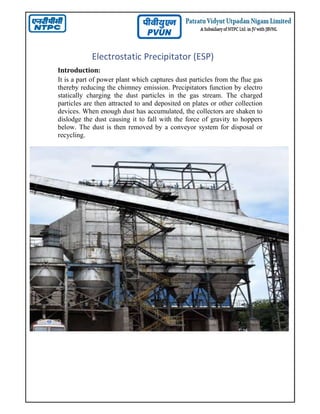
Introduction:
It is a part of power plant which captures dust particles from the flue gas
thereby reducing the chimney emission. Precipitators function by electro
statically charging the dust particles in the gas stream. The charged
particles are then attracted to and deposited on plates or other collection
devices. When enough dust has accumulated, the collectors are shaken to
dislodge the dust causing it to fall with the force of gravity to hoppers
below. The dust is then removed by a conveyor system for disposal or
recycling.
Working Principle:
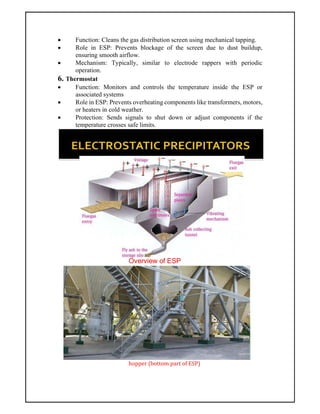
1. Flue Gas from Boiler:
Flue gas from pulverized coal-fired boilers contains fly ash, unburned carbon, and tiny
ash particles. The flue gas is directed to the ESP unit after passing through economizers
and air preheaters.
2. High Voltage Supply from TR Set
A Transformer Rectifier (TR) set, like the one in our image from BHEL, converts 415V
AC to high-voltage DC (up to 95kV and 1000 mA). This is connected to discharge
electrodes (wires) inside the ESP chamber.
3. Ionization & Charging
The high-voltage DC creates a corona discharge.
It ionizes the gas and charges the ash particles negatively.
4. Particle Migration and Collection
Charged particles migrate to grounded collecting plates (positively charged). Ash gets
deposited on these plates and forms a layer.
5. Rapping Mechanism
The ESP system has a mechanical or electromagnetic rapping system. It knocks the
plates at intervals, and collected ash falls into
hoppers.
6. Clean Gas Release
The now clean flue gas is released via the
chimney/stack. This reduces particulate emissions
and complies with CPCB/MoEF norms (e.g., <30
mg/Nm³ particulate limit).
Major Components Of ESP
1. HVR Transformer (High Voltage
Rectifier Transformer):
 Function: Converts incoming AC power into high-voltage DC power required
for the ESP.
 Role in ESP: Supplies 30-70 kV DC to the discharge electrodes to ionize the
gas stream.
 Working: Steps up the voltage using a transformer and then rectifies it to DC
using rectifier circuits.
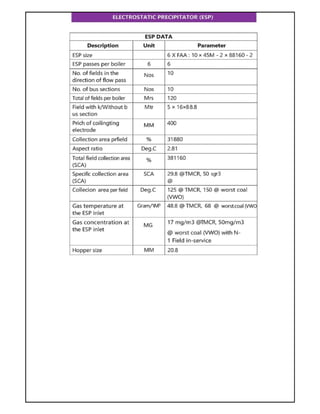
In this plant, each section of the ESP consists of 6 passes, and each pass contains 20
transformers, making a total of 120 transformers per section.
2. EERM Motor (Emitting Electrode Rapping Mechanism Motor)
 Function: Drives the mechanism that
cleans the discharge/emitting electrodes
by rapping (hitting) them.
 Role in ESP: Removes collected dust
from discharge wires to maintain
efficiency.
 Frequency: Operates periodically to
shake off accumulated particles.
3. CERM Motor (Collecting Electrode Rapping
Mechanism Motor)
 Function: Operates the mechanism that
cleans the collecting plates by vibration or
hammering.
 Role in ESP: Ensures that dust collected on
plates falls into the hopper.
 Result: Prevents re-entrainment of
particles into the gas flow.
4. Gas Distribution Screen
 Function: Ensures even flow
distribution of flue gases entering the
ESP.
 Role in ESP: Reduces turbulence and
ensures uniform gas velocity across all
collection fields.
 Material: Usually made of corrosion-resistant steel mesh or perforated
plates.
5. Gas Distribution Rapping Mechanism
 Function: Cleans the gas distribution screen using mechanical tapping.
 Role in ESP: Prevents blockage of the screen due to dust buildup,
ensuring smooth airflow.
 Mechanism: Typically, similar to electrode rappers with periodic
operation.
6. Thermostat
 Function: Monitors and controls the temperature inside the ESP or
associated systems
 Role in ESP: Prevents overheating components like transformers, motors,
or heaters in cold weather.
 Protection: Sends signals to shut down or adjust components if the
temperature crosses safe limits.
Overview of ESP
hopper (bottom part of ESP)
Ash Handling Plant (AHP)
Introduction:
An Ash Handling Plant (AHP) is a vital system in thermal power plants, used for
the collection, removal, and safe disposal of ash produced during the combustion
of coal in boilers. When coal is burned in a furnace, two types of ash are
produced: fly ash and bottom ash. The Ash Handling Plant (AHP) is responsible
for collecting, conveying, storing, and disposing of both types of ash generated
during combustion. With the growing focus on environmental protection and
resource recovery, AHPs also contribute to the reuse of ash in various industries
like cement manufacturing, brick making, and road construction.
Types Of Ash
Fly Ash:
Lighter particles that are carried with flue gases and collected by electrostatic
precipitators (ESPs) or bag filters.
Bottom Ash:
Heavier particles that fall to the bottom of the furnace.
Bottom Ash Handling Process:
Bottom ash is heavy ash that falls to the bottom of the boiler furnace after coal
combustion. It is collected in a water-filled bottom ash hopper, where it is
quenched (cooled with water). From there, it is removed using either a hydraulic
system (jet pumps and slurry pipelines) or a mechanical system (like submerged
conveyors). The ash is then transported to an ash pond or stored in a silo for reuse
in construction materials.
Fly Ash Handling Process
Fly ash is fine, light ash that travels with the flue gases and is collected using
electrostatic precipitators (ESP) or bag filters. This ash is transported using a
pneumatic system (vacuum or pressure), usually in dry form. It is stored in fly
ash silos and can either be sold for reuse (in cement and bricks) or mixed with
water and sent to an ash pond if disposal is needed.
Working Of Electrostatic Precipitator (ESP):
1. Flue gas containing fly ash enters the ESP chamber.
2. Inside the ESP, discharge electrodes are negatively charged, while collecting
plates are grounded or positively charged.
3. A high-voltage DC current (30–70 kV) ionizes the gas and imparts a negative
charge to the ash particles.
4. The negatively charged particles get attracted to the positively charged plates.
5. The ash accumulates on these plates and is periodically removed by rapping
mechanisms, allowing it to fall into fly ash hoppers.
6. The cleaned flue gas is then safely discharged through the chimney.
ESP systems are capable of removing up to 99.5% of fly ash from flue gas,
significantly reducing emissions and meeting environmental standards.
Fly Ash Collection and Disposal
 Fly ash is a fine powder generated when coal burns in a thermal power
plant.
 It gets carried along with flue gases.
 To collect it, Electrostatic Precipitators (ESPs) or bag filters are used.
 These devices trap fly ash and drop it into hoppers located below.
 The ash is then conveyed through pneumatic systems (using air pressure
or vacuum) to fly ash silos
Fly ash can be disposed of in two ways:
 Dry Disposal:
1. Dry fly ash from silos is loaded into trucks or tankers.
2. It is sent to cement plants, brick kilns, or used in road construction.
 Wet Disposal:
1. Fly ash is mixed with water to form a slurry.
2. The slurry is pumped to an ash pond or ash dyke for safe dumping.
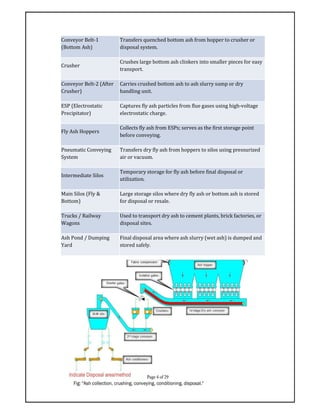
Silo System Overview
 The plant has:
o 6 main silos for fly ash
o 3 main silos for bottom ash
o 4 intermediate silos used in ash transfer and regulation
These silos act as buffer storage, allowing for regulated discharge and
flexibility in handling and disposal operations
Equipment Overview In AHP
Equipment Function / Description
Ash Hopper
Collects ash from the boiler furnace (bottom ash) or ESP (fly
ash).
Conveyor Belt-1
(Bottom Ash)
Transfers quenched bottom ash from hopper to crusher or
disposal system.
Crusher
Crushes large bottom ash clinkers into smaller pieces for easy
transport.
Conveyor Belt-2 (After
Crusher)
Carries crushed bottom ash to ash slurry sump or dry
handling unit.
ESP (Electrostatic
Precipitator)
Captures fly ash particles from flue gases using high-voltage
electrostatic charge.
Fly Ash Hoppers
Collects fly ash from ESPs; serves as the first storage point
before conveying.
Pneumatic Conveying
System
Transfers dry fly ash from hoppers to silos using pressurized
air or vacuum.
Intermediate Silos
Temporary storage for fly ash before final disposal or
utilization.
Main Silos (Fly &
Bottom)
Large storage silos where dry fly ash or bottom ash is stored
for disposal or resale.
Trucks / Railway
Wagons
Used to transport dry ash to cement plants, brick factories, or
disposal sites.
Ash Pond / Dumping
Yard
Final disposal area where ash slurry (wet ash) is dumped and
stored safely.
PT Plant & DM Plant
What is the need of PT plant?
 Removes suspended solids, turbidity, and organic matter.
 Protects downstream DM plant from clogging and fouling.
 Ensures smooth operation of filters and ion-exchange units.
Raw water comes from Patratu Dam and passes through the
following stages:
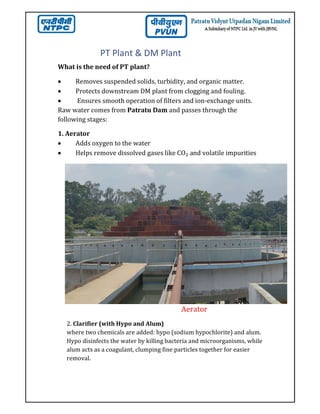
1. Aerator
 Adds oxygen to the water
 Helps remove dissolved gases like CO₂ and volatile impurities
Aerator
2. Clarifier (with Hypo and Alum)
where two chemicals are added: hypo (sodium hypochlorite) and alum.
Hypo disinfects the water by killing bacteria and microorganisms, while
alum acts as a coagulant, clumping fine particles together for easier
removal.
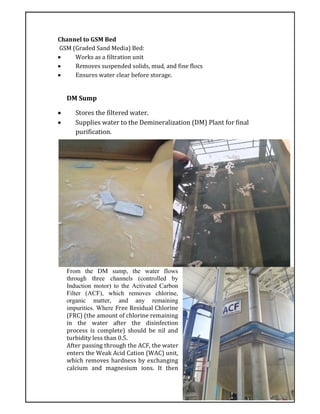
Channel to GSM Bed
GSM (Graded Sand Media) Bed:
 Works as a filtration unit
 Removes suspended solids, mud, and fine flocs
 Ensures water clear before storage.
DM Sump
 Stores the filtered water.
 Supplies water to the Demineralization (DM) Plant for final
purification.
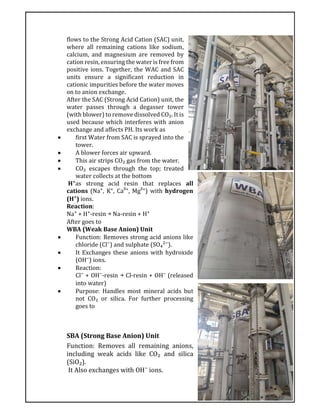
From the DM sump, the water flows
through three channels (controlled by
Induction motor) to the Activated Carbon
Filter (ACF), which removes chlorine,
organic matter, and any remaining
impurities. Where Free Residual Chlorine
(FRC) (the amount of chlorine remaining
in the water after the disinfection
process is complete) should be nil and
turbidity less than 0.5.
After passing through the ACF, the water
enters the Weak Acid Cation (WAC) unit,
which removes hardness by exchanging
calcium and magnesium ions. It then
flows to the Strong Acid Cation (SAC) unit,
where all remaining cations like sodium,
calcium, and magnesium are removed by
cation resin, ensuring the water is free from
positive ions. Together, the WAC and SAC
units ensure a significant reduction in
cationic impurities before the water moves
on to anion exchange.
After the SAC (Strong Acid Cation) unit, the
water passes through a degasser tower
(with blower) to remove dissolved CO₂. It is
used because which interferes with anion
exchange and affects PH. Its work as
 first Water from SAC is sprayed into the
tower.
 A blower forces air upward.
 This air strips CO₂ gas from the water.
 CO₂ escapes through the top; treated
water collects at the bottom
H⁺as strong acid resin that replaces all
cations (Na⁺, K⁺, Ca²⁺, Mg²⁺) with hydrogen
(H⁺) ions.
Reaction:
Na⁺ + H⁺-resin → Na-resin + H⁺
After goes to
WBA (Weak Base Anion) Unit
 Function: Removes strong acid anions like
chloride (Cl⁻) and sulphate (SO₄²⁻).
 It Exchanges these anions with hydroxide
(OH⁻) ions.
 Reaction:
Cl⁻ + OH⁻-resin → Cl-resin + OH⁻ (released
into water)
 Purpose: Handles most mineral acids but
not CO₂ or silica. For further processing
goes to
SBA (Strong Base Anion) Unit
Function: Removes all remaining anions,
including weak acids like CO₂ and silica
(SiO₂).
It Also exchanges with OH⁻ ions.
Reaction:
HCO₃⁻ + OH⁻ → H₂O + CO₃²⁻
after the SBA unit, the water often goes to MB
(Mixed Bed) Polisher for final purification
MB (Mixed Bed) Unit:
It contains a mixture of strong acid cation (SAC)
and strong base anion (SBA) resins in a single
vessel.
Removes any remaining traces of cations (like
Na⁺, Ca²⁺) and anions (like Cl⁻, SiO₂).
And ensures ultra-pure water with very low
conductivity (< 0.1 µS/cm).
And finally high-quality demineralized water
is obtained and stored in DM Tank.
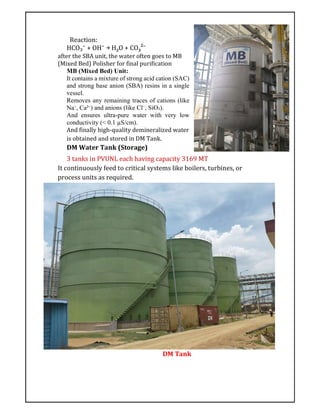
DM Water Tank (Storage)
3 tanks in PVUNL each having capacity 3169 MT
It continuously feed to critical systems like boilers, turbines, or
process units as required.
DM Tank
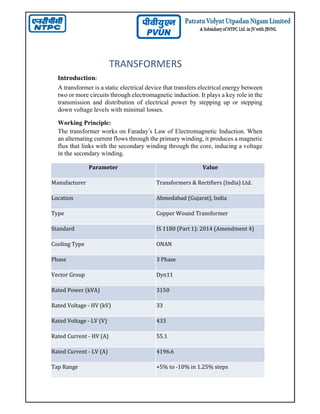
TRANSFORMERS
Introduction:
A transformer is a static electrical device that transfers electrical energy between
two or more circuits through electromagnetic induction. It plays a key role in the
transmission and distribution of electrical power by stepping up or stepping
down voltage levels with minimal losses.
Working Principle:
The transformer works on Faraday’s Law of Electromagnetic Induction. When
an alternating current flows through the primary winding, it produces a magnetic
flux that links with the secondary winding through the core, inducing a voltage
in the secondary winding.
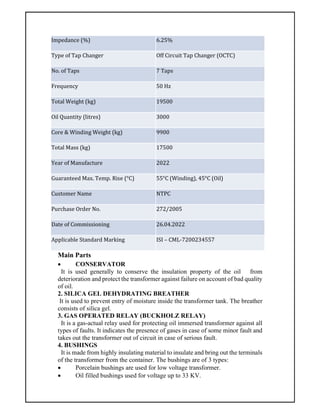
Parameter Value
Manufacturer Transformers & Rectifiers (India) Ltd.
Location Ahmedabad (Gujarat), India
Type Copper Wound Transformer
Standard IS 1180 (Part 1): 2014 (Amendment 4)
Cooling Type ONAN
Phase 3 Phase
Vector Group Dyn11
Rated Power (kVA) 3150
Rated Voltage - HV (kV) 33
Rated Voltage - LV (V) 433
Rated Current - HV (A) 55.1
Rated Current - LV (A) 4196.6
Tap Range +5% to -10% in 1.25% steps
Impedance (%) 6.25%
Type of Tap Changer Off Circuit Tap Changer (OCTC)
No. of Taps 7 Taps
Frequency 50 Hz
Total Weight (kg) 19500
Oil Quantity (litres) 3000
Core & Winding Weight (kg) 9900
Total Mass (kg) 17500
Year of Manufacture 2022
Guaranteed Max. Temp. Rise (°C) 55°C (Winding), 45°C (Oil)
Customer Name NTPC
Purchase Order No. 272/2005
Date of Commissioning 26.04.2022
Applicable Standard Marking ISI – CML-7200234557
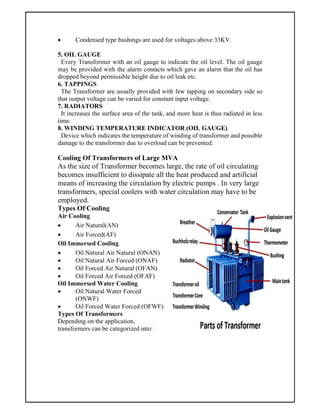
Main Parts
 CONSERVATOR
It is used generally to conserve the insulation property of the oil from
deterioration and protect the transformer against failure on account of bad quality
of oil.
2. SILICA GEL DEHYDRATING BREATHER
It is used to prevent entry of moisture inside the transformer tank. The breather
consists of silica gel.
3. GAS OPERATED RELAY (BUCKHOLZ RELAY)
It is a gas-actual relay used for protecting oil immersed transformer against all
types of faults. It indicates the presence of gases in case of some minor fault and
takes out the transformer out of circuit in case of serious fault.
4. BUSHINGS
It is made from highly insulating material to insulate and bring out the terminals
of the transformer from the container. The bushings are of 3 types:
 Porcelain bushings are used for low voltage transformer.
 Oil filled bushings used for voltage up to 33 KV.
 Condensed type bushings are used for voltages above 33KV.
5. OIL GAUGE
Every Transformer with an oil gauge to indicate the oil level. The oil gauge
may be provided with the alarm contacts which gave an alarm that the oil has
dropped beyond permissible height due to oil leak etc.
6. TAPPINGS
The Transformer are usually provided with few tapping on secondary side so
that output voltage can be varied for constant input voltage.
7. RADIATORS
It increases the surface area of the tank, and more heat is thus radiated in less
time.
8. WINDING TEMPERATURE INDICATOR (OIL GAUGE)
Device which indicates the temperature of winding of transformer and possible
damage to the transformer due to overload can be prevented.
Cooling Of Transformers of Large MVA
As the size of Transformer becomes large, the rate of oil circulating
becomes insufficient to dissipate all the heat produced and artificial
means of increasing the circulation by electric pumps . In very large
transformers, special coolers with water circulation may have to be
employed.
Types Of Cooling
Air Cooling
 Air Natural(AN)
 Air Forced(AF)
Oil Immersed Cooling
 Oil Natural Air Natural (ONAN)
 Oil Natural Air Forced (ONAF)
 Oil Forced Air Natural (OFAN)
 Oil Forced Air Forced (OFAF)
Oil Immersed Water Cooling
 Oil Natural Water Forced
(ONWF)
 Oil Forced Water Forced (OFWF)
Types Of Transformers
Depending on the application,
transformers can be categorized into:
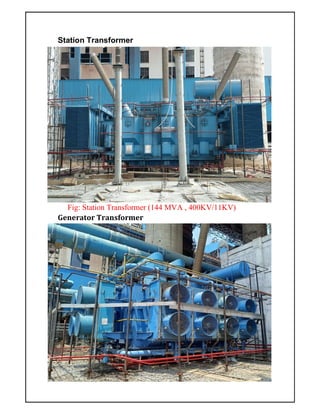
Station Transformer
Fig: Station Transformer (144 MVA , 400KV/11KV)
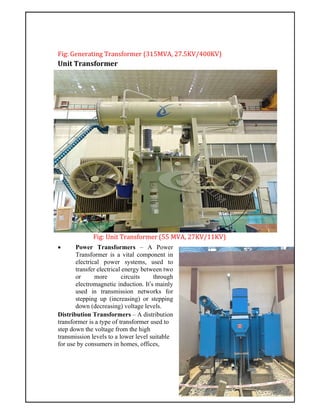
Generator Transformer
Fig: Generating Transformer (315MVA, 27.5KV/400KV)
Unit Transformer
Fig: Unit Transformer (55 MVA, 27KV/11KV)
 Power Transformers – A Power
Transformer is a vital component in
electrical power systems, used to
transfer electrical energy between two
or more circuits through
electromagnetic induction. It’s mainly
used in transmission networks for
stepping up (increasing) or stepping
down (decreasing) voltage levels.
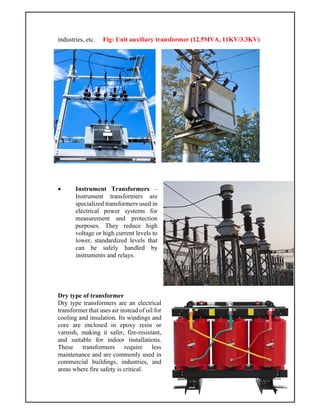
Distribution Transformers – A distribution
transformer is a type of transformer used to
step down the voltage from the high
transmission levels to a lower level suitable
for use by consumers in homes, offices,
industries, etc. Fig: Unit auxiliary transformer (12.5MVA, 11KV/3.3KV)
 Instrument Transformers –
Instrument transformers are
specialized transformers used in
electrical power systems for
measurement and protection
purposes. They reduce high
voltage or high current levels to
lower, standardized levels that
can be safely handled by
instruments and relays.
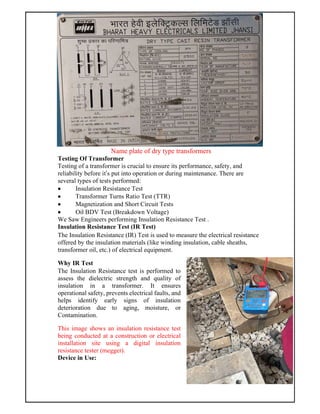
Dry type of transformer
Dry type transformers are an electrical
transformer that uses air instead of oil for
cooling and insulation. Its windings and
core are enclosed in epoxy resin or
varnish, making it safer, fire-resistant,
and suitable for indoor installations.
These transformers require less
maintenance and are commonly used in
commercial buildings, industries, and
areas where fire safety is critical.
Name plate of dry type transformers
Testing Of Transformer
Testing of a transformer is crucial to ensure its performance, safety, and
reliability before it’s put into operation or during maintenance. There are
several types of tests performed:
 Insulation Resistance Test
 Transformer Turns Ratio Test (TTR)
 Magnetization and Short Circuit Tests
 Oil BDV Test (Breakdown Voltage)
We Saw Engineers performing Insulation Resistance Test .
Insulation Resistance Test (IR Test)
The Insulation Resistance (IR) Test is used to measure the electrical resistance
offered by the insulation materials (like winding insulation, cable sheaths,
transformer oil, etc.) of electrical equipment.
Why IR Test
The Insulation Resistance test is performed to
assess the dielectric strength and quality of
insulation in a transformer. It ensures
operational safety, prevents electrical faults, and
helps identify early signs of insulation
deterioration due to aging, moisture, or
Contamination.
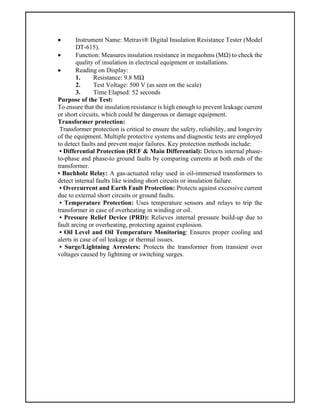
This image shows an insulation resistance test
being conducted at a construction or electrical
installation site using a digital insulation
resistance tester (megger).
Device in Use:
 Instrument Name: Metravi® Digital Insulation Resistance Tester (Model
DT-615).
 Function: Measures insulation resistance in megaohms (MΩ) to check the
quality of insulation in electrical equipment or installations.
 Reading on Display:
1. Resistance: 9.8 MΩ
2. Test Voltage: 500 V (as seen on the scale)
3. Time Elapsed: 52 seconds
Purpose of the Test:
To ensure that the insulation resistance is high enough to prevent leakage current
or short circuits, which could be dangerous or damage equipment.
Transformer protection:
Transformer protection is critical to ensure the safety, reliability, and longevity
of the equipment. Multiple protective systems and diagnostic tests are employed
to detect faults and prevent major failures. Key protection methods include:
• Differential Protection (REF & Main Differential): Detects internal phase-
to-phase and phase-to ground faults by comparing currents at both ends of the
transformer.
• Buchholz Relay: A gas-actuated relay used in oil-immersed transformers to
detect internal faults like winding short circuits or insulation failure.
• Overcurrent and Earth Fault Protection: Protects against excessive current
due to external short circuits or ground faults.
• Temperature Protection: Uses temperature sensors and relays to trip the
transformer in case of overheating in winding or oil.
• Pressure Relief Device (PRD): Relieves internal pressure build-up due to
fault arcing or overheating, protecting against explosion.
• Oil Level and Oil Temperature Monitoring: Ensures proper cooling and
alerts in case of oil leakage or thermal issues.
• Surge/Lightning Arresters: Protects the transformer from transient over
voltages caused by lightning or switching surges.
ELECTRICAL Single Line Diagram for Patratu UNIT-1
400 kV Switch yard
From 400 kV Switch yard
ST#1,144/72/72MVA,
400/11.5/11.5kV
GT#1
3x315MVA, 27/400kV
27kV
GEN. #1
941MVA,27kV UT#1B
UT#1A
55MVA, 27/11.5kV
11 kV 1BA 3150A 11 kV 1BB 3150A 11kV, 4000A 11kV, 4000A
To #0BD
To #0BC
0BA 0BB
Unit
SWBD
STATION
SWBD
UAT#1B
UAT#1A
12.5 MVA,
11/3.45kV
1CA
3.3 kV
2500A
CEP VFD-1A,1C
FD FAN -1A
ID FAN -1A
PA FAN-1A
G
Turbine
Srv.
Trf
1DBT01
2500kVA
,
11/.415
kV
M
CEP VFD-1B
FD FAN -1B
ID FAN -1B
PA FAN-1B
Turbine
Srv.
Trf
1DBT02
2500kVA
,
11/.415
kV
SEC-A
MILL- 1A,1C,1E,1G,1J
IAC-A
ECW (TG)- 1A, 1C
ACW- 1A
HOGGING PUMP- 1A
ECW (SG)- 1A
DRIP PUMP-1A
SEC-B
MILL- 1B,1D,1F,1H
BRCW PUMP- 1
ECW (TG)- 1B
ACW- 1B,1C
HOGGING PUMP- 1B
ECW (SG)- 1B
DRIP PUMP-1B
SAC- A
1DB
TURBINE PMCC
415 V, 4000A
M
Boiler
Srv.
Trf
1DAT02
2500kVA
,
11/.415
kV
Boiler
Srv.
Trf
1DAT01
2500kVA
,
11/.415
kV
BOILER PMCC
1DA
415 V, 4000A
G
Unit-1 DG
2000 kVA,
415 V
STANDBY
DG, 415 V
EMERG. MCC
1DG
415 V, 3000A
SERVICE ACDB
1QA 415 V, 630A
TURBINE VALVE DB
415 V, 250A 1KA
BOILER ACDB
415 V, 400A 1HB
415 V, 63A
SCR MCC
415 V, 400A 1HE
BOILER VALVE & DAMPER ACDB
415 V, 250A 1HA
M
MDBFP-A
Station
Srv.
Trf
0DAT01
2500kVA
,
11/.415
kV
Station
Srv.
Trf
0DAT02
2500kVA
,
11/.415
kV
STATION SERVICE PMCC
415 V, 4000A 0DA
AIR COND. MCC
415 V, 630A 0TA
VENTILATION MCC
415 V, 800A 1TA
MISC. SERVICES MCC
415 V, 400A 0QA
AIR WASHER MCC
415 V, 1250A 0SA
BOP SWBD
BOP AUX. SWBD
3.3 kV, 1000A 0CL
BOP AUX. TRF.#1
5 MVA, 11/3.45kV
BOP AUX.
TRF.#2
SEC-A
PRIMERY HC FEED PUMP-1
APH/ESP WASH PUMP-1
ACW CS PUMP-1
ECW CS PUMP-1
VACUUM PUMP-1
VACUUM PUMP-3
SERVICE WATER PUMP-1
FILTRATE WATER PUMP-1
SECONDARY HC FEED PUMP-1
SPRAY PUMP-1
HYDRANT MAIN PUMP-1
SEC-B
HYDRANT MAIN PUMP-2
HYDRANT MAIN PUMP-3
SPRAY PUMP-2
ASH/ESP WASH PUMP-2
ACW CS PUMP-2
ECW CS PUMP-2
VACUUM PUMP-2
VACUUM PUMP-4
SERVICE WATER PUMP-2
FILTRATE WATER PUMP-2
SECONDARY HC FEED PUMP-2
BOILER FILL PUMP-2
PRIMERY HC FEED PUMP-2
SEC-A
 24V BatteryCharger System
(VFD/ESP)
 220V DC CHARGER-1A
 220V DC CHARGER-1B
 INSTRUMENT AIR
COMPRESSOR AUXILIARY
SUPPLY
 24V BatteryCharger System
(ACC)
 AUX. OIL PUMP (MD BFP)
 24V BatteryCharger System
(SG and TG)
 PRIMARY WATER PUMP 2
SOOT
BLOWER
MCC
> 24V BATTERY CHARGER
SYSTEM (BOP)
>24V BATTERY CHARGER
SYSTEM (SG AND TG)
240V AC UPS
SEC-B
 SERVICE AIR
 24V BatteryCharger
System (FOPH)
 240V AC UPS (UNIT)
 AUX. OIL PUMP (MDBFP)
 24V BatteryCharger
System (BOP)
 UTILITY COMPRESSOR
 220V DC CHARGER -1A
 220V DC CHARGER -1B
G
FGD AUX. SWBD
3.3 kV, 2000A 1GA
FGD SERVICE PMCC
415 V, 4000A 1GD
G
FGD DG
2000 kVA, 415 V
FGDEMG.PCC
415 V, 3000A
FGD AUX. TRF.#1A
10 MVA, 11/3.45kV #1B
FGD SER. TRF.#1A
2.5 MVA, 11kV/415V
#1B
FROM BOP SWBD
SEC-1 #0BG
FROM BOP SWBD
SEC-3 #0BJ
FGD COMMON TRF.-A
2.5 MVA, 11kV/415V
FGD COMMON
TRF.-B
FGDCOMMONPMCC
415 V, 4000A 0GD
FGD AC & VENT MCC
415 V, 630A 0TC
AHP AUX. SWBD #1
3.3 kV, 3000A
AHP AUX. TRF.-A
16 MVA, 11/3.45kV
AHP AUX.
TRF.-B
From #1BA
SEC-A
AHP MCC-1 415 V
SEC-B
SEC-B
AHP MCC- 4 415 V
SEC-A
From BOP # 0BH
From BOP # 0BJ
AHP MCC-4 TRF.-A
2.5 MVA, 11/.415kV
TRF.-B
TRF.-C
0BJ
0BH
0BG
(UNIT-2)
From - 0BC
(UNIT-3)
From - 0BE
11 kV, 1600A
WET LIME
STONE MILL-A
WET LIME
STONE MILL-B
SEC-A
From BOP #0BH
From BOP #0BJ
AHP MCC-5 TRF.-A
2.5 MVA, 11/.415kV
TRF.-B
TRF.-C
SEC-B
AHP MCC- 5 415 V
AHP MCC-1 TRF.-A
2.5 MVA, 11/.415kV
TRF.-B
TRF.-C
AHP MCC-2
415 V
From #2BA From #2BB
AHP
MCC-2
TRF.-A
2.5
MVA,
11/.415kV
TRF.-B
AHP MCC-3
415 V
From #3BA From #3BB
AHP
MCC-3
TRF.-A
2.5
MVA,
11/.415kV
TRF.-B
CHP SWGR
CHP MCC-4
3.3 kV, 2500A
CHP MCC-4 TRF.#1
12.5 MVA, 11/3.45kV
CHP MCC-4
TRF.#2
CHP
MCC-1
TRF.-A
CHP
MCC-2
TRF.-A
CHP
MCC-3
TRF.-A
CHP
MCC-4
TRF.-A
2500kVA , 11/.415 kV
CHP
MCC-1
TRF.-C
CHP
MCC-2
TRF.-C
CHP
MCC-3
TRF.-C
CHP
MCC-4
TRF.-C
2500kVA , 11/.415 kV
(UNIT-2)
From #0BD
(UNIT-3)
From #0BF
11 kV, 1600A
CHP MCC-3 TRF.#1
16 MVA, 11/3.45kV
CHP MCC-3
TRF.#2
CHP MCC-3
3.3 kV, 3000A
CHP
MCC-1
TRF.-B
CHP
MCC-2
TRF.-B
CHP
MCC-3
TRF.-B
CHP
MCC-4
TRF.-B
2500kVA , 11/.415 kV
FWPH/AUX BOILER
SERVICE PMCC 0DP
415 V, 1600A
From BOP #0BG From BOP #0BJ
FW
/
AUX
BOILER
TRF.-1
1
MVA,
11/.415kV
TRF.-2
FOPH PMCC 0DK
415 V, 2500A
From BOP #0BH From BOP #0BJ
FOPH
TRF.-1
1.6
MVA,
11/.415kV
TRF.-2
ADMIN BLDG PMCC 0DD
415 V, 4000A
From BOP #0BH From BOP #0BJ
ADMIN
BLDG
TRF.-1
2.5
MVA,
11/.415kV
TRF.-2
SERV. BLDG PMCC 0DE
415 V, 2500A
From #0BB From #0BD
SERVICE
BLDG
TRF.-1
1.6
MVA,
11/.415kV
TRF.-2
DM & CPU PMCC 0DH
415 V, 4000A
From BOP #0BH From BOP #0BJ
DM
&
CPU
TRF.-1
2.5
MVA,
11/.415kV
TRF.-2
CPU MCC0WC
415 V, 1000A
ACWT CIO2 MCC 0WG
415 V, 400A
H2 PLANT SWGR 0DJ
415 V, 1600A
From MISC. SEC-A #0BK From MISC. SEC-B #0BK
H2
GENE.
SERV.
TRF.-1
1
MVA,
11/.415kV
TRF.-2
#1BB
MISC. SWBD
11 kV, 1000A 0BK
From #0BF
MISC.
TRF.-1
16
MVA,
11/11.5kV
MISC.
TRF.-2
ETP & CSSP PMCC 0DG
415 V, 4000A
From #0BB From #0BD
ETP
&
CSSP
TRF.-1
2.5
MVA,
11/.415kV
TRF.-2
ETP MCC 0WB
415 V, 1250A
From ESP #1DD
ESP AC & VENT MCC1TB
415 V, 400A
ESP STANDBY PMCC 1DL
415 V, 4000A
ESP PMCC 1DC
415 V, 4000A
ESP PMCC 1DD
415 V, 4000A
ESP PMCC 1DE
415 V, 4000A
ESP STANDBY PMCC 1DM
415 V, 4000A
ESP PMCC 1DF
415 V, 4000A
ESP PMCC 1DH
415 V, 4000A
ESP PMCC 1DJ
415 V, 4000A
From #0BA From #1BA From #1BA From #1BA From #0BB From #1BB From #1BB From #1BB
ESP SER. TRF 1DCT02
2.5 MVA, 11/.415kV
ESP TRF 1DCT01
2.5 MVA, 11/.415kV
ESP TRF 1DDT01
2.5 MVA, 11/.415kV
ESP TRF 1DET01
2.5 MVA, 11/.415kV
ESP SER. TRF 1DFT02
2.5 MVA, 11/.415kV
ESP TRF 1DFT01
2.5 MVA, 11/.415kV
ESP TRF 1DHT01
2.5 MVA, 11/.415kV
ESP TRF 1DJT01
2.5 MVA, 11/.415kV
From #1DG SEC-B
ESP & ID FAN AREA MCC 1HD
415 V, 400A
ACC - 1A 1DK
415 V, 3000A
ACC - 1B 1DN
415 V, 3000A
ACC - 1C 1DP
415 V, 3000A
From #0BA From #1BA From #1BA From #1BA
ACC STANDBY PMCC 1DX
415 V, 3000A
ACC SER. TRF 1DKT04
2 MVA, 11/.415kV
ACC SER. TRF 1DKT01
2 MVA, 11/.415kV
ACC SER. TRF 1DKT02
2 MVA, 11/.415kV
ACC SER. TRF 1DKT03
2 MVA, 11/.415kV
ACC - 1D 1DQ
415 V, 3000A
ACC - 1E 1DR
415 V, 3000A
ACC - 1F 1DS
415 V, 3000A
From #0BA From #1BA From #1BB From #1BB
ACC STANDBY PMCC 1DY
415 V, 3000A
ACC SER. TRF 1DKT08
2 MVA, 11/.415kV
ACC SER. TRF 1DKT05
2 MVA, 11/.415kV
ACC SER. TRF 1DKT06
2 MVA, 11/.415kV
ACC SER. TRF 1DKT07
2 MVA, 11/.415kV
ACC - 1G 1DU
415 V, 3000A
ACC - 1H 1DV
415 V, 3000A
From #0BB From #1BB From #1BB
ACC STANDBY PMCC 1DZ
415 V, 3000A
ACC SER. TRF 1DKT11
2 MVA, 11/.415kV
ACC SER. TRF 1DKT09
2 MVA, 11/.415kV
ACC SER. TRF 1DKT10
2 MVA, 11/.415kV
ACC AC &VENT MCC #0TD
415 V, 400A
RAW WATER PMCC 0DF
415 V, 4000A
From BOP #0BG From BOP #0BH
DM
&
CPU
TRF.-1
2.5
MVA,
11/.415kV
TRF.-2
STP MCC 0WF
415 V, 400A
PT PLANT MCC 0WA
415 V, 1000A
WORKSHOP MCC 0SD
415 V, 1000A
MANOJ KUMAR MEENA
SR. ASST. ENGG.
(OPERATION, O&M)
From SEC-B #0DA
To #1DB
SEC-B
From BOP #0BJ
#1BB
BAY 404
BAY 401
(UNIT-2)
From #0BD

NTPC PATRATU Summer internship report.pdf

  • 1.
    PROJECT REPORT ON ELECTRICITY GENERATIONAND VIEWING DIFFERENT COMPONENTS OF THE POWER PLANT AT PATRATU VIDYUT UTPADAN NIGAM LIMITED (PVUNL) SUBMITTED BY: HEMANT KUMAR B. TECH ELECTRICAL ENGINEERING IITRAM, AHMEDABAD GUIDED BY: Mr. Satya Ranjan Rout Deputy General Manager (DGM), NTPC
  • 2.
    ACKNOWLEDGEMENT First and foremost,I would like to express my sincere gratitude to NTPC Patratu for granting me the opportunity to undergo industrial training at their prestigious facility. I would especially like to thank Mr. Atul Chauhan, Senior Engineer in the Civil Department, for giving me this opportunity and for his valuable guidance throughout the training. Iam especiallythankfulto my Training Guide Mr. Satya Ranjan Rout, deputy General Manager (DGM), for his invaluable mentorship, consistent guidance, and encouragement throughout the course of this training. His depth of knowledge, supportive nature, and professional insights have been truly inspiring. It was an honour and privilege to work under his supervision. I also extend my heartfelt thanks to Mr. Ramesh Manda (Dy. Manager) and all the sta and employees of NTPC Patratu for their warm reception, kind cooperation, and the enriching learning environment they provided. Their support played a crucial role in enhancing the overall training experience. In addition, I am grateful to Institute of Infrastructure Technology Research and Management (IITRAM) and the Department of Electrical Engineering for organizing this training and o ering the necessary academic and administrative support. This training has enabled me to connect theoretical knowledge with real-world applications, enriching my technical understanding and preparing me for future professional challenges. Thanking you, HEMANT KUMAR
  • 3.
    Contents About NTPC andPVUNL...................................................................................................................1 Overview of Power plant..............................................................................................................3 Coal Handling Plant (CHP) ........................................................................................................... 4 BOILER................................................................................................................................................ 7 Turbine Generator.........................................................................................................................11 Switch Gear: .....................................................................................................................................16 SWITCH YARD.................................................................................................................................21 Air cooled Condenser (ACC) ......................................................................................................27 ESP.......................................................................................................................................................32 AHP......................................................................................................................................................37 PT Plant & DM Plant......................................................................................................................41 TRANSFORMERS............................................................................................................................46 Single Line Diagram……………...…………………....…………………………………………...…….56
  • 4.
    ABOUT NTPC LEADING INDIA'SPOWER SECTOR: NTPC Limited, formerly known as National Thermal Power Corporation, is an Indian central Public Sector Undertaking under the ownership of the Ministry of Power and the Government of India, who is engaged in the generation of electricity and other activities. The headquarters of the PSU are situated at New Delhi. NTPC is India’s largest integrated power company, dedicated to lighting every corner of the country and building a sustainable future for all. As a leader in the power sector, we are committed to generating e icient and a ordable power, aiming to achieve 130 GW by 2032. We embrace a diverse fuel mix, integrating fossil fuels, gas, hydro, nuclear, and renewable sources to minimize our carbon footprint. Established in 1975, NTPC has played a vital role in India’s economic growth for nearly five decades. With a commitment to operational excellence and adherence to global standards, we are lighting every fourth bulb in the country. Vision: With an aim to achieve 60 GW of renewable capacity by 2032, NTPC is taking active steps towards sustainable power generation. By implementing a robust ESG plan, we are optimizing operations and restoring ecosystems in order to create a healthier planet for generations to come. Achievements: They recently achieved the fastest-ever 300 billion Units (BU) of electricity generation in just 262 days in FY 2023-24. Floating Solar Project: NTPC has commissioned India's largest floating solar PV project of 100 MW at Ramagundam, Telangana. Financial Performance: NTPC has been paying dividends consistently for 32 years. Expansion: NTPC is involved in projects like the Sipat Super Thermal Power Project, Stage-III, in Chhattisgarh.
  • 5.
    ABOUT PVUNL The JVCompany namely Patratu Vidyut Utpadan Nigam Limited (PVUN Limited) was incorporated on 15.10.2015. It is a joint venture of a subsidiary of NTPC Ltd with shareholding of 74% and Jharkhand Bijli Vitran Nigam Limited (JBVNL) with shareholding of 26%. The JV Company is formed to install 4000 MW coal based thermal power plant consisting of 5 units of 800 MW each which is to be implemented in two phases (Phase I : 3 x 800 MW and Phase II: 2 x 800 MW) . Presently the JV Company is pursuing the Phase-I (3 x 800 MW) of Capacity addition. The funding for the project is proposed at Debt / Equity Ratio of 75:25. The equity will be contributed by the JV partners, NTPC and JBVNL. The debt funding has been tied up with Rural Electrification Corporation (REC). 85% of 4000MW power from the project will be allocated to State of Jharkhand. Banhardih captive coal block has been allocated to PVUN for end use. Banhardih Coal Mine has a Reserve of about 956 MT with total area of ~18 sq. KM. Ministry of Environment, Forest and Climate Change has given final Environmental Clearance to the project. AAI has issued Civil Aviation Clearance. Jharkhand Urja Utpadan Nigam Ltd has sanctioned 27 cusec waterforthe thermalproject which shall be drawn from Patratu Dam reservoir.
  • 6.
    OVERVIEW OF POWERPLANT A thermal power plant is a facility that generates electricity by converting the chemical energy of fuel into thermal energy and then into electrical energy. In most cases, coal is used as the primary fuel. The process begins with the combustion of coal in a boiler to produce high-pressure steam. This steam drives a turbine connected to a generator, which produces electricity. After passing through the turbine, the steam is condensed back into water and reused in a continuous cycle. The plant also includes systems for cooling, ash handling, emissioncontrol, and watertreatment toensure e icient and environmentally responsible operation. Thermal power plants play a vital role in meeting the energy demands of industries, households, and infrastructure development.
  • 7.
    Coal Handling Plant(CHP) Introduction: The Coal Handling Plant (CHP) in a thermal power plant is responsible for receiving, storing, and processing coal for efficient boiler combustion. It unloads coal from wagons or trucks, crushes it to the required size, and removes impurities like metal and stones. Conveyors then transport the processed coal to storage bunkers near the boiler. Overall, CHP ensures a continuous, clean, and reliable supply of coal to support uninterrupted power generation. There are many processes involved in a Coal Handling Plant (CHP):  Receives Coal: Coal comes to the power plant from mines using trains and trucks.  Unloading: Machines such as wagon tipplers take coal out of the wagons, and it then moves through a conveyor to the TP2 underground area. The BCN7 induction motor is used here to run the conveyor belt that transport coal from one place to other. Rating of BCN7 Induction motor :
  • 8.
    Voltage: 3.3 kV,Current (Rotor Amps): 80.8 A, Speed: 1500 RPM, Efficiency: 95.2%, Weight: 3350 kg, Protection: IP55(Ingress protection(Dust and Water)), Cooling Type: IC 411, Bearing: 6224 C3, Temperature Rise: 70°C, Insulation Class: F, Temperature Rise: 70°C and Gear rotor type.  Crushing Process: Crushers reduce big pieces of coal into smaller pieces. After the crashing, sent to the stacker (2 Stacker) via conveyer belt. Rating of induction Motor Used to rotate Crusher machine(4 available): Manufacturer: Bharat Heavy Electricals Limited (BHEL),Type: Squirrel Cage Induction Motor, Rated Output: 420 kW, Rated Voltage: 3300 V, Frequency: 50 Hz, Rated Speed : 1485 RPM, Power Factor: 0.89,Efficiency: 95.4%,Insulation Class: F, Temperature Rise: 70°C,Protection Class: IP55, Cooling Type: IC411,Bearing Type: 6224C3, Weight:3350 kg, Heater Rating: 240 V, 100 W, Lubrication (Grease: Servo Gem 3 or equivalent, Quantity: 50 grams, Interval: Every 2000 hours (25 degree c). Stacker: where small pieces of coal is stored and when there will be requirement it sends via TP (tripper polling 9 in our plant).  Conveying: Crushed coal is carried by belt conveyors from storage areas to the boiler bunkers (9 bunkers in plant each having capacity 100MW) via tripper for use.
  • 9.
    Conveyer Belt Conclusion: The CoalHandling Plant (CHP) plays a vital role in maintaining a consistent and efficient fuel supply to the boiler in a thermal power plant. By ensuring coal is properly received, processed, and conveyed, CHP supports smooth and reliable power generation. Its effective operation reduces downtime, minimizes losses, and contributes to the overall performance and safety of the plant. In summary, CHP is an essential system that enables uninterrupted and efficient electricity production from coal.
  • 10.
    BOILER Introduction A boiler ina thermal power plant is a closed vessel that uses the heat from burning coal (or other fuels) to convert water into high-pressure steam. This steam is then used to rotate a steam turbine, which drives a generator to produce electricity. The boiler plays a vital role in the energy conversion process. It includes various parts like the furnace, economizer, superheater, and water walls to improve efficiency and ensure safe operation. Without the boiler, steam generation and thus electricity production would not be possible in a thermal plant. Working Principle The working principle of a boiler is based on the conversion of chemical energy from fuel into thermal energy, which is then used to heat water and produce steam. This process takes place inside a closed, pressurized vessel and is governed by the principles of thermodynamics and heat transfer. The steam generated is used for power generation, heating, or various industrial processes. Working of Boiler:  Fuel Feeding (Coal Handling): Coal is transported and crushed into fine powder using a pulveriser. This fine coal is easier to burn.  Air Preheating: Before burning, the air required for combustion is passed through an air preheater. This device uses hot flue gases to warm up the air, improving combustion efficiency.  Combustion in Furnace: The preheated air and powdered coal are sent into the boiler furnace, where the coal burns to produce heat. This creates hot flue gases.  Water Heating in Boiler Tubes: Water circulates through water wall tubes around the furnace. The heat from the burning coal turns this water into steam.  Economizer (Preheating Feedwater): Before water enters the boiler drum, it passes through the economizer, where it is preheated using the leftover heat from flue gases. This increases boiler efficiency by reducing the energy needed to heat the water to steam.  Steam Drum and Steam Separation: The steam and water mixture enters the steam drum, where water and steam are separated. The water is recirculated, and the steam moves ahead.  Superheater (Steam Heating): The steam is then passed through the superheater tubes, where it is heated
  • 11.
    further by theflue gases. This superheated steam has higher pressure and temperature, ideal for turning the turbine.  Turbine and Generator: The superheated steam is sent to the steam turbine, where it spins the blades connected to a generator. The generator produces electricity.  Flue Gas Outlet (Chimney): The remaining hot gases pass through the air preheater and then go out through the chimney, after most of their heat is recovered. Components of Boiler Section  Boiler Drum: The boiler drum functions as a crucial steam-water separator in the boiler system. It maintains the required pressure and temporarily stores saturated steam before it is directed to the superheater for further heating. 2. Water Walls/ Furnace Wall Tubes: Tubes lining the furnace walls where water circulates and absorbs radiant heat to begin steam formation. 3. Superheater: Heat Saturated steam to superheated steam (dry, high energy) for driving turbines more efficiently. 4. Reheater: Reheats partially expanded steam from the turbine and sends it back to continue expansion, improving efficiency. 5. Economizer: Recovers heat from flue gases to preheat feedwater before it enters the boiler, increasing efficiency. 6. Air Preheater (APH): Uses exhaust flue gases to preheat the incoming combustion air, improving combustion and saving fuel. 7. Burners: Inject and mix fuel and air into the furnace for efficient combustion. 8. Pulverizes (Mills): Crush coal into fine powder to improve burning efficiency in the furnace. 9. Forced Draft Fan (FD) Fan: Pushes fresh air into the boiler furnace for combustion. 10. Induced Draft Fan (ID) Fan: Pulls flue gases out of the boiler and sends them to the chimney. 11. Primary Air Fan (PA) Fan: Supplies air to transport pulverized coal from mills to burners and supports initial combustion. 12. Boiler Feed Pumps (BFP): Pumps high pressure feedwater into the boiler drum or economizer. 13. Deaerator: Removes dissolved oxygen and Gases from feed water to prevent corrosion.
  • 12.
    14. Safety Valves:Automatically release steam if boiler pressure exceeds safe limits, preventing corrosion. 15. Scoot Blowers: Clean ash / soot deposits from boiler tubes using high pressure steam or air to maintain heat transfer. 16. Boiler Control System: Monitors and controls temperature, pressure, fuel- air ratio, and water level for safe and efficient operation. Economizer Superheater Deaerator Boiler Drum Properties of fuel:
  • 13.
    1. Flash Point:It is the minimum temperature at which the fuel is heated to give off inflammable vapor in sufficient quantity to ignite when brought in contact of flame. 2. Pour Point: It is a minimum temperature at which oil can handle or can flow easily in pipeline. 3. Fire Point: It is the minimum temperature of fuel at which it starts burning without external support. 4. Calorific Value: It is a heat energy liberated by complete combustion of unit mass of fuel. Conclusion The boiler in a thermal power plant is a crucial component responsible for converting chemical energy from fuel (usually coal) into thermal energy. This thermal energy is used to convert water into high-pressure, high-temperature steam, which drives the steam turbine connected to an electrical generator. Efficient operation of the boiler, along with components like the economizer, superheater, and air preheater, ensures optimal thermal efficiency and reduced emissions. In summary, the boiler acts as the heart of the steam generator. ID FAN FD FAN PA FAN Air preheater
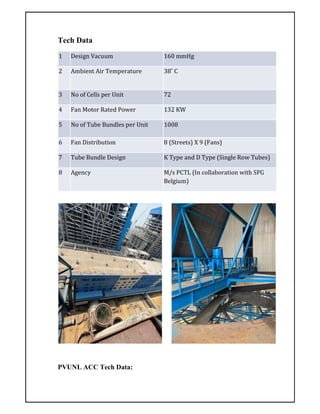
  • 15.
    Turbine Generator Introduction: A TurbineGenerator (TG) is a critical component in Thermal Power Plant, used extensively in thermal, hydroelectric, nuclear, and wind power plants. It converts mechanical energy (produced by a turbine) into electrical energy using a generator. The overall system is based on electromagnetic induction, where mechanical motion drives a magnetic field through coils to produce electricity. The performance and efficiency of the TG set directly influence the overall power output of the plant. In this plant 27 kV of electricity of generated. Working Principle The steam turbine operates on Ranking cycle principles, using high- pressure steam to produce rotational motion. The process involves: 1. High-Pressure Steam Expansion in HP Turbine: The steam which is generated in the boiler with a very high temperature and high pressure is directed towards the High Pressure (HP) Turbine through Mainstream Line (MSL). Each turbine consists of several stages, and one stage is made up of one rotor blade and one stator blade. As the steam expands through the nozzles and blades of the HP turbine, it undergoes a drop in pressure and temperature, while transferring its kinetic energy to the rotating blades. This initiates the rotational motion of the turbine shaft. 2. Reheating and Expansion in IP Turbine: Steam comes out of HP turbine and goes back to reheater in boiler through cold reheating line. Steam is then reheated in reheater and fed to the intermediate pressure (IP) turbine through Hot Reheating Line (HRL). It undergoes further expansion, causing additional rotation of the turbine shaft. 3. Final Expansion in LP Turbine: The exhaust steam from the IP turbine enters the Low-Pressure (LP) turbine. Here, it undergoes its final stage of expansion. The LP turbine is larger in size compared to HP and IP turbines due to the low density and volume of steam at this stage. This final expansion further drives the turbine shaft, maximizing energy extraction from the steam.
  • 16.
    4. The turbinerotor is directly coupled with the generator rotor, which spins inside a stator with electromagnetic coils, generating three-phase AC electricity. Major Components of TG Section: 1. Steam Turbine:  Convert high-pressure steam energy into rotational mechanical energy.  Drives the generator using a connected rotating shaft.  Consists of HP (High Pressure), IP (Intermediate Pressure), and LP (Low Pressure) stages. 1. HP: Receives high-pressure, high-temperature steam from boiler. 2. IP: Utilizes reheated steam from the boiler. 3. LP: Expands steam further before exhausting to condenser. 2. Generator:  Converts mechanical energy from the turbine into electrical energy.  Works on Faraday’s Law of Electromagnetic Induction.  Contains rotor (rotating magnetic field) and stator (stationary winding). 3. Excitation System :  Supplies DC current to the generator rotor to create a magnetic field.  Can be static or brushless.  Controls generator voltage and reactive power. 4. Turbine Bearings:  Support the rotating shaft of the turbine.  Reduce friction and allow smooth rotation.  Typically journal and thrust are used
  • 17.
    5. Rubrication OïlSystem :  Provides lubricating oil to bearings and moving parts.  Prevents wear, overheating, and ensures smooth operation.  Includes pumps, filters, coolers, and oil tanks. 6. Condenser:  Located after the LP turbine.  Converts exhaust steam from turbine back into water (condensate).  Maintains vacuum pressure to increase turbine efficiency. 7. Generator Transformer (GT):  Steps up the generator voltage 27KV to 400 KV.  Connects generator output to the transmission grid.  Ensures efficient long- distance power transmission. Conclusion Generator Transformer The Turbine Generator (TG) section is the heart of a power plant, where the actual conversion of thermal energy into electrical energy takes place. It involves the coordinated operation of critical equipment such as the steam turbine (HP, IP, LP stages), generator, excitation system, bearings, and the generator transformer. Each component plays a specific role in ensuring efficiency, reliability, and continuous power generation
  • 18.
  • 19.
  • 20.
    Switch Gear: Switchgear isa system of electrical devices used to control, protect, and isolate electrical equipment in a power plant. It includes switches, fuses, circuit breakers, and relays.  Circuit Breaker: A circuit breaker monitors current flow in an electrical system. When it detects a fault condition like a short circuit or current above the safe limit—it automatically opens (trips) the circuit, stopping the flow of electricity. Once the issue is resolved, it can be manually or automatically reset. In PVUNL power plant circuit breakers are used at Generators, Transformers, Busbars, Switchyard. Types of Circuit Breaker used in Plant  Air Circuit Breaker (ACB): Used for low voltage systems.  Vacuum Circuit Breaker (VCB): Used in medium voltage systems.  SF₆ (Sulphur Hexafluoride) Circuit Breaker: Used for high voltage applications. Vacuum Circuit Breaker (VCB):  It is mainly used in medium voltage range (3.3kv to 11kv)  VCBs provide fast arc quenching due to the vacuum.  They require minimal maintenance because there is no oil or gas. Working principle: In normal conditions, electricity flows smoothly through the circuit breaker. When something goes wrong, like a short circuit or overload, the breaker opens its contacts to stop the current. This creates a small electric spark, called an arc, between the contacts. The arc forms in a vacuum, which is an empty space with no air. Because there are no particles in the vacuum, the arc goes out very quickly. This stops the flow of electricity and protects the system. The vacuum helps to put out the arc fast and keeps it from starting again.
  • 21.
    Air Circuit Breaker(ACB): It is typically used in low-voltage systems (up to 1000V AC). Main Parts:  Contacts – Open and close the circuit.  Arc Chutes – Divide and cool the arc to help extinguish it.  Operating Mechanism Opens/closes the contacts manually or automatically.  Trip Unit – Senses the fault and triggers the breaker to open. How it Works?  Under normal conditions, current flows through the breaker without any problem.  If a fault occurs (like an overload or short circuit), the breaker automatically opens the contacts to stop the flow of electricity.  The arc that forms when the contacts open is extinguished using air at atmospheric pressure.  The air quickly cools and stretches the arc, which helps in stopping the current flow. Description of this image: ① Front cover, ② Arc extinguish chamber, ③ Control circuit terminal, ④ Electronic trip relay. ⑤ Counter, ⑥ Closing button, ⑦ Charging handle, ⑧ Name plate, ⑨ Caution mark ⑩ position indicator, ⑪ Pushing/Drawing lever hole, ⑫ Charging indicator, ⑬ Extension rail, ⑭ Trip button, ⑮ ON/OFF indicator, (16) Draw-out profile, (17) Main body profile, (18) Handle Relay: A relay is an electromechanical or electronic switch that detects abnormal conditions in an electrical circuit (like overcurrent, under-voltage, etc.) and sends a signal to isolate the fault by triggering a circuit breaker. Relay in Power Plant:
  • 22.
    In a powerplant, relays are essential for protection and automation of the electrical system. They monitor equipment like generators, transformers, feeders, motors, and busbars, ensuring they operate safely. Why Relays Are Important in a Power Plant:  Protect expensive equipment like generators and transformers  Prevent blackouts by isolating faults quickly  Improve reliability and efficiency of the power system  Support remote monitoring and control Types of relays used in Power Plant:  Distance Relay – Used in Transmission line to protect line based on resistance measurement.  Numerical relay - Digital, microprocessor-based, allows advanced logic and communication and mostly used in control panel.  Earth Fault Relay - It detects leakage current to the ground.  Overcurrent Relay – Protects against excessive current flow.  Under/Over Voltage Relay – Operates when voltage goes beyond safe limits.  Differential Relay - Detects difference in current at two points (e.g., transformer, Generator, Busbar protection). Numerical Relay Distance Relay Bus Bar: A bus bar is a metallic conductor (usually copper or aluminum) that is used in electrical systems to collect, carry, and distribute large amounts of electric power within switchgear, substations, or distribution boards.
  • 23.
    Differential Relays areused to detect faults and isolate the bus safely. Function of a Bus Bar:  Acts as a common connection point for incoming and outgoing power lines.  Distributes power to various components (transformers, feeders, loads).  Supports current sharing between different feeders or generators.  Helps in system expansion, maintenance, or fault isolation. Incomer: An incomer refers to the incoming feeder or line through which electrical power enters into a switchgear panel, busbar, or substation from a power source (like a generator, transformer). It includes Circuit Breaker, Current Transformer (CT), Potential Transformer (PT), Protective Relays (Overcurrent, Earth Fault, etc.) Internal connection of switch Gear Current Transformer (CT): A Current Transformer (CT) is an instrument transformer used to measure alternating current (AC). Key Functions of a CT:  Current Measurement: Converts high current to a lower, measurable value.  Isolation: Electrically isolates the measuring instruments from high-voltage circuits.  Protection: Supplies current to protective relays for detecting faults.
  • 24.
    Working of CurrentTransformer (CT):  works on the principle of electromagnetic induction, similar to a basic transformer, but it is designed for current measurement and protection.  The primary winding of the CT is connected in series with the line carrying the high current (busbar or cable). This winding has very few turns — often just one turn (a straight conductor).  When current flows through the primary, it produces a magnetic field in the CT’s magnetic core.  This magnetic field induces a current in the secondary winding (many more turns than the primary) due to Faraday's law of electromagnetic induction.  The secondary current is proportional to the primary current but reduced according to the CT ratio (e.g., 100:5 means 100A in primary gives 5A in secondary).  The secondary current flows to measuring instruments (ammeters) or protective relays (overcurrent or differential relays). Potential Transformer (PT): A Potential Transformer (PT) is an instrument transformer used to step down high voltage to a lower, safe voltage level for measuring and protection devices in power systems. Working Principle:  PT works on the principle of electromagnetic induction, but it’s specifically designed for voltage transformation with high accuracy.  The primary winding is connected across the high-voltage line.  AC voltage in the primary creates a magnetic flux in the PT’s iron core.  This flux induces a proportional lower voltage in the secondary winding, typically 110V or 63.5V.  The secondary voltage is sent to voltmeters, protective relays, or CCR systems for monitoring or control. Types of PTs:  Electromagnetic PT – Core and winding like a transformer.  Capacitor PT (CVT) – Used for very high voltages (66 kV and above), cheaper and better for transmission systems.
  • 25.
    SWITCH YARD A Switchyardis the heart of a power station or substation where the generated voltage is stepped up or stepped down and distributed or transmitted further. It acts as a bridge between the power plant and the transmission/distribution system. KEY FUNCTIONS OF A SWITCHYARD  Step up or step down voltage (via transformers).  Distribute power to multiple feeders or transmission lines.  Isolate faulty sections (using circuit breakers, isolators).  Ensure protection and control of equipment.  Provide metering and monitoring. TYPES OF SWITCHYARDS  AIS (Air Insulated Switchyard): 1. Open-air construction. 2. Uses air as insulating medium. 3. Cheaper but occupies more space.  GIS (Gas Insulated Switchyard): 1. Enclosed in metal housing with SF6 gas as insulation. 2. Compact and suitable for urban/space-limited areas. In PVUNL Gas insulated switchyard (GIS) used.
  • 26.
    Primary Components inGIS (Gas-Insulated Substation)  Busbar: Carries and distributes power inside the GIS. It is placed inside SF₆ gas for insulation.  Circuit Breaker (CB): Breaks the circuit during faults and also turns it on/off. SF₆ gas is used to stop the arc.  Disconnector (Isolator): Used to fully disconnect a part of the system for safe maintenance. Works only when there is no current.  Earthing Switch: Connects the disconnected part to the ground for safety. Some types work very quickly (FAES).  Current Transformer (CT): Measures the current in the system and sends the signal to protection and metering devices.  Voltage Transformer (VT/PT): Reduces high voltage to a lower level for measurement and protection. Can be inductive or capacitive.  Surge Arrester (LA): Protects equipment from high voltage surges due to lightning or switching by sending the surge to the ground.  Gas-Insulated Transmission Line (GIL): Joins the GIS with transformers or overhead lines. Filled with SF₆ or SF₆-N₂ gas mixture. # Auxiliary components in GIS:  SF₆ Gas Handling System Responsible for filling, recovery, filtration, and maintaining SF₆ gas pressure and purity. Ensures the gas remains dry and uncontaminated to maintain insulation strength.  Control and Relay Panel Operates GIS circuit breakers, isolators, and earthing switches. Houses protection relays, control logic, interlocks, and automation systems. Interfaces with SCADA for remote control and monitoring.  Partial Discharge Monitoring (PDM) Detects early-stage insulation deterioration or defects. Uses sensors to continuously monitor partial discharge signals.
  • 27.
     Gas DensityMonitor / Sensor Monitors SF₆ gas pressure and temperature. Triggers alarms and trips if pressure drops below safe levels.  Manometers and Pressure Relief Devices Manometers display gas pressure in compartments. Pressure relief devices prevent internal overpressure damage.  Local Control Cubicle (LCC) Located near each bay or GIS panel. Contains bay control units (BCUs), protection relays, and mimic diagrams. Used for local operation, control, and protection of individual bays.  Grounding System Ensures all metallic GIS parts are properly earthed. Prevents electric shock hazards and ensures safe fault current dissipation.  Energy Meters Measure how much electrical energy is used, mainly for billing and checking energy usage.  SCADA Integration (Remote Monitoring) SCADA allows remote control of GIS. It monitors alarms, logs data, and helps operate breakers and switches from a control room.  Disturbance Recorders These record faults or switching operations. The data helps in analyzing problems in the system. What is a Bus Reactor? A bus reactor is a type of inductor connected between busbars in a substation (either Air Insulated Substation or Gas Insulated Substation). Working of Bus Reactor:  It works by opposing sudden changes in current using its inductance.  When load decreases suddenly, voltage can rise dangerously. The bus reactor absorbs this excess voltage by storing energy in its magnetic field.  It also limits switching surges and controls overvoltage during light-load or no-load conditions.
  • 28.
     It isused in Between bus sections to maintain voltage balance, In GIS substations, enclosed in SF₆ gas chambers, at receiving end of long transmission lines. In PVUNL one and half breaker schemes are used. Basic Structure:  Two main buses.  Three circuit breakers for two circuits.  Each circuit shares one breaker with another circuit. Schematic diagram: Circuit 1 ── Breaker A ─┬── Bus 1 │ Breaker B │ Circuit 2 ── Breaker C ─┴── Bus 2 Single line diagram of 400kv switchyard  What is PLCC(Power Line Carrier Communication)? PLCC is a method of telecommunication in power systems where high-frequency signals (30 kHz to 500 kHz) are superimposed on power lines to send information such as protection signals, voice, or data without needing separate communication lines.
  • 29.
    What is Bay? Abay in a substation or switchyard is a physical and functional section that contains equipment for controlling, protecting, and monitoring a specific part of the power system. Each bay typically includes Circuit breaker, isolator and switch. Combination of three bay between busbar1 to busbar2 is called Dia. Substation Automation System (SAS):  Centralized digital system for monitoring, controlling, and automating substation functions.  Collects data from all LCCs and devices.  Integrates with SCADA for remote operation and data logging. Signals from switches, sensors, relays in the LCC are transmitted to SAS using Communication protocols: IEC 61850 (GOOSE), Modbus, or Fiber optic cables or Ethernet. What is BCU? A Bay Control Unit (BCU) is a digital intelligent electronic device (IED) installed inside the Local Control Cabinet (LCC) of a substation bay. It controls and monitors all equipment in that bay.
  • 30.
    BCU connects toSAS → SCADA → Control Room Lightning arrestor.
  • 31.
    Air Cooled Condenser AnAir-Cooled Condenser (ACC) is a type of heat exchanger used in power plants and industrial systems to condense steam or vapor into liquid using ambient air as cooling medium, instead of water. Working Principle: An Air-Cooled Condenser utilizes ambient air to remove heat out of exhaust steam for thermal or biomass power plants. The method of cooling is direct heat exchange. ACC can use natural draft or mechanical draft for heat exchange. Why ACC ●Air Cooled Condenser are designed for areas where water availability is low. ●Water requirement of ACC based plant reduces up to 60-70%. ●A Typical 3X800 MW Plant requires approx. 3 cum/MW =7200 m3/hr (80 % of this water is consumed in Cooling Towers) ●PVUNL Water requirement is 2093 Cum/hr for Phase – I (3 X 800 MW) Components Of ACC: ●Main steam duct: The main steam duct interfaces with the steam turbine and serves to convey all exhaust steam to steam distribution network. ●Steam distribution manifold: The steam distribution manifold is used to distribute steam between main steam duct and steam headers. This manifold includes vertical ducts referred to as riser. ●Steam header: The steam header serves to convey steam between the manifolds and the first stage bundles of an ACC row. ●Fin tube bundle: Set of tube bundle made of aluminum cladded carbon steel with aluminum fins for turbine exhaust steam condensation. ●Air removal system, Fin tube cleaning system ●Support structure and Wind wall: Support structure consists of , Main truss, Duct support, Fan deck beam, Fan bridge, A-Frame, Fan deck
  • 32.
    plate, Walkways, Windwall. Wind wall are installed around the perimeter of the ACC and extend from the fan deck to the top of the tube bundles. The function of the wind wall is to reduce the negative wind effect on the fan air flow and uniform heat transfer, as well as minimize potential for warm air recirculation. ●Mechanical draft equipment system: Axial fan, Gearbox and its lubrication system, Motor with multi speed or VFD. ●Condensate Tank: The condensate tank serves to collect the condensate that is formed within the ACC. Typically the condensate tank is located beneath the ACC ACC Drain Scheme: The ACC (Air-Cooled Condenser) Drain Scheme plays a vital role in the recovery and management of condensates in a thermal power plant, especially in systems where air is used instead of water for condensing turbine exhaust steam. Below is a detailed explanation of each component and its function in the scheme:  LP Turbine (Low Pressure Turbine): The LP Turbine is the final stage of the turbine system where steam expands and loses pressure. The exhaust steam from the LP turbine enters the Hot Box, and then passes through the Exhaust Duct to the ACC. 2. Hot Box and Bypass Line:  The Hot Box collects the low-pressure exhaust steam.  It includes a Bypass Line (LPH-1 Bypass) which ensures operational flexibility during part load or startup/shutdown conditions. 3. Drain Tank:
  • 33.
    Condensate formed dueto cooling of steam (in the exhaust duct and connected lines) is collected in the Drain Tank. This is a low-level tank used to temporarily store the condensate before it is pumped. 4. Drain Pumps: Drain pumps are used to transfer the collected condensate from the Drain Tank to the Condensate Tank. These pumps maintain the required pressure and ensure continuous operation without overflow or interruption. 5. Condensate Tank: The Condensate Tank acts as a storage and supply unit for recovered condensate. It receives drained condensate from the ACC system through the drain pumps. The tank also serves multiple functions:  Supplies water to Condensate Extraction Pumps (CEP A, B, C).  Maintains system pressure through Deaerator (D/A) to remove dissolved gases like oxygen and CO₂.  Accepts DM (De-Mineralized) Make-up Water when necessary to compensate for any losses.  Connected to an Evacuation Line, possibly for system venting or maintenance. 6. Condensante Extraction Pumps (CEP-A, B, C): These pumps draw water from the condensate tank and send it back to the system for reheating and reuse. Multiple CEPs provide redundancy and operational reliability. Condenser Tank
  • 34.
    Tech Data PVUNL ACCTech Data: 1 Design Vacuum 160 mmHg 2 Ambient Air Temperature 38˚ C 3 No of Cells per Unit 72 4 Fan Motor Rated Power 132 KW 5 No of Tube Bundles per Unit 1008 6 Fan Distribution 8 (Streets) X 9 (Fans) 7 Tube Bundle Design K Type and D Type (Single Row Tubes) 8 Agency M/s PCTL (In collaboration with SPG Belgium)
  • 35.
    Sl. No. Parameter Value 1 Design AmbientTemperature 38 deg. C 2 Design Condenser Back Pressure 160 mm Hg 3 No. of cells per ACC 72 No. 4 Tube Material Aluminium claded CS 5 Design Steam Flow 1275 tons/hr 6 Design Pressure 0.5bar (g) and Full Vacuum 7 Design Temperature 121 deg. C 8 Surface Area 3708980 sq. m 9 Design Wind Speed 5 m/s 10 Tube Bundle-Kondenser (K-Type) 896 No. 11 Tube Bundle-Dephlegmator (D-Type) 112 No. 12 Fan Motor Rated Power 132 KW 13 Gear Box Ratio 16.02 14 Condensate Tank Volume 138 m3 15 Vacuum Pump capacity (hogging); Qty-2 Nos. 47851m3/h 16 Vacuum Pump capacity (holding); Qty-2 Nos. 47851m3/h
  • 37.
    Electrostatic Precipitator (ESP) Introduction: Itis a part of power plant which captures dust particles from the flue gas thereby reducing the chimney emission. Precipitators function by electro statically charging the dust particles in the gas stream. The charged particles are then attracted to and deposited on plates or other collection devices. When enough dust has accumulated, the collectors are shaken to dislodge the dust causing it to fall with the force of gravity to hoppers below. The dust is then removed by a conveyor system for disposal or recycling.
  • 38.
    Working Principle: 1. FlueGas from Boiler: Flue gas from pulverized coal-fired boilers contains fly ash, unburned carbon, and tiny ash particles. The flue gas is directed to the ESP unit after passing through economizers and air preheaters. 2. High Voltage Supply from TR Set A Transformer Rectifier (TR) set, like the one in our image from BHEL, converts 415V AC to high-voltage DC (up to 95kV and 1000 mA). This is connected to discharge electrodes (wires) inside the ESP chamber. 3. Ionization & Charging The high-voltage DC creates a corona discharge. It ionizes the gas and charges the ash particles negatively. 4. Particle Migration and Collection Charged particles migrate to grounded collecting plates (positively charged). Ash gets deposited on these plates and forms a layer. 5. Rapping Mechanism The ESP system has a mechanical or electromagnetic rapping system. It knocks the plates at intervals, and collected ash falls into hoppers. 6. Clean Gas Release The now clean flue gas is released via the chimney/stack. This reduces particulate emissions and complies with CPCB/MoEF norms (e.g., <30 mg/Nm³ particulate limit). Major Components Of ESP 1. HVR Transformer (High Voltage Rectifier Transformer):
  • 39.
     Function: Convertsincoming AC power into high-voltage DC power required for the ESP.  Role in ESP: Supplies 30-70 kV DC to the discharge electrodes to ionize the gas stream.  Working: Steps up the voltage using a transformer and then rectifies it to DC using rectifier circuits. In this plant, each section of the ESP consists of 6 passes, and each pass contains 20 transformers, making a total of 120 transformers per section. 2. EERM Motor (Emitting Electrode Rapping Mechanism Motor)  Function: Drives the mechanism that cleans the discharge/emitting electrodes by rapping (hitting) them.  Role in ESP: Removes collected dust from discharge wires to maintain efficiency.  Frequency: Operates periodically to shake off accumulated particles. 3. CERM Motor (Collecting Electrode Rapping Mechanism Motor)  Function: Operates the mechanism that cleans the collecting plates by vibration or hammering.  Role in ESP: Ensures that dust collected on plates falls into the hopper.  Result: Prevents re-entrainment of particles into the gas flow. 4. Gas Distribution Screen  Function: Ensures even flow distribution of flue gases entering the ESP.  Role in ESP: Reduces turbulence and ensures uniform gas velocity across all collection fields.  Material: Usually made of corrosion-resistant steel mesh or perforated plates. 5. Gas Distribution Rapping Mechanism
  • 40.
     Function: Cleansthe gas distribution screen using mechanical tapping.  Role in ESP: Prevents blockage of the screen due to dust buildup, ensuring smooth airflow.  Mechanism: Typically, similar to electrode rappers with periodic operation. 6. Thermostat  Function: Monitors and controls the temperature inside the ESP or associated systems  Role in ESP: Prevents overheating components like transformers, motors, or heaters in cold weather.  Protection: Sends signals to shut down or adjust components if the temperature crosses safe limits. Overview of ESP hopper (bottom part of ESP)
  • 42.
    Ash Handling Plant(AHP) Introduction: An Ash Handling Plant (AHP) is a vital system in thermal power plants, used for the collection, removal, and safe disposal of ash produced during the combustion of coal in boilers. When coal is burned in a furnace, two types of ash are produced: fly ash and bottom ash. The Ash Handling Plant (AHP) is responsible for collecting, conveying, storing, and disposing of both types of ash generated during combustion. With the growing focus on environmental protection and resource recovery, AHPs also contribute to the reuse of ash in various industries like cement manufacturing, brick making, and road construction. Types Of Ash Fly Ash: Lighter particles that are carried with flue gases and collected by electrostatic precipitators (ESPs) or bag filters. Bottom Ash: Heavier particles that fall to the bottom of the furnace. Bottom Ash Handling Process: Bottom ash is heavy ash that falls to the bottom of the boiler furnace after coal combustion. It is collected in a water-filled bottom ash hopper, where it is quenched (cooled with water). From there, it is removed using either a hydraulic system (jet pumps and slurry pipelines) or a mechanical system (like submerged conveyors). The ash is then transported to an ash pond or stored in a silo for reuse in construction materials. Fly Ash Handling Process Fly ash is fine, light ash that travels with the flue gases and is collected using electrostatic precipitators (ESP) or bag filters. This ash is transported using a pneumatic system (vacuum or pressure), usually in dry form. It is stored in fly ash silos and can either be sold for reuse (in cement and bricks) or mixed with water and sent to an ash pond if disposal is needed. Working Of Electrostatic Precipitator (ESP): 1. Flue gas containing fly ash enters the ESP chamber. 2. Inside the ESP, discharge electrodes are negatively charged, while collecting plates are grounded or positively charged. 3. A high-voltage DC current (30–70 kV) ionizes the gas and imparts a negative charge to the ash particles. 4. The negatively charged particles get attracted to the positively charged plates.
  • 43.
    5. The ashaccumulates on these plates and is periodically removed by rapping mechanisms, allowing it to fall into fly ash hoppers. 6. The cleaned flue gas is then safely discharged through the chimney. ESP systems are capable of removing up to 99.5% of fly ash from flue gas, significantly reducing emissions and meeting environmental standards. Fly Ash Collection and Disposal  Fly ash is a fine powder generated when coal burns in a thermal power plant.  It gets carried along with flue gases.  To collect it, Electrostatic Precipitators (ESPs) or bag filters are used.  These devices trap fly ash and drop it into hoppers located below.  The ash is then conveyed through pneumatic systems (using air pressure or vacuum) to fly ash silos Fly ash can be disposed of in two ways:  Dry Disposal: 1. Dry fly ash from silos is loaded into trucks or tankers. 2. It is sent to cement plants, brick kilns, or used in road construction.  Wet Disposal: 1. Fly ash is mixed with water to form a slurry. 2. The slurry is pumped to an ash pond or ash dyke for safe dumping. Silo System Overview  The plant has: o 6 main silos for fly ash o 3 main silos for bottom ash o 4 intermediate silos used in ash transfer and regulation These silos act as buffer storage, allowing for regulated discharge and flexibility in handling and disposal operations Equipment Overview In AHP Equipment Function / Description Ash Hopper Collects ash from the boiler furnace (bottom ash) or ESP (fly ash).
  • 44.
    Conveyor Belt-1 (Bottom Ash) Transfersquenched bottom ash from hopper to crusher or disposal system. Crusher Crushes large bottom ash clinkers into smaller pieces for easy transport. Conveyor Belt-2 (After Crusher) Carries crushed bottom ash to ash slurry sump or dry handling unit. ESP (Electrostatic Precipitator) Captures fly ash particles from flue gases using high-voltage electrostatic charge. Fly Ash Hoppers Collects fly ash from ESPs; serves as the first storage point before conveying. Pneumatic Conveying System Transfers dry fly ash from hoppers to silos using pressurized air or vacuum. Intermediate Silos Temporary storage for fly ash before final disposal or utilization. Main Silos (Fly & Bottom) Large storage silos where dry fly ash or bottom ash is stored for disposal or resale. Trucks / Railway Wagons Used to transport dry ash to cement plants, brick factories, or disposal sites. Ash Pond / Dumping Yard Final disposal area where ash slurry (wet ash) is dumped and stored safely.
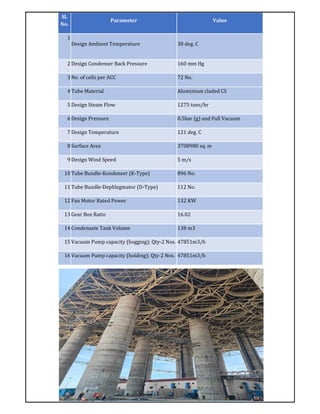
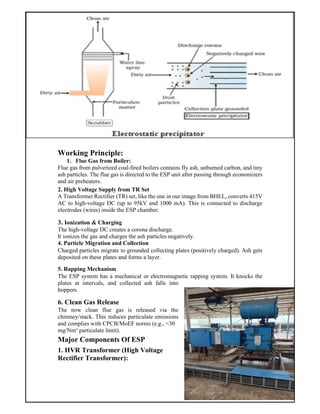
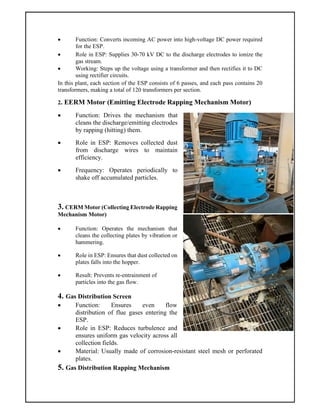
  • 46.
    PT Plant &DM Plant What is the need of PT plant?  Removes suspended solids, turbidity, and organic matter.  Protects downstream DM plant from clogging and fouling.  Ensures smooth operation of filters and ion-exchange units. Raw water comes from Patratu Dam and passes through the following stages: 1. Aerator  Adds oxygen to the water  Helps remove dissolved gases like CO₂ and volatile impurities Aerator 2. Clarifier (with Hypo and Alum) where two chemicals are added: hypo (sodium hypochlorite) and alum. Hypo disinfects the water by killing bacteria and microorganisms, while alum acts as a coagulant, clumping fine particles together for easier removal.
  • 47.
    Channel to GSMBed GSM (Graded Sand Media) Bed:  Works as a filtration unit  Removes suspended solids, mud, and fine flocs  Ensures water clear before storage. DM Sump  Stores the filtered water.  Supplies water to the Demineralization (DM) Plant for final purification. From the DM sump, the water flows through three channels (controlled by Induction motor) to the Activated Carbon Filter (ACF), which removes chlorine, organic matter, and any remaining impurities. Where Free Residual Chlorine (FRC) (the amount of chlorine remaining in the water after the disinfection process is complete) should be nil and turbidity less than 0.5. After passing through the ACF, the water enters the Weak Acid Cation (WAC) unit, which removes hardness by exchanging calcium and magnesium ions. It then
  • 48.
    flows to theStrong Acid Cation (SAC) unit, where all remaining cations like sodium, calcium, and magnesium are removed by cation resin, ensuring the water is free from positive ions. Together, the WAC and SAC units ensure a significant reduction in cationic impurities before the water moves on to anion exchange. After the SAC (Strong Acid Cation) unit, the water passes through a degasser tower (with blower) to remove dissolved CO₂. It is used because which interferes with anion exchange and affects PH. Its work as  first Water from SAC is sprayed into the tower.  A blower forces air upward.  This air strips CO₂ gas from the water.  CO₂ escapes through the top; treated water collects at the bottom H⁺as strong acid resin that replaces all cations (Na⁺, K⁺, Ca²⁺, Mg²⁺) with hydrogen (H⁺) ions. Reaction: Na⁺ + H⁺-resin → Na-resin + H⁺ After goes to WBA (Weak Base Anion) Unit  Function: Removes strong acid anions like chloride (Cl⁻) and sulphate (SO₄²⁻).  It Exchanges these anions with hydroxide (OH⁻) ions.  Reaction: Cl⁻ + OH⁻-resin → Cl-resin + OH⁻ (released into water)  Purpose: Handles most mineral acids but not CO₂ or silica. For further processing goes to SBA (Strong Base Anion) Unit Function: Removes all remaining anions, including weak acids like CO₂ and silica (SiO₂). It Also exchanges with OH⁻ ions.
  • 49.
    Reaction: HCO₃⁻ + OH⁻→ H₂O + CO₃²⁻ after the SBA unit, the water often goes to MB (Mixed Bed) Polisher for final purification MB (Mixed Bed) Unit: It contains a mixture of strong acid cation (SAC) and strong base anion (SBA) resins in a single vessel. Removes any remaining traces of cations (like Na⁺, Ca²⁺) and anions (like Cl⁻, SiO₂). And ensures ultra-pure water with very low conductivity (< 0.1 µS/cm). And finally high-quality demineralized water is obtained and stored in DM Tank. DM Water Tank (Storage) 3 tanks in PVUNL each having capacity 3169 MT It continuously feed to critical systems like boilers, turbines, or process units as required. DM Tank
  • 51.
    TRANSFORMERS Introduction: A transformer isa static electrical device that transfers electrical energy between two or more circuits through electromagnetic induction. It plays a key role in the transmission and distribution of electrical power by stepping up or stepping down voltage levels with minimal losses. Working Principle: The transformer works on Faraday’s Law of Electromagnetic Induction. When an alternating current flows through the primary winding, it produces a magnetic flux that links with the secondary winding through the core, inducing a voltage in the secondary winding. Parameter Value Manufacturer Transformers & Rectifiers (India) Ltd. Location Ahmedabad (Gujarat), India Type Copper Wound Transformer Standard IS 1180 (Part 1): 2014 (Amendment 4) Cooling Type ONAN Phase 3 Phase Vector Group Dyn11 Rated Power (kVA) 3150 Rated Voltage - HV (kV) 33 Rated Voltage - LV (V) 433 Rated Current - HV (A) 55.1 Rated Current - LV (A) 4196.6 Tap Range +5% to -10% in 1.25% steps
  • 52.
    Impedance (%) 6.25% Typeof Tap Changer Off Circuit Tap Changer (OCTC) No. of Taps 7 Taps Frequency 50 Hz Total Weight (kg) 19500 Oil Quantity (litres) 3000 Core & Winding Weight (kg) 9900 Total Mass (kg) 17500 Year of Manufacture 2022 Guaranteed Max. Temp. Rise (°C) 55°C (Winding), 45°C (Oil) Customer Name NTPC Purchase Order No. 272/2005 Date of Commissioning 26.04.2022 Applicable Standard Marking ISI – CML-7200234557 Main Parts  CONSERVATOR It is used generally to conserve the insulation property of the oil from deterioration and protect the transformer against failure on account of bad quality of oil. 2. SILICA GEL DEHYDRATING BREATHER It is used to prevent entry of moisture inside the transformer tank. The breather consists of silica gel. 3. GAS OPERATED RELAY (BUCKHOLZ RELAY) It is a gas-actual relay used for protecting oil immersed transformer against all types of faults. It indicates the presence of gases in case of some minor fault and takes out the transformer out of circuit in case of serious fault. 4. BUSHINGS It is made from highly insulating material to insulate and bring out the terminals of the transformer from the container. The bushings are of 3 types:  Porcelain bushings are used for low voltage transformer.  Oil filled bushings used for voltage up to 33 KV.
  • 53.
     Condensed typebushings are used for voltages above 33KV. 5. OIL GAUGE Every Transformer with an oil gauge to indicate the oil level. The oil gauge may be provided with the alarm contacts which gave an alarm that the oil has dropped beyond permissible height due to oil leak etc. 6. TAPPINGS The Transformer are usually provided with few tapping on secondary side so that output voltage can be varied for constant input voltage. 7. RADIATORS It increases the surface area of the tank, and more heat is thus radiated in less time. 8. WINDING TEMPERATURE INDICATOR (OIL GAUGE) Device which indicates the temperature of winding of transformer and possible damage to the transformer due to overload can be prevented. Cooling Of Transformers of Large MVA As the size of Transformer becomes large, the rate of oil circulating becomes insufficient to dissipate all the heat produced and artificial means of increasing the circulation by electric pumps . In very large transformers, special coolers with water circulation may have to be employed. Types Of Cooling Air Cooling  Air Natural(AN)  Air Forced(AF) Oil Immersed Cooling  Oil Natural Air Natural (ONAN)  Oil Natural Air Forced (ONAF)  Oil Forced Air Natural (OFAN)  Oil Forced Air Forced (OFAF) Oil Immersed Water Cooling  Oil Natural Water Forced (ONWF)  Oil Forced Water Forced (OFWF) Types Of Transformers Depending on the application, transformers can be categorized into:
  • 54.
    Station Transformer Fig: StationTransformer (144 MVA , 400KV/11KV) Generator Transformer
  • 55.
    Fig: Generating Transformer(315MVA, 27.5KV/400KV) Unit Transformer Fig: Unit Transformer (55 MVA, 27KV/11KV)  Power Transformers – A Power Transformer is a vital component in electrical power systems, used to transfer electrical energy between two or more circuits through electromagnetic induction. It’s mainly used in transmission networks for stepping up (increasing) or stepping down (decreasing) voltage levels. Distribution Transformers – A distribution transformer is a type of transformer used to step down the voltage from the high transmission levels to a lower level suitable for use by consumers in homes, offices,
  • 56.
    industries, etc. Fig:Unit auxiliary transformer (12.5MVA, 11KV/3.3KV)  Instrument Transformers – Instrument transformers are specialized transformers used in electrical power systems for measurement and protection purposes. They reduce high voltage or high current levels to lower, standardized levels that can be safely handled by instruments and relays. Dry type of transformer Dry type transformers are an electrical transformer that uses air instead of oil for cooling and insulation. Its windings and core are enclosed in epoxy resin or varnish, making it safer, fire-resistant, and suitable for indoor installations. These transformers require less maintenance and are commonly used in commercial buildings, industries, and areas where fire safety is critical.
  • 57.
    Name plate ofdry type transformers Testing Of Transformer Testing of a transformer is crucial to ensure its performance, safety, and reliability before it’s put into operation or during maintenance. There are several types of tests performed:  Insulation Resistance Test  Transformer Turns Ratio Test (TTR)  Magnetization and Short Circuit Tests  Oil BDV Test (Breakdown Voltage) We Saw Engineers performing Insulation Resistance Test . Insulation Resistance Test (IR Test) The Insulation Resistance (IR) Test is used to measure the electrical resistance offered by the insulation materials (like winding insulation, cable sheaths, transformer oil, etc.) of electrical equipment. Why IR Test The Insulation Resistance test is performed to assess the dielectric strength and quality of insulation in a transformer. It ensures operational safety, prevents electrical faults, and helps identify early signs of insulation deterioration due to aging, moisture, or Contamination. This image shows an insulation resistance test being conducted at a construction or electrical installation site using a digital insulation resistance tester (megger). Device in Use:
  • 58.
     Instrument Name:Metravi® Digital Insulation Resistance Tester (Model DT-615).  Function: Measures insulation resistance in megaohms (MΩ) to check the quality of insulation in electrical equipment or installations.  Reading on Display: 1. Resistance: 9.8 MΩ 2. Test Voltage: 500 V (as seen on the scale) 3. Time Elapsed: 52 seconds Purpose of the Test: To ensure that the insulation resistance is high enough to prevent leakage current or short circuits, which could be dangerous or damage equipment. Transformer protection: Transformer protection is critical to ensure the safety, reliability, and longevity of the equipment. Multiple protective systems and diagnostic tests are employed to detect faults and prevent major failures. Key protection methods include: • Differential Protection (REF & Main Differential): Detects internal phase- to-phase and phase-to ground faults by comparing currents at both ends of the transformer. • Buchholz Relay: A gas-actuated relay used in oil-immersed transformers to detect internal faults like winding short circuits or insulation failure. • Overcurrent and Earth Fault Protection: Protects against excessive current due to external short circuits or ground faults. • Temperature Protection: Uses temperature sensors and relays to trip the transformer in case of overheating in winding or oil. • Pressure Relief Device (PRD): Relieves internal pressure build-up due to fault arcing or overheating, protecting against explosion. • Oil Level and Oil Temperature Monitoring: Ensures proper cooling and alerts in case of oil leakage or thermal issues. • Surge/Lightning Arresters: Protects the transformer from transient over voltages caused by lightning or switching surges.
  • 59.
    ELECTRICAL Single LineDiagram for Patratu UNIT-1 400 kV Switch yard From 400 kV Switch yard ST#1,144/72/72MVA, 400/11.5/11.5kV GT#1 3x315MVA, 27/400kV 27kV GEN. #1 941MVA,27kV UT#1B UT#1A 55MVA, 27/11.5kV 11 kV 1BA 3150A 11 kV 1BB 3150A 11kV, 4000A 11kV, 4000A To #0BD To #0BC 0BA 0BB Unit SWBD STATION SWBD UAT#1B UAT#1A 12.5 MVA, 11/3.45kV 1CA 3.3 kV 2500A CEP VFD-1A,1C FD FAN -1A ID FAN -1A PA FAN-1A G Turbine Srv. Trf 1DBT01 2500kVA , 11/.415 kV M CEP VFD-1B FD FAN -1B ID FAN -1B PA FAN-1B Turbine Srv. Trf 1DBT02 2500kVA , 11/.415 kV SEC-A MILL- 1A,1C,1E,1G,1J IAC-A ECW (TG)- 1A, 1C ACW- 1A HOGGING PUMP- 1A ECW (SG)- 1A DRIP PUMP-1A SEC-B MILL- 1B,1D,1F,1H BRCW PUMP- 1 ECW (TG)- 1B ACW- 1B,1C HOGGING PUMP- 1B ECW (SG)- 1B DRIP PUMP-1B SAC- A 1DB TURBINE PMCC 415 V, 4000A M Boiler Srv. Trf 1DAT02 2500kVA , 11/.415 kV Boiler Srv. Trf 1DAT01 2500kVA , 11/.415 kV BOILER PMCC 1DA 415 V, 4000A G Unit-1 DG 2000 kVA, 415 V STANDBY DG, 415 V EMERG. MCC 1DG 415 V, 3000A SERVICE ACDB 1QA 415 V, 630A TURBINE VALVE DB 415 V, 250A 1KA BOILER ACDB 415 V, 400A 1HB 415 V, 63A SCR MCC 415 V, 400A 1HE BOILER VALVE & DAMPER ACDB 415 V, 250A 1HA M MDBFP-A Station Srv. Trf 0DAT01 2500kVA , 11/.415 kV Station Srv. Trf 0DAT02 2500kVA , 11/.415 kV STATION SERVICE PMCC 415 V, 4000A 0DA AIR COND. MCC 415 V, 630A 0TA VENTILATION MCC 415 V, 800A 1TA MISC. SERVICES MCC 415 V, 400A 0QA AIR WASHER MCC 415 V, 1250A 0SA BOP SWBD BOP AUX. SWBD 3.3 kV, 1000A 0CL BOP AUX. TRF.#1 5 MVA, 11/3.45kV BOP AUX. TRF.#2 SEC-A PRIMERY HC FEED PUMP-1 APH/ESP WASH PUMP-1 ACW CS PUMP-1 ECW CS PUMP-1 VACUUM PUMP-1 VACUUM PUMP-3 SERVICE WATER PUMP-1 FILTRATE WATER PUMP-1 SECONDARY HC FEED PUMP-1 SPRAY PUMP-1 HYDRANT MAIN PUMP-1 SEC-B HYDRANT MAIN PUMP-2 HYDRANT MAIN PUMP-3 SPRAY PUMP-2 ASH/ESP WASH PUMP-2 ACW CS PUMP-2 ECW CS PUMP-2 VACUUM PUMP-2 VACUUM PUMP-4 SERVICE WATER PUMP-2 FILTRATE WATER PUMP-2 SECONDARY HC FEED PUMP-2 BOILER FILL PUMP-2 PRIMERY HC FEED PUMP-2 SEC-A  24V BatteryCharger System (VFD/ESP)  220V DC CHARGER-1A  220V DC CHARGER-1B  INSTRUMENT AIR COMPRESSOR AUXILIARY SUPPLY  24V BatteryCharger System (ACC)  AUX. OIL PUMP (MD BFP)  24V BatteryCharger System (SG and TG)  PRIMARY WATER PUMP 2 SOOT BLOWER MCC > 24V BATTERY CHARGER SYSTEM (BOP) >24V BATTERY CHARGER SYSTEM (SG AND TG) 240V AC UPS SEC-B  SERVICE AIR  24V BatteryCharger System (FOPH)  240V AC UPS (UNIT)  AUX. OIL PUMP (MDBFP)  24V BatteryCharger System (BOP)  UTILITY COMPRESSOR  220V DC CHARGER -1A  220V DC CHARGER -1B G FGD AUX. SWBD 3.3 kV, 2000A 1GA FGD SERVICE PMCC 415 V, 4000A 1GD G FGD DG 2000 kVA, 415 V FGDEMG.PCC 415 V, 3000A FGD AUX. TRF.#1A 10 MVA, 11/3.45kV #1B FGD SER. TRF.#1A 2.5 MVA, 11kV/415V #1B FROM BOP SWBD SEC-1 #0BG FROM BOP SWBD SEC-3 #0BJ FGD COMMON TRF.-A 2.5 MVA, 11kV/415V FGD COMMON TRF.-B FGDCOMMONPMCC 415 V, 4000A 0GD FGD AC & VENT MCC 415 V, 630A 0TC AHP AUX. SWBD #1 3.3 kV, 3000A AHP AUX. TRF.-A 16 MVA, 11/3.45kV AHP AUX. TRF.-B From #1BA SEC-A AHP MCC-1 415 V SEC-B SEC-B AHP MCC- 4 415 V SEC-A From BOP # 0BH From BOP # 0BJ AHP MCC-4 TRF.-A 2.5 MVA, 11/.415kV TRF.-B TRF.-C 0BJ 0BH 0BG (UNIT-2) From - 0BC (UNIT-3) From - 0BE 11 kV, 1600A WET LIME STONE MILL-A WET LIME STONE MILL-B SEC-A From BOP #0BH From BOP #0BJ AHP MCC-5 TRF.-A 2.5 MVA, 11/.415kV TRF.-B TRF.-C SEC-B AHP MCC- 5 415 V AHP MCC-1 TRF.-A 2.5 MVA, 11/.415kV TRF.-B TRF.-C AHP MCC-2 415 V From #2BA From #2BB AHP MCC-2 TRF.-A 2.5 MVA, 11/.415kV TRF.-B AHP MCC-3 415 V From #3BA From #3BB AHP MCC-3 TRF.-A 2.5 MVA, 11/.415kV TRF.-B CHP SWGR CHP MCC-4 3.3 kV, 2500A CHP MCC-4 TRF.#1 12.5 MVA, 11/3.45kV CHP MCC-4 TRF.#2 CHP MCC-1 TRF.-A CHP MCC-2 TRF.-A CHP MCC-3 TRF.-A CHP MCC-4 TRF.-A 2500kVA , 11/.415 kV CHP MCC-1 TRF.-C CHP MCC-2 TRF.-C CHP MCC-3 TRF.-C CHP MCC-4 TRF.-C 2500kVA , 11/.415 kV (UNIT-2) From #0BD (UNIT-3) From #0BF 11 kV, 1600A CHP MCC-3 TRF.#1 16 MVA, 11/3.45kV CHP MCC-3 TRF.#2 CHP MCC-3 3.3 kV, 3000A CHP MCC-1 TRF.-B CHP MCC-2 TRF.-B CHP MCC-3 TRF.-B CHP MCC-4 TRF.-B 2500kVA , 11/.415 kV FWPH/AUX BOILER SERVICE PMCC 0DP 415 V, 1600A From BOP #0BG From BOP #0BJ FW / AUX BOILER TRF.-1 1 MVA, 11/.415kV TRF.-2 FOPH PMCC 0DK 415 V, 2500A From BOP #0BH From BOP #0BJ FOPH TRF.-1 1.6 MVA, 11/.415kV TRF.-2 ADMIN BLDG PMCC 0DD 415 V, 4000A From BOP #0BH From BOP #0BJ ADMIN BLDG TRF.-1 2.5 MVA, 11/.415kV TRF.-2 SERV. BLDG PMCC 0DE 415 V, 2500A From #0BB From #0BD SERVICE BLDG TRF.-1 1.6 MVA, 11/.415kV TRF.-2 DM & CPU PMCC 0DH 415 V, 4000A From BOP #0BH From BOP #0BJ DM & CPU TRF.-1 2.5 MVA, 11/.415kV TRF.-2 CPU MCC0WC 415 V, 1000A ACWT CIO2 MCC 0WG 415 V, 400A H2 PLANT SWGR 0DJ 415 V, 1600A From MISC. SEC-A #0BK From MISC. SEC-B #0BK H2 GENE. SERV. TRF.-1 1 MVA, 11/.415kV TRF.-2 #1BB MISC. SWBD 11 kV, 1000A 0BK From #0BF MISC. TRF.-1 16 MVA, 11/11.5kV MISC. TRF.-2 ETP & CSSP PMCC 0DG 415 V, 4000A From #0BB From #0BD ETP & CSSP TRF.-1 2.5 MVA, 11/.415kV TRF.-2 ETP MCC 0WB 415 V, 1250A From ESP #1DD ESP AC & VENT MCC1TB 415 V, 400A ESP STANDBY PMCC 1DL 415 V, 4000A ESP PMCC 1DC 415 V, 4000A ESP PMCC 1DD 415 V, 4000A ESP PMCC 1DE 415 V, 4000A ESP STANDBY PMCC 1DM 415 V, 4000A ESP PMCC 1DF 415 V, 4000A ESP PMCC 1DH 415 V, 4000A ESP PMCC 1DJ 415 V, 4000A From #0BA From #1BA From #1BA From #1BA From #0BB From #1BB From #1BB From #1BB ESP SER. TRF 1DCT02 2.5 MVA, 11/.415kV ESP TRF 1DCT01 2.5 MVA, 11/.415kV ESP TRF 1DDT01 2.5 MVA, 11/.415kV ESP TRF 1DET01 2.5 MVA, 11/.415kV ESP SER. TRF 1DFT02 2.5 MVA, 11/.415kV ESP TRF 1DFT01 2.5 MVA, 11/.415kV ESP TRF 1DHT01 2.5 MVA, 11/.415kV ESP TRF 1DJT01 2.5 MVA, 11/.415kV From #1DG SEC-B ESP & ID FAN AREA MCC 1HD 415 V, 400A ACC - 1A 1DK 415 V, 3000A ACC - 1B 1DN 415 V, 3000A ACC - 1C 1DP 415 V, 3000A From #0BA From #1BA From #1BA From #1BA ACC STANDBY PMCC 1DX 415 V, 3000A ACC SER. TRF 1DKT04 2 MVA, 11/.415kV ACC SER. TRF 1DKT01 2 MVA, 11/.415kV ACC SER. TRF 1DKT02 2 MVA, 11/.415kV ACC SER. TRF 1DKT03 2 MVA, 11/.415kV ACC - 1D 1DQ 415 V, 3000A ACC - 1E 1DR 415 V, 3000A ACC - 1F 1DS 415 V, 3000A From #0BA From #1BA From #1BB From #1BB ACC STANDBY PMCC 1DY 415 V, 3000A ACC SER. TRF 1DKT08 2 MVA, 11/.415kV ACC SER. TRF 1DKT05 2 MVA, 11/.415kV ACC SER. TRF 1DKT06 2 MVA, 11/.415kV ACC SER. TRF 1DKT07 2 MVA, 11/.415kV ACC - 1G 1DU 415 V, 3000A ACC - 1H 1DV 415 V, 3000A From #0BB From #1BB From #1BB ACC STANDBY PMCC 1DZ 415 V, 3000A ACC SER. TRF 1DKT11 2 MVA, 11/.415kV ACC SER. TRF 1DKT09 2 MVA, 11/.415kV ACC SER. TRF 1DKT10 2 MVA, 11/.415kV ACC AC &VENT MCC #0TD 415 V, 400A RAW WATER PMCC 0DF 415 V, 4000A From BOP #0BG From BOP #0BH DM & CPU TRF.-1 2.5 MVA, 11/.415kV TRF.-2 STP MCC 0WF 415 V, 400A PT PLANT MCC 0WA 415 V, 1000A WORKSHOP MCC 0SD 415 V, 1000A MANOJ KUMAR MEENA SR. ASST. ENGG. (OPERATION, O&M) From SEC-B #0DA To #1DB SEC-B From BOP #0BJ #1BB BAY 404 BAY 401 (UNIT-2) From #0BD