CLASSIFICATION
SOCIETIES
 The term ‘Classification’ comes from the fact
that we sort out ships categories according to
the level of confidence we assign them,
further to the results of the assessment
carried out thereon.
 The class is granted generally for a term of 5
years during which it’s validity is subject to
compulsory periodical surveys
What is CLASS ?
What is CLASS ?
 It defines technical and safety
standards of a ship, which reflects
the risk of insuring a ship
Reason to CLASS a ship
 Determination of Fitness
 Meet Requirement of jurisdictions
 Possible lower insurance premiums
 Indicates due negligence
 Indicates proper maintenance in
performed
 Assures that capital investment is
protected
 Owner satisfaction
Classification of the ship
enables :-
 The insurers to assess the premium relative
to the ship (hull insurance) and that relative
to the cargo (cargo insurance)
 Hence, the owner to find an insurer who
accepts to cover the risk incurred by the ship
 Then, the owner to charter his ship
 The charterer to select advisedly the ship
whom he will entrust with his cargo
 A future owner to assess the quality of the
ship prior to the purchase
 The flag authorities to trust the ship and,
therefore, to register her into their fleet
What is CLASSIFICATION
SOCIETY
 A body that ensures that class of a ship,
however, with increasing demands from
all quarters of the industry and the
continuous development of ship
technology, the societies have changed
in form as a consequences of accepting
the additional responsibilities
Present Role of
Classification Societies
 To assign a Class
notation
 Maintenance of class
 Relevant research
work
 Statutory surveys
(marine
administration)
 Charter surveys
 Profitability advice
(to owner)
 Development of
computer software
 Set up worldwide
networks
 Carry out surveys
 Certification
 Emergency technical
services
Classification Responsibilities
 To ensure that merchant ships and marine
structure presented to it comply with rules
that the society had established for
design, construction and periodic survey
 Trough it classification survey procedure it
is the intent of the society to prevent
vessel from falling into a substandard
condition.
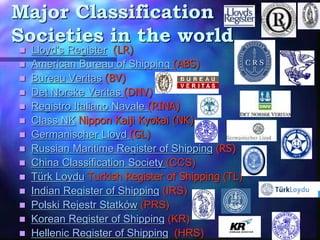
Major Classification
Societies in the world
 Lloyd's Register (LR)
 American Bureau of Shipping (ABS)
 Bureau Veritas (BV)
 Det Norske Veritas (DNV)
 Registro Italiano Navale (RINA)
 Class NK Nippon Kaiji Kyokai (NK)
 Germanischer Lloyd (GL)
 Russian Maritime Register of Shipping (RS)
 China Classification Society (CCS)
 Türk Loydu Turkish Register of Shipping (TL)
 Indian Register of Shipping (IRS)
 Polski Rejestr Statków (PRS)
 Korean Register of Shipping (KR)
 Hellenic Register of Shipping (HRS)
Surveys Areas for Container
Ships
LWL
Bow flare impact
pressure
High stress at
hatch corners in
forward hold
Watertight
bulkheads
Large distortion of
hatch opening for
hatch cover design
High stress at hatch
corners forward of
machinery room
Cross deck structure Hatch brackets
Connection of cross
deck beam to
longitudinal girder
Connection of cross
deck beam to upper
deck
Pillar
bulkhead
Bottom slamming
impact pressure
Transverse strength & fatigue
of longitudinal frame
One year survey after
construction
 Deck features and
integrity
 Overboard discharge
arrangement
 Vent piping
 Bilge level detection
(UMS)
 Anchoring / mooring
equipment
 Water-tight doors and
bulkhead penetrations
 Steering test
 Emergency escape
routes
 Bilge pumping system
 General conditions –
hull and machinery
 Satutory surveys
 Surveys of continuous
survey items
 Testing of tanks (FO,
LO, FW & DB tank)
- Pressure test
- Internal condition
- Stagger (tankers)
- Transverse webs
(cargo tank)
* Can be done in a float
condition
 Annual surveys
 Statutory surveys
 Continuous surveys
 Hull gauging –
where necessary
Ten years survey after
construction

fdocuments.in_2-classification-societies.ppt

  • 1.
  • 2.
     The term‘Classification’ comes from the fact that we sort out ships categories according to the level of confidence we assign them, further to the results of the assessment carried out thereon.  The class is granted generally for a term of 5 years during which it’s validity is subject to compulsory periodical surveys What is CLASS ?
  • 3.
    What is CLASS?  It defines technical and safety standards of a ship, which reflects the risk of insuring a ship
  • 4.
    Reason to CLASSa ship  Determination of Fitness  Meet Requirement of jurisdictions  Possible lower insurance premiums  Indicates due negligence  Indicates proper maintenance in performed  Assures that capital investment is protected  Owner satisfaction
  • 5.
    Classification of theship enables :-  The insurers to assess the premium relative to the ship (hull insurance) and that relative to the cargo (cargo insurance)  Hence, the owner to find an insurer who accepts to cover the risk incurred by the ship  Then, the owner to charter his ship  The charterer to select advisedly the ship whom he will entrust with his cargo  A future owner to assess the quality of the ship prior to the purchase  The flag authorities to trust the ship and, therefore, to register her into their fleet
  • 6.
    What is CLASSIFICATION SOCIETY A body that ensures that class of a ship, however, with increasing demands from all quarters of the industry and the continuous development of ship technology, the societies have changed in form as a consequences of accepting the additional responsibilities
  • 7.
    Present Role of ClassificationSocieties  To assign a Class notation  Maintenance of class  Relevant research work  Statutory surveys (marine administration)  Charter surveys  Profitability advice (to owner)  Development of computer software  Set up worldwide networks  Carry out surveys  Certification  Emergency technical services
  • 8.
    Classification Responsibilities  Toensure that merchant ships and marine structure presented to it comply with rules that the society had established for design, construction and periodic survey  Trough it classification survey procedure it is the intent of the society to prevent vessel from falling into a substandard condition.
  • 9.
    Major Classification Societies inthe world  Lloyd's Register (LR)  American Bureau of Shipping (ABS)  Bureau Veritas (BV)  Det Norske Veritas (DNV)  Registro Italiano Navale (RINA)  Class NK Nippon Kaiji Kyokai (NK)  Germanischer Lloyd (GL)  Russian Maritime Register of Shipping (RS)  China Classification Society (CCS)  Türk Loydu Turkish Register of Shipping (TL)  Indian Register of Shipping (IRS)  Polski Rejestr Statków (PRS)  Korean Register of Shipping (KR)  Hellenic Register of Shipping (HRS)
  • 10.
    Surveys Areas forContainer Ships LWL Bow flare impact pressure High stress at hatch corners in forward hold Watertight bulkheads Large distortion of hatch opening for hatch cover design High stress at hatch corners forward of machinery room Cross deck structure Hatch brackets Connection of cross deck beam to longitudinal girder Connection of cross deck beam to upper deck Pillar bulkhead Bottom slamming impact pressure Transverse strength & fatigue of longitudinal frame
  • 11.
    One year surveyafter construction  Deck features and integrity  Overboard discharge arrangement  Vent piping  Bilge level detection (UMS)  Anchoring / mooring equipment  Water-tight doors and bulkhead penetrations  Steering test  Emergency escape routes  Bilge pumping system  General conditions – hull and machinery  Satutory surveys  Surveys of continuous survey items
  • 12.
     Testing oftanks (FO, LO, FW & DB tank) - Pressure test - Internal condition - Stagger (tankers) - Transverse webs (cargo tank) * Can be done in a float condition  Annual surveys  Statutory surveys  Continuous surveys  Hull gauging – where necessary Ten years survey after construction