PRESENTEDBY: S E N S E I M A X W E L L J U D E
WWW.KONGOZEN.ORG
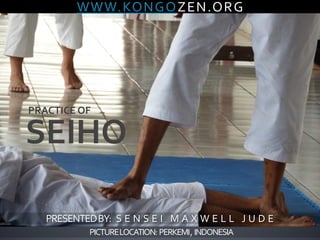
PRACTICE OF
PICTURELOCATION: PERKEMI, INDONESIA
Amidst the Atomic Ashes of Japan, there rose an illumined personality
named Nakano Michiomi. His wisdom and spiritual counsel of non-violence
in Post-World War-II , has become the scriptures of Kongo Zen.
It is owing to the generosity and open-mindedness of Nakano Michiomi
(Kaiso Doshin So), the world has unerring spiritual insights of Ancient
Oriental Science of Healing.
I am glad, indeed, to be able to place this presentation in the hands of
truth seekers.
Seiho Healing should be learnt directly under the supervision of
Authorized Instructors in the science.
This presentation is meant to kindle the passion for the healing science of
Seiho as founded by Kaiso Doshin So of Kongo Zen Sohanzan Shorinji,
Japan.
In India,The science is taught by an authorized team of instructors under
the expert guidance of Sensei Maxwell Jude Anthony.
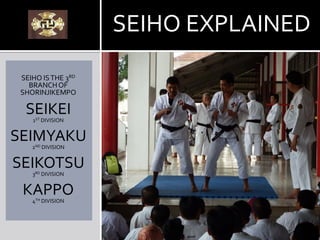
SEIHO ISTHE 3RD
BRANCHOF
SHORINJIKEMPO
SEIKEI1ST DIVISION
SEIMYAKU2ND DIVISION
SEIKOTSU3RD DIVISION
KAPPO4TH DIVISION
SEIHO EXPLAINED
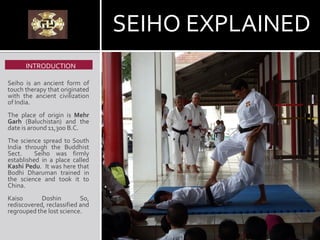
Seiho is an ancient form of
touch therapy that originated
with the ancient civilization
of India.
The place of origin is Mehr
Garh (Baluchistan) and the
date is around 11,300 B.C.
The science spread to South
India through the Buddhist
Sect. Seiho was firmly
established in a place called
Kashi Pedu. It was here that
Bodhi Dharuman trained in
the science and took it to
China.
Kaiso Doshin So,
rediscovered, reclassified and
regrouped the lost science.
INTRODUCTION
SEIHO EXPLAINED
SEI-KOTSU
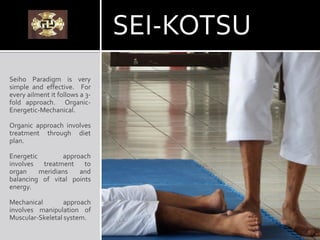
Seiho Paradigm is very
simple and effective. For
every ailment it follows a 3-
fold approach. Organic-
Energetic-Mechanical.
Organic approach involves
treatment through diet
plan.
Energetic approach
involves treatment to
organ meridians and
balancing of vital points
energy.
Mechanical approach
involves manipulation of
Muscular-Skeletal system.
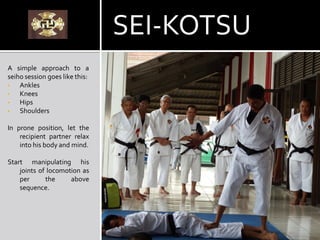
A simple approach to a
seiho session goes like this:
• Ankles
• Knees
• Hips
• Shoulders
In prone position, let the
recipient partner relax
into his body and mind.
Start manipulating his
joints of locomotion as
per the above
sequence.
SEI-KOTSU
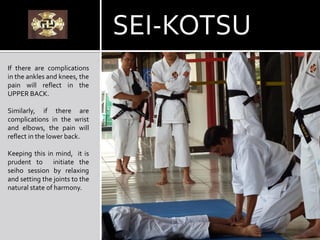
If there are complications
in the ankles and knees, the
pain will reflect in the
UPPER BACK.
Similarly, if there are
complications in the wrist
and elbows, the pain will
reflect in the lower back.
Keeping this in mind, it is
prudent to initiate the
seiho session by relaxing
and setting the joints to the
natural state of harmony.
SEI-KOTSU
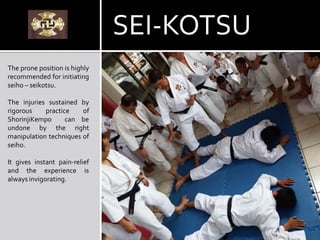
The prone position is highly
recommended for initiating
seiho – seikotsu.
The injuries sustained by
rigorous practice of
ShorinjiKempo can be
undone by the right
manipulation techniques of
seiho.
It gives instant pain-relief
and the experience is
always invigorating.
SEI-KOTSU
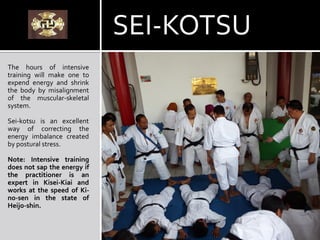
The hours of intensive
training will make one to
expend energy and shrink
the body by misalignment
of the muscular-skeletal
system.
Sei-kotsu is an excellent
way of correcting the
energy imbalance created
by postural stress.
Note: Intensive training
does not sap the energy if
the practitioner is an
expert in Kisei-Kiai and
works at the speed of Ki-
no-sen in the state of
Heijo-shin.
SEI-KOTSU
The use of feet in providing
therapy is highly
recommended. With practice,
the seiho practitioner will know
the right kind of pressure to be
applied on various joints.
Also, the angle of manipulating
each joint is vital. One must
always be sympathetic during
therapy and feel what is going
on in the recipient.
Staying connected with the
recipient is be alert. By this
way, the therapist can sense
energy blocks, heat-cold,
tightness and bulges etc of the
recipient body.
SEI-KOTSU
When you do a series of leg
flexes, you exercise
sufficient stretch to the
‘axial cruciate ligament’
(ACL).
It is vital to do this
technique at every seiho-
seikotsu session as it makes
the knee joints pliable and
works better as a shock-
absorber to the human
body.
SEI-KOTSU
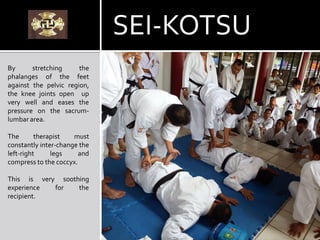
By stretching the
phalanges of the feet
against the pelvic region,
the knee joints open up
very well and eases the
pressure on the sacrum-
lumbar area.
The therapist must
constantly inter-change the
left-right legs and
compress to the coccyx.
This is very soothing
experience for the
recipient.
SEI-KOTSU
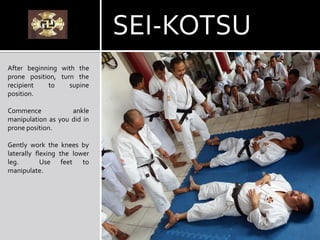
After beginning with the
prone position, turn the
recipient to supine
position.
Commence ankle
manipulation as you did in
prone position.
Gently work the knees by
laterally flexing the lower
leg. Use feet to
manipulate.
SEI-KOTSU
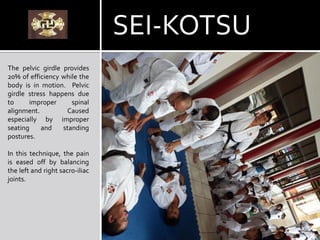
The pelvic girdle provides
20% of efficiency while the
body is in motion. Pelvic
girdle stress happens due
to improper spinal
alignment. Caused
especially by improper
seating and standing
postures.
In this technique, the pain
is eased off by balancing
the left and right sacro-iliac
joints.
SEI-KOTSU
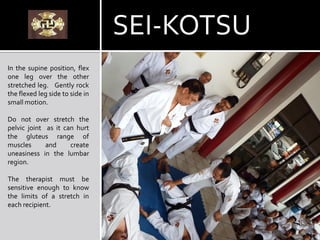
In the supine position, flex
one leg over the other
stretched leg. Gently rock
the flexed leg side to side in
small motion.
Do not over stretch the
pelvic joint as it can hurt
the gluteus range of
muscles and create
uneasiness in the lumbar
region.
The therapist must be
sensitive enough to know
the limits of a stretch in
each recipient.
SEI-KOTSU
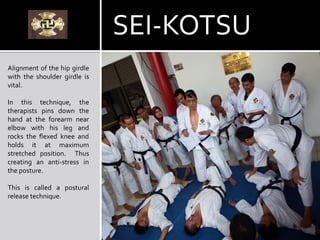
Alignment of the hip girdle
with the shoulder girdle is
vital.
In this technique, the
therapists pins down the
hand at the forearm near
elbow with his leg and
rocks the flexed knee and
holds it at maximum
stretched position. Thus
creating an anti-stress in
the posture.
This is called a postural
release technique.
SEI-KOTSU
SEI-KOTSU
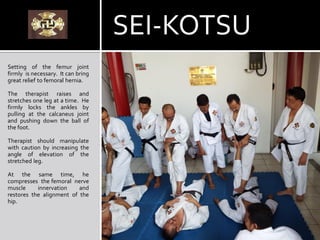
Setting of the femur joint
firmly is necessary. It can bring
great relief to femoral hernia.
The therapist raises and
stretches one leg at a time. He
firmly locks the ankles by
pulling at the calcaneus joint
and pushing down the ball of
the foot.
Therapist should manipulate
with caution by increasing the
angle of elevation of the
stretched leg.
At the same time, he
compresses the femoral nerve
muscle innervation and
restores the alignment of the
hip.
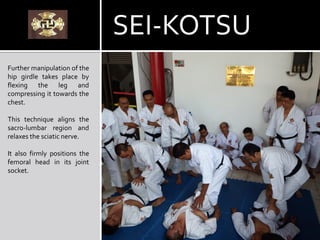
Further manipulation of the
hip girdle takes place by
flexing the leg and
compressing it towards the
chest.
This technique aligns the
sacro-lumbar region and
relaxes the sciatic nerve.
It also firmly positions the
femoral head in its joint
socket.
SEI-KOTSU
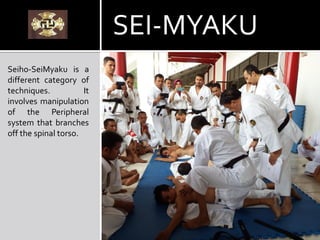
Seiho-SeiMyaku is a
different category of
techniques. It
involves manipulation
of the Peripheral
system that branches
off the spinal torso.
SEI-MYAKU
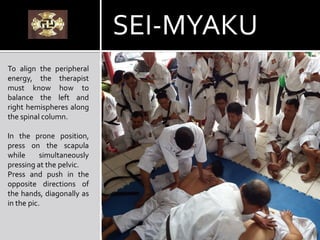
To align the peripheral
energy, the therapist
must know how to
balance the left and
right hemispheres along
the spinal column.
In the prone position,
press on the scapula
while simultaneously
pressing at the pelvic.
Press and push in the
opposite directions of
the hands, diagonally as
in the pic.
SEI-MYAKU
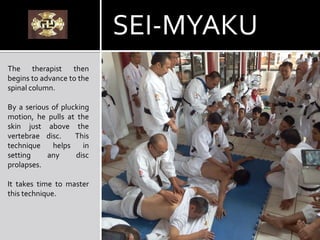
The therapist then
begins to advance to the
spinal column.
By a serious of plucking
motion, he pulls at the
skin just above the
vertebrae disc. This
technique helps in
setting any disc
prolapses.
It takes time to master
this technique.
SEI-MYAKU
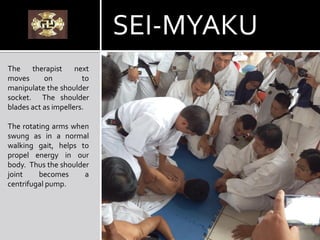
The therapist next
moves on to
manipulate the shoulder
socket. The shoulder
blades act as impellers.
The rotating arms when
swung as in a normal
walking gait, helps to
propel energy in our
body. Thus the shoulder
joint becomes a
centrifugal pump.
SEI-MYAKU
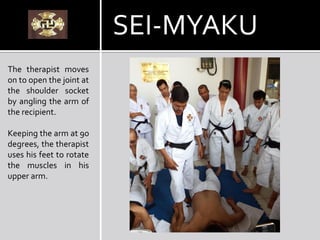
The therapist moves
on to open the joint at
the shoulder socket
by angling the arm of
the recipient.
Keeping the arm at 90
degrees, the therapist
uses his feet to rotate
the muscles in his
upper arm.
SEI-MYAKU
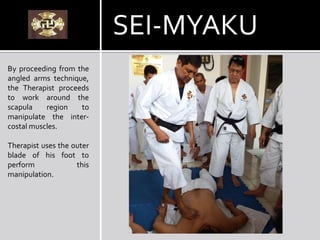
By proceeding from the
angled arms technique,
the Therapist proceeds
to work around the
scapula region to
manipulate the inter-
costal muscles.
Therapist uses the outer
blade of his foot to
perform this
manipulation.
SEI-MYAKU
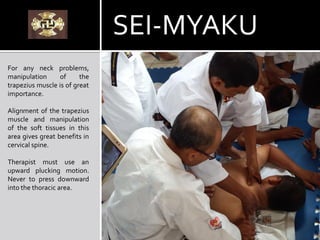
For any neck problems,
manipulation of the
trapezius muscle is of great
importance.
Alignment of the trapezius
muscle and manipulation
of the soft tissues in this
area gives great benefits in
cervical spine.
Therapist must use an
upward plucking motion.
Never to press downward
into the thoracic area.
SEI-MYAKU
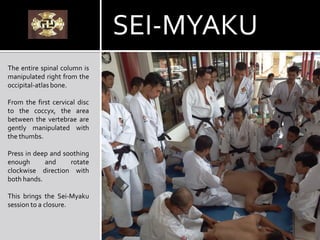
The entire spinal column is
manipulated right from the
occipital-atlas bone.
From the first cervical disc
to the coccyx, the area
between the vertebrae are
gently manipulated with
the thumbs.
Press in deep and soothing
enough and rotate
clockwise direction with
both hands.
This brings the Sei-Myaku
session to a closure.
SEI-MYAKU
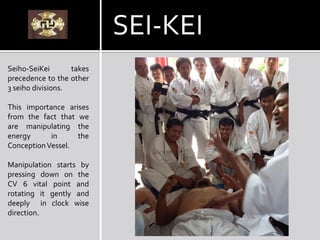
Seiho-SeiKei takes
precedence to the other
3 seiho divisions.
This importance arises
from the fact that we
are manipulating the
energy in the
ConceptionVessel.
Manipulation starts by
pressing down on the
CV 6 vital point and
rotating it gently and
deeply in clock wise
direction.
SEI-KEI
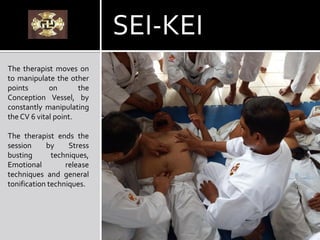
The therapist moves on
to manipulate the other
points on the
Conception Vessel, by
constantly manipulating
the CV 6 vital point.
The therapist ends the
session by Stress
busting techniques,
Emotional release
techniques and general
tonification techniques.
SEI-KEI

PRACTICE OF SEIHO

  • 1.
    PRESENTEDBY: S EN S E I M A X W E L L J U D E WWW.KONGOZEN.ORG PRACTICE OF PICTURELOCATION: PERKEMI, INDONESIA
  • 2.
    Amidst the AtomicAshes of Japan, there rose an illumined personality named Nakano Michiomi. His wisdom and spiritual counsel of non-violence in Post-World War-II , has become the scriptures of Kongo Zen. It is owing to the generosity and open-mindedness of Nakano Michiomi (Kaiso Doshin So), the world has unerring spiritual insights of Ancient Oriental Science of Healing. I am glad, indeed, to be able to place this presentation in the hands of truth seekers.
  • 3.
    Seiho Healing shouldbe learnt directly under the supervision of Authorized Instructors in the science. This presentation is meant to kindle the passion for the healing science of Seiho as founded by Kaiso Doshin So of Kongo Zen Sohanzan Shorinji, Japan. In India,The science is taught by an authorized team of instructors under the expert guidance of Sensei Maxwell Jude Anthony.
  • 4.
    SEIHO ISTHE 3RD BRANCHOF SHORINJIKEMPO SEIKEI1STDIVISION SEIMYAKU2ND DIVISION SEIKOTSU3RD DIVISION KAPPO4TH DIVISION SEIHO EXPLAINED
  • 5.
    Seiho is anancient form of touch therapy that originated with the ancient civilization of India. The place of origin is Mehr Garh (Baluchistan) and the date is around 11,300 B.C. The science spread to South India through the Buddhist Sect. Seiho was firmly established in a place called Kashi Pedu. It was here that Bodhi Dharuman trained in the science and took it to China. Kaiso Doshin So, rediscovered, reclassified and regrouped the lost science. INTRODUCTION SEIHO EXPLAINED
  • 6.
    SEI-KOTSU Seiho Paradigm isvery simple and effective. For every ailment it follows a 3- fold approach. Organic- Energetic-Mechanical. Organic approach involves treatment through diet plan. Energetic approach involves treatment to organ meridians and balancing of vital points energy. Mechanical approach involves manipulation of Muscular-Skeletal system.
  • 7.
    A simple approachto a seiho session goes like this: • Ankles • Knees • Hips • Shoulders In prone position, let the recipient partner relax into his body and mind. Start manipulating his joints of locomotion as per the above sequence. SEI-KOTSU
  • 8.
    If there arecomplications in the ankles and knees, the pain will reflect in the UPPER BACK. Similarly, if there are complications in the wrist and elbows, the pain will reflect in the lower back. Keeping this in mind, it is prudent to initiate the seiho session by relaxing and setting the joints to the natural state of harmony. SEI-KOTSU
  • 9.
    The prone positionis highly recommended for initiating seiho – seikotsu. The injuries sustained by rigorous practice of ShorinjiKempo can be undone by the right manipulation techniques of seiho. It gives instant pain-relief and the experience is always invigorating. SEI-KOTSU
  • 10.
    The hours ofintensive training will make one to expend energy and shrink the body by misalignment of the muscular-skeletal system. Sei-kotsu is an excellent way of correcting the energy imbalance created by postural stress. Note: Intensive training does not sap the energy if the practitioner is an expert in Kisei-Kiai and works at the speed of Ki- no-sen in the state of Heijo-shin. SEI-KOTSU
  • 11.
    The use offeet in providing therapy is highly recommended. With practice, the seiho practitioner will know the right kind of pressure to be applied on various joints. Also, the angle of manipulating each joint is vital. One must always be sympathetic during therapy and feel what is going on in the recipient. Staying connected with the recipient is be alert. By this way, the therapist can sense energy blocks, heat-cold, tightness and bulges etc of the recipient body. SEI-KOTSU
  • 12.
    When you doa series of leg flexes, you exercise sufficient stretch to the ‘axial cruciate ligament’ (ACL). It is vital to do this technique at every seiho- seikotsu session as it makes the knee joints pliable and works better as a shock- absorber to the human body. SEI-KOTSU
  • 13.
    By stretching the phalangesof the feet against the pelvic region, the knee joints open up very well and eases the pressure on the sacrum- lumbar area. The therapist must constantly inter-change the left-right legs and compress to the coccyx. This is very soothing experience for the recipient. SEI-KOTSU
  • 14.
    After beginning withthe prone position, turn the recipient to supine position. Commence ankle manipulation as you did in prone position. Gently work the knees by laterally flexing the lower leg. Use feet to manipulate. SEI-KOTSU
  • 15.
    The pelvic girdleprovides 20% of efficiency while the body is in motion. Pelvic girdle stress happens due to improper spinal alignment. Caused especially by improper seating and standing postures. In this technique, the pain is eased off by balancing the left and right sacro-iliac joints. SEI-KOTSU
  • 16.
    In the supineposition, flex one leg over the other stretched leg. Gently rock the flexed leg side to side in small motion. Do not over stretch the pelvic joint as it can hurt the gluteus range of muscles and create uneasiness in the lumbar region. The therapist must be sensitive enough to know the limits of a stretch in each recipient. SEI-KOTSU
  • 17.
    Alignment of thehip girdle with the shoulder girdle is vital. In this technique, the therapists pins down the hand at the forearm near elbow with his leg and rocks the flexed knee and holds it at maximum stretched position. Thus creating an anti-stress in the posture. This is called a postural release technique. SEI-KOTSU
  • 18.
    SEI-KOTSU Setting of thefemur joint firmly is necessary. It can bring great relief to femoral hernia. The therapist raises and stretches one leg at a time. He firmly locks the ankles by pulling at the calcaneus joint and pushing down the ball of the foot. Therapist should manipulate with caution by increasing the angle of elevation of the stretched leg. At the same time, he compresses the femoral nerve muscle innervation and restores the alignment of the hip.
  • 19.
    Further manipulation ofthe hip girdle takes place by flexing the leg and compressing it towards the chest. This technique aligns the sacro-lumbar region and relaxes the sciatic nerve. It also firmly positions the femoral head in its joint socket. SEI-KOTSU
  • 20.
    Seiho-SeiMyaku is a differentcategory of techniques. It involves manipulation of the Peripheral system that branches off the spinal torso. SEI-MYAKU
  • 21.
    To align theperipheral energy, the therapist must know how to balance the left and right hemispheres along the spinal column. In the prone position, press on the scapula while simultaneously pressing at the pelvic. Press and push in the opposite directions of the hands, diagonally as in the pic. SEI-MYAKU
  • 22.
    The therapist then beginsto advance to the spinal column. By a serious of plucking motion, he pulls at the skin just above the vertebrae disc. This technique helps in setting any disc prolapses. It takes time to master this technique. SEI-MYAKU
  • 23.
    The therapist next moveson to manipulate the shoulder socket. The shoulder blades act as impellers. The rotating arms when swung as in a normal walking gait, helps to propel energy in our body. Thus the shoulder joint becomes a centrifugal pump. SEI-MYAKU
  • 24.
    The therapist moves onto open the joint at the shoulder socket by angling the arm of the recipient. Keeping the arm at 90 degrees, the therapist uses his feet to rotate the muscles in his upper arm. SEI-MYAKU
  • 25.
    By proceeding fromthe angled arms technique, the Therapist proceeds to work around the scapula region to manipulate the inter- costal muscles. Therapist uses the outer blade of his foot to perform this manipulation. SEI-MYAKU
  • 26.
    For any neckproblems, manipulation of the trapezius muscle is of great importance. Alignment of the trapezius muscle and manipulation of the soft tissues in this area gives great benefits in cervical spine. Therapist must use an upward plucking motion. Never to press downward into the thoracic area. SEI-MYAKU
  • 27.
    The entire spinalcolumn is manipulated right from the occipital-atlas bone. From the first cervical disc to the coccyx, the area between the vertebrae are gently manipulated with the thumbs. Press in deep and soothing enough and rotate clockwise direction with both hands. This brings the Sei-Myaku session to a closure. SEI-MYAKU
  • 28.
    Seiho-SeiKei takes precedence tothe other 3 seiho divisions. This importance arises from the fact that we are manipulating the energy in the ConceptionVessel. Manipulation starts by pressing down on the CV 6 vital point and rotating it gently and deeply in clock wise direction. SEI-KEI
  • 29.
    The therapist moveson to manipulate the other points on the Conception Vessel, by constantly manipulating the CV 6 vital point. The therapist ends the session by Stress busting techniques, Emotional release techniques and general tonification techniques. SEI-KEI