Practical Cookery Level 3 Dynamic Learning published by Hodder Education © 2011 D Foskett, J Campbell and P Paskins
Shellfish
Practical Cookery Level 3 Dynamic Learning published by Hodder Education © 2011 D Foskett, J Campbell and P Paskins
Shellfish
• Shellfish, such as lobsters and crabs, are all
invertebrates (i.e. they do not possess an internal
skeleton) and are split into two main groups:
• Molluscs have either an external hinged double shell
(e.g. scallops, mussels) or a single spiral shell (e.g.
winkles, whelks), or have soft bodies with an internal shell
(e.g. squid, octopus).
• Crustaceans have tough outer shells that act like
armour, and also have flexible joints to allow quick
movement (e.g. crab, lobster).
Practical Cookery Level 3 Dynamic Learning published by Hodder Education © 2011 D Foskett, J Campbell and P Paskins
Choosing and buying shellfish
• Shellfish are prized for their tender, fine-textured
flesh which can be prepared in a variety of ways
but they are prone to rapid spoilage.
• The reason for this is that they contain proteins
and amino acids which encourage bacterial
growth.
• To ensure freshness and best flavour it is
preferable to choose live specimens and cook
them yourself. This is often possible with the
expansion of globalisation, air freight and such
like, creating an increasing trade in live shellfish.
Practical Cookery Level 3 Dynamic Learning published by Hodder Education © 2011 D Foskett, J Campbell and P Paskins
Shellfish quality
• Shells should not be cracked or broken.
• Shells of mussels and oysters should be tightly shut;
open shells that do not close when tapped sharply
should be discarded.
• Lobsters, crabs and prawns should have a good
colour and be heavy for their size.
• Lobsters and crabs should have all their limbs.
Practical Cookery Level 3 Dynamic Learning published by Hodder Education © 2011 D Foskett, J Campbell and P Paskins
Spoilage
• All shellfish will start to spoil as soon as they
have been removed from their natural
environment, therefore the longer shellfish
are stored the more they will deteriorate due
to the bacteria present.
Practical Cookery Level 3 Dynamic Learning published by Hodder Education © 2011 D Foskett, J Campbell and P Paskins
Storage of shellfish
• Best practice would be to cook immediately
then store as for cooked fish.
• Store in a refrigerator running below 4ºC.
• Ideally raw and cooked shellfish should be in
separate refrigerators but as a minimum keep
them well apart, covered, labelled and all raw
items stored below cooked items.
Practical Cookery Level 3 Dynamic Learning published by Hodder Education © 2011 D Foskett, J Campbell and P Paskins
Blanching
• Shellfish can be blanched quickly to remove
the shell and membrane (especially in
lobsters) but they will still need to be stored
as for a raw product as they require further
cooking.
Practical Cookery Level 3 Dynamic Learning published by Hodder Education © 2011 D Foskett, J Campbell and P Paskins
Cooking shellfish
• The flesh of fish and shellfish is different to meat
and, as a consequence, their muscle make-up is
very different too, making their connective tissue
very fragile, the muscle fibres shorter and the fat
content relatively low.
• Care should be taken when cooking and shellfish
should be cooked as little as possible, to the
point that the protein in the muscle groups just
coagulates. Beyond this point the flesh tends to
dry out, leading to toughening and a dry texture.
Practical Cookery Level 3 Dynamic Learning published by Hodder Education © 2011 D Foskett, J Campbell and P Paskins
Shellfish colour
• Shellfish are known for their dramatic colour
changing: from blue/grey to a vibrant orange
colour. This is because they contain red and
yellow pigments called carotenoids, bound to
molecules of protein. The protein bonds
obscure the yellow/red pigment and, once
heat is applied, the bonds are broken and the
vibrant pigmentation revealed.
Practical Cookery Level 3 Dynamic Learning published by Hodder Education © 2011 D Foskett, J Campbell and P Paskins
Types of shellfish (1)
• Cockles: these are enclosed in pretty cream-coloured
shells of 2–3cm. Cockles are soaked in salt water to
purge and then steamed. They may be used in soups,
salads and fish dishes, or served as a dish by
themselves.
• Shrimps: used for garnishes, decorating fish dishes,
cocktails, sauces, salads, hors d’oeuvres, potted
shrimps, omelettes and savouries.
• Prawns: prawns are larger than shrimps. They may be
used for garnishing and decorating fish dishes, for
cocktails, canapés, salad, hors d’oeuvres, and for hot
dishes such as curried prawns.
Practical Cookery Level 3 Dynamic Learning published by Hodder Education © 2011 D Foskett, J Campbell and P Paskins
Types of shellfish (2)
• Crayfish: a type of small freshwater lobster used for
garnishing cold buffet dishes and for recipes using
lobster. They are dark brown or grey, turning pink
when cooked. Average size 8cm.
• Crawfish (rock lobster) are like large lobsters without
claws, but with long antennae. They are brick red in
colour when raw and cooked. They are used mostly
on cold buffets but they can be served hot. The best
size is 1½–2kg.
Practical Cookery Level 3 Dynamic Learning published by Hodder Education © 2011 D Foskett, J Campbell and P Paskins
Lobster
• Lobster are highly prized shellfish and can be
expensive.
• When hot they are served with various
accompaniments and sauces (often finished
under the salamander). Lobster can also be
used for soup, pasta fillings and so on.
• Lobster is often served cold in cocktails, hors
d’oeuvres, salads, sandwiches and on
buffets.
Practical Cookery Level 3 Dynamic Learning published by Hodder Education © 2011 D Foskett, J Campbell and P Paskins
Crab
• Crabs can be eaten simply boiled, cooled
and with salad.
• They are also used for a variety of dishes,
crab cakes, dressed crab, hors d’oeuvres,
cocktails, salads, sandwiches and bouchées.
• Soft-shelled crabs are eaten in their entirety.
They are considered to have an excellent
flavour and may be deep- or shallow-fried, or
grilled.
Practical Cookery Level 3 Dynamic Learning published by Hodder Education © 2011 D Foskett, J Campbell and P Paskins
Scallops
• Scallops are increasingly popular menu items
available in their distinctive large shells or out of shell.
• Great scallops are up to 15cm in size, bay scallops
up to 8cm and queen scallops (queenies) are
smaller.
• Scallops can be steamed, poached, fried or grilled.
• When selecting scallops, always make hand-dived
scallops your first choice as dredged ones are
sometimes obtained in unethical ways. Hand-dived
scallops are more expensive but the difference in
quality is worth it.
Practical Cookery Level 3 Dynamic Learning published by Hodder Education © 2011 D Foskett, J Campbell and P Paskins
Scallops
Practical Cookery Level 3 Dynamic Learning published by Hodder Education © 2011 D Foskett, J Campbell and P Paskins
Oysters
• Whitstable and Colchester are the chief English
centres for oysters; they occur here naturally and
are also farmed.
• The popular way of eating oysters is in the raw
state. They may also be served in soups, hot
cocktail savouries, fish garnishes, as a fish dish,
and in meat puddings and savouries.
• Since the majority of oysters are eaten raw it is
essential they are thoroughly cleaned before
kitchens receive them.
Practical Cookery Level 3 Dynamic Learning published by Hodder Education © 2011 D Foskett, J Campbell and P Paskins
Purchasing oysters
• Oysters must be alive; this is indicated by the firmly
closed shells. If they are open, tap them sharply – if
they do not shut at once, discard them.
• Oysters should smell fresh and be purchased daily.
• English oysters are in season from September to
April (when there is an ‘R’ in the month). During the
summer oysters are imported from France, Holland
and Portugal.
• Oysters are graded in terms of size, and the price
varies accordingly.
• Oysters are stored in barrels or boxes, covered with
damp kitchen paper or cloths and kept in a cold room
to keep them moist and alive.
Practical Cookery Level 3 Dynamic Learning published by Hodder Education © 2011 D Foskett, J Campbell and P Paskins
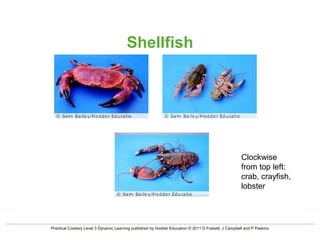
Shellfish
Clockwise
from top left:
crab, crayfish,
lobster

Shellfish intro

  • 1.
    Practical Cookery Level3 Dynamic Learning published by Hodder Education © 2011 D Foskett, J Campbell and P Paskins Shellfish
  • 2.
    Practical Cookery Level3 Dynamic Learning published by Hodder Education © 2011 D Foskett, J Campbell and P Paskins Shellfish • Shellfish, such as lobsters and crabs, are all invertebrates (i.e. they do not possess an internal skeleton) and are split into two main groups: • Molluscs have either an external hinged double shell (e.g. scallops, mussels) or a single spiral shell (e.g. winkles, whelks), or have soft bodies with an internal shell (e.g. squid, octopus). • Crustaceans have tough outer shells that act like armour, and also have flexible joints to allow quick movement (e.g. crab, lobster).
  • 3.
    Practical Cookery Level3 Dynamic Learning published by Hodder Education © 2011 D Foskett, J Campbell and P Paskins Choosing and buying shellfish • Shellfish are prized for their tender, fine-textured flesh which can be prepared in a variety of ways but they are prone to rapid spoilage. • The reason for this is that they contain proteins and amino acids which encourage bacterial growth. • To ensure freshness and best flavour it is preferable to choose live specimens and cook them yourself. This is often possible with the expansion of globalisation, air freight and such like, creating an increasing trade in live shellfish.
  • 4.
    Practical Cookery Level3 Dynamic Learning published by Hodder Education © 2011 D Foskett, J Campbell and P Paskins Shellfish quality • Shells should not be cracked or broken. • Shells of mussels and oysters should be tightly shut; open shells that do not close when tapped sharply should be discarded. • Lobsters, crabs and prawns should have a good colour and be heavy for their size. • Lobsters and crabs should have all their limbs.
  • 5.
    Practical Cookery Level3 Dynamic Learning published by Hodder Education © 2011 D Foskett, J Campbell and P Paskins Spoilage • All shellfish will start to spoil as soon as they have been removed from their natural environment, therefore the longer shellfish are stored the more they will deteriorate due to the bacteria present.
  • 6.
    Practical Cookery Level3 Dynamic Learning published by Hodder Education © 2011 D Foskett, J Campbell and P Paskins Storage of shellfish • Best practice would be to cook immediately then store as for cooked fish. • Store in a refrigerator running below 4ºC. • Ideally raw and cooked shellfish should be in separate refrigerators but as a minimum keep them well apart, covered, labelled and all raw items stored below cooked items.
  • 7.
    Practical Cookery Level3 Dynamic Learning published by Hodder Education © 2011 D Foskett, J Campbell and P Paskins Blanching • Shellfish can be blanched quickly to remove the shell and membrane (especially in lobsters) but they will still need to be stored as for a raw product as they require further cooking.
  • 8.
    Practical Cookery Level3 Dynamic Learning published by Hodder Education © 2011 D Foskett, J Campbell and P Paskins Cooking shellfish • The flesh of fish and shellfish is different to meat and, as a consequence, their muscle make-up is very different too, making their connective tissue very fragile, the muscle fibres shorter and the fat content relatively low. • Care should be taken when cooking and shellfish should be cooked as little as possible, to the point that the protein in the muscle groups just coagulates. Beyond this point the flesh tends to dry out, leading to toughening and a dry texture.
  • 9.
    Practical Cookery Level3 Dynamic Learning published by Hodder Education © 2011 D Foskett, J Campbell and P Paskins Shellfish colour • Shellfish are known for their dramatic colour changing: from blue/grey to a vibrant orange colour. This is because they contain red and yellow pigments called carotenoids, bound to molecules of protein. The protein bonds obscure the yellow/red pigment and, once heat is applied, the bonds are broken and the vibrant pigmentation revealed.
  • 10.
    Practical Cookery Level3 Dynamic Learning published by Hodder Education © 2011 D Foskett, J Campbell and P Paskins Types of shellfish (1) • Cockles: these are enclosed in pretty cream-coloured shells of 2–3cm. Cockles are soaked in salt water to purge and then steamed. They may be used in soups, salads and fish dishes, or served as a dish by themselves. • Shrimps: used for garnishes, decorating fish dishes, cocktails, sauces, salads, hors d’oeuvres, potted shrimps, omelettes and savouries. • Prawns: prawns are larger than shrimps. They may be used for garnishing and decorating fish dishes, for cocktails, canapés, salad, hors d’oeuvres, and for hot dishes such as curried prawns.
  • 11.
    Practical Cookery Level3 Dynamic Learning published by Hodder Education © 2011 D Foskett, J Campbell and P Paskins Types of shellfish (2) • Crayfish: a type of small freshwater lobster used for garnishing cold buffet dishes and for recipes using lobster. They are dark brown or grey, turning pink when cooked. Average size 8cm. • Crawfish (rock lobster) are like large lobsters without claws, but with long antennae. They are brick red in colour when raw and cooked. They are used mostly on cold buffets but they can be served hot. The best size is 1½–2kg.
  • 12.
    Practical Cookery Level3 Dynamic Learning published by Hodder Education © 2011 D Foskett, J Campbell and P Paskins Lobster • Lobster are highly prized shellfish and can be expensive. • When hot they are served with various accompaniments and sauces (often finished under the salamander). Lobster can also be used for soup, pasta fillings and so on. • Lobster is often served cold in cocktails, hors d’oeuvres, salads, sandwiches and on buffets.
  • 13.
    Practical Cookery Level3 Dynamic Learning published by Hodder Education © 2011 D Foskett, J Campbell and P Paskins Crab • Crabs can be eaten simply boiled, cooled and with salad. • They are also used for a variety of dishes, crab cakes, dressed crab, hors d’oeuvres, cocktails, salads, sandwiches and bouchées. • Soft-shelled crabs are eaten in their entirety. They are considered to have an excellent flavour and may be deep- or shallow-fried, or grilled.
  • 14.
    Practical Cookery Level3 Dynamic Learning published by Hodder Education © 2011 D Foskett, J Campbell and P Paskins Scallops • Scallops are increasingly popular menu items available in their distinctive large shells or out of shell. • Great scallops are up to 15cm in size, bay scallops up to 8cm and queen scallops (queenies) are smaller. • Scallops can be steamed, poached, fried or grilled. • When selecting scallops, always make hand-dived scallops your first choice as dredged ones are sometimes obtained in unethical ways. Hand-dived scallops are more expensive but the difference in quality is worth it.
  • 15.
    Practical Cookery Level3 Dynamic Learning published by Hodder Education © 2011 D Foskett, J Campbell and P Paskins Scallops
  • 16.
    Practical Cookery Level3 Dynamic Learning published by Hodder Education © 2011 D Foskett, J Campbell and P Paskins Oysters • Whitstable and Colchester are the chief English centres for oysters; they occur here naturally and are also farmed. • The popular way of eating oysters is in the raw state. They may also be served in soups, hot cocktail savouries, fish garnishes, as a fish dish, and in meat puddings and savouries. • Since the majority of oysters are eaten raw it is essential they are thoroughly cleaned before kitchens receive them.
  • 17.
    Practical Cookery Level3 Dynamic Learning published by Hodder Education © 2011 D Foskett, J Campbell and P Paskins Purchasing oysters • Oysters must be alive; this is indicated by the firmly closed shells. If they are open, tap them sharply – if they do not shut at once, discard them. • Oysters should smell fresh and be purchased daily. • English oysters are in season from September to April (when there is an ‘R’ in the month). During the summer oysters are imported from France, Holland and Portugal. • Oysters are graded in terms of size, and the price varies accordingly. • Oysters are stored in barrels or boxes, covered with damp kitchen paper or cloths and kept in a cold room to keep them moist and alive.
  • 18.
    Practical Cookery Level3 Dynamic Learning published by Hodder Education © 2011 D Foskett, J Campbell and P Paskins Shellfish Clockwise from top left: crab, crayfish, lobster