Searching & Sorting
• Searching
Linear Searching
Linear Search Algorithm
Advantages & Disadvantage
When to use Linear Search?
• When we are dealing with a small dataset.
• When you are searching for a dataset stored in
contiguous memory.
Linear Searching
Linear Searching
Analysis of Linear search
Example:2
Consider the array arr[] = {10, 50, 30, 70, 80,
20, 90, 40} and key = 30
// C code to linearly search x in arr[].
#include <stdio.h>
int search(int arr[], int N, int x)
{
for (int i = 0; i < N; i++)
if (arr[i] == x)
return i;
return -1; }
// Driver code
int main(void)
{
int arr[] = { 2, 3, 4, 10, 40 };
int x = 10;
int N = sizeof(arr) / sizeof(arr[0]);
// Function call
int result = search(arr, N, x);
(result == -1)
? printf("Element is not present in array")
: printf("Element is present at index %d", result);
return 0; }
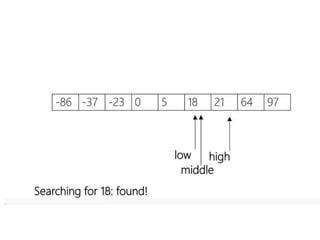
Binary Search
Binary Search
Binary Search
Divide & Conquer
Binary Search Algorithm
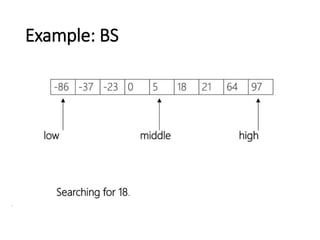
Example: BS
Example 2
Time complexity
Advantages
Disadvantages
Application of Binary Search
Bubble sort
Bubble sort
Bubble sort: orders a list of values by repetitively
comparing neighboring elements and swapping their
positions if necessary
• more specifically:
– scan the list, exchanging adjacent elements if they are
not in relative order; this bubbles the highest value to
the top
– scan the list again, bubbling up the second highest value
– repeat until all elements have been placed in their
proper order
33
• Traverse a collection of elements
• Move from the front to the end
• "Bubble" the largest value to the end using pair-wise
comparisons and swapping
5
12
35
42
77 101
0 1 2 3 4 5
Swap
42 77
"Bubbling" largest element
34
"Bubbling" largest element
• Traverse a collection of elements
• Move from the front to the end
• "Bubble" the largest value to the end using pair-wise
comparisons and swapping
5
12
35
77
42 101
0 1 2 3 4 5
Swap
35 77
35
"Bubbling" largest element
• Traverse a collection of elements
• Move from the front to the end
• "Bubble" the largest value to the end using pair-wise
comparisons and swapping
5
12
77
35
42 101
0 1 2 3 4 5
Swap
12 77
36
"Bubbling" largest element
• Traverse a collection of elements
• Move from the front to the end
• "Bubble" the largest value to the end using pair-wise
comparisons and swapping
5
77
12
35
42 101
0 1 2 3 4 5
No need to swap
37
"Bubbling" largest element
• Traverse a collection of elements
• Move from the front to the end
• "Bubble" the largest value to the end using pair-wise
comparisons and swapping
5
77
12
35
42 101
0 1 2 3 4 5
Swap
5 101
38
"Bubbling" largest element
• Traverse a collection of elements
• Move from the front to the end
• "Bubble" the largest value to the end using pair-wise
comparisons and swapping
77
12
35
42 5
0 1 2 3 4 5
101
Largest value correctly placed
39
Bubble sort code
public static void bubbleSort(int a[])
{
for (int i = 0; i < a.length; i++)
{
for (int j = 1; j < a.length - i; j++)
{
// swap adjacent out-of-order elements
if (a[j-1] > a[j]) {
swap(a, j-1, j);
}
}
}
} 40
Example :1
Input: arr[] = {6, 3, 0, 5}
First Pass:
• The largest element is placed in its correct
position, i.e., the end of the array.
Second Pass:
• Place the second largest element at correct
position
Third Pass:
• Place the remaining two elements at their
correct positions.
Total no. of passes: n-1
• Total no. of comparisons: n*(n-1)/2
Complexity Analysis of
Bubble Sort:
Time Complexity: O(N2)
Auxiliary Space: O(1)
Implementation of Bubble sort
#include <stdbool.h>
#include <stdio.h>
void swap(int* xp, int* yp)
{
int temp = *xp;
*xp = *yp;
*yp = temp;
}
// An optimized version of Bubble Sort
void bubbleSort(int arr[], int n)
{
int i, j;
bool swapped;
for (i = 0; i < n - 1; i++) {
swapped = false;
for (j = 0; j < n - i - 1; j++) {
if (arr[j] > arr[j + 1]) {
swap(&arr[j], &arr[j + 1]);
swapped = true;
} }
// If no two elements were swapped by inner loop,
// then break
if (swapped == false)
break;
}}
/ Function to print an array
void printArray(int arr[], int size)
{
int i;
for (i = 0; i < size; i++)
printf("%d ", arr[i]);
}
// Driver program to test above
functions
int main()
{
int arr[] = { 64, 34, 25, 12, 22,
11, 90 };
int n = sizeof(arr) /
sizeof(arr[0]);
bubbleSort(arr, n);
printf("Sorted array: n");
printArray(arr, n);
return 0;
}
Output:Sorted array: 11 12 22 25 34 64 90
Advantages of Bubble Sort:
• Bubble sort is easy to understand and implement.
• It does not require any additional memory space.
• It is a stable sorting algorithm, meaning that elements
with the same key value maintain their relative order
in the sorted output.
• Disadvantages of Bubble Sort:
• Bubble sort has a time complexity of O(N2) which
makes it very slow for large data sets.
• Bubble sort is a comparison-based sorting algorithm,
which means that it requires a comparison operator to
determine the relative order of elements in the input
data set. It can limit the efficiency of the algorithm in
certain cases.
Selection sort
• selection sort: orders a list of values by
repetitively putting a particular value into its
final position
• more specifically:
• find the smallest value in the list
• switch it with the value in the first position
• find the next smallest value in the list
• switch it with the value in the second position
• repeat until all values are in their proper places
48
Selection sort example
49
Index
0 1 2 3 4 5 6 7
Value
27 63 1 72 64 58 14 9
1st pass
1 63 27 72 64 58 14 9
2nd pass
1 9 27 72 64 58 14 63
3rd pass
1 9 14 72 64 58 27 63
…
Selection sort example 2
50
Selection sort code
public static void selectionSort(int[] a) {
for (int i = 0; i < a.length; i++) {
// find index of smallest element
int min = i;
for (int j = i + 1; j < a.length; j++) {
if (a[j] < a[min]) {
min = j;
}
}
// swap smallest element with a[i]
swap(a, i, min);
} 51
Insertion sort
Insertion sort
• insertion sort: orders a list of values by repetitively
inserting a particular value into a sorted subset of the
list
• more specifically:
– consider the first item to be a sorted sublist of length 1
– insert the second item into the sorted sublist, shifting the first
item if needed
– insert the third item into the sorted sublist, shifting the other
items as needed
– repeat until all values have been inserted into their proper
positions
53
Insertion sort
• Simple sorting algorithm.
• n-1 passes over the array
• At the end of pass i, the elements that occupied A[0]…A[i]
originally are still in those spots and in sorted order.
2 8 15 1 17 10 12 5
0 1 2 3 4 5 6 7
1 2 8 15 17 10 12 5
0 1 2 3 4 5 6 7
after
pass 2
after
pass 3
2 15 8 1 17 10 12 5
0 1 2 3 4 5 6 7
54
Insertion sort example
55
Insertion sort code
public static void insertionSort(int[] a) {
for (int i = 1; i < a.length; i++) {
int temp = a[i];
// slide elements down to make room for a[i]
int j = i;
while (j > 0 && a[j - 1] > temp) {
a[j] = a[j - 1];
j--;
}
a[j] = temp;
}
}
56
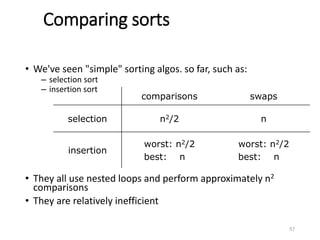
Comparing sorts
• We've seen "simple" sorting algos. so far, such as:
– selection sort
– insertion sort
• They all use nested loops and perform approximately n2
comparisons
• They are relatively inefficient
comparisons swaps
selection n2/2 n
insertion
worst: n2/2
best: n
worst: n2/2
best: n
57
Average Case Analysis
• Given an array A of elements, an inversion is an
ordered pair (i, j) such that i < j, but
A[i] > A[j].(out of order elements)
• Assume no duplicate elements.
• Theorem: The average number of inversions in
an array of n distinct elements is n (n - 1) / 4.
• Corollary: Any algorithm that sorts by
exchanging adjacent elements requires O(n2)
time on average.
58
Shell Sort
Shell Sort description
• shell sort: orders a list of values by comparing
elements that are separated by a gap of >1 indexes
– a generalization of insertion sort
– invented by computer scientist Donald Shell in 1959
• based on some observations about insertion sort:
– insertion sort runs fast if the input is almost sorted
– insertion sort's weakness is that it swaps each element
just one step at a time, taking many swaps to get the
element into its correct position
60
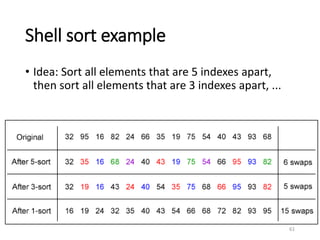
Shell sort example
• Idea: Sort all elements that are 5 indexes apart,
then sort all elements that are 3 indexes apart, ...
61
Shell sort code
public static void shellSort(int[] a)
{
for (int gap = a.length / 2; gap > 0; gap /= 2)
{
for (int i = gap; i < a.length; i++)
{
// slide element i back by gap indexes
// until it's "in order"
int temp = a[i];
int j = i;
while (j >= gap && temp < a[j - gap]) {
a[j] = a[j – gap];
j -= gap;
}
a[j] = temp;
}
}
}
62
Sorting practice problem
• Consider the following array of int values.
[22, 11, 34, -5, 3, 40, 9, 16, 6]
(a) Write the contents of the array after 3 passes of the outermost loop of bubble
sort.
(b) Write the contents of the array after 5 passes of the outermost loop of
insertion sort.
(c) Write the contents of the array after 4 passes of the outermost loop of
selection sort.
(d) Write the contents of the array after 1 pass of shell sort, using gap = 3.
(e) Write the contents of the array after a pass of bogo sort. (Just kidding.)
63
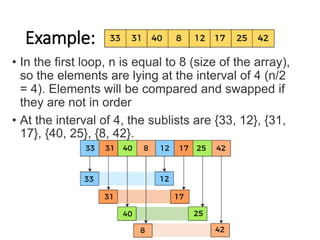
Example:
• In the first loop, n is equal to 8 (size of the array),
so the elements are lying at the interval of 4 (n/2
= 4). Elements will be compared and swapped if
they are not in order
• At the interval of 4, the sublists are {33, 12}, {31,
17}, {40, 25}, {8, 42}.
• In the second loop, elements are lying at the
interval of 2 (n/4 = 2), where n = 8.
• With an interval of 2, two sublists will be
generated - {12, 25, 33, 40}, and {17, 8, 31, 42}.
• In the third loop, elements are lying at the interval
of 1 (n/8 = 1), where n = 8
Time Complexity
Case Time Complexity
Best Case O(n*logn)
Average Case O(n*log(n)
2
)
Worst Case O(n
2
)
Radix Sort
Radix Sort
• Radix sort is one of the sorting algorithms used to sort a
list of integer numbers in order.
• In radix sort algorithm, a list of integer numbers will be
sorted based on the digits of individual numbers.
• Sorting is performed from least significant digit to the
most significant digit.
Step by Step Process
• Step 1 - Define 10 queues each representing a
bucket for each digit from 0 to 9.
• Step 2 - Consider the least significant digit of
each number in the list which is to be sorted.
• Step 3 - Insert each number into their respective
queue based on the least significant digit.
• Step 4 - Group all the numbers from queue 0 to
queue 9 in the order they have inserted into their
respective queues.
• Step 5 - Repeat from step 3 based on the next
least significant digit.
• Step 6 - Repeat from step 2 until all the numbers
are grouped based on the most significant digit.
Example :1
Sorted
Example:2
Complexity of the Radix
Sort Algorithm
• To sort an unsorted list with 'n' number of
elements, Radix sort algorithm needs the
following complexities...
WorstCase:O(n)
BestCase:O(n)
Average Case : O(n)
Hashing
102
Double Hashing Example
0
1
2
3
4
5
6 76
76
0
1
2
3
4
5
6
93
76
93
0
1
2
3
4
5
6
93
40
76
40
0
1
2
3
4
5
6
47
93
40
76
47
0
1
2
3
4
5
6
47
93
10
40
76
10
0
1
2
3
4
5
6
47
93
10
55
40
76
55
h(k) = k mod 7 and g(k) = 5 – (k mod 5)
Probes 1 1 1 2 1 2
Searching and sorting Techniques in Data structures

Searching and sorting Techniques in Data structures

  • 1.
  • 6.
  • 8.
  • 9.
  • 10.
    When to useLinear Search? • When we are dealing with a small dataset. • When you are searching for a dataset stored in contiguous memory.
  • 11.
  • 12.
  • 17.
  • 18.
    Example:2 Consider the arrayarr[] = {10, 50, 30, 70, 80, 20, 90, 40} and key = 30
  • 19.
    // C codeto linearly search x in arr[]. #include <stdio.h> int search(int arr[], int N, int x) { for (int i = 0; i < N; i++) if (arr[i] == x) return i; return -1; } // Driver code int main(void) { int arr[] = { 2, 3, 4, 10, 40 }; int x = 10; int N = sizeof(arr) / sizeof(arr[0]); // Function call int result = search(arr, N, x); (result == -1) ? printf("Element is not present in array") : printf("Element is present at index %d", result); return 0; }
  • 20.
  • 21.
  • 22.
  • 23.
  • 24.
  • 25.
  • 28.
  • 29.
  • 30.
  • 31.
  • 32.
  • 33.
    Bubble sort Bubble sort:orders a list of values by repetitively comparing neighboring elements and swapping their positions if necessary • more specifically: – scan the list, exchanging adjacent elements if they are not in relative order; this bubbles the highest value to the top – scan the list again, bubbling up the second highest value – repeat until all elements have been placed in their proper order 33
  • 34.
    • Traverse acollection of elements • Move from the front to the end • "Bubble" the largest value to the end using pair-wise comparisons and swapping 5 12 35 42 77 101 0 1 2 3 4 5 Swap 42 77 "Bubbling" largest element 34
  • 35.
    "Bubbling" largest element •Traverse a collection of elements • Move from the front to the end • "Bubble" the largest value to the end using pair-wise comparisons and swapping 5 12 35 77 42 101 0 1 2 3 4 5 Swap 35 77 35
  • 36.
    "Bubbling" largest element •Traverse a collection of elements • Move from the front to the end • "Bubble" the largest value to the end using pair-wise comparisons and swapping 5 12 77 35 42 101 0 1 2 3 4 5 Swap 12 77 36
  • 37.
    "Bubbling" largest element •Traverse a collection of elements • Move from the front to the end • "Bubble" the largest value to the end using pair-wise comparisons and swapping 5 77 12 35 42 101 0 1 2 3 4 5 No need to swap 37
  • 38.
    "Bubbling" largest element •Traverse a collection of elements • Move from the front to the end • "Bubble" the largest value to the end using pair-wise comparisons and swapping 5 77 12 35 42 101 0 1 2 3 4 5 Swap 5 101 38
  • 39.
    "Bubbling" largest element •Traverse a collection of elements • Move from the front to the end • "Bubble" the largest value to the end using pair-wise comparisons and swapping 77 12 35 42 5 0 1 2 3 4 5 101 Largest value correctly placed 39
  • 40.
    Bubble sort code publicstatic void bubbleSort(int a[]) { for (int i = 0; i < a.length; i++) { for (int j = 1; j < a.length - i; j++) { // swap adjacent out-of-order elements if (a[j-1] > a[j]) { swap(a, j-1, j); } } } } 40
  • 41.
  • 42.
    First Pass: • Thelargest element is placed in its correct position, i.e., the end of the array.
  • 43.
    Second Pass: • Placethe second largest element at correct position
  • 44.
    Third Pass: • Placethe remaining two elements at their correct positions.
  • 45.
    Total no. ofpasses: n-1 • Total no. of comparisons: n*(n-1)/2 Complexity Analysis of Bubble Sort: Time Complexity: O(N2) Auxiliary Space: O(1)
  • 46.
    Implementation of Bubblesort #include <stdbool.h> #include <stdio.h> void swap(int* xp, int* yp) { int temp = *xp; *xp = *yp; *yp = temp; } // An optimized version of Bubble Sort void bubbleSort(int arr[], int n) { int i, j; bool swapped; for (i = 0; i < n - 1; i++) { swapped = false; for (j = 0; j < n - i - 1; j++) { if (arr[j] > arr[j + 1]) { swap(&arr[j], &arr[j + 1]); swapped = true; } } // If no two elements were swapped by inner loop, // then break if (swapped == false) break; }} / Function to print an array void printArray(int arr[], int size) { int i; for (i = 0; i < size; i++) printf("%d ", arr[i]); } // Driver program to test above functions int main() { int arr[] = { 64, 34, 25, 12, 22, 11, 90 }; int n = sizeof(arr) / sizeof(arr[0]); bubbleSort(arr, n); printf("Sorted array: n"); printArray(arr, n); return 0; } Output:Sorted array: 11 12 22 25 34 64 90
  • 47.
    Advantages of BubbleSort: • Bubble sort is easy to understand and implement. • It does not require any additional memory space. • It is a stable sorting algorithm, meaning that elements with the same key value maintain their relative order in the sorted output. • Disadvantages of Bubble Sort: • Bubble sort has a time complexity of O(N2) which makes it very slow for large data sets. • Bubble sort is a comparison-based sorting algorithm, which means that it requires a comparison operator to determine the relative order of elements in the input data set. It can limit the efficiency of the algorithm in certain cases.
  • 48.
    Selection sort • selectionsort: orders a list of values by repetitively putting a particular value into its final position • more specifically: • find the smallest value in the list • switch it with the value in the first position • find the next smallest value in the list • switch it with the value in the second position • repeat until all values are in their proper places 48
  • 49.
  • 50.
    Index 0 1 23 4 5 6 7 Value 27 63 1 72 64 58 14 9 1st pass 1 63 27 72 64 58 14 9 2nd pass 1 9 27 72 64 58 14 63 3rd pass 1 9 14 72 64 58 27 63 … Selection sort example 2 50
  • 51.
    Selection sort code publicstatic void selectionSort(int[] a) { for (int i = 0; i < a.length; i++) { // find index of smallest element int min = i; for (int j = i + 1; j < a.length; j++) { if (a[j] < a[min]) { min = j; } } // swap smallest element with a[i] swap(a, i, min); } 51
  • 52.
  • 53.
    Insertion sort • insertionsort: orders a list of values by repetitively inserting a particular value into a sorted subset of the list • more specifically: – consider the first item to be a sorted sublist of length 1 – insert the second item into the sorted sublist, shifting the first item if needed – insert the third item into the sorted sublist, shifting the other items as needed – repeat until all values have been inserted into their proper positions 53
  • 54.
    Insertion sort • Simplesorting algorithm. • n-1 passes over the array • At the end of pass i, the elements that occupied A[0]…A[i] originally are still in those spots and in sorted order. 2 8 15 1 17 10 12 5 0 1 2 3 4 5 6 7 1 2 8 15 17 10 12 5 0 1 2 3 4 5 6 7 after pass 2 after pass 3 2 15 8 1 17 10 12 5 0 1 2 3 4 5 6 7 54
  • 55.
  • 56.
    Insertion sort code publicstatic void insertionSort(int[] a) { for (int i = 1; i < a.length; i++) { int temp = a[i]; // slide elements down to make room for a[i] int j = i; while (j > 0 && a[j - 1] > temp) { a[j] = a[j - 1]; j--; } a[j] = temp; } } 56
  • 57.
    Comparing sorts • We'veseen "simple" sorting algos. so far, such as: – selection sort – insertion sort • They all use nested loops and perform approximately n2 comparisons • They are relatively inefficient comparisons swaps selection n2/2 n insertion worst: n2/2 best: n worst: n2/2 best: n 57
  • 58.
    Average Case Analysis •Given an array A of elements, an inversion is an ordered pair (i, j) such that i < j, but A[i] > A[j].(out of order elements) • Assume no duplicate elements. • Theorem: The average number of inversions in an array of n distinct elements is n (n - 1) / 4. • Corollary: Any algorithm that sorts by exchanging adjacent elements requires O(n2) time on average. 58
  • 59.
  • 60.
    Shell Sort description •shell sort: orders a list of values by comparing elements that are separated by a gap of >1 indexes – a generalization of insertion sort – invented by computer scientist Donald Shell in 1959 • based on some observations about insertion sort: – insertion sort runs fast if the input is almost sorted – insertion sort's weakness is that it swaps each element just one step at a time, taking many swaps to get the element into its correct position 60
  • 61.
    Shell sort example •Idea: Sort all elements that are 5 indexes apart, then sort all elements that are 3 indexes apart, ... 61
  • 62.
    Shell sort code publicstatic void shellSort(int[] a) { for (int gap = a.length / 2; gap > 0; gap /= 2) { for (int i = gap; i < a.length; i++) { // slide element i back by gap indexes // until it's "in order" int temp = a[i]; int j = i; while (j >= gap && temp < a[j - gap]) { a[j] = a[j – gap]; j -= gap; } a[j] = temp; } } } 62
  • 63.
    Sorting practice problem •Consider the following array of int values. [22, 11, 34, -5, 3, 40, 9, 16, 6] (a) Write the contents of the array after 3 passes of the outermost loop of bubble sort. (b) Write the contents of the array after 5 passes of the outermost loop of insertion sort. (c) Write the contents of the array after 4 passes of the outermost loop of selection sort. (d) Write the contents of the array after 1 pass of shell sort, using gap = 3. (e) Write the contents of the array after a pass of bogo sort. (Just kidding.) 63
  • 64.
    Example: • In thefirst loop, n is equal to 8 (size of the array), so the elements are lying at the interval of 4 (n/2 = 4). Elements will be compared and swapped if they are not in order • At the interval of 4, the sublists are {33, 12}, {31, 17}, {40, 25}, {8, 42}.
  • 65.
    • In thesecond loop, elements are lying at the interval of 2 (n/4 = 2), where n = 8. • With an interval of 2, two sublists will be generated - {12, 25, 33, 40}, and {17, 8, 31, 42}.
  • 66.
    • In thethird loop, elements are lying at the interval of 1 (n/8 = 1), where n = 8
  • 67.
    Time Complexity Case TimeComplexity Best Case O(n*logn) Average Case O(n*log(n) 2 ) Worst Case O(n 2 )
  • 68.
  • 69.
    Radix Sort • Radixsort is one of the sorting algorithms used to sort a list of integer numbers in order. • In radix sort algorithm, a list of integer numbers will be sorted based on the digits of individual numbers. • Sorting is performed from least significant digit to the most significant digit.
  • 70.
    Step by StepProcess • Step 1 - Define 10 queues each representing a bucket for each digit from 0 to 9. • Step 2 - Consider the least significant digit of each number in the list which is to be sorted. • Step 3 - Insert each number into their respective queue based on the least significant digit. • Step 4 - Group all the numbers from queue 0 to queue 9 in the order they have inserted into their respective queues. • Step 5 - Repeat from step 3 based on the next least significant digit. • Step 6 - Repeat from step 2 until all the numbers are grouped based on the most significant digit.
  • 71.
  • 75.
  • 76.
  • 78.
    Complexity of theRadix Sort Algorithm • To sort an unsorted list with 'n' number of elements, Radix sort algorithm needs the following complexities... WorstCase:O(n) BestCase:O(n) Average Case : O(n)
  • 79.
  • 102.
    102 Double Hashing Example 0 1 2 3 4 5 676 76 0 1 2 3 4 5 6 93 76 93 0 1 2 3 4 5 6 93 40 76 40 0 1 2 3 4 5 6 47 93 40 76 47 0 1 2 3 4 5 6 47 93 10 40 76 10 0 1 2 3 4 5 6 47 93 10 55 40 76 55 h(k) = k mod 7 and g(k) = 5 – (k mod 5) Probes 1 1 1 2 1 2