

1
SHELL
ENERGY
TRANSITIONREPORT
3
SHELL AND
THE ENERGY TRANSITION
CONTENTS
Chair’s message and Chief Executive Officer’s introduction
Executive summary
1.	Towards a low-carbon future
2.	Shell Scenarios
3.	Our resilience in the medium term, to 2030
4.	Changing our portfolio in the long term, after 2030
5.	Shell’s actions today
6.	Working with others
Closing Comment
5
1	Throughout this report, Shell expresses
Net Carbon Footprint in grams of carbon
dioxide (CO2
) equivalent per megajoule
consumed. This includes methane and
other greenhouse gas emissions. It covers
emissions directly from Shell operations,
those caused by third parties who supply
energy for that production and those from
consumption of these products by end-users.
CHAIR’S MESSAGE
This report is an important step in answering a question
I’m often asked by investors, politicians, reporters, and
even friends. How can Shell survive, let alone thrive, as
the world transitions to lower-carbon energy?
As you will read here, we see several possible paths
towards a lower-carbon energy system. And we believe
we have a strategy that is flexible enough to keep in step
with the changes in the energy system as they unfold.
This strategy is based on creating strong returns for our
shareholders and continuing to provide the world with
the oil and gas it needs for decades to come. It is based
on exploring new business models and technologies to
help us find the clear commercial winners in a lower-
carbon world.
Contributing to society
Thriving through the energy transition also means
working with society. The United Nations’ sustainable
development goals provide an excellent roadmap, with
their pledges to end poverty, protect the planet and
ensure prosperity for all by 2030.
Shell is helping advance some of these goals. We
have set an ambition to reduce the Net Carbon
Footprint1
of our energy products by around half by the
middle of the century. And we will review our progress
every five years to make sure we are in step with society
as it moves towards the Paris Agreement goal of limiting
global warming.
We also support the goal to improve access to energy
for the 1.1 billion people on earth who are still without
electricity, and the 3 billion who cook using solid
fuels that pollute their air and reduce the quality of
people’s lives.
Shell can play a part here by offering new energy
supplies to communities that are underserved, and
by providing cleaner energy solutions in the form of
electricity generated from a combination of natural gas
and renewable energy.
Preparing for the future
Today’s Shell has many strengths: we have a global
energy supply and trading network; we have the
biggest branded retail network in the world; we are a
world leader in natural gas, the cleanest-burning fossil
fuel when burnt to produce electricity; and we have
some of the best engineering and project management
expertise around.
We are preparing for the future by using those
strengths while investing in new areas of energy,
whether that is wind or solar power, charging points
for electric vehicles or lower-carbon biofuels.
Building new skills
Over the course of the coming decades, as the world
moves increasingly towards lower-carbon energy, we
will have to learn new skills at Shell. And the ways we
work will have to evolve.
There are many uncertainties ahead. No doubt we will
have setbacks along the way, but when that happens
we are determined to pick ourselves up and move on
quickly. The key will be to engage, learn and adapt to
find and realise new opportunities. And the same spirit
of innovation that has been the foundation of Shell’s
success for more than a century will continue to fuel
our success in the future.
In the three years since I became Chair of Shell, I have
seen great progress. Under Ben’s leadership, we have
improved free cash flow and returns to shareholders. We
acquired BG Group, speeding up our growth in natural
gas and deep water to help meet demand for oil and
gas in the decades ahead. We have set bold climate-
related ambitions to prepare our company for the
future, and we have created a New Energies business,
that is focusing on new, lower-carbon fuels and power.
I like to think that our New Energies business is
sowing different seeds in different places. Over time,
we will see where the best and most profitable crops
start to grow. Then we will give the winners all the
nourishment they need to flourish.
These are the many reasons why the Board of Directors
of Royal Dutch Shell is confident that the company will
continue to thrive and navigate the opportunities, and
risks, of the energy transition ahead.
CHAD HOLLIDAY
Chair
Chad Holliday, Chair
7
CHIEF EXECUTIVE OFFICER’S
INTRODUCTION
We have set three strategic ambitions for Shell. They
all provide a strong foundation for managing the risks
and opportunities linked to the transition to a lower-
carbon energy system.
Our first ambition is to provide a world-class investment
case, which means being the number one company in
our sector in terms of total shareholder return. This will
give us the financial capacity to invest in areas where
we see growth, and to withstand volatility in oil and
gas prices, as well as in downstream manufacturing
and marketing margins.
The second is to thrive through the transition to lower-
carbon energy by meeting society’s need for more
and cleaner energy. This means providing the mix of
products our customers need as the energy system
evolves. It means investing in assets that will remain
financially resilient in the energy system of the future.
The third is to sustain Shell’s societal licence to
operate, to make a real contribution to people’s lives.
This means being a responsible energy company that
operates with care for people and the environment.
Our strategy is underpinned by Shell’s outlook for the
energy sector and the need to adapt to substantial
changes in the world. A rising global population and
rising standards of living should continue to drive
growth in demand for energy for decades to come.
At the same time, there is a transition under way to a
lower-carbon energy system with increasing customer
choice and potential price volatility.
Increased transparency
This report helps answer questions from shareholders,
governments and non-governmental organisations
about what the energy transition means for Shell. It
follows talks with the Financial Stability Board’s Task
Force on Climate-related Financial Disclosures, that is
calling on companies to be more open about climate-
related risks and opportunities.
I see this move towards greater transparency as an
excellent opportunity to demonstrate Shell’s strength
and resilience in this period of profound change.
This report has two main aims: to show our financial
and portfolio resilience in the short and medium term
to 2030, and to explain how we are preparing to
adapt for the longer term.
As you will read here, we assess the financial
resilience of Shell’s business until the end of the next
decade against a range of oil prices, which we have
determined based on assumptions about economic
growth, government policies, consumer choices and
technology developments.
And we use our scenarios analysis to look further
into the future, where there is far more uncertainty. In
this future, consumer choice, government policy and
technological advances will influence the development
of the energy system in ways that will be far reaching
but impossible to predict with precision.
Lower-carbon mix
If society is to meet the aims of Paris, we believe it will
have to stop adding to the stock of CO2
from energy
in the atmosphere by 2070. That will require the world
to significantly reduce the amount of CO2
produced for
each unit of energy used by 2050.
Shell plans to keep pace and catch up with society’s
progress towards the Paris goals. That will likely
mean we need to reduce the Net Carbon Footprint of
our energy products by around half by the middle of
the century.
Ben van Beurden, CEO
We have many ways to achieve this ambition. They
include reducing emissions from our own operations, and
changing the mix of products we sell to our customers.
This will drive change across our portfolio. It is likely
to mean more renewable power, biofuels, and electric
vehicle charging points; supplying more natural gas
for power, industry and transport; helping further
advance technology to capture and store carbon safely
underground; and helping develop natural carbon
sinks like forests and wetlands to help compensate for
those emissions that society will find harder to avoid.
We are already making investments in these areas.
And we expect to do more. We also expect to
continue to invest in sustaining oil and gas supply to
meet growing demand for energy around the world.
Achieving society’s goals
I am hopeful that the world can achieve the goals of
the Paris Agreement. I believe society has the scientific
knowledge, and that it is technically possible to
achieve a world where global warming is limited to
well below two degrees Celsius.
In fact, many changes are happening already. We see
a rising number of electric vehicles in some countries,
and a greater use of renewable energy to power
homes and businesses.
However, these steps will not be enough on their
own. This is a long-term journey. There are tough
challenges ahead that society will need to address
because the transition will require enormous levels
of investment, and profound changes in consumer
behaviour.
Shell is also on a journey. We cannot know exactly
how this transition will play out, or how long it will
take. But it could mean significant changes for Shell in
the long term. We will learn, and adapt our approach
over time.
Understanding what climate change means for our
company is one of the biggest strategic questions on
my mind today. In answering that question, we are
determined to work with society and our customers.
We will help, inform and encourage progress towards
the aims of the Paris Agreement. And we intend to
continue to provide strong returns for shareholders
well into the future.
BEN VAN BEURDEN
CEO
7
9
Executive SUMMARY
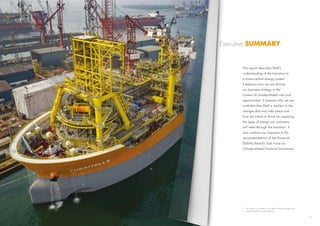
This report describes Shell’s
understanding of the transition to
a lower-carbon energy system2
.
It explains how we are driving
our business strategy in the
context of climate-related risks and
opportunities. It presents why we are
confident that Shell is resilient to the
changes that may take place and
how we intend to thrive by supplying
the types of energy our customers
will need through the transition. It
also contains our response to the
recommendations of the Financial
Stability Board’s Task Force on
Climate-related Financial Disclosures.
2	This report is an update to the ‘Shell: Energy Transitions and
Portfolio Resilience’ report (2016).
11
flexibility and intent to maintain a strong balance sheet
to provide further resilience.
We conclude there is a low risk of Shell having
stranded assets, or reserves that we cannot produce
economically, in the medium term.
Chapter 4
CHANGING OUR PORTFOLIO IN THE LONG TERM,
BEYOND 2030 describes Shell’s intent to move in step
with society towards a lower-carbon future. It describes
our ambition to halve the Net Carbon Footprint of
the energy products we sell by 2050. This will mean
reducing emissions from our operations, but most of
the reductions will come from changing the portfolio
of products we sell.
We outline the ways we could achieve this ambition.
These include selling more natural gas compared to oil,
selling more biofuels, selling more electricity, developing
more carbon capture and storage (CCS) capacity and
employing nature-based solutions, such as planting
forests or restoring wetlands to act as carbon sinks.
Chapter 5
SHELL’S ACTIONS TODAY provides examples of how
we are already active in many of the growth areas
that will drive our continued success and resilience. It
describes how we are managing operational emissions
including methane, growing our existing businesses
in areas such as liquefied natural gas and investing
in new businesses such as new fuels, electric-vehicle
charging and providing electricity to homes.
Chapter 6
WORKING WITH OTHERS illustrates the ways we
are collaborating and sharing our knowledge with the
many different actors in society. We aim to help inform
and accelerate the policy, technology and societal
changes that will be necessary to achieve a successful
transition.
This section also explains that we see a government-
led price on carbon as an essential tool for reducing
emissions.
Chapter 1
TOWARDS A LOW-CARBON FUTURE describes the
importance of energy to support growth and prosperity.
It highlights the societal challenge to provide more
energy while reducing carbon emissions. Shell supports
the Paris Agreement to tackle climate change.
Consumers, companies and governments will face
tough choices, and the path towards lower-carbon
energy will vary by country and sector. Shell sees
commercial opportunity in the drive to provide more
and cleaner energy.
Chapter 2
SHELL SCENARIOS explains how we navigate
uncertainties in the energy system by developing
scenarios. It gives highlights from our three main
scenarios, called Mountains, Oceans and Sky. They
describe a wide range of possible outcomes for the
energy system and show we expect demand for oil
and gas to be higher in 2030 than today.
Sky shows the most rapid transition to lower-carbon
energy. It represents a challenging but technically
possible and economically plausible pathway for the
world to achieve the temperature goal of the Paris
Agreement. Under this scenario, changes in energy
demand emerge in the 2020s, and materially impact
the energy system in the 2030s and beyond.
In all three scenarios, investment in new oil and gas
production will remain essential to meet society’s
ongoing demand for oil and gas for decades to come.
Chapter 3
OUR RESILIENCE IN THE MEDIUM TERM, TO 2030
demonstrates our ability to remain competitive and
resilient even in Sky, our scenario that shows the most
rapid transition to lower-carbon energy. We present
the sources of our resilience to potential changes in the
energy system. These include our strategy to reshape
the company, the diversity and quality of our portfolio
of businesses and geographic footprint, and our strong
financial framework.
We describe our active portfolio management that
will grow our business in areas that we expect to be
important in the energy transition, while reducing costs
and improving our CO2
performance. We illustrate
our capacity to generate free cash flow and the
sensitivity of our cash flow to oil prices ranging from
$40 to $100 per barrel and to government-led CO2
costs. And we explain our capital discipline, capital
This is one of a series of Shell
publications that contain information
about our view of climate change,
the energy transition and our
company strategy.
The Financial Stability Board - TCFD
The Task Force on Climate-related Financial
Disclosures (TCFD) is a global initiative to
get companies across all sectors to assess
climate-related risks and opportunities.
It recommends that companies disclose
information in four areas: governance,
strategy, risk management, targets and
metrics. Shell supports the work and
objectives of the TCFD. In this report, we
provide information investors need to assess
our strategy and performance.
Shell discloses TCFD-relevant information
through different channels:
■■ This is our second report on energy
transitions. It describes our strategy to
remain resilient and thrive through climate-
related risks and opportunities.
■■ The Shell Annual Report/20-F provides
further information on our governance and
risk management of climate change.
■■ The annual Shell Sustainability Report
publishes relevant climate-related emissions
performance data.
■■ Periodic Shell scenario publications share
our analysis and understanding of the
ways the energy system could evolve over
the long term.
Our company website contains further
relevant information such as equity emissions
performance data, executive speeches, feature
articles and news items. We have mapped
Shell´s 2018 disclosures against the TCFD’s
recommended categories in the appendix at
the end of this report (see page 77).
13
1.Society today faces a challenge
on an unprecedented scale:
how to meet increasing energy
needs while reducing carbon
emissions.
As societies grow and people
pursue a higher quality of life,
demand for energy increases. It fuels
economies, homes, schools, industry,
transport and construction. It’s the
vital ingredient in the products and
services many of us take for granted
in our everyday lives.
Towards a LOW-CARBON FUTURE
15
Today’s energy system is the result of many
decades of choices by consumers, energy
suppliers and governments. Societies want
energy that is reliable, widely available and
affordable. As a result, hydrocarbons account
for more than 80% of the energy mix.
Now society faces one of its toughest challenges
ever: how to provide more energy to a growing
world population, while also reducing the
greenhouse gas emissions that contribute to
climate change and to air pollution, which affect
people around the world.
Addressing this fundamental challenge must
include providing energy to the 1.1 billion
people who have no access to electricity, or the
3 billion people3
who still rely on solid fuels like
firewood or dung for cooking and heating.
Way forward
Governments took a great stride forward in 2015,
when they came together in Paris to reach a landmark
agreement to tackle climate change. Shell welcomes
and supports the Paris Agreement and the ambition to
limit the global rise in temperatures to well below two
degrees Celsius (2°C) above pre-industrial levels.
It is an ambition that will depend on unprecedented
collaboration between governments, companies and
society, and crucially, realism about the challenges
ahead. It requires a transformation in the way energy
is produced, distributed and used.
Capital investment measured in trillions of dollars over
decades will be necessary to finance both new sources
of energy, and to adjust existing infrastructure. It will
also be necessary to change how energy is consumed,
as a vast range of capital assets that consume energy –
from homes, domestic appliances, vehicles, machinery
and entire industries – will need to be adapted or
replaced.
The solutions will vary by economic sector. Some,
like clothes and food manufacturing, require low-
temperature processes and mechanical activities,
which electricity is well suited to deliver. These can
therefore be powered by low and zero carbon sources
of power, including renewable energy.
Other sectors, such as the iron, steel, cement, plastic
and chemical industries, and certain types of transport,
currently rely on the unique ability of hydrocarbons to
provide extremely high temperatures, chemical reactions
or dense energy storage. Today, many of these cannot
be electrified at all, or only at a prohibitively high cost.
The solutions will also vary by geography. Different
countries have different needs depending on local
circumstances: their development priorities, types of
economy, domestic energy resources, ability to invest
and national energy policies.
As a result, the transformation of the energy system
will move at different paces and produce different
outcomes and different energy mixes in different
sectors and countries. It will require trade-offs by
energy consumers, companies and governments.
It will require willingness to make hard choices.
This is the reality of the change needed across the
world to meet the aims of Paris. It is a transition that
will span decades. For companies, it will create both
risks and opportunities.
Shell is an active player in and has embraced
the transformation of the energy system. We see
commercial opportunity in participating in the global
drive to provide more and cleaner energy solutions.
3	 Source: The World Health Organization.
Source: International Energy Agency, 2017.
Mtoe = Million tonnes of oil equivalent
27%
32%
22%
5%
4%
10%
13,647
Mtoe
Coal
Oil
Natural gas
Nuclear
Renewables including Hydro
Bio-energy
IEA KEY ENERGY STATISTICS 2017
SOCIETAL CHALLENGE
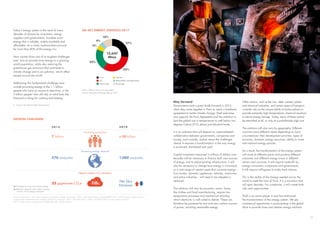
Increasing population
7 billion 10 billion
Increasing energy demand
Need to reduce CO2
emissions
570 exajoules 1,000 exajoules
32 gigatonnes CO2
e
Net Zero
Emissions
2 0 1 5 2 0 7 0
Sources: Population – UN world population projections, energy consumption. 2015 – IEA World Energy Outlook (WEO) 2017, 2070 outlook – Shell scenarios
analysis from A Better Life with a Healthy Planet CO2
emissions: 2015 – IEA WEO 2017: 2040 – IEA WEO 2017 Current policies scenario;
2017 – Shell scenario analysis from A Better Life with a Healthy Planet.
■ Challenge for more and cleaner energy
■ Reduction required in the carbon intensity
of every unit of energy consumed
17
2.Shell uses scenarios to
stretch our thinking and
consider events that may
only be remotely possible.
It is impossible to predict with
precision how future energy systems
will evolve, because there are too
many unknowns. Unknowns about
how technologies will develop, about
the types of energy consumers will
choose, about the energy policies
governments will implement.
Shell develops scenarios4
to navigate
such uncertainty and to inform and
test our business decisions. They are
not forecasts or business plans. They
describe what could happen, under
certain circumstances.
4	www.shell.com/scenarios
Shell SCENARIOS
19
Today, our three main scenarios are called
Mountains, Oceans and – our most recent
– Sky. One of the variables they explore is
the type and level of collaboration between
governments, businesses and energy users
and the impact this has on the energy system.
For example, in Mountains, strong
governments and powerful economic
actors work together to create stability and
maintain their own interests. This enables
big initiatives like the deployment of carbon
capture and storage (CCS) at scale or the
building of widespread gas and hydrogen
infrastructure.
In contrast, in Oceans, competitive
markets and a strong private sector are the
main engines of change. There is major
technology innovation, but big coordinated
initiatives are more difficult to achieve.
Energy needs are increasingly delivered
through a patchwork of initiatives.
Both Mountains and Oceans deliver net-zero
emissions5
(NZE) from the energy system by
the end of the century. But they fall short of the
temperature goal of the Paris Agreement.
Sky builds on this earlier work and assumes
that society takes actions so as to meet the
Paris goal. It requires unprecedented and
sustained collaboration across all sectors
of society, supported by highly effective
government policy.
In Sky, the world reaches net-zero CO2
emissions from the energy system by
2070 and achieves the goal of the Paris
Agreement to limit the rise in temperatures
to well below two degrees Celsius (2°C).
Like Mountains and Oceans, Sky adopts an
approach grounded in the reality of the current
economic policy development mechanisms.
But it then progressively becomes driven simply
by the goal to achieve NZE by 2070.
5	Net-zero emissions means that any CO2
from energy emitted into the atmosphere is balanced by extracting CO2
elsewhere so
that the total stock of CO2
stops growing – an essential step to tackling climate change. Extracting CO2
from the atmosphere
can be done using technologies such as CCS or by nature itself.
HIGH HURDLES
Sky is a technologically, industrially and economically
possible route to achieving the goals of the Paris
Agreement. It is ambitious and challenging to deliver. The
magnitude of change needed under Sky is apparent in
some of the main developments in different sectors.
Electricity: The share of electricity in final energy
consumption rises from 18% today to 26% by 2030
and grows to as much as 50% by 2060. Renewable
energy overtakes fossil fuels such as oil, gas and coal
as the primary source of energy in the 2050s. The
world uses hardly any fossil fuels in the power sector
after 2060. The share of nuclear in the global electricity
mix remains steady at around 10% to 2070. A new
addition to the sector is generation from biomass
combustion, which is linked with CCS to offer an
important carbon sink.
Mobility: The percentage of internal combustion
engines (ICE) in passenger cars falls from 100% in 2010
to around 75% by 2030. By 2050, it is impossible
to buy a new passenger vehicle powered by an ICE
anywhere in the world.
Industry: Sky assumes that industrial applications
are electrified where possible. To provide the negative
emissions required to achieve net-zero emissions from
the energy system, Sky requires the construction of
around 10,000 large CCS plants by 2070, compared to
fewer than 50 in operation in 2020.
Land use: Sky achieves net-zero global deforestation
by 2070. In addition, an area the size of Brazil being
reforested offers the possibility of limiting warming to
1.5°C, the ultimate ambition of the Paris Agreement.
Hydrogen: The share of hydrogen in total final energy
consumption rises from less than 1% before 2040, to 6% by
2070. It is used as a high-density and storable energy source
in transport and industry. Importantly in Sky, it is produced
from water electrolysis using mainly renewable power.
In Sky, these changes begin to emerge during the
2020s and accelerate over time. Some sectors,
countries or even cities move more rapidly than others.
Globally, these early developments begin to make a
material impact on the energy system in the 2030s.
SHELL AND ENERGY SCENARIOS
For over four decades, Shell has developed scenarios
to deepen our strategic thinking and consider the future.
Today, the Shell scenario team comprises energy experts,
modellers, economists, political scientists and social analysts.
We share and regularly test our thinking and modelling with
expert institutes, including the International Energy Agency
(IEA) based in Paris, France, the Massachusetts Institute of
Technology (MIT) Joint Program on the Science and Policy of
Global Change (Cambridge, USA) and the Energy Information
Administration (Washington, USA). MIT has used our energy
model profiles to calculate the global warming trajectories for
our scenarios. They publish their findings independently6
. Their
evaluation concludes that the central estimate of the global
temperature rise in the Sky scenario is 1.75ºC above pre-
industrial levels with an 85% chance of remaining below 2ºC.
6	For MIT’s findings for Mountains, Oceans and Sky, see: https://globalchange.
mit.edu/publications/joint-program (report numbers 291 and 330).
19
3.0
2.5
2.0
1.5
1.0
0.5
0.0
-0.5
1900 1940 1980 2020 2060 2100
°Cabove1861-1880
History Oceans MountainsSky
Oceans MountainsSky
50
40
30
20
10
0
-10
2000 2100207520502025
CO2emissions,gigatonnesperyear
WORLD ENERGY RELATED CO2
EMISSIONS
GLOBAL AVERAGE SURFACE TEMPERATURE RISE
Source: Shell analysis.
Source: MIT.
21
Growth in energy demand
In all our scenarios, energy demand grows
during the century as the global population
increases to more than 10 billion and the
world becomes more prosperous. They all
feature continued long-term demand for oil
and gas, alongside rapid growth in renewable
sources like wind and solar, and low-emission
fuels such as biofuels.
The energy mix varies between regions and
countries because of their different starting
points, levels of development, types of
economy, and energy resources available
locally. In north-west Europe, energy demand
remains relatively constant and renewables
overtake hydrocarbons as the dominant
primary energy source.
In countries such as China, India and across
Africa, all forms of primary energy – including
both hydrocarbons and renewable sources –
grow strongly from today’s base to support
industrialisation, build modern economies and
raise living standards.
The transition to new sources of energy around
the world requires major changes to industrial,
commercial and residential infrastructure. This
takes time and substantial investment, so the
pace of change will build in the 2020s and
accelerate thereafter.
PRIMARY ENERGY BY SOURCE IN THE THREE SCENARIOS
0
200
400
600
800
1000
1200
1400
2000 2025 2050 2075 2100
EJperyear
MTN OCN SKY MTN OCN SKY MTN OCN SKY MTN OCN SKY
Oil
Biofuels
Natural gas
Biomass
Coal
Nuclear
Solar
Wind
Other renewables
MTN = Mountains
OCN = Oceans
0
200
400
600
800
1000
1200
1400
2000 2025 2050 2075 2100
EJperyear
MTN OCN SKY MTN OCN SKY MTN OCN SKY MTN OCN SKY
Oil
Biofuels
Natural gas
Biomass
Coal
Nuclear
Solar
Wind
Other renewables
MTN = Mountains
OCN = Oceans
PRIMARY ENERGY USE BY GEOGRAPHY
Oil
Natural Gas
Coal
Nuclear
Hydro-electricity
Biofuels
Biomass  Waste
Biomass - Traditional
Geothermal
Solar
Wind
Other renewables
2017 2070 2017 2070 2017 2070 2017 2070
100
200
300
400
500
600
North America Europe Asia Africa
0
EJperyear
Source: Shell analysis.
23
Oil and gas demand in
Shell Scenarios
The three scenarios result in
different outlooks for demand for
oil, gas and coal. They all show
that demand for oil and gas is
higher in 2030 than today, but that
the share of oil, gas and coal in
the overall energy system falls.
The Sky scenario, the most rapid
transition, results in the lowest
overall demand for oil, gas and
coal in the long term. Oil demand
grows 1% per year from 2020-25.
It peaks around the middle of the
decade and then falls by about 1%
per year until about 2040.
In 2050, demand for oil is 78
million barrels a day (mb/d)
– about 85% of today’s oil
production. Even in 2070, oil use
remains around 50-60 mb/d,
because of the continued need for
oil in heavy transport, as well as
chemical manufacturing.
Gas demand in Sky rises 2% per
year between 2020-2025 and
by 1.5% between 2025-2030. It
peaks around the middle of the
2030s and falls by 0.5% per year
for the rest of the decade.
In all three scenarios, investment in
new oil and gas production will be
essential to meet ongoing demand.
That’s because demand for oil and
gas shrinks more slowly than the
natural decline in production from
existing oil and gas fields under
any credible scenario.
0
20
40
60
80
100
120
2005 2010 2015 2020 2025 2030 2035 2040
mlnboe/d
Year
Supply
Gap
OIL, GAS AND COAL: SHARE OF WORLD'S PRIMARY ENERGY
0
50
100
150
200
250
EJ
2005 2010 2015 2020 2025 2030 2035 2040
Supply
Gap
Year
IEA Demand WEO17 CPS
IEA Demand WEO17 NPS
IEA Demand WEO17 SDS
IEA Demand OMR17
IEA Demand GMR17
Supply Existing + Planned Fields
Extra Recovery Existing Fields
Shell Demand Range
IEA SCENARIOS
IEA Current Policies Scenario CPS An outlook on the basis of just those policies in place
IEA New Policies Scenario NPS Derived from the policies already in place and those officially announced
IEA Sustainable Development Scenario SDS
An integrated approach to achieving internationally agreed objectives
on climate change, air quality and universal access to modern energy
IEA Oil Market Report 17
OMR
17
IEA five-year oil market forecast
IEA Gas Market Report 17
GMR
17
Provides a detailed analysis of supply and trade developments,
infrastructure investments, and demand-growth forecast through 2022
https://www.iea.org/publications/freepublications/publication/market-report-series-oil-2017.html
http://www.iea.org/bookshop/741-Market_Report_Series:_Gas_2017
WORLD OIL DEMAND RANGES VS BASE SUPPLY
WORLD GAS DEMAND RANGES VS BASE SUPPLY
This chart compares Shell projections of energy demand of our scenarios (in yellow) with those
of the IEA (dotted lines). It also shows natural decline in production rates (in blue).
0%
10%
20%
30%
40%
50%
60%
70%
80%
90%
2000 2010 2020 2030 2040 2050 2060 2070
TPEFossil/TPETotal
Year
IEA Below 2 Degree Scenario
IEA 2 Degree Scenario
IEA Sustainable Development Scenario (WEO17)
IEA Current Policies Scenario (WEO17)
IEA New Policies Scenario (WEO17)
Sky
Oceans
Mountains
WEO17 = IEA’s World Economic Outlook publication
NEED FOR CONTINUED
OIL AND GAS INVESTMENT
Natural decline in production
happens because the pressure
and production efficiency in oil
and gas reservoirs decreases over
time. This makes it increasingly
expensive and eventually
uneconomic to produce. Such
decline rates average 5% per
year across the oil and gas
industry, according to the IEA.
Without ongoing investment to
boost production from existing
fields, the production decline rate
would be about 7% per year,
according to the IEA. Over a
period of five years, that would
translate into about 30 million
barrels of oil equivalent per day
(mmboe/d) of lost production
from the current level of around
95 mmboe/d.
Source: Shell analysis, IEA.
23
25
3.Shell’s strategy, portfolio and
strong financial framework
give us the sources of resilience
to potential changes in the
energy system to 2030.
The transition to lower-carbon energy
presents opportunities, as well as
risks, for Shell. It requires major
changes to industrial, commercial
and residential infrastructure. This
takes time and substantial investment.
We are reshaping our company
to provide the energy, and related
products and services, that consumers
need as society works to meet the
goals of the Paris Agreement.
OUR RESILIENCE in the medium term,
to 2030
27
Our strategic ambitions are to be a world-class
investment case, to thrive through the energy transition,
and to maintain a strong societal licence to operate.
We aim to grow our business in areas that will be
essential in the energy transition, and where we
see growth in demand over the next decade. We
expect these will include natural gas, chemicals,
electricity, renewable power, and new fuels such as
biofuels and hydrogen. We are also growing our oil
business, including in deep water and shales, to meet
continued demand.
We have a diverse portfolio – both geographically
and across different parts of the energy industry.
This means we are not dependent on any one
country or sector. It also means we can respond
to change.
We assess portfolio decisions, including divestments
and investments, against potential impacts from the
transition to lower-carbon energy. These include higher
regulatory costs linked to carbon emissions and lower
demand for oil and gas.
These sources of resilience reduce the risk of stranded assets in our
portfolio, a risk we see as low.
We consider the resilience of our portfolio in the medium term by
exploring potential ranges in oil prices, and their implications for
Shell’s cash flows. To ensure that we challenge our thinking, these
ranges go beyond the prices implied by our three main scenarios –
Mountains, Oceans and Sky.
In the longer term, after 2030, there is far more uncertainty. Here we
use scenarios to consider how we could reshape Shell’s portfolio of
products to meet the changing needs of society, depending on how
the pace of transition develops.
At the same time, we plan to maintain a strong financial
framework. This means growing free cash flow and
creating the financial capacity to provide returns to
investors, and to invest in new business models.
It also means reducing costs in our businesses so that
we can profitably produce the oil and gas that the
world will need for decades to come, even if prices
remain low for a long time.
SHELL STRATEGY
RESILIENCE
FINANCIAL FRAMEWORK
■■ Growing free cash flow
■■ Capital discipline and flexibility
■■ Strong balance sheet
The ability to meet our financial commitments, maintain a strong balance
sheet and provide attractive returns for our shareholders
PORTFOLIO
■■ Diverse business segments
■■ Geographic diversity
■■ Active portfolio management
- Lowering costs
- Improving CO2
performance
SOURCES OF RESILIENCE
Strategic Ambitions
Wining! CapabilitiesAspired Portfolio
Customer Centricity
Commercial Value Delivery
Technology Commercialisation
Project Delivery
Operational Excellence
Cash
engines
World-Class Investment Case
Thrive in the Energy Transition
Strong Societal Licence to Operate
We power progress together
by providing more and
cleaner energy solutions.
Growth
priorities
Emerging
opportunities
Our Purpose
Underpinned by our Values, Goal Zero, and People
SHELL STRATEGY
29
Diverse business segments
The energy system will evolve differently in
different countries and economic sectors,
and the business risks and opportunities will
vary significantly. Our diverse business helps
reduce our exposure to unexpected changes
in any one sector or country. It also gives us
the ability to shift in and out of assets and
businesses depending on our outlook.
Our resilience is strengthened by having
operations in many parts of the energy
system, as demonstrated by our seven
strategic themes: Conventional Oil and Gas,
Deep Water, Shales, Integrated Gas, Oil
Products, Chemicals and our recently created
New Energies business, that focuses on
power and new fuels.
These businesses range from the primary
extraction of energy and its processing, to
the eventual sale to customers, giving us
flexibility to manage risk and returns as the
energy system evolves.
We have demonstrated the strength of our
integrated model. In the past three years,
our Downstream business, which includes
chemicals, marketing, and refining and
trading, generated strong earnings.
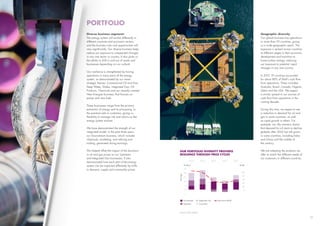
This helped offset the impact of the downturn
in oil and gas prices on our Upstream
and Integrated Gas businesses. It also
demonstrated how each part of the energy
system can be impacted differently by shifts
in demand, supply and commodity prices.
Geographic diversity
Our global business has operations
in more than 70 countries, giving
us a wide geographic reach. This
exposure is spread across countries
at different stages in their economic
development and transition to
lower-carbon energy, reducing
our exposure to potential rapid
changes in any one country.
In 2017, 19 countries accounted
for about 80% of Shell’s cash flow
from operations. These included
Australia, Brazil, Canada, Nigeria,
Qatar and the USA. We expect
a similar spread in our sources of
cash flow from operations in the
coming decade.
During this time, we expect to see
a reduction in demand for oil and
gas in some countries, as well
as rapid growth in others. For
example, our Sky scenario shows
that demand for oil starts to decline
globally after 2025 but still grows
in some countries, including India
and China until the middle of
the century.
We are adapting the products we
offer to match the different needs of
our customers in different countries.
PORTFOLIO
Earnings
Downstream
Upstream
Integrated Gas
Corporate
$ billion $/bbl
0
20
40
60
80
100
-5
0
5
10
15
20
25
2013 2014 2015 2016 2017
Brent price (RHS)
OUR PORTFOLIO DIVERSITY PROVIDES
RESILIENCE THROUGH PRICE CYCLES
Source: Shell analysis.
31
Active portfolio management
We are reshaping our portfolio by growing our
Integrated Gas, Chemicals, and New Energies
businesses. These are the areas where we could see
the highest increases in demand over the next decade
as the world transitions to lower-carbon energy.
We took an important step in the reshaping of our
portfolio with the acquisition of BG Group in 2016.
This acquisition accelerated our growth in Integrated
Gas where we expect more demand as gas is the
cleanest-burning hydrocarbon when used to generate
electricity. The acquisition also increased our positions
in deep water, especially in Brazil.
We are expanding in the power market because we
expect the energy system to increasingly electrify in
the coming decades. And we expect the power sector
to shift toward lower-CO2
electricity generated by gas
and renewables.
We are investing in areas such as wind power
generation in the Netherlands and the supply of power
to retail customers in the UK. This takes advantage of
our existing gas and power trading capabilities while
building new business models for the future.
We are also adjusting our businesses to meet changing
demand in different countries. For example, we are
offering hydrogen and electric-vehicle charging, in
addition to liquefied natural gas (LNG) and biofuels, in
European markets such as Germany where we see a
faster transition to lower-carbon energy.
And we plan to grow the number of retail sites in
countries such as China, Mexico, India, Indonesia and
Russia where we see demand for oil products growing
in the next decade.
We assess our portfolio decisions, including
divestments and investments, against potential impacts
from the transition to lower-carbon energy. These
include higher regulatory costs linked to carbon
emissions and lower demand for oil and gas.
The portfolio changes we are making reduce the risk
of having assets that are uneconomic to operate, or
oil and gas reserves that are uneconomic to produce
because of changes in demand or CO2
regulations.
Reducing our CO2
intensity
Managing our CO2
performance is an
important part of our long-term resilience.
We consider CO2
performance when we
take decisions about our portfolio.
For example, our petrochemicals complex in
Pennsylvania, USA will use a co-generation
facility to produce both heat and electricity
for the plant, as well as surplus electricity that
will be exported to the grid at a lower CO2
intensity than the regional average.
The plant will also have a highly efficient
ethylene cracker which will result in top-
quartile CO2
intensity, according to
benchmarking specialists Solomon. We
expect the plant to begin commercial
production early in the next decade.
In Canada, we are including measures to
reduce carbon emissions in plans for our
Groundbirch project, a tight shale gas
operation in British Columbia. These include
using electricity instead of natural gas for
the processing plant, using gas instead of
diesel to power drilling and using solar
energy to power pumps.
We actively consider the use of carbon
capture and storage (CCS) to reduce
emissions from our projects. Where CCS
is not economically feasible at current CO2
prices, we design some projects to be
available for CCS retrofits in the future.
Shell standards require that operating assets
with CO2
emissions of more than 50,000
tonnes of CO2
equivalent per year create
greenhouse gas (GHG) management plans
that seek to improve our CO2
performance.
These plans provide clarity on investment
options to reduce CO2
intensity in each of our
assets, and have allowed us to identify and
prioritise opportunities across our portfolio. 
World India US
2020-
2025
2025-
2030
2030-
2040
2040-
2060
2020-
2025
2025-
2030
2030-
2040
2040-
2060
2020-
2025
2025-
2030
2030-
2040
2040-
2060
Coal +0.3% -0.6% -1.7% -2.8% +5.8% +2.5% +1.6% -1.0% -3.4% -4.4% -7.8% -3.8%
Gas +2.1% +0.9% -0.5% -3.3% +5.4% -1.4% -3.3% -0.3% +1.0% -0.8% -1.2% -3.7%
Oil¹ +0.9% -0.9% -0.9% -1.6% +4.8% +2.6% +2.7% +1.2% -1.4% -3.5% -4.3% -4.7%
Biofuels +2.5% +1.2% +9.6% +5.5% +5.0% +9.0% +11.7% +16.5% -1.9% -6.4% +13.1% +0.9%
Oil products* +1.0% -0.8% -0.2% -0.7% +5.2% +2.6% +3.2% +1.8% -1.4% -3.6% -3.0% -3.4%
consumed by road transport +0.9% -1.1% -0.4% -1.6% +5.5% +2.9% +3.7% +2.1% -1.5% -4.3% -3.7% -5.0%
consumed by aviation +1.6% +0.9% +3.0% +2.1% +7.2% +5.1% +7.4% +5.9% -0.3% -1.3% +1.1% +0.8%
consumed by marine +1.2% +0.8% +0.7% -0.0% +19.7% +12.9% +5.5% -0.5% -0.6% -1.0% -0.8% -1.1%
consumed by industry +1.5% -2.7% -6.4% -11.5% +4.7% +0.1% +0.6% -6.7% 0.0% -3.3% -7.7% -24.5%
used for (petro)chemicals +2.1% +1.3% +0.8% +0.2% +5.5% +3.6% +2.3% +0.8% -0.2% -1.5% -2.6% -6.9%
Hydrogen +29.7% +25.9% +17.6% +12.6% +32.4% +8.0% +14.2% +16.6% +32.3% +32.5% +23.3% +9.4%
Solar PV +20.3% +19.0% +10.3% +6.0% +17.5% +16.1% +9.5% +11.2% +19.0% +24.0% +10.2% +3.1%
Solar Thermal +8.1% +8.3% +8.3% +4.9% +22.2% +12.0% +4.3% +6.4% +2.6% +5.1% +19.9% -1.5%
Wind +11.3% +9.5% +10.1% +5.4% +20.2% +12.8% +8.8% +4.0% +3.4% +6.6% +10.8% +6.8%
1 Oil demand excludes refinery gains, biofuels and synthetics.
* The demand for liquid hydrocarbon fuels is used as a proxy for oil products demand. By 2030, a minor fraction (less than 5%) of the liquid hydrocarbon fuels will
come from biofuels alongside crude oil. By 2060, this will be close to 25% on average globally (more than 10% in India and close to 40% in the USA).
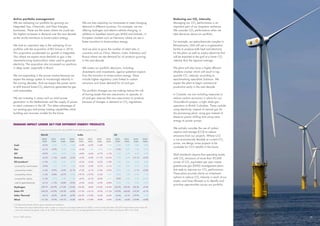
DEMAND IMPACT UNDER SKY FOR DIFFERENT ENERGY PRODUCTS
Compound annual growth rates (CAGR) for the defined period in time.
31Source: Shell analysis.
33
STRONG FINANCIAL
FRAMEWORK
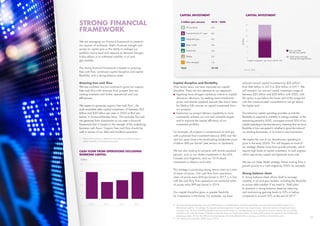
We are managing our financial framework to preserve
our sources of resilience. Shell’s financial strength and
access to capital give us the ability to reshape our
portfolio and to lead and respond as demand changes.
It also allows us to withstand volatility in oil and
gas markets.
This strong financial framework is based on growing
free cash flow, continued capital discipline and capital
flexibility, and a strong balance sheet.
Growing free cash flow
We are confident we can continue to grow our organic
free cash flow with revenues from projects that are
coming onstream and further operational and cost
efficiencies.
We expect to generate organic free cash flow7
, the
cash available after capital investment, of between $25
billion and $30 billion per year in 2020 at $65 per
barrel, in money-of-the-day terms. This excludes the cash
we generate from divestments as we seek a financial
framework that is based on the strength of the underlying
business cash flows. Organic free cash flow should be
well in excess of our debt and dividend payments.
7	Organic free cash flow is defined as free cash flow excluding inorganic
capital investment and divestment proceeds.
Capital discipline and flexibility
Over recent years, we have improved our capital
discipline. There are two elements to our approach:
■■ Applying more stringent resilience criteria to capital
allocation decisions, by seeking lower break-even
prices and shorter payback periods (the time it takes
for Shell to fully recover its capital investment) from
our projects;
■■ Improving our project delivery capability to more
consistently achieve our cost and schedule targets
and to improve the capital efficiency of our
investment portfolio.
For example, all projects in conventional oil and gas
with a planned final investment decision (FID) over the
next two years have a forward-looking break-even price
of below $40 per barrel8
(see section on Upstream).
We are also looking for projects with shorter payback
periods, such as our shales investments in the USA,
Canada and Argentina, and our Oil Products
investments in Mexico and India.
This strategy is producing strong returns even at a time
of lower oil prices. Our cash flow from operations
when oil prices were $54 per barrel in 2017 is in line
with the cash flow from operations we achieved when
oil prices were $99 per barrel in 2014.
Our capital discipline gives us greater flexibility
for investments in the future. For example, we have
reduced annual capital investment by $22 billion9
,
from $46 billion in 2013 to $24 billion in 2017. We
will maintain our annual capital investment range of
between $25 billion and $30 billion until 2020, with
the option to go below the lower end of the range but
with the communicated commitment to not go above
the higher end.
Discretionary capital spending provides us with the
flexibility to respond to volatility in energy markets. In the
remaining period to 2020, we expect around 30% of our
capital spending to be discretionary, meaning that we have
flexibility in how we spend it; whether to grow the value of
our existing businesses, or to invest in new businesses.
We expect the size of our discretionary spending to
grow in the early 2020s. This will happen as more of
our strategic themes move from growth priorities, which
require high levels of capital investment, to cash engines,
which require less capital and generate more cash.
We see our Deep Water strategic theme moving from a
growth priority to a cash engine by 2020, for example.
Strong balance sheet
A strong balance sheet allows Shell to manage
volatility in oil and gas markets, including the flexibility
to access debt markets if we need to. Shell plans
to maintain a strong balance sheet by reducing
and maintaining gearing levels to 20% or below,
compared to around 25% at the end of 2017.
8	The forward-looking breakeven price for pre-FID projects is calculated based on all forward-looking costs associated with pre-FID projects in our
development portfolio. Accordingly, this typically excludes exploration  appraisal costs, lease bonuses, exploration seismic and exploration team
overhead costs. The forward-looking breakeven price for pre-FID projects is calculated based on our estimate of resources volumes that are currently
classified as 2C under the Society of Petroleum Engineers’ Resource Classification System. As these pre-FID projects are expected to be multi-decade
producing projects, the less than $40 per barrel projection will not be reflected either in earnings or cash flow in the next five years.
9	 This excludes the acquisition of BG Group in 2016.
CASH FLOW FROM OPERATIONS EXCLUDING
WORKING CAPITAL
-10
0
10
20
30
40
50
2014 2015 2016 2017
CFFO ex W/C
$ billion
CAPITAL INVESTMENTCAPITAL INVESTMENT
0
5
10
15
20
25
30
$billion
Capital investment - per annum 2018 -’20
Non- and little
discretionary spend
Small scale and large
value growth opportunities
0
5
10
15
20
25
30
$billion
Capital investment - per annum 2018 -’20
Non- and little
discretionary spend
Small scale and large
value growth opportunities
0
5
10
15
20
25
30
$billion
Capital investment - per annum 2018 -’20
Non- and little
discretionary spend
Small scale and large
value growth opportunities
$ billion (per annum) 2018 – 2020
Oil products 4-5
Conventional oil + gas 4-5
Integrated gas 4-5
Deep water 5-6
Chemicals 3-4
Shales 2-3
New energies 1-2
Total 25-30
Source: Shell.
35
STRESS TESTING OUR PORTFOLIO
To assess our financial resilience in the short and
medium term to 2030, we look at the sensitivity of our
cash flow to changes in oil prices, and to changes in
the cost of CO2
emissions. We expect that the risks
associated with the energy transition will ultimately be
reflected in the price of oil and gas, and therefore this
is the basis for stress testing our portfolio.
Our scenarios show a range of possible outcomes for
the energy system based on factors including growth in
demand, the development of new technologies, world
politics and government policy.
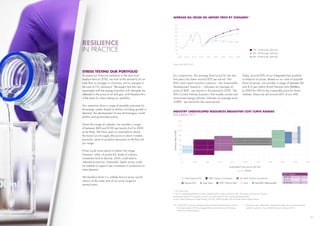
Given this range of outlooks, we consider a range
of between $40 and $100 per barrel of oil to 2030
to be likely. We have used our assumptions about
the future cost of supply (the price at which it makes
economic sense to produce resources) as the floor for
our range.
Prices could move above or below this range.
However, when oil prices fall, levels of industry
investment tend to decline, which could lead to
reduced production. Eventually, higher prices could
be needed to support new investment in production to
meet demand.
We therefore think it is unlikely that oil prices would
remain at the lower end of our price range for
several years.
For comparison, the average Brent price for the last
five years has been around $70 per barrel. The
IEA’s most rapid transition scenario – the Sustainable
Development Scenario – indicates an average oil
price of $6811
per barrel in the period to 2030. The
IEA’s Current Policies Scenario, that models current and
announced energy policies, indicates an average price
of $9011
per barrel for the same period.
Today, around 60% of our Integrated Gas portfolio
is linked to oil prices. Based on our view of possible
future oil prices, we consider a range of between $6
and $12 per million British thermal units (MMBtu)
to 2030 for LNG to be a plausible price for Asian
markets, where we sell around 60% of our LNG.
10	 Actual 2017 oil prices averaged $54 per barrel and actual prices for the
first three months of 2018 averaged $66 per barrel (source: US Energy
Information Administration).
11	 The IEA oil price reflects the “weighted average import price among IEA
member countries”. Source World Economic Outlook 2018.
RESILIENCE
IN PRACTICE
OPEC Onshore Conventional
OPEC Offshore ShelfDeep Water ArcticBitumen/EHO
Non-OPEC Onshore ConventionalNorth American LTO
Undeveloped Crude resource (bin bbl)
Breakeven(Brent$/bbl)
Non-OPEC Offshore ShelfNon-OPEC Offshore Shelf
Median
$120/bbl 52
$80/bbl 33
$40/bbl 11
R/P** (Years)
160
140
120
100
80
60
40
20
200
0
0 400 600 800 1000 1200 1400 1600 1800 2000
0
20
40
60
80
100
120
140
160
2000 20202010 20302005 20252015 2035 2040
CPS - Oil IEA (real) - $2016/b
NPS - Oil IEA (real) - $2016/b
SDS - Oil IEA (real) - $2016/b
AVERAGE IEA CRUDE OIL IMPORT PRICE BY SCENARIO10
INDUSTRY UNDEVELOPED RESOURCES BREAKEVEN COST CURVE RANGES
(INCLUDING YTF*)
Source: IEA WEO 2017.
* YTF: Yet To Find
** R/P is Undeveloped Resource volume divided by the current production rate, which gives an indication of future
development potential compared to needs. It excludes volumes from already developed fields.
Source: Wood Mackenzie, Rystad Energy, IHS, EIA, NEB (Canada), IEA and Shell internal data/analysis.
37
Sensitivity to oil prices
Assuming we meet the conditions in our operational
plans, especially with regards to production and costs,
we estimate that to 2027, a $10 per barrel change
in oil prices would be expected to have a roughly
$6 billion impact per year on our cash flow from
operations. This is an indicative estimate and not a
prediction.
Based on this assumption, if the oil price fell from
around $65 per barrel today to $40 per barrel money-
of-the-day, our cash flow from operations would be
expected to decrease by $15 billion per year.12
Similarly, if the oil price rose to $100 per barrel
money-of-the-day, our cash flow from operations would
be expected to rise by $21 billion per year.12
In addition to the resilience of our cash flow from
operations, we are also managing the resilience of our
organic free cash flow by actively managing the upper
levels of our expected capital investment.
The capital investment levels included in our business
plan offer sufficient flexibility to be reduced by $5-10
billion per year, without materially impacting the long-
term sustainability of our business.
Our financial framework could sustain a potential
reduction of up to $15 billion per year in organic
free cash flow, according to our estimates. Some of
the ways we could respond to this shortfall include
reducing capital investment to below $25 billion,
further reducing operational expenditure, increasing
our levels of debt and accelerating divestments.
If prices were to remain below the bottom of our range
for more than three to five years, an outcome we think
unlikely, we would consider making further strategic,
portfolio and financial framework choices to remain
financially resilient.
Conversely, in periods of high oil and gas prices we
would use the excess organic free cash flow to strengthen
our balance sheet and consider share buybacks.
A $10PER BARREL
CHANGE IN OIL PRICES
WOULD BE EXPECTED TO HAVE A ROUGHLY
$6 BILLION
IMPACT PER YEAR
ON OUR CASH FLOW
FROM OPERATIONS
A $10PER TONNE
INCREASE IN GLOBAL CO2
PRICES WOULD RESULT IN
A REDUCTION
OF ABOUT
$1 BILLION
IN SHELL’S PRE-TAX
CASH FLOWS
12	Significant variations in oil and/or gas prices will potentially impact certain operating costs, or
result in foreign exchange movements the effect of which are not reflected in this price sensitivity.
Sensitivity to government-led CO2
prices
At our current CO2
emission levels, we estimate that
a $10 per tonne increase in global CO2
prices would
result in a reduction of about $1 billion in Shell’s
pre-tax cash flows. By embedding a CO2
cost in our
outlook for cash flow, we are reflecting potential
changes and ensuring our cash flow is robust in the
face of these changes.
In 2017, we increased the CO2
costs reflected in our
cash-flow projections as part of our planning process,
LOW RISK OF STRANDED ASSETS
Every year, we test our portfolio under different scenarios, including prolonged
low oil prices. In addition, we rank the break-even prices of our assets in the
Upstream and Integrated Gas businesses to assess their resilience against low oil
and gas prices. These assessments indicate that the risk of stranded assets in the
current portfolio is low.   
At December 31, 2017, we estimate that around 80% of our current proved oil
and gas reserves, will be produced by 2030 and only around 20% after that
time. Production that is already on stream will continue as long as we cover our
marginal costs.
We also estimate that around 76% of our proved plus probable oil and gas
reserves, known as 2P, will be produced by 2030, and only 24% after that time.
with an impact of a reduction of around $1 billion on
a net present value basis.
Between now and 2030, we are confident that
our current portfolio is resilient in Sky, our most
rapid transition scenario. For Shell, this means that
we will still produce and sell the oil and gas that
society needs, while preparing our portfolio to move
more into lower-carbon energy, where this makes
commercial sense.
39
RESILIENCE: HIGHLIGHTS FROM OUR
UPSTREAM, INTEGRATED GAS AND
DOWNSTREAM BUSINESSES
In the section below, we examine the potential
impact of the risks and opportunities related to
climate change on our businesses and how we are
managing that impact. Each of our businesses has
different characteristics and strategies that support their
resilience in the period to 2030.
Upstream
Our Upstream business covers three strategic themes:
Conventional Oil and Gas, Deep Water and Shales.
It manages the exploration for, and the extraction of
crude oil, natural gas and natural gas liquids. It also
markets and transports oil and gas, and operates the
infrastructure necessary to deliver them to market.
In 2030, we expect demand for oil and gas to be
higher than today in each of our Mountains, Oceans
and Sky scenarios. To meet that demand, we expect to
make continued investments in finding and producing
oil and gas.
Today, we hold around 8.8 years of proved reserves
and 13 years of 2P reserves. We hold between
20 and 26 years of resources (2P plus 2C13
). As a
result, we believe we have the potential to sustain our
Upstream business into the 2030s.
We continue to explore for more resources to meet
the expected demand for oil that we see in Sky in the
2030s. We will continue to develop our projects to
be competitive on costs so that we are resilient even if
there is excess supply and low oil prices.
We can also tailor our exploration work and
investment to meet expected demand and prices for oil
and gas.
The recent lower oil prices have been a significant
catalyst for improved competitiveness in Shell’s
Upstream business, which has improved our resilience.
Since 2015, we have reduced costs in Upstream by
more than 20%, while increasing production by 20%.
At today’s oil price, that means Upstream is generating
significant cash flows for the Group, enough to pay
taxes and reinvest capital to bring more production on
line, while still helping pay dividends and reduce debt.
Even if oil prices fell to $40 per barrel, the lower end
of our range, Upstream would still generate cash flow
from operations.
Break-even prices are an important indicator of the
resilience of our Upstream projects. For example,
deep-water projects waiting for a final investment
decision have an average forward-looking break-even
price14
of below $30 per barrel, providing us with
competitive growth opportunities.
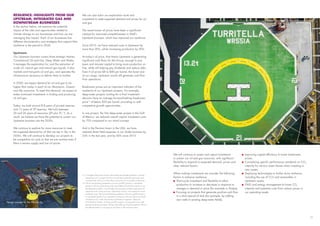
In one project, the Vito deep-water project in the Gulf
of Mexico, we reduced overall capital investment costs
by 70% compared to our initial concept.
And in the Permian basin in the USA, we have
reduced direct field expenses in our shales business by
33% in the last year, and by 60% since 2015.
13	Contingent Resources are the discovered recoverable petroleum volumes
associated with a project that has not yet been deemed technically and
commercially mature and thus these resources do not qualify as Reserves.
14	The forward-looking breakeven price for pre-FID projects is calculated
based on all forward-looking costs associated with pre-FID projects in our
development portfolio. Accordingly, this typically excludes exploration 
appraisal costs, lease bonuses, exploration seismic and exploration team
overhead costs. The forward-looking breakeven price for pre-FID projects
is calculated based on our estimate of resources volumes that are currently
classified as 2C under the Society of Petroleum Engineers’ Resource
Classification System. As these pre-FID projects are expected to be multi-
decade producing projects, the less than $30 per barrel projection will not
be reflected either in earnings or cash flow in the next five years.
We will continue to assess and adjust investments
to sustain our oil and gas resources, with significant
flexibility to respond to expected demand, prices and
other relevant factors.
 
When making investments we consider the following
factors to enhance resilience:
■■ Short-cycle investment and flexibility to allow
production to increase or decrease in response to
changes in demand or price (for example in Shales);
■■ Focusing on projects that generate positive cash flow
in a short period of time (for example, by adding
new wells to existing deep-water fields);
■■ Improving capital efficiency to lower break-even
prices;
■■ Considering specific performance standards on CO2
intensity for various asset classes when investing in
new assets;
■■ Deploying technologies to further drive resilience,
including the use of CCS and renewables in
Upstream assets;
■■ GHG and energy management to lower CO2
intensity and potential costs from carbon prices in
our operating assets.
Design concept for the Vito facility.
41
Integrated Gas
Our Integrated Gas business
manages LNG activities and the
conversion of gas-to-liquids (GTL)
fuels and other products. It markets
and trades natural gas, LNG,
crude oil and electricity. It also
markets and sells LNG as a fuel
for heavy-duty vehicles and marine
vessels.
Demand for gas will grow by
around 30% by 2030 compared
with 2015, with LNG as the fastest-
growing segment, according to
our Sky scenario. This is boosted
by gas replacing coal in power
generation and industry. Demand
for gas peaks around the middle of
the 2030s, and falls by 0.5% per
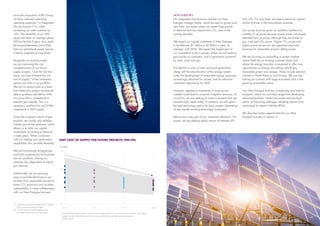
year for the rest of the decade. Total demand for LNG grew by 29
million tonnes to 293 million tonnes in
2017, according to our calculations.
Based on our current demand
projections, we see the potential for a
supply shortage in the middle of the
2020s, unless companies commit to
new LNG production projects soon.
We expect strong demand for LNG
as a fuel for transport. Switching
heavy-duty vehicles to LNG can
help reduce harmful air pollution. In
shipping, for example, natural gas
combustion produces up to 80%
less nitrogen oxides compared to
heavy fuel oil. Natural gas also emits
virtually no sulphur dioxide.
Today, the market for LNG as a fuel
for transport is around 14 million
tonnes per annum (mtpa). If the entire
marine and heavy-duty freight sector
converted to LNG, it would require
1,200 mtpa of LNG fuel.
We have a globally diversified
portfolio of 13 operational LNG plants,
and nearly 70 different customers in
more than 25 countries, making our
Integrated Gas business resilient to
variations in regional demand.
Existing
Under construction
Peru LNG
Atlantic LNG
Nigeria LNG
Gasnor
Egypt LNG
Qatar Gas 4
Oman LNG
Sakhalin
Brunei LNG
Malaysia LNG
Prelude
North West Shelf
Gorgon
QCLNG
LIQUEFACTION CAPACITY
BY INDEPENDENT COMPANY
LEADING PORTFOLIO
WORLD-CLASS LNG SUPPLY PORTFOLIO
13 liquefaction plants
41 million tonnes per annum capacity
95% reliability
Utilisation upside – feedgas availability
Focus on unit cost reduction
% TOTAL SALES - GEOGRAPHIC SPLIT
0
10
20
30
40
50
Milliontonnesperannum
In operation
Under construction
Existing
Under construction
Shell Cheniere Total Chevron BPXOM
Peru LNG
Atlantic LNG
Nigeria LNG
Gasnor
Egypt LNG
Qatar Gas 4
Oman LNG
Sakhalin
Brunei LNG
Malaysia LNG
Prelude
North West Shelf
Gorgon
QCLNG
29%
21%
13%
9%
5%
11%
12%
China (mainland)
Japan, Korea, Taiwan
Asia Pacific
North America
South America
Middle East
Europe
Source: Shell analysis.
2017 - Shell and JV marketed volumes.
43
Since the acquisition of BG Group,
we have reduced underlying
operating expenses15
in Integrated
Gas by around 11%, while
increasing our sales volumes by
15%. The reliability of our LNG
plants has been on average above
95% for the last 3 years. As a result,
the forward-delivered cost of LNG
from our operational supply sources
is below expected pricing levels.
Alongside our existing assets,
we are improving the cost
competitiveness of our future
supply projects. Over the last few
years, we have lowered the unit
cost of supply16
of the investment
options we hold in our portfolio.
We aim to reduce costs to a level
that makes any project we execute
able to produce and deliver LNG
at a price that is competitive in
relevant gas markets. This is a
necessary condition for any further
investments in LNG supply.
Given the long-term nature of gas
projects, we usually only develop
initially part of the resources, which
allows us to tailor our capital
investments according to demand
in later years. When combined
with our trading and optimisation
capabilities, this provides flexibility.
We are increasingly bringing gas
and LNG produced by third parties
into our portfolio, making our
revenues less dependent on equity
gas reserves.
Additionally, we are pursuing
ways to provide electricity to our
facilities from renewable sources to
lower CO2
emissions and increase
sustainability, in close collaboration
with our New Energies business.
NEW ENERGIES
Our Integrated Gas business includes our New
Energies strategic theme, which focuses on power and
new fuels, two areas where we expect high growth
in demand and low impact from CO2
costs in the
coming decades.
We expect our capital investment in New Energies
to be between $1 billion to $2 billion a year, on
average, until 2020. We expect the largest part of
our investments to be in power, where we will invest to
gain access to customers, and in generation powered
by solar, wind and gas.
The decline in costs of solar and wind generation,
along with the electrification of the energy system,
make the development of renewable energy resources
increasingly attractive for society, and an attractive
investment opportunity for Shell.
However, regulatory uncertainty in some power
markets could lead to uncertain long-term revenues. To
avoid this, we are seeking to invest in projects that are
commercially viable today. In addition, we will select
the best technology option for each project, depending
on the rapidly evolving technology landscape.
Returns are a key part of our investment decisions. For
power, we are seeking equity returns of between 8%
and 12%. For new fuels, we expect returns on capital
similar to those in the Downstream business.
Our power business gives our portfolio resilience to
volatility in oil prices because power prices are largely
delinked from oil prices, although they are linked to
gas, coal and CO2
prices. Higher CO2
prices and
higher power prices can also generate improved
revenues for renewable projects selling power.
We are focusing on expanding in power markets
where Shell has an existing customer base, and
where the energy transition is expected to offer new
opportunities in trading and selling natural gas,
renewable power and storage. These include selected
markets in North America and Europe. We are also
looking at countries with large economies and a fast-
growing renewables sector.
Our New Energies business is exploring new fuels for
transport, where our activities range from developing
advanced biofuels, made from waste and non-food
plants, to launching hydrogen refuelling stations and
recharging for electric vehicles (EVs).
We describe further opportunities for our New
Energies business in Section 5.
15	 Operating expenses excluding New Energies
and scope/accounting changes.
16	 Cost of supply includes shipping costs,
excludes finding costs and fiscal take.
0
5
10
15
2014 2015 2016 2017
$/mmbtu
UNIT COST OF SUPPLY FOR FUTURE PROJECTS (PRE-FID)
43
Note: Diamonds represent the funnel of future supply options in our LNG projects portfolio. Unit cost of
supply includes all estimated costs from reservoir to delivery at LNG receiving terminals.
Source: Shell.
45
Downstream
Our Downstream business comprises two strategic themes: Oil
Products and Chemicals. Oil Products activities are marketing,
and refining and trading. Marketing includes retail, lubricants,
business-to-business, pipelines and biofuels. Chemicals has
manufacturing plants and its own marketing network. In trading
and supply, we trade crude oil, oil products and petrochemicals.
MARKETING
We expect demand for oil products to grow to 2030. That’s
because some key sectors such as road freight, aviation and
petrochemicals have strong underlying growth in demand, and
an expected slower transition away from oil than other sectors.
We expect a faster transition in sectors like passenger cars, as
more people switch to EVs (see box on EVs).
In 2017, our marketing business represented around 50% of
Downstream’s earnings. We expect marketing to deliver an
incremental $2.5 billion in earnings per year by 2025.
Earnings from our Marketing business17
are well spread and in
2017 were split between the Americas (44%), East Asia (23%),
and the European Union and Africa (33%).
This diversity is important because it gives us exposure to
different regional economic cycles and to the different pace of
energy transition in each region.
RETAIL
By 2025, we aim to achieve 40 million daily customers and
55,000 sites around the world, compared to 30 million daily
customers in 44,000 sites around the world in 2017. Around
half our new sites will be in fast-growing markets such as China,
India, Indonesia, Mexico and Russia.
We are making our retail business resilient to potential changes in
demand for oil. For example, we plan to increase the contribution
of non-fuel retail sales to margins in our Shell-operated retail
network to 50%, from about 35% today. This means adding
more than 5,000 convenience stores in our network by 2025.
We also plan to increase the portion of our fuels business that
comes from low-emission energy solutions to 20% by 2025,
from around 7% today.
We have opened more than 20 charging locations – called Shell
Recharge – for EVs in the UK and the Netherlands. Together with
IONITY, an operator of high-powered charging networks, we plan
to offer 500 charge points across 10 European countries, starting
with 80 of our biggest service stations in the next two years.
17	 This excludes pipelines.
ELECTRIC VEHICLES AND
IMPACT ON LIQUID FUELS
Shell’s Mountains, Oceans and Sky
scenarios show a rise in demand
for electric vehicles (EVs) in the
next few decades.
This trend is fastest in Sky, where
more than half of global new
passenger car sales are electric by
2030. By 2050, consumers in this
scenario will not be able to buy an
internal combustion engine (ICE)
anywhere in the world.
As a result, the number of ICE cars
will fall over time and the number
of passenger kilometres driven on
electricity will rise rapidly.
Combined with the impact of better
mileage of the remaining ICE cars,
this means global consumption
of liquid hydrocarbon fuels in the
passenger segment falls by 1.5-2
million barrels per day by 2030
compared with today.
This transition will happen at
different paces in different parts
of the world. In the Sky scenario,
100% of new car sales will be
electric by 2030 in places such
as China and Western Europe,
and by 2035 in North America
and some other parts of the Asia
Pacific region.
Other countries, including India
and those in Africa, take longer
to make the change. This is partly
due to the time it takes to build the
power infrastructure required in
those countries where the grid is
still underdeveloped.
10,000
20,000
30,000
40,000
50,000
60,000
70,000
80,000
2000
2x
3x
2010 2020 2030 2040 2050 2060 2070 2080 2090 2100
100% 100% 99% 74% 36% 18% 12% 10% 10% 6% 2%
billionvehiclekm
ICE share
of total fleet
Liquid hydrocarbon fuels Gaseous hydrocarbon fuels Grid electricity Hydrogen
ENERGY SERVICE BY CARRIER FOR PASSENGER TRANSPORT (ROAD) IN SKY
0
2
4
6
8
10
12
14
16
18
2010 2030 2050 2070 2010 2030 2050 2070
millionboe/day(Energycarrier)
Liquid hydrocarbon fuels Gaseous hydrocarbon fuels
0
2
4
6
8
10
12
14
16
18
Grid electricity Hydrogen
ENERGY CONSUMPTION FOR PASSENGER TRANSPORT (ROAD) IN SKY
NON OECDOECD18
WORLD ELECTRIC VEHICLES FLEET IN SKY
Source: Shell, BNEF,BP,XOM, OPEC,IEA
0
200
400
600
800
1000
1200
1400
2015 2020 2025 2030 2035 2040
millionvehicles
Shell Sky
Shell Mountains
Shell Oceans
BNEF - 2016
BP - 2018
BP - 2017
Exxon - 2018
Exxon - 2017
OPEC - 2016
IEA - NPS 2017
IEA - SDS 2017
BNEF - 2017
18	 The Organisation for Economic Co-operation
and Development.
45
47
Competitive refineries
We have taken significant steps to improve the
financial performance and competitiveness of our
refineries to increase our resilience to potential
changes in demand.
Over the past 15 years, we have reduced our
refinery site interests from 51 sites with capacity of
4.4 million barrels per day, to 18 sites with equity
refining capacity of nearly 3 million barrels per day.
We sell more than 6 million barrels of products to
our customers.
We have focused on retaining increasingly complex
refineries, which offer crude-grade flexibility, proximity
to trading centres and strong integration with
Chemicals manufacturing assets. Some smaller and
less complex refineries in key markets still offer value in
combination with the marketing business they supply.
Our integrated refining, trading and chemical assets
around the world allow us to capture margins as
they shift from region to region. Our three main
trading hubs are now in the USA, Singapore and
the Netherlands.
Our global portfolio of refineries has a wide geographic
spread, reducing exposure to individual markets.
We are reducing the CO2
intensity of some refineries.
For example, by installing energy efficient equipment,
improving heat integration and using higher efficiency
electric motors. At our site in Fredericia, Denmark,
we also sell excess heat to our neighbours, heating
21,000 homes.
Over many decades, Shell has built a deep knowledge
and strength in trading a range of products, not only
oil and gas, but also CO2
, power, biofuels, hydrogen
and other commodities. This capacity will serve
as a strong foundation to trade new products and
commodities as demand and the energy mix evolves
through the transition.
Puget Sound
Martinez
Deer Park (JV)
Geismar
Convent
Norco
Mobile
Pennsylvania
FEP/Stanlow (JV) Fredericia
Rheinland
Schwedt (JV)
Karachi
Durban
Pulau Bukom
Jurong Island
Tabangao (JV)
Nanhai (JV)Al Jubail (JV)
Miro (JV)
Pernis
Moerdijk
Buenos Aires
Sarnia
CALGARY
HOUSTON
LONDON ROTTERDAM
MOSCOW
BEIJING
DUBAI
SINGAPORE
SHELL
WEST
Scotford
Refinery
Chemical plant
Chemicals and integrated refining site
XYZ Trading offices
Crude and product trading hub
Chemical Site under construction
0
400
200
600
Refinery capacity in thousand barrels per day (100%)
2.9 million barrels per day
Retained site 2017
Exits 2005–17
CONSOLIDATED FOOTPRINT
GLOBALLY INTEGRATED REFINING, CHEMICALS AND TRADING WITH
HUB LOCATIONS AND ADVANTAGED MARKETS
47
Source: Shell.
Source: Shell.
49
Chemicals
We plan to increase earnings in our Chemicals
business from $2.6 billion in 2017 to between
$3.5 billion and $4.0 billion per year by 2025.
We expect strong demand growth for chemicals
in the medium term, mostly because of economic
growth and demand for the everyday products
that petrochemicals help produce. Chemicals
can also help deliver some of the materials that
will help the energy transition – such as high-
performance insulation for homes and light plastic
parts in cars and planes that can help save energy.
Petrochemicals are also ingredients for components
in energy-efficient lighting and low-temperature
detergents.
Since 1998, we have reduced the number of
chemicals production sites from 133 to15. Our
global asset portfolio now offers both a regional
balance and a balanced feedstock exposure. This
ensures our resilience in a range of volatile market
environments.
Earnings from our Chemicals
business are split between Asia
(44.5%), the European Union and
Africa (38%), and the Americas
(17.5%).
We are taking steps to improve
the CO2
performance of some of
our chemicals plants, by improving
their reliability and installing more
efficient equipment. We are also
developing a solar power plant at
our Moerdijk chemicals site in the
Netherlands. The power produced
will be used by the Moerdijk site.
And in Singapore, the combined
heat and power plant at our Bukom
refinery and chemical plant is
saving more than 200,000 tonnes
of CO2
 per year.
0
500,000
300,000
400,000
200,000
100,000
2005 2005 2010 2015 2020 2025 2030
Year
N. America
S. America
Europe
Middle East
Asia
Others
*Cracker base chemicals (aromatics, derivatives, ethylene, propylene and
isobutylene). Source IHS/Shell analysis.
Petrochemicals* demand in thousand tonnes/year
37%
Asia
52%
Asia
CHEMICALS DEMAND OUTLOOK
Scotford
Sarnia
Buenos Aires
Durban
Nanhai
Shell-CNOOC JV –
Petrochemical complex
Moerdijk
Pernis
Rheinland
FEP
Stanlow
Small Chemical activities at group refineries
Advantaged gas feed site
Integrated Chemical/refinery mega sites/clusters
China in-market
Americas Europe Asia
US Gulf coast
Deer Park
Geismar
Norco
Mobile
Singapore
Bukom
Jurong
* Base chemicals capacity (C2+C3+bz);
portfolio includes Shell operated (12) and
non-operated (3)
33%
40%
27%
CAPACITY* IS REGIONALLY
BALANCED
PORTFOLIO CONSOLIDATED FROM 133 LOCATIONS
IN 1998 TO 15 TODAY
EIGHT CORE MARKETS FOR THE CHEMICAL INDUSTRY
Consumer
Clothing, furniture, toys
Electronics
Phone casings, resins
Construction
PVC pipes, plywood, insulation
Transportation
Upholstery, car body parts
Packaging
Bottles food packaging, crates
Durables  industrial
Wiring, cables, hoses
Agriculture
Fertilizer
Energy and water
Fuel additives, water treatment
Source: Shell.
51
4.The transition to lower-carbon
energy will feature enormous
change in the types of products
consumers need. It will also
bring major commercial
opportunities for companies
who supply those products.
Shell intends to thrive as the world
transitions to lower-carbon energy.
One important way we will do this is
by reducing the Net Carbon Footprint
of our energy products. Our ambition
covers not just emissions from our
own operations but also those
produced by customers when they
use the energy products we sell.
CHANGING OUR PORTFOLIO in the long term
after 2030
53
Reducing our Net Carbon Footprint
We plan to reduce the Net Carbon Footprint of our
energy products in step with society’s progress. We
have applied our own unique Net Carbon Footprint
methodology, using our Sky scenario analysis and the
IEA’s Energy Technology Perspectives 2017 as inputs.
This has identified the reduction in the Net Carbon
Footprint of the energy system needed to achieve a
reasonable chance of limiting global warming to well
below two degrees Celsius (2°C).
Based on this analysis, we believe society will have to
achieve net zero additional CO2
equivalent emissions
from energy by 2070. That will likely require the world
to reduce the amount of CO2
e produced for each unit of
energy consumed from today’s level of around 74 grams
to around 43 grams of CO2
e per megajoule by 205019
.
By 2050 we intend to match the Net Carbon Footprint
of the global energy system. To achieve this we need to
go even faster than society because our starting point
is higher. It will likely mean we need to reduce the Net
Carbon Footprint of our portfolio of energy products by
around half from its current value of around 83 grams
of CO2
e per megajoule, to around 43 grams of CO2
e
per megajoule by the middle of the century. We plan
to reduce our Net Carbon Footprint by around 20% by
2035 as an interim measure.
Shell has a higher starting point today than society’s
average because our portfolio has a different energy
mix compared to the overall energy system. That’s
mostly because we do not have the large quantities of
nuclear power, hydro power, renewables and large-scale
primary biomass that the global energy system has.
Critically, our plan covers the full energy life cycle of
our products, making it unique in the energy industry.
It includes not only emissions from the production of
energy products, but also those from their consumption,
where around 85% of the emissions associated with our
energy products occur.
CALCULATING OUR NET CARBON FOOTPRINT
Shell’s Net Carbon Footprint (NCF) methodology is
bespoke and unique. It covers the total greenhouse
gas (GHG) emissions associated with the production,
processing and consumption of the energy products
Shell sells. This includes direct emissions from Shell
operations, as well as those caused by third parties
who supply energy for our production. It includes the
hydrocarbons we procure from other producers, refiners
and manufacturers that we incorporate into our supply
chain, and the emissions from the consumption of these
products by our customers.
The calculation includes biofuels and electricity
products, as well as emissions that we offset by using
carbon capture and storage (CCS), or natural sinks
such as forests and wetlands. It does not include non-
energy products such as chemicals and lubricants. This
is because they are not intended to be burned, which
releases CO2
.
We express our Net Carbon Footprint as grams of CO2
equivalent produced for each unit of energy delivered.
This includes methane and other greenhouse gases.
We developed the Net Carbon Footprint methodology
in-house at Shell and have designed it to reflect the
activities that we are directly involved in and the
carbon content of the energy products we sell. Unlike
some other approaches, it aggregates and calculates
emissions and energy at the point where the energy is
delivered to our customers and consumed.
After purchasing our products, some customers will take
further steps to reduce emissions such as embedding
them in long-life materials, or applying CCS, or
improving their own energy efficiency. Because these
are outside our control, our NCF methodology excludes
these emissions reductions and ascribes no credit for
them to Shell unless we are directly involved. For this
reason, the relative reductions required to achieve
the aims of the Paris Agreement under the NCF
methodology will differ from, but are consistent with,
IEA projections.
This is a new, and we believe, ground-breaking
methodology. We are working with respected experts
from independent organisations to review and validate
our approach.
We will report our Net Carbon Footprint numbers
every year. We will review Shell’s progress against
society’s progress every five years, and revise our
ambition accordingly. We will assess this progress by
reviewing updated commitments from countries in their
nationally determined contributions under the terms of
the Paris Agreement, as well as updated scenarios that
see the world limiting global warming to 2°C or lower.
19	Based on Shell analysis of IEA scenario data. The results of using our
methodology may differ from other commonly referenced approaches which
cover a different scope. We are confident that Shell’s Net Carbon Footprint
ambition is consistent with the aims of the Paris Agreement and is an
appropriate approach to address the activities of a company like Shell.
Oil products
Shell oil production
Upstream assets
3rd
party crude supply
Country average
3rd
party gas
3rd
party LNG
3rd
party electricity
3rd
party oil products
Regional average
Oil transport
Shipping or pipeline
Shell refinery
Downstream assets
Distribution
Pipeline gas
Biofuels
Renewable 
grid electricity
LNG
GTL
Shell gas production
Upstream assets
Gas pipeline
Pipeline
Shell LNG
Shell assets
Shipping
LNG transport
Regasification
 pipeline
Shell gas production
Upstream assets
Net Carbon Footprint also includes the use of natural sinks and carbon capture usage and storage, not shown in diagram.
Gas pipeline
Pipeline
Shell GTL
GTL assets
Shipping
LNG transport
Distribution
Electric power
Residential 
commercial
END - USE
Industrial
Shell gas production
Upstream assets
Gas pipeline
Pipeline
Shell biofuel production
(1st
/2nd
generation)
Transport
Road/shipping
Distribution
Solar/wind/grid Electricity
Transportation
NET CARBON FOOTPRINT
AMBITION FOR NET CARBON FOOTPRINT1
Society trajectory2
Shell trajectory2
Shell “business as usual”
~20% reduction by 2035
WtW gCO2
e/MJ1
In line with society by 2050
0
30
60
90
2015 2020 2025 2030 2035 2040 2045 2050
1	Net Carbon Footprint measured on an aggregate “well to wheel”
or “well to wire” basis, from production through to consumption,
on grams of CO2
equivalent per megajoule of energy products
consumed; chemicals + lubricants products are excluded. Carbon
Footprint of the energy system is modelled using Shell methodology
aggregating life-cycle emissions of energy products on a fossil-
equivalence basis. The methodology will be further reviewed and
validated in collaboration with external experts.
2	Potential society trajectory includes analysis from Shell scenarios
estimate of Net Zero Emissions by 2070 and IEA Energy Technology
Perspectives 2017; potential illustrative Shell trajectory.
55
Big ambitions
Reducing our Net Carbon Footprint will require us to
reduce emissions from our own operations. But most of
the reductions will come from changing our portfolio
to supply customers more products that produce
lower emissions. We will do this in ways that make
commercial sense for Shell, in response to changing
consumer demand and in step with society’s progress.
To give some sense of the scale of the ambition, these
are some of the changes that reducing our Net Carbon
Footprint to match the energy system by 2050 could
mean for our business.20
And it could mean doing not
just one, but all of them.
■■ Selling the output from 200 large offshore wind
farms the size of our planned Borssele wind farm in
the North Sea.
■■ Changing the proportion of gas in the total amount
of oil and gas we produce, so that natural gas
increases from 50% to 75%.
■■ Selling the fuel produced by 25 biofuel companies
the size of our joint venture Raízen in Brazil.
■■ Selling enough electricity on our forecourts around
the world to meet three times the total demand for
power in the Netherlands.
■■ Developing the capacity of 20 CCS plants the size
of our Quest CCS plant in Canada.
■■ Planting forests the size of Spain to act a carbon
sink for emissions that still exist.
These examples reflect Shell’s size and scale in the
overall energy system: Shell produces around 1.5% of
the world’s total energy and we sell about 3% of the
total energy consumed. They also provide a sense of
the far greater ambition that society has set itself in the
Paris Agreement.
20	Note: these are illustrative of the type of activities that Shell might
employ, where they make commercial sense, to manage the Net
Carbon Footprint of the portfolio of energy products it sells.
55
SHELL ASKED EXPERTS TO REVIEW OUR METHODOLOGY
Sonia Yeh
PROFESSOR IN TRANSPORT AND ENERGY SYSTEMS, Chalmers
University of Technology, Gothenburg, Sweden.
It is encouraging to see Shell make the commitment to reduce its Net
Carbon Footprint by half by 2050. This goal is ambitious, it shows
leadership within the industry, and it will inspire others to follow. But
it will take robust strategic planning to realise this ambition within
the bounds of Shell’s other corporate responsibilities as the world’s
energy system continues to transform.
To support its ability to do this, Shell has initiated a transparent
process to account for net carbon emissions, using state-of-the-art
tools for energy and emissions tracking. These steps give a clear
signal that Shell is committed to reaching its emissions goal.
Lewis Fulton
DIRECTOR, SUSTAINABLE TRANSPORTATION ENERGY PATHWAYS
PROGRAMME, Institute of Transportation Studies, University of
California, Davis, USA.
I’m not aware of any other energy company that is trying to track its
Net Carbon Footprint including the products it sells. That’s a big step
for a company selling mostly carbon-based products and I’d like to
see more companies taking this approach.
The methodology is very thorough in the way it tracks carbon
molecules through the system. It’s a tough job. Today, no data set
in the world is robust enough to fully support this work. What’s
important, though, is that Shell is creating a baseline that will allow
it to measure its progress over the next 30 years. That really puts
Shell in the hot seat.
Michael Wang
MANAGER OF THE SYSTEMS ASSESSMENT GROUP, ENERGY
SYSTEMS DIVISION, Argonne National Laboratory, Chicago, USA.
It’s good to see that Shell plans to proactively track its progress in
reducing its GHG footprints every year. It is the right timing to take
this action because of the global trend of significantly reducing
GHG emissions towards a low-carbon future. Obviously, achieving
meaningful GHG reductions takes time because technology
deployment and transition take time. Thus, it will take at least until
2035 to see clear trends in the energy system’s GHG reductions.
Note: Shell is paying Chalmers University and the University of California, Davis for
their review of our Net Carbon Footprint methodology. Shell is paying Mr. Wang of the
Argonne National Laboratory directly. In all cases, the opinions expressed above are
solely those of the academics.
57
We are active in many of the
areas that will help reduce
our Net Carbon Footprint
and contribute to the energy
transition.
These include managing emissions
from our operations, supplying
customers with lower-carbon products
and developing technologies like
carbon capture and storage (CCS)
that will be critical in the future.
5.Shell’s Actions TODAY
59
REDUCING EMISSIONS
FROM OUR OPERATIONS
We are taking action to manage
the emissions from our own
operations and the emissions
from the energy we use in our
operations.
Greenhouse gas (GHG)
management plans
Our GHG and energy
management plans for our facilities
and projects help drive our
emissions performance through
a range of actions. These include
improving the schedules for
equipment maintenance, installing
more energy-efficient equipment
and considering the potential for
CCS in the design of our new and
largest projects.
GHG and energy management
plans must include the sources
of GHG emissions, as well as a
forecast of expected emissions at
the site for at least 10 years.
To assess the resilience of new
projects, we consider potential
costs associated with GHG
emissions when evaluating all new
investments.
This means projects may be
stopped at an early planning stage
if the GHG emissions are expected
to be too high, or a design may be
altered to reduce GHG emissions.
REDUCING EMISSIONS
In Integrated Gas, at our Pearl GTL plant in
Qatar, we are using heavy paraffin synthesis
off-gas as a fuel to power the plant. This fuel
had previously been flared. Using it in this way
has helped us reduce our overall emissions
by 700,000 tonnes of CO2
each year.
We are expanding the deployment of
solar photovoltaics (PV) in our operations.
For example, in California, USA, Shell is
delivering a PV project to provide on-site
solar power to the Stockton fuels distribution
terminal.
Shell is also developing a solar power
plant at its Moerdijk chemicals site in the
Netherlands, with construction planned to
begin in 2018. The project will provide an
approximate peak capacity of 20 megawatts
(MW) of renewable power.
Shell has a 34% share in Petroleum
Development Oman, which is building a
one-gigawatt solar thermal plant – one of the
largest ever. It will make energy production in
Oman less carbon-intensive by using sunlight
to generate 6,000 tonnes a day of steam
needed in day-to-day operations.
59
61
Emissions performance
In 2017, we changed the company’s bonus scorecard
so that 10% was dependent on GHG management.
This was based on various emissions targets covering
60% of the company portfolio. In 2018, we will
increase that to cover close to 90% of the portfolio.
For 2017, we selected scorecard measures focused
on three business areas: refining, chemical plants and
flaring in Upstream assets. For 2018, we will keep
refining and chemicals metrics and emissions coverage
in Upstream and Integrated Gas will be measured on
an intensity basis and expanded beyond flaring.
TACKLING METHANE
EMISSIONS
Methane is the main component of
natural gas. As one of the largest
producers of oil and natural gas
in the world, Shell is tackling
methane emissions, a more potent
greenhouse gas than CO2
. We are
working with governments, the oil
and gas sector and regulators to
manage and reduce the amount of
methane that is released into the
atmosphere.
We use advanced technology
to detect and reduce fugitive
(unintended) methane emissions
at some of our facilities, including
using infrared cameras at sites in
the USA, Canada, the Netherlands
and Tunisia.
We also collaborate on next-
generation detection technologies
to improve monitoring. In 2017,
Shell launched a methane detector
pilot in our oil and gas exploration
asset in Alberta, Canada. The pilot
is part of the Methane Detectors
Challenge, a collaboration
between the Environmental Defense
Fund, oil and gas companies, US-
based technology developers and
other experts.
In 2017, methane emissions from
Shell-operated ventures accounted
for less than 5% of Shell’s overall
greenhouse gas emissions.
BASRAH GAS COMPANY
Basrah Gas Company (BGC, Shell
interest 44%) is a joint venture with
Iraq’s South Gas Company and
Japan’s Mitsubishi. It captures gas
that would otherwise be flared
from three non-Shell-operated oil
fields in southern Iraq for use in the
domestic market.
In 2017, BGC processed an
average of 676 million standard
cubic feet of gas each day from
these fields to produce electricity.
Ending routine gas flaring and channelling
flared gas
Shell’s policy is to reduce any routine flaring or venting
of associated gas at our operations to a level as low
as technically and commercially viable. We also aim
to minimise operational flaring required for safety
reasons.
All our facilities must be designed to export, use or
reinject associated gas that is produced, and all
facilities must meet strict performance criteria.
63
GAS FOR TRANSPORT
Shell is developing a business in LNG fuel for
transport. Switching from diesel and heavy-fuel oil
to LNG could be an effective way to reduce GHG
emissions and reduce air pollution from trucks
and ships.
We have created a network of six LNG truck
refuelling stations in the Netherlands, for example.
One of the stations, located on the premises of
Albert Heijn – one of the largest Dutch supermarket
chains – is used by 150 LNG-fuelled delivery trucks
a day.
In 2016, Shell signed an agreement with Carnival
Corporation, the world’s biggest cruise operator,
to supply LNG to fuel two of the world’s largest
passenger cruise ships. And in 2017, Shell finalised
an agreement to provide LNG fuel for two additional
Carnival cruise ships based in North America.
We were the first customer of new LNG-for-transport
infrastructure at the Gas Access To Europe terminal
at the port of Rotterdam in the Netherlands.
In addition, Shell has acquired Gasnor, a
Norwegian company, which provides LNG fuel
for ships and industrial customers. It has an LNG
supply capacity of 300,000 tonnes per year and
operates three LNG plants, two LNG tankers,
20 LNG trucks and supplies LNG to 30 terminals.
That’s because gas emits between
45% and 55% lower greenhouse
gas emissions than coal when used
to generate electricity, according to
the International Energy Agency.
In addition, modern natural gas
plants emit less than one-tenth of
the sulphur oxides, nitrogen oxides,
particulate and heavy metals that
coal does when used to generate
power – and so can help improve
local air quality. Natural-gas fired
power plants also consume less
than 50% of the water needed for
coal-fired power generation.
Today, natural gas makes up
around 50% of Shell’s portfolio.
We are the world’s largest marketer
of liquefied natural gas (LNG)
among the independent oil and gas
companies, with positions in Japan,
Korea, Taiwan and China.
SUPPLYING MORE
PRODUCTS THAT PRODUCE
LOWER EMISSIONS TO
CUSTOMERS
Shell produces and sells a wide range
of low-emission energy products,
technologies and services that can
contribute to reducing overall emissions
from the energy system.
Selling more natural gas for
power, transport and industry
Growing the share of natural gas in
our portfolio compared to oil is one
of the most important ways we can
reduce the Net Carbon Footprint of our
energy products and help contribute
to reducing overall emissions from the
energy system.
Gas-fired electricity generation
can reduce GHG emissions and
air pollution by displacing coal-
fired generation and supporting the
integration of renewables into the
energy mix.
EMISSIONS OF AIR POLLUTANTS AND CO
²
BY ENERGY TYPE (IEA)
Data are for 2015: Mt = million tonnes, Gt = gigatonnes
Source: IEA analysis
Particulate
matter
31 Mt
Sulphur
dioxide
79 Mt
Nitrogen
oxides
108 Mt
Carbon
dioxide
32 Gt
Gas Coal Oil Bioenergy Non-combustion
63
65
Growing our power business
Electricity, including from renewable sources, will be a
large part of Shell’s future as the world moves to lower-
carbon energy. We want it to become the fourth pillar
of our business, alongside oil, gas and chemicals.
We are involved in every step of the oil and gas
market, and we intend to apply this same model to
electricity. We want to work back from the customer
including the supply of electricity to end users, buying
and selling it, and producing the electricity.
We currently produce electricity through renewable
projects in the USA, and in Europe. We have decades
of experience trading electricity and we supply it
wholesale to energy retailers. In the USA, we have
consistently been ranked in the top three power
wholesalers over the past decade.
We manage over 10,000 MW of power across
North America – of which over one-third comes from
renewable producers.
Investing in electric mobility
In line with our ambition to sell
more and cleaner energy, we
are expanding into supplying
electricity for transport. In 2017,
Shell acquired Netherlands-based
NewMotion, a company with one
of Europe’s biggest networks of
electric vehicle (EV) charging points.
NewMotion operates more than
30,000 private electric charge
points located in homes and offices
in the Netherlands, Germany,
France and the UK. It also provides
100,000 registered charge card
users access to over 50,000 public
charge points across 25 countries
in Europe.
Shell is also introducing electric
charging points on forecourts in
the UK, with 10 in 2017. We are
building a connected network of
fast charging points across Shell
retail stations in the Netherlands.
And in 2017, we signed an
agreement with high-powered
charging network operator IONITY
to offer faster charge points across
10 European countries.
Shell is also offering customers
smart-charging technology, which
helps integrate EVs into the power
grid at times when overall demand
is at its lowest. This would be
beneficial for the power grid and
cheaper for the customers charging
their vehicles.
The system was trialled in three
pilot projects in the UK, Germany
and the USA. We are now looking
for opportunities on a larger scale
to use this expertise.
In 2017, we expanded our capability to supply
electricity directly to industrial and commercial
customers through the MP2 Energy deal, which
gave us direct access to large-scale industrial and
commercial markets in Texas and the north-east USA.
In 2017, we agreed to acquire First Utility, a leading
independent energy provider to 825,000 households
in the UK.
In addition, we want to improve access to electricity
in the developing world. We will help to bring a
reliable flow of electricity to those who do not have
it, by investing in companies that operate mini-grids
and provide access through secure, pay-as-you-go
systems.
In early 2018, for example, we agreed to jointly invest
in Husk, a company based in India, that supplies
electricity to rural areas in Asia and Africa.
65
67
Developing conventional and
advanced biofuels
Biofuels today make up around
3% of global transport fuels and
we expect their share to grow as
the world shifts to lower-carbon
energy. Shell is one of the world’s
largest producers of biofuels made
from sugar cane, through our joint
venture in Brazil called Raízen.
Raízen (Shell interest 50%)
produces low-carbon biofuel from
sugar cane. This Brazilian sugar
cane ethanol can emit around 70%
less CO2
compared with gasoline,
from cultivation of the sugar cane
to using the ethanol as fuel. In
2017, Raízen produced around 2
billion litres of low-carbon ethanol
from Brazilian sugar cane.
Shell is also one of the largest
blenders and distributors of biofuels
worldwide. We purchase biofuels to
blend into our fuels to comply with
country regulations and mandates.
DEVELOPING ADVANCED BIOFUELS
We are active in the development of advanced biofuels
made from alternative feedstocks such as waste and
cellulosic biomass from non-food plants.
In 2015, Raízen opened its first advanced biofuels
plant at its Costa Pinto mill in Brazil. In 2017, the
plant produced 10 million litres of cellulosic ethanol
from sugar-cane residues. It is expected to produce
40 million litres per year once fully operational.
In Bangalore, India, we have built a demonstration
plant that will turn waste – including food, cardboard,
plastics and paper – into petrol or diesel that can
power cars. This provides the final stage of the RD process
we will need to see if it is successful to scale up and support
the commercialisation of this waste-to-fuel process.
The process has been developed by a USA-based research
centre, the Gas Technology Institute, and is called IH2.
The IH2 process uses heat, hydrogen and catalysts to
convert large molecules of the sort found in waste into
smaller fragments. Oxygen and other contaminants
are removed to create two pure elements: hydrogen
and carbon. The two are then combined to create
hydrocarbon molecules: petrol, diesel and jet fuel.
IN 2017,
WE USED AROUND
9 BILLION
LITRES OF
BIOFUEL
IN THE PETROL AND
DIESEL WE SOLD
In 2017, we used around 9 billion
litres of biofuel in the petrol and
diesel we sold. We market biofuels
in many countries including the
USA, Brazil, European Union
countries, Turkey, Thailand,
Malaysia, the Philippines,
Argentina and Canada.
69
Expanding the role of CCS and CCUS
Some sectors cannot be easily electrified, either
because their processes rely on extremely high
temperatures, or because they require the carbon
contained in fossil fuels to drive chemical reactions.
Industries that produce iron, steel and cement, as well
as other sectors such as aviation, shipping and long-
distance freight will therefore see fossil fuels play a
core role for decades to come.
CCS is a critical technology to help reduce CO2
emissions from large industrial facilities and power
plants. It is a combination of existing technologies
that capture and store CO2
deep underground,
preventing its release into the atmosphere. Sometimes
the captured CO2
is used, instead of being stored,
in a process called carbon capture, use and storage
(CCUS). In the oil and gas industry, for example, it
can be injected into ageing oil fields to enhance the
volume of oil recovered. It can also be used as a
feedstock in industrial processes.
There are currently 21 large-scale CCS projects in
operation or under construction globally, with a
combined capacity to capture around 40 million
tonnes of CO2
each year.
In partnership with the Canadian government and our
joint-venture partners, Shell operates the Quest CCS
project in Alberta that captures and stores CO2
from
the Scotford Upgrader. The Upgrader turns bitumen
into synthetic crude oil using hydrogen. In less than
two years, Quest has captured and safely stored more
than 2 million tonnes of CO2
.
CCS technology developed by Shell Cansolv, a
subsidiary of Shell, is used at the power station Boundary
Dam in Saskatchewan, Canada. It is SaskPower’s largest
coal-fired power station and a significant source of
power for the region. Both sulphur dioxide and CO2
are
captured from the power station. We continue to support
SaskPower to improve the application of the technology.
At the Technology Centre Mongstad (TCM), Shell,
together with the Norwegian government, Statoil and
Sasol, will undertake further research and development
into CCS technology to help reduce its costs. In
2017, we reaffirmed our commitment to participate in
continued testing at TCM until 2020.
In October 2017, Shell entered a CO2
storage
partnership in Norway to continue the development of
carbon storage on the Norwegian continental shelf.
The project is part of the Norwegian authorities’ efforts
to develop full-scale CCS in Norway.
Meanwhile, in Australia, Shell is involved in the Gorgon
CO2
injection project, which will be the world’s largest
CCS operation when completed. Gorgon CCS will
separate and reinject between 3.4 million and 4 million
tonnes of reservoir CO2
each year. Over the life of the
project, it is expected that around 100 million tonnes
of CO2
will be captured and stored.
NATURAL SOLUTIONS TO REDUCING EMISSIONS
Natural ecosystems such as forests and wetlands play
a critical role in capturing and storing carbon and can
make a vital contribution to limiting global warming.
Article 5 of the Paris Agreement acknowledges the
importance of these natural sinks to help balance the
GHG emissions created from other sources.
One example of our efforts to reduce the emissions
associated with the use of our products is in the
Netherlands, where we offer companies the
opportunity to compensate for the emissions associated
with the use of their vehicles.
The service calculates and compensates for CO2
emissions from fuel used in vehicles, emissions that
are difficult or expensive for companies to avoid,
helping them reduce the environmental impact of their
operations. We continue to explore opportunities to
expand this service to customers in other countries.
Today, this initiative supports third-party projects,
including the Kasigau Corridor project in Kenya,
which was developed by project development and
management company Wildlife Works. The Kasigau
Corridor project protects 500,000 acres of a
threatened area of forest, while preserving biodiversity
and wildlife habitat.
Shell will explore opportunities to make investments
to develop its own nature-based projects as a key
contribution towards achieving our Net Carbon
Footprint ambition. We are also calling on
governments to recognise and ensure the eligibility
of these nature-based emission reductions in their
carbon pricing mechanisms, including under the
Paris Agreement, to support this emerging and
necessary market.
RESEARCH AND DEVELOPMENT
We continue to invest in research
and development (RD) to improve
the efficiency of our products,
processes and operations, and to
commercialise technologies for the
transition to a low-carbon energy
future. In 2017, we spent $922
million on RD.
We operate a global network of
technology centres, with major hubs
in Houston, the USA; Amsterdam,
the Netherlands; and Bangalore,
India. Thousands of employees
across the network work on RD
projects that seek, for example, to
turn natural gas into more efficient
and cleaner fuels, unlock oil from
rock layers thousands of metres
below the sea surface, and reduce
Shell’s Net Carbon Footprint.
RD projects often involve
collaborations with public
or private entities, including
universities, government
laboratories, technology
start-ups and incubators. For
example, in 2017 we agreed to
support research by the Energy
Biosciences Institute in the USA
into using biochemical processes
to store or deliver energy, or to
synthesise high-value chemicals.
Most of our research focuses
on the near term, to help our
existing businesses reduce
capital and operating costs, and
to enhance customer products
and services. This research also
focuses on ways to lower energy
consumption. For the long term,
we aim to quickly acquire deeper
insights into the science and
engineering that underpins new
energy technologies that can help
create a lower-carbon future.
Our open innovation programmes
include:
Shell GameChanger
This programme works with
start-ups and businesses on
unproven early-stage ideas with
the potential to impact the future
of energy. We provide companies
with support, expertise and seed
funding, while they maintain the
independence to make their own
decisions.
Shell Technology Ventures
This is our corporate venturing
arm. It invests in companies
that are developing promising
technologies that complement
Shell’s businesses – mainly in
oil and gas, new energies and
information technology.
Shell TechWorks
Based in Massachusetts, the USA,
Shell TechWorks accelerates the
adoption of proven technologies
from other industries and applies
them to the oil and gas sector.
Founded in 2013, the programme
has collaborated with companies,
universities, research institutes
and start-ups to help develop and
deploy technology quickly and
cost-effectively.
SCALING UP CCS
The IPCC has estimated that keeping to a 2°C pathway would cost global society approximately
140% more without CCS. CCS is a capital-intensive technology. To date, individual CCS projects
have largely relied on a combination of major capital grants from government to underpin
construction costs and access to a modest cost on CO2
for on-going commercial viability. The very
large-scale deployment of CCS required to achieve net-zero emissions from the energy system,
however, cannot sustainably proceed on the back of such grants. Commercial viability for a CCS
plant would currently require governments to place a more meaningful cost on CO2
emissions and
lower deployment costs. Deployment costs will likely decline as more CCS plants are built and the
supply chains they rely upon mature.
Given the present lack of effective government-led carbon pricing systems, financial support for low-
carbon technologies (as is offered to renewables in many countries) could be extended to include
CCS. Such a mechanism could encourage the continuation of CCS RD and deployment to scale up
CCS until carbon pricing ramps up to levels sufficient to support commercial deployment.
71
6.
Shell’s work with organisations
around the world helps us learn
from others and share our
knowledge and experience.
The challenge of tackling climate
change can only be met through
unprecedented collaboration. Shell
is working in close partnership with
governments, other companies, our
customers and wider society. We aim
to learn from others and help inform
and accelerate the policy, technology
and societal changes that will be
necessary to achieve a successful
transition.
Working with OTHERS
73
TCFD
The publication of this report follows our discussions
with the Task Force on Climate-related Financial
Disclosures (TCFD) about increasing transparency to
help investors understand climate-related risks and
opportunities.
We continue to work with the TCFD to help develop
best practices for reporting linked to climate change.
To that end, we have joined the Oil and Gas Preparer
Forum, initiated by the TCFD and convened by the
World Business Council for Sustainable Development,
an advocacy association. The forum´s objectives
include encouraging companies to consider the use of
scenarios in an uncertain world, and to recognise a
range of possible outcomes and trajectories.
Collaborating with countries
We work with some governments to explore pathways
that can help them move towards a prosperous, low-
carbon future.
In the Netherlands, for example, we are working with
policymakers and industry representatives to help the
government meet its target of reducing GHG emissions
by 80-95% by 2050. This will require significant shifts
in the way energy is produced and consumed across
the economy.
In 2016, Dutch energy company Eneco, the Port of
Rotterdam, German engineering group Siemens, Dutch
contracting company Van Oord and Shell initiated a coalition
to accelerate the energy transition in the Netherlands.
Together, we called on the Dutch government to
prioritise the international climate goals set during
the climate summit in Paris in 2015 and decide on a
long-term policy framework to support them. Today, this
coalition has more than 50 member companies.
Together with China’s Development Research Centre
of the State Council, Shell has also been looking at
how natural gas could boost economic development,
improve air quality and help China’s progress towards
the commitments it made in Paris.
World Resources Institute
We are working with the World Resources Institute
(WRI), a global research organisation, to review and
further develop our GHG aspirations. We have also
recently joined the WRI’s Corporate Consultative
Group to learn from and share best sustainability
practices with other members.
European power
In September 2017, Shell joined a coalition of
renewables, natural gas and technology organisations
calling for the introduction of an emission performance
standard (EPS) linked to capacity remuneration
mechanisms in the European Commission’s Clean
Energy for All Europeans package. This EPS would
exclude coal from capacity payments across the
European Union and send a signal to investors to
switch from coal to gas and renewables.
Carbon pricing
Shell has long recognised the importance of
government-led carbon pricing systems as an essential
tool for reducing emissions.
We are supporting the World Bank’s Carbon Pricing
Leadership Coalition that is made up of governments,
businesses and organisations with the long-term
objective of achieving a government-led carbon price
throughout the global economy. We also participate
in the International Emissions Trading Association
(IETA), a non-profit business organisation created in
June 1999 to establish an international framework for
trading in GHG emission reduction credits.
We have long supported the European Union’s
Emissions Trading Scheme and have worked with
policymakers, industry groups and non-governmental
organisations to support the recent reform of the system
after 2020.
Climate Leadership Council
Launched in 2017, the Climate Leadership Council
is an international policy institute that promotes
a government-led strategy to lower emissions by
returning the income from a nation’s carbon taxes
directly to its citizens through “carbon dividends”.
Shell is a founding member along with other
companies including ExxonMobil, Total, BP, Unilever
and PG, and non-governmental organisations
Conservation International and The Nature
Conservancy.
Currently active in the USA and the UK, the council is
planning to expand to Germany, China and India.
Joris Thijssen (Director, Greenpeace Netherlands), Mark Rutte (Prime Minister of the Netherlands), Marjan van Loon
(President Director of Shell Netherlands) and Hans de Boer (Chairman VNO-NCW) at the National Climate Summit 2016.
75
Energy Transitions Commission
In 2015, Shell helped establish the Energy Transitions
Commission (ETC) which aims to accelerate change
towards low-carbon energy systems that enable robust
economic development and limit the rise in global
temperature to well below 2°C.
The ETC brings together leaders representing a wide
range of sectors and interests: investors, energy
companies, innovators, industrial energy users, non-
profit organisations and research institutes. As of
October 2017, the ETC had 29 members. It is chaired
by Lord Adair Turner and Dr Ajay Mathur. Chad
Holliday serves as Shell’s Commissioner.
Oil and Gas Climate Initiative
We are a member of the Oil and Gas Climate Initiative
(OGCI), which aims to increase the ambition, speed
and scale of companies’ individual initiatives to reduce
their greenhouse gas footprint and explore new business
models and technologies. OGCI focuses on carbon
capture, utilisation and storage (CCUS), methane
detection and reduction, as well as energy efficiency.
Environmental and social
issues
As a member of IPIECA, the global
oil and gas industry association
for environmental and social
issues, we take part in discussions
on topics including biodiversity,
climate change and resettlement.
Reducing flaring
Shell has been an active member
of the World Bank-sponsored
Global Gas Flaring Reduction
Partnership since 2002. This
public-private partnership helps
reduce flaring by working to find
alternative uses for gas that would
otherwise be flared.
As part of the partnership, in
2015 we signed up to the World
Bank’s Zero Routine Flaring by
2030 initiative. This aims to
ensure all stakeholders, including
governments and companies, work
together to identify ways to use gas
from oil production, for example,
to generate electricity for local
communities.
Reducing methane emissions
In late 2017, Shell joined seven
other energy companies in signing
a Guiding Principles document.
These principles aim to help
reduce methane emissions from the
production and use of natural gas.
In December 2017, Shell agreed to
join the Environmental Partnership
which aims to voluntarily reduce
methane emissions in the USA in
areas including leak detection and
repair, replacement or upgrade of
equipment.
Hydrogen Council
In January 2017, Shell and other companies launched
the Hydrogen Council, a global coalition of chief
executives working to raise the profile of hydrogen’s
role in the transition to a low-carbon energy system.
The council seeks to accelerate investment in the
development and commercialisation of the hydrogen
and fuel-cell sectors. It provides recommendations to
ensure appropriate conditions are in place to facilitate the
deployment of hydrogen technologies. Shell is already
part of a cross-industry consortium developing around
400 hydrogen refuelling stations in Germany. We have
several hydrogen stations in the USA and the UK.
The council comprises 18 CEOs of energy, transport
and industrial multinationals. In January 2017, the
council published a report: “How hydrogen empowers
the energy transition“ which further details hydrogen’s
potential. In November 2017, the group launched a
second report, called “Hydrogen, scaling up,” outlining
a path to greater hydrogen deployment and its role in
the energy transition.
75
77
APPENDIX TO THE EXECUTIVE SUMMARY
This table shows where to find Shell disclosures that are related to recommendations by the Task Force
on Climate-related Financial Disclosures (TCFD) in Shell reports, publications and websites.
TCFD RECOMMENDATION DISCLOSURE
GOVERNANCE:
Disclose the organisation’s governance around climate-related risks and opportunities.
a) Describe the Board’s oversight of climate-related risks and
opportunities.
Annual Report (page 62-63): “Our governance and management
of climate change risks and opportunities” section, including
references to the Report’s sections “Corporate governance” (page
82) and ”Directors’ Remuneration Report” (page 94)
b) Describe management’s role in assessing and managing climate-
related risks and opportunities.
Annual Report (page 62-63): “Our governance and management
of climate change risks and opportunities”
STRATEGY:
Disclose the actual and potential impacts of climate-related risks and opportunities on the organisation’s
businesses, strategy and financial planning, where such information is material.
a) Describe the climate-related risks and opportunities the
organisation has identified over the short, medium and long term.
Annual Report (page 65-66): “Our strategy on climate change”
CDP submission: describes detailed examples
b) Describe the impact of climate-related risks and opportunities on
the organisation’s businesses, strategy and financial planning.
Annual Report (pages 65-66): “Our strategy on climate change”
Shell Energy Transitions Report (page 24): “Our resilience in
the medium term, to 2030”
c) Describe the resilience of the organisation’s strategy, taking into
consideration different climate-related scenarios, including a 2°C
or lower scenario.
Shell Energy Transitions Report (page 50): “Changing our
portfolio in the long term, after 2030”
Sky Scenario: describes our scenarios approach
RISK MANAGEMENT:
Disclose how the organisation identifies, assesses and manages climate-related risks.
a) Describe the organisation’s processes for identifying and
assessing climate-related risks.
Annual Report (pages 62-63): “Our governance and
management of climate change risks and opportunities”
Sustainability Report section: “About this report”
b) Describe the organisation’s processes for managing climate-
related risks.
Annual Report (pages 62-65): “Our governance and
management of climate change risks and opportunities” and
“Our portfolio and climate change”
Sustainability Report sections: “Energy Transition” and
“Embedding sustainability into projects”
c) Describe how processes for identifying, assessing and managing
climate-related risks are integrated into the organisation’s overall
risk management.
Annual Report (page 82): “Controls and procedures”
Sustainability Report section: “Sustainability at Shell”
METRICS AND TARGETS:
Disclose the metrics and targets used to assess and manage relevant climate-related risks and opportunities,
where such information is material.
a) Disclose the metrics used by the organisation to assess climate-
related risks and opportunities, in line with its strategy and risk
management process.
Sustainability Report sections : “Environment data” and
“Our Executive scorecard”
b) Disclose Scope 1, Scope 2, and, if appropriate, Scope 3
greenhouse gas (GHG) emissions, and the related risks.
Greenhouse gas webpage: www.shell.com/ghg provides our
performance data on Scope 1, 2 and 3
Shell Energy Transitions Report (page 24): “Our resilience in
the medium term, to 2030”
c) Describe the targets used by the organisation to manage climate-
related risks, opportunities, and performance against targets.
Annual Report (pages 65-66): “Our strategy on climate change”
CLOSING COMMENT
It’s impossible to predict exactly how the transition to
lower-carbon energy will play out, but we expect it will
mean profound changes for the energy system over the
long term.
We are confident that Shell is resilient to those changes,
and that we can thrive by continuing to supply the types
of energy our customers need.
Our strategy to reshape the company, the diversity
and quality of our portfolio, and our strong financial
framework all contribute to the resilience of our
company.
We are growing our business in areas that we expect
to be important in the energy transition, while reducing
costs and seeking to improve our CO2
performance.
Looking further into the future, we have set the
ambition to bring down the Net Carbon Footprint of
our energy products by around half by 2050, in step
with society’s progress towards meeting the goals of
the Paris Agreement.
This will drive change across our portfolio. It is likely
to mean more renewable power, biofuels, and electric
vehicle charging points; supplying more natural gas;
helping advance technology to capture and store
carbon safely underground; and helping develop
natural carbon sinks like forests and wetlands.
We are making investments in these areas today and
we expect to do more. We also expect to continue to
invest in finding and producing the oil and gas that the
world will need for decades to come.
79
DISCLAIMERS
This report contains data and analysis from Shell’s new Sky
Scenario. Unlike Shell’s previously published Mountains and Oceans
exploratory scenarios, the Sky Scenario is targeted through the
assumption that society reaches the Paris Agreement’s goal of
holding global average temperatures to well below two degrees
Celsius (2°C). Unlike Shell’s Mountains and Oceans scenarios which
unfolded in an open-ended way based upon plausible assumptions
and quantifications, the Sky Scenario was specifically designed to
reach the Paris Agreement’s goal in a technically possible manner.
These scenarios are a part of an ongoing process used in Shell for
over 40 years to challenge executives’ perspectives on the future
business environment. They are designed to stretch management to
consider even events that may only be remotely possible. Scenarios,
therefore, are not intended to be predictions of likely future events
or outcomes and investors should not rely on them when making an
investment decision with regard to Royal Dutch Shell plc securities.
Additionally, it is important to note that Shell’s existing portfolio has
been decades in development. While we believe our portfolio is
resilient under a wide range of outlooks, including the IEA’s 450
scenario (World Energy Outlook 2016), it includes assets across a
spectrum of energy intensities including some with above-average
intensity. While we seek to enhance our operations’ average
energy intensity through both the development of new projects and
divestments, we have no immediate plans to move to a net-zero
emissions portfolio over our investment horizon of 10-20 years.
Although, we have no immediate plans to move to a net-zero
emissions portfolio, in November of 2017, we announced our
ambition to reduce the Net Carbon Footprint of the energy products
we sell in accordance with society’s implementation of the Paris
Agreement’s goal of holding global average temperature to well
below 2°C above pre industrial levels. Accordingly, assuming
society aligns itself with the Paris Agreement’s goals, we aim to
reduce our Net Carbon Footprint, which includes not only our direct
and indirect carbon emissions, associated with producing the energy
products which we sell, but also our customers’ emissions from their
use of the energy products that we sell, by 20% in 2035 and by
50% in 2050.
Also, in this report we may refer to “Shell’s Net Carbon Footprint”,
which includes Shell’s carbon emissions from the production of
our energy products, our suppliers’ carbon emissions in supplying
energy for that production and our customers’ carbon emissions
associated with their use of the energy products we sell. Shell only
controls its own emissions but, to support society in achieving the
Paris Agreement goals, we aim to help and influence such suppliers
and consumers to likewise lower their emissions. The use of the
terminology “Shell’s Net Carbon Footprint” is for convenience only
and not intended to suggest these emissions are those of Shell or its
subsidiaries.
CAUTIONARY NOTE
The companies in which Royal Dutch Shell plc directly and indirectly
owns investments are separate legal entities. In this report “Shell”,
“Shell group” and “Royal Dutch Shell” are sometimes used for
convenience where references are made to Royal Dutch Shell plc
and its subsidiaries in general. Likewise, the words “we”, “us” and
“our” are also used to refer to Royal Dutch Shell plc and subsidiaries
in general or to those who work for them. These terms are also
used where no useful purpose is served by identifying the particular
entity or entities. ‘‘Subsidiaries’’, “Shell subsidiaries” and “Shell
companies” as used in this report refer to entities over which Royal
Dutch Shell plc either directly or indirectly has control. Entities and
unincorporated arrangements over which Shell has joint control
are generally referred to as “joint ventures” and “joint operations”,
respectively. Entities over which Shell has significant influence but
neither control nor joint control are referred to as “associates”. The
term “Shell interest” is used for convenience to indicate the direct
and/or indirect ownership interest held by Shell in an entity or
unincorporated joint arrangement, after exclusion of all third-party
interest.
This report contains forward-looking statements (within the
meaning of the U.S. Private Securities Litigation Reform Act of
1995) concerning the financial condition, results of operations
and businesses of Royal Dutch Shell. All statements other than
statements of historical fact are, or may be deemed to be, forward-
looking statements. Forward-looking statements are statements
of future expectations that are based on management’s current
expectations and assumptions and involve known and unknown risks
and uncertainties that could cause actual results, performance or
events to differ materially from those expressed or implied in these
statements. Forward-looking statements include, among other things,
statements concerning the potential exposure of Royal Dutch Shell to
market risks and statements expressing management’s expectations,
beliefs, estimates, forecasts, projections and assumptions. These
forward-looking statements are identified by their use of terms and
phrases such as “aim”, “ambition’, ‘‘anticipate’’, ‘‘believe’’, ‘‘could’’,
‘‘estimate’’, ‘‘expect’’, ‘‘goals’’, ‘‘intend’’, ‘‘may’’, ‘‘objectives’’,
‘‘outlook’’, ‘‘plan’’, ‘‘probably’’, ‘‘project’’, ‘‘risks’’, “schedule”,
‘‘seek’’, ‘‘should’’, ‘‘target’’, ‘‘will’’ and similar terms and phrases.
There are a number of factors that could affect the future operations
of Royal Dutch Shell and could cause those results to differ materially
from those expressed in the forward-looking statements included
in this report, including (without limitation): (a) price fluctuations
in crude oil and natural gas; (b) changes in demand for Shell’s
products; (c) currency fluctuations; (d) drilling and production
results; (e) reserves estimates; (f) loss of market share and industry
competition; (g) environmental and physical risks; (h) risks associated
with the identification of suitable potential acquisition properties
and targets, and successful negotiation and completion of such
transactions; (i) the risk of doing business in developing countries and
countries subject to international sanctions; (j) legislative, fiscal and
regulatory developments including regulatory measures addressing
climate change; (k) economic and financial market conditions in
various countries and regions; (l) political risks, including the risks
of expropriation and renegotiation of the terms of contracts with
governmental entities, delays or advancements in the approval of
projects and delays in the reimbursement for shared costs; and
(m) changes in trading conditions. No assurance is provided that
future dividend payments will match or exceed previous dividend
payments. All forward-looking statements contained in this report
are expressly qualified in their entirety by the cautionary statements
contained or referred to in this section. Readers should not place
undue reliance on forward-looking statements. Additional risk factors
that may affect future results are contained in Royal Dutch Shell’s 20-F
for the year ended December 31, 2017 (available at www.shell.
com/investor and www.sec.gov). These risk factors also expressly
qualify all forward looking statements contained in this report and
should be considered by the reader. Each forward-looking statement
speaks only as of the date of this report, [insert date]. Neither Royal
Dutch Shell plc nor any of its subsidiaries undertake any obligation
to publicly update or revise any forward-looking statement as a result
of new information, future events or other information. In light of
these risks, results could differ materially from those stated, implied or
inferred from the forward-looking statements contained in this report.
We may have used certain terms, such as resources, in this report
that United States Securities and Exchange Commission (SEC) strictly
prohibits us from including in our filings with the SEC. U.S. Investors
are urged to consider closely the disclosure in our Form 20-F, File No
1-32575, available on the SEC website www.sec.gov.
Shell Energy Transition Report

Shell Energy Transition Report

  • 1.
  • 2.
    3 SHELL AND THE ENERGYTRANSITION CONTENTS Chair’s message and Chief Executive Officer’s introduction Executive summary 1. Towards a low-carbon future 2. Shell Scenarios 3. Our resilience in the medium term, to 2030 4. Changing our portfolio in the long term, after 2030 5. Shell’s actions today 6. Working with others Closing Comment
  • 3.
    5 1 Throughout this report,Shell expresses Net Carbon Footprint in grams of carbon dioxide (CO2 ) equivalent per megajoule consumed. This includes methane and other greenhouse gas emissions. It covers emissions directly from Shell operations, those caused by third parties who supply energy for that production and those from consumption of these products by end-users. CHAIR’S MESSAGE This report is an important step in answering a question I’m often asked by investors, politicians, reporters, and even friends. How can Shell survive, let alone thrive, as the world transitions to lower-carbon energy? As you will read here, we see several possible paths towards a lower-carbon energy system. And we believe we have a strategy that is flexible enough to keep in step with the changes in the energy system as they unfold. This strategy is based on creating strong returns for our shareholders and continuing to provide the world with the oil and gas it needs for decades to come. It is based on exploring new business models and technologies to help us find the clear commercial winners in a lower- carbon world. Contributing to society Thriving through the energy transition also means working with society. The United Nations’ sustainable development goals provide an excellent roadmap, with their pledges to end poverty, protect the planet and ensure prosperity for all by 2030. Shell is helping advance some of these goals. We have set an ambition to reduce the Net Carbon Footprint1 of our energy products by around half by the middle of the century. And we will review our progress every five years to make sure we are in step with society as it moves towards the Paris Agreement goal of limiting global warming. We also support the goal to improve access to energy for the 1.1 billion people on earth who are still without electricity, and the 3 billion who cook using solid fuels that pollute their air and reduce the quality of people’s lives. Shell can play a part here by offering new energy supplies to communities that are underserved, and by providing cleaner energy solutions in the form of electricity generated from a combination of natural gas and renewable energy. Preparing for the future Today’s Shell has many strengths: we have a global energy supply and trading network; we have the biggest branded retail network in the world; we are a world leader in natural gas, the cleanest-burning fossil fuel when burnt to produce electricity; and we have some of the best engineering and project management expertise around. We are preparing for the future by using those strengths while investing in new areas of energy, whether that is wind or solar power, charging points for electric vehicles or lower-carbon biofuels. Building new skills Over the course of the coming decades, as the world moves increasingly towards lower-carbon energy, we will have to learn new skills at Shell. And the ways we work will have to evolve. There are many uncertainties ahead. No doubt we will have setbacks along the way, but when that happens we are determined to pick ourselves up and move on quickly. The key will be to engage, learn and adapt to find and realise new opportunities. And the same spirit of innovation that has been the foundation of Shell’s success for more than a century will continue to fuel our success in the future. In the three years since I became Chair of Shell, I have seen great progress. Under Ben’s leadership, we have improved free cash flow and returns to shareholders. We acquired BG Group, speeding up our growth in natural gas and deep water to help meet demand for oil and gas in the decades ahead. We have set bold climate- related ambitions to prepare our company for the future, and we have created a New Energies business, that is focusing on new, lower-carbon fuels and power. I like to think that our New Energies business is sowing different seeds in different places. Over time, we will see where the best and most profitable crops start to grow. Then we will give the winners all the nourishment they need to flourish. These are the many reasons why the Board of Directors of Royal Dutch Shell is confident that the company will continue to thrive and navigate the opportunities, and risks, of the energy transition ahead. CHAD HOLLIDAY Chair Chad Holliday, Chair
  • 4.
    7 CHIEF EXECUTIVE OFFICER’S INTRODUCTION Wehave set three strategic ambitions for Shell. They all provide a strong foundation for managing the risks and opportunities linked to the transition to a lower- carbon energy system. Our first ambition is to provide a world-class investment case, which means being the number one company in our sector in terms of total shareholder return. This will give us the financial capacity to invest in areas where we see growth, and to withstand volatility in oil and gas prices, as well as in downstream manufacturing and marketing margins. The second is to thrive through the transition to lower- carbon energy by meeting society’s need for more and cleaner energy. This means providing the mix of products our customers need as the energy system evolves. It means investing in assets that will remain financially resilient in the energy system of the future. The third is to sustain Shell’s societal licence to operate, to make a real contribution to people’s lives. This means being a responsible energy company that operates with care for people and the environment. Our strategy is underpinned by Shell’s outlook for the energy sector and the need to adapt to substantial changes in the world. A rising global population and rising standards of living should continue to drive growth in demand for energy for decades to come. At the same time, there is a transition under way to a lower-carbon energy system with increasing customer choice and potential price volatility. Increased transparency This report helps answer questions from shareholders, governments and non-governmental organisations about what the energy transition means for Shell. It follows talks with the Financial Stability Board’s Task Force on Climate-related Financial Disclosures, that is calling on companies to be more open about climate- related risks and opportunities. I see this move towards greater transparency as an excellent opportunity to demonstrate Shell’s strength and resilience in this period of profound change. This report has two main aims: to show our financial and portfolio resilience in the short and medium term to 2030, and to explain how we are preparing to adapt for the longer term. As you will read here, we assess the financial resilience of Shell’s business until the end of the next decade against a range of oil prices, which we have determined based on assumptions about economic growth, government policies, consumer choices and technology developments. And we use our scenarios analysis to look further into the future, where there is far more uncertainty. In this future, consumer choice, government policy and technological advances will influence the development of the energy system in ways that will be far reaching but impossible to predict with precision. Lower-carbon mix If society is to meet the aims of Paris, we believe it will have to stop adding to the stock of CO2 from energy in the atmosphere by 2070. That will require the world to significantly reduce the amount of CO2 produced for each unit of energy used by 2050. Shell plans to keep pace and catch up with society’s progress towards the Paris goals. That will likely mean we need to reduce the Net Carbon Footprint of our energy products by around half by the middle of the century. Ben van Beurden, CEO We have many ways to achieve this ambition. They include reducing emissions from our own operations, and changing the mix of products we sell to our customers. This will drive change across our portfolio. It is likely to mean more renewable power, biofuels, and electric vehicle charging points; supplying more natural gas for power, industry and transport; helping further advance technology to capture and store carbon safely underground; and helping develop natural carbon sinks like forests and wetlands to help compensate for those emissions that society will find harder to avoid. We are already making investments in these areas. And we expect to do more. We also expect to continue to invest in sustaining oil and gas supply to meet growing demand for energy around the world. Achieving society’s goals I am hopeful that the world can achieve the goals of the Paris Agreement. I believe society has the scientific knowledge, and that it is technically possible to achieve a world where global warming is limited to well below two degrees Celsius. In fact, many changes are happening already. We see a rising number of electric vehicles in some countries, and a greater use of renewable energy to power homes and businesses. However, these steps will not be enough on their own. This is a long-term journey. There are tough challenges ahead that society will need to address because the transition will require enormous levels of investment, and profound changes in consumer behaviour. Shell is also on a journey. We cannot know exactly how this transition will play out, or how long it will take. But it could mean significant changes for Shell in the long term. We will learn, and adapt our approach over time. Understanding what climate change means for our company is one of the biggest strategic questions on my mind today. In answering that question, we are determined to work with society and our customers. We will help, inform and encourage progress towards the aims of the Paris Agreement. And we intend to continue to provide strong returns for shareholders well into the future. BEN VAN BEURDEN CEO 7
  • 5.
    9 Executive SUMMARY This reportdescribes Shell’s understanding of the transition to a lower-carbon energy system2 . It explains how we are driving our business strategy in the context of climate-related risks and opportunities. It presents why we are confident that Shell is resilient to the changes that may take place and how we intend to thrive by supplying the types of energy our customers will need through the transition. It also contains our response to the recommendations of the Financial Stability Board’s Task Force on Climate-related Financial Disclosures. 2 This report is an update to the ‘Shell: Energy Transitions and Portfolio Resilience’ report (2016).
  • 6.
    11 flexibility and intentto maintain a strong balance sheet to provide further resilience. We conclude there is a low risk of Shell having stranded assets, or reserves that we cannot produce economically, in the medium term. Chapter 4 CHANGING OUR PORTFOLIO IN THE LONG TERM, BEYOND 2030 describes Shell’s intent to move in step with society towards a lower-carbon future. It describes our ambition to halve the Net Carbon Footprint of the energy products we sell by 2050. This will mean reducing emissions from our operations, but most of the reductions will come from changing the portfolio of products we sell. We outline the ways we could achieve this ambition. These include selling more natural gas compared to oil, selling more biofuels, selling more electricity, developing more carbon capture and storage (CCS) capacity and employing nature-based solutions, such as planting forests or restoring wetlands to act as carbon sinks. Chapter 5 SHELL’S ACTIONS TODAY provides examples of how we are already active in many of the growth areas that will drive our continued success and resilience. It describes how we are managing operational emissions including methane, growing our existing businesses in areas such as liquefied natural gas and investing in new businesses such as new fuels, electric-vehicle charging and providing electricity to homes. Chapter 6 WORKING WITH OTHERS illustrates the ways we are collaborating and sharing our knowledge with the many different actors in society. We aim to help inform and accelerate the policy, technology and societal changes that will be necessary to achieve a successful transition. This section also explains that we see a government- led price on carbon as an essential tool for reducing emissions. Chapter 1 TOWARDS A LOW-CARBON FUTURE describes the importance of energy to support growth and prosperity. It highlights the societal challenge to provide more energy while reducing carbon emissions. Shell supports the Paris Agreement to tackle climate change. Consumers, companies and governments will face tough choices, and the path towards lower-carbon energy will vary by country and sector. Shell sees commercial opportunity in the drive to provide more and cleaner energy. Chapter 2 SHELL SCENARIOS explains how we navigate uncertainties in the energy system by developing scenarios. It gives highlights from our three main scenarios, called Mountains, Oceans and Sky. They describe a wide range of possible outcomes for the energy system and show we expect demand for oil and gas to be higher in 2030 than today. Sky shows the most rapid transition to lower-carbon energy. It represents a challenging but technically possible and economically plausible pathway for the world to achieve the temperature goal of the Paris Agreement. Under this scenario, changes in energy demand emerge in the 2020s, and materially impact the energy system in the 2030s and beyond. In all three scenarios, investment in new oil and gas production will remain essential to meet society’s ongoing demand for oil and gas for decades to come. Chapter 3 OUR RESILIENCE IN THE MEDIUM TERM, TO 2030 demonstrates our ability to remain competitive and resilient even in Sky, our scenario that shows the most rapid transition to lower-carbon energy. We present the sources of our resilience to potential changes in the energy system. These include our strategy to reshape the company, the diversity and quality of our portfolio of businesses and geographic footprint, and our strong financial framework. We describe our active portfolio management that will grow our business in areas that we expect to be important in the energy transition, while reducing costs and improving our CO2 performance. We illustrate our capacity to generate free cash flow and the sensitivity of our cash flow to oil prices ranging from $40 to $100 per barrel and to government-led CO2 costs. And we explain our capital discipline, capital This is one of a series of Shell publications that contain information about our view of climate change, the energy transition and our company strategy. The Financial Stability Board - TCFD The Task Force on Climate-related Financial Disclosures (TCFD) is a global initiative to get companies across all sectors to assess climate-related risks and opportunities. It recommends that companies disclose information in four areas: governance, strategy, risk management, targets and metrics. Shell supports the work and objectives of the TCFD. In this report, we provide information investors need to assess our strategy and performance. Shell discloses TCFD-relevant information through different channels: ■■ This is our second report on energy transitions. It describes our strategy to remain resilient and thrive through climate- related risks and opportunities. ■■ The Shell Annual Report/20-F provides further information on our governance and risk management of climate change. ■■ The annual Shell Sustainability Report publishes relevant climate-related emissions performance data. ■■ Periodic Shell scenario publications share our analysis and understanding of the ways the energy system could evolve over the long term. Our company website contains further relevant information such as equity emissions performance data, executive speeches, feature articles and news items. We have mapped Shell´s 2018 disclosures against the TCFD’s recommended categories in the appendix at the end of this report (see page 77).
  • 7.
    13 1.Society today facesa challenge on an unprecedented scale: how to meet increasing energy needs while reducing carbon emissions. As societies grow and people pursue a higher quality of life, demand for energy increases. It fuels economies, homes, schools, industry, transport and construction. It’s the vital ingredient in the products and services many of us take for granted in our everyday lives. Towards a LOW-CARBON FUTURE
  • 8.
    15 Today’s energy systemis the result of many decades of choices by consumers, energy suppliers and governments. Societies want energy that is reliable, widely available and affordable. As a result, hydrocarbons account for more than 80% of the energy mix. Now society faces one of its toughest challenges ever: how to provide more energy to a growing world population, while also reducing the greenhouse gas emissions that contribute to climate change and to air pollution, which affect people around the world. Addressing this fundamental challenge must include providing energy to the 1.1 billion people who have no access to electricity, or the 3 billion people3 who still rely on solid fuels like firewood or dung for cooking and heating. Way forward Governments took a great stride forward in 2015, when they came together in Paris to reach a landmark agreement to tackle climate change. Shell welcomes and supports the Paris Agreement and the ambition to limit the global rise in temperatures to well below two degrees Celsius (2°C) above pre-industrial levels. It is an ambition that will depend on unprecedented collaboration between governments, companies and society, and crucially, realism about the challenges ahead. It requires a transformation in the way energy is produced, distributed and used. Capital investment measured in trillions of dollars over decades will be necessary to finance both new sources of energy, and to adjust existing infrastructure. It will also be necessary to change how energy is consumed, as a vast range of capital assets that consume energy – from homes, domestic appliances, vehicles, machinery and entire industries – will need to be adapted or replaced. The solutions will vary by economic sector. Some, like clothes and food manufacturing, require low- temperature processes and mechanical activities, which electricity is well suited to deliver. These can therefore be powered by low and zero carbon sources of power, including renewable energy. Other sectors, such as the iron, steel, cement, plastic and chemical industries, and certain types of transport, currently rely on the unique ability of hydrocarbons to provide extremely high temperatures, chemical reactions or dense energy storage. Today, many of these cannot be electrified at all, or only at a prohibitively high cost. The solutions will also vary by geography. Different countries have different needs depending on local circumstances: their development priorities, types of economy, domestic energy resources, ability to invest and national energy policies. As a result, the transformation of the energy system will move at different paces and produce different outcomes and different energy mixes in different sectors and countries. It will require trade-offs by energy consumers, companies and governments. It will require willingness to make hard choices. This is the reality of the change needed across the world to meet the aims of Paris. It is a transition that will span decades. For companies, it will create both risks and opportunities. Shell is an active player in and has embraced the transformation of the energy system. We see commercial opportunity in participating in the global drive to provide more and cleaner energy solutions. 3 Source: The World Health Organization. Source: International Energy Agency, 2017. Mtoe = Million tonnes of oil equivalent 27% 32% 22% 5% 4% 10% 13,647 Mtoe Coal Oil Natural gas Nuclear Renewables including Hydro Bio-energy IEA KEY ENERGY STATISTICS 2017 SOCIETAL CHALLENGE Increasing population 7 billion 10 billion Increasing energy demand Need to reduce CO2 emissions 570 exajoules 1,000 exajoules 32 gigatonnes CO2 e Net Zero Emissions 2 0 1 5 2 0 7 0 Sources: Population – UN world population projections, energy consumption. 2015 – IEA World Energy Outlook (WEO) 2017, 2070 outlook – Shell scenarios analysis from A Better Life with a Healthy Planet CO2 emissions: 2015 – IEA WEO 2017: 2040 – IEA WEO 2017 Current policies scenario; 2017 – Shell scenario analysis from A Better Life with a Healthy Planet. ■ Challenge for more and cleaner energy ■ Reduction required in the carbon intensity of every unit of energy consumed
  • 9.
    17 2.Shell uses scenariosto stretch our thinking and consider events that may only be remotely possible. It is impossible to predict with precision how future energy systems will evolve, because there are too many unknowns. Unknowns about how technologies will develop, about the types of energy consumers will choose, about the energy policies governments will implement. Shell develops scenarios4 to navigate such uncertainty and to inform and test our business decisions. They are not forecasts or business plans. They describe what could happen, under certain circumstances. 4 www.shell.com/scenarios Shell SCENARIOS
  • 10.
    19 Today, our threemain scenarios are called Mountains, Oceans and – our most recent – Sky. One of the variables they explore is the type and level of collaboration between governments, businesses and energy users and the impact this has on the energy system. For example, in Mountains, strong governments and powerful economic actors work together to create stability and maintain their own interests. This enables big initiatives like the deployment of carbon capture and storage (CCS) at scale or the building of widespread gas and hydrogen infrastructure. In contrast, in Oceans, competitive markets and a strong private sector are the main engines of change. There is major technology innovation, but big coordinated initiatives are more difficult to achieve. Energy needs are increasingly delivered through a patchwork of initiatives. Both Mountains and Oceans deliver net-zero emissions5 (NZE) from the energy system by the end of the century. But they fall short of the temperature goal of the Paris Agreement. Sky builds on this earlier work and assumes that society takes actions so as to meet the Paris goal. It requires unprecedented and sustained collaboration across all sectors of society, supported by highly effective government policy. In Sky, the world reaches net-zero CO2 emissions from the energy system by 2070 and achieves the goal of the Paris Agreement to limit the rise in temperatures to well below two degrees Celsius (2°C). Like Mountains and Oceans, Sky adopts an approach grounded in the reality of the current economic policy development mechanisms. But it then progressively becomes driven simply by the goal to achieve NZE by 2070. 5 Net-zero emissions means that any CO2 from energy emitted into the atmosphere is balanced by extracting CO2 elsewhere so that the total stock of CO2 stops growing – an essential step to tackling climate change. Extracting CO2 from the atmosphere can be done using technologies such as CCS or by nature itself. HIGH HURDLES Sky is a technologically, industrially and economically possible route to achieving the goals of the Paris Agreement. It is ambitious and challenging to deliver. The magnitude of change needed under Sky is apparent in some of the main developments in different sectors. Electricity: The share of electricity in final energy consumption rises from 18% today to 26% by 2030 and grows to as much as 50% by 2060. Renewable energy overtakes fossil fuels such as oil, gas and coal as the primary source of energy in the 2050s. The world uses hardly any fossil fuels in the power sector after 2060. The share of nuclear in the global electricity mix remains steady at around 10% to 2070. A new addition to the sector is generation from biomass combustion, which is linked with CCS to offer an important carbon sink. Mobility: The percentage of internal combustion engines (ICE) in passenger cars falls from 100% in 2010 to around 75% by 2030. By 2050, it is impossible to buy a new passenger vehicle powered by an ICE anywhere in the world. Industry: Sky assumes that industrial applications are electrified where possible. To provide the negative emissions required to achieve net-zero emissions from the energy system, Sky requires the construction of around 10,000 large CCS plants by 2070, compared to fewer than 50 in operation in 2020. Land use: Sky achieves net-zero global deforestation by 2070. In addition, an area the size of Brazil being reforested offers the possibility of limiting warming to 1.5°C, the ultimate ambition of the Paris Agreement. Hydrogen: The share of hydrogen in total final energy consumption rises from less than 1% before 2040, to 6% by 2070. It is used as a high-density and storable energy source in transport and industry. Importantly in Sky, it is produced from water electrolysis using mainly renewable power. In Sky, these changes begin to emerge during the 2020s and accelerate over time. Some sectors, countries or even cities move more rapidly than others. Globally, these early developments begin to make a material impact on the energy system in the 2030s. SHELL AND ENERGY SCENARIOS For over four decades, Shell has developed scenarios to deepen our strategic thinking and consider the future. Today, the Shell scenario team comprises energy experts, modellers, economists, political scientists and social analysts. We share and regularly test our thinking and modelling with expert institutes, including the International Energy Agency (IEA) based in Paris, France, the Massachusetts Institute of Technology (MIT) Joint Program on the Science and Policy of Global Change (Cambridge, USA) and the Energy Information Administration (Washington, USA). MIT has used our energy model profiles to calculate the global warming trajectories for our scenarios. They publish their findings independently6 . Their evaluation concludes that the central estimate of the global temperature rise in the Sky scenario is 1.75ºC above pre- industrial levels with an 85% chance of remaining below 2ºC. 6 For MIT’s findings for Mountains, Oceans and Sky, see: https://globalchange. mit.edu/publications/joint-program (report numbers 291 and 330). 19 3.0 2.5 2.0 1.5 1.0 0.5 0.0 -0.5 1900 1940 1980 2020 2060 2100 °Cabove1861-1880 History Oceans MountainsSky Oceans MountainsSky 50 40 30 20 10 0 -10 2000 2100207520502025 CO2emissions,gigatonnesperyear WORLD ENERGY RELATED CO2 EMISSIONS GLOBAL AVERAGE SURFACE TEMPERATURE RISE Source: Shell analysis. Source: MIT.
  • 11.
    21 Growth in energydemand In all our scenarios, energy demand grows during the century as the global population increases to more than 10 billion and the world becomes more prosperous. They all feature continued long-term demand for oil and gas, alongside rapid growth in renewable sources like wind and solar, and low-emission fuels such as biofuels. The energy mix varies between regions and countries because of their different starting points, levels of development, types of economy, and energy resources available locally. In north-west Europe, energy demand remains relatively constant and renewables overtake hydrocarbons as the dominant primary energy source. In countries such as China, India and across Africa, all forms of primary energy – including both hydrocarbons and renewable sources – grow strongly from today’s base to support industrialisation, build modern economies and raise living standards. The transition to new sources of energy around the world requires major changes to industrial, commercial and residential infrastructure. This takes time and substantial investment, so the pace of change will build in the 2020s and accelerate thereafter. PRIMARY ENERGY BY SOURCE IN THE THREE SCENARIOS 0 200 400 600 800 1000 1200 1400 2000 2025 2050 2075 2100 EJperyear MTN OCN SKY MTN OCN SKY MTN OCN SKY MTN OCN SKY Oil Biofuels Natural gas Biomass Coal Nuclear Solar Wind Other renewables MTN = Mountains OCN = Oceans 0 200 400 600 800 1000 1200 1400 2000 2025 2050 2075 2100 EJperyear MTN OCN SKY MTN OCN SKY MTN OCN SKY MTN OCN SKY Oil Biofuels Natural gas Biomass Coal Nuclear Solar Wind Other renewables MTN = Mountains OCN = Oceans PRIMARY ENERGY USE BY GEOGRAPHY Oil Natural Gas Coal Nuclear Hydro-electricity Biofuels Biomass Waste Biomass - Traditional Geothermal Solar Wind Other renewables 2017 2070 2017 2070 2017 2070 2017 2070 100 200 300 400 500 600 North America Europe Asia Africa 0 EJperyear Source: Shell analysis. Source: Shell analysis.
  • 12.
    23 Oil and gasdemand in Shell Scenarios The three scenarios result in different outlooks for demand for oil, gas and coal. They all show that demand for oil and gas is higher in 2030 than today, but that the share of oil, gas and coal in the overall energy system falls. The Sky scenario, the most rapid transition, results in the lowest overall demand for oil, gas and coal in the long term. Oil demand grows 1% per year from 2020-25. It peaks around the middle of the decade and then falls by about 1% per year until about 2040. In 2050, demand for oil is 78 million barrels a day (mb/d) – about 85% of today’s oil production. Even in 2070, oil use remains around 50-60 mb/d, because of the continued need for oil in heavy transport, as well as chemical manufacturing. Gas demand in Sky rises 2% per year between 2020-2025 and by 1.5% between 2025-2030. It peaks around the middle of the 2030s and falls by 0.5% per year for the rest of the decade. In all three scenarios, investment in new oil and gas production will be essential to meet ongoing demand. That’s because demand for oil and gas shrinks more slowly than the natural decline in production from existing oil and gas fields under any credible scenario. 0 20 40 60 80 100 120 2005 2010 2015 2020 2025 2030 2035 2040 mlnboe/d Year Supply Gap OIL, GAS AND COAL: SHARE OF WORLD'S PRIMARY ENERGY 0 50 100 150 200 250 EJ 2005 2010 2015 2020 2025 2030 2035 2040 Supply Gap Year IEA Demand WEO17 CPS IEA Demand WEO17 NPS IEA Demand WEO17 SDS IEA Demand OMR17 IEA Demand GMR17 Supply Existing + Planned Fields Extra Recovery Existing Fields Shell Demand Range IEA SCENARIOS IEA Current Policies Scenario CPS An outlook on the basis of just those policies in place IEA New Policies Scenario NPS Derived from the policies already in place and those officially announced IEA Sustainable Development Scenario SDS An integrated approach to achieving internationally agreed objectives on climate change, air quality and universal access to modern energy IEA Oil Market Report 17 OMR 17 IEA five-year oil market forecast IEA Gas Market Report 17 GMR 17 Provides a detailed analysis of supply and trade developments, infrastructure investments, and demand-growth forecast through 2022 https://www.iea.org/publications/freepublications/publication/market-report-series-oil-2017.html http://www.iea.org/bookshop/741-Market_Report_Series:_Gas_2017 WORLD OIL DEMAND RANGES VS BASE SUPPLY WORLD GAS DEMAND RANGES VS BASE SUPPLY This chart compares Shell projections of energy demand of our scenarios (in yellow) with those of the IEA (dotted lines). It also shows natural decline in production rates (in blue). 0% 10% 20% 30% 40% 50% 60% 70% 80% 90% 2000 2010 2020 2030 2040 2050 2060 2070 TPEFossil/TPETotal Year IEA Below 2 Degree Scenario IEA 2 Degree Scenario IEA Sustainable Development Scenario (WEO17) IEA Current Policies Scenario (WEO17) IEA New Policies Scenario (WEO17) Sky Oceans Mountains WEO17 = IEA’s World Economic Outlook publication NEED FOR CONTINUED OIL AND GAS INVESTMENT Natural decline in production happens because the pressure and production efficiency in oil and gas reservoirs decreases over time. This makes it increasingly expensive and eventually uneconomic to produce. Such decline rates average 5% per year across the oil and gas industry, according to the IEA. Without ongoing investment to boost production from existing fields, the production decline rate would be about 7% per year, according to the IEA. Over a period of five years, that would translate into about 30 million barrels of oil equivalent per day (mmboe/d) of lost production from the current level of around 95 mmboe/d. Source: Shell analysis, IEA. Source: Shell analysis, IEA. 23
  • 13.
    25 3.Shell’s strategy, portfolioand strong financial framework give us the sources of resilience to potential changes in the energy system to 2030. The transition to lower-carbon energy presents opportunities, as well as risks, for Shell. It requires major changes to industrial, commercial and residential infrastructure. This takes time and substantial investment. We are reshaping our company to provide the energy, and related products and services, that consumers need as society works to meet the goals of the Paris Agreement. OUR RESILIENCE in the medium term, to 2030
  • 14.
    27 Our strategic ambitionsare to be a world-class investment case, to thrive through the energy transition, and to maintain a strong societal licence to operate. We aim to grow our business in areas that will be essential in the energy transition, and where we see growth in demand over the next decade. We expect these will include natural gas, chemicals, electricity, renewable power, and new fuels such as biofuels and hydrogen. We are also growing our oil business, including in deep water and shales, to meet continued demand. We have a diverse portfolio – both geographically and across different parts of the energy industry. This means we are not dependent on any one country or sector. It also means we can respond to change. We assess portfolio decisions, including divestments and investments, against potential impacts from the transition to lower-carbon energy. These include higher regulatory costs linked to carbon emissions and lower demand for oil and gas. These sources of resilience reduce the risk of stranded assets in our portfolio, a risk we see as low. We consider the resilience of our portfolio in the medium term by exploring potential ranges in oil prices, and their implications for Shell’s cash flows. To ensure that we challenge our thinking, these ranges go beyond the prices implied by our three main scenarios – Mountains, Oceans and Sky. In the longer term, after 2030, there is far more uncertainty. Here we use scenarios to consider how we could reshape Shell’s portfolio of products to meet the changing needs of society, depending on how the pace of transition develops. At the same time, we plan to maintain a strong financial framework. This means growing free cash flow and creating the financial capacity to provide returns to investors, and to invest in new business models. It also means reducing costs in our businesses so that we can profitably produce the oil and gas that the world will need for decades to come, even if prices remain low for a long time. SHELL STRATEGY RESILIENCE FINANCIAL FRAMEWORK ■■ Growing free cash flow ■■ Capital discipline and flexibility ■■ Strong balance sheet The ability to meet our financial commitments, maintain a strong balance sheet and provide attractive returns for our shareholders PORTFOLIO ■■ Diverse business segments ■■ Geographic diversity ■■ Active portfolio management - Lowering costs - Improving CO2 performance SOURCES OF RESILIENCE Strategic Ambitions Wining! CapabilitiesAspired Portfolio Customer Centricity Commercial Value Delivery Technology Commercialisation Project Delivery Operational Excellence Cash engines World-Class Investment Case Thrive in the Energy Transition Strong Societal Licence to Operate We power progress together by providing more and cleaner energy solutions. Growth priorities Emerging opportunities Our Purpose Underpinned by our Values, Goal Zero, and People SHELL STRATEGY
  • 15.
    29 Diverse business segments Theenergy system will evolve differently in different countries and economic sectors, and the business risks and opportunities will vary significantly. Our diverse business helps reduce our exposure to unexpected changes in any one sector or country. It also gives us the ability to shift in and out of assets and businesses depending on our outlook. Our resilience is strengthened by having operations in many parts of the energy system, as demonstrated by our seven strategic themes: Conventional Oil and Gas, Deep Water, Shales, Integrated Gas, Oil Products, Chemicals and our recently created New Energies business, that focuses on power and new fuels. These businesses range from the primary extraction of energy and its processing, to the eventual sale to customers, giving us flexibility to manage risk and returns as the energy system evolves. We have demonstrated the strength of our integrated model. In the past three years, our Downstream business, which includes chemicals, marketing, and refining and trading, generated strong earnings. This helped offset the impact of the downturn in oil and gas prices on our Upstream and Integrated Gas businesses. It also demonstrated how each part of the energy system can be impacted differently by shifts in demand, supply and commodity prices. Geographic diversity Our global business has operations in more than 70 countries, giving us a wide geographic reach. This exposure is spread across countries at different stages in their economic development and transition to lower-carbon energy, reducing our exposure to potential rapid changes in any one country. In 2017, 19 countries accounted for about 80% of Shell’s cash flow from operations. These included Australia, Brazil, Canada, Nigeria, Qatar and the USA. We expect a similar spread in our sources of cash flow from operations in the coming decade. During this time, we expect to see a reduction in demand for oil and gas in some countries, as well as rapid growth in others. For example, our Sky scenario shows that demand for oil starts to decline globally after 2025 but still grows in some countries, including India and China until the middle of the century. We are adapting the products we offer to match the different needs of our customers in different countries. PORTFOLIO Earnings Downstream Upstream Integrated Gas Corporate $ billion $/bbl 0 20 40 60 80 100 -5 0 5 10 15 20 25 2013 2014 2015 2016 2017 Brent price (RHS) OUR PORTFOLIO DIVERSITY PROVIDES RESILIENCE THROUGH PRICE CYCLES Source: Shell analysis.
  • 16.
    31 Active portfolio management Weare reshaping our portfolio by growing our Integrated Gas, Chemicals, and New Energies businesses. These are the areas where we could see the highest increases in demand over the next decade as the world transitions to lower-carbon energy. We took an important step in the reshaping of our portfolio with the acquisition of BG Group in 2016. This acquisition accelerated our growth in Integrated Gas where we expect more demand as gas is the cleanest-burning hydrocarbon when used to generate electricity. The acquisition also increased our positions in deep water, especially in Brazil. We are expanding in the power market because we expect the energy system to increasingly electrify in the coming decades. And we expect the power sector to shift toward lower-CO2 electricity generated by gas and renewables. We are investing in areas such as wind power generation in the Netherlands and the supply of power to retail customers in the UK. This takes advantage of our existing gas and power trading capabilities while building new business models for the future. We are also adjusting our businesses to meet changing demand in different countries. For example, we are offering hydrogen and electric-vehicle charging, in addition to liquefied natural gas (LNG) and biofuels, in European markets such as Germany where we see a faster transition to lower-carbon energy. And we plan to grow the number of retail sites in countries such as China, Mexico, India, Indonesia and Russia where we see demand for oil products growing in the next decade. We assess our portfolio decisions, including divestments and investments, against potential impacts from the transition to lower-carbon energy. These include higher regulatory costs linked to carbon emissions and lower demand for oil and gas. The portfolio changes we are making reduce the risk of having assets that are uneconomic to operate, or oil and gas reserves that are uneconomic to produce because of changes in demand or CO2 regulations. Reducing our CO2 intensity Managing our CO2 performance is an important part of our long-term resilience. We consider CO2 performance when we take decisions about our portfolio. For example, our petrochemicals complex in Pennsylvania, USA will use a co-generation facility to produce both heat and electricity for the plant, as well as surplus electricity that will be exported to the grid at a lower CO2 intensity than the regional average. The plant will also have a highly efficient ethylene cracker which will result in top- quartile CO2 intensity, according to benchmarking specialists Solomon. We expect the plant to begin commercial production early in the next decade. In Canada, we are including measures to reduce carbon emissions in plans for our Groundbirch project, a tight shale gas operation in British Columbia. These include using electricity instead of natural gas for the processing plant, using gas instead of diesel to power drilling and using solar energy to power pumps. We actively consider the use of carbon capture and storage (CCS) to reduce emissions from our projects. Where CCS is not economically feasible at current CO2 prices, we design some projects to be available for CCS retrofits in the future. Shell standards require that operating assets with CO2 emissions of more than 50,000 tonnes of CO2 equivalent per year create greenhouse gas (GHG) management plans that seek to improve our CO2 performance. These plans provide clarity on investment options to reduce CO2 intensity in each of our assets, and have allowed us to identify and prioritise opportunities across our portfolio.  World India US 2020- 2025 2025- 2030 2030- 2040 2040- 2060 2020- 2025 2025- 2030 2030- 2040 2040- 2060 2020- 2025 2025- 2030 2030- 2040 2040- 2060 Coal +0.3% -0.6% -1.7% -2.8% +5.8% +2.5% +1.6% -1.0% -3.4% -4.4% -7.8% -3.8% Gas +2.1% +0.9% -0.5% -3.3% +5.4% -1.4% -3.3% -0.3% +1.0% -0.8% -1.2% -3.7% Oil¹ +0.9% -0.9% -0.9% -1.6% +4.8% +2.6% +2.7% +1.2% -1.4% -3.5% -4.3% -4.7% Biofuels +2.5% +1.2% +9.6% +5.5% +5.0% +9.0% +11.7% +16.5% -1.9% -6.4% +13.1% +0.9% Oil products* +1.0% -0.8% -0.2% -0.7% +5.2% +2.6% +3.2% +1.8% -1.4% -3.6% -3.0% -3.4% consumed by road transport +0.9% -1.1% -0.4% -1.6% +5.5% +2.9% +3.7% +2.1% -1.5% -4.3% -3.7% -5.0% consumed by aviation +1.6% +0.9% +3.0% +2.1% +7.2% +5.1% +7.4% +5.9% -0.3% -1.3% +1.1% +0.8% consumed by marine +1.2% +0.8% +0.7% -0.0% +19.7% +12.9% +5.5% -0.5% -0.6% -1.0% -0.8% -1.1% consumed by industry +1.5% -2.7% -6.4% -11.5% +4.7% +0.1% +0.6% -6.7% 0.0% -3.3% -7.7% -24.5% used for (petro)chemicals +2.1% +1.3% +0.8% +0.2% +5.5% +3.6% +2.3% +0.8% -0.2% -1.5% -2.6% -6.9% Hydrogen +29.7% +25.9% +17.6% +12.6% +32.4% +8.0% +14.2% +16.6% +32.3% +32.5% +23.3% +9.4% Solar PV +20.3% +19.0% +10.3% +6.0% +17.5% +16.1% +9.5% +11.2% +19.0% +24.0% +10.2% +3.1% Solar Thermal +8.1% +8.3% +8.3% +4.9% +22.2% +12.0% +4.3% +6.4% +2.6% +5.1% +19.9% -1.5% Wind +11.3% +9.5% +10.1% +5.4% +20.2% +12.8% +8.8% +4.0% +3.4% +6.6% +10.8% +6.8% 1 Oil demand excludes refinery gains, biofuels and synthetics. * The demand for liquid hydrocarbon fuels is used as a proxy for oil products demand. By 2030, a minor fraction (less than 5%) of the liquid hydrocarbon fuels will come from biofuels alongside crude oil. By 2060, this will be close to 25% on average globally (more than 10% in India and close to 40% in the USA). DEMAND IMPACT UNDER SKY FOR DIFFERENT ENERGY PRODUCTS Compound annual growth rates (CAGR) for the defined period in time. 31Source: Shell analysis.
  • 17.
    33 STRONG FINANCIAL FRAMEWORK We aremanaging our financial framework to preserve our sources of resilience. Shell’s financial strength and access to capital give us the ability to reshape our portfolio and to lead and respond as demand changes. It also allows us to withstand volatility in oil and gas markets. This strong financial framework is based on growing free cash flow, continued capital discipline and capital flexibility, and a strong balance sheet. Growing free cash flow We are confident we can continue to grow our organic free cash flow with revenues from projects that are coming onstream and further operational and cost efficiencies. We expect to generate organic free cash flow7 , the cash available after capital investment, of between $25 billion and $30 billion per year in 2020 at $65 per barrel, in money-of-the-day terms. This excludes the cash we generate from divestments as we seek a financial framework that is based on the strength of the underlying business cash flows. Organic free cash flow should be well in excess of our debt and dividend payments. 7 Organic free cash flow is defined as free cash flow excluding inorganic capital investment and divestment proceeds. Capital discipline and flexibility Over recent years, we have improved our capital discipline. There are two elements to our approach: ■■ Applying more stringent resilience criteria to capital allocation decisions, by seeking lower break-even prices and shorter payback periods (the time it takes for Shell to fully recover its capital investment) from our projects; ■■ Improving our project delivery capability to more consistently achieve our cost and schedule targets and to improve the capital efficiency of our investment portfolio. For example, all projects in conventional oil and gas with a planned final investment decision (FID) over the next two years have a forward-looking break-even price of below $40 per barrel8 (see section on Upstream). We are also looking for projects with shorter payback periods, such as our shales investments in the USA, Canada and Argentina, and our Oil Products investments in Mexico and India. This strategy is producing strong returns even at a time of lower oil prices. Our cash flow from operations when oil prices were $54 per barrel in 2017 is in line with the cash flow from operations we achieved when oil prices were $99 per barrel in 2014. Our capital discipline gives us greater flexibility for investments in the future. For example, we have reduced annual capital investment by $22 billion9 , from $46 billion in 2013 to $24 billion in 2017. We will maintain our annual capital investment range of between $25 billion and $30 billion until 2020, with the option to go below the lower end of the range but with the communicated commitment to not go above the higher end. Discretionary capital spending provides us with the flexibility to respond to volatility in energy markets. In the remaining period to 2020, we expect around 30% of our capital spending to be discretionary, meaning that we have flexibility in how we spend it; whether to grow the value of our existing businesses, or to invest in new businesses. We expect the size of our discretionary spending to grow in the early 2020s. This will happen as more of our strategic themes move from growth priorities, which require high levels of capital investment, to cash engines, which require less capital and generate more cash. We see our Deep Water strategic theme moving from a growth priority to a cash engine by 2020, for example. Strong balance sheet A strong balance sheet allows Shell to manage volatility in oil and gas markets, including the flexibility to access debt markets if we need to. Shell plans to maintain a strong balance sheet by reducing and maintaining gearing levels to 20% or below, compared to around 25% at the end of 2017. 8 The forward-looking breakeven price for pre-FID projects is calculated based on all forward-looking costs associated with pre-FID projects in our development portfolio. Accordingly, this typically excludes exploration appraisal costs, lease bonuses, exploration seismic and exploration team overhead costs. The forward-looking breakeven price for pre-FID projects is calculated based on our estimate of resources volumes that are currently classified as 2C under the Society of Petroleum Engineers’ Resource Classification System. As these pre-FID projects are expected to be multi-decade producing projects, the less than $40 per barrel projection will not be reflected either in earnings or cash flow in the next five years. 9 This excludes the acquisition of BG Group in 2016. CASH FLOW FROM OPERATIONS EXCLUDING WORKING CAPITAL -10 0 10 20 30 40 50 2014 2015 2016 2017 CFFO ex W/C $ billion CAPITAL INVESTMENTCAPITAL INVESTMENT 0 5 10 15 20 25 30 $billion Capital investment - per annum 2018 -’20 Non- and little discretionary spend Small scale and large value growth opportunities 0 5 10 15 20 25 30 $billion Capital investment - per annum 2018 -’20 Non- and little discretionary spend Small scale and large value growth opportunities 0 5 10 15 20 25 30 $billion Capital investment - per annum 2018 -’20 Non- and little discretionary spend Small scale and large value growth opportunities $ billion (per annum) 2018 – 2020 Oil products 4-5 Conventional oil + gas 4-5 Integrated gas 4-5 Deep water 5-6 Chemicals 3-4 Shales 2-3 New energies 1-2 Total 25-30 Source: Shell.
  • 18.
    35 STRESS TESTING OURPORTFOLIO To assess our financial resilience in the short and medium term to 2030, we look at the sensitivity of our cash flow to changes in oil prices, and to changes in the cost of CO2 emissions. We expect that the risks associated with the energy transition will ultimately be reflected in the price of oil and gas, and therefore this is the basis for stress testing our portfolio. Our scenarios show a range of possible outcomes for the energy system based on factors including growth in demand, the development of new technologies, world politics and government policy. Given this range of outlooks, we consider a range of between $40 and $100 per barrel of oil to 2030 to be likely. We have used our assumptions about the future cost of supply (the price at which it makes economic sense to produce resources) as the floor for our range. Prices could move above or below this range. However, when oil prices fall, levels of industry investment tend to decline, which could lead to reduced production. Eventually, higher prices could be needed to support new investment in production to meet demand. We therefore think it is unlikely that oil prices would remain at the lower end of our price range for several years. For comparison, the average Brent price for the last five years has been around $70 per barrel. The IEA’s most rapid transition scenario – the Sustainable Development Scenario – indicates an average oil price of $6811 per barrel in the period to 2030. The IEA’s Current Policies Scenario, that models current and announced energy policies, indicates an average price of $9011 per barrel for the same period. Today, around 60% of our Integrated Gas portfolio is linked to oil prices. Based on our view of possible future oil prices, we consider a range of between $6 and $12 per million British thermal units (MMBtu) to 2030 for LNG to be a plausible price for Asian markets, where we sell around 60% of our LNG. 10 Actual 2017 oil prices averaged $54 per barrel and actual prices for the first three months of 2018 averaged $66 per barrel (source: US Energy Information Administration). 11 The IEA oil price reflects the “weighted average import price among IEA member countries”. Source World Economic Outlook 2018. RESILIENCE IN PRACTICE OPEC Onshore Conventional OPEC Offshore ShelfDeep Water ArcticBitumen/EHO Non-OPEC Onshore ConventionalNorth American LTO Undeveloped Crude resource (bin bbl) Breakeven(Brent$/bbl) Non-OPEC Offshore ShelfNon-OPEC Offshore Shelf Median $120/bbl 52 $80/bbl 33 $40/bbl 11 R/P** (Years) 160 140 120 100 80 60 40 20 200 0 0 400 600 800 1000 1200 1400 1600 1800 2000 0 20 40 60 80 100 120 140 160 2000 20202010 20302005 20252015 2035 2040 CPS - Oil IEA (real) - $2016/b NPS - Oil IEA (real) - $2016/b SDS - Oil IEA (real) - $2016/b AVERAGE IEA CRUDE OIL IMPORT PRICE BY SCENARIO10 INDUSTRY UNDEVELOPED RESOURCES BREAKEVEN COST CURVE RANGES (INCLUDING YTF*) Source: IEA WEO 2017. * YTF: Yet To Find ** R/P is Undeveloped Resource volume divided by the current production rate, which gives an indication of future development potential compared to needs. It excludes volumes from already developed fields. Source: Wood Mackenzie, Rystad Energy, IHS, EIA, NEB (Canada), IEA and Shell internal data/analysis.
  • 19.
    37 Sensitivity to oilprices Assuming we meet the conditions in our operational plans, especially with regards to production and costs, we estimate that to 2027, a $10 per barrel change in oil prices would be expected to have a roughly $6 billion impact per year on our cash flow from operations. This is an indicative estimate and not a prediction. Based on this assumption, if the oil price fell from around $65 per barrel today to $40 per barrel money- of-the-day, our cash flow from operations would be expected to decrease by $15 billion per year.12 Similarly, if the oil price rose to $100 per barrel money-of-the-day, our cash flow from operations would be expected to rise by $21 billion per year.12 In addition to the resilience of our cash flow from operations, we are also managing the resilience of our organic free cash flow by actively managing the upper levels of our expected capital investment. The capital investment levels included in our business plan offer sufficient flexibility to be reduced by $5-10 billion per year, without materially impacting the long- term sustainability of our business. Our financial framework could sustain a potential reduction of up to $15 billion per year in organic free cash flow, according to our estimates. Some of the ways we could respond to this shortfall include reducing capital investment to below $25 billion, further reducing operational expenditure, increasing our levels of debt and accelerating divestments. If prices were to remain below the bottom of our range for more than three to five years, an outcome we think unlikely, we would consider making further strategic, portfolio and financial framework choices to remain financially resilient. Conversely, in periods of high oil and gas prices we would use the excess organic free cash flow to strengthen our balance sheet and consider share buybacks. A $10PER BARREL CHANGE IN OIL PRICES WOULD BE EXPECTED TO HAVE A ROUGHLY $6 BILLION IMPACT PER YEAR ON OUR CASH FLOW FROM OPERATIONS A $10PER TONNE INCREASE IN GLOBAL CO2 PRICES WOULD RESULT IN A REDUCTION OF ABOUT $1 BILLION IN SHELL’S PRE-TAX CASH FLOWS 12 Significant variations in oil and/or gas prices will potentially impact certain operating costs, or result in foreign exchange movements the effect of which are not reflected in this price sensitivity. Sensitivity to government-led CO2 prices At our current CO2 emission levels, we estimate that a $10 per tonne increase in global CO2 prices would result in a reduction of about $1 billion in Shell’s pre-tax cash flows. By embedding a CO2 cost in our outlook for cash flow, we are reflecting potential changes and ensuring our cash flow is robust in the face of these changes. In 2017, we increased the CO2 costs reflected in our cash-flow projections as part of our planning process, LOW RISK OF STRANDED ASSETS Every year, we test our portfolio under different scenarios, including prolonged low oil prices. In addition, we rank the break-even prices of our assets in the Upstream and Integrated Gas businesses to assess their resilience against low oil and gas prices. These assessments indicate that the risk of stranded assets in the current portfolio is low.    At December 31, 2017, we estimate that around 80% of our current proved oil and gas reserves, will be produced by 2030 and only around 20% after that time. Production that is already on stream will continue as long as we cover our marginal costs. We also estimate that around 76% of our proved plus probable oil and gas reserves, known as 2P, will be produced by 2030, and only 24% after that time. with an impact of a reduction of around $1 billion on a net present value basis. Between now and 2030, we are confident that our current portfolio is resilient in Sky, our most rapid transition scenario. For Shell, this means that we will still produce and sell the oil and gas that society needs, while preparing our portfolio to move more into lower-carbon energy, where this makes commercial sense.
  • 20.
    39 RESILIENCE: HIGHLIGHTS FROMOUR UPSTREAM, INTEGRATED GAS AND DOWNSTREAM BUSINESSES In the section below, we examine the potential impact of the risks and opportunities related to climate change on our businesses and how we are managing that impact. Each of our businesses has different characteristics and strategies that support their resilience in the period to 2030. Upstream Our Upstream business covers three strategic themes: Conventional Oil and Gas, Deep Water and Shales. It manages the exploration for, and the extraction of crude oil, natural gas and natural gas liquids. It also markets and transports oil and gas, and operates the infrastructure necessary to deliver them to market. In 2030, we expect demand for oil and gas to be higher than today in each of our Mountains, Oceans and Sky scenarios. To meet that demand, we expect to make continued investments in finding and producing oil and gas. Today, we hold around 8.8 years of proved reserves and 13 years of 2P reserves. We hold between 20 and 26 years of resources (2P plus 2C13 ). As a result, we believe we have the potential to sustain our Upstream business into the 2030s. We continue to explore for more resources to meet the expected demand for oil that we see in Sky in the 2030s. We will continue to develop our projects to be competitive on costs so that we are resilient even if there is excess supply and low oil prices. We can also tailor our exploration work and investment to meet expected demand and prices for oil and gas. The recent lower oil prices have been a significant catalyst for improved competitiveness in Shell’s Upstream business, which has improved our resilience. Since 2015, we have reduced costs in Upstream by more than 20%, while increasing production by 20%. At today’s oil price, that means Upstream is generating significant cash flows for the Group, enough to pay taxes and reinvest capital to bring more production on line, while still helping pay dividends and reduce debt. Even if oil prices fell to $40 per barrel, the lower end of our range, Upstream would still generate cash flow from operations. Break-even prices are an important indicator of the resilience of our Upstream projects. For example, deep-water projects waiting for a final investment decision have an average forward-looking break-even price14 of below $30 per barrel, providing us with competitive growth opportunities. In one project, the Vito deep-water project in the Gulf of Mexico, we reduced overall capital investment costs by 70% compared to our initial concept. And in the Permian basin in the USA, we have reduced direct field expenses in our shales business by 33% in the last year, and by 60% since 2015. 13 Contingent Resources are the discovered recoverable petroleum volumes associated with a project that has not yet been deemed technically and commercially mature and thus these resources do not qualify as Reserves. 14 The forward-looking breakeven price for pre-FID projects is calculated based on all forward-looking costs associated with pre-FID projects in our development portfolio. Accordingly, this typically excludes exploration appraisal costs, lease bonuses, exploration seismic and exploration team overhead costs. The forward-looking breakeven price for pre-FID projects is calculated based on our estimate of resources volumes that are currently classified as 2C under the Society of Petroleum Engineers’ Resource Classification System. As these pre-FID projects are expected to be multi- decade producing projects, the less than $30 per barrel projection will not be reflected either in earnings or cash flow in the next five years. We will continue to assess and adjust investments to sustain our oil and gas resources, with significant flexibility to respond to expected demand, prices and other relevant factors.   When making investments we consider the following factors to enhance resilience: ■■ Short-cycle investment and flexibility to allow production to increase or decrease in response to changes in demand or price (for example in Shales); ■■ Focusing on projects that generate positive cash flow in a short period of time (for example, by adding new wells to existing deep-water fields); ■■ Improving capital efficiency to lower break-even prices; ■■ Considering specific performance standards on CO2 intensity for various asset classes when investing in new assets; ■■ Deploying technologies to further drive resilience, including the use of CCS and renewables in Upstream assets; ■■ GHG and energy management to lower CO2 intensity and potential costs from carbon prices in our operating assets. Design concept for the Vito facility.
  • 21.
    41 Integrated Gas Our IntegratedGas business manages LNG activities and the conversion of gas-to-liquids (GTL) fuels and other products. It markets and trades natural gas, LNG, crude oil and electricity. It also markets and sells LNG as a fuel for heavy-duty vehicles and marine vessels. Demand for gas will grow by around 30% by 2030 compared with 2015, with LNG as the fastest- growing segment, according to our Sky scenario. This is boosted by gas replacing coal in power generation and industry. Demand for gas peaks around the middle of the 2030s, and falls by 0.5% per year for the rest of the decade. Total demand for LNG grew by 29 million tonnes to 293 million tonnes in 2017, according to our calculations. Based on our current demand projections, we see the potential for a supply shortage in the middle of the 2020s, unless companies commit to new LNG production projects soon. We expect strong demand for LNG as a fuel for transport. Switching heavy-duty vehicles to LNG can help reduce harmful air pollution. In shipping, for example, natural gas combustion produces up to 80% less nitrogen oxides compared to heavy fuel oil. Natural gas also emits virtually no sulphur dioxide. Today, the market for LNG as a fuel for transport is around 14 million tonnes per annum (mtpa). If the entire marine and heavy-duty freight sector converted to LNG, it would require 1,200 mtpa of LNG fuel. We have a globally diversified portfolio of 13 operational LNG plants, and nearly 70 different customers in more than 25 countries, making our Integrated Gas business resilient to variations in regional demand. Existing Under construction Peru LNG Atlantic LNG Nigeria LNG Gasnor Egypt LNG Qatar Gas 4 Oman LNG Sakhalin Brunei LNG Malaysia LNG Prelude North West Shelf Gorgon QCLNG LIQUEFACTION CAPACITY BY INDEPENDENT COMPANY LEADING PORTFOLIO WORLD-CLASS LNG SUPPLY PORTFOLIO 13 liquefaction plants 41 million tonnes per annum capacity 95% reliability Utilisation upside – feedgas availability Focus on unit cost reduction % TOTAL SALES - GEOGRAPHIC SPLIT 0 10 20 30 40 50 Milliontonnesperannum In operation Under construction Existing Under construction Shell Cheniere Total Chevron BPXOM Peru LNG Atlantic LNG Nigeria LNG Gasnor Egypt LNG Qatar Gas 4 Oman LNG Sakhalin Brunei LNG Malaysia LNG Prelude North West Shelf Gorgon QCLNG 29% 21% 13% 9% 5% 11% 12% China (mainland) Japan, Korea, Taiwan Asia Pacific North America South America Middle East Europe Source: Shell analysis. 2017 - Shell and JV marketed volumes.
  • 22.
    43 Since the acquisitionof BG Group, we have reduced underlying operating expenses15 in Integrated Gas by around 11%, while increasing our sales volumes by 15%. The reliability of our LNG plants has been on average above 95% for the last 3 years. As a result, the forward-delivered cost of LNG from our operational supply sources is below expected pricing levels. Alongside our existing assets, we are improving the cost competitiveness of our future supply projects. Over the last few years, we have lowered the unit cost of supply16 of the investment options we hold in our portfolio. We aim to reduce costs to a level that makes any project we execute able to produce and deliver LNG at a price that is competitive in relevant gas markets. This is a necessary condition for any further investments in LNG supply. Given the long-term nature of gas projects, we usually only develop initially part of the resources, which allows us to tailor our capital investments according to demand in later years. When combined with our trading and optimisation capabilities, this provides flexibility. We are increasingly bringing gas and LNG produced by third parties into our portfolio, making our revenues less dependent on equity gas reserves. Additionally, we are pursuing ways to provide electricity to our facilities from renewable sources to lower CO2 emissions and increase sustainability, in close collaboration with our New Energies business. NEW ENERGIES Our Integrated Gas business includes our New Energies strategic theme, which focuses on power and new fuels, two areas where we expect high growth in demand and low impact from CO2 costs in the coming decades. We expect our capital investment in New Energies to be between $1 billion to $2 billion a year, on average, until 2020. We expect the largest part of our investments to be in power, where we will invest to gain access to customers, and in generation powered by solar, wind and gas. The decline in costs of solar and wind generation, along with the electrification of the energy system, make the development of renewable energy resources increasingly attractive for society, and an attractive investment opportunity for Shell. However, regulatory uncertainty in some power markets could lead to uncertain long-term revenues. To avoid this, we are seeking to invest in projects that are commercially viable today. In addition, we will select the best technology option for each project, depending on the rapidly evolving technology landscape. Returns are a key part of our investment decisions. For power, we are seeking equity returns of between 8% and 12%. For new fuels, we expect returns on capital similar to those in the Downstream business. Our power business gives our portfolio resilience to volatility in oil prices because power prices are largely delinked from oil prices, although they are linked to gas, coal and CO2 prices. Higher CO2 prices and higher power prices can also generate improved revenues for renewable projects selling power. We are focusing on expanding in power markets where Shell has an existing customer base, and where the energy transition is expected to offer new opportunities in trading and selling natural gas, renewable power and storage. These include selected markets in North America and Europe. We are also looking at countries with large economies and a fast- growing renewables sector. Our New Energies business is exploring new fuels for transport, where our activities range from developing advanced biofuels, made from waste and non-food plants, to launching hydrogen refuelling stations and recharging for electric vehicles (EVs). We describe further opportunities for our New Energies business in Section 5. 15 Operating expenses excluding New Energies and scope/accounting changes. 16 Cost of supply includes shipping costs, excludes finding costs and fiscal take. 0 5 10 15 2014 2015 2016 2017 $/mmbtu UNIT COST OF SUPPLY FOR FUTURE PROJECTS (PRE-FID) 43 Note: Diamonds represent the funnel of future supply options in our LNG projects portfolio. Unit cost of supply includes all estimated costs from reservoir to delivery at LNG receiving terminals. Source: Shell.
  • 23.
    45 Downstream Our Downstream businesscomprises two strategic themes: Oil Products and Chemicals. Oil Products activities are marketing, and refining and trading. Marketing includes retail, lubricants, business-to-business, pipelines and biofuels. Chemicals has manufacturing plants and its own marketing network. In trading and supply, we trade crude oil, oil products and petrochemicals. MARKETING We expect demand for oil products to grow to 2030. That’s because some key sectors such as road freight, aviation and petrochemicals have strong underlying growth in demand, and an expected slower transition away from oil than other sectors. We expect a faster transition in sectors like passenger cars, as more people switch to EVs (see box on EVs). In 2017, our marketing business represented around 50% of Downstream’s earnings. We expect marketing to deliver an incremental $2.5 billion in earnings per year by 2025. Earnings from our Marketing business17 are well spread and in 2017 were split between the Americas (44%), East Asia (23%), and the European Union and Africa (33%). This diversity is important because it gives us exposure to different regional economic cycles and to the different pace of energy transition in each region. RETAIL By 2025, we aim to achieve 40 million daily customers and 55,000 sites around the world, compared to 30 million daily customers in 44,000 sites around the world in 2017. Around half our new sites will be in fast-growing markets such as China, India, Indonesia, Mexico and Russia. We are making our retail business resilient to potential changes in demand for oil. For example, we plan to increase the contribution of non-fuel retail sales to margins in our Shell-operated retail network to 50%, from about 35% today. This means adding more than 5,000 convenience stores in our network by 2025. We also plan to increase the portion of our fuels business that comes from low-emission energy solutions to 20% by 2025, from around 7% today. We have opened more than 20 charging locations – called Shell Recharge – for EVs in the UK and the Netherlands. Together with IONITY, an operator of high-powered charging networks, we plan to offer 500 charge points across 10 European countries, starting with 80 of our biggest service stations in the next two years. 17 This excludes pipelines. ELECTRIC VEHICLES AND IMPACT ON LIQUID FUELS Shell’s Mountains, Oceans and Sky scenarios show a rise in demand for electric vehicles (EVs) in the next few decades. This trend is fastest in Sky, where more than half of global new passenger car sales are electric by 2030. By 2050, consumers in this scenario will not be able to buy an internal combustion engine (ICE) anywhere in the world. As a result, the number of ICE cars will fall over time and the number of passenger kilometres driven on electricity will rise rapidly. Combined with the impact of better mileage of the remaining ICE cars, this means global consumption of liquid hydrocarbon fuels in the passenger segment falls by 1.5-2 million barrels per day by 2030 compared with today. This transition will happen at different paces in different parts of the world. In the Sky scenario, 100% of new car sales will be electric by 2030 in places such as China and Western Europe, and by 2035 in North America and some other parts of the Asia Pacific region. Other countries, including India and those in Africa, take longer to make the change. This is partly due to the time it takes to build the power infrastructure required in those countries where the grid is still underdeveloped. 10,000 20,000 30,000 40,000 50,000 60,000 70,000 80,000 2000 2x 3x 2010 2020 2030 2040 2050 2060 2070 2080 2090 2100 100% 100% 99% 74% 36% 18% 12% 10% 10% 6% 2% billionvehiclekm ICE share of total fleet Liquid hydrocarbon fuels Gaseous hydrocarbon fuels Grid electricity Hydrogen ENERGY SERVICE BY CARRIER FOR PASSENGER TRANSPORT (ROAD) IN SKY 0 2 4 6 8 10 12 14 16 18 2010 2030 2050 2070 2010 2030 2050 2070 millionboe/day(Energycarrier) millionboe/day(Energycarrier) Liquid hydrocarbon fuels Gaseous hydrocarbon fuels 0 2 4 6 8 10 12 14 16 18 Grid electricity Hydrogen ENERGY CONSUMPTION FOR PASSENGER TRANSPORT (ROAD) IN SKY NON OECDOECD18 WORLD ELECTRIC VEHICLES FLEET IN SKY Source: Shell, BNEF,BP,XOM, OPEC,IEA 0 200 400 600 800 1000 1200 1400 2015 2020 2025 2030 2035 2040 millionvehicles Shell Sky Shell Mountains Shell Oceans BNEF - 2016 BP - 2018 BP - 2017 Exxon - 2018 Exxon - 2017 OPEC - 2016 IEA - NPS 2017 IEA - SDS 2017 BNEF - 2017 18 The Organisation for Economic Co-operation and Development. 45
  • 24.
    47 Competitive refineries We havetaken significant steps to improve the financial performance and competitiveness of our refineries to increase our resilience to potential changes in demand. Over the past 15 years, we have reduced our refinery site interests from 51 sites with capacity of 4.4 million barrels per day, to 18 sites with equity refining capacity of nearly 3 million barrels per day. We sell more than 6 million barrels of products to our customers. We have focused on retaining increasingly complex refineries, which offer crude-grade flexibility, proximity to trading centres and strong integration with Chemicals manufacturing assets. Some smaller and less complex refineries in key markets still offer value in combination with the marketing business they supply. Our integrated refining, trading and chemical assets around the world allow us to capture margins as they shift from region to region. Our three main trading hubs are now in the USA, Singapore and the Netherlands. Our global portfolio of refineries has a wide geographic spread, reducing exposure to individual markets. We are reducing the CO2 intensity of some refineries. For example, by installing energy efficient equipment, improving heat integration and using higher efficiency electric motors. At our site in Fredericia, Denmark, we also sell excess heat to our neighbours, heating 21,000 homes. Over many decades, Shell has built a deep knowledge and strength in trading a range of products, not only oil and gas, but also CO2 , power, biofuels, hydrogen and other commodities. This capacity will serve as a strong foundation to trade new products and commodities as demand and the energy mix evolves through the transition. Puget Sound Martinez Deer Park (JV) Geismar Convent Norco Mobile Pennsylvania FEP/Stanlow (JV) Fredericia Rheinland Schwedt (JV) Karachi Durban Pulau Bukom Jurong Island Tabangao (JV) Nanhai (JV)Al Jubail (JV) Miro (JV) Pernis Moerdijk Buenos Aires Sarnia CALGARY HOUSTON LONDON ROTTERDAM MOSCOW BEIJING DUBAI SINGAPORE SHELL WEST Scotford Refinery Chemical plant Chemicals and integrated refining site XYZ Trading offices Crude and product trading hub Chemical Site under construction 0 400 200 600 Refinery capacity in thousand barrels per day (100%) 2.9 million barrels per day Retained site 2017 Exits 2005–17 CONSOLIDATED FOOTPRINT GLOBALLY INTEGRATED REFINING, CHEMICALS AND TRADING WITH HUB LOCATIONS AND ADVANTAGED MARKETS 47 Source: Shell. Source: Shell.
  • 25.
    49 Chemicals We plan toincrease earnings in our Chemicals business from $2.6 billion in 2017 to between $3.5 billion and $4.0 billion per year by 2025. We expect strong demand growth for chemicals in the medium term, mostly because of economic growth and demand for the everyday products that petrochemicals help produce. Chemicals can also help deliver some of the materials that will help the energy transition – such as high- performance insulation for homes and light plastic parts in cars and planes that can help save energy. Petrochemicals are also ingredients for components in energy-efficient lighting and low-temperature detergents. Since 1998, we have reduced the number of chemicals production sites from 133 to15. Our global asset portfolio now offers both a regional balance and a balanced feedstock exposure. This ensures our resilience in a range of volatile market environments. Earnings from our Chemicals business are split between Asia (44.5%), the European Union and Africa (38%), and the Americas (17.5%). We are taking steps to improve the CO2 performance of some of our chemicals plants, by improving their reliability and installing more efficient equipment. We are also developing a solar power plant at our Moerdijk chemicals site in the Netherlands. The power produced will be used by the Moerdijk site. And in Singapore, the combined heat and power plant at our Bukom refinery and chemical plant is saving more than 200,000 tonnes of CO2  per year. 0 500,000 300,000 400,000 200,000 100,000 2005 2005 2010 2015 2020 2025 2030 Year N. America S. America Europe Middle East Asia Others *Cracker base chemicals (aromatics, derivatives, ethylene, propylene and isobutylene). Source IHS/Shell analysis. Petrochemicals* demand in thousand tonnes/year 37% Asia 52% Asia CHEMICALS DEMAND OUTLOOK Scotford Sarnia Buenos Aires Durban Nanhai Shell-CNOOC JV – Petrochemical complex Moerdijk Pernis Rheinland FEP Stanlow Small Chemical activities at group refineries Advantaged gas feed site Integrated Chemical/refinery mega sites/clusters China in-market Americas Europe Asia US Gulf coast Deer Park Geismar Norco Mobile Singapore Bukom Jurong * Base chemicals capacity (C2+C3+bz); portfolio includes Shell operated (12) and non-operated (3) 33% 40% 27% CAPACITY* IS REGIONALLY BALANCED PORTFOLIO CONSOLIDATED FROM 133 LOCATIONS IN 1998 TO 15 TODAY EIGHT CORE MARKETS FOR THE CHEMICAL INDUSTRY Consumer Clothing, furniture, toys Electronics Phone casings, resins Construction PVC pipes, plywood, insulation Transportation Upholstery, car body parts Packaging Bottles food packaging, crates Durables industrial Wiring, cables, hoses Agriculture Fertilizer Energy and water Fuel additives, water treatment Source: Shell.
  • 26.
    51 4.The transition tolower-carbon energy will feature enormous change in the types of products consumers need. It will also bring major commercial opportunities for companies who supply those products. Shell intends to thrive as the world transitions to lower-carbon energy. One important way we will do this is by reducing the Net Carbon Footprint of our energy products. Our ambition covers not just emissions from our own operations but also those produced by customers when they use the energy products we sell. CHANGING OUR PORTFOLIO in the long term after 2030
  • 27.
    53 Reducing our NetCarbon Footprint We plan to reduce the Net Carbon Footprint of our energy products in step with society’s progress. We have applied our own unique Net Carbon Footprint methodology, using our Sky scenario analysis and the IEA’s Energy Technology Perspectives 2017 as inputs. This has identified the reduction in the Net Carbon Footprint of the energy system needed to achieve a reasonable chance of limiting global warming to well below two degrees Celsius (2°C). Based on this analysis, we believe society will have to achieve net zero additional CO2 equivalent emissions from energy by 2070. That will likely require the world to reduce the amount of CO2 e produced for each unit of energy consumed from today’s level of around 74 grams to around 43 grams of CO2 e per megajoule by 205019 . By 2050 we intend to match the Net Carbon Footprint of the global energy system. To achieve this we need to go even faster than society because our starting point is higher. It will likely mean we need to reduce the Net Carbon Footprint of our portfolio of energy products by around half from its current value of around 83 grams of CO2 e per megajoule, to around 43 grams of CO2 e per megajoule by the middle of the century. We plan to reduce our Net Carbon Footprint by around 20% by 2035 as an interim measure. Shell has a higher starting point today than society’s average because our portfolio has a different energy mix compared to the overall energy system. That’s mostly because we do not have the large quantities of nuclear power, hydro power, renewables and large-scale primary biomass that the global energy system has. Critically, our plan covers the full energy life cycle of our products, making it unique in the energy industry. It includes not only emissions from the production of energy products, but also those from their consumption, where around 85% of the emissions associated with our energy products occur. CALCULATING OUR NET CARBON FOOTPRINT Shell’s Net Carbon Footprint (NCF) methodology is bespoke and unique. It covers the total greenhouse gas (GHG) emissions associated with the production, processing and consumption of the energy products Shell sells. This includes direct emissions from Shell operations, as well as those caused by third parties who supply energy for our production. It includes the hydrocarbons we procure from other producers, refiners and manufacturers that we incorporate into our supply chain, and the emissions from the consumption of these products by our customers. The calculation includes biofuels and electricity products, as well as emissions that we offset by using carbon capture and storage (CCS), or natural sinks such as forests and wetlands. It does not include non- energy products such as chemicals and lubricants. This is because they are not intended to be burned, which releases CO2 . We express our Net Carbon Footprint as grams of CO2 equivalent produced for each unit of energy delivered. This includes methane and other greenhouse gases. We developed the Net Carbon Footprint methodology in-house at Shell and have designed it to reflect the activities that we are directly involved in and the carbon content of the energy products we sell. Unlike some other approaches, it aggregates and calculates emissions and energy at the point where the energy is delivered to our customers and consumed. After purchasing our products, some customers will take further steps to reduce emissions such as embedding them in long-life materials, or applying CCS, or improving their own energy efficiency. Because these are outside our control, our NCF methodology excludes these emissions reductions and ascribes no credit for them to Shell unless we are directly involved. For this reason, the relative reductions required to achieve the aims of the Paris Agreement under the NCF methodology will differ from, but are consistent with, IEA projections. This is a new, and we believe, ground-breaking methodology. We are working with respected experts from independent organisations to review and validate our approach. We will report our Net Carbon Footprint numbers every year. We will review Shell’s progress against society’s progress every five years, and revise our ambition accordingly. We will assess this progress by reviewing updated commitments from countries in their nationally determined contributions under the terms of the Paris Agreement, as well as updated scenarios that see the world limiting global warming to 2°C or lower. 19 Based on Shell analysis of IEA scenario data. The results of using our methodology may differ from other commonly referenced approaches which cover a different scope. We are confident that Shell’s Net Carbon Footprint ambition is consistent with the aims of the Paris Agreement and is an appropriate approach to address the activities of a company like Shell. Oil products Shell oil production Upstream assets 3rd party crude supply Country average 3rd party gas 3rd party LNG 3rd party electricity 3rd party oil products Regional average Oil transport Shipping or pipeline Shell refinery Downstream assets Distribution Pipeline gas Biofuels Renewable grid electricity LNG GTL Shell gas production Upstream assets Gas pipeline Pipeline Shell LNG Shell assets Shipping LNG transport Regasification pipeline Shell gas production Upstream assets Net Carbon Footprint also includes the use of natural sinks and carbon capture usage and storage, not shown in diagram. Gas pipeline Pipeline Shell GTL GTL assets Shipping LNG transport Distribution Electric power Residential commercial END - USE Industrial Shell gas production Upstream assets Gas pipeline Pipeline Shell biofuel production (1st /2nd generation) Transport Road/shipping Distribution Solar/wind/grid Electricity Transportation NET CARBON FOOTPRINT AMBITION FOR NET CARBON FOOTPRINT1 Society trajectory2 Shell trajectory2 Shell “business as usual” ~20% reduction by 2035 WtW gCO2 e/MJ1 In line with society by 2050 0 30 60 90 2015 2020 2025 2030 2035 2040 2045 2050 1 Net Carbon Footprint measured on an aggregate “well to wheel” or “well to wire” basis, from production through to consumption, on grams of CO2 equivalent per megajoule of energy products consumed; chemicals + lubricants products are excluded. Carbon Footprint of the energy system is modelled using Shell methodology aggregating life-cycle emissions of energy products on a fossil- equivalence basis. The methodology will be further reviewed and validated in collaboration with external experts. 2 Potential society trajectory includes analysis from Shell scenarios estimate of Net Zero Emissions by 2070 and IEA Energy Technology Perspectives 2017; potential illustrative Shell trajectory.
  • 28.
    55 Big ambitions Reducing ourNet Carbon Footprint will require us to reduce emissions from our own operations. But most of the reductions will come from changing our portfolio to supply customers more products that produce lower emissions. We will do this in ways that make commercial sense for Shell, in response to changing consumer demand and in step with society’s progress. To give some sense of the scale of the ambition, these are some of the changes that reducing our Net Carbon Footprint to match the energy system by 2050 could mean for our business.20 And it could mean doing not just one, but all of them. ■■ Selling the output from 200 large offshore wind farms the size of our planned Borssele wind farm in the North Sea. ■■ Changing the proportion of gas in the total amount of oil and gas we produce, so that natural gas increases from 50% to 75%. ■■ Selling the fuel produced by 25 biofuel companies the size of our joint venture Raízen in Brazil. ■■ Selling enough electricity on our forecourts around the world to meet three times the total demand for power in the Netherlands. ■■ Developing the capacity of 20 CCS plants the size of our Quest CCS plant in Canada. ■■ Planting forests the size of Spain to act a carbon sink for emissions that still exist. These examples reflect Shell’s size and scale in the overall energy system: Shell produces around 1.5% of the world’s total energy and we sell about 3% of the total energy consumed. They also provide a sense of the far greater ambition that society has set itself in the Paris Agreement. 20 Note: these are illustrative of the type of activities that Shell might employ, where they make commercial sense, to manage the Net Carbon Footprint of the portfolio of energy products it sells. 55 SHELL ASKED EXPERTS TO REVIEW OUR METHODOLOGY Sonia Yeh PROFESSOR IN TRANSPORT AND ENERGY SYSTEMS, Chalmers University of Technology, Gothenburg, Sweden. It is encouraging to see Shell make the commitment to reduce its Net Carbon Footprint by half by 2050. This goal is ambitious, it shows leadership within the industry, and it will inspire others to follow. But it will take robust strategic planning to realise this ambition within the bounds of Shell’s other corporate responsibilities as the world’s energy system continues to transform. To support its ability to do this, Shell has initiated a transparent process to account for net carbon emissions, using state-of-the-art tools for energy and emissions tracking. These steps give a clear signal that Shell is committed to reaching its emissions goal. Lewis Fulton DIRECTOR, SUSTAINABLE TRANSPORTATION ENERGY PATHWAYS PROGRAMME, Institute of Transportation Studies, University of California, Davis, USA. I’m not aware of any other energy company that is trying to track its Net Carbon Footprint including the products it sells. That’s a big step for a company selling mostly carbon-based products and I’d like to see more companies taking this approach. The methodology is very thorough in the way it tracks carbon molecules through the system. It’s a tough job. Today, no data set in the world is robust enough to fully support this work. What’s important, though, is that Shell is creating a baseline that will allow it to measure its progress over the next 30 years. That really puts Shell in the hot seat. Michael Wang MANAGER OF THE SYSTEMS ASSESSMENT GROUP, ENERGY SYSTEMS DIVISION, Argonne National Laboratory, Chicago, USA. It’s good to see that Shell plans to proactively track its progress in reducing its GHG footprints every year. It is the right timing to take this action because of the global trend of significantly reducing GHG emissions towards a low-carbon future. Obviously, achieving meaningful GHG reductions takes time because technology deployment and transition take time. Thus, it will take at least until 2035 to see clear trends in the energy system’s GHG reductions. Note: Shell is paying Chalmers University and the University of California, Davis for their review of our Net Carbon Footprint methodology. Shell is paying Mr. Wang of the Argonne National Laboratory directly. In all cases, the opinions expressed above are solely those of the academics.
  • 29.
    57 We are activein many of the areas that will help reduce our Net Carbon Footprint and contribute to the energy transition. These include managing emissions from our operations, supplying customers with lower-carbon products and developing technologies like carbon capture and storage (CCS) that will be critical in the future. 5.Shell’s Actions TODAY
  • 30.
    59 REDUCING EMISSIONS FROM OUROPERATIONS We are taking action to manage the emissions from our own operations and the emissions from the energy we use in our operations. Greenhouse gas (GHG) management plans Our GHG and energy management plans for our facilities and projects help drive our emissions performance through a range of actions. These include improving the schedules for equipment maintenance, installing more energy-efficient equipment and considering the potential for CCS in the design of our new and largest projects. GHG and energy management plans must include the sources of GHG emissions, as well as a forecast of expected emissions at the site for at least 10 years. To assess the resilience of new projects, we consider potential costs associated with GHG emissions when evaluating all new investments. This means projects may be stopped at an early planning stage if the GHG emissions are expected to be too high, or a design may be altered to reduce GHG emissions. REDUCING EMISSIONS In Integrated Gas, at our Pearl GTL plant in Qatar, we are using heavy paraffin synthesis off-gas as a fuel to power the plant. This fuel had previously been flared. Using it in this way has helped us reduce our overall emissions by 700,000 tonnes of CO2 each year. We are expanding the deployment of solar photovoltaics (PV) in our operations. For example, in California, USA, Shell is delivering a PV project to provide on-site solar power to the Stockton fuels distribution terminal. Shell is also developing a solar power plant at its Moerdijk chemicals site in the Netherlands, with construction planned to begin in 2018. The project will provide an approximate peak capacity of 20 megawatts (MW) of renewable power. Shell has a 34% share in Petroleum Development Oman, which is building a one-gigawatt solar thermal plant – one of the largest ever. It will make energy production in Oman less carbon-intensive by using sunlight to generate 6,000 tonnes a day of steam needed in day-to-day operations. 59
  • 31.
    61 Emissions performance In 2017,we changed the company’s bonus scorecard so that 10% was dependent on GHG management. This was based on various emissions targets covering 60% of the company portfolio. In 2018, we will increase that to cover close to 90% of the portfolio. For 2017, we selected scorecard measures focused on three business areas: refining, chemical plants and flaring in Upstream assets. For 2018, we will keep refining and chemicals metrics and emissions coverage in Upstream and Integrated Gas will be measured on an intensity basis and expanded beyond flaring. TACKLING METHANE EMISSIONS Methane is the main component of natural gas. As one of the largest producers of oil and natural gas in the world, Shell is tackling methane emissions, a more potent greenhouse gas than CO2 . We are working with governments, the oil and gas sector and regulators to manage and reduce the amount of methane that is released into the atmosphere. We use advanced technology to detect and reduce fugitive (unintended) methane emissions at some of our facilities, including using infrared cameras at sites in the USA, Canada, the Netherlands and Tunisia. We also collaborate on next- generation detection technologies to improve monitoring. In 2017, Shell launched a methane detector pilot in our oil and gas exploration asset in Alberta, Canada. The pilot is part of the Methane Detectors Challenge, a collaboration between the Environmental Defense Fund, oil and gas companies, US- based technology developers and other experts. In 2017, methane emissions from Shell-operated ventures accounted for less than 5% of Shell’s overall greenhouse gas emissions. BASRAH GAS COMPANY Basrah Gas Company (BGC, Shell interest 44%) is a joint venture with Iraq’s South Gas Company and Japan’s Mitsubishi. It captures gas that would otherwise be flared from three non-Shell-operated oil fields in southern Iraq for use in the domestic market. In 2017, BGC processed an average of 676 million standard cubic feet of gas each day from these fields to produce electricity. Ending routine gas flaring and channelling flared gas Shell’s policy is to reduce any routine flaring or venting of associated gas at our operations to a level as low as technically and commercially viable. We also aim to minimise operational flaring required for safety reasons. All our facilities must be designed to export, use or reinject associated gas that is produced, and all facilities must meet strict performance criteria.
  • 32.
    63 GAS FOR TRANSPORT Shellis developing a business in LNG fuel for transport. Switching from diesel and heavy-fuel oil to LNG could be an effective way to reduce GHG emissions and reduce air pollution from trucks and ships. We have created a network of six LNG truck refuelling stations in the Netherlands, for example. One of the stations, located on the premises of Albert Heijn – one of the largest Dutch supermarket chains – is used by 150 LNG-fuelled delivery trucks a day. In 2016, Shell signed an agreement with Carnival Corporation, the world’s biggest cruise operator, to supply LNG to fuel two of the world’s largest passenger cruise ships. And in 2017, Shell finalised an agreement to provide LNG fuel for two additional Carnival cruise ships based in North America. We were the first customer of new LNG-for-transport infrastructure at the Gas Access To Europe terminal at the port of Rotterdam in the Netherlands. In addition, Shell has acquired Gasnor, a Norwegian company, which provides LNG fuel for ships and industrial customers. It has an LNG supply capacity of 300,000 tonnes per year and operates three LNG plants, two LNG tankers, 20 LNG trucks and supplies LNG to 30 terminals. That’s because gas emits between 45% and 55% lower greenhouse gas emissions than coal when used to generate electricity, according to the International Energy Agency. In addition, modern natural gas plants emit less than one-tenth of the sulphur oxides, nitrogen oxides, particulate and heavy metals that coal does when used to generate power – and so can help improve local air quality. Natural-gas fired power plants also consume less than 50% of the water needed for coal-fired power generation. Today, natural gas makes up around 50% of Shell’s portfolio. We are the world’s largest marketer of liquefied natural gas (LNG) among the independent oil and gas companies, with positions in Japan, Korea, Taiwan and China. SUPPLYING MORE PRODUCTS THAT PRODUCE LOWER EMISSIONS TO CUSTOMERS Shell produces and sells a wide range of low-emission energy products, technologies and services that can contribute to reducing overall emissions from the energy system. Selling more natural gas for power, transport and industry Growing the share of natural gas in our portfolio compared to oil is one of the most important ways we can reduce the Net Carbon Footprint of our energy products and help contribute to reducing overall emissions from the energy system. Gas-fired electricity generation can reduce GHG emissions and air pollution by displacing coal- fired generation and supporting the integration of renewables into the energy mix. EMISSIONS OF AIR POLLUTANTS AND CO ² BY ENERGY TYPE (IEA) Data are for 2015: Mt = million tonnes, Gt = gigatonnes Source: IEA analysis Particulate matter 31 Mt Sulphur dioxide 79 Mt Nitrogen oxides 108 Mt Carbon dioxide 32 Gt Gas Coal Oil Bioenergy Non-combustion 63
  • 33.
    65 Growing our powerbusiness Electricity, including from renewable sources, will be a large part of Shell’s future as the world moves to lower- carbon energy. We want it to become the fourth pillar of our business, alongside oil, gas and chemicals. We are involved in every step of the oil and gas market, and we intend to apply this same model to electricity. We want to work back from the customer including the supply of electricity to end users, buying and selling it, and producing the electricity. We currently produce electricity through renewable projects in the USA, and in Europe. We have decades of experience trading electricity and we supply it wholesale to energy retailers. In the USA, we have consistently been ranked in the top three power wholesalers over the past decade. We manage over 10,000 MW of power across North America – of which over one-third comes from renewable producers. Investing in electric mobility In line with our ambition to sell more and cleaner energy, we are expanding into supplying electricity for transport. In 2017, Shell acquired Netherlands-based NewMotion, a company with one of Europe’s biggest networks of electric vehicle (EV) charging points. NewMotion operates more than 30,000 private electric charge points located in homes and offices in the Netherlands, Germany, France and the UK. It also provides 100,000 registered charge card users access to over 50,000 public charge points across 25 countries in Europe. Shell is also introducing electric charging points on forecourts in the UK, with 10 in 2017. We are building a connected network of fast charging points across Shell retail stations in the Netherlands. And in 2017, we signed an agreement with high-powered charging network operator IONITY to offer faster charge points across 10 European countries. Shell is also offering customers smart-charging technology, which helps integrate EVs into the power grid at times when overall demand is at its lowest. This would be beneficial for the power grid and cheaper for the customers charging their vehicles. The system was trialled in three pilot projects in the UK, Germany and the USA. We are now looking for opportunities on a larger scale to use this expertise. In 2017, we expanded our capability to supply electricity directly to industrial and commercial customers through the MP2 Energy deal, which gave us direct access to large-scale industrial and commercial markets in Texas and the north-east USA. In 2017, we agreed to acquire First Utility, a leading independent energy provider to 825,000 households in the UK. In addition, we want to improve access to electricity in the developing world. We will help to bring a reliable flow of electricity to those who do not have it, by investing in companies that operate mini-grids and provide access through secure, pay-as-you-go systems. In early 2018, for example, we agreed to jointly invest in Husk, a company based in India, that supplies electricity to rural areas in Asia and Africa. 65
  • 34.
    67 Developing conventional and advancedbiofuels Biofuels today make up around 3% of global transport fuels and we expect their share to grow as the world shifts to lower-carbon energy. Shell is one of the world’s largest producers of biofuels made from sugar cane, through our joint venture in Brazil called Raízen. Raízen (Shell interest 50%) produces low-carbon biofuel from sugar cane. This Brazilian sugar cane ethanol can emit around 70% less CO2 compared with gasoline, from cultivation of the sugar cane to using the ethanol as fuel. In 2017, Raízen produced around 2 billion litres of low-carbon ethanol from Brazilian sugar cane. Shell is also one of the largest blenders and distributors of biofuels worldwide. We purchase biofuels to blend into our fuels to comply with country regulations and mandates. DEVELOPING ADVANCED BIOFUELS We are active in the development of advanced biofuels made from alternative feedstocks such as waste and cellulosic biomass from non-food plants. In 2015, Raízen opened its first advanced biofuels plant at its Costa Pinto mill in Brazil. In 2017, the plant produced 10 million litres of cellulosic ethanol from sugar-cane residues. It is expected to produce 40 million litres per year once fully operational. In Bangalore, India, we have built a demonstration plant that will turn waste – including food, cardboard, plastics and paper – into petrol or diesel that can power cars. This provides the final stage of the RD process we will need to see if it is successful to scale up and support the commercialisation of this waste-to-fuel process. The process has been developed by a USA-based research centre, the Gas Technology Institute, and is called IH2. The IH2 process uses heat, hydrogen and catalysts to convert large molecules of the sort found in waste into smaller fragments. Oxygen and other contaminants are removed to create two pure elements: hydrogen and carbon. The two are then combined to create hydrocarbon molecules: petrol, diesel and jet fuel. IN 2017, WE USED AROUND 9 BILLION LITRES OF BIOFUEL IN THE PETROL AND DIESEL WE SOLD In 2017, we used around 9 billion litres of biofuel in the petrol and diesel we sold. We market biofuels in many countries including the USA, Brazil, European Union countries, Turkey, Thailand, Malaysia, the Philippines, Argentina and Canada.
  • 35.
    69 Expanding the roleof CCS and CCUS Some sectors cannot be easily electrified, either because their processes rely on extremely high temperatures, or because they require the carbon contained in fossil fuels to drive chemical reactions. Industries that produce iron, steel and cement, as well as other sectors such as aviation, shipping and long- distance freight will therefore see fossil fuels play a core role for decades to come. CCS is a critical technology to help reduce CO2 emissions from large industrial facilities and power plants. It is a combination of existing technologies that capture and store CO2 deep underground, preventing its release into the atmosphere. Sometimes the captured CO2 is used, instead of being stored, in a process called carbon capture, use and storage (CCUS). In the oil and gas industry, for example, it can be injected into ageing oil fields to enhance the volume of oil recovered. It can also be used as a feedstock in industrial processes. There are currently 21 large-scale CCS projects in operation or under construction globally, with a combined capacity to capture around 40 million tonnes of CO2 each year. In partnership with the Canadian government and our joint-venture partners, Shell operates the Quest CCS project in Alberta that captures and stores CO2 from the Scotford Upgrader. The Upgrader turns bitumen into synthetic crude oil using hydrogen. In less than two years, Quest has captured and safely stored more than 2 million tonnes of CO2 . CCS technology developed by Shell Cansolv, a subsidiary of Shell, is used at the power station Boundary Dam in Saskatchewan, Canada. It is SaskPower’s largest coal-fired power station and a significant source of power for the region. Both sulphur dioxide and CO2 are captured from the power station. We continue to support SaskPower to improve the application of the technology. At the Technology Centre Mongstad (TCM), Shell, together with the Norwegian government, Statoil and Sasol, will undertake further research and development into CCS technology to help reduce its costs. In 2017, we reaffirmed our commitment to participate in continued testing at TCM until 2020. In October 2017, Shell entered a CO2 storage partnership in Norway to continue the development of carbon storage on the Norwegian continental shelf. The project is part of the Norwegian authorities’ efforts to develop full-scale CCS in Norway. Meanwhile, in Australia, Shell is involved in the Gorgon CO2 injection project, which will be the world’s largest CCS operation when completed. Gorgon CCS will separate and reinject between 3.4 million and 4 million tonnes of reservoir CO2 each year. Over the life of the project, it is expected that around 100 million tonnes of CO2 will be captured and stored. NATURAL SOLUTIONS TO REDUCING EMISSIONS Natural ecosystems such as forests and wetlands play a critical role in capturing and storing carbon and can make a vital contribution to limiting global warming. Article 5 of the Paris Agreement acknowledges the importance of these natural sinks to help balance the GHG emissions created from other sources. One example of our efforts to reduce the emissions associated with the use of our products is in the Netherlands, where we offer companies the opportunity to compensate for the emissions associated with the use of their vehicles. The service calculates and compensates for CO2 emissions from fuel used in vehicles, emissions that are difficult or expensive for companies to avoid, helping them reduce the environmental impact of their operations. We continue to explore opportunities to expand this service to customers in other countries. Today, this initiative supports third-party projects, including the Kasigau Corridor project in Kenya, which was developed by project development and management company Wildlife Works. The Kasigau Corridor project protects 500,000 acres of a threatened area of forest, while preserving biodiversity and wildlife habitat. Shell will explore opportunities to make investments to develop its own nature-based projects as a key contribution towards achieving our Net Carbon Footprint ambition. We are also calling on governments to recognise and ensure the eligibility of these nature-based emission reductions in their carbon pricing mechanisms, including under the Paris Agreement, to support this emerging and necessary market. RESEARCH AND DEVELOPMENT We continue to invest in research and development (RD) to improve the efficiency of our products, processes and operations, and to commercialise technologies for the transition to a low-carbon energy future. In 2017, we spent $922 million on RD. We operate a global network of technology centres, with major hubs in Houston, the USA; Amsterdam, the Netherlands; and Bangalore, India. Thousands of employees across the network work on RD projects that seek, for example, to turn natural gas into more efficient and cleaner fuels, unlock oil from rock layers thousands of metres below the sea surface, and reduce Shell’s Net Carbon Footprint. RD projects often involve collaborations with public or private entities, including universities, government laboratories, technology start-ups and incubators. For example, in 2017 we agreed to support research by the Energy Biosciences Institute in the USA into using biochemical processes to store or deliver energy, or to synthesise high-value chemicals. Most of our research focuses on the near term, to help our existing businesses reduce capital and operating costs, and to enhance customer products and services. This research also focuses on ways to lower energy consumption. For the long term, we aim to quickly acquire deeper insights into the science and engineering that underpins new energy technologies that can help create a lower-carbon future. Our open innovation programmes include: Shell GameChanger This programme works with start-ups and businesses on unproven early-stage ideas with the potential to impact the future of energy. We provide companies with support, expertise and seed funding, while they maintain the independence to make their own decisions. Shell Technology Ventures This is our corporate venturing arm. It invests in companies that are developing promising technologies that complement Shell’s businesses – mainly in oil and gas, new energies and information technology. Shell TechWorks Based in Massachusetts, the USA, Shell TechWorks accelerates the adoption of proven technologies from other industries and applies them to the oil and gas sector. Founded in 2013, the programme has collaborated with companies, universities, research institutes and start-ups to help develop and deploy technology quickly and cost-effectively. SCALING UP CCS The IPCC has estimated that keeping to a 2°C pathway would cost global society approximately 140% more without CCS. CCS is a capital-intensive technology. To date, individual CCS projects have largely relied on a combination of major capital grants from government to underpin construction costs and access to a modest cost on CO2 for on-going commercial viability. The very large-scale deployment of CCS required to achieve net-zero emissions from the energy system, however, cannot sustainably proceed on the back of such grants. Commercial viability for a CCS plant would currently require governments to place a more meaningful cost on CO2 emissions and lower deployment costs. Deployment costs will likely decline as more CCS plants are built and the supply chains they rely upon mature. Given the present lack of effective government-led carbon pricing systems, financial support for low- carbon technologies (as is offered to renewables in many countries) could be extended to include CCS. Such a mechanism could encourage the continuation of CCS RD and deployment to scale up CCS until carbon pricing ramps up to levels sufficient to support commercial deployment.
  • 36.
    71 6. Shell’s work withorganisations around the world helps us learn from others and share our knowledge and experience. The challenge of tackling climate change can only be met through unprecedented collaboration. Shell is working in close partnership with governments, other companies, our customers and wider society. We aim to learn from others and help inform and accelerate the policy, technology and societal changes that will be necessary to achieve a successful transition. Working with OTHERS
  • 37.
    73 TCFD The publication ofthis report follows our discussions with the Task Force on Climate-related Financial Disclosures (TCFD) about increasing transparency to help investors understand climate-related risks and opportunities. We continue to work with the TCFD to help develop best practices for reporting linked to climate change. To that end, we have joined the Oil and Gas Preparer Forum, initiated by the TCFD and convened by the World Business Council for Sustainable Development, an advocacy association. The forum´s objectives include encouraging companies to consider the use of scenarios in an uncertain world, and to recognise a range of possible outcomes and trajectories. Collaborating with countries We work with some governments to explore pathways that can help them move towards a prosperous, low- carbon future. In the Netherlands, for example, we are working with policymakers and industry representatives to help the government meet its target of reducing GHG emissions by 80-95% by 2050. This will require significant shifts in the way energy is produced and consumed across the economy. In 2016, Dutch energy company Eneco, the Port of Rotterdam, German engineering group Siemens, Dutch contracting company Van Oord and Shell initiated a coalition to accelerate the energy transition in the Netherlands. Together, we called on the Dutch government to prioritise the international climate goals set during the climate summit in Paris in 2015 and decide on a long-term policy framework to support them. Today, this coalition has more than 50 member companies. Together with China’s Development Research Centre of the State Council, Shell has also been looking at how natural gas could boost economic development, improve air quality and help China’s progress towards the commitments it made in Paris. World Resources Institute We are working with the World Resources Institute (WRI), a global research organisation, to review and further develop our GHG aspirations. We have also recently joined the WRI’s Corporate Consultative Group to learn from and share best sustainability practices with other members. European power In September 2017, Shell joined a coalition of renewables, natural gas and technology organisations calling for the introduction of an emission performance standard (EPS) linked to capacity remuneration mechanisms in the European Commission’s Clean Energy for All Europeans package. This EPS would exclude coal from capacity payments across the European Union and send a signal to investors to switch from coal to gas and renewables. Carbon pricing Shell has long recognised the importance of government-led carbon pricing systems as an essential tool for reducing emissions. We are supporting the World Bank’s Carbon Pricing Leadership Coalition that is made up of governments, businesses and organisations with the long-term objective of achieving a government-led carbon price throughout the global economy. We also participate in the International Emissions Trading Association (IETA), a non-profit business organisation created in June 1999 to establish an international framework for trading in GHG emission reduction credits. We have long supported the European Union’s Emissions Trading Scheme and have worked with policymakers, industry groups and non-governmental organisations to support the recent reform of the system after 2020. Climate Leadership Council Launched in 2017, the Climate Leadership Council is an international policy institute that promotes a government-led strategy to lower emissions by returning the income from a nation’s carbon taxes directly to its citizens through “carbon dividends”. Shell is a founding member along with other companies including ExxonMobil, Total, BP, Unilever and PG, and non-governmental organisations Conservation International and The Nature Conservancy. Currently active in the USA and the UK, the council is planning to expand to Germany, China and India. Joris Thijssen (Director, Greenpeace Netherlands), Mark Rutte (Prime Minister of the Netherlands), Marjan van Loon (President Director of Shell Netherlands) and Hans de Boer (Chairman VNO-NCW) at the National Climate Summit 2016.
  • 38.
    75 Energy Transitions Commission In2015, Shell helped establish the Energy Transitions Commission (ETC) which aims to accelerate change towards low-carbon energy systems that enable robust economic development and limit the rise in global temperature to well below 2°C. The ETC brings together leaders representing a wide range of sectors and interests: investors, energy companies, innovators, industrial energy users, non- profit organisations and research institutes. As of October 2017, the ETC had 29 members. It is chaired by Lord Adair Turner and Dr Ajay Mathur. Chad Holliday serves as Shell’s Commissioner. Oil and Gas Climate Initiative We are a member of the Oil and Gas Climate Initiative (OGCI), which aims to increase the ambition, speed and scale of companies’ individual initiatives to reduce their greenhouse gas footprint and explore new business models and technologies. OGCI focuses on carbon capture, utilisation and storage (CCUS), methane detection and reduction, as well as energy efficiency. Environmental and social issues As a member of IPIECA, the global oil and gas industry association for environmental and social issues, we take part in discussions on topics including biodiversity, climate change and resettlement. Reducing flaring Shell has been an active member of the World Bank-sponsored Global Gas Flaring Reduction Partnership since 2002. This public-private partnership helps reduce flaring by working to find alternative uses for gas that would otherwise be flared. As part of the partnership, in 2015 we signed up to the World Bank’s Zero Routine Flaring by 2030 initiative. This aims to ensure all stakeholders, including governments and companies, work together to identify ways to use gas from oil production, for example, to generate electricity for local communities. Reducing methane emissions In late 2017, Shell joined seven other energy companies in signing a Guiding Principles document. These principles aim to help reduce methane emissions from the production and use of natural gas. In December 2017, Shell agreed to join the Environmental Partnership which aims to voluntarily reduce methane emissions in the USA in areas including leak detection and repair, replacement or upgrade of equipment. Hydrogen Council In January 2017, Shell and other companies launched the Hydrogen Council, a global coalition of chief executives working to raise the profile of hydrogen’s role in the transition to a low-carbon energy system. The council seeks to accelerate investment in the development and commercialisation of the hydrogen and fuel-cell sectors. It provides recommendations to ensure appropriate conditions are in place to facilitate the deployment of hydrogen technologies. Shell is already part of a cross-industry consortium developing around 400 hydrogen refuelling stations in Germany. We have several hydrogen stations in the USA and the UK. The council comprises 18 CEOs of energy, transport and industrial multinationals. In January 2017, the council published a report: “How hydrogen empowers the energy transition“ which further details hydrogen’s potential. In November 2017, the group launched a second report, called “Hydrogen, scaling up,” outlining a path to greater hydrogen deployment and its role in the energy transition. 75
  • 39.
    77 APPENDIX TO THEEXECUTIVE SUMMARY This table shows where to find Shell disclosures that are related to recommendations by the Task Force on Climate-related Financial Disclosures (TCFD) in Shell reports, publications and websites. TCFD RECOMMENDATION DISCLOSURE GOVERNANCE: Disclose the organisation’s governance around climate-related risks and opportunities. a) Describe the Board’s oversight of climate-related risks and opportunities. Annual Report (page 62-63): “Our governance and management of climate change risks and opportunities” section, including references to the Report’s sections “Corporate governance” (page 82) and ”Directors’ Remuneration Report” (page 94) b) Describe management’s role in assessing and managing climate- related risks and opportunities. Annual Report (page 62-63): “Our governance and management of climate change risks and opportunities” STRATEGY: Disclose the actual and potential impacts of climate-related risks and opportunities on the organisation’s businesses, strategy and financial planning, where such information is material. a) Describe the climate-related risks and opportunities the organisation has identified over the short, medium and long term. Annual Report (page 65-66): “Our strategy on climate change” CDP submission: describes detailed examples b) Describe the impact of climate-related risks and opportunities on the organisation’s businesses, strategy and financial planning. Annual Report (pages 65-66): “Our strategy on climate change” Shell Energy Transitions Report (page 24): “Our resilience in the medium term, to 2030” c) Describe the resilience of the organisation’s strategy, taking into consideration different climate-related scenarios, including a 2°C or lower scenario. Shell Energy Transitions Report (page 50): “Changing our portfolio in the long term, after 2030” Sky Scenario: describes our scenarios approach RISK MANAGEMENT: Disclose how the organisation identifies, assesses and manages climate-related risks. a) Describe the organisation’s processes for identifying and assessing climate-related risks. Annual Report (pages 62-63): “Our governance and management of climate change risks and opportunities” Sustainability Report section: “About this report” b) Describe the organisation’s processes for managing climate- related risks. Annual Report (pages 62-65): “Our governance and management of climate change risks and opportunities” and “Our portfolio and climate change” Sustainability Report sections: “Energy Transition” and “Embedding sustainability into projects” c) Describe how processes for identifying, assessing and managing climate-related risks are integrated into the organisation’s overall risk management. Annual Report (page 82): “Controls and procedures” Sustainability Report section: “Sustainability at Shell” METRICS AND TARGETS: Disclose the metrics and targets used to assess and manage relevant climate-related risks and opportunities, where such information is material. a) Disclose the metrics used by the organisation to assess climate- related risks and opportunities, in line with its strategy and risk management process. Sustainability Report sections : “Environment data” and “Our Executive scorecard” b) Disclose Scope 1, Scope 2, and, if appropriate, Scope 3 greenhouse gas (GHG) emissions, and the related risks. Greenhouse gas webpage: www.shell.com/ghg provides our performance data on Scope 1, 2 and 3 Shell Energy Transitions Report (page 24): “Our resilience in the medium term, to 2030” c) Describe the targets used by the organisation to manage climate- related risks, opportunities, and performance against targets. Annual Report (pages 65-66): “Our strategy on climate change” CLOSING COMMENT It’s impossible to predict exactly how the transition to lower-carbon energy will play out, but we expect it will mean profound changes for the energy system over the long term. We are confident that Shell is resilient to those changes, and that we can thrive by continuing to supply the types of energy our customers need. Our strategy to reshape the company, the diversity and quality of our portfolio, and our strong financial framework all contribute to the resilience of our company. We are growing our business in areas that we expect to be important in the energy transition, while reducing costs and seeking to improve our CO2 performance. Looking further into the future, we have set the ambition to bring down the Net Carbon Footprint of our energy products by around half by 2050, in step with society’s progress towards meeting the goals of the Paris Agreement. This will drive change across our portfolio. It is likely to mean more renewable power, biofuels, and electric vehicle charging points; supplying more natural gas; helping advance technology to capture and store carbon safely underground; and helping develop natural carbon sinks like forests and wetlands. We are making investments in these areas today and we expect to do more. We also expect to continue to invest in finding and producing the oil and gas that the world will need for decades to come.
  • 40.
    79 DISCLAIMERS This report containsdata and analysis from Shell’s new Sky Scenario. Unlike Shell’s previously published Mountains and Oceans exploratory scenarios, the Sky Scenario is targeted through the assumption that society reaches the Paris Agreement’s goal of holding global average temperatures to well below two degrees Celsius (2°C). Unlike Shell’s Mountains and Oceans scenarios which unfolded in an open-ended way based upon plausible assumptions and quantifications, the Sky Scenario was specifically designed to reach the Paris Agreement’s goal in a technically possible manner. These scenarios are a part of an ongoing process used in Shell for over 40 years to challenge executives’ perspectives on the future business environment. They are designed to stretch management to consider even events that may only be remotely possible. Scenarios, therefore, are not intended to be predictions of likely future events or outcomes and investors should not rely on them when making an investment decision with regard to Royal Dutch Shell plc securities. Additionally, it is important to note that Shell’s existing portfolio has been decades in development. While we believe our portfolio is resilient under a wide range of outlooks, including the IEA’s 450 scenario (World Energy Outlook 2016), it includes assets across a spectrum of energy intensities including some with above-average intensity. While we seek to enhance our operations’ average energy intensity through both the development of new projects and divestments, we have no immediate plans to move to a net-zero emissions portfolio over our investment horizon of 10-20 years. Although, we have no immediate plans to move to a net-zero emissions portfolio, in November of 2017, we announced our ambition to reduce the Net Carbon Footprint of the energy products we sell in accordance with society’s implementation of the Paris Agreement’s goal of holding global average temperature to well below 2°C above pre industrial levels. Accordingly, assuming society aligns itself with the Paris Agreement’s goals, we aim to reduce our Net Carbon Footprint, which includes not only our direct and indirect carbon emissions, associated with producing the energy products which we sell, but also our customers’ emissions from their use of the energy products that we sell, by 20% in 2035 and by 50% in 2050. Also, in this report we may refer to “Shell’s Net Carbon Footprint”, which includes Shell’s carbon emissions from the production of our energy products, our suppliers’ carbon emissions in supplying energy for that production and our customers’ carbon emissions associated with their use of the energy products we sell. Shell only controls its own emissions but, to support society in achieving the Paris Agreement goals, we aim to help and influence such suppliers and consumers to likewise lower their emissions. The use of the terminology “Shell’s Net Carbon Footprint” is for convenience only and not intended to suggest these emissions are those of Shell or its subsidiaries. CAUTIONARY NOTE The companies in which Royal Dutch Shell plc directly and indirectly owns investments are separate legal entities. In this report “Shell”, “Shell group” and “Royal Dutch Shell” are sometimes used for convenience where references are made to Royal Dutch Shell plc and its subsidiaries in general. Likewise, the words “we”, “us” and “our” are also used to refer to Royal Dutch Shell plc and subsidiaries in general or to those who work for them. These terms are also used where no useful purpose is served by identifying the particular entity or entities. ‘‘Subsidiaries’’, “Shell subsidiaries” and “Shell companies” as used in this report refer to entities over which Royal Dutch Shell plc either directly or indirectly has control. Entities and unincorporated arrangements over which Shell has joint control are generally referred to as “joint ventures” and “joint operations”, respectively. Entities over which Shell has significant influence but neither control nor joint control are referred to as “associates”. The term “Shell interest” is used for convenience to indicate the direct and/or indirect ownership interest held by Shell in an entity or unincorporated joint arrangement, after exclusion of all third-party interest. This report contains forward-looking statements (within the meaning of the U.S. Private Securities Litigation Reform Act of 1995) concerning the financial condition, results of operations and businesses of Royal Dutch Shell. All statements other than statements of historical fact are, or may be deemed to be, forward- looking statements. Forward-looking statements are statements of future expectations that are based on management’s current expectations and assumptions and involve known and unknown risks and uncertainties that could cause actual results, performance or events to differ materially from those expressed or implied in these statements. Forward-looking statements include, among other things, statements concerning the potential exposure of Royal Dutch Shell to market risks and statements expressing management’s expectations, beliefs, estimates, forecasts, projections and assumptions. These forward-looking statements are identified by their use of terms and phrases such as “aim”, “ambition’, ‘‘anticipate’’, ‘‘believe’’, ‘‘could’’, ‘‘estimate’’, ‘‘expect’’, ‘‘goals’’, ‘‘intend’’, ‘‘may’’, ‘‘objectives’’, ‘‘outlook’’, ‘‘plan’’, ‘‘probably’’, ‘‘project’’, ‘‘risks’’, “schedule”, ‘‘seek’’, ‘‘should’’, ‘‘target’’, ‘‘will’’ and similar terms and phrases. There are a number of factors that could affect the future operations of Royal Dutch Shell and could cause those results to differ materially from those expressed in the forward-looking statements included in this report, including (without limitation): (a) price fluctuations in crude oil and natural gas; (b) changes in demand for Shell’s products; (c) currency fluctuations; (d) drilling and production results; (e) reserves estimates; (f) loss of market share and industry competition; (g) environmental and physical risks; (h) risks associated with the identification of suitable potential acquisition properties and targets, and successful negotiation and completion of such transactions; (i) the risk of doing business in developing countries and countries subject to international sanctions; (j) legislative, fiscal and regulatory developments including regulatory measures addressing climate change; (k) economic and financial market conditions in various countries and regions; (l) political risks, including the risks of expropriation and renegotiation of the terms of contracts with governmental entities, delays or advancements in the approval of projects and delays in the reimbursement for shared costs; and (m) changes in trading conditions. No assurance is provided that future dividend payments will match or exceed previous dividend payments. All forward-looking statements contained in this report are expressly qualified in their entirety by the cautionary statements contained or referred to in this section. Readers should not place undue reliance on forward-looking statements. Additional risk factors that may affect future results are contained in Royal Dutch Shell’s 20-F for the year ended December 31, 2017 (available at www.shell. com/investor and www.sec.gov). These risk factors also expressly qualify all forward looking statements contained in this report and should be considered by the reader. Each forward-looking statement speaks only as of the date of this report, [insert date]. Neither Royal Dutch Shell plc nor any of its subsidiaries undertake any obligation to publicly update or revise any forward-looking statement as a result of new information, future events or other information. In light of these risks, results could differ materially from those stated, implied or inferred from the forward-looking statements contained in this report. We may have used certain terms, such as resources, in this report that United States Securities and Exchange Commission (SEC) strictly prohibits us from including in our filings with the SEC. U.S. Investors are urged to consider closely the disclosure in our Form 20-F, File No 1-32575, available on the SEC website www.sec.gov.