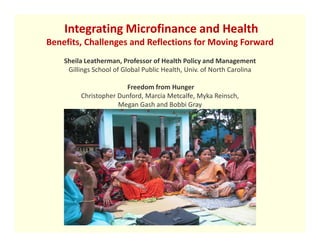
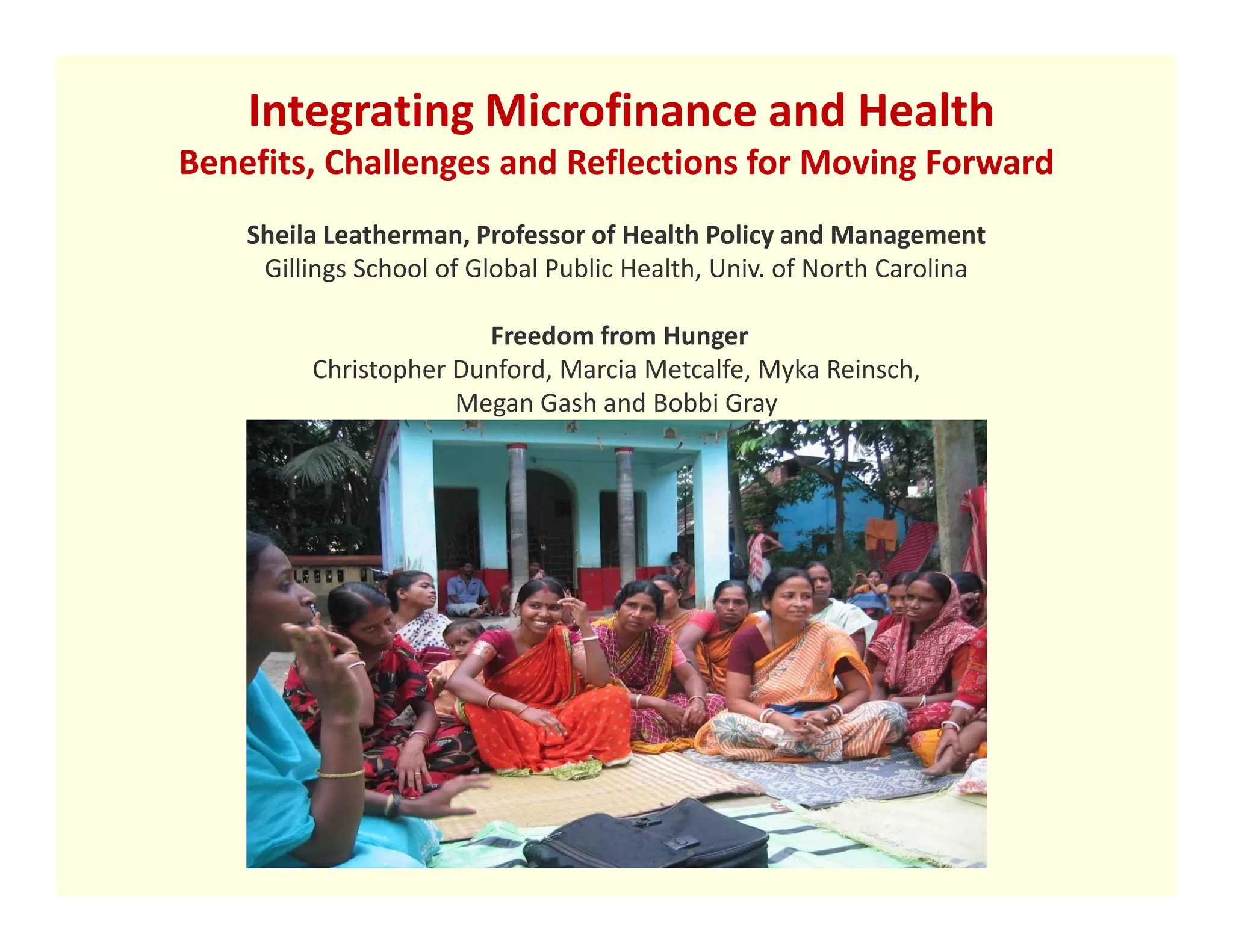
Integrating Microfinance and Health
Benefits, Challenges and Reflections for Moving Forward
    Sheila Leatherman, Professor of Health Policy and Management
     Gillings School of Global Public Health, Univ. of North Carolina

                       Freedom from Hunger
         Christopher Dunford, Marcia Metcalfe, Myka Reinsch,
                     Megan Gash and Bobbi Gray
Remarks

• Why add health programs to microfinance

• What can be done to meet basic health needs

• How; a look at the evidence for “ what works”

• Summary; how can we move forward
Why Integrate Microfinance and Health ?

 Opportunity to reach hundreds of millions globally
  3500 MFIs - 190 million clients; incl. 43 mil. very poor families


 Illness (w/cost) is barrier to progress out of poverty
       Evidence is strong and compelling

 Microfinance – is a vast distribution channel for
 proven, simple, and low cost health interventions
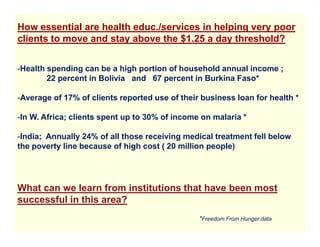
How essential are health educ./services in helping very poor
clients to move and stay above the $1.25 a day threshold?


-Health spending can be a high portion of household annual income ;
        22 percent in Bolivia and 67 percent in Burkina Faso*

-Average of 17% of clients reported use of their business loan for health *

-In W. Africa; clients spent up to 30% of income on malaria *

-India; Annually 24% of all those receiving medical treatment fell below
the poverty line because of high cost ( 20 million people)


What can we learn from institutions that have been most
successful in this area?
                                                *Freedom From Hunger data
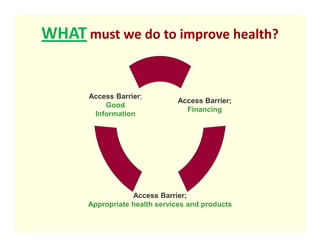
WHAT must we do to improve health?


      Access Barrier;
                              Access Barrier;
          Good
                                Financing
       Information


                  Access Barrier;
      Appropriate health services and products
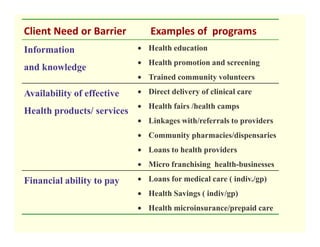
Client Need or Barrier         Examples of programs
Information                 • Health education
                            • Health promotion and screening
and knowledge
                            • Trained community volunteers

Availability of effective   • Direct delivery of clinical care
                            • Health fairs /health camps
Health products/ services
                            • Linkages with/referrals to providers
                            • Community pharmacies/dispensaries
                            • Loans to health providers
                            • Micro franchising health-businesses

Financial ability to pay    • Loans for medical care ( indiv./gp)
                            • Health Savings ( indiv/gp)
                            • Health microinsurance/prepaid care
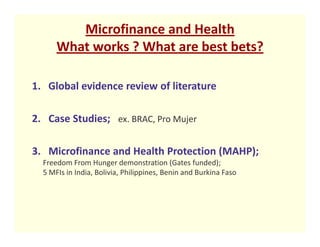
Microfinance and Health
      What works ? What are best bets?

1. Global evidence review of literature

2. Case Studies; ex. BRAC, Pro Mujer

3. Microfinance and Health Protection (MAHP);
  Freedom From Hunger demonstration (Gates funded);
  5 MFIs in India, Bolivia, Philippines, Benin and Burkina Faso
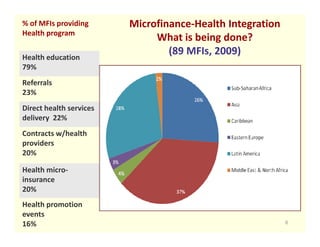
% of MFIs providing      Microfinance-Health Integration
Health program
                              What is being done?
Health education
                                 (89 MFIs, 2009)
79%
Referrals
23%
Direct health services
delivery 22%
Contracts w/health
providers
20%

Health micro-
insurance
20%
Health promotion
events
16%                                                        8
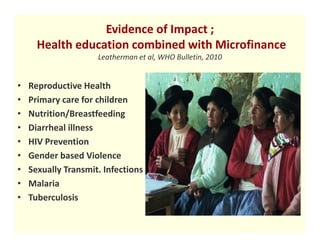
Evidence of Impact ;
      Health education combined with Microfinance
                     Leatherman et al, WHO Bulletin, 2010


•   Reproductive Health
•   Primary care for children
•   Nutrition/Breastfeeding
•   Diarrheal illness
•   HIV Prevention
•   Gender based Violence
•   Sexually Transmit. Infections
•   Malaria
•   Tuberculosis
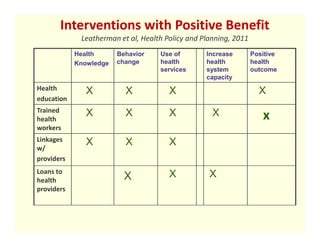
Interventions with Positive Benefit
             Leatherman et al, Health Policy and Planning, 2011
            Health      Behavior    Use of        Increase        Positive
            Knowledge   change      health        health          health
                                    services      system          outcome
                                                  capacity
Health         X          X            X                            X
education
Trained        X          X            X            X
health                                                               x
workers
Linkages       X          X            X
w/
providers
Loans to                               X           X
health                    X
providers
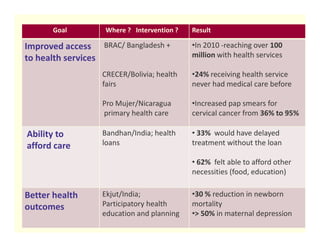
Goal        Where ? Intervention ?   Result

Improved access BRAC/ Bangladesh +         •In 2010 -reaching over 100
to health services                         million with health services

                  CRECER/Bolivia; health   •24% receiving health service
                  fairs                    never had medical care before

                  Pro Mujer/Nicaragua      •Increased pap smears for
                  primary health care      cervical cancer from 36% to 95%

Ability to        Bandhan/India; health    • 33% would have delayed
afford care       loans                    treatment without the loan

                                           • 62% felt able to afford other
                                           necessities (food, education)

Better health     Ekjut/India;             •30 % reduction in newborn
outcomes          Participatory health     mortality
                  education and planning   •> 50% in maternal depression
Integrating Microfinance and Health
               Benefits Multiple Stakeholders


• Benefits to the microfinance provider
   – Business benefits, ex. competitive advantage , retention of clients
   – Healthier and financially more stable clients
   – Achievement of social mission


• Benefits to Clients, households and communities
   – Financial protection
   – Better health access, knowledge and behaviors
   – Improved health status and productivity
Potential to contribute to health is clear
    The microfinance sector offers a unique opportunity
   to address critical health needs of the poor


          So how can we move forward?

What are the barriers and how can they be addressed?
How do we identify “ the best bets” among health programs?
What mechanisms are needed for shared learning?
How can we speed the process of adoption and scale up?
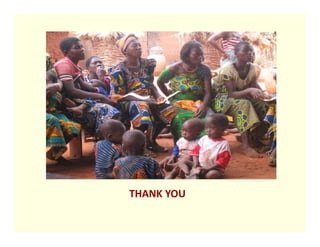
THANK YOU
The End
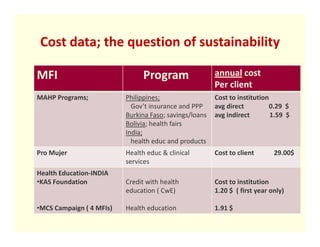
Cost data; the question of sustainability

MFI                             Program                 annual cost
                                                        Per client
MAHP Programs;            Philippines;                  Cost to institution
                            Gov’t insurance and PPP     avg direct          0.29 $
                          Burkina Faso; savings/loans   avg indirect        1.59 $
                          Bolivia; health fairs
                          India;
                            health educ and products
Pro Mujer                 Health educ & clinical        Cost to client       29.00$
                          services
Health Education-INDIA
•KAS Foundation           Credit with health            Cost to institution
                          education ( CwE)              1.20 $ ( first year only)

•MCS Campaign ( 4 MFIs)   Health education              1.91 $
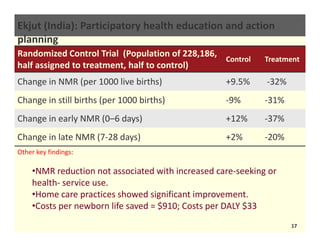
Ekjut (India): Participatory health education and action
planning
Randomized Control Trial (Population of 228,186,
                                                 Control     Treatment
half assigned to treatment, half to control)
Change in NMR (per 1000 live births)               +9.5%     -32%
Change in still births (per 1000 births)           -9%       -31%
Change in early NMR (0–6 days)                     +12%      -37%
Change in late NMR (7-28 days)                     +2%       -20%
Other key findings:

    •NMR reduction not associated with increased care-seeking or
    health- service use.
    •Home care practices showed significant improvement.
    •Costs per newborn life saved = $910; Costs per DALY $33
                                                                    17

Sheila Leatherman, Why Integrating Microfinance, Health Education, and Other Forms of Health Protection

  • 1.
    Integrating Microfinance andHealth Benefits, Challenges and Reflections for Moving Forward Sheila Leatherman, Professor of Health Policy and Management Gillings School of Global Public Health, Univ. of North Carolina Freedom from Hunger Christopher Dunford, Marcia Metcalfe, Myka Reinsch, Megan Gash and Bobbi Gray
  • 2.
    Remarks • Why addhealth programs to microfinance • What can be done to meet basic health needs • How; a look at the evidence for “ what works” • Summary; how can we move forward
  • 3.
    Why Integrate Microfinanceand Health ? Opportunity to reach hundreds of millions globally 3500 MFIs - 190 million clients; incl. 43 mil. very poor families Illness (w/cost) is barrier to progress out of poverty Evidence is strong and compelling Microfinance – is a vast distribution channel for proven, simple, and low cost health interventions
  • 4.
    How essential arehealth educ./services in helping very poor clients to move and stay above the $1.25 a day threshold? -Health spending can be a high portion of household annual income ; 22 percent in Bolivia and 67 percent in Burkina Faso* -Average of 17% of clients reported use of their business loan for health * -In W. Africa; clients spent up to 30% of income on malaria * -India; Annually 24% of all those receiving medical treatment fell below the poverty line because of high cost ( 20 million people) What can we learn from institutions that have been most successful in this area? *Freedom From Hunger data
  • 5.
    WHAT must wedo to improve health? Access Barrier; Access Barrier; Good Financing Information Access Barrier; Appropriate health services and products
  • 6.
    Client Need orBarrier Examples of programs Information • Health education • Health promotion and screening and knowledge • Trained community volunteers Availability of effective • Direct delivery of clinical care • Health fairs /health camps Health products/ services • Linkages with/referrals to providers • Community pharmacies/dispensaries • Loans to health providers • Micro franchising health-businesses Financial ability to pay • Loans for medical care ( indiv./gp) • Health Savings ( indiv/gp) • Health microinsurance/prepaid care
  • 7.
    Microfinance and Health What works ? What are best bets? 1. Global evidence review of literature 2. Case Studies; ex. BRAC, Pro Mujer 3. Microfinance and Health Protection (MAHP); Freedom From Hunger demonstration (Gates funded); 5 MFIs in India, Bolivia, Philippines, Benin and Burkina Faso
  • 8.
    % of MFIsproviding Microfinance-Health Integration Health program What is being done? Health education (89 MFIs, 2009) 79% Referrals 23% Direct health services delivery 22% Contracts w/health providers 20% Health micro- insurance 20% Health promotion events 16% 8
  • 9.
    Evidence of Impact; Health education combined with Microfinance Leatherman et al, WHO Bulletin, 2010 • Reproductive Health • Primary care for children • Nutrition/Breastfeeding • Diarrheal illness • HIV Prevention • Gender based Violence • Sexually Transmit. Infections • Malaria • Tuberculosis
  • 10.
    Interventions with PositiveBenefit Leatherman et al, Health Policy and Planning, 2011 Health Behavior Use of Increase Positive Knowledge change health health health services system outcome capacity Health X X X X education Trained X X X X health x workers Linkages X X X w/ providers Loans to X X health X providers
  • 11.
    Goal Where ? Intervention ? Result Improved access BRAC/ Bangladesh + •In 2010 -reaching over 100 to health services million with health services CRECER/Bolivia; health •24% receiving health service fairs never had medical care before Pro Mujer/Nicaragua •Increased pap smears for primary health care cervical cancer from 36% to 95% Ability to Bandhan/India; health • 33% would have delayed afford care loans treatment without the loan • 62% felt able to afford other necessities (food, education) Better health Ekjut/India; •30 % reduction in newborn outcomes Participatory health mortality education and planning •> 50% in maternal depression
  • 12.
    Integrating Microfinance andHealth Benefits Multiple Stakeholders • Benefits to the microfinance provider – Business benefits, ex. competitive advantage , retention of clients – Healthier and financially more stable clients – Achievement of social mission • Benefits to Clients, households and communities – Financial protection – Better health access, knowledge and behaviors – Improved health status and productivity
  • 13.
    Potential to contributeto health is clear The microfinance sector offers a unique opportunity to address critical health needs of the poor So how can we move forward? What are the barriers and how can they be addressed? How do we identify “ the best bets” among health programs? What mechanisms are needed for shared learning? How can we speed the process of adoption and scale up?
  • 14.
  • 15.
  • 16.
    Cost data; thequestion of sustainability MFI Program annual cost Per client MAHP Programs; Philippines; Cost to institution Gov’t insurance and PPP avg direct 0.29 $ Burkina Faso; savings/loans avg indirect 1.59 $ Bolivia; health fairs India; health educ and products Pro Mujer Health educ & clinical Cost to client 29.00$ services Health Education-INDIA •KAS Foundation Credit with health Cost to institution education ( CwE) 1.20 $ ( first year only) •MCS Campaign ( 4 MFIs) Health education 1.91 $
  • 17.
    Ekjut (India): Participatoryhealth education and action planning Randomized Control Trial (Population of 228,186, Control Treatment half assigned to treatment, half to control) Change in NMR (per 1000 live births) +9.5% -32% Change in still births (per 1000 births) -9% -31% Change in early NMR (0–6 days) +12% -37% Change in late NMR (7-28 days) +2% -20% Other key findings: •NMR reduction not associated with increased care-seeking or health- service use. •Home care practices showed significant improvement. •Costs per newborn life saved = $910; Costs per DALY $33 17