Home . net Mobile Clinic SCHDU Center S ERVICES  C ONTINUUM FOR  H ARD  D RUG  U SERS Reduction the H.I.V. spread in Ho chi Minh City by direct action  on the transmission of the virus  by injectable drug users © HOIPHUC 2008
Wellcome Presenting organisations:   Jules & Paul Emile Leger Foundation Presence in Viet Nam (1998) Acute detoxification (2000) Treatment case load management (2002) Experience with naltrexone for 4 years Desire of sharing developed expertise  Presence in Viet Nam since 2002 Outreach activities Harm reduction program Health services distribution through Mobile Clinic Strong desire to stay in HCMC Medecins du Monde Canada © HOIPHUC 2008
Why ? Contextual situation of the project Médecin du Monde Canada and Jules & Paul Leger Fundation  have developped in the last  5 years experience in  Harm reduction  program, Outreach activities, Outpatients services, Cognitive Behavioral Therapy and Naltrexone use. We think that this  experience can be positively used. Relapse prevention programs and outpatients treatment facilities actually in place in Ho Chi Minh City are not suffisant and/or  efficient enough to allow the release of incarcerated inmates after purged sentences The lack of qualified staff and absence of professionallism  kept  high risk population stigmatised when facing addiction  and H.I.V. problem Even with a harm reduction program as incarceration for hard  drug user, H.I.V. continue to spread out and serign exchange is still  a main factor of transmission Main reasons why we have conceive  this project © HOIPHUC 2008
Why ? Contextual situation of the project Long term adherence to ARV and drug free Maintenance Therapy share similar issues;  Referals between services are problematic Need for better coordination and cooperation between each organisations INTL Organisations recommandations; Main reasons why we have conceive  this project HIV prevention high on agenda  (2)  Raise access to ARV  (3)  Harm reduction programs have to recognize inviduality of each IDU and Include many alternatives to Tx IDU (1)   Long term involvement of client and staff  (2)  Failure rate © HOIPHUC 2008
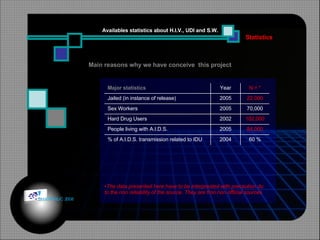
Statistics Availables statistics about H.I.V., UDI and S.W. Main reasons why we have conceive  this project The data presented here have to be interprested with precaution du  to the non reliability of the source. They are fron non official sources  Major statistics Year N = * Jailed (in instance of release)  2005 22,000 Sex Workers 2005 70,000 Hard Drug Users 2002 102,000 People living with A.I.D.S. 2005 84,000 % of A.I.D.S. transmission related to IDU 2004 60 % © HOIPHUC 2008
Objectives Main objectives of  SCHDU « To reduce the H.I.V. spread in Ho chi Minh City by acting on the transmission of the virus from hard drug users » Distribute primary health care to IDU, SW, PLWA and Spouses, through an integrated network and via the Mobile Clinic Reduce H.I.V. transmission trough an integrated network of resources and program Integrate  harm reduction program and treatment program trough a continuum of services including information  technologies, community presence, outreach,  acute detoxification, outpatient program and maintenance therapy Demonstre usufulness of integrated Tx services for a better adherence to ARV, to abstinence and, in the long term, to a lower  HIV transmission Demonstrate that, following treatment, the persons can access to dignity and live as any ajusted citizen © HOIPHUC 2008
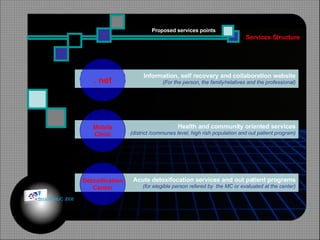
Information, self recovery and collaboration website (For the person, the family/relatives and the professional) . net Health and community oriented services (district /communes level, high rish population and out patient program) Mobile Clinic Acute detoxifocation services and out patient programs (for elegible person refered by  the MC or evaluated at the center) Detoxification Center Services Structure Proposed services points © HOIPHUC 2008
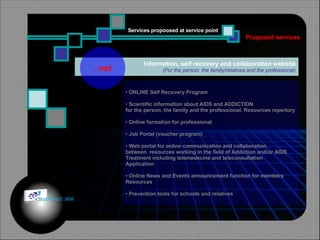
Information, self recovery and collaboration website (For the person, the family/relatives and the professional) . net ONLINE Self Recovery Program  Scientific information about AIDS and ADDICTION for the person, the family and the professional. Resources repertory  Online formation for professional Job Portal (voucher program) Web portal for online communication and collaboration between  resources working in the field of Addiction and/or AIDS Treatment including telemedecine and teleconsultation  Application Online News and Events announcement function for members Resources Prevention tools for schools and relatives Proposed services Services propoosed at service point © HOIPHUC 2008
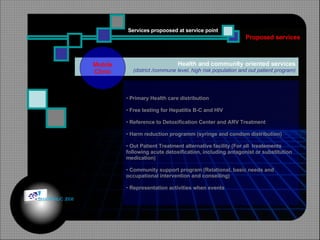
Health and community oriented services (district /commune level, high risk population and out patient program) Mobile Clinic Primary Health care distribution Free testing for Hepatitis B-C and HIV Reference to Detoxification Center and ARV Treatment Harm reduction programm (syringe and condom distribution)  Out Patient Treatment alternative facility (For all  treatements following acute detoxification, including antagonist or substitution medication) Community support program (Relational, basic needs and  occupational intervention and conseiling) Representation activities when events Proposed services Services propoosed at service point © HOIPHUC 2008
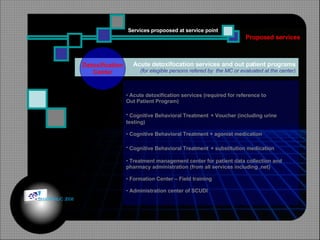
Acute detoxifocation services and out patient programs (for elegible persons refered by  the MC or evaluated at the center) Detoxification Center Acute detoxification services (required for reference to Out Patient Program) Cognitive Behavioral Treatment   + Voucher (including urine testing) Cognitive Behavioral Treatment + agonist medication Cognitive Behavioral Treatment   + substitution medication Treatment management center for patient data collection and  pharmacy administration (from all services including .net) Formation Center – Field training Administration center of SCUDI  Proposed services Services propoosed at service point © HOIPHUC 2008
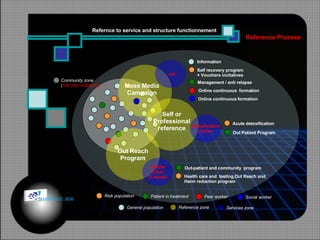
General population Risk population Patient in treatment Peer worker Social worker Reference Process Out Reach Program Self or Professional reference Mobile Clinic (5 zones) Health care and  testing,Out Reach and  Harm reduction program Out-patient and community  program Mass Media Campaign . net Information Self recovery program + Vouchers incitatives Management / anti relapse Online continuous  formation Online continuous formation Community zone ( 100,000 inhibitants) Reference zone Services zone Refernce to service and structure functionnement Detoxification Center Acute detoxification Out Patient Program © HOIPHUC 2008
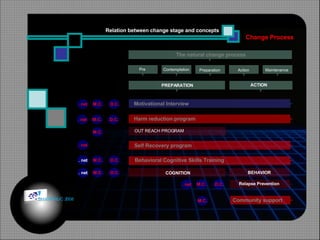
quan hệ tình cảm Change Process Relation between change stage and concepts The natural change process Contemplation Maintenance Action Preparation Pre Behavioral Cognitive Skills Training PREPARATION ACTION COGNITION BEHAVIOR Relapse Prevention Community support  . net M.C. .D.C. . net M.C. .D.C. M.C. Harm reduction program . net M.C. .D.C. OUT REACH PROGRAM M.C. Self Recovery program . net . net M.C. .D.C. Motivational Interview  M.C. .D.C. . net © HOIPHUC 2008
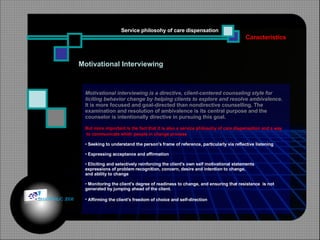
Motivational Interviewing Motivational interviewing is a directive, client-centered counseling style for  liciting behavior change by helping clients to explore and resolve ambivalence . It is more focused and goal-directed than nondirective counselling. The  examination and resolution of ambivalence is its central purpose and the  counselor is intentionally directive in pursuing this goal.  But more important is the fact that it is also a service philosohy of care dispensation and a way to communicate whith people in change process   Seeking to understand the person's frame of reference, particularly via reflective listening  Expressing acceptance and affirmation    Eliciting and selectively reinforcing the client's own self motivational statements  expressions of problem recognition, concern, desire and intention to change,  and ability to change  Monitoring the client's degree of readiness to change, and ensuring that resistance  is not  generated by jumping ahead of the client.    Affirming the client's freedom of choice and self-direction    Caracteristics Service philosohy of care dispensation © HOIPHUC 2008
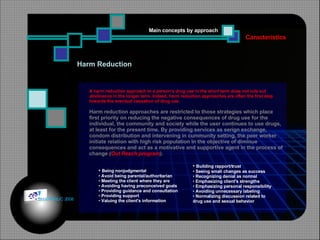
Harm Reduction   Caracteristics Main concepts by approach Being nonjudgmental  Avoid being parental/authoritarian  Meeting the client where they are  Avoiding having preconceived goals  Providing guidance and consultation  Providing support  Valuing the client's information  Building rapport/trust  Seeing small changes as success  Recognizing denial as normal  Emphasizing client's strengths  Emphasizing personal responsibility Avoiding unnecessary labeling  Normalizing discussion related to  drug use and sexual behavior  A harm reduction approach to a person's drug use in the short term does not rule out abstinence in the longer term. Indeed, harm reduction approaches are often the first step towards the eventual cessation of drug use.  Harm reduction approaches are restricted to those strategies which place first priority on reducing the negative consequences of drug use for the individual, the community and society while the user continues to use drugs, at least for the present time. By providing services as serign exchange, condom distribution and intervening in cummunity setting, the peer worker initiate relation with high risk population in the objective of diminue consequences and act as a motivative and supportive agent in the process of change  ( Out Reach program ). © HOIPHUC 2008
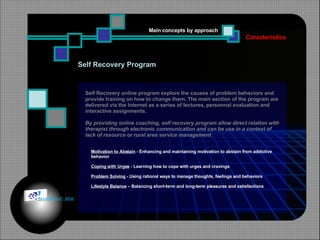
Self Recovery Program Caracteristics Main concepts by approach Self Recovery online program explore the causes of problem behaviors and provide training on how to change them. The main section of the program are delivered via the Internet as a series of lectures, personnal evaluation and interactive assignments.  By providing online coaching, self recovery program allow direct relation with therapist through electronic communication and can be use in a context of lack of resource or rural area service management  Motivation to Abstain  - Enhancing and maintaining motivation to abstain from addictive behavior Coping with Urges  - Learning how to cope with urges and cravings Problem Solving  - Using rational ways to manage thoughts, feelings and behaviors Lifestyle Balance  – Balancing short-term and long-term pleasures and satisfactions © HOIPHUC 2008
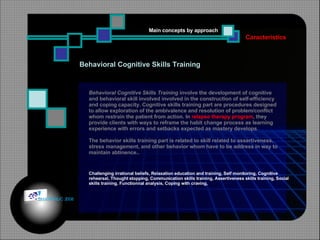
Behavioral Cognitive Skills Training Caracteristics Main concepts by approach Challenging irrational beliefs, Relaxation education and training, Self monitoring, Cognitive rehearsal, Thought stopping, Communication skills training, Assertiveness skills training, Social skills training, Functionnal analysis, Coping with craving,  Behavioral Cognitive Skills Training  involve the development of cognitive and behavioral skill involved involved in the construction of self-efficiency and coping capacity. Cognitive skills training part are procedures designed to allow exploration of the ambivalence and resolution of problem/conflict whom restrain the patient from action. In  relapse therapy program , they provide clients with ways to reframe the habit change process as learning experience with errors and setbacks expected as mastery develops .  The behavior skills training part is related to skill related to assertiveness, stress management, and other behavior whom have to be address in way to maintain abtinence..  © HOIPHUC 2008
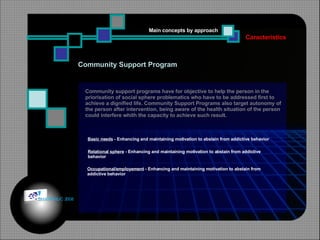
Community Support Program Caracteristics Main concepts by approach Community support programs have for objective to help the person in the priorisation of social sphere problematics who have to be addressed first to achieve a dignified life. Community Support Programs also target autonomy of the person after intervention, being aware of the health situation of the person could interfere whith the capacity to achieve such result. Basic needs  - Enhancing and maintaining motivation to abstain from addictive behavior Occupational/employement  - Enhancing and maintaining motivation to abstain from addictive behavior Relational sphere  - Enhancing and maintaining motivation to abstain from addictive behavior © HOIPHUC 2008
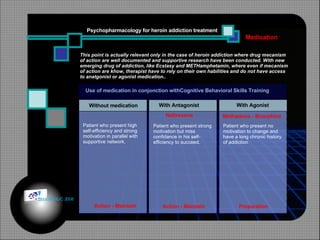
Medication Use of medication in conjonction withCognitive Behavioral Skills Training Without medication With Agonist With Antagonist Naltrexone Methadone - Bnorphine Patient who present high self-efficiency and strong motivation in parallel with supportive network. Patient who present strong motivation but miss confidance in his self-efficiency to succeed. Patient who present no motivation to change and have a long chronic history of addiction Action - Maintain Action - Maintain Preparation Psychopharmacology for heroin addiction treatment This point is actually relevant only in the case of heroin addiction where drug mecanism of action are well documented and supportive research have been conducted. With new emerging drug of addiction, like Ecstasy and METHamphetamin, where even if mecanism of action are khow, therapist have to rely on their own habilities and do not have access to anatgonist or agonist medication..  © HOIPHUC 2008
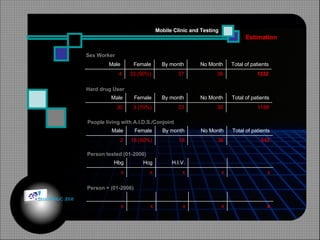
Estimation Mobile Clinic and Testing Sex Worker Hard drug User People living with A.I.D.S./Conjoint  Person tested (01-2006) Person + (01-2006) Male  Female By month No Month Total of patients 4 33 (90%) 37 36 1332 Male Female By month No Month Total of patients 30 3 (10%) 33 36 1188 Male Female By month No Month Total of patients 2 16 (90%) 18 36 648 Hbg Hcg H.I.V. x x x x x x x x x x © HOIPHUC 2008
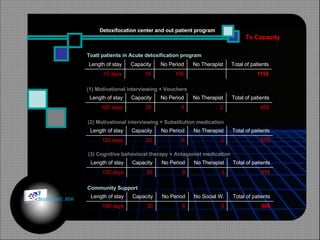
Tx Capacity Detoxifocation center and out patient program Toatl patients in Acute detoxification program (1) Motivational interviewing + Vouchers (2) Motivational interviewing + Substitution medication (3) Cognitive bahavioral therapy + Antagonist medication Community Support Length of stay Capacity No Period No Therapist Total of patients 10 days 16 106 1756 Length of stay Capacity No Period No Therapist Total of patients 120 days 25 9 2 450 Length of stay Capacity No Period No Therapist Total of patients 120 days 25 9 3 675 Length of stay Capacity No Period No Therapist Total of patients 120 days 25 9 3 675 Length of stay Capacity No Period No Social W. Total of patients 180 days 30 6 5 900 © HOIPHUC 2008
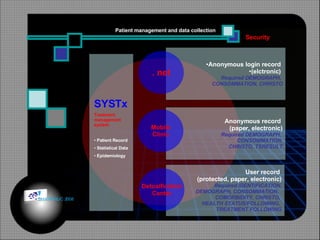
Anonymous login record  (elctronic)  Required DEMOGRAPH,  CONSOMMATION, CHRISTO . net User record  (protected, paper, electronic) Required IDENTIFICATION, DEMOGRAPH, CONSOMMATION,  COMORBIDITY, CHRISTO,  HEALTH STATUS/FOLLOWING,  TREATMENT FOLLOWING Detoxification Center Anonymous record  (paper, electronic) Required DEMOGRAPH,  CONSOMMATION, CHRISTO, TSRESULT Mobile Clinic SYSTx Treatment management system Patient Record Statistical Data Epidemiology Security Patient management and data collection © HOIPHUC 2008
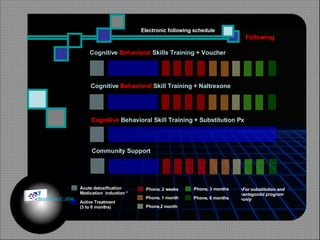
Cognitive  Behavioral  Skills Training + Voucher Cognitive  Behavioral  Skill Training + Naltrexone Cognitive  Behavioral Skill Training   + Substitution Px Community Support Phone, 3 months Phone, 1 month Phone,2 month Phone, 6 months Active Treatment (3 to 6 months) Acute detoxification Medication  induction * Phone, 2 weeks For substitution and  antagonist program  only Following Electronic following schedule © HOIPHUC 2008
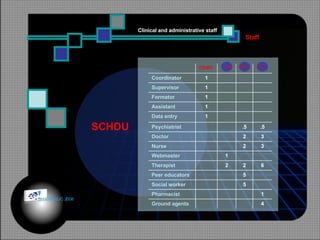
SCHDU Staff Clinical and administrative staff M.C. D.C. . net CSUDI Coordinator 1 Supervisor 1 Formator 1 Assistant 1 Data entry 1 Psychiatrist .5 .5 Doctor 2 3 Nurse 2 3 Webmaster 1 Therapist 2 2 6 Peer educators 5 Social worker 5 Pharmacist 1 Ground agents 4 © HOIPHUC 2008
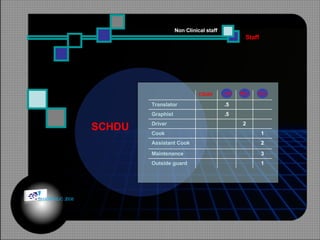
SCHDU Staff Non Clinical staff M.C. .D.C. . net CSUDI Translator .5 Graphist .5 Driver 2 Cook 1 Assistant Cook 2 Maintenance 3 Outside guard 1 © HOIPHUC 2008
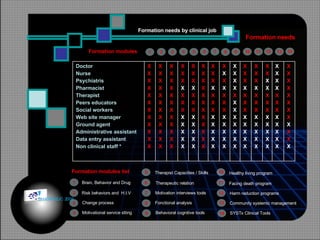
Formation needs Formation needs by clinical job 1 2 3 4 5 6 7 8 9 10 11 12 13 14 1 2 3 4 5 6 7 8 9 10 11 12 13 14 Brain, Behavior and Drug Risk behaviors and  H.I.V Change process Motivational service stting Therapist Capacities / Skills Therapeutic relation Motivation interviews tools Fonctional analysis Behavioral cognitive tools Healthy living program Facing death program Harm reduction programs Community systemic management SYSTx Clinical Tools Formation modules list Formation modules Doctor Nurse Psychiatris Pharmacist Therapist Peers educators Social workers Web site manager Ground agent Administrative assistant Data entry assistant Non clinical staff * X X X X X X X X X X X X X X X X X X X X X X X X X X X X X X X X X X X X X X X X X X X X X X X X X X X X X X X X X X X X X X X X X X X X X X X X X X X X X X X X X X X X X X X X X X X X X X X X X X X X X X X X X X X X X X X X X X X X X X X X X X X X X X X X X X X X X X X X X X X X X X X X X X X X X X X X X X X X X X X X X X X X X X X X © HOIPHUC 2008
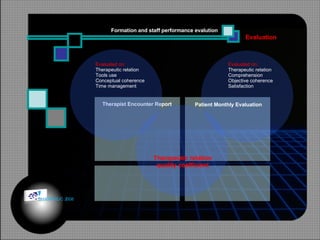
Evaluation Formation and staff performance evalution Therapist Encounter Report Patient Monthly Evaluation Therapeutic relation quality coefficient Evaluated on: Therapeutic relation Tools use Conceptual coherence Time management Evaluated on: Therapeutic relation Comprehension Objective coherence Satisfaction © HOIPHUC 2008
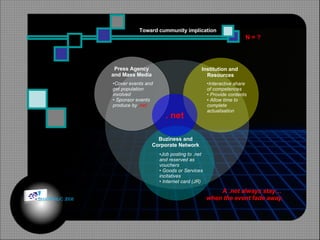
Toward cummunity implication . net Institution and  Resources Press Agency and Mass Media Buziness and Corporate Network Job posting to .net  and reserved as vouchers Goods or Services incitatives Internet card (JR) Interactive share of competences Provide contents Allow time to complete actualisation Cover events and get population involved Sponsor events produce by  .net A .net always stay…  when the event fade away . N = ? © HOIPHUC 2008
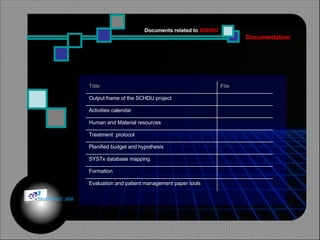
Documentation Documents related to  SCHDU   Title File Output frame of the SCHDU project Activities calendar Human and Material resources Treatment  protocol Planified budget and hypothesis SYSTx database mapping Formation Evaluation and patient management paper tools © HOIPHUC 2008
Thank you Presented by:   Alain Bergeron, Bps. Jules & Paul Emile Leger Fundation Volunteer advisor, Projet Santé Viêtnam [email_address] Marc Paquette, Dr. Medecins du Monde Canada Project Coordinator [email_address] © HOIPHUC 2008
Start a little buziness , (National & International program) Start a little buziness is size for international donator who desire to live a online experience of  living in a development contry. By contribuing $US 200, the personis paired with an ex-toxicomane and he have they have to start a little buziness for allow him to live in dignity. Onlive interactive analysis of opportunities (buy-sale,  service shop, every ideas have to be discuss. Learning  opportunities for both and unique experience. Future SCHDU , Continuous idea © HOIPHUC 2008

CSHDU Hoiphuc

  • 1.
    Home . netMobile Clinic SCHDU Center S ERVICES C ONTINUUM FOR H ARD D RUG U SERS Reduction the H.I.V. spread in Ho chi Minh City by direct action on the transmission of the virus by injectable drug users © HOIPHUC 2008
  • 2.
    Wellcome Presenting organisations:  Jules & Paul Emile Leger Foundation Presence in Viet Nam (1998) Acute detoxification (2000) Treatment case load management (2002) Experience with naltrexone for 4 years Desire of sharing developed expertise Presence in Viet Nam since 2002 Outreach activities Harm reduction program Health services distribution through Mobile Clinic Strong desire to stay in HCMC Medecins du Monde Canada © HOIPHUC 2008
  • 3.
    Why ? Contextualsituation of the project Médecin du Monde Canada and Jules & Paul Leger Fundation have developped in the last 5 years experience in Harm reduction program, Outreach activities, Outpatients services, Cognitive Behavioral Therapy and Naltrexone use. We think that this experience can be positively used. Relapse prevention programs and outpatients treatment facilities actually in place in Ho Chi Minh City are not suffisant and/or efficient enough to allow the release of incarcerated inmates after purged sentences The lack of qualified staff and absence of professionallism kept high risk population stigmatised when facing addiction and H.I.V. problem Even with a harm reduction program as incarceration for hard drug user, H.I.V. continue to spread out and serign exchange is still a main factor of transmission Main reasons why we have conceive this project © HOIPHUC 2008
  • 4.
    Why ? Contextualsituation of the project Long term adherence to ARV and drug free Maintenance Therapy share similar issues; Referals between services are problematic Need for better coordination and cooperation between each organisations INTL Organisations recommandations; Main reasons why we have conceive this project HIV prevention high on agenda (2) Raise access to ARV (3) Harm reduction programs have to recognize inviduality of each IDU and Include many alternatives to Tx IDU (1) Long term involvement of client and staff (2) Failure rate © HOIPHUC 2008
  • 5.
    Statistics Availables statisticsabout H.I.V., UDI and S.W. Main reasons why we have conceive this project The data presented here have to be interprested with precaution du to the non reliability of the source. They are fron non official sources Major statistics Year N = * Jailed (in instance of release) 2005 22,000 Sex Workers 2005 70,000 Hard Drug Users 2002 102,000 People living with A.I.D.S. 2005 84,000 % of A.I.D.S. transmission related to IDU 2004 60 % © HOIPHUC 2008
  • 6.
    Objectives Main objectivesof SCHDU « To reduce the H.I.V. spread in Ho chi Minh City by acting on the transmission of the virus from hard drug users » Distribute primary health care to IDU, SW, PLWA and Spouses, through an integrated network and via the Mobile Clinic Reduce H.I.V. transmission trough an integrated network of resources and program Integrate harm reduction program and treatment program trough a continuum of services including information technologies, community presence, outreach, acute detoxification, outpatient program and maintenance therapy Demonstre usufulness of integrated Tx services for a better adherence to ARV, to abstinence and, in the long term, to a lower HIV transmission Demonstrate that, following treatment, the persons can access to dignity and live as any ajusted citizen © HOIPHUC 2008
  • 7.
    Information, self recoveryand collaboration website (For the person, the family/relatives and the professional) . net Health and community oriented services (district /communes level, high rish population and out patient program) Mobile Clinic Acute detoxifocation services and out patient programs (for elegible person refered by the MC or evaluated at the center) Detoxification Center Services Structure Proposed services points © HOIPHUC 2008
  • 8.
    Information, self recoveryand collaboration website (For the person, the family/relatives and the professional) . net ONLINE Self Recovery Program Scientific information about AIDS and ADDICTION for the person, the family and the professional. Resources repertory Online formation for professional Job Portal (voucher program) Web portal for online communication and collaboration between resources working in the field of Addiction and/or AIDS Treatment including telemedecine and teleconsultation Application Online News and Events announcement function for members Resources Prevention tools for schools and relatives Proposed services Services propoosed at service point © HOIPHUC 2008
  • 9.
    Health and communityoriented services (district /commune level, high risk population and out patient program) Mobile Clinic Primary Health care distribution Free testing for Hepatitis B-C and HIV Reference to Detoxification Center and ARV Treatment Harm reduction programm (syringe and condom distribution) Out Patient Treatment alternative facility (For all treatements following acute detoxification, including antagonist or substitution medication) Community support program (Relational, basic needs and occupational intervention and conseiling) Representation activities when events Proposed services Services propoosed at service point © HOIPHUC 2008
  • 10.
    Acute detoxifocation servicesand out patient programs (for elegible persons refered by the MC or evaluated at the center) Detoxification Center Acute detoxification services (required for reference to Out Patient Program) Cognitive Behavioral Treatment + Voucher (including urine testing) Cognitive Behavioral Treatment + agonist medication Cognitive Behavioral Treatment + substitution medication Treatment management center for patient data collection and pharmacy administration (from all services including .net) Formation Center – Field training Administration center of SCUDI Proposed services Services propoosed at service point © HOIPHUC 2008
  • 11.
    General population Riskpopulation Patient in treatment Peer worker Social worker Reference Process Out Reach Program Self or Professional reference Mobile Clinic (5 zones) Health care and testing,Out Reach and Harm reduction program Out-patient and community program Mass Media Campaign . net Information Self recovery program + Vouchers incitatives Management / anti relapse Online continuous formation Online continuous formation Community zone ( 100,000 inhibitants) Reference zone Services zone Refernce to service and structure functionnement Detoxification Center Acute detoxification Out Patient Program © HOIPHUC 2008
  • 12.
    quan hệ tìnhcảm Change Process Relation between change stage and concepts The natural change process Contemplation Maintenance Action Preparation Pre Behavioral Cognitive Skills Training PREPARATION ACTION COGNITION BEHAVIOR Relapse Prevention Community support . net M.C. .D.C. . net M.C. .D.C. M.C. Harm reduction program . net M.C. .D.C. OUT REACH PROGRAM M.C. Self Recovery program . net . net M.C. .D.C. Motivational Interview M.C. .D.C. . net © HOIPHUC 2008
  • 13.
    Motivational Interviewing Motivationalinterviewing is a directive, client-centered counseling style for liciting behavior change by helping clients to explore and resolve ambivalence . It is more focused and goal-directed than nondirective counselling. The examination and resolution of ambivalence is its central purpose and the counselor is intentionally directive in pursuing this goal.  But more important is the fact that it is also a service philosohy of care dispensation and a way to communicate whith people in change process Seeking to understand the person's frame of reference, particularly via reflective listening  Expressing acceptance and affirmation   Eliciting and selectively reinforcing the client's own self motivational statements expressions of problem recognition, concern, desire and intention to change, and ability to change  Monitoring the client's degree of readiness to change, and ensuring that resistance is not generated by jumping ahead of the client.   Affirming the client's freedom of choice and self-direction   Caracteristics Service philosohy of care dispensation © HOIPHUC 2008
  • 14.
    Harm Reduction  Caracteristics Main concepts by approach Being nonjudgmental Avoid being parental/authoritarian Meeting the client where they are Avoiding having preconceived goals Providing guidance and consultation Providing support Valuing the client's information Building rapport/trust Seeing small changes as success Recognizing denial as normal Emphasizing client's strengths Emphasizing personal responsibility Avoiding unnecessary labeling Normalizing discussion related to drug use and sexual behavior A harm reduction approach to a person's drug use in the short term does not rule out abstinence in the longer term. Indeed, harm reduction approaches are often the first step towards the eventual cessation of drug use. Harm reduction approaches are restricted to those strategies which place first priority on reducing the negative consequences of drug use for the individual, the community and society while the user continues to use drugs, at least for the present time. By providing services as serign exchange, condom distribution and intervening in cummunity setting, the peer worker initiate relation with high risk population in the objective of diminue consequences and act as a motivative and supportive agent in the process of change ( Out Reach program ). © HOIPHUC 2008
  • 15.
    Self Recovery ProgramCaracteristics Main concepts by approach Self Recovery online program explore the causes of problem behaviors and provide training on how to change them. The main section of the program are delivered via the Internet as a series of lectures, personnal evaluation and interactive assignments. By providing online coaching, self recovery program allow direct relation with therapist through electronic communication and can be use in a context of lack of resource or rural area service management Motivation to Abstain - Enhancing and maintaining motivation to abstain from addictive behavior Coping with Urges - Learning how to cope with urges and cravings Problem Solving - Using rational ways to manage thoughts, feelings and behaviors Lifestyle Balance – Balancing short-term and long-term pleasures and satisfactions © HOIPHUC 2008
  • 16.
    Behavioral Cognitive SkillsTraining Caracteristics Main concepts by approach Challenging irrational beliefs, Relaxation education and training, Self monitoring, Cognitive rehearsal, Thought stopping, Communication skills training, Assertiveness skills training, Social skills training, Functionnal analysis, Coping with craving, Behavioral Cognitive Skills Training involve the development of cognitive and behavioral skill involved involved in the construction of self-efficiency and coping capacity. Cognitive skills training part are procedures designed to allow exploration of the ambivalence and resolution of problem/conflict whom restrain the patient from action. In relapse therapy program , they provide clients with ways to reframe the habit change process as learning experience with errors and setbacks expected as mastery develops . The behavior skills training part is related to skill related to assertiveness, stress management, and other behavior whom have to be address in way to maintain abtinence.. © HOIPHUC 2008
  • 17.
    Community Support ProgramCaracteristics Main concepts by approach Community support programs have for objective to help the person in the priorisation of social sphere problematics who have to be addressed first to achieve a dignified life. Community Support Programs also target autonomy of the person after intervention, being aware of the health situation of the person could interfere whith the capacity to achieve such result. Basic needs - Enhancing and maintaining motivation to abstain from addictive behavior Occupational/employement - Enhancing and maintaining motivation to abstain from addictive behavior Relational sphere - Enhancing and maintaining motivation to abstain from addictive behavior © HOIPHUC 2008
  • 18.
    Medication Use ofmedication in conjonction withCognitive Behavioral Skills Training Without medication With Agonist With Antagonist Naltrexone Methadone - Bnorphine Patient who present high self-efficiency and strong motivation in parallel with supportive network. Patient who present strong motivation but miss confidance in his self-efficiency to succeed. Patient who present no motivation to change and have a long chronic history of addiction Action - Maintain Action - Maintain Preparation Psychopharmacology for heroin addiction treatment This point is actually relevant only in the case of heroin addiction where drug mecanism of action are well documented and supportive research have been conducted. With new emerging drug of addiction, like Ecstasy and METHamphetamin, where even if mecanism of action are khow, therapist have to rely on their own habilities and do not have access to anatgonist or agonist medication.. © HOIPHUC 2008
  • 19.
    Estimation Mobile Clinicand Testing Sex Worker Hard drug User People living with A.I.D.S./Conjoint Person tested (01-2006) Person + (01-2006) Male Female By month No Month Total of patients 4 33 (90%) 37 36 1332 Male Female By month No Month Total of patients 30 3 (10%) 33 36 1188 Male Female By month No Month Total of patients 2 16 (90%) 18 36 648 Hbg Hcg H.I.V. x x x x x x x x x x © HOIPHUC 2008
  • 20.
    Tx Capacity Detoxifocationcenter and out patient program Toatl patients in Acute detoxification program (1) Motivational interviewing + Vouchers (2) Motivational interviewing + Substitution medication (3) Cognitive bahavioral therapy + Antagonist medication Community Support Length of stay Capacity No Period No Therapist Total of patients 10 days 16 106 1756 Length of stay Capacity No Period No Therapist Total of patients 120 days 25 9 2 450 Length of stay Capacity No Period No Therapist Total of patients 120 days 25 9 3 675 Length of stay Capacity No Period No Therapist Total of patients 120 days 25 9 3 675 Length of stay Capacity No Period No Social W. Total of patients 180 days 30 6 5 900 © HOIPHUC 2008
  • 21.
    Anonymous login record (elctronic) Required DEMOGRAPH, CONSOMMATION, CHRISTO . net User record (protected, paper, electronic) Required IDENTIFICATION, DEMOGRAPH, CONSOMMATION, COMORBIDITY, CHRISTO, HEALTH STATUS/FOLLOWING, TREATMENT FOLLOWING Detoxification Center Anonymous record (paper, electronic) Required DEMOGRAPH, CONSOMMATION, CHRISTO, TSRESULT Mobile Clinic SYSTx Treatment management system Patient Record Statistical Data Epidemiology Security Patient management and data collection © HOIPHUC 2008
  • 22.
    Cognitive Behavioral Skills Training + Voucher Cognitive Behavioral Skill Training + Naltrexone Cognitive Behavioral Skill Training + Substitution Px Community Support Phone, 3 months Phone, 1 month Phone,2 month Phone, 6 months Active Treatment (3 to 6 months) Acute detoxification Medication induction * Phone, 2 weeks For substitution and antagonist program only Following Electronic following schedule © HOIPHUC 2008
  • 23.
    SCHDU Staff Clinicaland administrative staff M.C. D.C. . net CSUDI Coordinator 1 Supervisor 1 Formator 1 Assistant 1 Data entry 1 Psychiatrist .5 .5 Doctor 2 3 Nurse 2 3 Webmaster 1 Therapist 2 2 6 Peer educators 5 Social worker 5 Pharmacist 1 Ground agents 4 © HOIPHUC 2008
  • 24.
    SCHDU Staff NonClinical staff M.C. .D.C. . net CSUDI Translator .5 Graphist .5 Driver 2 Cook 1 Assistant Cook 2 Maintenance 3 Outside guard 1 © HOIPHUC 2008
  • 25.
    Formation needs Formationneeds by clinical job 1 2 3 4 5 6 7 8 9 10 11 12 13 14 1 2 3 4 5 6 7 8 9 10 11 12 13 14 Brain, Behavior and Drug Risk behaviors and H.I.V Change process Motivational service stting Therapist Capacities / Skills Therapeutic relation Motivation interviews tools Fonctional analysis Behavioral cognitive tools Healthy living program Facing death program Harm reduction programs Community systemic management SYSTx Clinical Tools Formation modules list Formation modules Doctor Nurse Psychiatris Pharmacist Therapist Peers educators Social workers Web site manager Ground agent Administrative assistant Data entry assistant Non clinical staff * X X X X X X X X X X X X X X X X X X X X X X X X X X X X X X X X X X X X X X X X X X X X X X X X X X X X X X X X X X X X X X X X X X X X X X X X X X X X X X X X X X X X X X X X X X X X X X X X X X X X X X X X X X X X X X X X X X X X X X X X X X X X X X X X X X X X X X X X X X X X X X X X X X X X X X X X X X X X X X X X X X X X X X X X © HOIPHUC 2008
  • 26.
    Evaluation Formation andstaff performance evalution Therapist Encounter Report Patient Monthly Evaluation Therapeutic relation quality coefficient Evaluated on: Therapeutic relation Tools use Conceptual coherence Time management Evaluated on: Therapeutic relation Comprehension Objective coherence Satisfaction © HOIPHUC 2008
  • 27.
    Toward cummunity implication. net Institution and Resources Press Agency and Mass Media Buziness and Corporate Network Job posting to .net and reserved as vouchers Goods or Services incitatives Internet card (JR) Interactive share of competences Provide contents Allow time to complete actualisation Cover events and get population involved Sponsor events produce by .net A .net always stay… when the event fade away . N = ? © HOIPHUC 2008
  • 28.
    Documentation Documents relatedto SCHDU   Title File Output frame of the SCHDU project Activities calendar Human and Material resources Treatment protocol Planified budget and hypothesis SYSTx database mapping Formation Evaluation and patient management paper tools © HOIPHUC 2008
  • 29.
    Thank you Presentedby:   Alain Bergeron, Bps. Jules & Paul Emile Leger Fundation Volunteer advisor, Projet Santé Viêtnam [email_address] Marc Paquette, Dr. Medecins du Monde Canada Project Coordinator [email_address] © HOIPHUC 2008
  • 30.
    Start a littlebuziness , (National & International program) Start a little buziness is size for international donator who desire to live a online experience of living in a development contry. By contribuing $US 200, the personis paired with an ex-toxicomane and he have they have to start a little buziness for allow him to live in dignity. Onlive interactive analysis of opportunities (buy-sale, service shop, every ideas have to be discuss. Learning opportunities for both and unique experience. Future SCHDU , Continuous idea © HOIPHUC 2008

Editor's Notes

  • #2 Mais une philosophie, approche rogérienne à un établissement. Touchent tous les membres de l’établissement