College to Career Transition
Sharon Hanna
Director, Career Development
International Development, Community and Environment, (IDCE)
Clark University, Worcester, MA
Where are the jobs?
 Bureau of Labor Statistics defines “green jobs” as:
those that produce goods or provide services that
benefit the environment or use fewer natural
resources.
 Sustainability jobs span all types of organizations
in the for-profit, non-profit sectors and
government with many pathways to improve
quality of life, economy and eco-systems.
Just to name a few…
 Biomass Plant Designer, Manager, Technician…
 Heating and Air Conditioning/ Building Automation
Technician Controls Specialist
 Refuse & Recycling Worker
 Sustainable Agriculture: farmer, distributor, marketer…
 Risk Property Assessor
 Building Codes Inspector
 City/Community/Operations Manager
 Energy Storage Specialists (e.g. Smart grid, hydrogen,
batteries, and compressed air)
 Water Reservoir and Watershed Engineer/Technician
 Green Building Designers, Distributor, Installer …
 Energy Statistician
 Recycling Director
 Energy Efficiency and Renewable Energy Products
 • Energy/Sustainability Policy Analysts and Advocacy
Specialists
 • Non-Profit Sustainability Related Educator/Program
Manager
 Greenhouse Gas Analyst/Broker
 Brownfields Real Estate Developer
 Environmental Economist
 Socially Responsible Investment Advisor
 Sustainability Related Social Media Specialist
 Sustainable Neighborhoods Community Organizer
 Permaculture Designer/Contractor or Sustainable
Landscape Architect
 • Climate Change Risk Assessor and Mitigation Expert
 • Sustainable Transportation Planner
 • Federal, state and Local Energy and Other Sustainability
Related Staff (e.g. economic development, workforce
development)
 • Corporate Social Responsibility Staff
 • Corporate Sustainability Staff
 • Energy Manager
 • Facilities Director/Maintenance Staff
Clark University, Career Development
prepares students to:
 Assess transferable skills and be able to communicate them effectively to
potential employers.
 Prepare a response to: “Why do you want to work in this field?” “…For this
organization?”
 Articulate impact of professional and academic background, interests and
abilities.
 Perform informational interviews with people doing the work, learn from
them and build your professional network. Instill that networking
relationships are reciprocal.
 Establish a vision of career trajectory, and communicate strengths effectively.
Preparation
 Orientation includes required session: Career Development Overview
 While one foot is in, the other is out the door
 Establish a plan, take ownership
 Be Flexible and think broadly
 No, it’s not too early
 Apply research skills to the job search
 Tap into hidden job market; get comfortable, being uncomfortable
 Speak with alumni, professionals in your field
 Be interested, take notes, show gratitude
 Help people…… help you
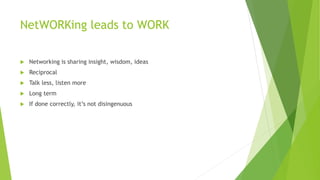
NetWORKing leads to WORK
 Networking is sharing insight, wisdom, ideas
 Reciprocal
 Talk less, listen more
 Long term
 If done correctly, it’s not disingenuous
Practice the pitch
 Identify skills pertaining to positions
 Articulate outcomes/achievements
 Become comfortable speaking about what you want to do and why
 PAR’s Model (S.Hanna, 2010)
 PROJECT: specific tasks, responsibilities, expectations
 ACTION: approach, methodology, application, analysis, problem solving
 RESULTS: outcome, impact, value added, recommendations
Think about it differently,
It’s not about you…..
 It’s about the organization: their goals/needs and what
you can do for them
 Reframe approach: Consider yourself a problem-solver,
not a job seeker
 Present professional, accomplished image vs. new grad
 Anticipate need and provide solutions
Core competencies for effective delivery
 Delivery-related: interpret, take initiative, seek best
practice, work with a team, resolve conflict
 Strategic: awareness of impact, understand goals,
provide/receive constructive feedback, think critically
 Interpersonal: client/consumer focus, anticipate needs,
negotiate, influence
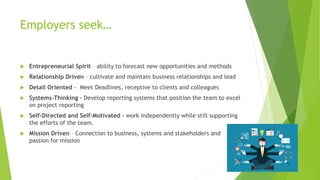
Employers seek…
 Entrepreneurial Spirit – ability to forecast new opportunities and methods
 Relationship Driven – cultivate and maintain business relationships and lead
 Detail Oriented - Meet Deadlines, receptive to clients and colleagues
 Systems-Thinking – Develop reporting systems that position the team to excel
on project reporting
 Self-Directed and Self-Motivated - work independently while still supporting
the efforts of the team.
 Mission Driven – Connection to business, systems and stakeholders and
passion for mission
Clark University
Environmental Science and Policy
 Creative, critical thinking and problem solving – framing and understanding issues in
diverse ways; crafting creative, strategic responses to complex problems by factoring
in a rich set of criteria, informed by sustainability principles.
 Scientific/technical literacy –command of technical and scientific languages and
theory to describe problems/issues, draw from natural sciences, engineering, social
sciences and humanities.
 Integrative analysis/synthesis - ability to use systems modeling to understand dynamic
human-environment systems, explore policy implications, and integrate across
sectors/topics/issues.
 Critical policy perspective –well-developed understanding of policy implications and
relevance of scientific knowledge, social, economic and cultural contexts of policy,
and the politics/power dynamics that influence public policy.
Clark University
Environmental Science and Policy
 Quantitative, qualitative and narrative research and data analysis skills - command of
mixed-methods approaches consistent with our integrative signature.
 GIS and Information & Communication Technologies –working knowledge of GIS, core
competency with Excel®, SPSS® other stats software, and databases.
 Practical Field and/or Lab Experience –working knowledge to design environmental
field studies -- sampling techniques and field measurement.
 Knowledge of Partnership Approaches –working knowledge to collaborate with multiple
stakeholders – stakeholder engagement and dialogue, conflict mediation.
 Communication Competency - writing skills, oral skills (incl. presentations and running
meetings)
 Motivation, Initiative, Resilience & Drive –nurture and develop, research projects and
mentoring/advising.
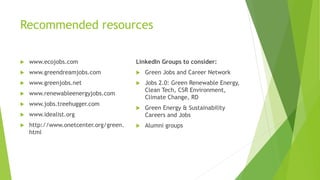
Recommended resources
 www.ecojobs.com
 www.greendreamjobs.com
 www.greenjobs.net
 www.renewableenergyjobs.com
 www.jobs.treehugger.com
 www.idealist.org
 http://www.onetcenter.org/green.
html
LinkedIn Groups to consider:
 Green Jobs and Career Network
 Jobs 2.0: Green Renewable Energy,
Clean Tech, CSR Environment,
Climate Change, RD
 Green Energy & Sustainability
Careers and Jobs
 Alumni groups

sharonhanna

  • 1.
    College to CareerTransition Sharon Hanna Director, Career Development International Development, Community and Environment, (IDCE) Clark University, Worcester, MA
  • 2.
    Where are thejobs?  Bureau of Labor Statistics defines “green jobs” as: those that produce goods or provide services that benefit the environment or use fewer natural resources.  Sustainability jobs span all types of organizations in the for-profit, non-profit sectors and government with many pathways to improve quality of life, economy and eco-systems.
  • 3.
    Just to namea few…  Biomass Plant Designer, Manager, Technician…  Heating and Air Conditioning/ Building Automation Technician Controls Specialist  Refuse & Recycling Worker  Sustainable Agriculture: farmer, distributor, marketer…  Risk Property Assessor  Building Codes Inspector  City/Community/Operations Manager  Energy Storage Specialists (e.g. Smart grid, hydrogen, batteries, and compressed air)  Water Reservoir and Watershed Engineer/Technician  Green Building Designers, Distributor, Installer …  Energy Statistician  Recycling Director  Energy Efficiency and Renewable Energy Products  • Energy/Sustainability Policy Analysts and Advocacy Specialists  • Non-Profit Sustainability Related Educator/Program Manager  Greenhouse Gas Analyst/Broker  Brownfields Real Estate Developer  Environmental Economist  Socially Responsible Investment Advisor  Sustainability Related Social Media Specialist  Sustainable Neighborhoods Community Organizer  Permaculture Designer/Contractor or Sustainable Landscape Architect  • Climate Change Risk Assessor and Mitigation Expert  • Sustainable Transportation Planner  • Federal, state and Local Energy and Other Sustainability Related Staff (e.g. economic development, workforce development)  • Corporate Social Responsibility Staff  • Corporate Sustainability Staff  • Energy Manager  • Facilities Director/Maintenance Staff
  • 4.
    Clark University, CareerDevelopment prepares students to:  Assess transferable skills and be able to communicate them effectively to potential employers.  Prepare a response to: “Why do you want to work in this field?” “…For this organization?”  Articulate impact of professional and academic background, interests and abilities.  Perform informational interviews with people doing the work, learn from them and build your professional network. Instill that networking relationships are reciprocal.  Establish a vision of career trajectory, and communicate strengths effectively.
  • 5.
    Preparation  Orientation includesrequired session: Career Development Overview  While one foot is in, the other is out the door  Establish a plan, take ownership  Be Flexible and think broadly  No, it’s not too early  Apply research skills to the job search  Tap into hidden job market; get comfortable, being uncomfortable  Speak with alumni, professionals in your field  Be interested, take notes, show gratitude  Help people…… help you
  • 6.
    NetWORKing leads toWORK  Networking is sharing insight, wisdom, ideas  Reciprocal  Talk less, listen more  Long term  If done correctly, it’s not disingenuous
  • 7.
    Practice the pitch Identify skills pertaining to positions  Articulate outcomes/achievements  Become comfortable speaking about what you want to do and why  PAR’s Model (S.Hanna, 2010)  PROJECT: specific tasks, responsibilities, expectations  ACTION: approach, methodology, application, analysis, problem solving  RESULTS: outcome, impact, value added, recommendations
  • 8.
    Think about itdifferently, It’s not about you…..  It’s about the organization: their goals/needs and what you can do for them  Reframe approach: Consider yourself a problem-solver, not a job seeker  Present professional, accomplished image vs. new grad  Anticipate need and provide solutions
  • 9.
    Core competencies foreffective delivery  Delivery-related: interpret, take initiative, seek best practice, work with a team, resolve conflict  Strategic: awareness of impact, understand goals, provide/receive constructive feedback, think critically  Interpersonal: client/consumer focus, anticipate needs, negotiate, influence
  • 10.
    Employers seek…  EntrepreneurialSpirit – ability to forecast new opportunities and methods  Relationship Driven – cultivate and maintain business relationships and lead  Detail Oriented - Meet Deadlines, receptive to clients and colleagues  Systems-Thinking – Develop reporting systems that position the team to excel on project reporting  Self-Directed and Self-Motivated - work independently while still supporting the efforts of the team.  Mission Driven – Connection to business, systems and stakeholders and passion for mission
  • 11.
    Clark University Environmental Scienceand Policy  Creative, critical thinking and problem solving – framing and understanding issues in diverse ways; crafting creative, strategic responses to complex problems by factoring in a rich set of criteria, informed by sustainability principles.  Scientific/technical literacy –command of technical and scientific languages and theory to describe problems/issues, draw from natural sciences, engineering, social sciences and humanities.  Integrative analysis/synthesis - ability to use systems modeling to understand dynamic human-environment systems, explore policy implications, and integrate across sectors/topics/issues.  Critical policy perspective –well-developed understanding of policy implications and relevance of scientific knowledge, social, economic and cultural contexts of policy, and the politics/power dynamics that influence public policy.
  • 12.
    Clark University Environmental Scienceand Policy  Quantitative, qualitative and narrative research and data analysis skills - command of mixed-methods approaches consistent with our integrative signature.  GIS and Information & Communication Technologies –working knowledge of GIS, core competency with Excel®, SPSS® other stats software, and databases.  Practical Field and/or Lab Experience –working knowledge to design environmental field studies -- sampling techniques and field measurement.  Knowledge of Partnership Approaches –working knowledge to collaborate with multiple stakeholders – stakeholder engagement and dialogue, conflict mediation.  Communication Competency - writing skills, oral skills (incl. presentations and running meetings)  Motivation, Initiative, Resilience & Drive –nurture and develop, research projects and mentoring/advising.
  • 13.
    Recommended resources  www.ecojobs.com www.greendreamjobs.com  www.greenjobs.net  www.renewableenergyjobs.com  www.jobs.treehugger.com  www.idealist.org  http://www.onetcenter.org/green. html LinkedIn Groups to consider:  Green Jobs and Career Network  Jobs 2.0: Green Renewable Energy, Clean Tech, CSR Environment, Climate Change, RD  Green Energy & Sustainability Careers and Jobs  Alumni groups