Sharing Motion Information with Close Family and Friends Frank Bentley and Crysta Metcalf Motorola Labs – Schaumburg, IL USA
Overview Motivation The Motion Presence application Research Questions  Field study methods Findings Design Implications
Motivation The changing role of the phone Two classic HCI/CSCW problems, but in a mobile setting… 1) Availability - Phones now tied to a person, not a place - Schedules more variable - Is it OK to call now? 2)  Social Awareness - Phones almost always on and almost always with you - Feel connected throughout the day - Feel connected when apart - Know when someone is available to perform a task
Motivation Ambient Mobile Communications Exploring ways that people can stay in touch and aware Implicit sharing Visible sharing Information at a glance on mobile phones
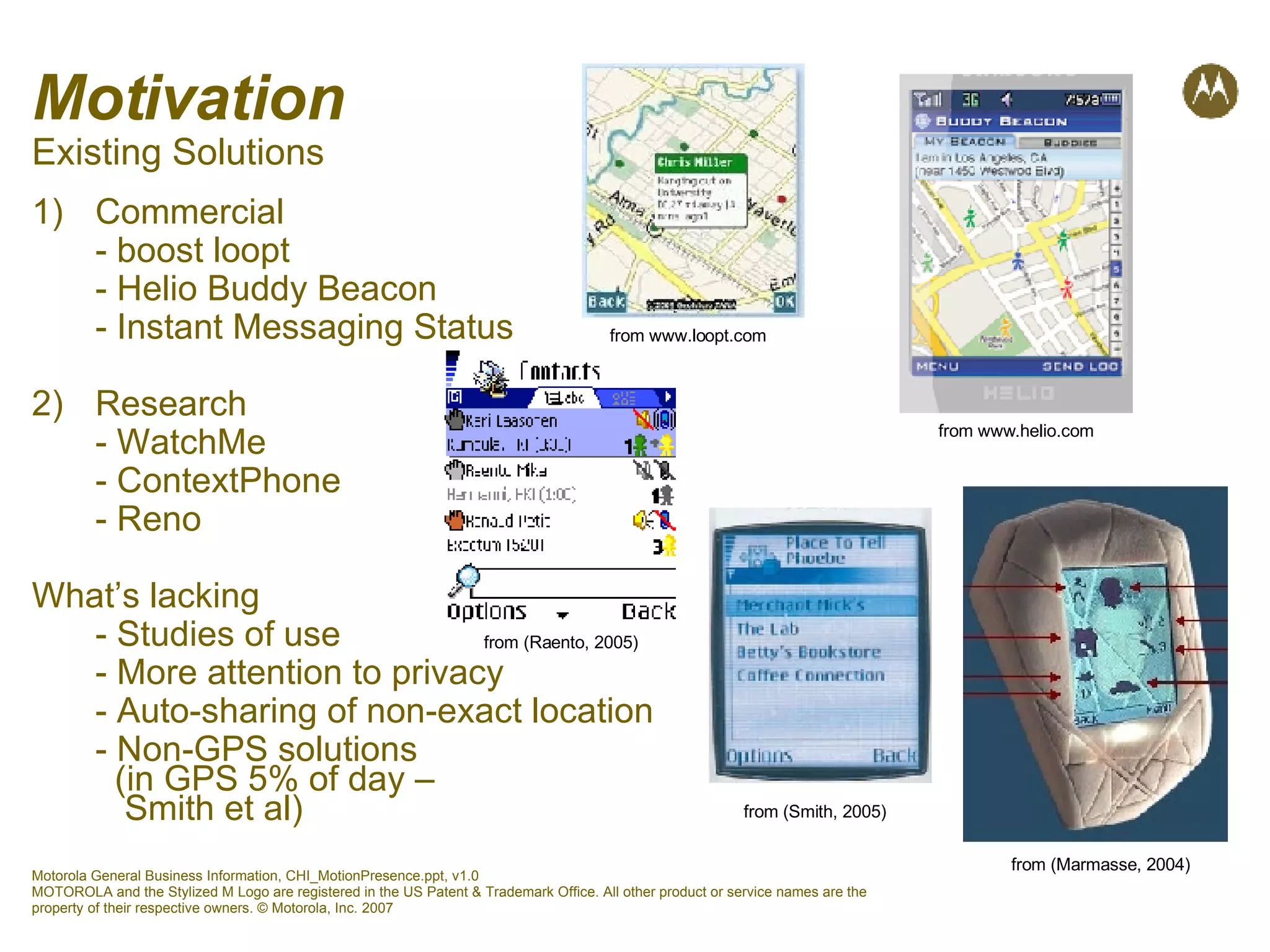
Motivation Existing Solutions Commercial - boost loopt - Helio Buddy Beacon - Instant Messaging Status 2)  Research - WatchMe - ContextPhone - Reno What’s lacking - Studies of use - More attention to privacy - Auto-sharing of non-exact location - Non-GPS solutions    (in GPS 5% of day –    Smith et al) from www.loopt.com from www.helio.com from (Raento, 2005) from (Marmasse, 2004) from (Smith, 2005)
Motivation The Inspiration AIM active/idle status - Close friends and family can infer quite a bit - Totally automatic - Very few privacy concerns Can we do something similar on the mobile? Hypotheses: - Moving/At-a-Place can be like Active/Idle - Close friends and family will be able to infer   location/activity/availability from this information - Fewer privacy concerns than applications that share   absolute location - Participants maintain a large sense of plausible    deniability 10:00 am on a Friday, what can I infer?
The Motion Presence Application
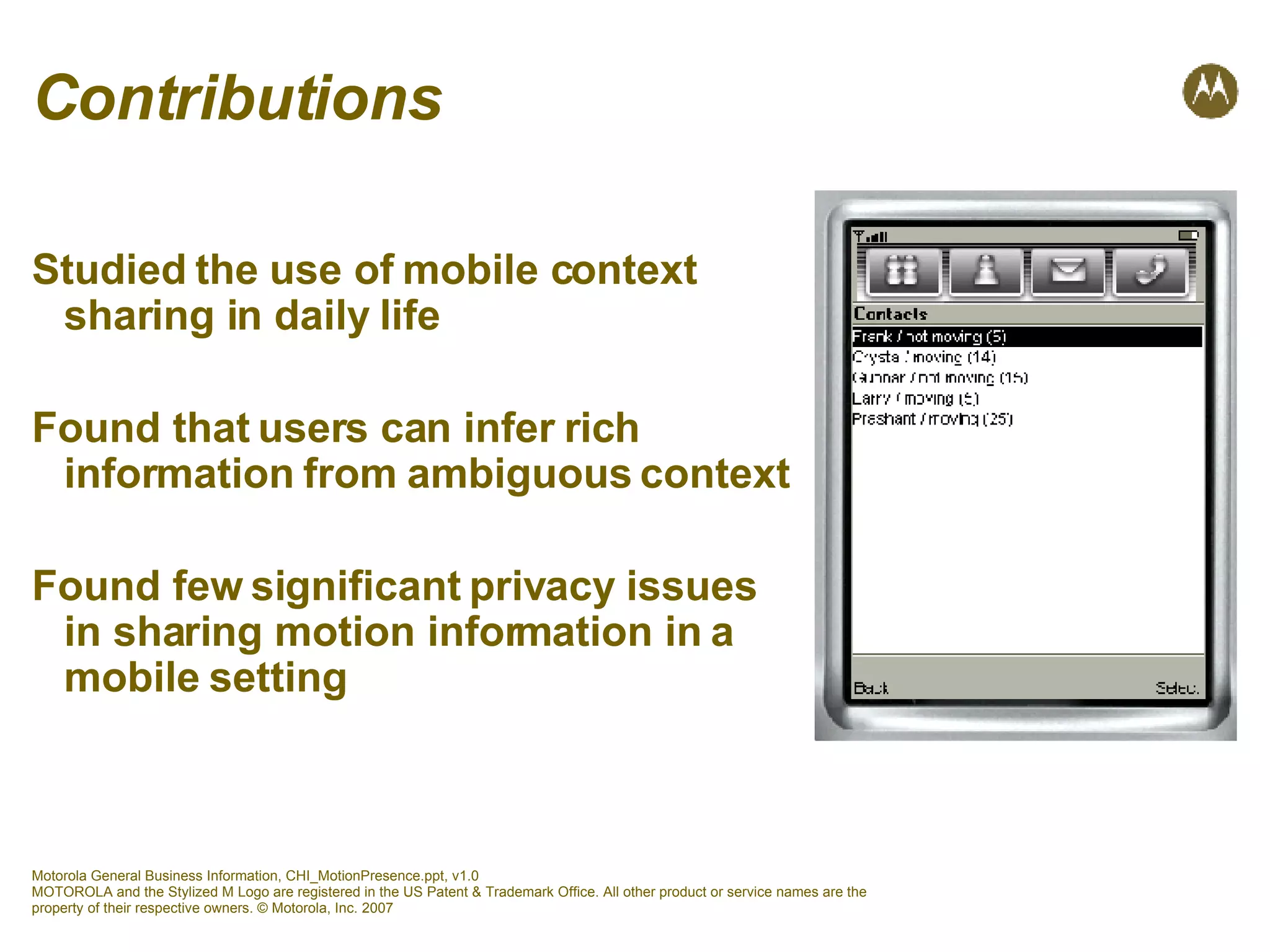
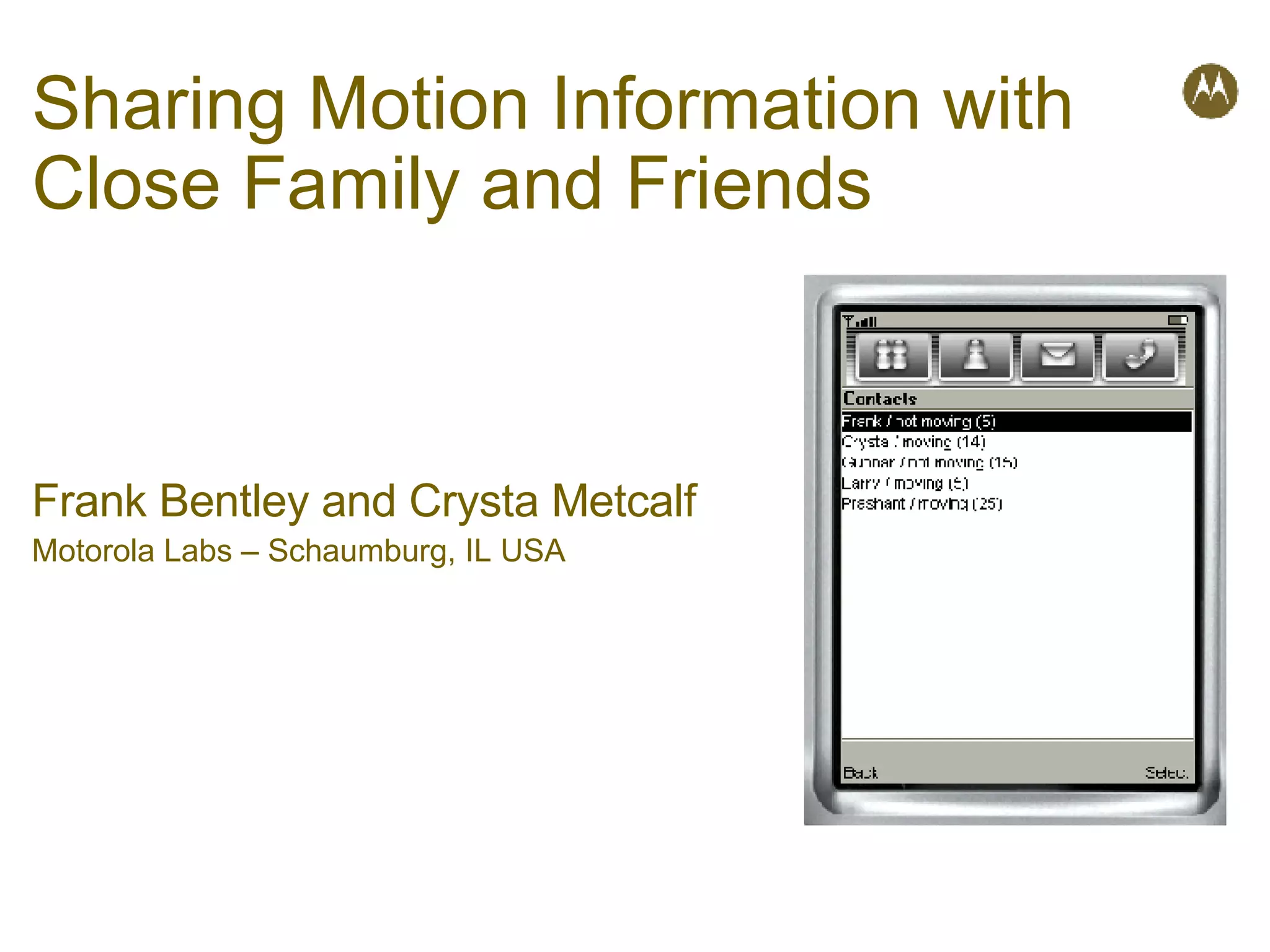
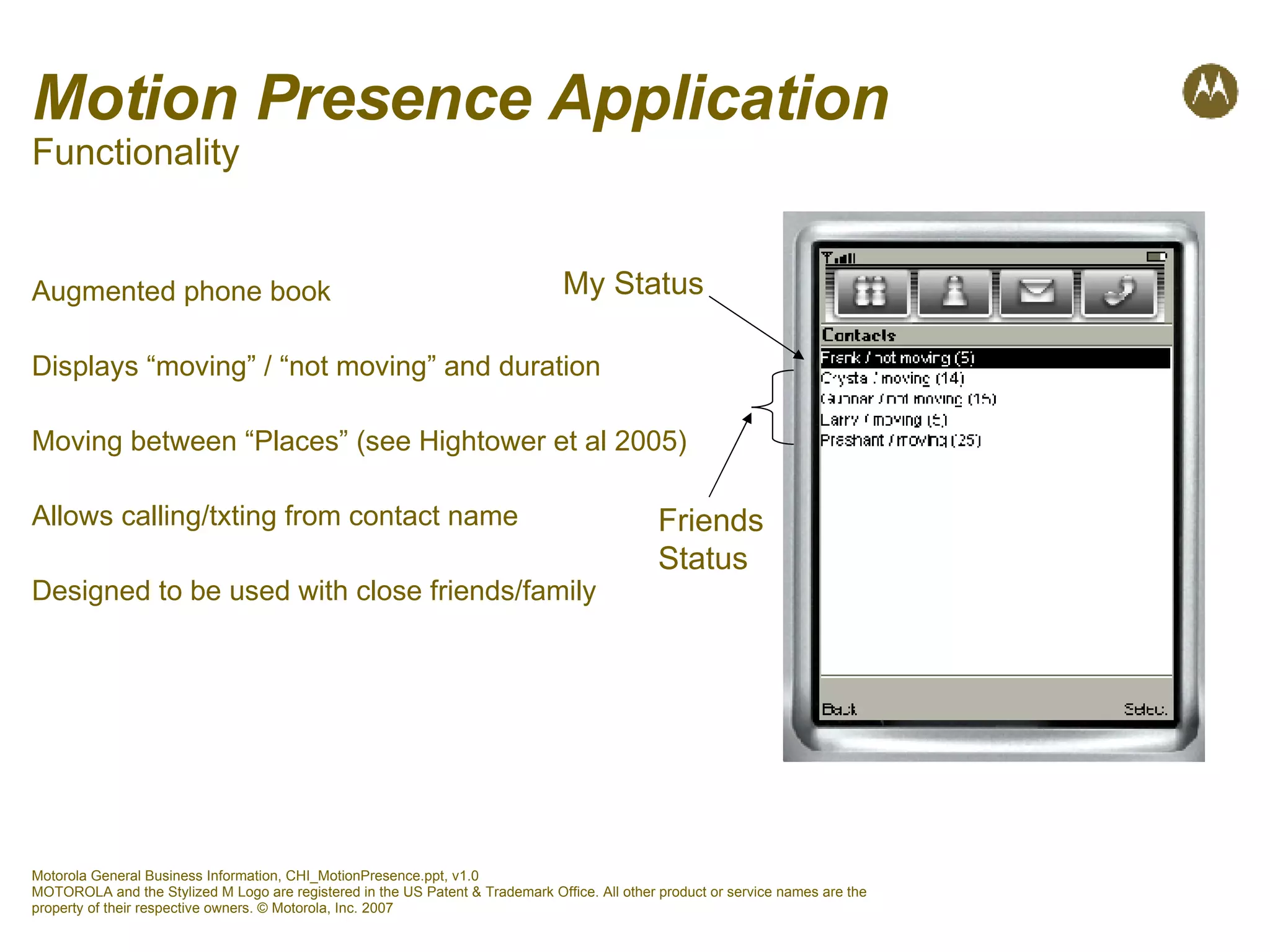
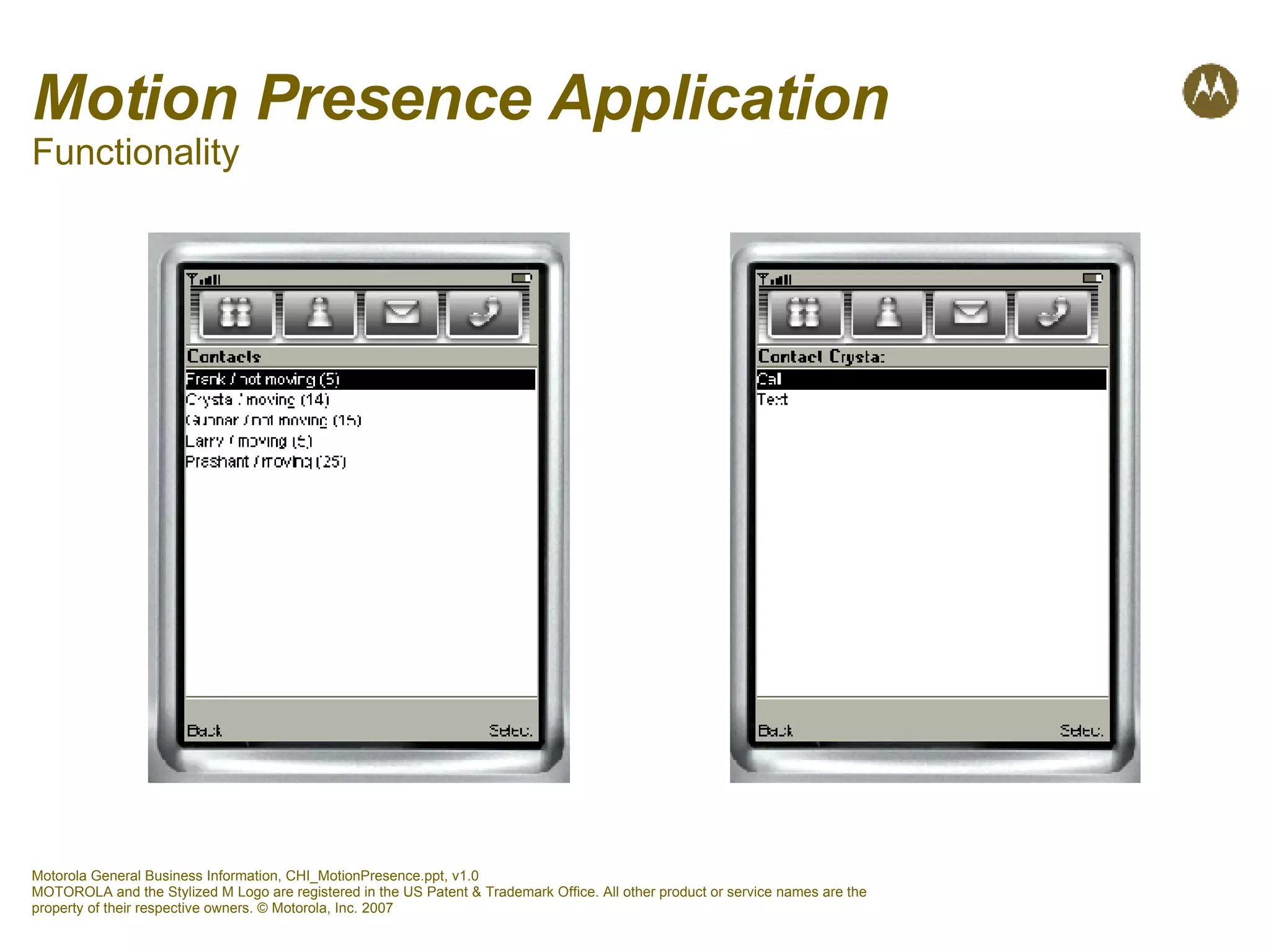
Motion Presence Application Functionality Augmented phone book Displays “moving” / “not moving” and duration Moving between “Places” (see Hightower et al 2005) Allows calling/txting from contact name Designed to be used with close friends/family My Status Friends Status
Motion Presence Application Functionality
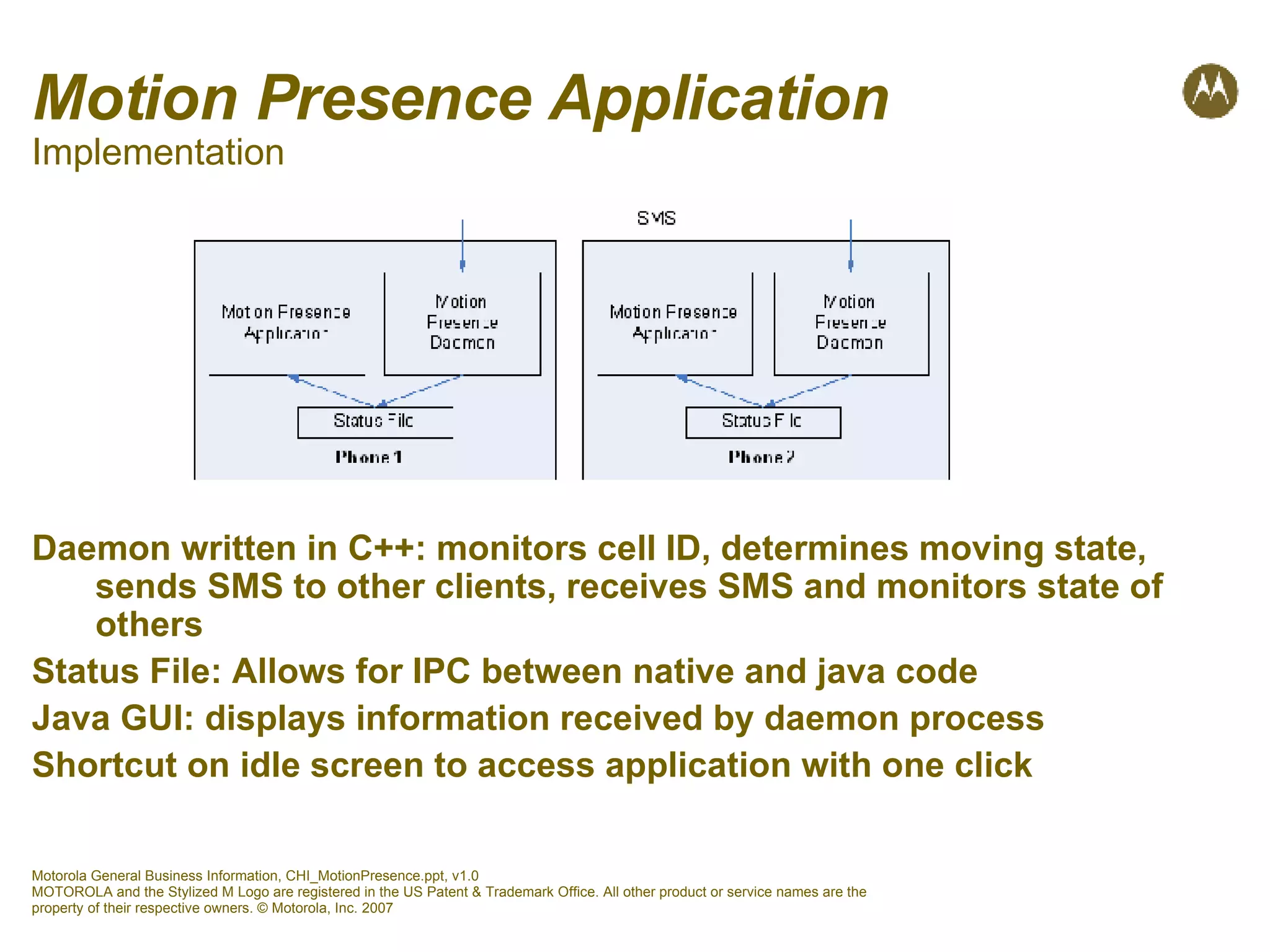
Motion Presence Application Implementation Daemon written in C++: monitors cell ID, determines moving state, sends SMS to other clients, receives SMS and monitors state of others Status File: Allows for IPC between native and java code Java GUI: displays information received by daemon process Shortcut on idle screen to access application with one click
Research Questions Among a close social group,   is motion presence used to infer something other than motion?   If so, what? Does having motion information about a potential communication partner   influence when people initiate a communication   with them?  How? How do  ambiguities and errors   in motion detection affect the derived value of the application? In a close social group, what   privacy concerns   are raised by the use of this prototype?  Does having motion information about a potential communication partner   affect how “connected” people feel?   How?
Field Study Methods
Field Study Methods 10 participants – 3 couples, one group of four friends Participants used the phone as their primary mobile phone for two weeks - Transferred SIM/Phonebook
Field Study Methods Receive Phone /  In-Person Demo Final  In-Person Interview Mid-Study Phone Interview 7 days 14 days Nightly Voicemail Nightly Voicemail Logging of Application Use Recording of phone calls with study participants
Participants Pseudonym Age Occupation Gender Alejandro 34 Mechanic M Beatriz 38 Admin. Assistant F Chris 40 Fundraiser M Dana 40 Interior Design F Ebony 46 Transportation Mgr F Farisa 47 HR Manager F George 23 Server M Harold 22 Loan Officer M Ian 23 Warehouse Profiler M James 23 Credit Analyst M
Findings
Findings Inferences Participants were able to infer: - Location - Activity - Availability - Arrival Time - Destination Confirm knowledge
Findings Inferences “ George, I knew he was going to work, but I wasn’t sure if he got there already and  I saw that he was not moving for 12 minutes.  So judging by that I’m getting that he was already at work so I didn’t bother calling him .” (Harold) “ I knew he had, it was either a 10am or 11am meeting Cleveland time, so I was checking.  I actually checked that application to see whether he was moving or not to know whether I should call.   I didn’t want to disturb him in his meeting so if it said ‘not moving’ I wasn’t going to call .” (Dana)
Findings Use Participants used the application to: - Moderate availability - Micro-coordinate - Arrive at the same time - Get more time at their current activity - See people were following through on commitments - Check on other’s safety - Social awareness – know what’s going on with others
Findings Use “ If you knew someone was going to go pick you up or if someone was going to go someplace and you knew that and you know about what time,  you could see if they were actually on their way or if they were running late. … Kind of lets you know when you should be ready or things like that .” (James) “ I could tell when he was leaving work by when he went off of ‘not moving.’ …  It was like, ok,  I saw that he was already on his way and we’d get there about the same time .” (Harold) “Oh, he’s not in class, he’s moving, he must be on his way home, I need milk!” (Beatriz)
Findings Privacy Privacy not a major concern with close friends and family Plausible deniability of vague motion information gives them an out Participants all wanted more information shared - Motion History - Direction/Heading - Distance from you - Speed - Map w/ directions - History of motion information - Custom “away” messages
Findings Privacy “ As a couple we wouldn’t turn it off.” (Farisa) “ It would be helpful if there was a line in there saying, kind of, what the last batch of moving was, so that you kind of knew that this was the next segment.” (Dana)  “ I think it would be a situation in which the other person,  you could be checking on the other person and it would create conflicts .”  (Alejandro)
Findings Ambiguities/Errors Motion Data was seen to be correct almost all of the time Times when participants mental model did not agree with application’s model:  - walking around a large (1/2 square mile) warehouse - taking a stop for gas and snacks on a long trip Most issues could be solved with a visualization of motion history
Findings Ambiguities/Errors “It didn’t really tell me anything unless I kind of knew in my mind, I had some theory in my mind about what she was doing.” (Chris) “He was supposed to be at home and it said he wasn’t moving.  But he ended up not being at home.  So it didn’t really help me.” (Ian) “Maybe they thought I was going to lunch at like 10:00 or whatever but I was still at the warehouse working.”  (James)
Findings Feeling Connected Learn more about patterns of friends and family “Check up” on others safety (e.g. still moving when they were on a long road trip, etc.) Find out when friends were going out at night, even if they were not going to join them Stay connected to home events while traveling (e.g. walking dog)
Findings Feeling Connected “ I’ve been working a lot and I’m not with Ebony, so  I’ve been looking at it just to see the motion on the phone .” (Farisa) “ I’d be worried, like if it was late and she was coming home from a client in Wisconsin.  If I knew she should be coming home and she wasn’t [moving].” (Chris) “ I’d be like, oh, this guy actually left for work at 7:30 and then  I felt bad for him.  I knew he went to work way earlier than I ever woke up, but I never knew exactly when.  When it hit the same time everyday, I was like, that’s kinda cool.” (George)
Design Implications
Design Implications You don’t need to send everything… - Take advantage of existing social knowledge  - Sending more ambiguous data can moderate privacy    concerns - Automatic presence updates can work Make users feel in control… - Keep information ambiguous enough to allow for    plausible deniability Support sending more detailed information… - Users wanted to know something new - Sharing more allows for more connections, surprise
Contributions Studied the use of mobile context  sharing in daily life Found that users can infer rich  information from ambiguous context Found few significant privacy issues  in sharing motion information in a  mobile setting

Sharing Motion Information with Close Family and Friends

  • 1.
    Sharing Motion Informationwith Close Family and Friends Frank Bentley and Crysta Metcalf Motorola Labs – Schaumburg, IL USA
  • 2.
    Overview Motivation TheMotion Presence application Research Questions Field study methods Findings Design Implications
  • 3.
    Motivation The changingrole of the phone Two classic HCI/CSCW problems, but in a mobile setting… 1) Availability - Phones now tied to a person, not a place - Schedules more variable - Is it OK to call now? 2) Social Awareness - Phones almost always on and almost always with you - Feel connected throughout the day - Feel connected when apart - Know when someone is available to perform a task
  • 4.
    Motivation Ambient MobileCommunications Exploring ways that people can stay in touch and aware Implicit sharing Visible sharing Information at a glance on mobile phones
  • 5.
    Motivation Existing SolutionsCommercial - boost loopt - Helio Buddy Beacon - Instant Messaging Status 2) Research - WatchMe - ContextPhone - Reno What’s lacking - Studies of use - More attention to privacy - Auto-sharing of non-exact location - Non-GPS solutions (in GPS 5% of day – Smith et al) from www.loopt.com from www.helio.com from (Raento, 2005) from (Marmasse, 2004) from (Smith, 2005)
  • 6.
    Motivation The InspirationAIM active/idle status - Close friends and family can infer quite a bit - Totally automatic - Very few privacy concerns Can we do something similar on the mobile? Hypotheses: - Moving/At-a-Place can be like Active/Idle - Close friends and family will be able to infer location/activity/availability from this information - Fewer privacy concerns than applications that share absolute location - Participants maintain a large sense of plausible deniability 10:00 am on a Friday, what can I infer?
  • 7.
  • 8.
    Motion Presence ApplicationFunctionality Augmented phone book Displays “moving” / “not moving” and duration Moving between “Places” (see Hightower et al 2005) Allows calling/txting from contact name Designed to be used with close friends/family My Status Friends Status
  • 9.
  • 10.
    Motion Presence ApplicationImplementation Daemon written in C++: monitors cell ID, determines moving state, sends SMS to other clients, receives SMS and monitors state of others Status File: Allows for IPC between native and java code Java GUI: displays information received by daemon process Shortcut on idle screen to access application with one click
  • 11.
    Research Questions Amonga close social group, is motion presence used to infer something other than motion? If so, what? Does having motion information about a potential communication partner influence when people initiate a communication with them? How? How do ambiguities and errors in motion detection affect the derived value of the application? In a close social group, what privacy concerns are raised by the use of this prototype? Does having motion information about a potential communication partner affect how “connected” people feel? How?
  • 12.
  • 13.
    Field Study Methods10 participants – 3 couples, one group of four friends Participants used the phone as their primary mobile phone for two weeks - Transferred SIM/Phonebook
  • 14.
    Field Study MethodsReceive Phone / In-Person Demo Final In-Person Interview Mid-Study Phone Interview 7 days 14 days Nightly Voicemail Nightly Voicemail Logging of Application Use Recording of phone calls with study participants
  • 15.
    Participants Pseudonym AgeOccupation Gender Alejandro 34 Mechanic M Beatriz 38 Admin. Assistant F Chris 40 Fundraiser M Dana 40 Interior Design F Ebony 46 Transportation Mgr F Farisa 47 HR Manager F George 23 Server M Harold 22 Loan Officer M Ian 23 Warehouse Profiler M James 23 Credit Analyst M
  • 16.
  • 17.
    Findings Inferences Participantswere able to infer: - Location - Activity - Availability - Arrival Time - Destination Confirm knowledge
  • 18.
    Findings Inferences “George, I knew he was going to work, but I wasn’t sure if he got there already and I saw that he was not moving for 12 minutes. So judging by that I’m getting that he was already at work so I didn’t bother calling him .” (Harold) “ I knew he had, it was either a 10am or 11am meeting Cleveland time, so I was checking. I actually checked that application to see whether he was moving or not to know whether I should call. I didn’t want to disturb him in his meeting so if it said ‘not moving’ I wasn’t going to call .” (Dana)
  • 19.
    Findings Use Participantsused the application to: - Moderate availability - Micro-coordinate - Arrive at the same time - Get more time at their current activity - See people were following through on commitments - Check on other’s safety - Social awareness – know what’s going on with others
  • 20.
    Findings Use “If you knew someone was going to go pick you up or if someone was going to go someplace and you knew that and you know about what time, you could see if they were actually on their way or if they were running late. … Kind of lets you know when you should be ready or things like that .” (James) “ I could tell when he was leaving work by when he went off of ‘not moving.’ … It was like, ok, I saw that he was already on his way and we’d get there about the same time .” (Harold) “Oh, he’s not in class, he’s moving, he must be on his way home, I need milk!” (Beatriz)
  • 21.
    Findings Privacy Privacynot a major concern with close friends and family Plausible deniability of vague motion information gives them an out Participants all wanted more information shared - Motion History - Direction/Heading - Distance from you - Speed - Map w/ directions - History of motion information - Custom “away” messages
  • 22.
    Findings Privacy “As a couple we wouldn’t turn it off.” (Farisa) “ It would be helpful if there was a line in there saying, kind of, what the last batch of moving was, so that you kind of knew that this was the next segment.” (Dana) “ I think it would be a situation in which the other person, you could be checking on the other person and it would create conflicts .” (Alejandro)
  • 23.
    Findings Ambiguities/Errors MotionData was seen to be correct almost all of the time Times when participants mental model did not agree with application’s model: - walking around a large (1/2 square mile) warehouse - taking a stop for gas and snacks on a long trip Most issues could be solved with a visualization of motion history
  • 24.
    Findings Ambiguities/Errors “Itdidn’t really tell me anything unless I kind of knew in my mind, I had some theory in my mind about what she was doing.” (Chris) “He was supposed to be at home and it said he wasn’t moving. But he ended up not being at home. So it didn’t really help me.” (Ian) “Maybe they thought I was going to lunch at like 10:00 or whatever but I was still at the warehouse working.” (James)
  • 25.
    Findings Feeling ConnectedLearn more about patterns of friends and family “Check up” on others safety (e.g. still moving when they were on a long road trip, etc.) Find out when friends were going out at night, even if they were not going to join them Stay connected to home events while traveling (e.g. walking dog)
  • 26.
    Findings Feeling Connected“ I’ve been working a lot and I’m not with Ebony, so I’ve been looking at it just to see the motion on the phone .” (Farisa) “ I’d be worried, like if it was late and she was coming home from a client in Wisconsin. If I knew she should be coming home and she wasn’t [moving].” (Chris) “ I’d be like, oh, this guy actually left for work at 7:30 and then I felt bad for him. I knew he went to work way earlier than I ever woke up, but I never knew exactly when. When it hit the same time everyday, I was like, that’s kinda cool.” (George)
  • 27.
  • 28.
    Design Implications Youdon’t need to send everything… - Take advantage of existing social knowledge - Sending more ambiguous data can moderate privacy concerns - Automatic presence updates can work Make users feel in control… - Keep information ambiguous enough to allow for plausible deniability Support sending more detailed information… - Users wanted to know something new - Sharing more allows for more connections, surprise
  • 29.
    Contributions Studied theuse of mobile context sharing in daily life Found that users can infer rich information from ambiguous context Found few significant privacy issues in sharing motion information in a mobile setting