Understanding the Privacy Implications of
Using Context-based Awareness Cues in
Social Networks
Ville Antila*^, Jussi Polet*


*VTT Technical Research Centre of Finland, Oulu, Finland
^Philips Research, Eindhoven, The Netherlands
Background – Smarcos project

• Smarcos creates solutions to allow
  devices and services to exchange
  context information, user actions,
  and semantic data

• One important part of the work has
  been to investigate the practical
  usage of context information and to
  develop models that can be
  dynamic and adaptive as well as
  applicable to different applications

• www.smarcos-project.eu
Outline of the talk

• Introduction and challenges

• ContextCapture -application

• User study

• Results

• Discussion and lessons learned

• Conclusions
Introduction

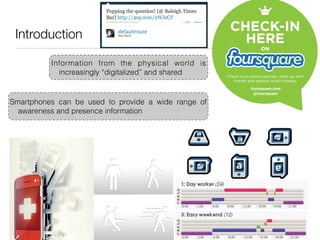
          Information from the physical world is
            increasingly “digitalized” and shared


Smartphones can be used to provide a wide range of
  awareness and presence information
Challenges (privacy implications of context-
awareness in social networks)

 Context (“anything that can              Privacy
 characterize the situation of an
 entity”)                                • The level of information disclosure
                                           can be difficult to manage
• The notion of ‘context’ can not be       (awareness of consequences might
  objectively defined (a prior) by          not be clear)
  settings, actions and actors
                                         • People can end-up disclosing more
• Rather, context is the meaning that      information than they meant to
  the actions and actors acquire at        (unwillingly)
  any given time from the subjective
  perspective [Mancini et al., 2009]     • “Privacy is a dynamic and
                                           continuously negotiated
• Awareness of ‘consequences’ is           process” [Palen & Dourish, 2003]
  important for grasping the effect of
  actions determining the level of       • People tend to appropriate the
  information disclosure                   usage of a service to their own
                                           needs [Barkhuus et al, 2008]
Context-based awareness cues

• Sharing context information can create awareness about the user’s situation
  and thus enhance or make communication more efficient [Oulasvirta, 2008]
• Creating awareness can have multiple purposes...
   • “Declaring one’s position is perhaps as much about deixis (pointing at and
     referencing features of the environment) as it is about telling someone exactly
     where you are” [Benford et al., 2004]

• Our hypothesis is that in many cases, rather than using exact parameters
  provided by sensors, people would like to add semantic meaning by using
  more abstract terms
• Also we claim that people prefer abstraction to ensure a certain level of
  privacy
   • The challenge is to give means for the dynamic abstraction while keeping as
     brief as possible (cf. interactions in “4-second bursts”)
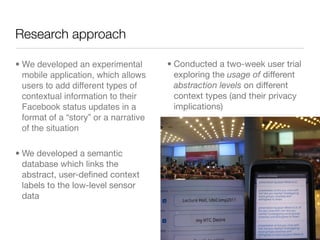
Research approach

• We developed an experimental         • Conducted a two-week user trial
  mobile application, which allows       exploring the usage of different
  users to add different types of        abstraction levels on different
  contextual information to their        context types (and their privacy
  Facebook status updates in a           implications)
  format of a “story” or a narrative
  of the situation

• We developed a semantic
  database which links the
  abstract, user-defined context
  labels to the low-level sensor
  data
ContextCapture -application (1/4)

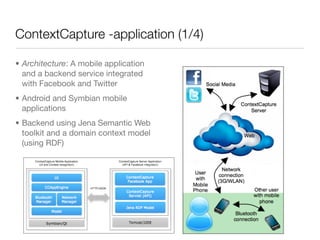
• Architecture: A mobile application
  and a backend service integrated
  with Facebook and Twitter
• Android and Symbian mobile
  applications
• Backend using Jena Semantic Web
  toolkit and a domain context model
  (using RDF)
ContextCapture -application (2/4)

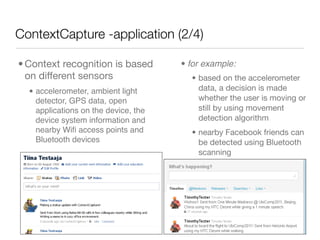
• Context recognition is based        • for example:
  on different sensors                  • based on the accelerometer
  • accelerometer, ambient light          data, a decision is made
    detector, GPS data, open              whether the user is moving or
    applications on the device, the       still by using movement
    device system information and         detection algorithm
    nearby Wifi access points and        • nearby Facebook friends can
    Bluetooth devices                     be detected using Bluetooth
                                          scanning
ContextCapture -application (3/4)

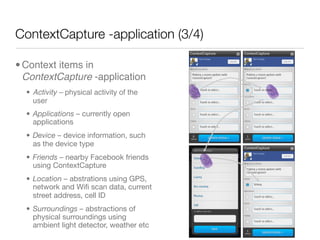
• Context items in
  ContextCapture -application
  • Activity – physical activity of the
    user
  • Applications – currently open
    applications
  • Device – device information, such
    as the device type
  • Friends – nearby Facebook friends
    using ContextCapture
  • Location – abstrations using GPS,
    network and Wifi scan data, current
    street address, cell ID
  • Surroundings – abstractions of
    physical surroundings using
    ambient light detector, weather etc
(Example)

• Creating a message:

  “[User-defined message]
   Sent from [Location] while [Activity] [Description] [Topic] and
   [Applications Activity] with [Friends].”


As an example, a status update message generated with the previous rule
  could be:

  “I think this is the killer app for Pervasive Computing!
  Sent from Conference Room 1 at PerCom 2012, Lugano, Switzerland while
  listening to an interesting presentation by Dr. Firstname Lastname and using
  Notepad with 4 conference buddies nearby.”
ContextCapture -application (4/4)

• “Collective” context is gathered from nearby devices (running
  ContextCapture)
  • If lacking, the mobile client can ask nearby devices for additional
    context information, such as GPS coordinates, address, weather etc.

  • Bluetooth communication is used with a simple protocol over
    RFCOMM
    • Request:
                    • CCRAControlProtocol:Client:ClientBluetoothName:
                      WTHR:Request

    • Response:


            • CCRAControlProtocol:Server:ServerBluetoothName:WTHR:-3
              degrees Celsius,Sunny
User study

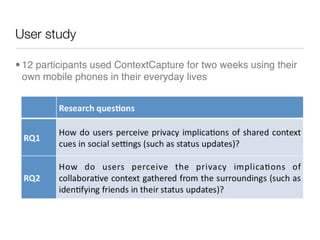
• 12 participants used ContextCapture for two weeks using their
  own mobile phones in their everyday lives
Participants

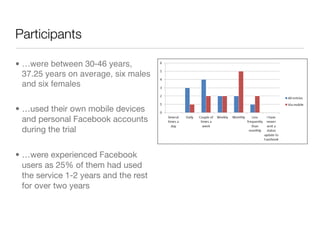
• …were between 30-46 years,
  37.25 years on average, six males
  and six females

• …used their own mobile devices
  and personal Facebook accounts
  during the trial


• …were experienced Facebook
  users as 25% of them had used
  the service 1-2 years and the rest
  for over two years
The study setup

•The participants…

  1.…were    emailed a short description of the study
    • Purpose, a short manual, a link with installation instructions and a link to the
      initial Web questionnaire

  2.…used    the application for two (2) weeks
    • During that time, they could tell their experiences through a Web diary (we
      asked them to fill in the diary at least five times)

  3.…were    interviewed at the end of the trial
    • The interviews were semi-structured, including questions about the users’
      expectations, attitudes, privacy and the most pleasing and unpleasing
      experiences related to the usage
    • The participants also filled a Web questionnaire about their experiences
Findings (1/3)

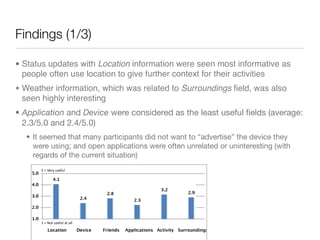
• Status updates with Location information were seen most informative as
  people often use location to give further context for their activities
• Weather information, which was related to Surroundings field, was also
  seen highly interesting
• Application and Device were considered as the least useful fields (average:
  2.3/5.0 and 2.4/5.0)
  • It seemed that many participants did not want to “advertise” the device they
    were using; and open applications were often unrelated or uninteresting (with
    regards of the current situation)
Findings (2/3)

• The participants were clearly aware of their privacy and had thought about
  it while using the application
  • E.g. the participants did not use the addresses of their homes or the kindergarten
    their children were, even though the audience consisted of Facebook friends

  • The accurate location of places was too sensitive to be shared, many of the
    participants stated that the semantic meaning of the place is enough

     • E.g. stating “I’m at home” is adequate enough for the people the message is meant
       for

  • In many participants’ opinion sharing friends’ location without permission is not
    acceptable, participants preferred to use more abstract words, like “group of
    friends”, instead of giving the exact names
Findings (3/3)

• One key finding was that people were clearly interested about “context” as a
  form of communication enabler, especially while communicating to their
  friends (i.e. social network)

• Context information was seen to add value, but users wanted to have full
  control in the level of abstraction (and each subsequent time they used the
  system)

• Abstract labels (with a semantic meaning), such as “home”, “work” and
  “kindergarten” were seen more useful than more exact terms

• Abstract labels were also considered more privacy preserving in many
  situations

• Moreover the usage of different abstractions were observed to be dynamic
  rather than static, therefore users did change the usage of different labels in
  different situations
Implications for design of context-aware social
applications

• With applications dealing with privacy sensitive information, the
  information disclosure and privacy should be fully controlled by the
  user
• By giving freedom for users to control the disclosure and
  abstraction level of contextual information, it creates:
  • meaningfulness and motivation for the users
  • and in the same time allows the system to gather a set of user-defined
    context labels with different abstraction levels (which can be associated
    with the gathered low-level sensor data)
• Privacy is indeed a dynamic and continuously negotiated process
  in which a rigorous set of prior rules can render the application
  useless
  • People often appropriate the shared information level according to the
    needs of the moment
Discussion

• Through the analysis of contextual information derived from mobile device
  usage patterns it is possible to infer a lot of potentially privacy-sensitive
  information

   • There has been research in extracting these patterns from large datasets [Eagle
     & Pentland, 2006; Farrahi & Gatica-Perez, 2008 and 2010]

   • In addition there has been an increasing interest of exploring the social-side of
     context-awareness in pervasive computing [Endler et al., 2011, Hosio et al.,
     2010]

• We argue that the increased context-awareness is an inevitable step in
  pervasive computing but the privacy implications of this progress are largely
  not tested in the “real-world” yet

• Novel approaches for capturing and storing context “labels” are called for..
Conclusions

• We have presented a work investigating the practical use of labeling
  context information in social computing..

• The main findings include:
  • Current location, activity and surroundings were the most relevant context types
    (in this study)

  • Disclosing the nearby friends or colleagues in the status updates was seen as
    relevant but problematic due to privacy issues

  • The context types were seen as most meaningful when the used abstraction
    level was high

     • Participants felt that exact information, such as street address or coordinates,
       conveyed a too matter-of-fact type description

     • Whereas more abstract descriptions, such as “at the movie theatre” or “at the
       botanical garden” were seen as more illustrative, interesting and meaningful
Something to take away from the talk...

• Avoid using “hard to define” rules for setting privacy preferences for
  different situations

• Instead, a programming-by-example -approach to let user to label
  situations with the intended abstraction level “on-the-go” (along with
  ensuring the privacy)

• Allow to change these settings/labels dynamically, preferably with least
  effort possible (e.g. one-click selection from a set of recommendations)

• Make the system learnable (learning the contexts and their associated
  labels/ privacy rules while the user defines and refines these)
Understanding the Privacy Implications of Using Context-based
Awareness Cues in Social Networks


Thank you!
Questions?


 Ville Antila
 ville.antila@vtt.fi

 Jussi Polet
 jussi.polet@vtt.fi

PerCol 2012 - Presentation

  • 1.
    Understanding the PrivacyImplications of Using Context-based Awareness Cues in Social Networks Ville Antila*^, Jussi Polet* *VTT Technical Research Centre of Finland, Oulu, Finland ^Philips Research, Eindhoven, The Netherlands
  • 2.
    Background – Smarcosproject • Smarcos creates solutions to allow devices and services to exchange context information, user actions, and semantic data • One important part of the work has been to investigate the practical usage of context information and to develop models that can be dynamic and adaptive as well as applicable to different applications • www.smarcos-project.eu
  • 3.
    Outline of thetalk • Introduction and challenges • ContextCapture -application • User study • Results • Discussion and lessons learned • Conclusions
  • 4.
    Introduction Information from the physical world is increasingly “digitalized” and shared Smartphones can be used to provide a wide range of awareness and presence information
  • 5.
    Challenges (privacy implicationsof context- awareness in social networks) Context (“anything that can Privacy characterize the situation of an entity”) • The level of information disclosure can be difficult to manage • The notion of ‘context’ can not be (awareness of consequences might objectively defined (a prior) by not be clear) settings, actions and actors • People can end-up disclosing more • Rather, context is the meaning that information than they meant to the actions and actors acquire at (unwillingly) any given time from the subjective perspective [Mancini et al., 2009] • “Privacy is a dynamic and continuously negotiated • Awareness of ‘consequences’ is process” [Palen & Dourish, 2003] important for grasping the effect of actions determining the level of • People tend to appropriate the information disclosure usage of a service to their own needs [Barkhuus et al, 2008]
  • 6.
    Context-based awareness cues •Sharing context information can create awareness about the user’s situation and thus enhance or make communication more efficient [Oulasvirta, 2008] • Creating awareness can have multiple purposes... • “Declaring one’s position is perhaps as much about deixis (pointing at and referencing features of the environment) as it is about telling someone exactly where you are” [Benford et al., 2004] • Our hypothesis is that in many cases, rather than using exact parameters provided by sensors, people would like to add semantic meaning by using more abstract terms • Also we claim that people prefer abstraction to ensure a certain level of privacy • The challenge is to give means for the dynamic abstraction while keeping as brief as possible (cf. interactions in “4-second bursts”)
  • 7.
    Research approach • Wedeveloped an experimental • Conducted a two-week user trial mobile application, which allows exploring the usage of different users to add different types of abstraction levels on different contextual information to their context types (and their privacy Facebook status updates in a implications) format of a “story” or a narrative of the situation • We developed a semantic database which links the abstract, user-defined context labels to the low-level sensor data
  • 8.
    ContextCapture -application (1/4) •Architecture: A mobile application and a backend service integrated with Facebook and Twitter • Android and Symbian mobile applications • Backend using Jena Semantic Web toolkit and a domain context model (using RDF)
  • 9.
    ContextCapture -application (2/4) •Context recognition is based • for example: on different sensors • based on the accelerometer • accelerometer, ambient light data, a decision is made detector, GPS data, open whether the user is moving or applications on the device, the still by using movement device system information and detection algorithm nearby Wifi access points and • nearby Facebook friends can Bluetooth devices be detected using Bluetooth scanning
  • 10.
    ContextCapture -application (3/4) •Context items in ContextCapture -application • Activity – physical activity of the user • Applications – currently open applications • Device – device information, such as the device type • Friends – nearby Facebook friends using ContextCapture • Location – abstrations using GPS, network and Wifi scan data, current street address, cell ID • Surroundings – abstractions of physical surroundings using ambient light detector, weather etc
  • 11.
    (Example) • Creating amessage: “[User-defined message] Sent from [Location] while [Activity] [Description] [Topic] and [Applications Activity] with [Friends].” As an example, a status update message generated with the previous rule could be: “I think this is the killer app for Pervasive Computing! Sent from Conference Room 1 at PerCom 2012, Lugano, Switzerland while listening to an interesting presentation by Dr. Firstname Lastname and using Notepad with 4 conference buddies nearby.”
  • 12.
    ContextCapture -application (4/4) •“Collective” context is gathered from nearby devices (running ContextCapture) • If lacking, the mobile client can ask nearby devices for additional context information, such as GPS coordinates, address, weather etc. • Bluetooth communication is used with a simple protocol over RFCOMM • Request: • CCRAControlProtocol:Client:ClientBluetoothName: WTHR:Request • Response: • CCRAControlProtocol:Server:ServerBluetoothName:WTHR:-3 degrees Celsius,Sunny
  • 13.
    User study • 12participants used ContextCapture for two weeks using their own mobile phones in their everyday lives
  • 14.
    Participants • …were between30-46 years, 37.25 years on average, six males and six females • …used their own mobile devices and personal Facebook accounts during the trial • …were experienced Facebook users as 25% of them had used the service 1-2 years and the rest for over two years
  • 15.
    The study setup •Theparticipants… 1.…were emailed a short description of the study • Purpose, a short manual, a link with installation instructions and a link to the initial Web questionnaire 2.…used the application for two (2) weeks • During that time, they could tell their experiences through a Web diary (we asked them to fill in the diary at least five times) 3.…were interviewed at the end of the trial • The interviews were semi-structured, including questions about the users’ expectations, attitudes, privacy and the most pleasing and unpleasing experiences related to the usage • The participants also filled a Web questionnaire about their experiences
  • 16.
    Findings (1/3) • Statusupdates with Location information were seen most informative as people often use location to give further context for their activities • Weather information, which was related to Surroundings field, was also seen highly interesting • Application and Device were considered as the least useful fields (average: 2.3/5.0 and 2.4/5.0) • It seemed that many participants did not want to “advertise” the device they were using; and open applications were often unrelated or uninteresting (with regards of the current situation)
  • 17.
    Findings (2/3) • Theparticipants were clearly aware of their privacy and had thought about it while using the application • E.g. the participants did not use the addresses of their homes or the kindergarten their children were, even though the audience consisted of Facebook friends • The accurate location of places was too sensitive to be shared, many of the participants stated that the semantic meaning of the place is enough • E.g. stating “I’m at home” is adequate enough for the people the message is meant for • In many participants’ opinion sharing friends’ location without permission is not acceptable, participants preferred to use more abstract words, like “group of friends”, instead of giving the exact names
  • 18.
    Findings (3/3) • Onekey finding was that people were clearly interested about “context” as a form of communication enabler, especially while communicating to their friends (i.e. social network) • Context information was seen to add value, but users wanted to have full control in the level of abstraction (and each subsequent time they used the system) • Abstract labels (with a semantic meaning), such as “home”, “work” and “kindergarten” were seen more useful than more exact terms • Abstract labels were also considered more privacy preserving in many situations • Moreover the usage of different abstractions were observed to be dynamic rather than static, therefore users did change the usage of different labels in different situations
  • 19.
    Implications for designof context-aware social applications • With applications dealing with privacy sensitive information, the information disclosure and privacy should be fully controlled by the user • By giving freedom for users to control the disclosure and abstraction level of contextual information, it creates: • meaningfulness and motivation for the users • and in the same time allows the system to gather a set of user-defined context labels with different abstraction levels (which can be associated with the gathered low-level sensor data) • Privacy is indeed a dynamic and continuously negotiated process in which a rigorous set of prior rules can render the application useless • People often appropriate the shared information level according to the needs of the moment
  • 20.
    Discussion • Through theanalysis of contextual information derived from mobile device usage patterns it is possible to infer a lot of potentially privacy-sensitive information • There has been research in extracting these patterns from large datasets [Eagle & Pentland, 2006; Farrahi & Gatica-Perez, 2008 and 2010] • In addition there has been an increasing interest of exploring the social-side of context-awareness in pervasive computing [Endler et al., 2011, Hosio et al., 2010] • We argue that the increased context-awareness is an inevitable step in pervasive computing but the privacy implications of this progress are largely not tested in the “real-world” yet • Novel approaches for capturing and storing context “labels” are called for..
  • 21.
    Conclusions • We havepresented a work investigating the practical use of labeling context information in social computing.. • The main findings include: • Current location, activity and surroundings were the most relevant context types (in this study) • Disclosing the nearby friends or colleagues in the status updates was seen as relevant but problematic due to privacy issues • The context types were seen as most meaningful when the used abstraction level was high • Participants felt that exact information, such as street address or coordinates, conveyed a too matter-of-fact type description • Whereas more abstract descriptions, such as “at the movie theatre” or “at the botanical garden” were seen as more illustrative, interesting and meaningful
  • 22.
    Something to takeaway from the talk... • Avoid using “hard to define” rules for setting privacy preferences for different situations • Instead, a programming-by-example -approach to let user to label situations with the intended abstraction level “on-the-go” (along with ensuring the privacy) • Allow to change these settings/labels dynamically, preferably with least effort possible (e.g. one-click selection from a set of recommendations) • Make the system learnable (learning the contexts and their associated labels/ privacy rules while the user defines and refines these)
  • 23.
    Understanding the PrivacyImplications of Using Context-based Awareness Cues in Social Networks Thank you! Questions? Ville Antila ville.antila@vtt.fi Jussi Polet jussi.polet@vtt.fi