PROTOTYPING AND FIELD EVALUATION AS RISK MITIGATION IN MOBILE PRODUCT DEVELOPMENT Frank Bentley Motorola Applied Research and Technology Center
In fewer words… How to decide which experiences to  productize with minimal effort.
Outline Who we are/were How we get ideas What we build How we test Case Study: Ambient Mobile Communications
Preface Meant to encourage lively discussion Please ask questions at any point!
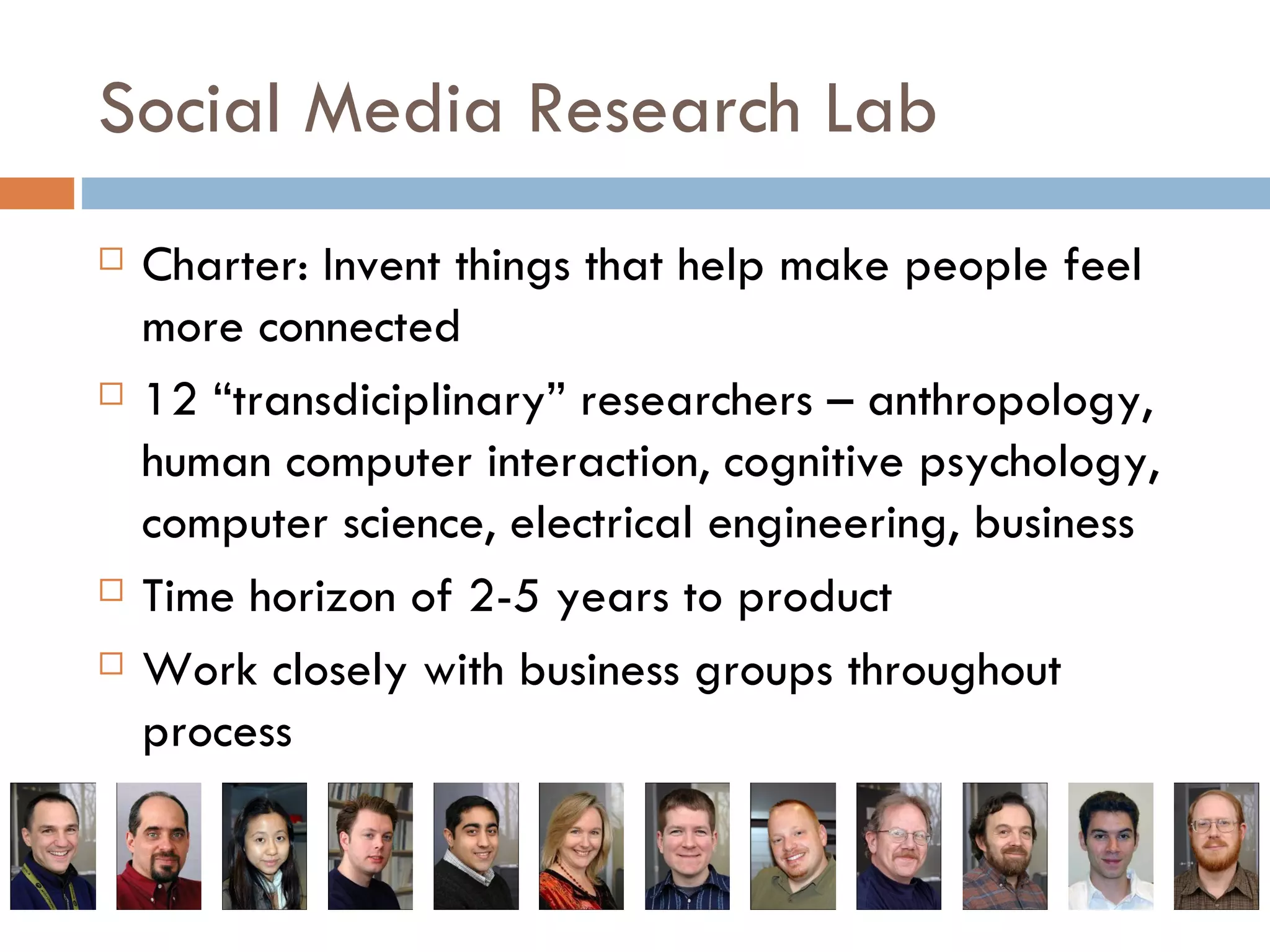
Social Media Research Lab Charter: Invent things that help make people feel more connected 12 “transdiciplinary” researchers – anthropology, human computer interaction, cognitive psychology, computer science, electrical engineering, business Time horizon of 2-5 years to product Work closely with business groups throughout process
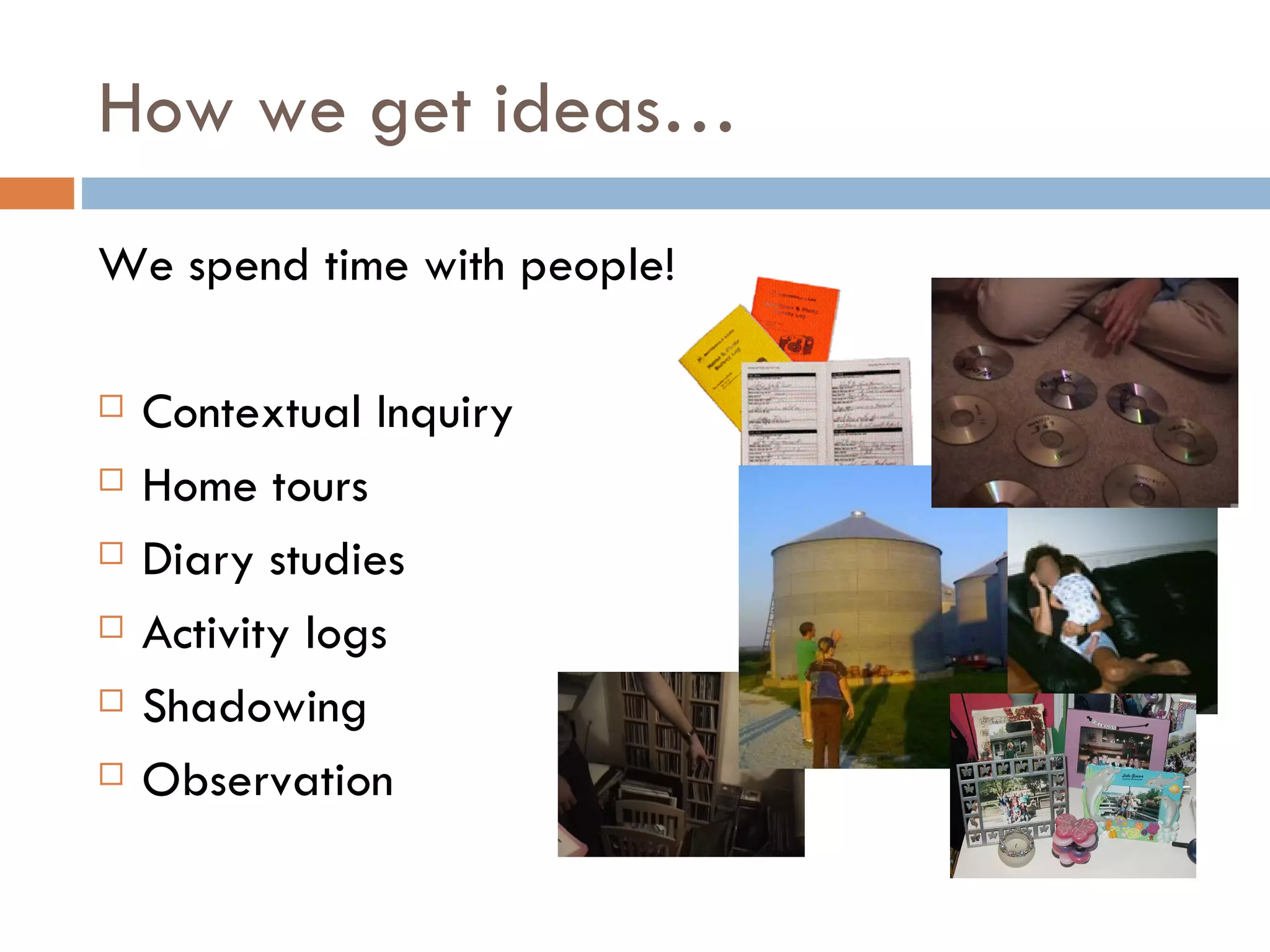
How we get ideas… We spend time with people! Contextual Inquiry Home tours Diary studies Activity logs Shadowing Observation
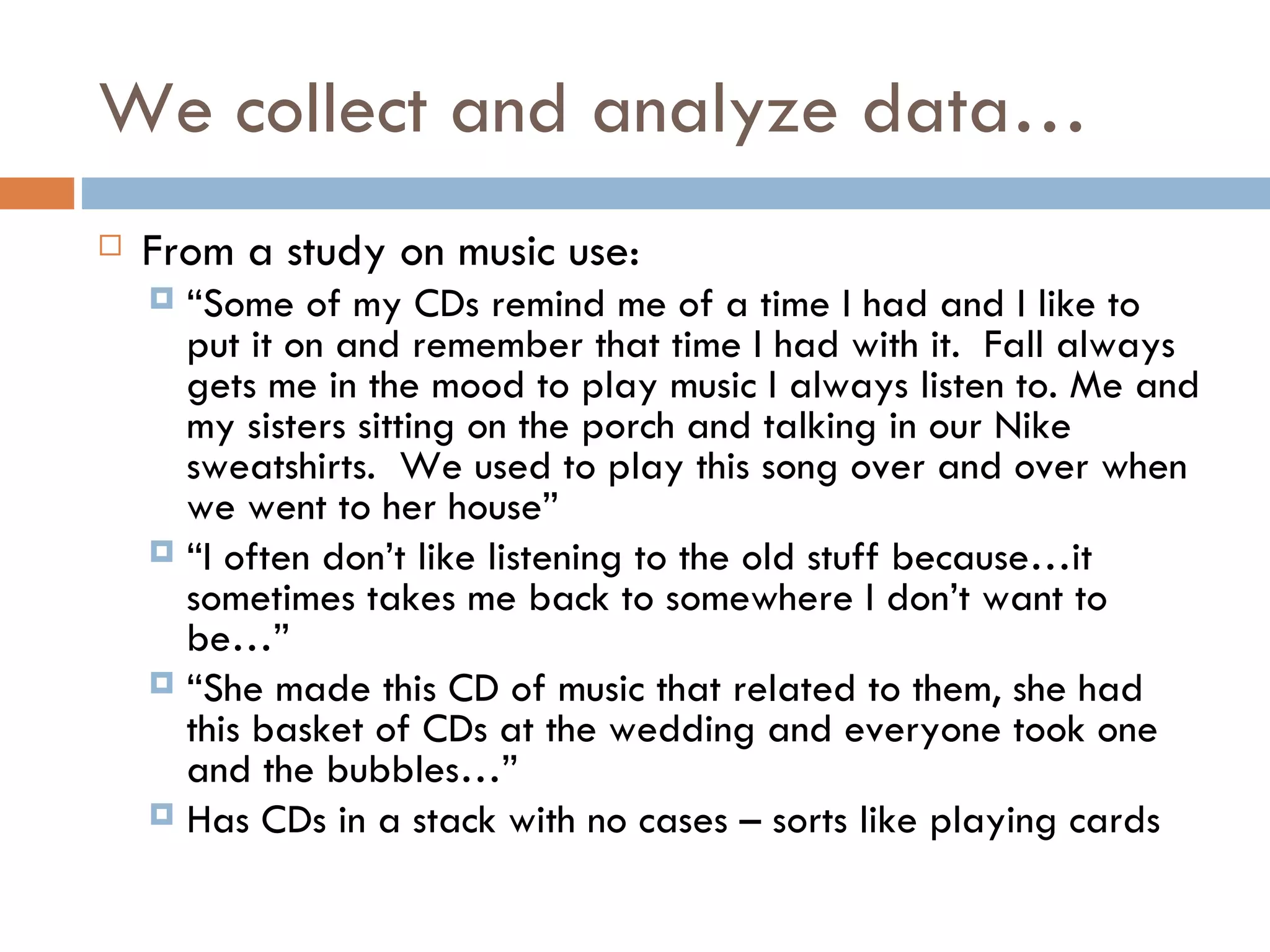
We collect and analyze data… From a study on music use: “ Some of my CDs remind me of a time I had and I like to put it on and remember that time I had with it.  Fall always gets me in the mood to play music I always listen to. Me and my sisters sitting on the porch and talking in our Nike sweatshirts.  We used to play this song over and over when we went to her house” “ I often don’t like listening to the old stuff because…it sometimes takes me back to somewhere I don’t want to be…”  “ She made this CD of music that related to them, she had this basket of CDs at the wedding and everyone took one and the bubbles…” Has CDs in a stack with no cases – sorts like playing cards
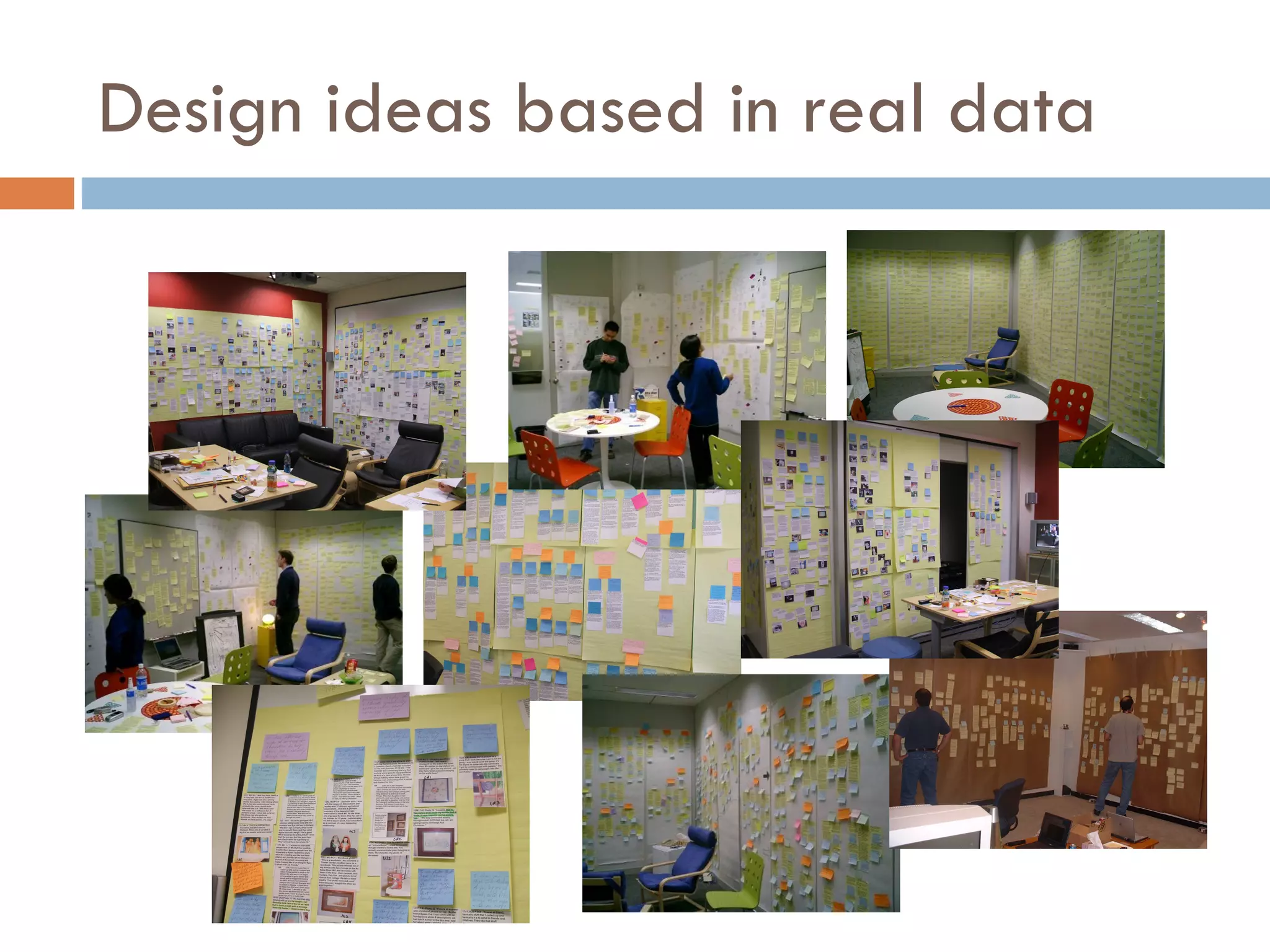
Design ideas based in real data
Research questions to mitigate risk How does (or doesn’t!) the experience fit into everyday life? What existing solutions do people have to meet this needs? What are existing workarounds? What aspects of our prototype solution need to be optimized in a real product? (is it too slow, not integrated enough, etc.)
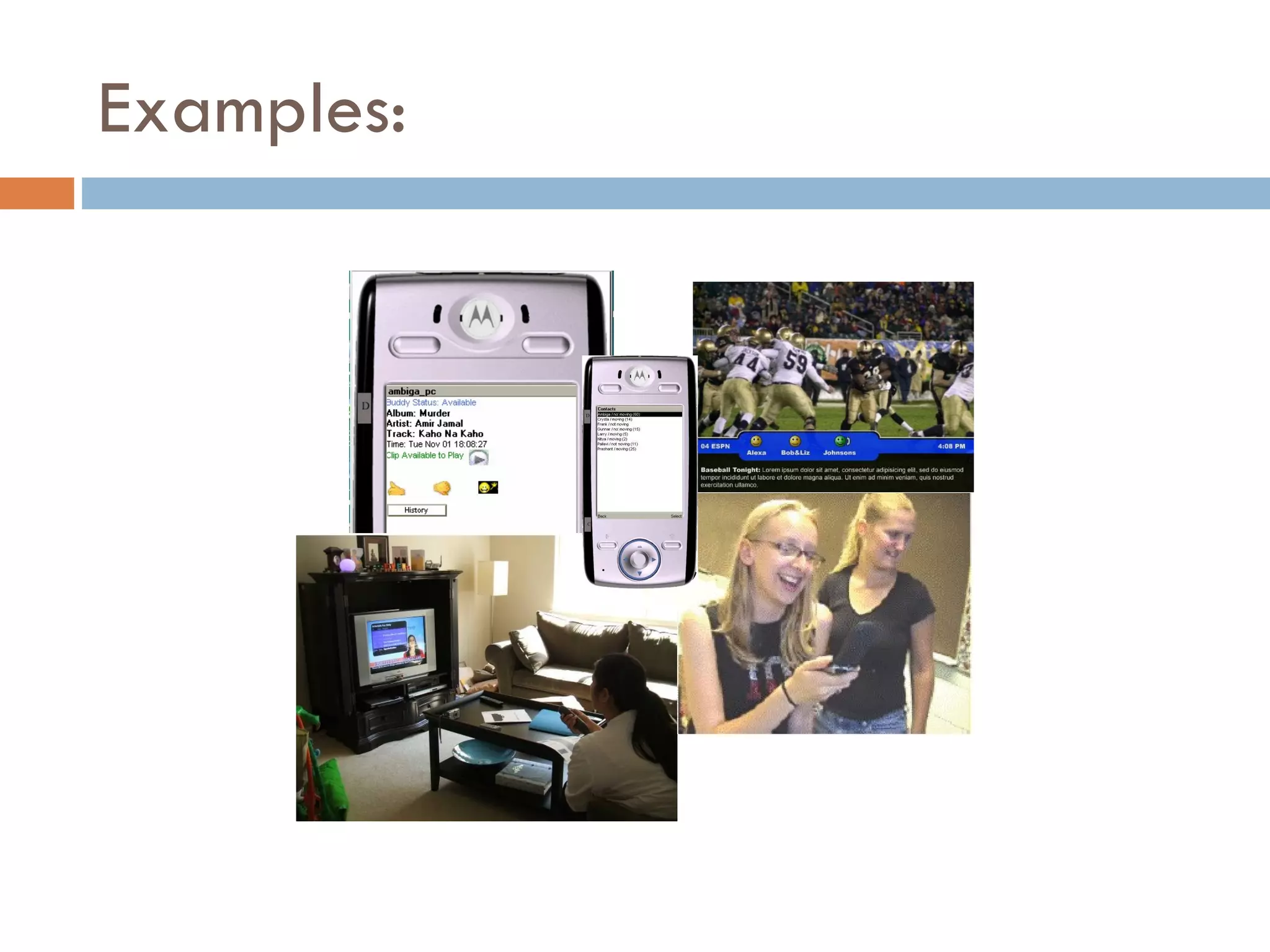
What we build: Several rapid functional prototypes of most promising design ideas from ethnographic work Goal: to decide on experiences that fit into people’s lives and are worth turning into a product Principles: Build only what you need Build the experience, not the technology
Examples:
How we test: Small field-research teams (2-3 people) Rapid data collection and analysis 8-10 users, 2-4 weeks (go until you see repetitions in data) Principles: Social groups for social technologies Real context of use Primary device Field-based data collection
Case Study: Ambient Mobile Communications How to use ambient context to aid mobile  communication and enhance existing  social communities
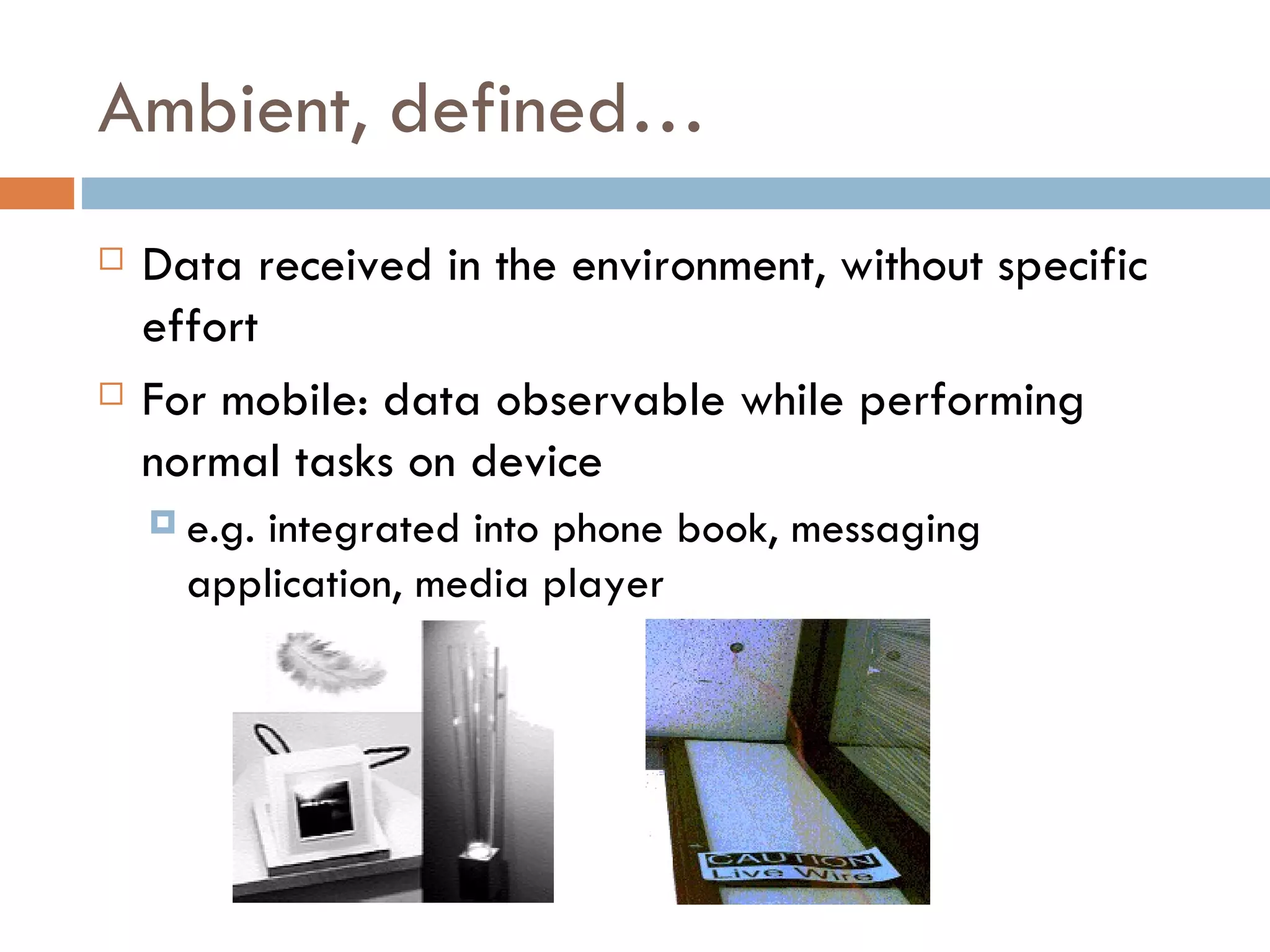
Ambient, defined… Data received in the environment, without specific effort For mobile: data observable while performing normal tasks on device  e.g. integrated into phone book, messaging application, media player
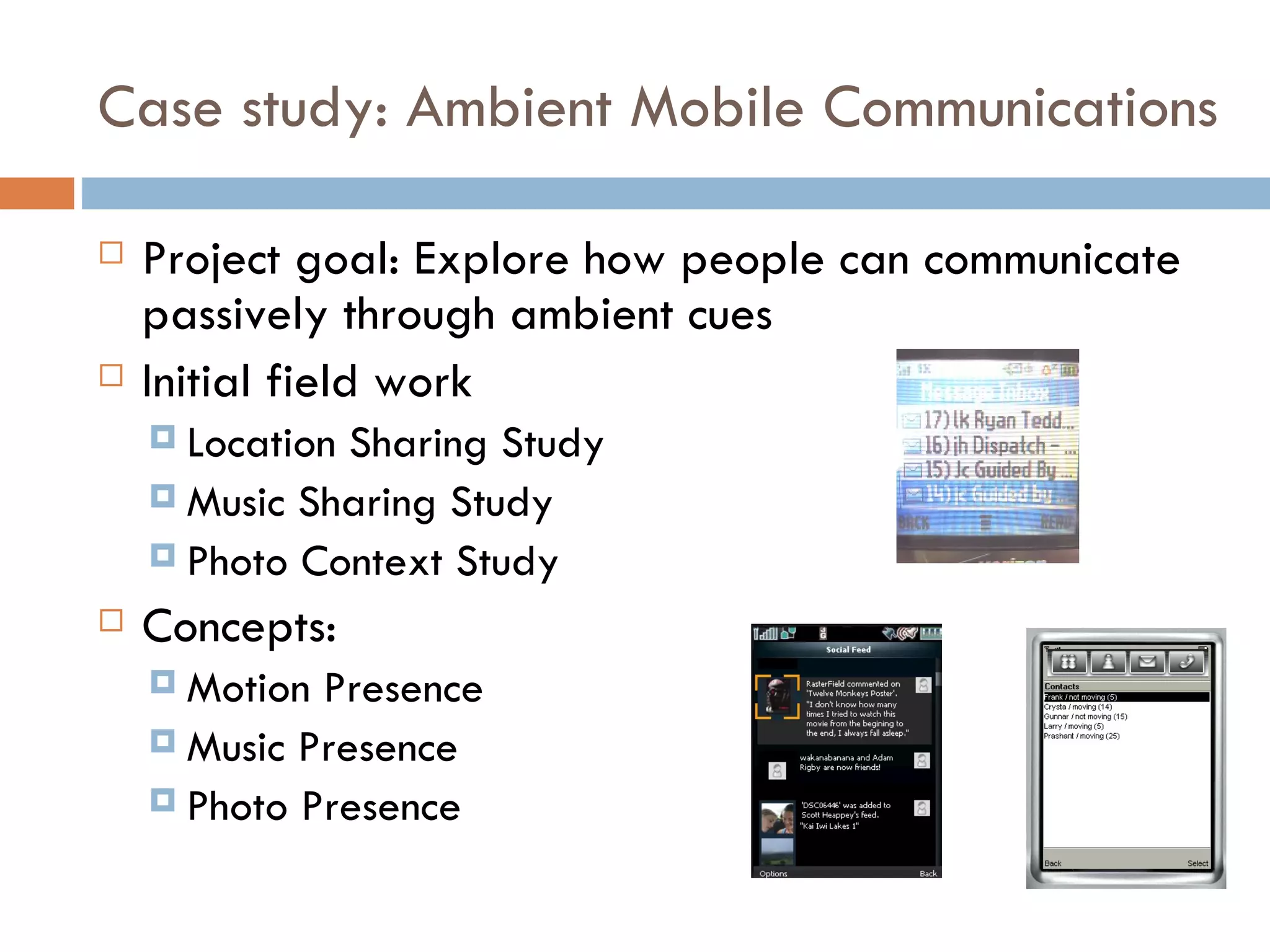
Case study: Ambient Mobile Communications Project goal: Explore how people can communicate passively through ambient cues Initial field work Location Sharing Study Music Sharing Study Photo Context Study Concepts: Motion Presence Music Presence Photo Presence
Location Sharing Study Objective: To use current location sharing practices as inspiration for the design of new mobile social applications Methods:  Recorded phone calls of 7 participants for one week Analyzed for purpose of location disclosure, place  disclosed, social relationships involved, truth Finding: People often know location of close friends and family, but are unaware of exact transitions
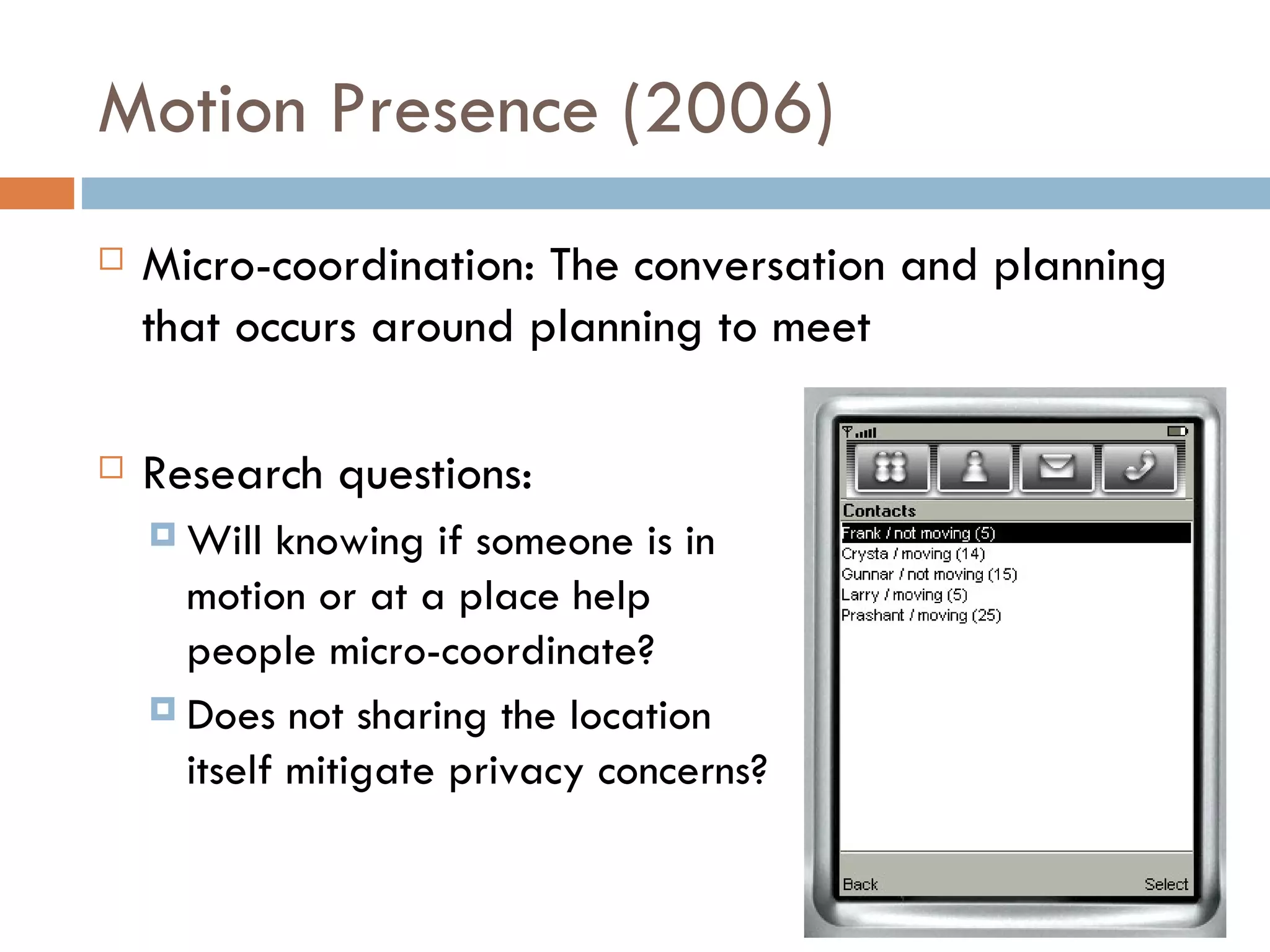
Motion Presence (2006) Micro-coordination: The conversation and planning that occurs around planning to meet Research questions:  Will knowing if someone is in  motion or at a place help  people micro-coordinate? Does not sharing the location  itself mitigate privacy concerns?
Motion Presence Build only what you need Built simple phonebook (call, text, name, number, motion only) 1 person-week of development Build the experience, not the technology Sent presence over port-based SMS Social groups for social technologies 4 groups of friends/family (10 total)  Real context of use Used in their everyday lives for two weeks Primary device Moved SIM and phonebook into our phone for duration of trial Field-based data collection Voicemails and interviews + usage logs
Motion Presence: Findings Participants were able to infer: Location, Activity, Availability, Arrival Time, Destination Participants used the application to: Moderate availability Micro-coordinate Arrive at the same time Get more time at their current activity See people were following through on commitments Check on other’s safety Social awareness – know what’s going on with others Privacy not a major concern given plausible deniability
Risk Mitigated… While research hypotheses confirmed, business case not there Application not heavily used Participants did not want to continue using service Calling others seen as sufficient solution Concepts of ambient micro-coordination useful Lessons learned to design future applications in the business Concept of inference from ambiguous social data
Music Context Study Objective: Understand how context plays a role in music selection, playback, and sharing Methods: 12 participants Home tour, contextual inquiry, semi-structured interviews Findings: Music knowledge often comes from friends Music choice often depends on occasion, who is around
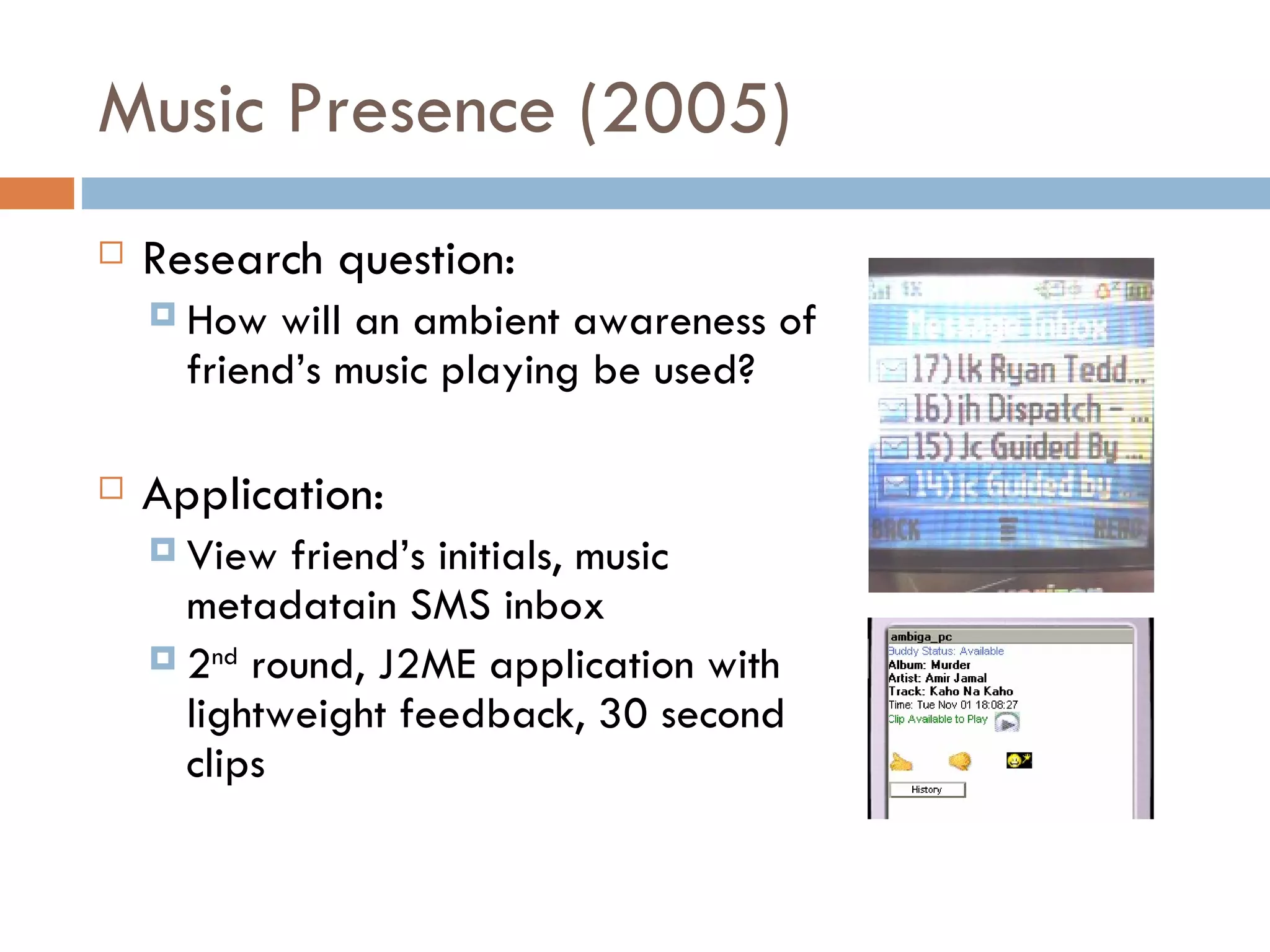
Music Presence (2005) Research question:  How will an ambient awareness of  friend’s music playing be used? Application:  View friend’s initials, music  metadatain SMS inbox 2 nd  round, J2ME application with lightweight feedback, 30 second  clips
Music Presence Build only what you need No code on phone: web service that monitors last.fm feeds and sends SMS to friends Build the experience, not the technology Sent updates over SMS, not fully integrated with last.fm Social groups for social technologies 1 group of 4 friends (initial study) Real context of use Used in their everyday lives for 7 days Primary device Never had to switch phones (just ensured they added SMS plans) Field-based data collection Voicemails and interviews + server logs
Music Presence Findings Used music playing to infer other presence information (at home, bored, etc.) Explicitly played music so that other people would notice (e.g. a song a friend had given) SMS + IM around playback (“that rocks!”) “ I was looking at her [music updates] to see when she’d gotten back from going out.”
Risk Mitigated… Concept successful Further iterations performed Learnings shared with business teams Helped to create more social experience Added lightweight responses (thumbs up/down) Added 30 second clips to help with unfamiliar songs
Photo Sharing Study Objective: To understand how and why people share photos Methods:  5 users Home tours, semi-structured interviews Findings Desire to share photos in-the-moment Sharing photos to particular (and changing) groups of people
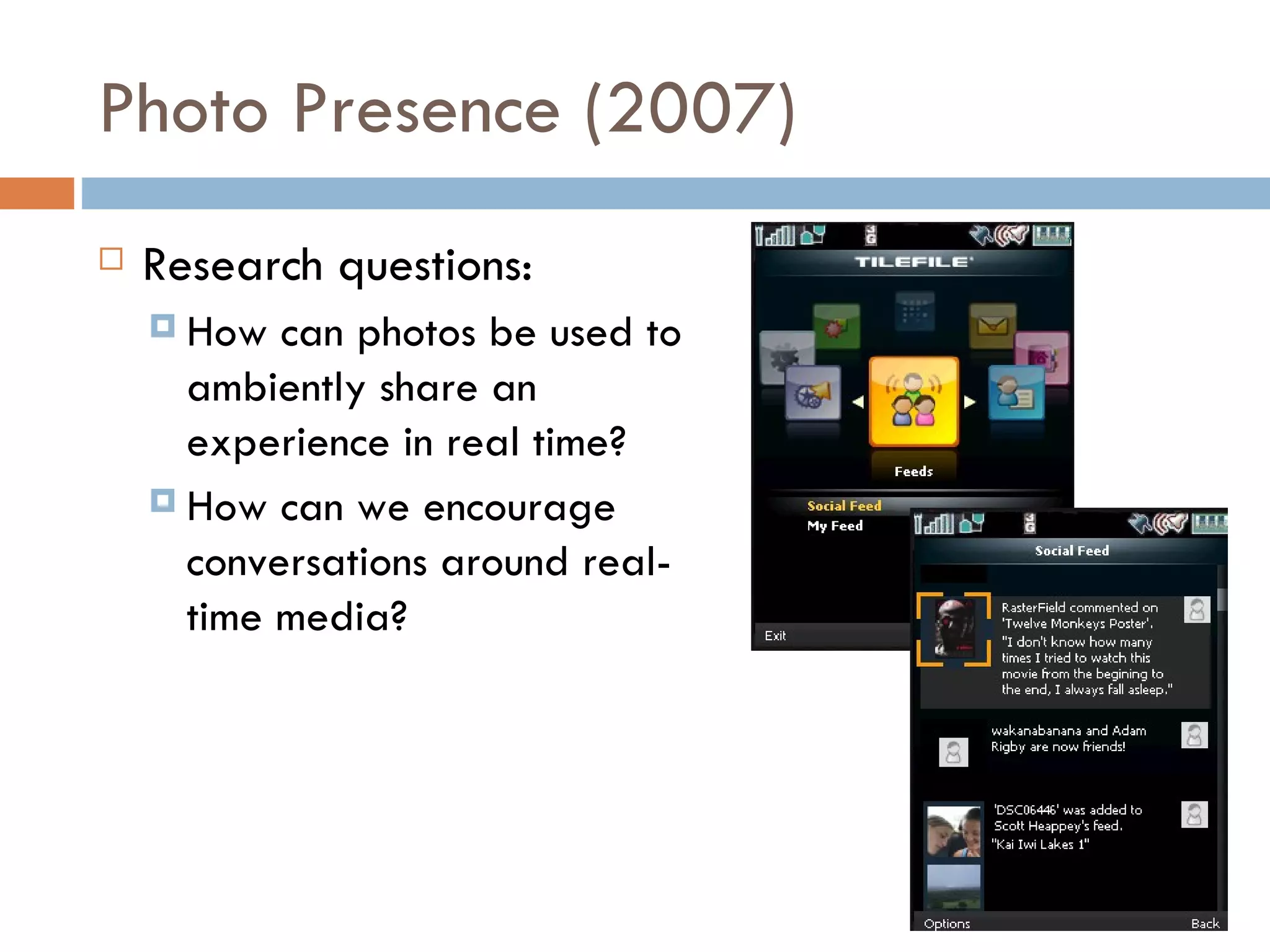
Photo Presence (2007) Research questions:  How can photos be used to ambiently share an experience in real time? How can we encourage conversations around real-time media?
Photo Presence Build only what you need J2ME application built by Sydney startup Build the experience, not the technology Application integrated with existing web service Social groups for social technologies 3 social groups (10 participants) Real context of use Used in their everyday lives for three weeks Primary device Participants were given devices with application preloaded, switched SIM and phonebook Field-based data collection Voicemails and interviews
Photo Presence Findings Telepresence Being able to log on and see what she was doing, like when we were at work and couldn’t talk – B2 There’s something kind of satisfying about the immediacy of right now in California my brother is doing this – B1 Automatic I like it cause I can just take pictures and I don’t have to fuss with it and it gets uploaded. –C3  Communication Looking at people’s tiles and looking at people’s comments on mine.  It shows that they were interested in what I liked.  Took enough time out of their day to make a comment.  To some people that might make their day or brighten up their day – A2
Risk Mitigated… Concept successful Startup continued on path Changes to focus on small-group sharing Learnings helped clarify value prop Automatic, ambient sharing throughout day Small groups of close friends and family Simple communication around media
Overall guiding principles: Keep prototyping simple and focused on your research questions Evaluate with real users in their real situations of interaction Try a lot of ideas and pick ones that stick Iterate!
Benefits: Validate main user value without building full application/service Introduce several cycles of iteration before committing to product Get initial feedback for market segmentation
Principles Build only what you need Build the experience, not the technology Social groups for social technologies Real context of use Primary device Field-based data collection Questions? Discussion?

Prototyping and Field Evaluation as Risk Mitigation in Mobile Product Development

  • 1.
    PROTOTYPING AND FIELDEVALUATION AS RISK MITIGATION IN MOBILE PRODUCT DEVELOPMENT Frank Bentley Motorola Applied Research and Technology Center
  • 2.
    In fewer words…How to decide which experiences to productize with minimal effort.
  • 3.
    Outline Who weare/were How we get ideas What we build How we test Case Study: Ambient Mobile Communications
  • 4.
    Preface Meant toencourage lively discussion Please ask questions at any point!
  • 5.
    Social Media ResearchLab Charter: Invent things that help make people feel more connected 12 “transdiciplinary” researchers – anthropology, human computer interaction, cognitive psychology, computer science, electrical engineering, business Time horizon of 2-5 years to product Work closely with business groups throughout process
  • 6.
    How we getideas… We spend time with people! Contextual Inquiry Home tours Diary studies Activity logs Shadowing Observation
  • 7.
    We collect andanalyze data… From a study on music use: “ Some of my CDs remind me of a time I had and I like to put it on and remember that time I had with it. Fall always gets me in the mood to play music I always listen to. Me and my sisters sitting on the porch and talking in our Nike sweatshirts. We used to play this song over and over when we went to her house” “ I often don’t like listening to the old stuff because…it sometimes takes me back to somewhere I don’t want to be…” “ She made this CD of music that related to them, she had this basket of CDs at the wedding and everyone took one and the bubbles…” Has CDs in a stack with no cases – sorts like playing cards
  • 8.
    Design ideas basedin real data
  • 9.
    Research questions tomitigate risk How does (or doesn’t!) the experience fit into everyday life? What existing solutions do people have to meet this needs? What are existing workarounds? What aspects of our prototype solution need to be optimized in a real product? (is it too slow, not integrated enough, etc.)
  • 10.
    What we build:Several rapid functional prototypes of most promising design ideas from ethnographic work Goal: to decide on experiences that fit into people’s lives and are worth turning into a product Principles: Build only what you need Build the experience, not the technology
  • 11.
  • 12.
    How we test:Small field-research teams (2-3 people) Rapid data collection and analysis 8-10 users, 2-4 weeks (go until you see repetitions in data) Principles: Social groups for social technologies Real context of use Primary device Field-based data collection
  • 13.
    Case Study: AmbientMobile Communications How to use ambient context to aid mobile communication and enhance existing social communities
  • 14.
    Ambient, defined… Datareceived in the environment, without specific effort For mobile: data observable while performing normal tasks on device e.g. integrated into phone book, messaging application, media player
  • 15.
    Case study: AmbientMobile Communications Project goal: Explore how people can communicate passively through ambient cues Initial field work Location Sharing Study Music Sharing Study Photo Context Study Concepts: Motion Presence Music Presence Photo Presence
  • 16.
    Location Sharing StudyObjective: To use current location sharing practices as inspiration for the design of new mobile social applications Methods: Recorded phone calls of 7 participants for one week Analyzed for purpose of location disclosure, place disclosed, social relationships involved, truth Finding: People often know location of close friends and family, but are unaware of exact transitions
  • 17.
    Motion Presence (2006)Micro-coordination: The conversation and planning that occurs around planning to meet Research questions: Will knowing if someone is in motion or at a place help people micro-coordinate? Does not sharing the location itself mitigate privacy concerns?
  • 18.
    Motion Presence Buildonly what you need Built simple phonebook (call, text, name, number, motion only) 1 person-week of development Build the experience, not the technology Sent presence over port-based SMS Social groups for social technologies 4 groups of friends/family (10 total) Real context of use Used in their everyday lives for two weeks Primary device Moved SIM and phonebook into our phone for duration of trial Field-based data collection Voicemails and interviews + usage logs
  • 19.
    Motion Presence: FindingsParticipants were able to infer: Location, Activity, Availability, Arrival Time, Destination Participants used the application to: Moderate availability Micro-coordinate Arrive at the same time Get more time at their current activity See people were following through on commitments Check on other’s safety Social awareness – know what’s going on with others Privacy not a major concern given plausible deniability
  • 20.
    Risk Mitigated… Whileresearch hypotheses confirmed, business case not there Application not heavily used Participants did not want to continue using service Calling others seen as sufficient solution Concepts of ambient micro-coordination useful Lessons learned to design future applications in the business Concept of inference from ambiguous social data
  • 21.
    Music Context StudyObjective: Understand how context plays a role in music selection, playback, and sharing Methods: 12 participants Home tour, contextual inquiry, semi-structured interviews Findings: Music knowledge often comes from friends Music choice often depends on occasion, who is around
  • 22.
    Music Presence (2005)Research question: How will an ambient awareness of friend’s music playing be used? Application: View friend’s initials, music metadatain SMS inbox 2 nd round, J2ME application with lightweight feedback, 30 second clips
  • 23.
    Music Presence Buildonly what you need No code on phone: web service that monitors last.fm feeds and sends SMS to friends Build the experience, not the technology Sent updates over SMS, not fully integrated with last.fm Social groups for social technologies 1 group of 4 friends (initial study) Real context of use Used in their everyday lives for 7 days Primary device Never had to switch phones (just ensured they added SMS plans) Field-based data collection Voicemails and interviews + server logs
  • 24.
    Music Presence FindingsUsed music playing to infer other presence information (at home, bored, etc.) Explicitly played music so that other people would notice (e.g. a song a friend had given) SMS + IM around playback (“that rocks!”) “ I was looking at her [music updates] to see when she’d gotten back from going out.”
  • 25.
    Risk Mitigated… Conceptsuccessful Further iterations performed Learnings shared with business teams Helped to create more social experience Added lightweight responses (thumbs up/down) Added 30 second clips to help with unfamiliar songs
  • 26.
    Photo Sharing StudyObjective: To understand how and why people share photos Methods: 5 users Home tours, semi-structured interviews Findings Desire to share photos in-the-moment Sharing photos to particular (and changing) groups of people
  • 27.
    Photo Presence (2007)Research questions: How can photos be used to ambiently share an experience in real time? How can we encourage conversations around real-time media?
  • 28.
    Photo Presence Buildonly what you need J2ME application built by Sydney startup Build the experience, not the technology Application integrated with existing web service Social groups for social technologies 3 social groups (10 participants) Real context of use Used in their everyday lives for three weeks Primary device Participants were given devices with application preloaded, switched SIM and phonebook Field-based data collection Voicemails and interviews
  • 29.
    Photo Presence FindingsTelepresence Being able to log on and see what she was doing, like when we were at work and couldn’t talk – B2 There’s something kind of satisfying about the immediacy of right now in California my brother is doing this – B1 Automatic I like it cause I can just take pictures and I don’t have to fuss with it and it gets uploaded. –C3 Communication Looking at people’s tiles and looking at people’s comments on mine. It shows that they were interested in what I liked. Took enough time out of their day to make a comment. To some people that might make their day or brighten up their day – A2
  • 30.
    Risk Mitigated… Conceptsuccessful Startup continued on path Changes to focus on small-group sharing Learnings helped clarify value prop Automatic, ambient sharing throughout day Small groups of close friends and family Simple communication around media
  • 31.
    Overall guiding principles:Keep prototyping simple and focused on your research questions Evaluate with real users in their real situations of interaction Try a lot of ideas and pick ones that stick Iterate!
  • 32.
    Benefits: Validate mainuser value without building full application/service Introduce several cycles of iteration before committing to product Get initial feedback for market segmentation
  • 33.
    Principles Build onlywhat you need Build the experience, not the technology Social groups for social technologies Real context of use Primary device Field-based data collection Questions? Discussion?