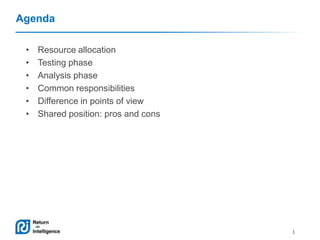
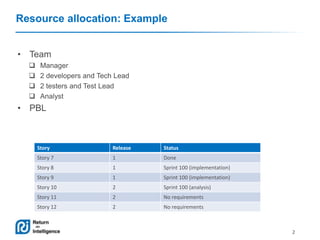
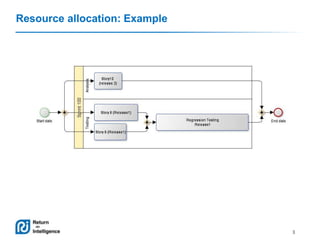
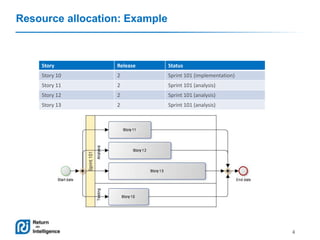
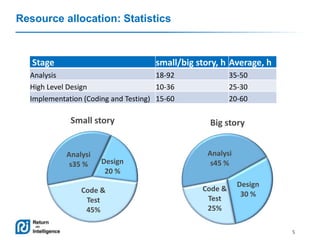
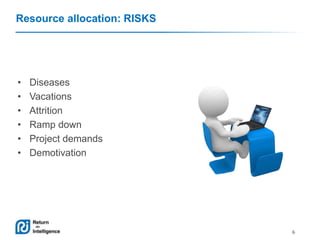
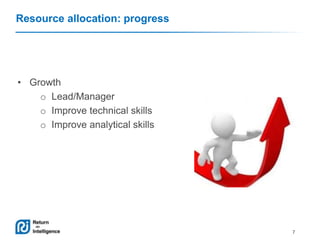
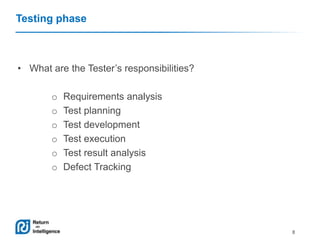
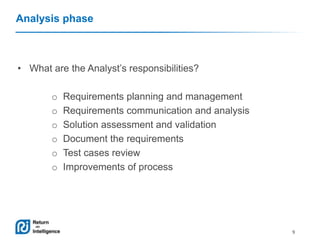
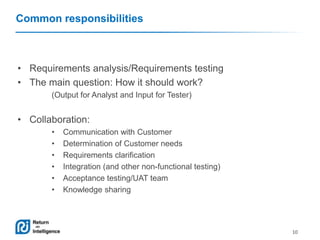
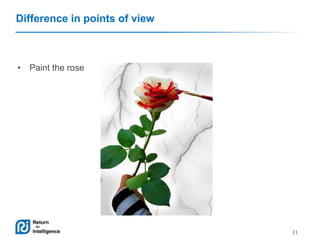
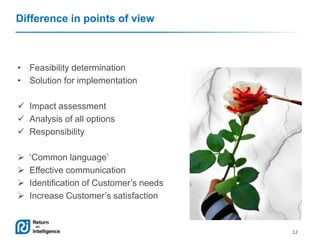
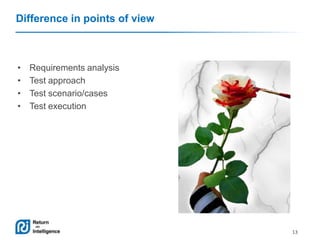
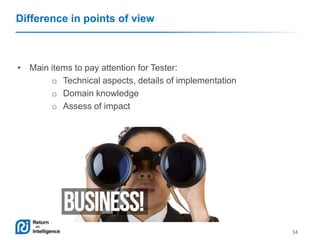
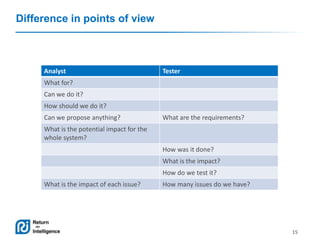
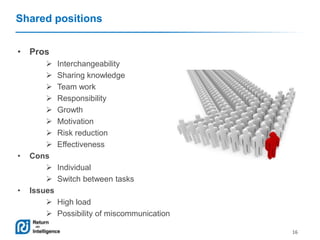
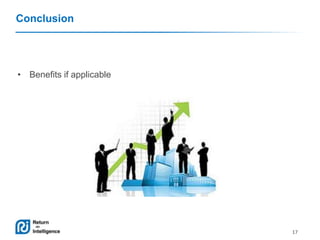


The document discusses resource allocation and shared responsibilities among team members during the testing and analysis phases of a project. It outlines the roles of testers and analysts, their responsibilities, and the challenges faced, including risks and differences in perspectives. Additionally, it highlights the pros and cons of shared positions within the team to improve collaboration and effectiveness.


![[HCMC STC Jan 2015] How To Work Effectively As a Tester in Agile Teams](https://cdn.slidesharecdn.com/ss_thumbnails/anlehowtoworkeffectivelyasatesterinagileteams-150208211133-conversion-gate01-thumbnail.jpg?width=640&height=640&fit=bounds)
![[Paul Holland] Trends in Software Testing](https://cdn.slidesharecdn.com/ss_thumbnails/paulhollandtrendsinswtesting-140717230533-phpapp01-thumbnail.jpg?width=640&height=640&fit=bounds)


![[Paul Holland] Bad Metrics and What You Can Do About It](https://cdn.slidesharecdn.com/ss_thumbnails/paulhollandbadmetricsandwhatyou-140717230402-phpapp02-thumbnail.jpg?width=640&height=640&fit=bounds)

![[Vu Van Nguyen] Value-based Software Testing an Approach to Prioritizing Tests](https://cdn.slidesharecdn.com/ss_thumbnails/vuvannguyen-value-basedsoftwaretestinganapproachtoprioritizingtests-140717231415-phpapp02-thumbnail.jpg?width=640&height=640&fit=bounds)
![[HCMC STC Jan 2015] Risk-Based Software Testing Approaches](https://cdn.slidesharecdn.com/ss_thumbnails/vuvnguyen-risk-basedtesting-150209013653-conversion-gate02-thumbnail.jpg?width=640&height=640&fit=bounds)


![[Thao Vo] Deadly Traps of Automation Testing](https://cdn.slidesharecdn.com/ss_thumbnails/thaovodeadlytrapsofautomationtesting-140717230807-phpapp02-thumbnail.jpg?width=640&height=640&fit=bounds)


