
Shaping the Future
of Travel with
MongoDB
©2014AmadeusITGroupSA
Real-Time Analytics
with MongoDB
Attila Tozser, Amadeus Data
Processing GmbH, 12.11.2014.
Munich MongoDB Days
Page 2
Agenda
©2014AmadeusITGroupSA
_ Amadeus IT Group
_ DevOps considerations
_ Real-time analytics
_ Deployment customization
1
2
3
4
Amadeus IT Group and
Amadeus Global Operations
1
©2014AmadeusITGroupSA
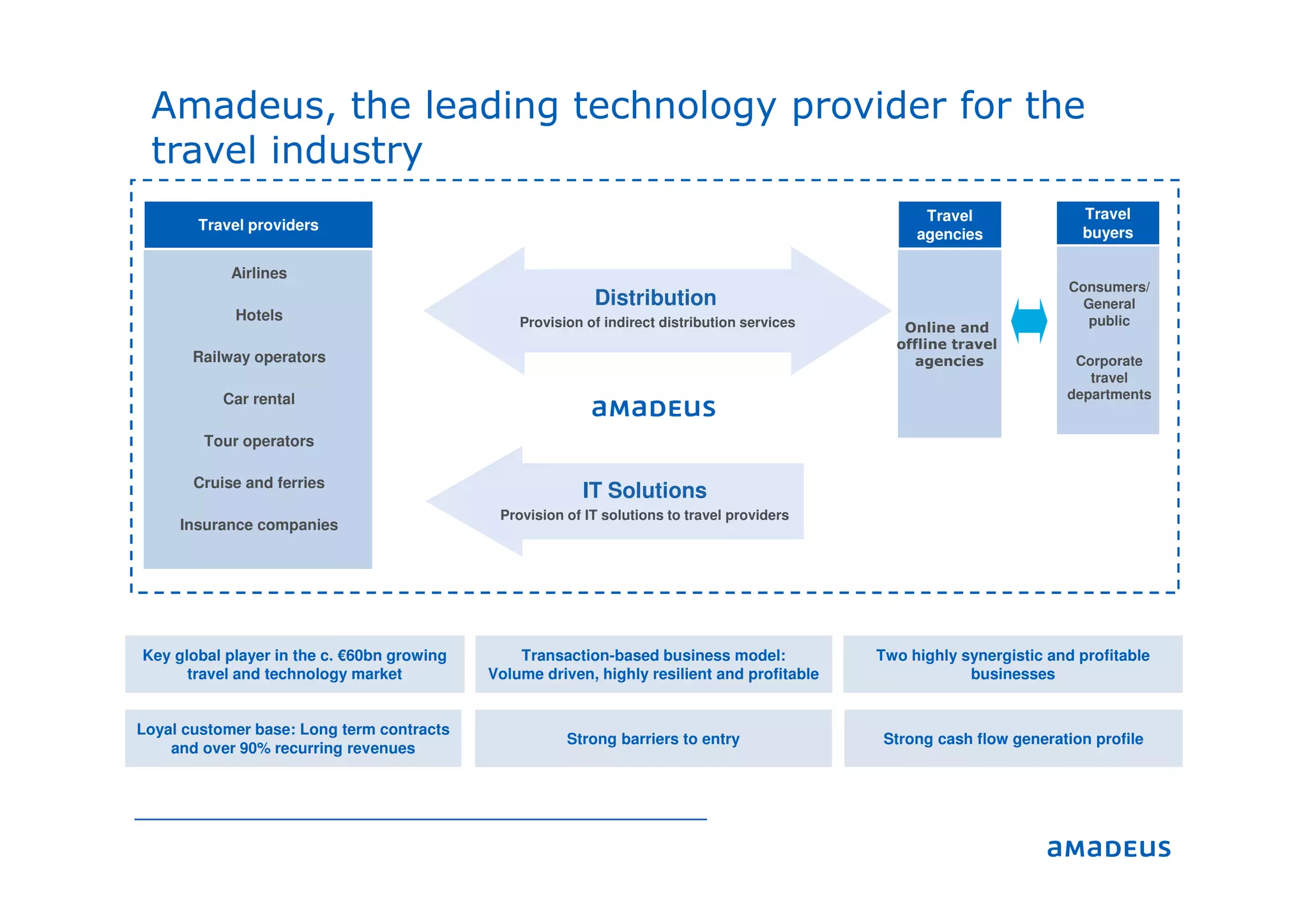
Amadeus, the leading technology provider for the
travel industry
Transaction-based business model:
Volume driven, highly resilient and profitable
Key global player in the c. €60bn growing
travel and technology market
Two highly synergistic and profitable
businesses
Loyal customer base: Long term contracts
and over 90% recurring revenues
Strong cash flow generation profile
Consumers/
General
public
Corporate
travel
departments
Online and
offline travel
agencies
IT Solutions
Provision of IT solutions to travel providers
Travel
agencies
Distribution
Provision of indirect distribution services
Travel
buyers
Airlines
Hotels
Railway operators
Car rental
Tour operators
Cruise and ferries
Insurance companies
Travel providers
Strong barriers to entry
Page 5
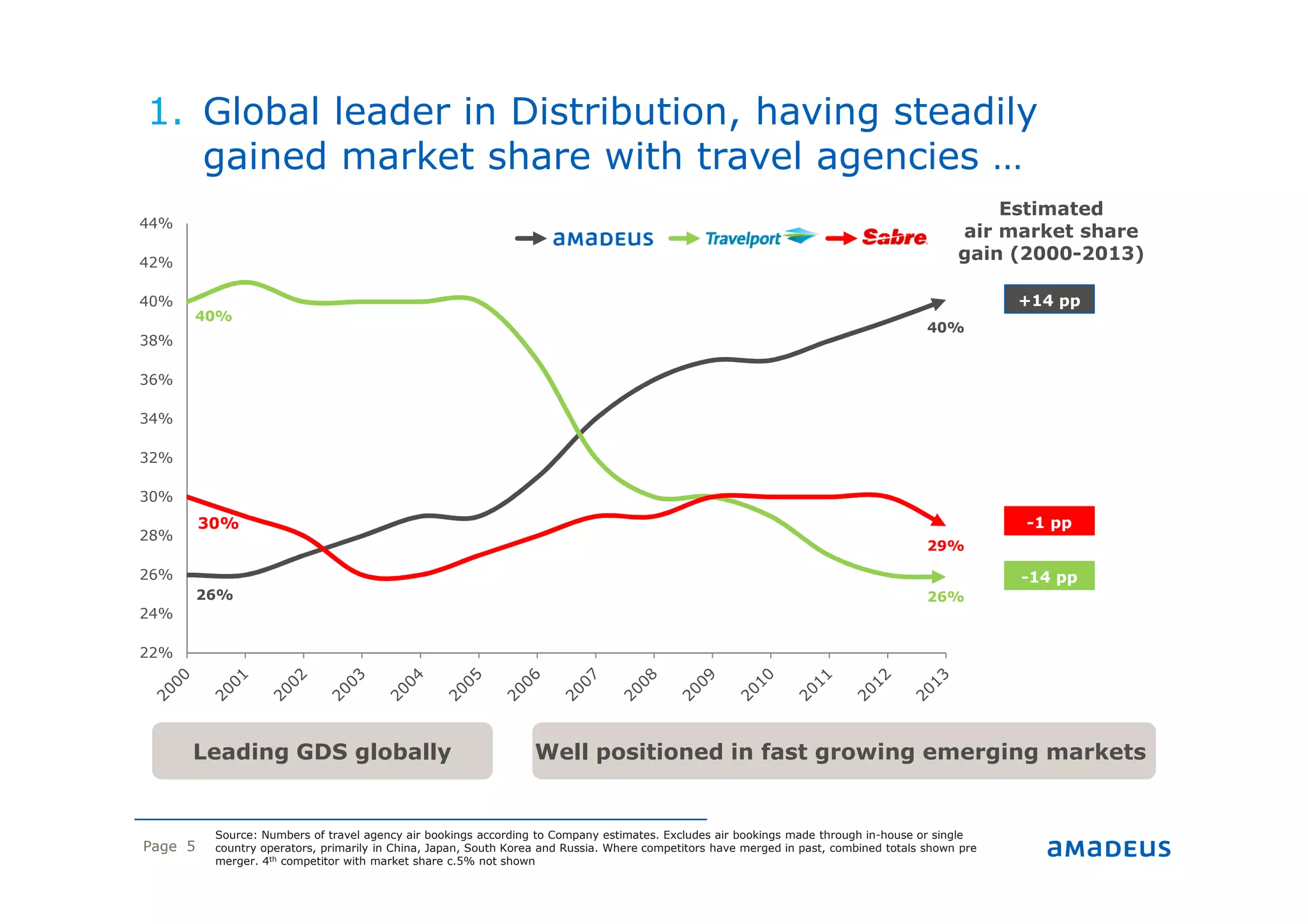
26%
40%
40%
26%
30%
29%
22%
24%
26%
28%
30%
32%
34%
36%
38%
40%
42%
44%
Amadeus Travelport Sabre
-1 pp
-14 pp
+14 pp
Estimated
air market share
gain (2000-2013)
Source: Numbers of travel agency air bookings according to Company estimates. Excludes air bookings made through in-house or single
country operators, primarily in China, Japan, South Korea and Russia. Where competitors have merged in past, combined totals shown pre
merger. 4th competitor with market share c.5% not shown
Leading GDS globally Well positioned in fast growing emerging markets
1. Global leader in Distribution, having steadily
gained market share with travel agencies …
Page 6
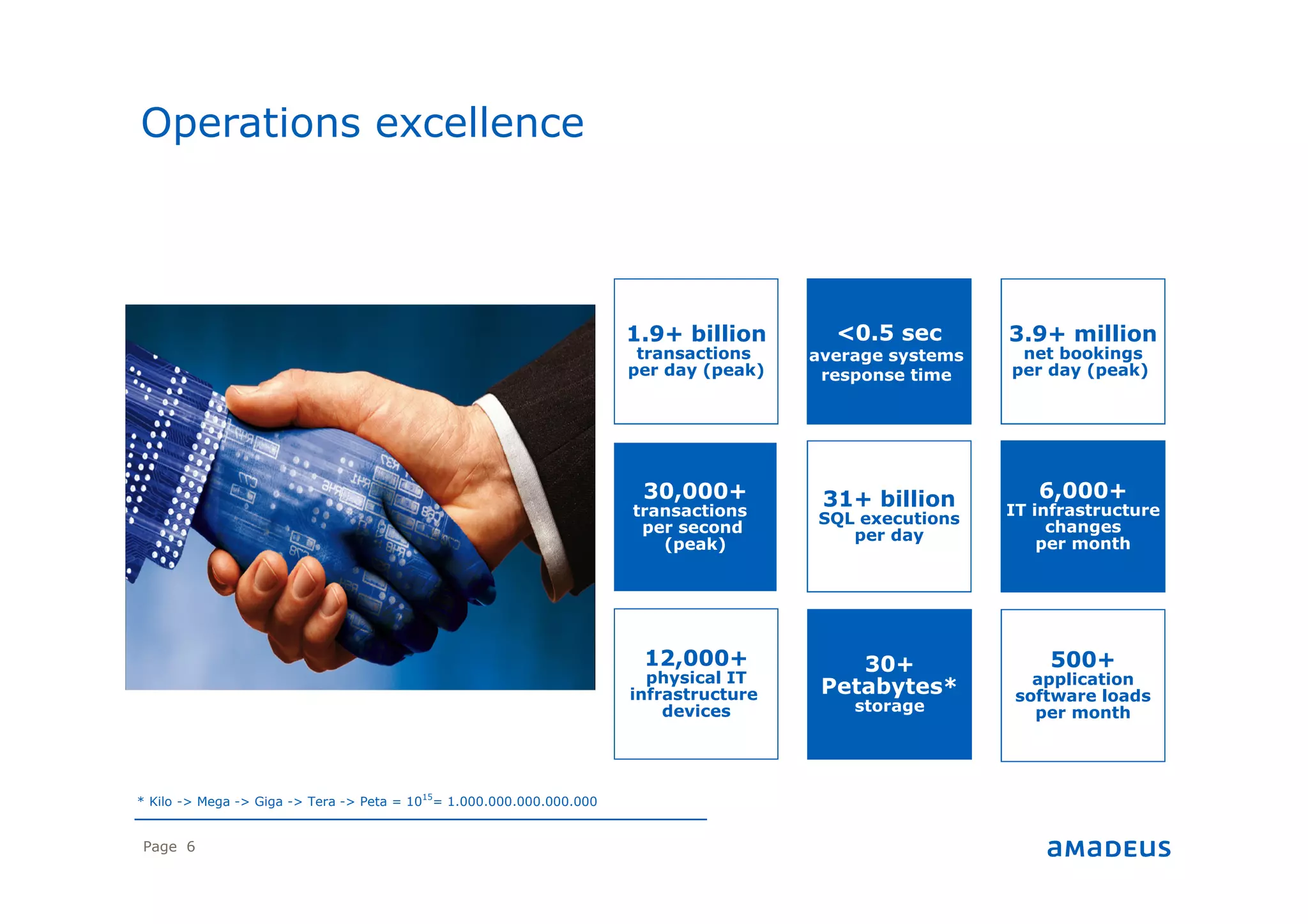
Operations excellence
1.9+ billion
transactions
per day (peak)
30+
Petabytes*
storage
500+
application
software loads
per month
6,000+
IT infrastructure
changes
per month
<0.5 sec
average systems
response time
3.9+ million
net bookings
per day (peak)
31+ billion
SQL executions
per day
30,000+
transactions
per second
(peak)
12,000+
physical IT
infrastructure
devices
* Kilo -> Mega -> Giga -> Tera -> Peta = 1015
= 1.000.000.000.000.000
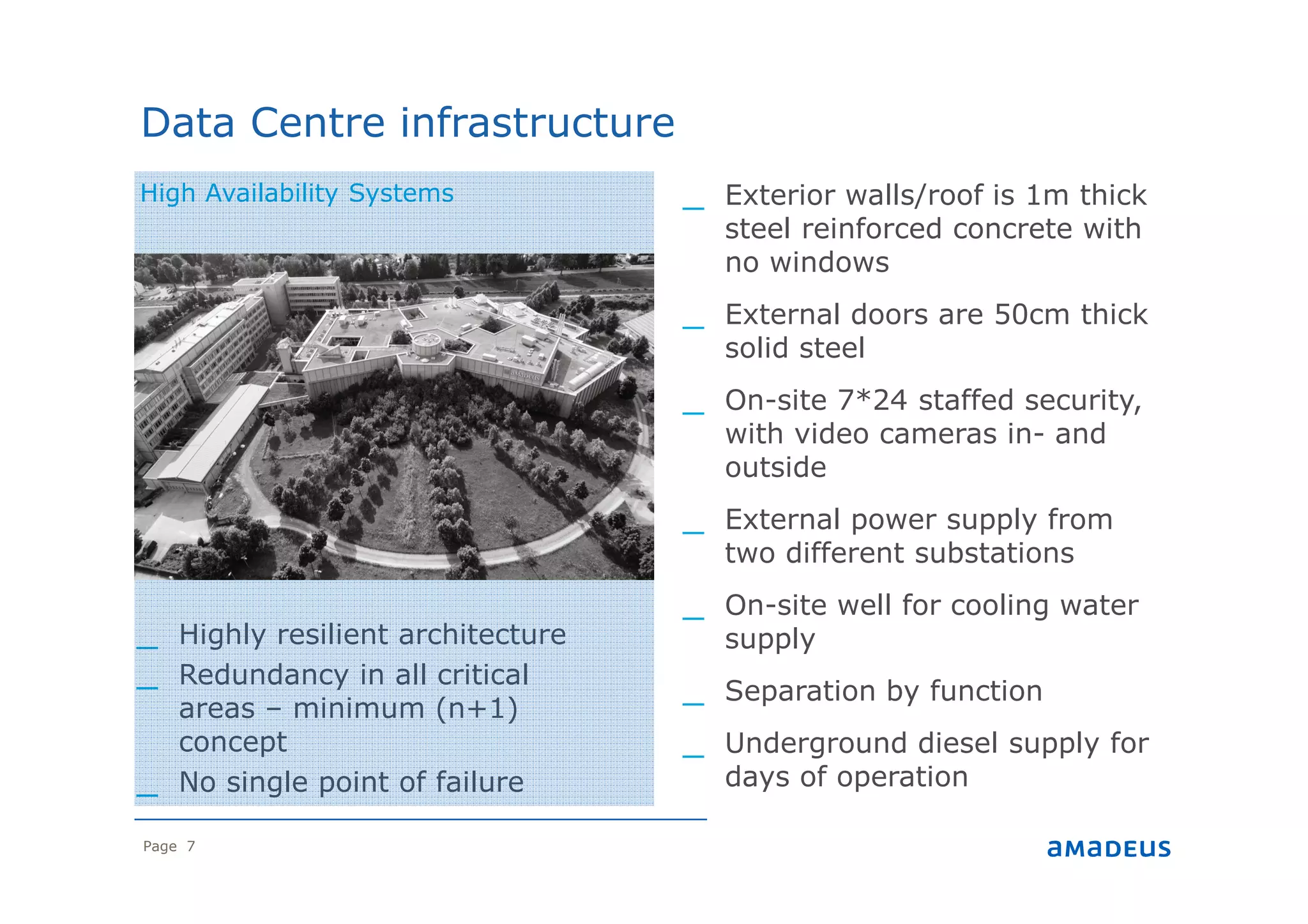
Page 7
_ Exterior walls/roof is 1m thick
steel reinforced concrete with
no windows
_ External doors are 50cm thick
solid steel
_ On-site 7*24 staffed security,
with video cameras in- and
outside
_ External power supply from
two different substations
_ On-site well for cooling water
supply
_ Separation by function
_ Underground diesel supply for
days of operation
Data Centre infrastructure
High Availability Systems
_ Highly resilient architecture
_ Redundancy in all critical
areas – minimum (n+1)
concept
_ No single point of failure
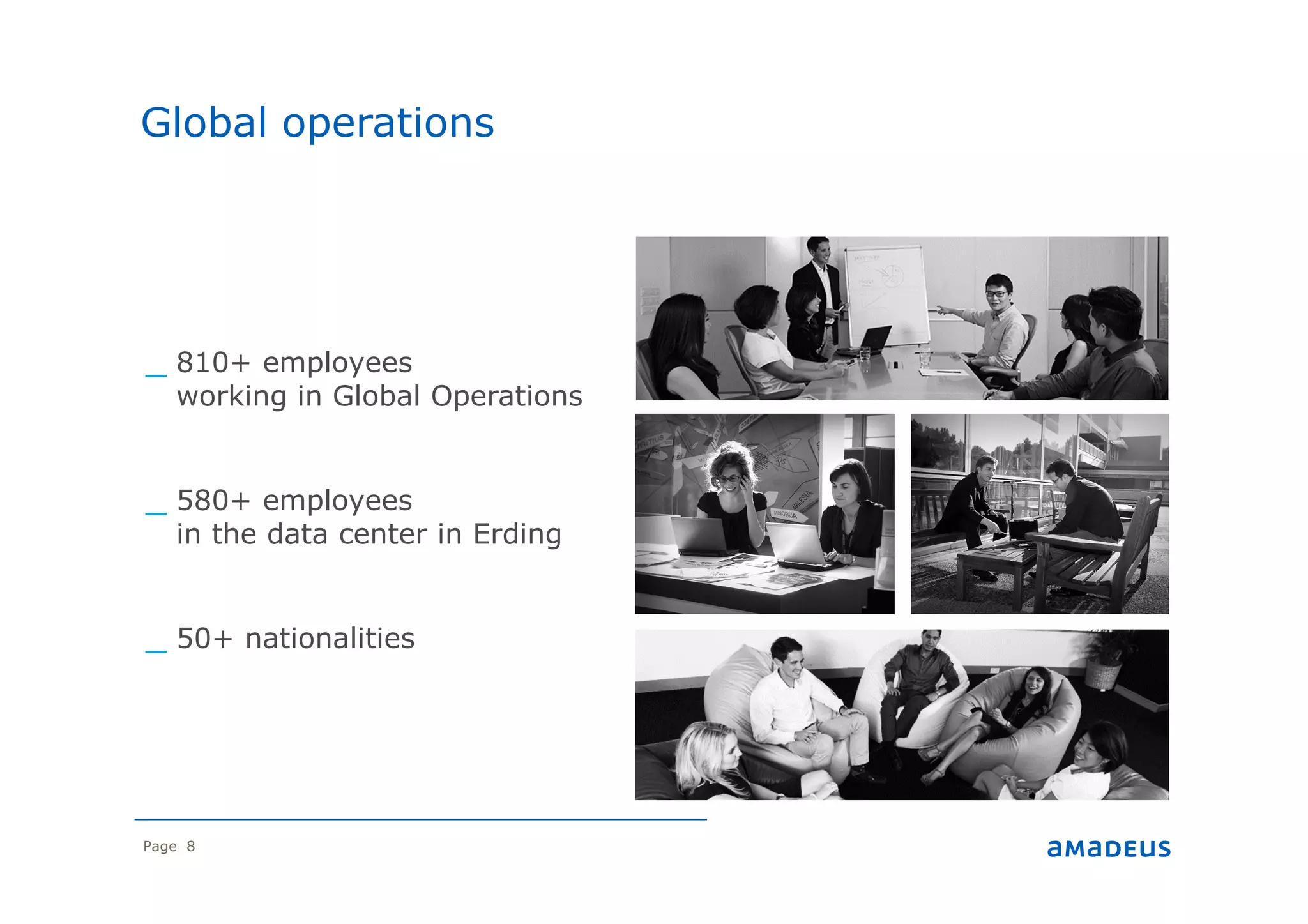
Page 8
_ 810+ employees
working in Global Operations
_ 580+ employees
in the data center in Erding
_ 50+ nationalities
Global operations
DevOps considerations
2
©2014AmadeusITGroupSA
Page 10
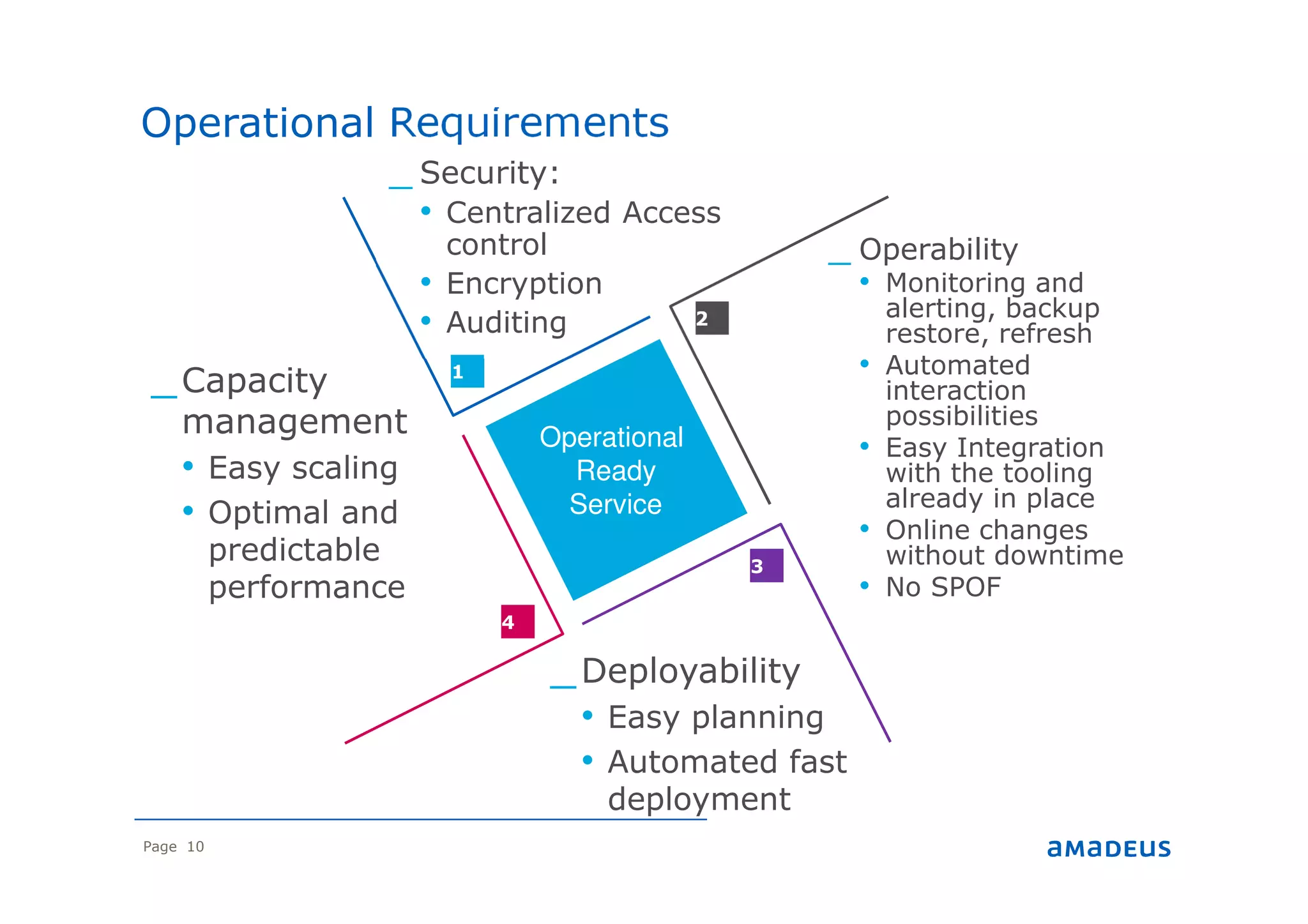
Operational Requirements
1
2
3
4
Operational
Ready
Service
_ Security:
• Centralized Access
control
• Encryption
• Auditing
_ Operability
• Monitoring and
alerting, backup
restore, refresh
• Automated
interaction
possibilities
• Easy Integration
with the tooling
already in place
• Online changes
without downtime
• No SPOF
_Deployability
• Easy planning
• Automated fast
deployment
_Capacity
management
• Easy scaling
• Optimal and
predictable
performance
Page 11
©2014AmadeusITGroupSA
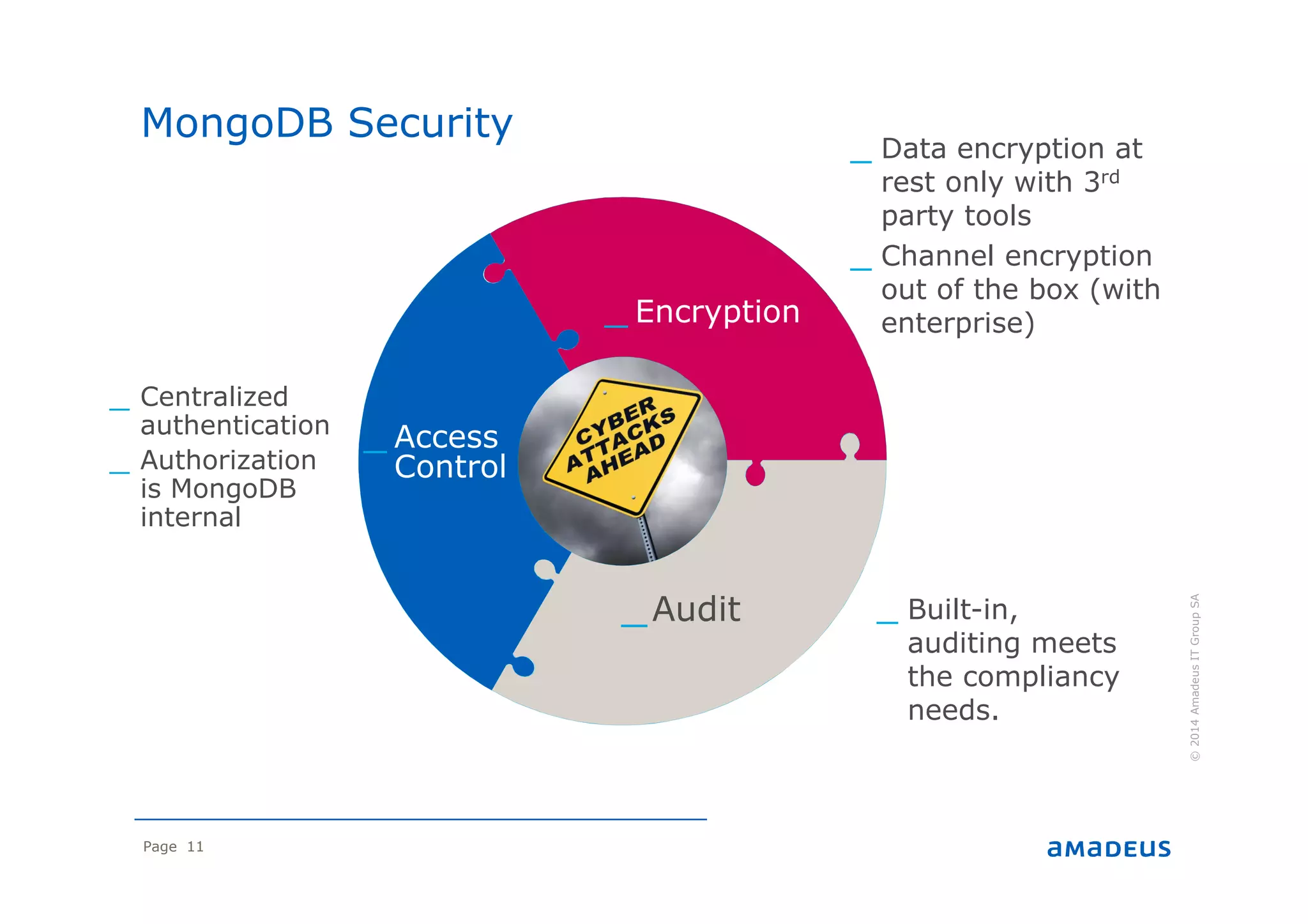
MongoDB Security
_ Centralized
authentication
_ Authorization
is MongoDB
internal
_ Access
Control
_ Encryption
_Audit
_ Data encryption at
rest only with 3rd
party tools
_ Channel encryption
out of the box (with
enterprise)
_ Built-in,
auditing meets
the compliancy
needs.
Page 12
©2014AmadeusITGroupSA
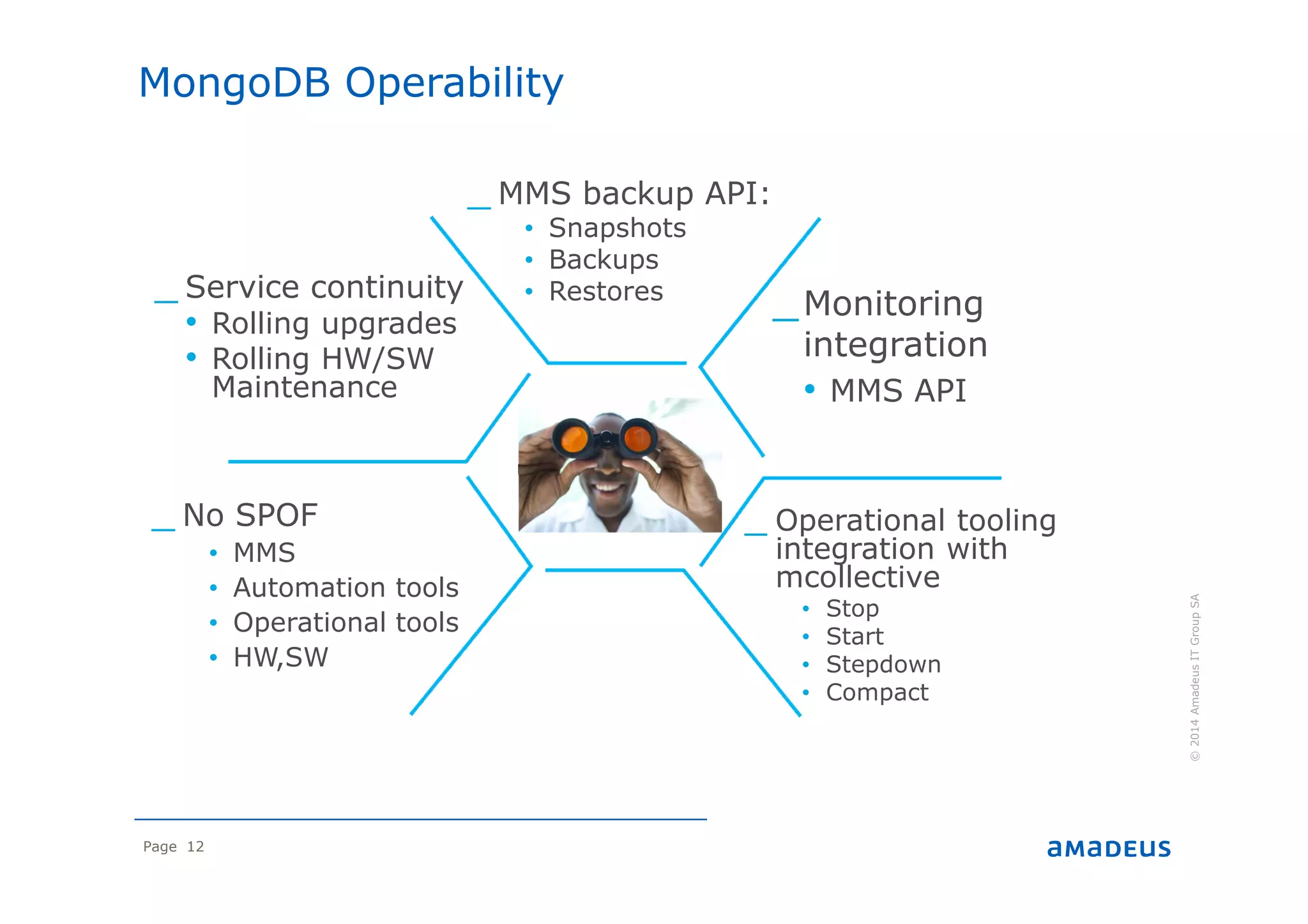
_ MMS backup API:
• Snapshots
• Backups
• Restores
_ Operational tooling
integration with
mcollective
• Stop
• Start
• Stepdown
• Compact
_Monitoring
integration
• MMS API
_ Service continuity
• Rolling upgrades
• Rolling HW/SW
Maintenance
_ No SPOF
• MMS
• Automation tools
• Operational tools
• HW,SW
MongoDB Operability
Page 13
©2014AmadeusITGroupSA
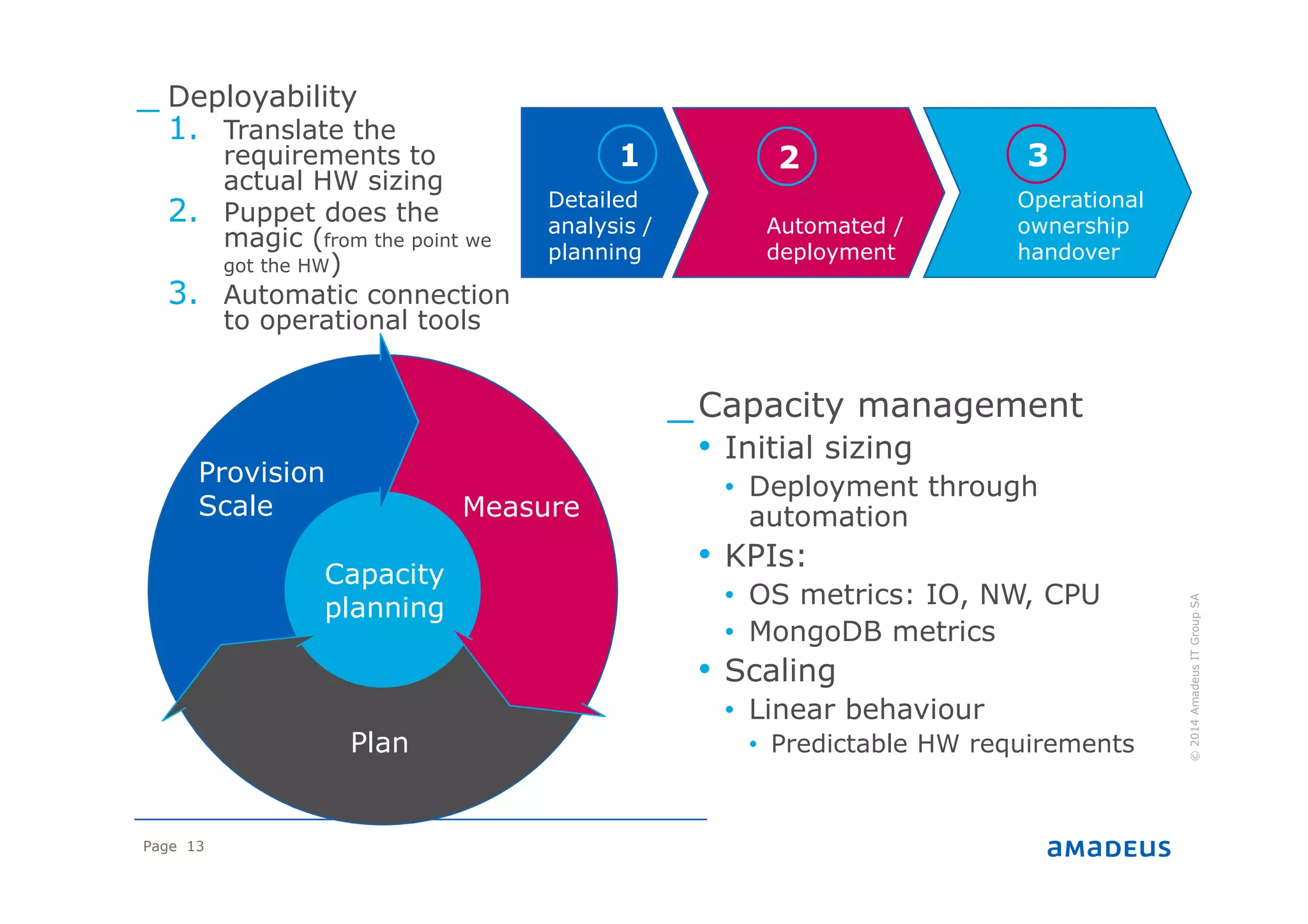
_ Deployability
1. Translate the
requirements to
actual HW sizing
2. Puppet does the
magic (from the point we
got the HW)
3. Automatic connection
to operational tools
_Capacity management
• Initial sizing
• Deployment through
automation
• KPIs:
• OS metrics: IO, NW, CPU
• MongoDB metrics
• Scaling
• Linear behaviour
• Predictable HW requirements
Capacity
planning
Provision
Scale Measure
Plan
Detailed
analysis /
planning
Automated /
deployment
Operational
ownership
handover
21 3
Page 14
©2014AmadeusITGroupSA
Plan
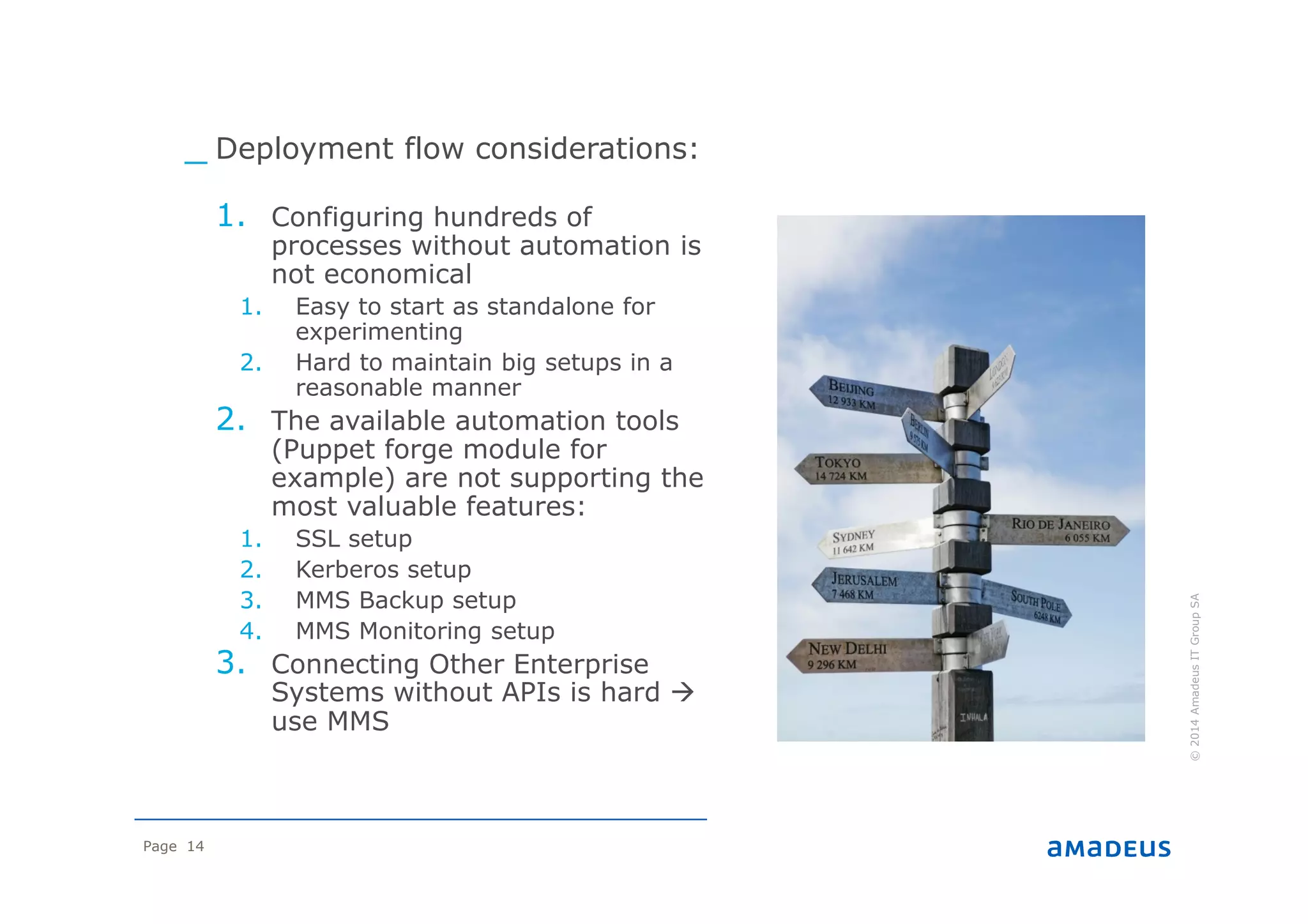
_ Deployment flow considerations:
1. Configuring hundreds of
processes without automation is
not economical
1. Easy to start as standalone for
experimenting
2. Hard to maintain big setups in a
reasonable manner
2. The available automation tools
(Puppet forge module for
example) are not supporting the
most valuable features:
1. SSL setup
2. Kerberos setup
3. MMS Backup setup
4. MMS Monitoring setup
3. Connecting Other Enterprise
Systems without APIs is hard
use MMS
Real-time analytics with
MongoDB
3
©2014AmadeusITGroupSA
Page 16
©2014AmadeusITGroupSA
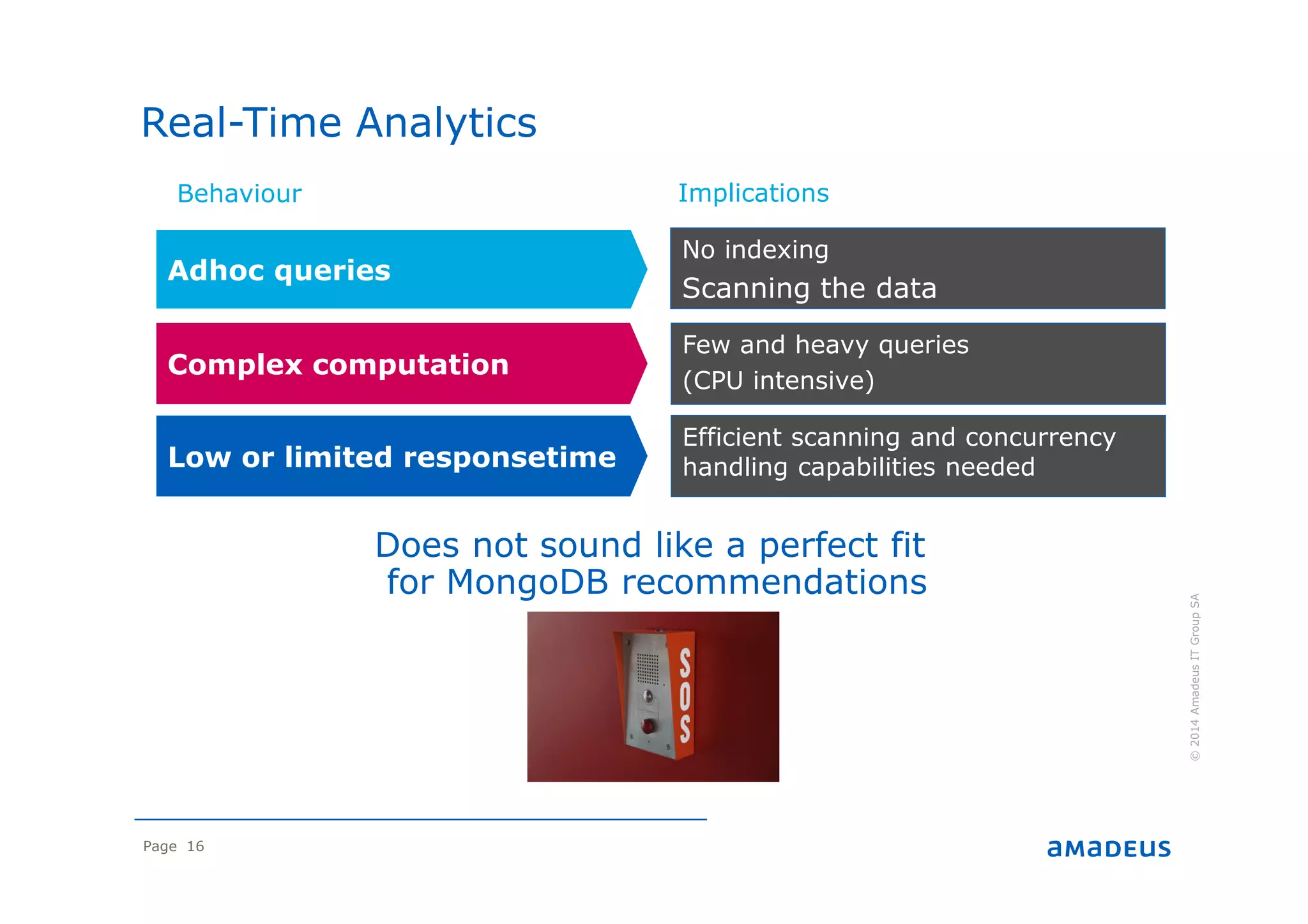
No indexing
Scanning the data
Efficient scanning and concurrency
handling capabilities needed
Few and heavy queries
(CPU intensive)
Adhoc queries
Low or limited responsetime
Complex computation
Real-Time Analytics
Behaviour Implications
Does not sound like a perfect fit
for MongoDB recommendations
Page 17
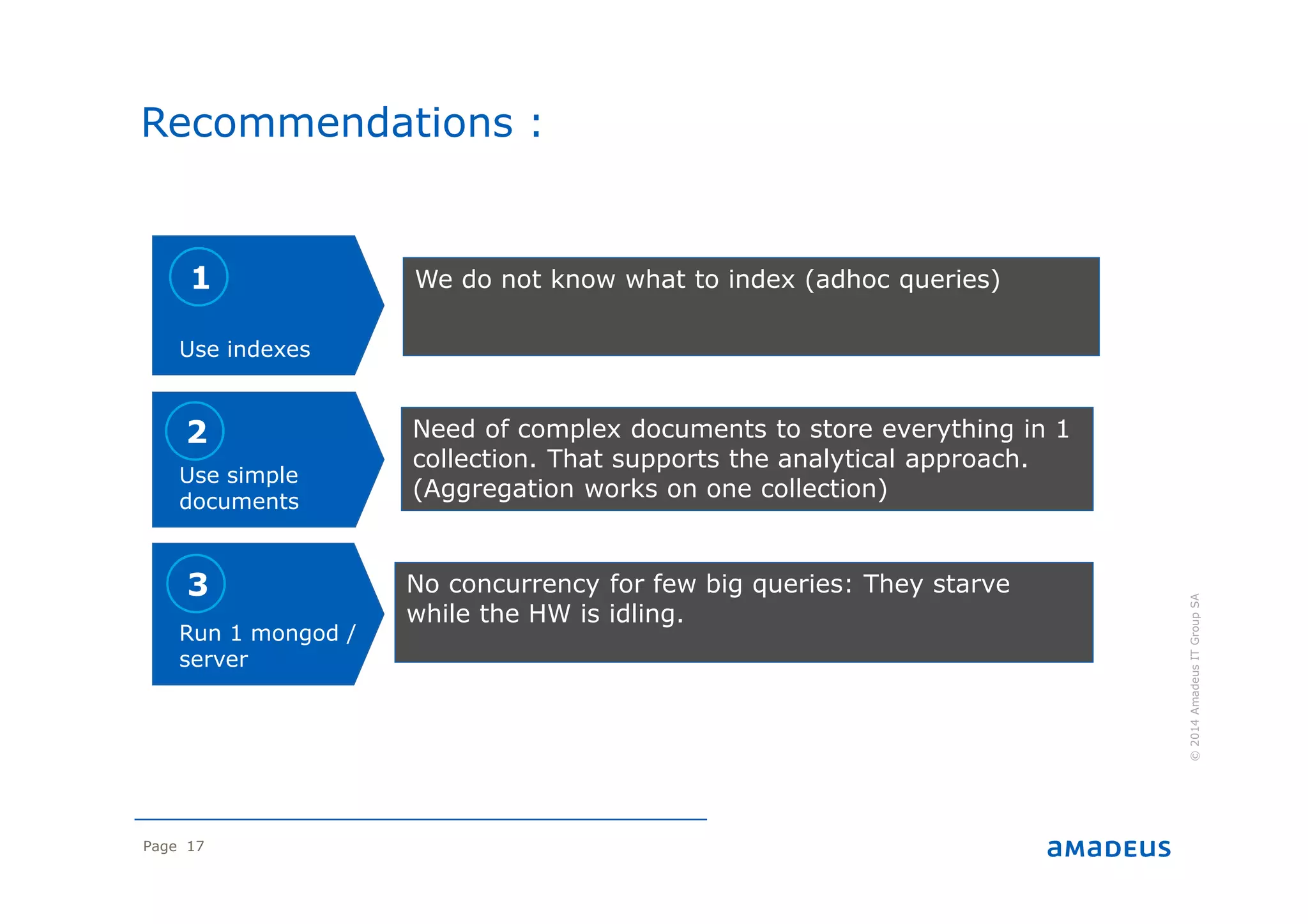
Run 1 mongod /
server
Use simple
documents
2
©2014AmadeusITGroupSA
Recommendations :
We do not know what to index (adhoc queries)
Need of complex documents to store everything in 1
collection. That supports the analytical approach.
(Aggregation works on one collection)
No concurrency for few big queries: They starve
while the HW is idling.
Use indexes
1
3
Page 18
©2014AmadeusITGroupSA
_Able to fit to the purpose
_Ease of development
• Dynamic schema
• Rich document structure
• Rich query language
_Ease of operations
• No need for special HW
• No shared storage
• Runs on standard x86
• Good security features
• SSL channel encryption
• Kerberos, LDAP auth
• Configurable clustering features
• Replication
• Sharding
• Linear scalability
_Aggregation framework
• Provides the analytical
functionality
• Improvements in 2.6:
• Cursor
• $out
Advantages of MongoDB
Page 19
©2014AmadeusITGroupSA
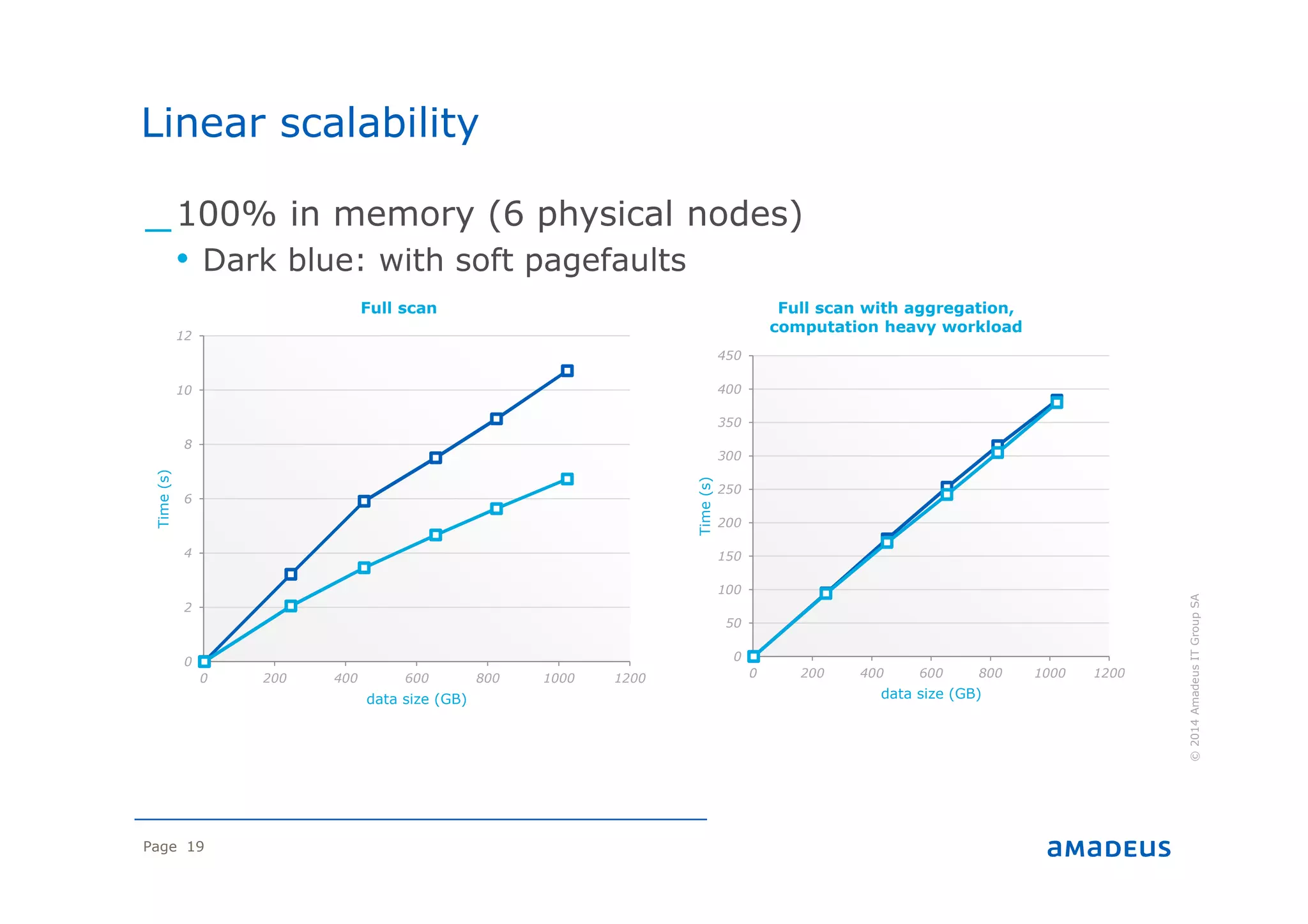
_100% in memory (6 physical nodes)
• Dark blue: with soft pagefaults
Linear scalability
0
2
4
6
8
10
12
0 200 400 600 800 1000 1200
Time(s)
data size (GB)
Full scan
0
50
100
150
200
250
300
350
400
450
0 200 400 600 800 1000 1200
Time(s)
data size (GB)
Full scan with aggregation,
computation heavy workload
MongoDB Deployment
customization
4
©2014AmadeusITGroupSA
Page 21
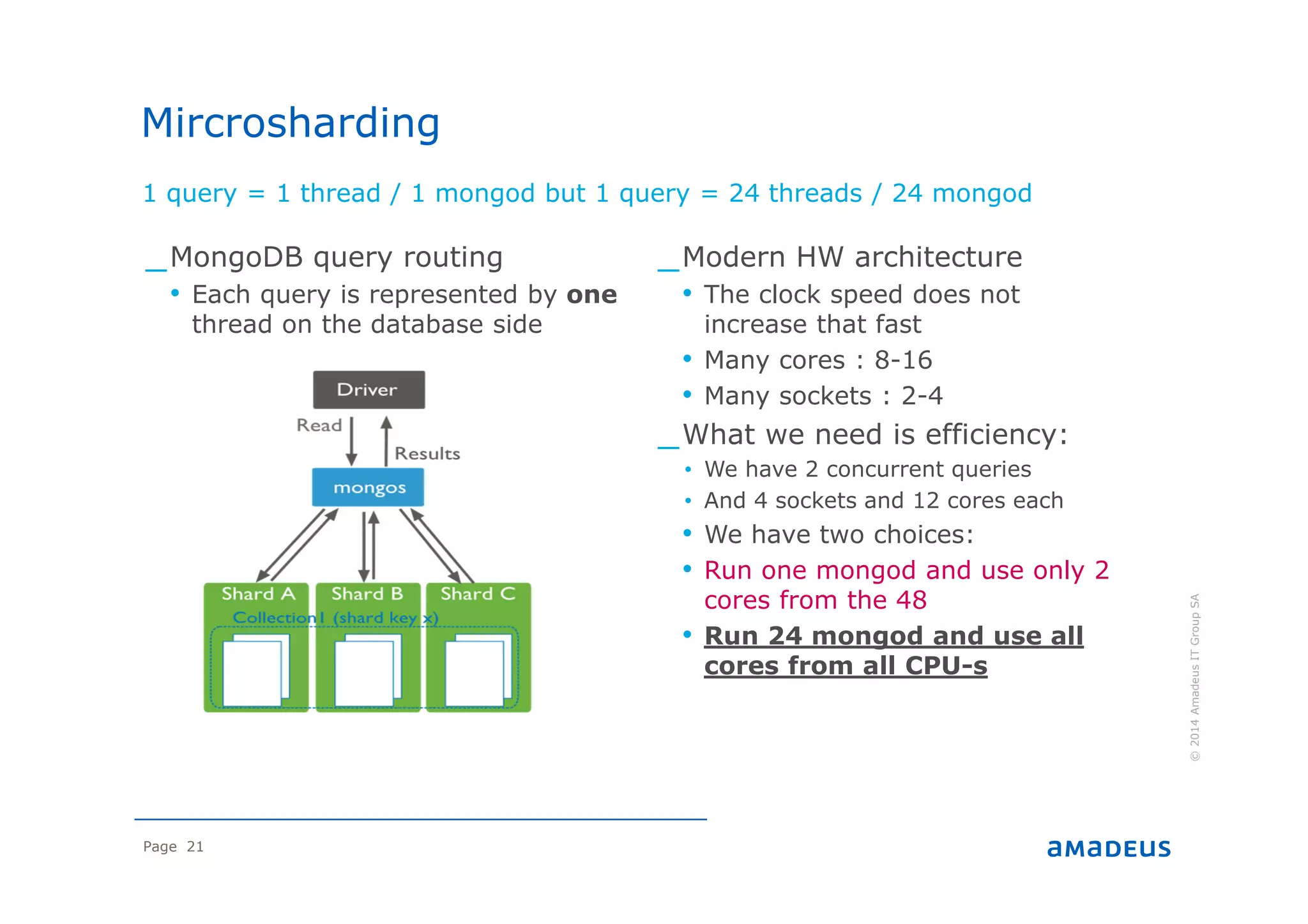
1 query = 1 thread / 1 mongod but 1 query = 24 threads / 24 mongod
©2014AmadeusITGroupSA
_MongoDB query routing
• Each query is represented by one
thread on the database side
_Modern HW architecture
• The clock speed does not
increase that fast
• Many cores : 8-16
• Many sockets : 2-4
_What we need is efficiency:
• We have 2 concurrent queries
• And 4 sockets and 12 cores each
• We have two choices:
• Run one mongod and use only 2
cores from the 48
• Run 24 mongod and use all
cores from all CPU-s
Mircrosharding
Page 22
©2014AmadeusITGroupSA
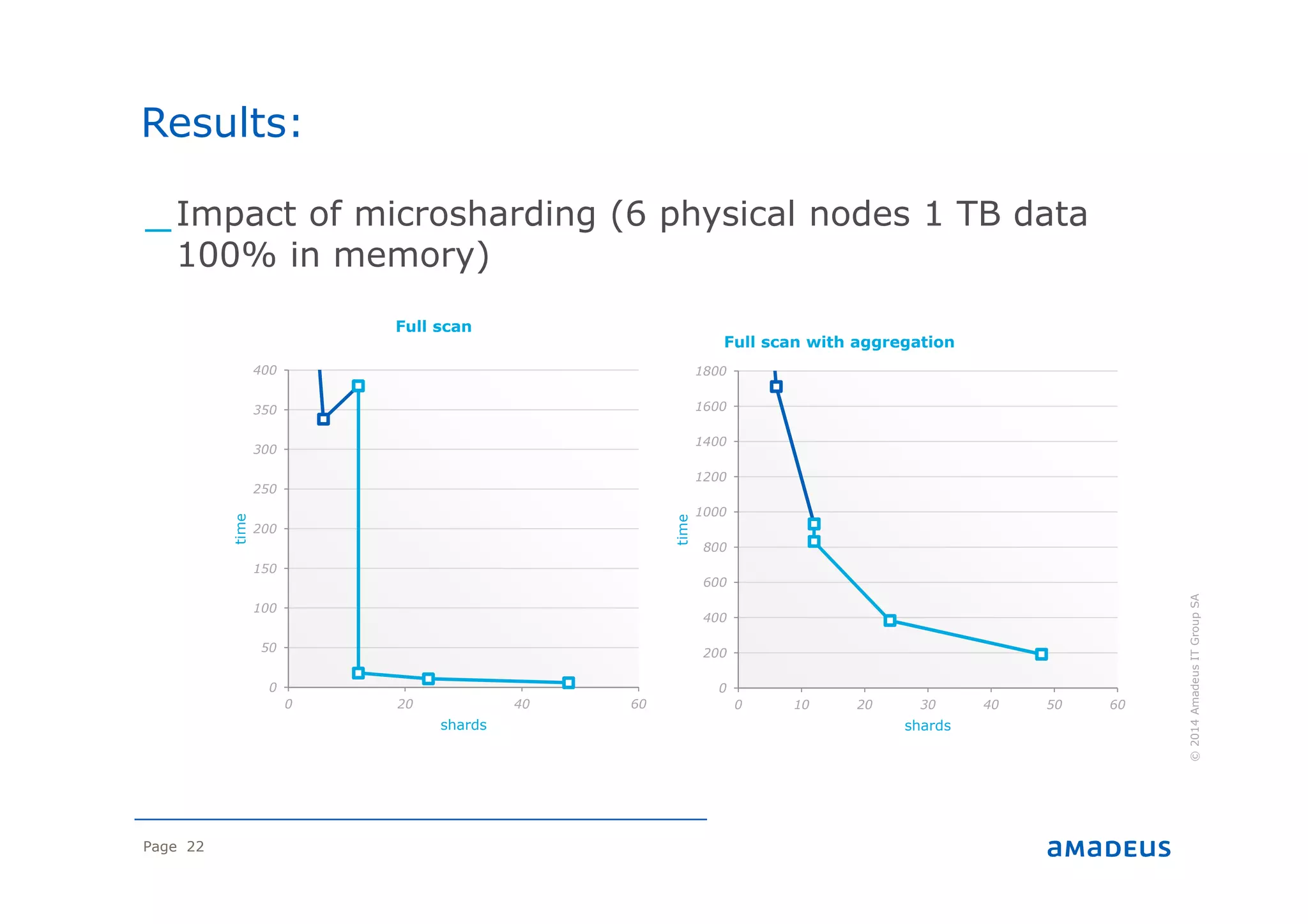
_Impact of microsharding (6 physical nodes 1 TB data
100% in memory)
Results:
0
50
100
150
200
250
300
350
400
0 20 40 60
time
shards
Full scan
0
200
400
600
800
1000
1200
1400
1600
1800
0 10 20 30 40 50 60
time
shards
Full scan with aggregation
Page 23
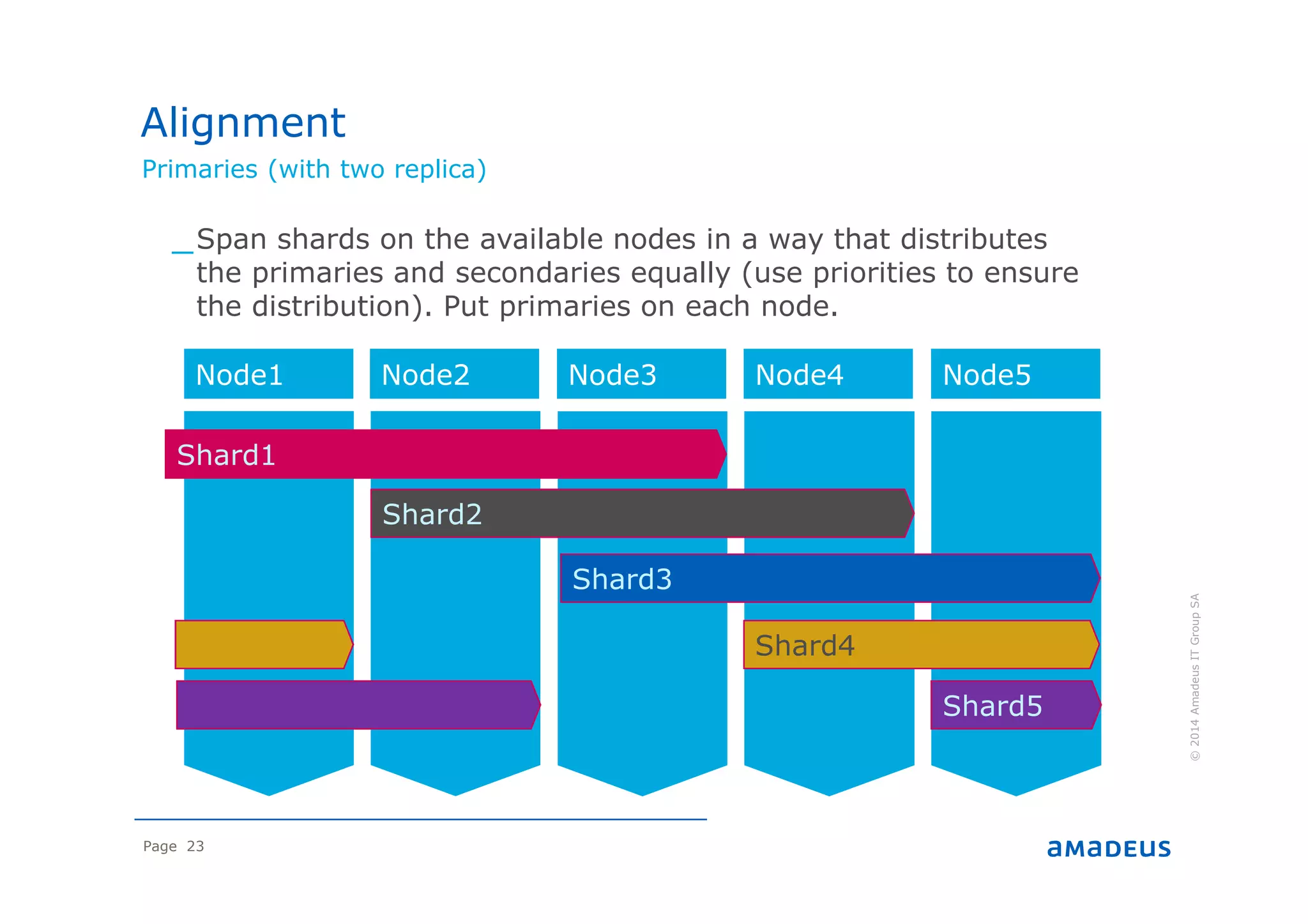
Primaries (with two replica)
©2014AmadeusITGroupSA
Alignment
_Span shards on the available nodes in a way that distributes
the primaries and secondaries equally (use priorities to ensure
the distribution). Put primaries on each node.
Node1
Shard1
Shard2
Shard3
Node2 Node3 Node4 Node5
Shard4
Shard5
Page 24
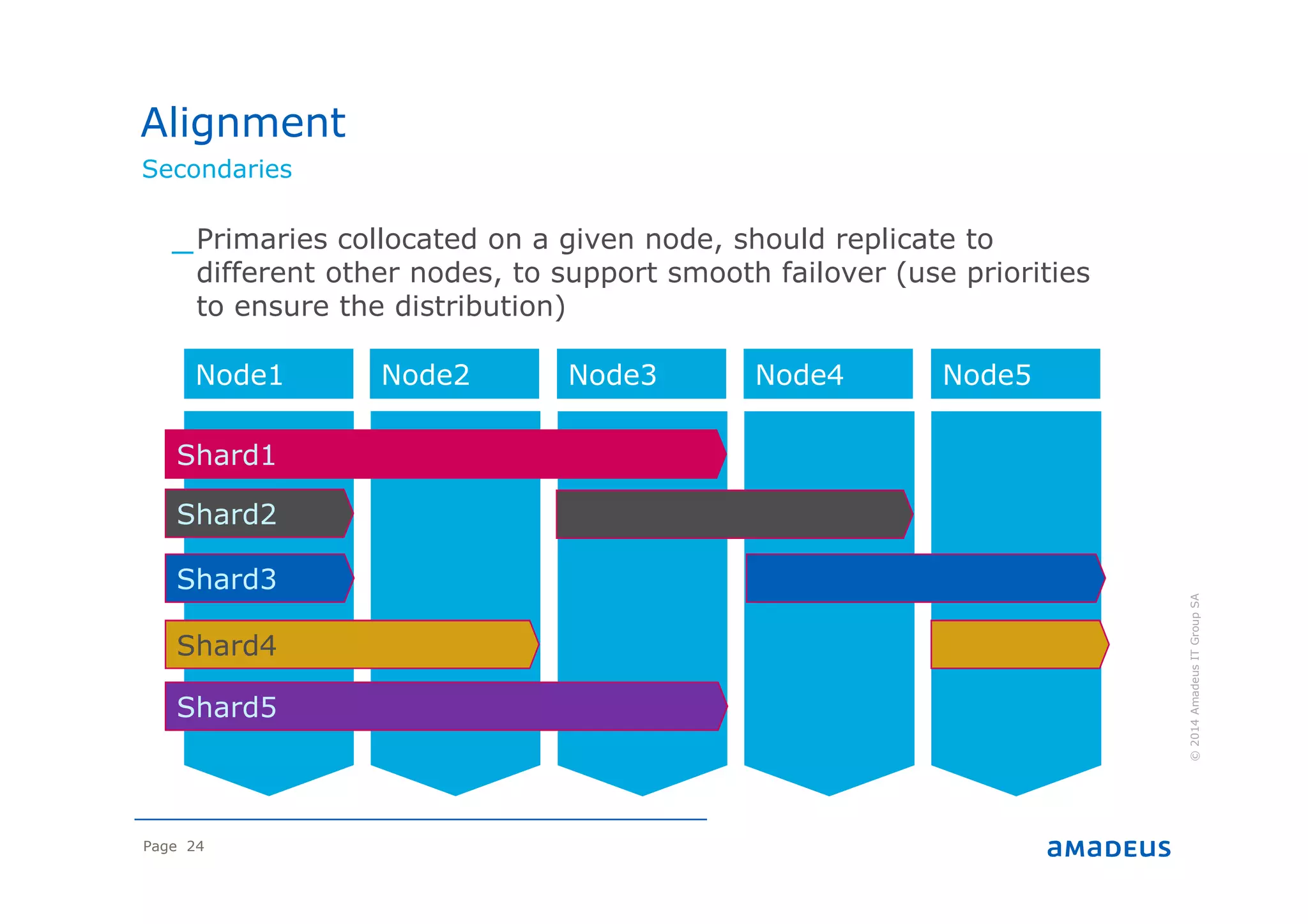
Secondaries
©2014AmadeusITGroupSA
Alignment
_Primaries collocated on a given node, should replicate to
different other nodes, to support smooth failover (use priorities
to ensure the distribution)
Node1
Shard1
Shard2
Shard3
Node2 Node3 Node4 Node5
Shard4
Shard5
Page 25
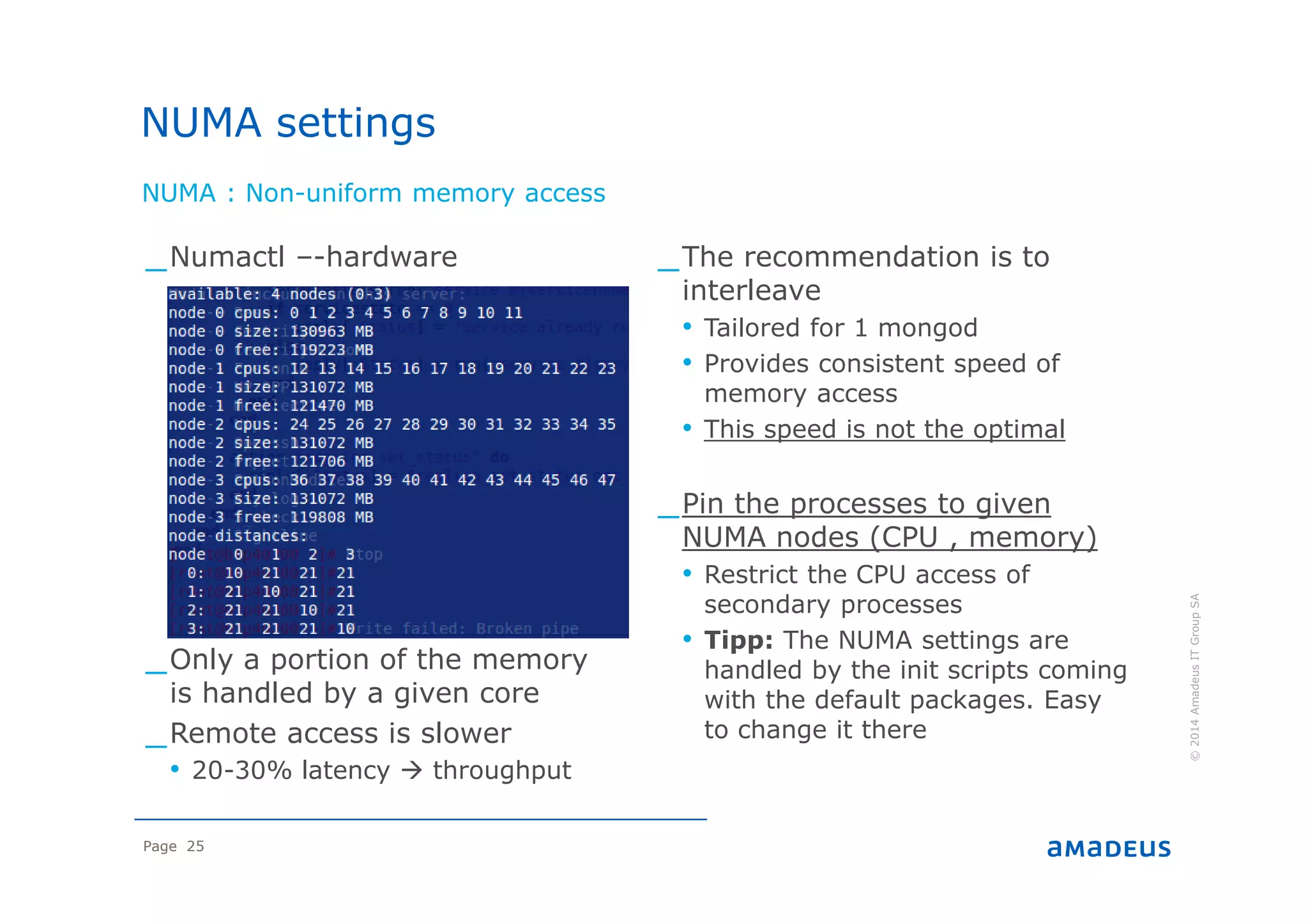
NUMA : Non-uniform memory access
©2014AmadeusITGroupSA
_Numactl –-hardware
_Only a portion of the memory
is handled by a given core
_Remote access is slower
• 20-30% latency throughput
_The recommendation is to
interleave
• Tailored for 1 mongod
• Provides consistent speed of
memory access
• This speed is not the optimal
_Pin the processes to given
NUMA nodes (CPU , memory)
• Restrict the CPU access of
secondary processes
• Tipp: The NUMA settings are
handled by the init scripts coming
with the default packages. Easy
to change it there
NUMA settings
Page 26
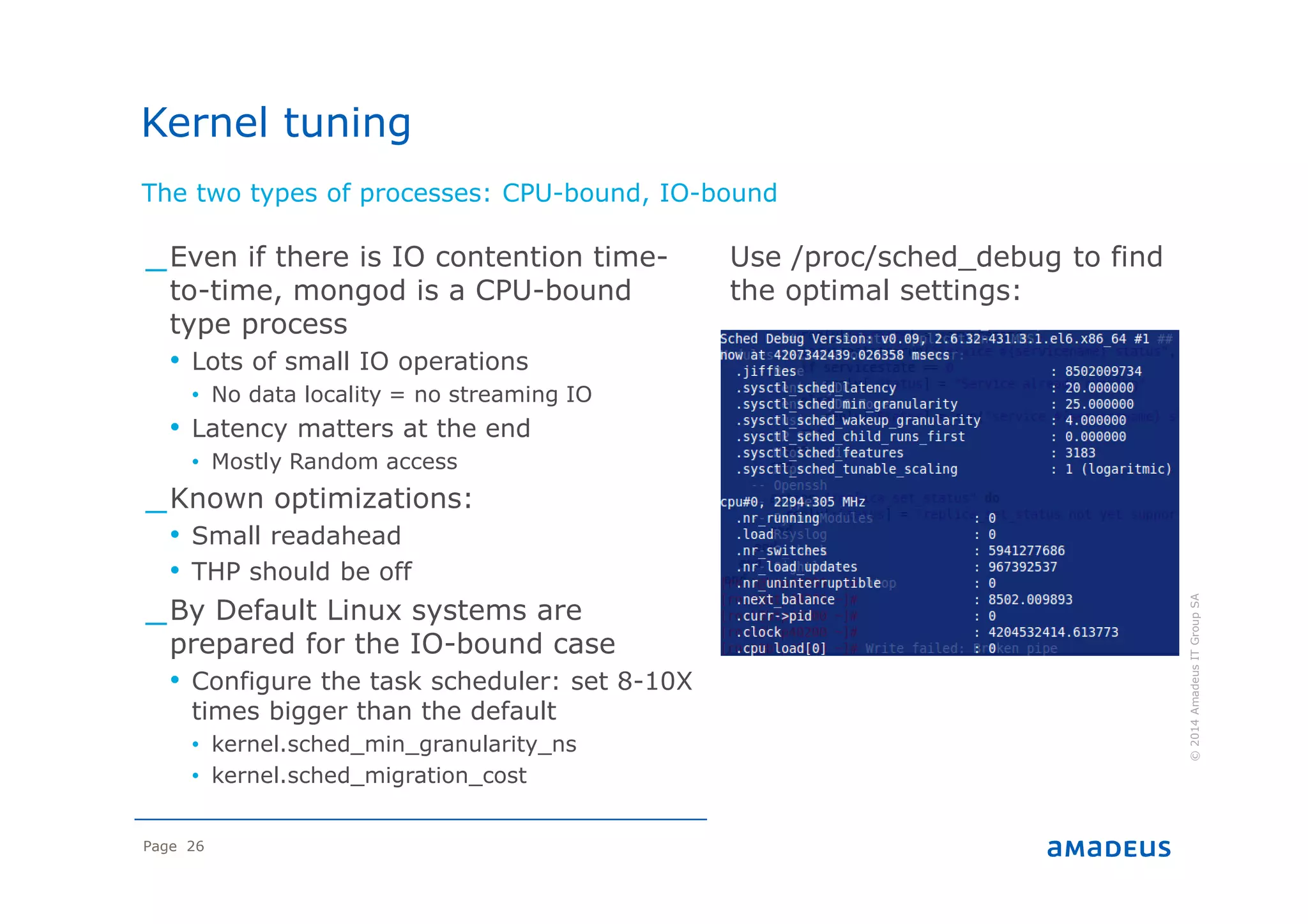
The two types of processes: CPU-bound, IO-bound
©2014AmadeusITGroupSA
_Even if there is IO contention time-
to-time, mongod is a CPU-bound
type process
• Lots of small IO operations
• No data locality = no streaming IO
• Latency matters at the end
• Mostly Random access
_Known optimizations:
• Small readahead
• THP should be off
_By Default Linux systems are
prepared for the IO-bound case
• Configure the task scheduler: set 8-10X
times bigger than the default
• kernel.sched_min_granularity_ns
• kernel.sched_migration_cost
Use /proc/sched_debug to find
the optimal settings:
Kernel tuning
Page 27
Query 2 : progress at 70%
Query 2 : progress at 0%
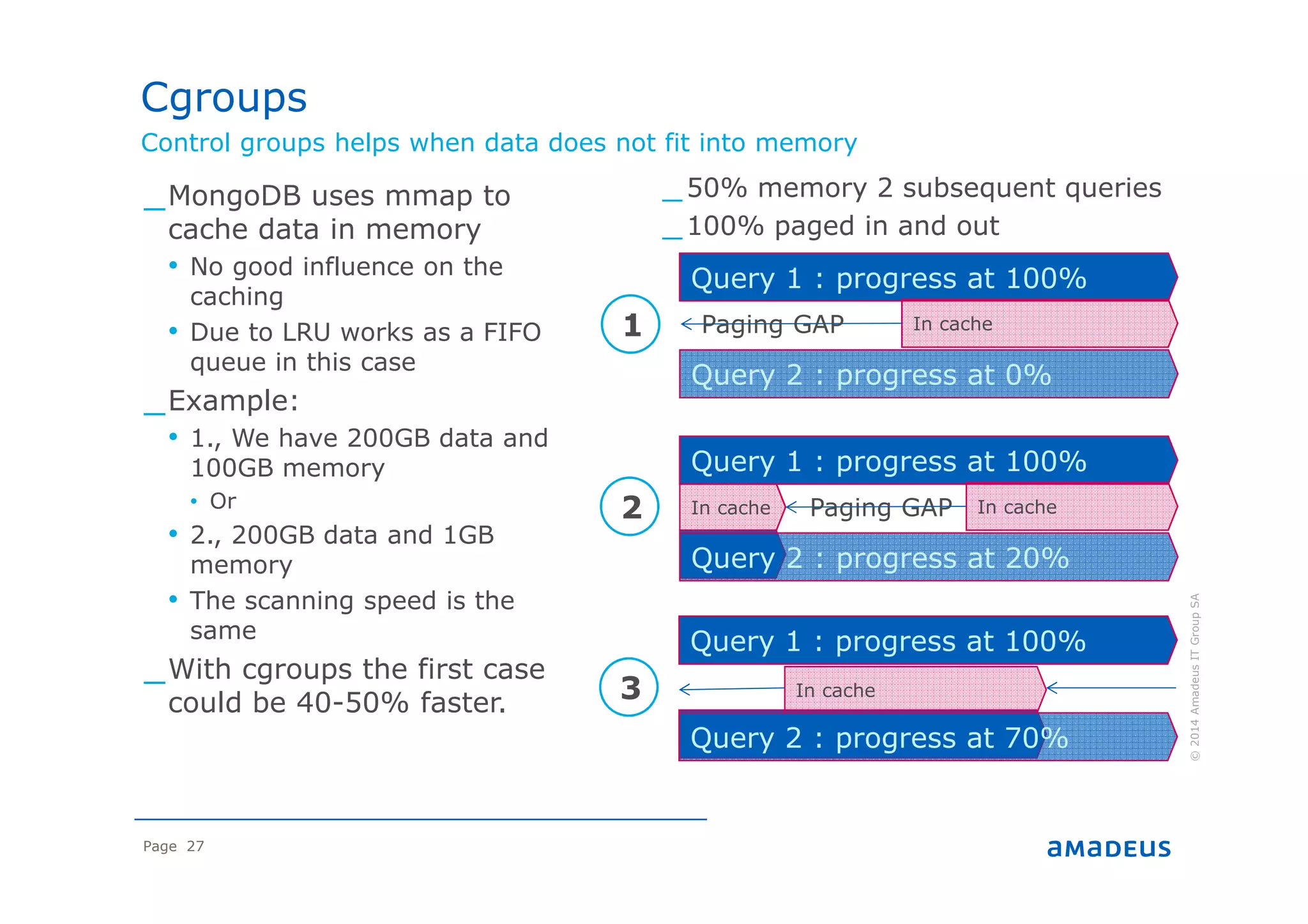
Control groups helps when data does not fit into memory
©2014AmadeusITGroupSA
_MongoDB uses mmap to
cache data in memory
• No good influence on the
caching
• Due to LRU works as a FIFO
queue in this case
_Example:
• 1., We have 200GB data and
100GB memory
• Or
• 2., 200GB data and 1GB
memory
• The scanning speed is the
same
_With cgroups the first case
could be 40-50% faster.
Cgroups
Query 1 : progress at 100%
In cachePaging GAP
Query 1 : progress at 100%
Query 2 : progress at 20%
In cacheIn cache Paging GAP
Query 1 : progress at 100%
In cache
_50% memory 2 subsequent queries
_100% paged in and out
1
2
3
Page 28
Q 1
©2014AmadeusITGroupSA
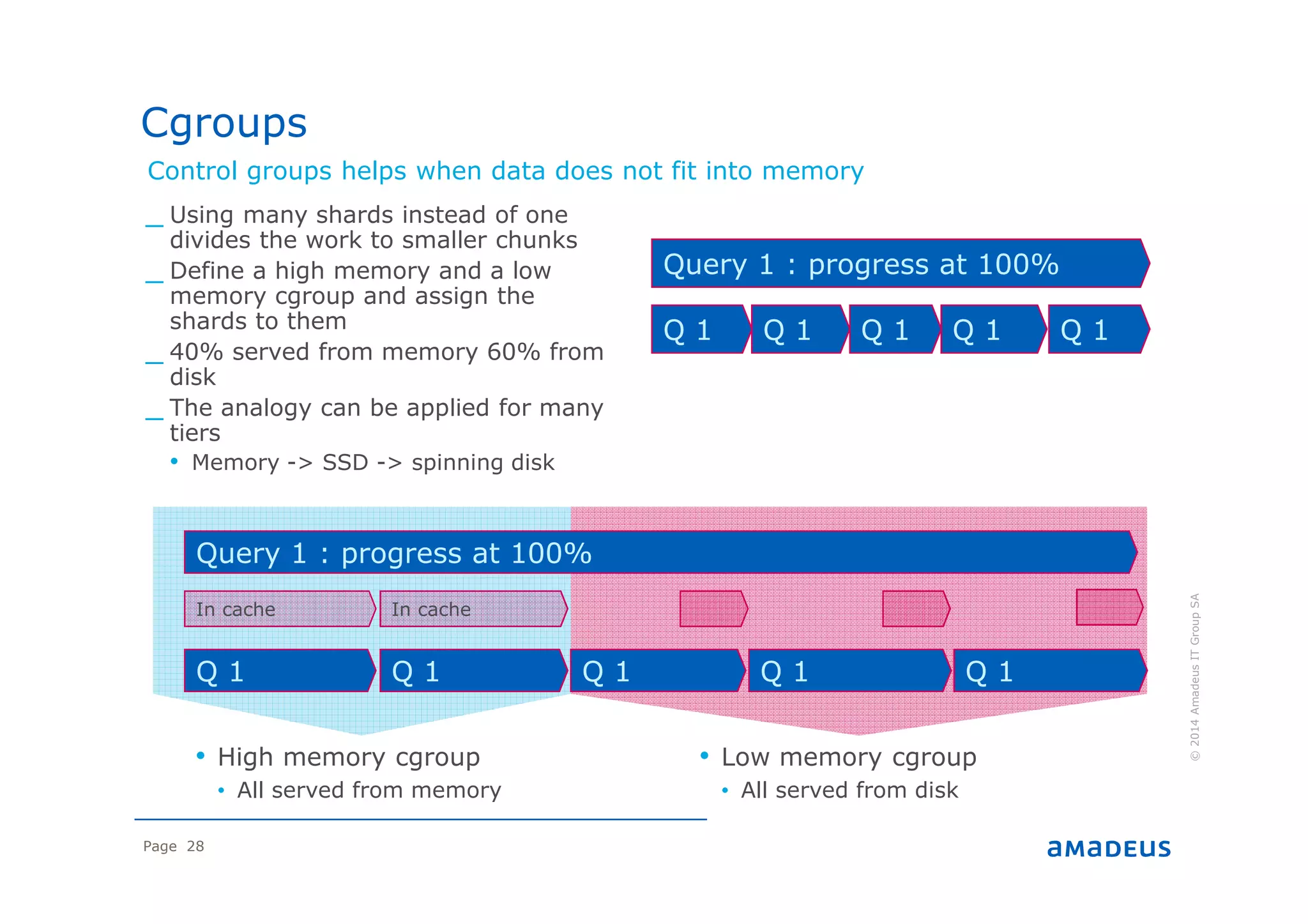
_ Using many shards instead of one
divides the work to smaller chunks
_ Define a high memory and a low
memory cgroup and assign the
shards to them
_ 40% served from memory 60% from
disk
_ The analogy can be applied for many
tiers
• Memory -> SSD -> spinning disk
Cgroups
Query 1 : progress at 100%
Control groups helps when data does not fit into memory
Q 1 Q 1 Q 1 Q 1
Q 1
Query 1 : progress at 100%
Q 1 Q 1 Q 1 Q 1
In cache In cache
• High memory cgroup
• All served from memory
• Low memory cgroup
• All served from disk
Page 29
©2014AmadeusITGroupSA
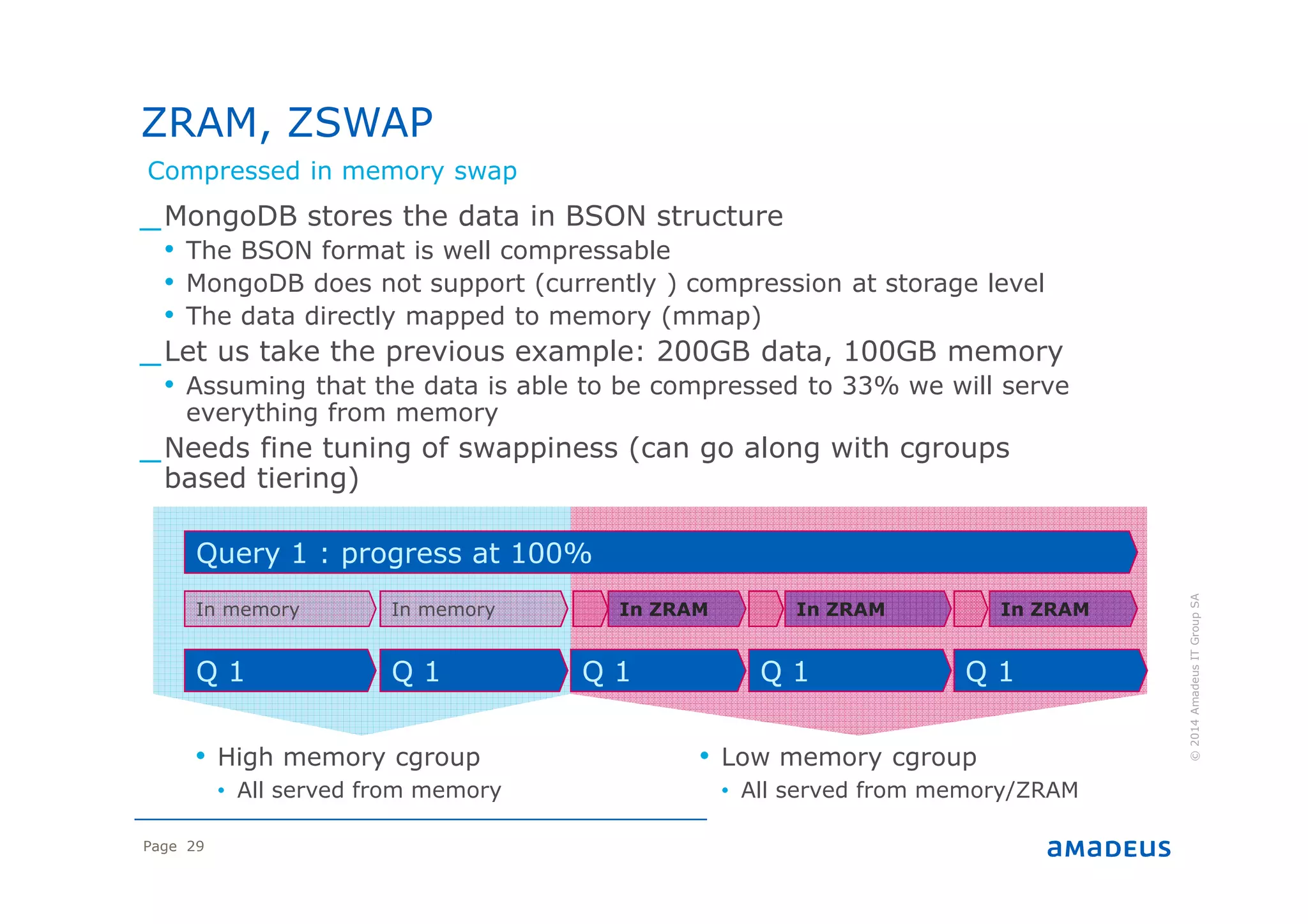
_MongoDB stores the data in BSON structure
• The BSON format is well compressable
• MongoDB does not support (currently ) compression at storage level
• The data directly mapped to memory (mmap)
_Let us take the previous example: 200GB data, 100GB memory
• Assuming that the data is able to be compressed to 33% we will serve
everything from memory
_Needs fine tuning of swappiness (can go along with cgroups
based tiering)
ZRAM, ZSWAP
Compressed in memory swap
Q 1
Query 1 : progress at 100%
Q 1 Q 1 Q 1 Q 1
In memory In memory
• High memory cgroup
• All served from memory
• Low memory cgroup
• All served from memory/ZRAM
In ZRAMIn ZRAMIn ZRAM
Page 30
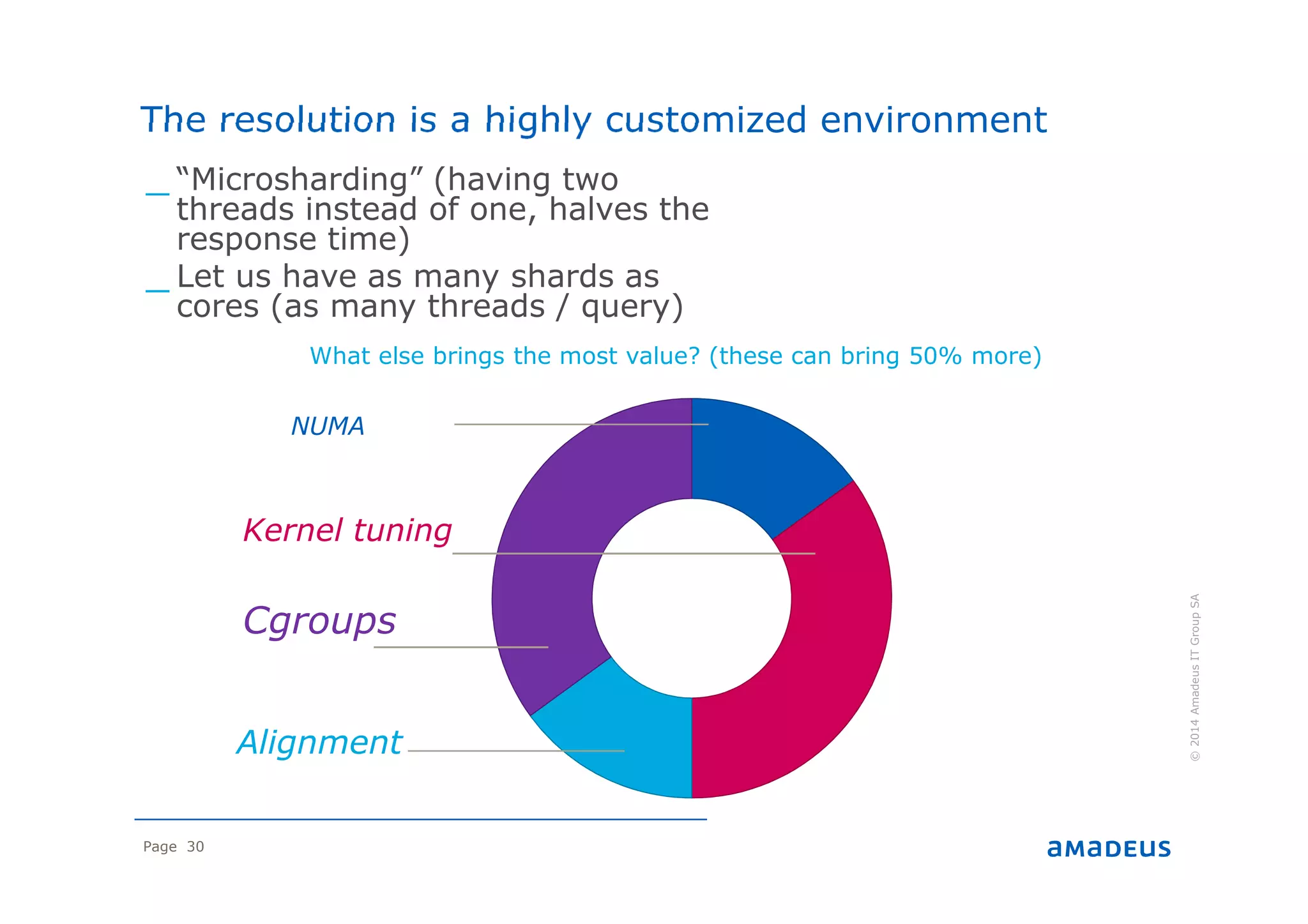
What else brings the most value? (these can bring 50% more)
©2014AmadeusITGroupSA
The resolution is a highly customized environment
NUMA
Kernel tuning
Alignment
Cgroups
_ “Microsharding” (having two
threads instead of one, halves the
response time)
_ Let us have as many shards as
cores (as many threads / query)
Page 31
MongoDB is a good fit for real-time analytics
©2014AmadeusITGroupSA
_MongoDB is compliant with the enterprise requirements
_MongoDB has sufficient querying capabilities to run analytical
workload
_Some customization is required compared to the general
recommendations
• Cluster alignment
• OS configuration
_The HW utilization can be efficient on any type of HW
_The support is aware of the possible optimization steps
_Upcoming features can bring a big boost for this type of usage:
• Pluggable storage
• Index intersection for many indices
Conclusions
Thank you
©2014AmadeusITGroupSA
You can follow us on:
AmadeusITGroup
amadeus.com/blog
amadeus.com

Shaping the Future of Travel with MongoDB

  • 1.
    Shaping the Future ofTravel with MongoDB ©2014AmadeusITGroupSA Real-Time Analytics with MongoDB Attila Tozser, Amadeus Data Processing GmbH, 12.11.2014. Munich MongoDB Days
  • 2.
    Page 2 Agenda ©2014AmadeusITGroupSA _ AmadeusIT Group _ DevOps considerations _ Real-time analytics _ Deployment customization 1 2 3 4
  • 3.
    Amadeus IT Groupand Amadeus Global Operations 1 ©2014AmadeusITGroupSA
  • 4.
    Amadeus, the leadingtechnology provider for the travel industry Transaction-based business model: Volume driven, highly resilient and profitable Key global player in the c. €60bn growing travel and technology market Two highly synergistic and profitable businesses Loyal customer base: Long term contracts and over 90% recurring revenues Strong cash flow generation profile Consumers/ General public Corporate travel departments Online and offline travel agencies IT Solutions Provision of IT solutions to travel providers Travel agencies Distribution Provision of indirect distribution services Travel buyers Airlines Hotels Railway operators Car rental Tour operators Cruise and ferries Insurance companies Travel providers Strong barriers to entry
  • 5.
    Page 5 26% 40% 40% 26% 30% 29% 22% 24% 26% 28% 30% 32% 34% 36% 38% 40% 42% 44% Amadeus TravelportSabre -1 pp -14 pp +14 pp Estimated air market share gain (2000-2013) Source: Numbers of travel agency air bookings according to Company estimates. Excludes air bookings made through in-house or single country operators, primarily in China, Japan, South Korea and Russia. Where competitors have merged in past, combined totals shown pre merger. 4th competitor with market share c.5% not shown Leading GDS globally Well positioned in fast growing emerging markets 1. Global leader in Distribution, having steadily gained market share with travel agencies …
  • 6.
    Page 6 Operations excellence 1.9+billion transactions per day (peak) 30+ Petabytes* storage 500+ application software loads per month 6,000+ IT infrastructure changes per month <0.5 sec average systems response time 3.9+ million net bookings per day (peak) 31+ billion SQL executions per day 30,000+ transactions per second (peak) 12,000+ physical IT infrastructure devices * Kilo -> Mega -> Giga -> Tera -> Peta = 1015 = 1.000.000.000.000.000
  • 7.
    Page 7 _ Exteriorwalls/roof is 1m thick steel reinforced concrete with no windows _ External doors are 50cm thick solid steel _ On-site 7*24 staffed security, with video cameras in- and outside _ External power supply from two different substations _ On-site well for cooling water supply _ Separation by function _ Underground diesel supply for days of operation Data Centre infrastructure High Availability Systems _ Highly resilient architecture _ Redundancy in all critical areas – minimum (n+1) concept _ No single point of failure
  • 8.
    Page 8 _ 810+employees working in Global Operations _ 580+ employees in the data center in Erding _ 50+ nationalities Global operations
  • 9.
  • 10.
    Page 10 Operational Requirements 1 2 3 4 Operational Ready Service _Security: • Centralized Access control • Encryption • Auditing _ Operability • Monitoring and alerting, backup restore, refresh • Automated interaction possibilities • Easy Integration with the tooling already in place • Online changes without downtime • No SPOF _Deployability • Easy planning • Automated fast deployment _Capacity management • Easy scaling • Optimal and predictable performance
  • 11.
    Page 11 ©2014AmadeusITGroupSA MongoDB Security _Centralized authentication _ Authorization is MongoDB internal _ Access Control _ Encryption _Audit _ Data encryption at rest only with 3rd party tools _ Channel encryption out of the box (with enterprise) _ Built-in, auditing meets the compliancy needs.
  • 12.
    Page 12 ©2014AmadeusITGroupSA _ MMSbackup API: • Snapshots • Backups • Restores _ Operational tooling integration with mcollective • Stop • Start • Stepdown • Compact _Monitoring integration • MMS API _ Service continuity • Rolling upgrades • Rolling HW/SW Maintenance _ No SPOF • MMS • Automation tools • Operational tools • HW,SW MongoDB Operability
  • 13.
    Page 13 ©2014AmadeusITGroupSA _ Deployability 1.Translate the requirements to actual HW sizing 2. Puppet does the magic (from the point we got the HW) 3. Automatic connection to operational tools _Capacity management • Initial sizing • Deployment through automation • KPIs: • OS metrics: IO, NW, CPU • MongoDB metrics • Scaling • Linear behaviour • Predictable HW requirements Capacity planning Provision Scale Measure Plan Detailed analysis / planning Automated / deployment Operational ownership handover 21 3
  • 14.
    Page 14 ©2014AmadeusITGroupSA Plan _ Deploymentflow considerations: 1. Configuring hundreds of processes without automation is not economical 1. Easy to start as standalone for experimenting 2. Hard to maintain big setups in a reasonable manner 2. The available automation tools (Puppet forge module for example) are not supporting the most valuable features: 1. SSL setup 2. Kerberos setup 3. MMS Backup setup 4. MMS Monitoring setup 3. Connecting Other Enterprise Systems without APIs is hard use MMS
  • 15.
  • 16.
    Page 16 ©2014AmadeusITGroupSA No indexing Scanningthe data Efficient scanning and concurrency handling capabilities needed Few and heavy queries (CPU intensive) Adhoc queries Low or limited responsetime Complex computation Real-Time Analytics Behaviour Implications Does not sound like a perfect fit for MongoDB recommendations
  • 17.
    Page 17 Run 1mongod / server Use simple documents 2 ©2014AmadeusITGroupSA Recommendations : We do not know what to index (adhoc queries) Need of complex documents to store everything in 1 collection. That supports the analytical approach. (Aggregation works on one collection) No concurrency for few big queries: They starve while the HW is idling. Use indexes 1 3
  • 18.
    Page 18 ©2014AmadeusITGroupSA _Able tofit to the purpose _Ease of development • Dynamic schema • Rich document structure • Rich query language _Ease of operations • No need for special HW • No shared storage • Runs on standard x86 • Good security features • SSL channel encryption • Kerberos, LDAP auth • Configurable clustering features • Replication • Sharding • Linear scalability _Aggregation framework • Provides the analytical functionality • Improvements in 2.6: • Cursor • $out Advantages of MongoDB
  • 19.
    Page 19 ©2014AmadeusITGroupSA _100% inmemory (6 physical nodes) • Dark blue: with soft pagefaults Linear scalability 0 2 4 6 8 10 12 0 200 400 600 800 1000 1200 Time(s) data size (GB) Full scan 0 50 100 150 200 250 300 350 400 450 0 200 400 600 800 1000 1200 Time(s) data size (GB) Full scan with aggregation, computation heavy workload
  • 20.
  • 21.
    Page 21 1 query= 1 thread / 1 mongod but 1 query = 24 threads / 24 mongod ©2014AmadeusITGroupSA _MongoDB query routing • Each query is represented by one thread on the database side _Modern HW architecture • The clock speed does not increase that fast • Many cores : 8-16 • Many sockets : 2-4 _What we need is efficiency: • We have 2 concurrent queries • And 4 sockets and 12 cores each • We have two choices: • Run one mongod and use only 2 cores from the 48 • Run 24 mongod and use all cores from all CPU-s Mircrosharding
  • 22.
    Page 22 ©2014AmadeusITGroupSA _Impact ofmicrosharding (6 physical nodes 1 TB data 100% in memory) Results: 0 50 100 150 200 250 300 350 400 0 20 40 60 time shards Full scan 0 200 400 600 800 1000 1200 1400 1600 1800 0 10 20 30 40 50 60 time shards Full scan with aggregation
  • 23.
    Page 23 Primaries (withtwo replica) ©2014AmadeusITGroupSA Alignment _Span shards on the available nodes in a way that distributes the primaries and secondaries equally (use priorities to ensure the distribution). Put primaries on each node. Node1 Shard1 Shard2 Shard3 Node2 Node3 Node4 Node5 Shard4 Shard5
  • 24.
    Page 24 Secondaries ©2014AmadeusITGroupSA Alignment _Primaries collocatedon a given node, should replicate to different other nodes, to support smooth failover (use priorities to ensure the distribution) Node1 Shard1 Shard2 Shard3 Node2 Node3 Node4 Node5 Shard4 Shard5
  • 25.
    Page 25 NUMA :Non-uniform memory access ©2014AmadeusITGroupSA _Numactl –-hardware _Only a portion of the memory is handled by a given core _Remote access is slower • 20-30% latency throughput _The recommendation is to interleave • Tailored for 1 mongod • Provides consistent speed of memory access • This speed is not the optimal _Pin the processes to given NUMA nodes (CPU , memory) • Restrict the CPU access of secondary processes • Tipp: The NUMA settings are handled by the init scripts coming with the default packages. Easy to change it there NUMA settings
  • 26.
    Page 26 The twotypes of processes: CPU-bound, IO-bound ©2014AmadeusITGroupSA _Even if there is IO contention time- to-time, mongod is a CPU-bound type process • Lots of small IO operations • No data locality = no streaming IO • Latency matters at the end • Mostly Random access _Known optimizations: • Small readahead • THP should be off _By Default Linux systems are prepared for the IO-bound case • Configure the task scheduler: set 8-10X times bigger than the default • kernel.sched_min_granularity_ns • kernel.sched_migration_cost Use /proc/sched_debug to find the optimal settings: Kernel tuning
  • 27.
    Page 27 Query 2: progress at 70% Query 2 : progress at 0% Control groups helps when data does not fit into memory ©2014AmadeusITGroupSA _MongoDB uses mmap to cache data in memory • No good influence on the caching • Due to LRU works as a FIFO queue in this case _Example: • 1., We have 200GB data and 100GB memory • Or • 2., 200GB data and 1GB memory • The scanning speed is the same _With cgroups the first case could be 40-50% faster. Cgroups Query 1 : progress at 100% In cachePaging GAP Query 1 : progress at 100% Query 2 : progress at 20% In cacheIn cache Paging GAP Query 1 : progress at 100% In cache _50% memory 2 subsequent queries _100% paged in and out 1 2 3
  • 28.
    Page 28 Q 1 ©2014AmadeusITGroupSA _Using many shards instead of one divides the work to smaller chunks _ Define a high memory and a low memory cgroup and assign the shards to them _ 40% served from memory 60% from disk _ The analogy can be applied for many tiers • Memory -> SSD -> spinning disk Cgroups Query 1 : progress at 100% Control groups helps when data does not fit into memory Q 1 Q 1 Q 1 Q 1 Q 1 Query 1 : progress at 100% Q 1 Q 1 Q 1 Q 1 In cache In cache • High memory cgroup • All served from memory • Low memory cgroup • All served from disk
  • 29.
    Page 29 ©2014AmadeusITGroupSA _MongoDB storesthe data in BSON structure • The BSON format is well compressable • MongoDB does not support (currently ) compression at storage level • The data directly mapped to memory (mmap) _Let us take the previous example: 200GB data, 100GB memory • Assuming that the data is able to be compressed to 33% we will serve everything from memory _Needs fine tuning of swappiness (can go along with cgroups based tiering) ZRAM, ZSWAP Compressed in memory swap Q 1 Query 1 : progress at 100% Q 1 Q 1 Q 1 Q 1 In memory In memory • High memory cgroup • All served from memory • Low memory cgroup • All served from memory/ZRAM In ZRAMIn ZRAMIn ZRAM
  • 30.
    Page 30 What elsebrings the most value? (these can bring 50% more) ©2014AmadeusITGroupSA The resolution is a highly customized environment NUMA Kernel tuning Alignment Cgroups _ “Microsharding” (having two threads instead of one, halves the response time) _ Let us have as many shards as cores (as many threads / query)
  • 31.
    Page 31 MongoDB isa good fit for real-time analytics ©2014AmadeusITGroupSA _MongoDB is compliant with the enterprise requirements _MongoDB has sufficient querying capabilities to run analytical workload _Some customization is required compared to the general recommendations • Cluster alignment • OS configuration _The HW utilization can be efficient on any type of HW _The support is aware of the possible optimization steps _Upcoming features can bring a big boost for this type of usage: • Pluggable storage • Index intersection for many indices Conclusions
  • 32.
    Thank you ©2014AmadeusITGroupSA You canfollow us on: AmadeusITGroup amadeus.com/blog amadeus.com