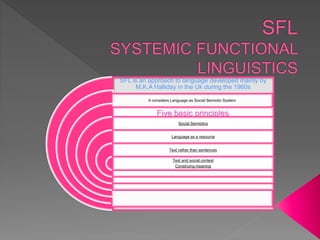
SFL is an approach to language developed mainly by
M.K.A Halliday in the Uk during the 1960s
It considers Language as Social Semiotic System
Five basic principles:
Social Semiotics
Language as a resource
Text rather than sentences
Text and social context
Construing meaning
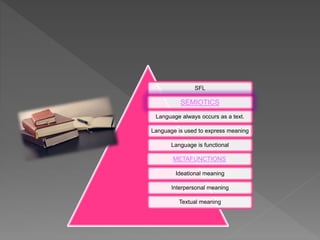
SFL
SEMIOTICS
Language always occurs as a text.
Language is used to express meaning
Language is functional
METAFUNCTIONS
Ideational meaning
Interpersonal meaning
Textual meaning
SPEECH Temporal
Immediate
Sequencial
WRITING An inscription
Language in spatial medium
GENRE-BASED-
GRAMMAR
MODEL.
Based on a
Functional Model of
Language
The aim is to
provide students
with the ability to
use the codes of
writing( genre and
grammar)
effectively and
efficiently
What field/
ideational
meaning
Who tenor/
interpersonal
meaning
How mode/
textual meaning
Context is seen as
a virtual force
acting on and
generating
language events
in order to get
things done.
Genre is part of
the contextual
variable of mode.
Register: to define
the individual
characteristics of a
text.
GENRE AS A SOCIAL PROCESS
MODEL
Genres are the result
of processes of social
production
Will attain a certain
degree of stability and
persistence over time
Different genres have
convey and give
access to different
degrees and kinds of
social power
Have specifiable
linguistic
characteristics
 Literacy texts to create images in reader’s
minds.
language enables readers to
engage with the text.
Novels- Epics- Poems- Dramas- Sagas.
 Factual texts Primary aim to communicating
knowledge.
Technical descriptions- Explanations-
Procedures- Essays- Reviews- Arguments.
Media texts
Any text that
are used in
channels of
mass
communication.
Print- Broad-
casting- Cable-
Film- Video.
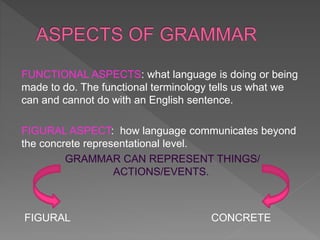
FUNCTIONAL ASPECTS: what language is doing or being
made to do. The functional terminology tells us what we
can and cannot do with an English sentence.
FIGURAL ASPECT: how language communicates beyond
the concrete representational level.
GRAMMAR CAN REPRESENT THINGS/
ACTIONS/EVENTS.
FIGURAL CONCRETE
Source
Knapp P, Watkins M (2005). “Genre,Text,Grammar.”
University of New South Wales, Sidney.
Sfl

Sfl

  • 1.
    SFL is anapproach to language developed mainly by M.K.A Halliday in the Uk during the 1960s It considers Language as Social Semiotic System Five basic principles: Social Semiotics Language as a resource Text rather than sentences Text and social context Construing meaning
  • 2.
    SFL SEMIOTICS Language always occursas a text. Language is used to express meaning Language is functional METAFUNCTIONS Ideational meaning Interpersonal meaning Textual meaning
  • 3.
    SPEECH Temporal Immediate Sequencial WRITING Aninscription Language in spatial medium
  • 5.
    GENRE-BASED- GRAMMAR MODEL. Based on a FunctionalModel of Language The aim is to provide students with the ability to use the codes of writing( genre and grammar) effectively and efficiently
  • 6.
    What field/ ideational meaning Who tenor/ interpersonal meaning Howmode/ textual meaning Context is seen as a virtual force acting on and generating language events in order to get things done. Genre is part of the contextual variable of mode. Register: to define the individual characteristics of a text.
  • 7.
    GENRE AS ASOCIAL PROCESS MODEL Genres are the result of processes of social production Will attain a certain degree of stability and persistence over time Different genres have convey and give access to different degrees and kinds of social power Have specifiable linguistic characteristics
  • 8.
     Literacy textsto create images in reader’s minds. language enables readers to engage with the text. Novels- Epics- Poems- Dramas- Sagas.  Factual texts Primary aim to communicating knowledge. Technical descriptions- Explanations- Procedures- Essays- Reviews- Arguments.
  • 9.
    Media texts Any textthat are used in channels of mass communication. Print- Broad- casting- Cable- Film- Video.
  • 11.
    FUNCTIONAL ASPECTS: whatlanguage is doing or being made to do. The functional terminology tells us what we can and cannot do with an English sentence. FIGURAL ASPECT: how language communicates beyond the concrete representational level. GRAMMAR CAN REPRESENT THINGS/ ACTIONS/EVENTS. FIGURAL CONCRETE
  • 13.
    Source Knapp P, WatkinsM (2005). “Genre,Text,Grammar.” University of New South Wales, Sidney.