SEWA
Self Employed Women’s
Association
Introduction
 SEWA is a trade union registered in 1972.
 It is an organisation of poor, self-employed
women workers.
 SEWA’s main goals are to organise women
workers for full employment. (Full
employment means employment whereby
workers obtain work security, income
security, food security and social security )
 Practically, the strategy is carried out
through the joint action of union and
cooperatives.
 Gandhian thinking is the guiding force for SEWA’s poor, self-employed
members in organising for social change.
 We follow the principles of satya (truth), ahinsa (non-violence),
sarvadharma (integrating all faiths, all people) and khadi (propagation of
local employment and self reliance).
 SEWA is both an organisation and a movement.
 The SEWA movement is enhanced by its being a sangam or confluence of
three movements : the labour movement,
the cooperative movement and the
women’s movement.
 It is also a movement of self-employed workers :
their own, home-grown movement with women
as the leaders.
 Through their own movement women become
strong and visible.
History of SEVA
 Self Employed Women's Assoication
 SEWA was born in 1972 as a trade union of self
employed women.
 It grew out of the Textile Labour Association , TLA,
India's oldest and largest union of textile
workers founded in 1920 by a women,
Anasuya Sarabhai.
 The inspiration for the union came
from Mahatma Gandhi, who led a
successful strike of textile workers
in 1917.
Goals of SEWA
 It has two main goals : Full Employment and Self
Reliance.
 The following eleven question have
emerged from the members and
continually serve as a guide for all
members, group leaders, executive
committee members and full-time
organisers of SEWA.
 It is also useful for monitoring
SEWA’s progress and the relevance of
its various activities and their congruence with member’s
reality and priorities.
The Eleven Questions of SEWA :
1. Have more members obtained more employment ?
2. Has their income increased ?
3. Have they obtained food and nutrition ?
4. Has their health been safeguarded ?
5. Have they obtained child-care?
6. Have they obtained or improved their housing ?
7. Have their assets increased ? (e.g. their own savings, land,
house, work-space, tools or work, licenses, identity cards,
cattled and share in cooperatives; and all in their own name.
8. Have the worker’s organisational strength increased ?
9. Has worker’s leadership increased ?
10. Have they become self-reliant both collectively and
individually ?
11. Have they become literate?
 Questions 1 to 7 are linked to the goal of full employment while 8 to 11 are those concerned with
SEWA’s goal of self reliance. However each of these are interconnected to each other.
SEWA's Membership
 SEWA members are workers who have no fixed employee-
employer relationship and depend on their own labour for
survival.
 Hawkers, vendors and small business women
like vegetable, fruit, fish, egg and other vendors
 Home-based workers
like weavers, potters, bidi and agarbatti workers, papad rollers, ready-
made garment workers
 Manual labourers & service providers
like agricultural labourers, construction workers, contract labourers,
handcart pullers
 Producers & Services who invest their labour and capital to
carry out their businesses
like cattle rearers , salt workers, gum collectors, cooking & vending etc.
2008 SEWA Membership
All - India Membership year – 2008
State Membership
Gujarat 5,19,309
Murshidabad 1,758
Delhi 15,771
Madhya Pradesh
- SEWA -Indore
3,82,000
Uttar Pradesh
- Bareli
- Lucknow
402
24,100
Kerala
- Trivandrum 675
Dehradhun 954
All India Membership 9,66,139
Gujarat Membership 5,19,309
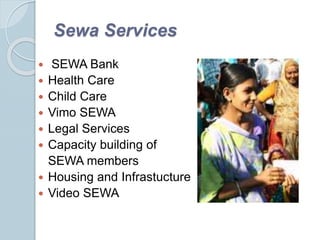
Sewa Services
 SEWA Bank
 Health Care
 Child Care
 Vimo SEWA
 Legal Services
 Capacity building of
SEWA members
 Housing and Infrastucture
 Video SEWA
Sewa

Sewa

  • 1.
    SEWA Self Employed Women’s Association Introduction SEWA is a trade union registered in 1972.  It is an organisation of poor, self-employed women workers.  SEWA’s main goals are to organise women workers for full employment. (Full employment means employment whereby workers obtain work security, income security, food security and social security )  Practically, the strategy is carried out through the joint action of union and cooperatives.
  • 2.
     Gandhian thinkingis the guiding force for SEWA’s poor, self-employed members in organising for social change.  We follow the principles of satya (truth), ahinsa (non-violence), sarvadharma (integrating all faiths, all people) and khadi (propagation of local employment and self reliance).  SEWA is both an organisation and a movement.  The SEWA movement is enhanced by its being a sangam or confluence of three movements : the labour movement, the cooperative movement and the women’s movement.  It is also a movement of self-employed workers : their own, home-grown movement with women as the leaders.  Through their own movement women become strong and visible.
  • 3.
    History of SEVA Self Employed Women's Assoication  SEWA was born in 1972 as a trade union of self employed women.  It grew out of the Textile Labour Association , TLA, India's oldest and largest union of textile workers founded in 1920 by a women, Anasuya Sarabhai.  The inspiration for the union came from Mahatma Gandhi, who led a successful strike of textile workers in 1917.
  • 4.
    Goals of SEWA It has two main goals : Full Employment and Self Reliance.  The following eleven question have emerged from the members and continually serve as a guide for all members, group leaders, executive committee members and full-time organisers of SEWA.  It is also useful for monitoring SEWA’s progress and the relevance of its various activities and their congruence with member’s reality and priorities.
  • 5.
    The Eleven Questionsof SEWA : 1. Have more members obtained more employment ? 2. Has their income increased ? 3. Have they obtained food and nutrition ? 4. Has their health been safeguarded ? 5. Have they obtained child-care? 6. Have they obtained or improved their housing ? 7. Have their assets increased ? (e.g. their own savings, land, house, work-space, tools or work, licenses, identity cards, cattled and share in cooperatives; and all in their own name. 8. Have the worker’s organisational strength increased ? 9. Has worker’s leadership increased ? 10. Have they become self-reliant both collectively and individually ? 11. Have they become literate?  Questions 1 to 7 are linked to the goal of full employment while 8 to 11 are those concerned with SEWA’s goal of self reliance. However each of these are interconnected to each other.
  • 6.
    SEWA's Membership  SEWAmembers are workers who have no fixed employee- employer relationship and depend on their own labour for survival.  Hawkers, vendors and small business women like vegetable, fruit, fish, egg and other vendors  Home-based workers like weavers, potters, bidi and agarbatti workers, papad rollers, ready- made garment workers  Manual labourers & service providers like agricultural labourers, construction workers, contract labourers, handcart pullers  Producers & Services who invest their labour and capital to carry out their businesses like cattle rearers , salt workers, gum collectors, cooking & vending etc.
  • 7.
    2008 SEWA Membership All- India Membership year – 2008 State Membership Gujarat 5,19,309 Murshidabad 1,758 Delhi 15,771 Madhya Pradesh - SEWA -Indore 3,82,000 Uttar Pradesh - Bareli - Lucknow 402 24,100 Kerala - Trivandrum 675 Dehradhun 954 All India Membership 9,66,139 Gujarat Membership 5,19,309
  • 8.
    Sewa Services  SEWABank  Health Care  Child Care  Vimo SEWA  Legal Services  Capacity building of SEWA members  Housing and Infrastucture  Video SEWA