Slash
                    and
                                    Burn


R.B.D.A.V. Sr. Sec. Public School    Presented by : Aashish goyal,
            Bathinda
What
                    is Slash and Burn?
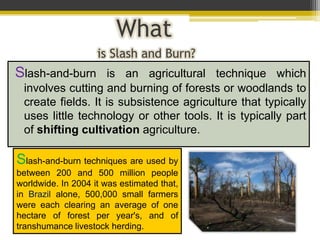
Slash-and-burn      is an agricultural technique which
 involves cutting and burning of forests or woodlands to
 create fields. It is subsistence agriculture that typically
 uses little technology or other tools. It is typically part
 of shifting cultivation agriculture.

Slash-and-burn techniques are used by
between 200 and 500 million people
worldwide. In 2004 it was estimated that,
in Brazil alone, 500,000 small farmers
were each clearing an average of one
hectare of forest per year's, and of
transhumance livestock herding.
How
       slash and burn would has originated?


It is kind of natural. Supposedly when lightning would
 strike the dead trees a forest fire would start and
 burn down everything. Our ancestors realized that
 the land left behind from that fire was extremely
 fertile after a while. It was now able to grow crops on
 that land. So are ancestors opted it as a good method
 and started clearing land by burning and cultivating
 crops on it.
How
                        is it done?
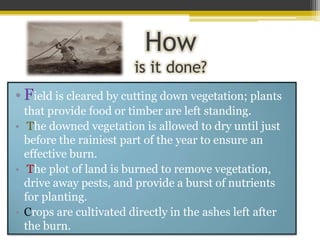
• Field is cleared by cutting down vegetation; plants
  that provide food or timber are left standing.
• The downed vegetation is allowed to dry until just
  before the rainiest part of the year to ensure an
  effective burn.
• The plot of land is burned to remove vegetation,
  drive away pests, and provide a burst of nutrients
  for planting.
• Crops are cultivated directly in the ashes left after
  the burn.
Benefits
                  to farmers

Slash and burn agriculture has proven more
 sustainable and about as productive as more
 modern, energy-intensive agricultural methods.
 In contrast, modern mechanized agriculture often
 results in large areas planted in a monocrop and
 requires the removal of almost all trees. But in
 slash and burn agriculture same land can be used
 to grow multiple crops together. Also crops can
 be cultivated at input of Rs 600 per year. Crops
 yielded from this are good.
Disadvantages
                       to our environment

• Deforestation: When practiced by large populations, when fields are not
  given sufficient time for vegetation to grow back, there is a temporary or
  permanent loss of forest cover.
• Erosion: When fields are slashed, burned, and cultivated next to each
  other in rapid succession, roots and temporary water storages are lost and
  unable to prevent nutrients from leaving the area permanently.
• Nutrient Loss: For the same reasons, fields may gradually lose the fertility
  they once had. The result may be desertification, a situation in which land
  is infertile and unable to support growth of any kind.
• Biodiversity Loss: When plots of land area cleared, the various plants and
  animals that lived there are swept away. If a particular area is the only
  one that holds a particular species, slashing and burning could result in
  extinction for that species. Because slash and burn agriculture is often
  practiced in tropical regions where biodiversity is extremely high,
  endangerment and extinction may be magnified.
Is there any alternative to

                    slash and burn
Answer to this question is a yes. Global associations are trying to
  prevent slash and burn and they have given us some ways. One of
  them is crop rotation. In this crops are changed after a season. It
  gives us different crops replenishes soil fertility and is pollution free.
   But the only problem with that is that you still have to destroy a
  part of the land to get the field for the crops. The other way is
  growing profitable trees in rows with an annual crop in between.
  The key to that is each plant must benefit the health/ growth of the
  other. An example would be planting walnut trees in rows with soy
  beans. The soy fixes nitrogen that the walnuts will benefit from and
  the walnuts provide some means of protection from the wind/
  weather.
ConclusioN
At the end I say that Slash and burn
 agriculture was a good discovery by our
 ancestors which gave a lot of benefits to
 humans. But with changing times
 population, needs of people and everything
 else is increasing. With which slash and burn
 agriculture can’t be carried on and is now
 becoming destructive. So new alternatives
 are needed to be discovered which good for
 present times and take place of slash and
 burn successfully.
Thank
  yu
  o

Slash and burn

  • 1.
    Slash and Burn R.B.D.A.V. Sr. Sec. Public School Presented by : Aashish goyal, Bathinda
  • 2.
    What is Slash and Burn? Slash-and-burn is an agricultural technique which involves cutting and burning of forests or woodlands to create fields. It is subsistence agriculture that typically uses little technology or other tools. It is typically part of shifting cultivation agriculture. Slash-and-burn techniques are used by between 200 and 500 million people worldwide. In 2004 it was estimated that, in Brazil alone, 500,000 small farmers were each clearing an average of one hectare of forest per year's, and of transhumance livestock herding.
  • 3.
    How slash and burn would has originated? It is kind of natural. Supposedly when lightning would strike the dead trees a forest fire would start and burn down everything. Our ancestors realized that the land left behind from that fire was extremely fertile after a while. It was now able to grow crops on that land. So are ancestors opted it as a good method and started clearing land by burning and cultivating crops on it.
  • 4.
    How is it done? • Field is cleared by cutting down vegetation; plants that provide food or timber are left standing. • The downed vegetation is allowed to dry until just before the rainiest part of the year to ensure an effective burn. • The plot of land is burned to remove vegetation, drive away pests, and provide a burst of nutrients for planting. • Crops are cultivated directly in the ashes left after the burn.
  • 5.
    Benefits to farmers Slash and burn agriculture has proven more sustainable and about as productive as more modern, energy-intensive agricultural methods. In contrast, modern mechanized agriculture often results in large areas planted in a monocrop and requires the removal of almost all trees. But in slash and burn agriculture same land can be used to grow multiple crops together. Also crops can be cultivated at input of Rs 600 per year. Crops yielded from this are good.
  • 6.
    Disadvantages to our environment • Deforestation: When practiced by large populations, when fields are not given sufficient time for vegetation to grow back, there is a temporary or permanent loss of forest cover. • Erosion: When fields are slashed, burned, and cultivated next to each other in rapid succession, roots and temporary water storages are lost and unable to prevent nutrients from leaving the area permanently. • Nutrient Loss: For the same reasons, fields may gradually lose the fertility they once had. The result may be desertification, a situation in which land is infertile and unable to support growth of any kind. • Biodiversity Loss: When plots of land area cleared, the various plants and animals that lived there are swept away. If a particular area is the only one that holds a particular species, slashing and burning could result in extinction for that species. Because slash and burn agriculture is often practiced in tropical regions where biodiversity is extremely high, endangerment and extinction may be magnified.
  • 7.
    Is there anyalternative to slash and burn Answer to this question is a yes. Global associations are trying to prevent slash and burn and they have given us some ways. One of them is crop rotation. In this crops are changed after a season. It gives us different crops replenishes soil fertility and is pollution free. But the only problem with that is that you still have to destroy a part of the land to get the field for the crops. The other way is growing profitable trees in rows with an annual crop in between. The key to that is each plant must benefit the health/ growth of the other. An example would be planting walnut trees in rows with soy beans. The soy fixes nitrogen that the walnuts will benefit from and the walnuts provide some means of protection from the wind/ weather.
  • 8.
    ConclusioN At the endI say that Slash and burn agriculture was a good discovery by our ancestors which gave a lot of benefits to humans. But with changing times population, needs of people and everything else is increasing. With which slash and burn agriculture can’t be carried on and is now becoming destructive. So new alternatives are needed to be discovered which good for present times and take place of slash and burn successfully.
  • 9.