Techniques to commits cyber frauds
Hacking
Cracking
Data diddling – changing data before, during, or after it is
entered into system
Data leakage – unauthorized copying of company data such as
computer files
Denial of service attack – prevent access to a software system
by its authorized users
Techniques to commits cyber frauds
Internet terrorism – using internet to disrupt e-commerce ex. -
SONY
Logic time bombs – program that lies idle until some specified
circumstances triggers; after this programs or data destroyed
Masquerading or impersonation – perpetrator gsins access to the
system by pretending to be an authorized user
Password cracking – steals the file containing valid passwords,
decrypts them and use them to gain access to system resources
Piggybacking – tapping into a telecomm. Line and latching on to a
legitimate user before he got into the system
Techniques to commits cyber frauds
Round down – all int. calculation up to 2 decimal places,
remaining fraction is placed in account controlled by perpetrator
Scavenging or dumpster diving – searching confidential info in
rubbish bin of corporate records
Social engineering techniques – perpetrator tricks an employee
into giving out info needed
Super zapping – unauthorized use of special system programs to
bypass regular system controls and perform illegal acts
Trap door - enter into the system using a back door
Impact of cyber frauds on enterprises
Financial loss Legal repercussions
Loss of credibility or
competitive edge
Disclosure of
confidential, sensitive
or embarrassing
information
sabotage
Examples of impact
Unauthorized data
access of citi bank
Sony mail hack
Reason behind Cyber frauds
Organization
to update
themselves to
new set of
risks
Smart
fraudsters
Failure of
internal
control
system
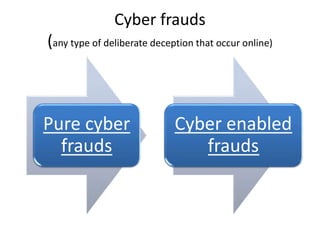
Cyber frauds
(any type of deliberate deception that occur online)
Pure cyber
frauds
Cyber enabled
frauds
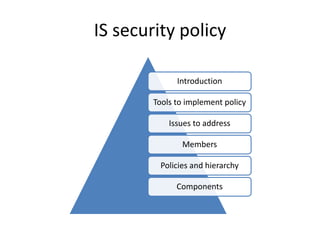
IS security policy
Introduction
Tools to implement policy
Issues to address
Members
Policies and hierarchy
Components
Introduction
• Intent by top level mgmt. about how to
protect info. Assets
• Formal statement of rules (documented)
• IS security program
• Direction and instruction to employees
Security policy invariably includes rules
intended
Preserve and protect information from
unauthorized access
Limit legal liability from employees or
third party
Prevent waste or inappropriate use of
organization resources
Tools to implement policy
(standard, guideline & procedures)
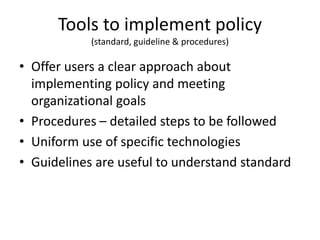
• Offer users a clear approach about
implementing policy and meeting
organizational goals
• Procedures – detailed steps to be followed
• Uniform use of specific technologies
• Guidelines are useful to understand standard
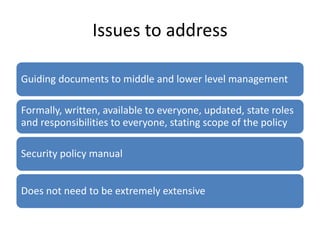
Issues to address
Guiding documents to middle and lower level management
Formally, written, available to everyone, updated, state roles
and responsibilities to everyone, stating scope of the policy
Security policy manual
Does not need to be extremely extensive
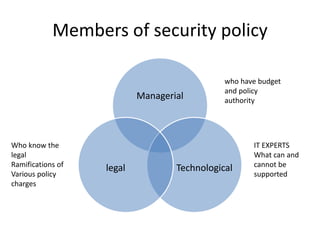
Members of security policy
Managerial
Technologicallegal
who have budget
and policy
authority
IT EXPERTS
What can and
cannot be
supported
Who know the
legal
Ramifications of
Various policy
charges
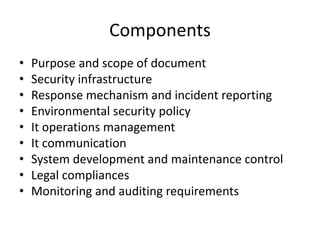
Components
• Purpose and scope of document
• Security infrastructure
• Response mechanism and incident reporting
• Environmental security policy
• It operations management
• It communication
• System development and maintenance control
• Legal compliances
• Monitoring and auditing requirements
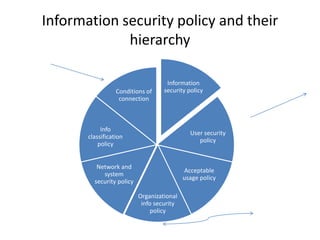
Information security policy and their
hierarchy
Information
security policy
User security
policy
Acceptable
usage policy
Organizational
info security
policy
Network and
system
security policy
Info
classification
policy
Conditions of
connection
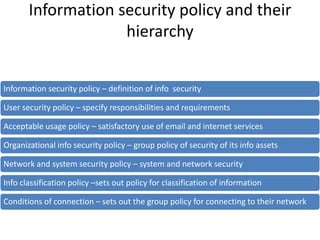
Information security policy and their
hierarchy
Information security policy – definition of info security
User security policy – specify responsibilities and requirements
Acceptable usage policy – satisfactory use of email and internet services
Organizational info security policy – group policy of security of its info assets
Network and system security policy – system and network security
Info classification policy –sets out policy for classification of information
Conditions of connection – sets out the group policy for connecting to their network

Seurity policy

  • 1.
    Techniques to commitscyber frauds Hacking Cracking Data diddling – changing data before, during, or after it is entered into system Data leakage – unauthorized copying of company data such as computer files Denial of service attack – prevent access to a software system by its authorized users
  • 2.
    Techniques to commitscyber frauds Internet terrorism – using internet to disrupt e-commerce ex. - SONY Logic time bombs – program that lies idle until some specified circumstances triggers; after this programs or data destroyed Masquerading or impersonation – perpetrator gsins access to the system by pretending to be an authorized user Password cracking – steals the file containing valid passwords, decrypts them and use them to gain access to system resources Piggybacking – tapping into a telecomm. Line and latching on to a legitimate user before he got into the system
  • 3.
    Techniques to commitscyber frauds Round down – all int. calculation up to 2 decimal places, remaining fraction is placed in account controlled by perpetrator Scavenging or dumpster diving – searching confidential info in rubbish bin of corporate records Social engineering techniques – perpetrator tricks an employee into giving out info needed Super zapping – unauthorized use of special system programs to bypass regular system controls and perform illegal acts Trap door - enter into the system using a back door
  • 4.
    Impact of cyberfrauds on enterprises Financial loss Legal repercussions Loss of credibility or competitive edge Disclosure of confidential, sensitive or embarrassing information sabotage
  • 5.
    Examples of impact Unauthorizeddata access of citi bank Sony mail hack
  • 6.
    Reason behind Cyberfrauds Organization to update themselves to new set of risks Smart fraudsters Failure of internal control system
  • 7.
    Cyber frauds (any typeof deliberate deception that occur online) Pure cyber frauds Cyber enabled frauds
  • 8.
    IS security policy Introduction Toolsto implement policy Issues to address Members Policies and hierarchy Components
  • 9.
    Introduction • Intent bytop level mgmt. about how to protect info. Assets • Formal statement of rules (documented) • IS security program • Direction and instruction to employees
  • 10.
    Security policy invariablyincludes rules intended Preserve and protect information from unauthorized access Limit legal liability from employees or third party Prevent waste or inappropriate use of organization resources
  • 11.
    Tools to implementpolicy (standard, guideline & procedures) • Offer users a clear approach about implementing policy and meeting organizational goals • Procedures – detailed steps to be followed • Uniform use of specific technologies • Guidelines are useful to understand standard
  • 12.
    Issues to address Guidingdocuments to middle and lower level management Formally, written, available to everyone, updated, state roles and responsibilities to everyone, stating scope of the policy Security policy manual Does not need to be extremely extensive
  • 13.
    Members of securitypolicy Managerial Technologicallegal who have budget and policy authority IT EXPERTS What can and cannot be supported Who know the legal Ramifications of Various policy charges
  • 14.
    Components • Purpose andscope of document • Security infrastructure • Response mechanism and incident reporting • Environmental security policy • It operations management • It communication • System development and maintenance control • Legal compliances • Monitoring and auditing requirements
  • 15.
    Information security policyand their hierarchy Information security policy User security policy Acceptable usage policy Organizational info security policy Network and system security policy Info classification policy Conditions of connection
  • 16.
    Information security policyand their hierarchy Information security policy – definition of info security User security policy – specify responsibilities and requirements Acceptable usage policy – satisfactory use of email and internet services Organizational info security policy – group policy of security of its info assets Network and system security policy – system and network security Info classification policy –sets out policy for classification of information Conditions of connection – sets out the group policy for connecting to their network