REPRODUCTIVE HEALTH ISSUES INREPRODUCTIVE HEALTH ISSUES IN
ASIA AND THE PACIFIC:ASIA AND THE PACIFIC:
OLD CHALLENGES,OLD CHALLENGES,
NEW STRATEGIESNEW STRATEGIES
Dr. Sona Sethi
Regional Director, Asia
Overview of Asia and the PacificOverview of Asia and the Pacific
 Home to 60 per cent of the world's peopleHome to 60 per cent of the world's people
 Two out of every three people living in extremeTwo out of every three people living in extreme
poverty live in the region and struggle to survive onpoverty live in the region and struggle to survive on
less than $1 a dayless than $1 a day
 Includes more than half of the world's young people -Includes more than half of the world's young people -
some 850 million. Some parts of South/South-eastsome 850 million. Some parts of South/South-east
Asia, young people make up between ⅓ to ½ of theAsia, young people make up between ⅓ to ½ of the
populationpopulation
 Adolescents comprise more than 20 % of total AsianAdolescents comprise more than 20 % of total Asian
population and are the most at risk of unwantedpopulation and are the most at risk of unwanted
pregnancies, sexually transmitted infections and AIDSpregnancies, sexually transmitted infections and AIDS
Overview of Asia and the PacificOverview of Asia and the Pacific
 Nearly 40 million people in the region migrateNearly 40 million people in the region migrate
each year to urban areas in search of economiceach year to urban areas in search of economic
opportunity and end up living in slum-likeopportunity and end up living in slum-like
conditions - insecure tenure, inadequate housing,conditions - insecure tenure, inadequate housing,
lack of access to water or sanitationlack of access to water or sanitation
 Within the next 15 years, 18 of the projected 27Within the next 15 years, 18 of the projected 27
megacities (urban areas with more than 10 millionmegacities (urban areas with more than 10 million
people) will be in Asia, and over half of the peoplepeople) will be in Asia, and over half of the people
will live in slums and informal settlementswill live in slums and informal settlements
RH Issues – Old challengesRH Issues – Old challenges
 Gender-based violence remains widespread and hasGender-based violence remains widespread and has
only recently been recognized as a significant publiconly recently been recognized as a significant public
health and development concernhealth and development concern
 Low status of women and early marriage lead to high-
risk adolescent pregnancies, Poverty and illiteracy are
common
 Strong son preference andStrong son preference and discrimination against the
girl-child, has led to pre-natal sex selection or neglecthas led to pre-natal sex selection or neglect
of infant girls; at least 60 million girls are 'missing' inof infant girls; at least 60 million girls are 'missing' in
Asia, with potentially serious social consequencesAsia, with potentially serious social consequences
 Poor access to reproductive health services,Poor access to reproductive health services,
especially for the poor and those living in remoteespecially for the poor and those living in remote
areasareas
,,
PPFA-International in AsiaPPFA-International in Asia
 16 projects in five countries: India, Myanmar,16 projects in five countries: India, Myanmar,
Nepal, Thailand, PhilippinesNepal, Thailand, Philippines
 Country program focusCountry program focus
 Focus on youth, street kids, law enforcers, privateFocus on youth, street kids, law enforcers, private
paramedics and chemists, clinic and communityparamedics and chemists, clinic and community
service providers, parliamentariansservice providers, parliamentarians
 Safe abortion, postabortion care, SRH informationSafe abortion, postabortion care, SRH information
and services, advocacy, STI/HIV/FP and genderand services, advocacy, STI/HIV/FP and gender
mainstreamingmainstreaming
RH Issues – Old challengesRH Issues – Old challenges
 Maternal mortality ratios exceed 400 per 100,000 liveMaternal mortality ratios exceed 400 per 100,000 live
births in some countries (Afghanistan, Bhutan,births in some countries (Afghanistan, Bhutan,
Cambodia, India, Lao PDR, Nepal); others (Myanmar,Cambodia, India, Lao PDR, Nepal); others (Myanmar,
Pakistan, Philippines) have large unmet RH needsPakistan, Philippines) have large unmet RH needs
 Although HIV/AIDS came later to Asia, HIV is quicklyAlthough HIV/AIDS came later to Asia, HIV is quickly
spreading to the general population. More than 6.5spreading to the general population. More than 6.5
million people living with HIV/AIDS, some 5 million inmillion people living with HIV/AIDS, some 5 million in
China and India alone (second highest number of HIV-China and India alone (second highest number of HIV-
infected adults in the world)infected adults in the world)
 Cambodia, Myanmar and Thailand are dealing withCambodia, Myanmar and Thailand are dealing with
serious epidemics, but Thailand has shown that it isserious epidemics, but Thailand has shown that it is
possible to reverse the spread of the infection withpossible to reverse the spread of the infection with
large-scale, sustained and concerted programminglarge-scale, sustained and concerted programming
RH Issues – Old challengesRH Issues – Old challenges
 Several factors have muted an effective response:Several factors have muted an effective response:
denial of the problem, stigma and discriminationdenial of the problem, stigma and discrimination
against those living with infection, lack of resources &against those living with infection, lack of resources &
political commitment, increasing volume of migration,political commitment, increasing volume of migration,
trafficking of women and youth.trafficking of women and youth.
 Some 220,000 women in Asia die each year fromSome 220,000 women in Asia die each year from
complications of pregnancy and childbirth,complications of pregnancy and childbirth,
 The lifetime risk of maternal death in Asia is 18 timesThe lifetime risk of maternal death in Asia is 18 times
greater than in Europe.greater than in Europe.
 Sri Lanka reduced its maternal mortality rate fromSri Lanka reduced its maternal mortality rate from
more than 1,500 per 100,000 live births to 60 bymore than 1,500 per 100,000 live births to 60 by
making safe motherhood a priority and achieving near-making safe motherhood a priority and achieving near-
universal use of skilled attendants at birth.universal use of skilled attendants at birth.
““To confront the challenges of the twenty-firstTo confront the challenges of the twenty-first
century successfully, we must strive to promote,century successfully, we must strive to promote,
respect and protect all human rights: economic,respect and protect all human rights: economic,
social, civil and political. Asia has made excellentsocial, civil and political. Asia has made excellent
progress over the past 30 years and we mustprogress over the past 30 years and we must
maintain the momentum”.maintain the momentum”.
- Thoraya Ahmed Obaid,Thoraya Ahmed Obaid,
Executive Director, UNFPAExecutive Director, UNFPA
New Strategies ….New Strategies ….
 Poor people must be empowered to take steps toPoor people must be empowered to take steps to
improve their lives, governments must assist them byimprove their lives, governments must assist them by
ensuring that they can obtain the services they need:ensuring that they can obtain the services they need:
universal access to reproductive health and primaryuniversal access to reproductive health and primary
education (ICPD, 1994).education (ICPD, 1994).
 Need to have community-based programs to combatNeed to have community-based programs to combat
widespread poverty and illiteracy, genderwidespread poverty and illiteracy, gender
discrimination, growing demands in urban areas,discrimination, growing demands in urban areas,
environmental degradation and spread of HIV/AIDSenvironmental degradation and spread of HIV/AIDS
through greater political commitment and financialthrough greater political commitment and financial
supportsupport
New Strategies ….New Strategies ….
 HIV/AIDS programming requires a multisectoral responseHIV/AIDS programming requires a multisectoral response
that reaches beyond the health system to the community.that reaches beyond the health system to the community.
Effective strategies include: behavior change, condomEffective strategies include: behavior change, condom
programming, targeting and involving specific sectors ofprogramming, targeting and involving specific sectors of
society, including those living with HIV/AIDS.society, including those living with HIV/AIDS.
 HIV/ AIDS programs include three strategic interventions:HIV/ AIDS programs include three strategic interventions:
– ensuring that information and services reach andensuring that information and services reach and
involve young people, especially adolescent girls;involve young people, especially adolescent girls;
– ensuring that pregnant women and their children canensuring that pregnant women and their children can
remain HIV-free, andremain HIV-free, and
– ensuring that condoms are accessible, and usedensuring that condoms are accessible, and used
correctly and consistently.correctly and consistently.
New Strategies ….New Strategies ….
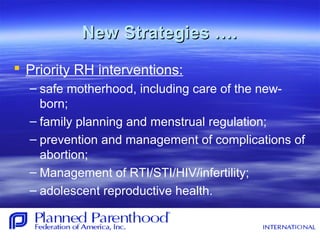
 Priority RH interventions:
– safe motherhood, including care of the new-
born;
– family planning and menstrual regulation;
– prevention and management of complications of
abortion;
– Management of RTI/STI/HIV/infertility;
– adolescent reproductive health.
New Strategies ….New Strategies ….
 A life-cycle approach whereby specific RH
services would be designed according to
the following stages:
– Before sexual maturity
– Sexually mature and unmarried
– Sexually mature and married
– After the fertile period
New Strategies ….New Strategies ….
 RH strategies now include integrated
services for women’s health that are client-
centered
 Massive re-orientation of the existing vertical
program structure
 More prominent role for NGOs, the private
sector, physicians and operations, and
operations research organization (evidence-
based data)
Replicable Best PracticesReplicable Best Practices
Replicable Best Practices for RHReplicable Best Practices for RH
programmingprogramming
 Develop alliances with key players – INGOS, localDevelop alliances with key players – INGOS, local
NGOs, govts., for better impact in the countryNGOs, govts., for better impact in the country
 Partner with local NGOs with diverse expertise:Partner with local NGOs with diverse expertise:
legal, research, community-based, service deliverylegal, research, community-based, service delivery
 Organize joint meetings with all partners to obtainOrganize joint meetings with all partners to obtain
feedback on the SRH need in the country forfeedback on the SRH need in the country for
advocacy, training, services, etc.,advocacy, training, services, etc.,
 Develop a country-wide joint program with allDevelop a country-wide joint program with all
partners (key results and strategies) with clearpartners (key results and strategies) with clear
roles and responsibilitiesroles and responsibilities
Replicable Best Practices for RHReplicable Best Practices for RH
programmingprogramming
 Facilitate periodic “Partners’ Meet” to shareFacilitate periodic “Partners’ Meet” to share
achievements, lessons learned, IEC materials, buildachievements, lessons learned, IEC materials, build
relationship among partners, provide TA and sharerelationship among partners, provide TA and share
resourcesresources
 Establish public-private partnerships (Establish public-private partnerships (an innovative
approach for the public and private sectors to work
together to achieve intended results) to obtainto obtain
feedback on policy reform, service delivery guidelines,feedback on policy reform, service delivery guidelines,
etc.etc.
 Conduct annual dissemination meetings and invite keyand invite key
GO/ INGO/ NGOsGO/ INGO/ NGOs
Replicable Best Practices for RHReplicable Best Practices for RH
programmingprogramming
 Document cases of violation of RRs andDocument cases of violation of RRs and
develop litigation strategies with legaldevelop litigation strategies with legal
organizationsorganizations
 Sensitize media and highlight violations ofSensitize media and highlight violations of
RRsRRs
 Obtain inputs from key stakeholders and theObtain inputs from key stakeholders and the
community regarding the existing RH law forcommunity regarding the existing RH law for
policy reformpolicy reform
Replicable Best Practices for RHReplicable Best Practices for RH
programmingprogramming
 Increase awareness on SRH issues among lawIncrease awareness on SRH issues among law
enforcers, judges, police, pharmacists andenforcers, judges, police, pharmacists and
community-based service providerscommunity-based service providers
 Identify GO/NGO facilities that provide SRHIdentify GO/NGO facilities that provide SRH
services and establish referral linkagesservices and establish referral linkages
 Conduct IEC sessions to change the attitudes ofConduct IEC sessions to change the attitudes of
service providersservice providers
 Conduct client satisfaction surveys and provideConduct client satisfaction surveys and provide
feedback to service providers and clinic stafffeedback to service providers and clinic staff
Replicable Best Practices for YRHReplicable Best Practices for YRH
 Involve youth in developing strategies, key messagesInvolve youth in developing strategies, key messages
and IEC materialsand IEC materials
 Include youth in the Project Steering CommitteeInclude youth in the Project Steering Committee
 Conduct SRH sessions for in- & out-of-school youthConduct SRH sessions for in- & out-of-school youth
and include gender issuesand include gender issues
 Conduct life skills training; link to vocational trainingConduct life skills training; link to vocational training
 Sensitize community stakeholders – religiousSensitize community stakeholders – religious
leaders, teachers, parents, mothers-in-laws andleaders, teachers, parents, mothers-in-laws and
involve them in project interventionsinvolve them in project interventions
 Conduct SRH sessions for the to-be-married andConduct SRH sessions for the to-be-married and
newly married youthnewly married youth
Replicable Best Practices for YRHReplicable Best Practices for YRH
 Train young couples to provide information andTrain young couples to provide information and
services to other young couplesservices to other young couples
 Develop youth leaders and give them recognitionDevelop youth leaders and give them recognition
 Train youth to be Peer EducatorsTrain youth to be Peer Educators
 Encourage youth to organize dramas, quizEncourage youth to organize dramas, quiz
competitions, develop folk songs, games on SRHcompetitions, develop folk songs, games on SRH
issuesissues
 Conduct inter-community and inter-school dramaConduct inter-community and inter-school drama
competitions on SRH issuescompetitions on SRH issues
 Establish social marketing, community-basedEstablish social marketing, community-based
distribution of contraceptivesdistribution of contraceptives
Replicable Best Practices for YRHReplicable Best Practices for YRH
 Encourage youth to develop newsletter ‘By theEncourage youth to develop newsletter ‘By the
Youth for the Youth’Youth for the Youth’
 Organize sports events to convey SRH messagesOrganize sports events to convey SRH messages
 Organize residential RH camps to bring youthOrganize residential RH camps to bring youth
togethertogether
 Conduct workshops for the media to sensitizeConduct workshops for the media to sensitize
them on YRH issuesthem on YRH issues
 Train teachers on SRH issues so that they couldTrain teachers on SRH issues so that they could
conduct sessions for the youthconduct sessions for the youth

Reproductive Health Issues in Asia and the Pacific: Old Challenges, New Strategies

  • 1.
    REPRODUCTIVE HEALTH ISSUESINREPRODUCTIVE HEALTH ISSUES IN ASIA AND THE PACIFIC:ASIA AND THE PACIFIC: OLD CHALLENGES,OLD CHALLENGES, NEW STRATEGIESNEW STRATEGIES Dr. Sona Sethi Regional Director, Asia
  • 2.
    Overview of Asiaand the PacificOverview of Asia and the Pacific  Home to 60 per cent of the world's peopleHome to 60 per cent of the world's people  Two out of every three people living in extremeTwo out of every three people living in extreme poverty live in the region and struggle to survive onpoverty live in the region and struggle to survive on less than $1 a dayless than $1 a day  Includes more than half of the world's young people -Includes more than half of the world's young people - some 850 million. Some parts of South/South-eastsome 850 million. Some parts of South/South-east Asia, young people make up between ⅓ to ½ of theAsia, young people make up between ⅓ to ½ of the populationpopulation  Adolescents comprise more than 20 % of total AsianAdolescents comprise more than 20 % of total Asian population and are the most at risk of unwantedpopulation and are the most at risk of unwanted pregnancies, sexually transmitted infections and AIDSpregnancies, sexually transmitted infections and AIDS
  • 3.
    Overview of Asiaand the PacificOverview of Asia and the Pacific  Nearly 40 million people in the region migrateNearly 40 million people in the region migrate each year to urban areas in search of economiceach year to urban areas in search of economic opportunity and end up living in slum-likeopportunity and end up living in slum-like conditions - insecure tenure, inadequate housing,conditions - insecure tenure, inadequate housing, lack of access to water or sanitationlack of access to water or sanitation  Within the next 15 years, 18 of the projected 27Within the next 15 years, 18 of the projected 27 megacities (urban areas with more than 10 millionmegacities (urban areas with more than 10 million people) will be in Asia, and over half of the peoplepeople) will be in Asia, and over half of the people will live in slums and informal settlementswill live in slums and informal settlements
  • 4.
    RH Issues –Old challengesRH Issues – Old challenges  Gender-based violence remains widespread and hasGender-based violence remains widespread and has only recently been recognized as a significant publiconly recently been recognized as a significant public health and development concernhealth and development concern  Low status of women and early marriage lead to high- risk adolescent pregnancies, Poverty and illiteracy are common  Strong son preference andStrong son preference and discrimination against the girl-child, has led to pre-natal sex selection or neglecthas led to pre-natal sex selection or neglect of infant girls; at least 60 million girls are 'missing' inof infant girls; at least 60 million girls are 'missing' in Asia, with potentially serious social consequencesAsia, with potentially serious social consequences  Poor access to reproductive health services,Poor access to reproductive health services, especially for the poor and those living in remoteespecially for the poor and those living in remote areasareas ,,
  • 5.
    PPFA-International in AsiaPPFA-Internationalin Asia  16 projects in five countries: India, Myanmar,16 projects in five countries: India, Myanmar, Nepal, Thailand, PhilippinesNepal, Thailand, Philippines  Country program focusCountry program focus  Focus on youth, street kids, law enforcers, privateFocus on youth, street kids, law enforcers, private paramedics and chemists, clinic and communityparamedics and chemists, clinic and community service providers, parliamentariansservice providers, parliamentarians  Safe abortion, postabortion care, SRH informationSafe abortion, postabortion care, SRH information and services, advocacy, STI/HIV/FP and genderand services, advocacy, STI/HIV/FP and gender mainstreamingmainstreaming
  • 6.
    RH Issues –Old challengesRH Issues – Old challenges  Maternal mortality ratios exceed 400 per 100,000 liveMaternal mortality ratios exceed 400 per 100,000 live births in some countries (Afghanistan, Bhutan,births in some countries (Afghanistan, Bhutan, Cambodia, India, Lao PDR, Nepal); others (Myanmar,Cambodia, India, Lao PDR, Nepal); others (Myanmar, Pakistan, Philippines) have large unmet RH needsPakistan, Philippines) have large unmet RH needs  Although HIV/AIDS came later to Asia, HIV is quicklyAlthough HIV/AIDS came later to Asia, HIV is quickly spreading to the general population. More than 6.5spreading to the general population. More than 6.5 million people living with HIV/AIDS, some 5 million inmillion people living with HIV/AIDS, some 5 million in China and India alone (second highest number of HIV-China and India alone (second highest number of HIV- infected adults in the world)infected adults in the world)  Cambodia, Myanmar and Thailand are dealing withCambodia, Myanmar and Thailand are dealing with serious epidemics, but Thailand has shown that it isserious epidemics, but Thailand has shown that it is possible to reverse the spread of the infection withpossible to reverse the spread of the infection with large-scale, sustained and concerted programminglarge-scale, sustained and concerted programming
  • 7.
    RH Issues –Old challengesRH Issues – Old challenges  Several factors have muted an effective response:Several factors have muted an effective response: denial of the problem, stigma and discriminationdenial of the problem, stigma and discrimination against those living with infection, lack of resources &against those living with infection, lack of resources & political commitment, increasing volume of migration,political commitment, increasing volume of migration, trafficking of women and youth.trafficking of women and youth.  Some 220,000 women in Asia die each year fromSome 220,000 women in Asia die each year from complications of pregnancy and childbirth,complications of pregnancy and childbirth,  The lifetime risk of maternal death in Asia is 18 timesThe lifetime risk of maternal death in Asia is 18 times greater than in Europe.greater than in Europe.  Sri Lanka reduced its maternal mortality rate fromSri Lanka reduced its maternal mortality rate from more than 1,500 per 100,000 live births to 60 bymore than 1,500 per 100,000 live births to 60 by making safe motherhood a priority and achieving near-making safe motherhood a priority and achieving near- universal use of skilled attendants at birth.universal use of skilled attendants at birth.
  • 8.
    ““To confront thechallenges of the twenty-firstTo confront the challenges of the twenty-first century successfully, we must strive to promote,century successfully, we must strive to promote, respect and protect all human rights: economic,respect and protect all human rights: economic, social, civil and political. Asia has made excellentsocial, civil and political. Asia has made excellent progress over the past 30 years and we mustprogress over the past 30 years and we must maintain the momentum”.maintain the momentum”. - Thoraya Ahmed Obaid,Thoraya Ahmed Obaid, Executive Director, UNFPAExecutive Director, UNFPA
  • 9.
    New Strategies ….NewStrategies ….  Poor people must be empowered to take steps toPoor people must be empowered to take steps to improve their lives, governments must assist them byimprove their lives, governments must assist them by ensuring that they can obtain the services they need:ensuring that they can obtain the services they need: universal access to reproductive health and primaryuniversal access to reproductive health and primary education (ICPD, 1994).education (ICPD, 1994).  Need to have community-based programs to combatNeed to have community-based programs to combat widespread poverty and illiteracy, genderwidespread poverty and illiteracy, gender discrimination, growing demands in urban areas,discrimination, growing demands in urban areas, environmental degradation and spread of HIV/AIDSenvironmental degradation and spread of HIV/AIDS through greater political commitment and financialthrough greater political commitment and financial supportsupport
  • 10.
    New Strategies ….NewStrategies ….  HIV/AIDS programming requires a multisectoral responseHIV/AIDS programming requires a multisectoral response that reaches beyond the health system to the community.that reaches beyond the health system to the community. Effective strategies include: behavior change, condomEffective strategies include: behavior change, condom programming, targeting and involving specific sectors ofprogramming, targeting and involving specific sectors of society, including those living with HIV/AIDS.society, including those living with HIV/AIDS.  HIV/ AIDS programs include three strategic interventions:HIV/ AIDS programs include three strategic interventions: – ensuring that information and services reach andensuring that information and services reach and involve young people, especially adolescent girls;involve young people, especially adolescent girls; – ensuring that pregnant women and their children canensuring that pregnant women and their children can remain HIV-free, andremain HIV-free, and – ensuring that condoms are accessible, and usedensuring that condoms are accessible, and used correctly and consistently.correctly and consistently.
  • 11.
    New Strategies ….NewStrategies ….  Priority RH interventions: – safe motherhood, including care of the new- born; – family planning and menstrual regulation; – prevention and management of complications of abortion; – Management of RTI/STI/HIV/infertility; – adolescent reproductive health.
  • 12.
    New Strategies ….NewStrategies ….  A life-cycle approach whereby specific RH services would be designed according to the following stages: – Before sexual maturity – Sexually mature and unmarried – Sexually mature and married – After the fertile period
  • 13.
    New Strategies ….NewStrategies ….  RH strategies now include integrated services for women’s health that are client- centered  Massive re-orientation of the existing vertical program structure  More prominent role for NGOs, the private sector, physicians and operations, and operations research organization (evidence- based data)
  • 15.
  • 16.
    Replicable Best Practicesfor RHReplicable Best Practices for RH programmingprogramming  Develop alliances with key players – INGOS, localDevelop alliances with key players – INGOS, local NGOs, govts., for better impact in the countryNGOs, govts., for better impact in the country  Partner with local NGOs with diverse expertise:Partner with local NGOs with diverse expertise: legal, research, community-based, service deliverylegal, research, community-based, service delivery  Organize joint meetings with all partners to obtainOrganize joint meetings with all partners to obtain feedback on the SRH need in the country forfeedback on the SRH need in the country for advocacy, training, services, etc.,advocacy, training, services, etc.,  Develop a country-wide joint program with allDevelop a country-wide joint program with all partners (key results and strategies) with clearpartners (key results and strategies) with clear roles and responsibilitiesroles and responsibilities
  • 17.
    Replicable Best Practicesfor RHReplicable Best Practices for RH programmingprogramming  Facilitate periodic “Partners’ Meet” to shareFacilitate periodic “Partners’ Meet” to share achievements, lessons learned, IEC materials, buildachievements, lessons learned, IEC materials, build relationship among partners, provide TA and sharerelationship among partners, provide TA and share resourcesresources  Establish public-private partnerships (Establish public-private partnerships (an innovative approach for the public and private sectors to work together to achieve intended results) to obtainto obtain feedback on policy reform, service delivery guidelines,feedback on policy reform, service delivery guidelines, etc.etc.  Conduct annual dissemination meetings and invite keyand invite key GO/ INGO/ NGOsGO/ INGO/ NGOs
  • 18.
    Replicable Best Practicesfor RHReplicable Best Practices for RH programmingprogramming  Document cases of violation of RRs andDocument cases of violation of RRs and develop litigation strategies with legaldevelop litigation strategies with legal organizationsorganizations  Sensitize media and highlight violations ofSensitize media and highlight violations of RRsRRs  Obtain inputs from key stakeholders and theObtain inputs from key stakeholders and the community regarding the existing RH law forcommunity regarding the existing RH law for policy reformpolicy reform
  • 19.
    Replicable Best Practicesfor RHReplicable Best Practices for RH programmingprogramming  Increase awareness on SRH issues among lawIncrease awareness on SRH issues among law enforcers, judges, police, pharmacists andenforcers, judges, police, pharmacists and community-based service providerscommunity-based service providers  Identify GO/NGO facilities that provide SRHIdentify GO/NGO facilities that provide SRH services and establish referral linkagesservices and establish referral linkages  Conduct IEC sessions to change the attitudes ofConduct IEC sessions to change the attitudes of service providersservice providers  Conduct client satisfaction surveys and provideConduct client satisfaction surveys and provide feedback to service providers and clinic stafffeedback to service providers and clinic staff
  • 20.
    Replicable Best Practicesfor YRHReplicable Best Practices for YRH  Involve youth in developing strategies, key messagesInvolve youth in developing strategies, key messages and IEC materialsand IEC materials  Include youth in the Project Steering CommitteeInclude youth in the Project Steering Committee  Conduct SRH sessions for in- & out-of-school youthConduct SRH sessions for in- & out-of-school youth and include gender issuesand include gender issues  Conduct life skills training; link to vocational trainingConduct life skills training; link to vocational training  Sensitize community stakeholders – religiousSensitize community stakeholders – religious leaders, teachers, parents, mothers-in-laws andleaders, teachers, parents, mothers-in-laws and involve them in project interventionsinvolve them in project interventions  Conduct SRH sessions for the to-be-married andConduct SRH sessions for the to-be-married and newly married youthnewly married youth
  • 21.
    Replicable Best Practicesfor YRHReplicable Best Practices for YRH  Train young couples to provide information andTrain young couples to provide information and services to other young couplesservices to other young couples  Develop youth leaders and give them recognitionDevelop youth leaders and give them recognition  Train youth to be Peer EducatorsTrain youth to be Peer Educators  Encourage youth to organize dramas, quizEncourage youth to organize dramas, quiz competitions, develop folk songs, games on SRHcompetitions, develop folk songs, games on SRH issuesissues  Conduct inter-community and inter-school dramaConduct inter-community and inter-school drama competitions on SRH issuescompetitions on SRH issues  Establish social marketing, community-basedEstablish social marketing, community-based distribution of contraceptivesdistribution of contraceptives
  • 22.
    Replicable Best Practicesfor YRHReplicable Best Practices for YRH  Encourage youth to develop newsletter ‘By theEncourage youth to develop newsletter ‘By the Youth for the Youth’Youth for the Youth’  Organize sports events to convey SRH messagesOrganize sports events to convey SRH messages  Organize residential RH camps to bring youthOrganize residential RH camps to bring youth togethertogether  Conduct workshops for the media to sensitizeConduct workshops for the media to sensitize them on YRH issuesthem on YRH issues  Train teachers on SRH issues so that they couldTrain teachers on SRH issues so that they could conduct sessions for the youthconduct sessions for the youth