Human Rights
Prepared by
Ziyad Siso
Supervised by
DR. Numan Kanar
What is human rights ?
Human rights are defined as the rights and freedoms that are
inherent to all human beings, regardless of their nationality, place of
residence, sex, national or ethnic origin, color, religion, language, or
any other status.
Everyone has the right to life, liberty and security of
person.
Human rights must be afforded to everyone, without
exception. The entire premise of the framework is that
people are entitled to these rights simply by virtue of being
human.
 Universality
Some of the basic human rights
 Indivisibility
Human rights are indivisible and interdependent, which means that in
order to guarantee civil and political rights, a government must also
ensure economic, social and cultural rights (and visa versa). The
indivisibility principle recognizes that if a government violates rights
such as health, it necessarily affects people’s ability to exercise other
rights such as the right to life.
People have a right to participate in how decisions are made
regarding protection of their rights. This includes but is not limited to
having input on government decisions about rights. To ensure human
rights, governments must engage and support the participation of
civil society on these issues.
 Participation:
Accountability
Governments must create mechanisms of accountability for the
enforcement of rights. It is not enough that rights are recognized in
domestic law or in policy rhetoric, there must actually be effective
measures put in place so that the government can be held accountable
if those rights standards are not met.
 Transparency
Transparency means that governments must be open about all
information and decision-making processes related to rights. People
must be able to know and understand how major decisions affecting
rights are made and how public institutions, such as hospitals and
schools, which are needed to protect rights, are managed and run.
Human rights must be guaranteed without discrimination of any
kind. This includes not only purposeful discrimination, but also
protection from policies and practices which may have a
discriminatory effect
Non-Discrimination
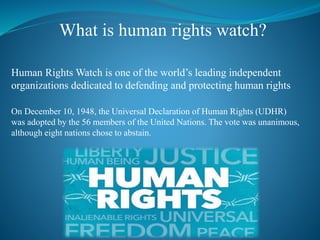
What is human rights watch?
Human Rights Watch is one of the world’s leading independent
organizations dedicated to defending and protecting human rights
On December 10, 1948, the Universal Declaration of Human Rights (UDHR)
was adopted by the 56 members of the United Nations. The vote was unanimous,
although eight nations chose to abstain.
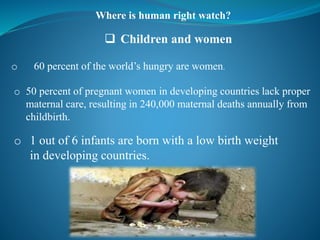
Where is human right watch?
 Children and women
o 60 percent of the world’s hungry are women.
o 50 percent of pregnant women in developing countries lack proper
maternal care, resulting in 240,000 maternal deaths annually from
childbirth.
o 1 out of 6 infants are born with a low birth weight
in developing countries.
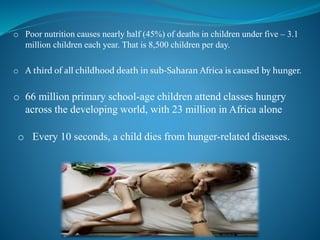
o Poor nutrition causes nearly half (45%) of deaths in children under five – 3.1
million children each year. That is 8,500 children per day.
o A third of all childhood death in sub-Saharan Africa is caused by hunger.
o 66 million primary school-age children attend classes hungry
across the developing world, with 23 million in Africa alone
o Every 10 seconds, a child dies from hunger-related diseases.
 HIV/AIDS and other Diseases
o 35 million people are living with HIV/AIDS.
o 52 percent of people living with HIV/AIDS are women
o 88 percent of all children and 60 percent of all women living with HIV
are in sub-Saharan Africa
o 6.9 million children died in 2011 each year – 19,000 a day- mostly from preventable
health issues such as malaria, diarrhea and pneumonia.
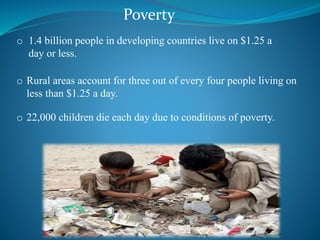
Poverty
o 1.4 billion people in developing countries live on $1.25 a
day or less.
o Rural areas account for three out of every four people living on
less than $1.25 a day.
o 22,000 children die each day due to conditions of poverty.
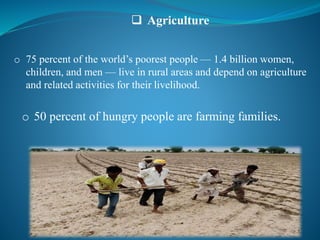
 Agriculture
o 75 percent of the world’s poorest people — 1.4 billion women,
children, and men — live in rural areas and depend on agriculture
and related activities for their livelihood.
o 50 percent of hungry people are farming families.
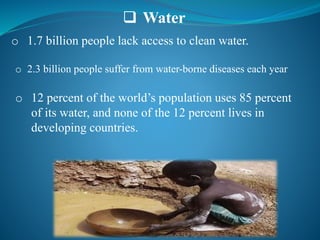
 Water
o 1.7 billion people lack access to clean water.
o 2.3 billion people suffer from water-borne diseases each year
o 12 percent of the world’s population uses 85 percent
of its water, and none of the 12 percent lives in
developing countries.
Sources
 http://www.34.jubilee.edu.jo/Definition%20of%20Human%20Rights.html
 http://www.nesri.org/programs/what-are-the-basic-principles-of-the-human-
rights-framework
 http://www.un.org/en/events/humanrightsday/
 http://www.nesri.org/programs/what-are-the-basic-principles-of-the-human-
rights-framework
 http://thp.org/knowledge-center/know-your-world-facts-about-hunger-poverty/
Human Rights

Human Rights

  • 1.
    Human Rights Prepared by ZiyadSiso Supervised by DR. Numan Kanar
  • 2.
    What is humanrights ? Human rights are defined as the rights and freedoms that are inherent to all human beings, regardless of their nationality, place of residence, sex, national or ethnic origin, color, religion, language, or any other status.
  • 3.
    Everyone has theright to life, liberty and security of person.
  • 4.
    Human rights mustbe afforded to everyone, without exception. The entire premise of the framework is that people are entitled to these rights simply by virtue of being human.  Universality Some of the basic human rights
  • 5.
     Indivisibility Human rightsare indivisible and interdependent, which means that in order to guarantee civil and political rights, a government must also ensure economic, social and cultural rights (and visa versa). The indivisibility principle recognizes that if a government violates rights such as health, it necessarily affects people’s ability to exercise other rights such as the right to life.
  • 6.
    People have aright to participate in how decisions are made regarding protection of their rights. This includes but is not limited to having input on government decisions about rights. To ensure human rights, governments must engage and support the participation of civil society on these issues.  Participation:
  • 7.
    Accountability Governments must createmechanisms of accountability for the enforcement of rights. It is not enough that rights are recognized in domestic law or in policy rhetoric, there must actually be effective measures put in place so that the government can be held accountable if those rights standards are not met.
  • 8.
     Transparency Transparency meansthat governments must be open about all information and decision-making processes related to rights. People must be able to know and understand how major decisions affecting rights are made and how public institutions, such as hospitals and schools, which are needed to protect rights, are managed and run.
  • 9.
    Human rights mustbe guaranteed without discrimination of any kind. This includes not only purposeful discrimination, but also protection from policies and practices which may have a discriminatory effect Non-Discrimination
  • 10.
    What is humanrights watch? Human Rights Watch is one of the world’s leading independent organizations dedicated to defending and protecting human rights On December 10, 1948, the Universal Declaration of Human Rights (UDHR) was adopted by the 56 members of the United Nations. The vote was unanimous, although eight nations chose to abstain.
  • 11.
    Where is humanright watch?  Children and women o 60 percent of the world’s hungry are women. o 50 percent of pregnant women in developing countries lack proper maternal care, resulting in 240,000 maternal deaths annually from childbirth. o 1 out of 6 infants are born with a low birth weight in developing countries.
  • 12.
    o Poor nutritioncauses nearly half (45%) of deaths in children under five – 3.1 million children each year. That is 8,500 children per day. o A third of all childhood death in sub-Saharan Africa is caused by hunger. o 66 million primary school-age children attend classes hungry across the developing world, with 23 million in Africa alone o Every 10 seconds, a child dies from hunger-related diseases.
  • 13.
     HIV/AIDS andother Diseases o 35 million people are living with HIV/AIDS. o 52 percent of people living with HIV/AIDS are women o 88 percent of all children and 60 percent of all women living with HIV are in sub-Saharan Africa o 6.9 million children died in 2011 each year – 19,000 a day- mostly from preventable health issues such as malaria, diarrhea and pneumonia.
  • 14.
    Poverty o 1.4 billionpeople in developing countries live on $1.25 a day or less. o Rural areas account for three out of every four people living on less than $1.25 a day. o 22,000 children die each day due to conditions of poverty.
  • 15.
     Agriculture o 75percent of the world’s poorest people — 1.4 billion women, children, and men — live in rural areas and depend on agriculture and related activities for their livelihood. o 50 percent of hungry people are farming families.
  • 16.
     Water o 1.7billion people lack access to clean water. o 2.3 billion people suffer from water-borne diseases each year o 12 percent of the world’s population uses 85 percent of its water, and none of the 12 percent lives in developing countries.
  • 17.
    Sources  http://www.34.jubilee.edu.jo/Definition%20of%20Human%20Rights.html  http://www.nesri.org/programs/what-are-the-basic-principles-of-the-human- rights-framework http://www.un.org/en/events/humanrightsday/  http://www.nesri.org/programs/what-are-the-basic-principles-of-the-human- rights-framework  http://thp.org/knowledge-center/know-your-world-facts-about-hunger-poverty/