EDU1006: Education in Developing Countries
Session 11: Informal learning
Dr James Stanfield
• Introduction
• Projects Hello World!
• Big Question
• Group presentations
• Assignments
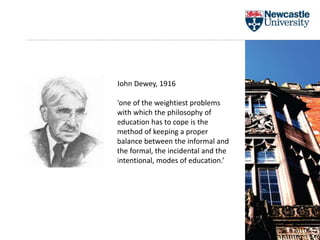
John Dewey, 1916
‘one of the weightiest problems
with which the philosophy of
education has to cope is the
method of keeping a proper
balance between the informal and
the formal, the incidental and the
intentional, modes of education.’
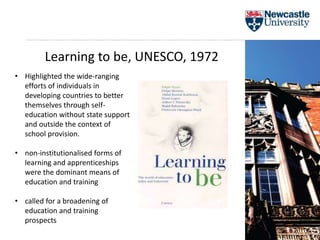
Learning to be, UNESCO, 1972
• Highlighted the wide-ranging
efforts of individuals in
developing countries to better
themselves through self-
education without state support
and outside the context of
school provision.
• non-institutionalised forms of
learning and apprenticeships
were the dominant means of
education and training
• called for a broadening of
education and training
prospects
Characteristics of informal learning
• Less organised, more spontaneous
• There is no formal curriculum.
• Informal learners are often highly motivated to
learn.
• Not dependent on qualified teachers
• Essential to a child’s early development and to
an adult’s lifelong learning.
• Its difficult to quantify
Learning that takes place in dedicated educational
institutions such as schools is seen as formal,
learning which occurs beyond the school walls is
‘informal’.
Session 11: Informal learning

Session 11: Informal learning

  • 1.
    EDU1006: Education inDeveloping Countries Session 11: Informal learning Dr James Stanfield
  • 2.
    • Introduction • ProjectsHello World! • Big Question • Group presentations • Assignments
  • 3.
    John Dewey, 1916 ‘oneof the weightiest problems with which the philosophy of education has to cope is the method of keeping a proper balance between the informal and the formal, the incidental and the intentional, modes of education.’
  • 4.
    Learning to be,UNESCO, 1972 • Highlighted the wide-ranging efforts of individuals in developing countries to better themselves through self- education without state support and outside the context of school provision. • non-institutionalised forms of learning and apprenticeships were the dominant means of education and training • called for a broadening of education and training prospects
  • 5.
    Characteristics of informallearning • Less organised, more spontaneous • There is no formal curriculum. • Informal learners are often highly motivated to learn. • Not dependent on qualified teachers • Essential to a child’s early development and to an adult’s lifelong learning. • Its difficult to quantify Learning that takes place in dedicated educational institutions such as schools is seen as formal, learning which occurs beyond the school walls is ‘informal’.