PR Media Production
Session 1: Introduction & Course Overview
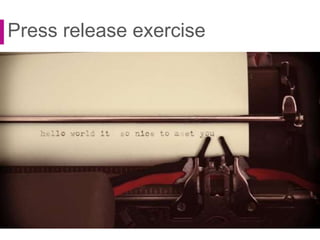
Press release exercise
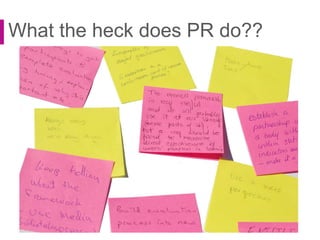
What the heck does PR do??
• The post it exercise
What PR really does…
Chartered Institute of PR (UK)
• Program planning – analyzing problems and
opportunities, defining goals, recommending and
planning activities and measuring results. Liaising
with management and clients throughout.
• Writing & editing – shareholder reports, annual
reports, press releases, film scripts, articles and
features, speeches, booklets, newsletters.
What PR really does
• Media relations – developing & maintaining good
working contact with the media. This involves applying
knowledge of how local and national papers,
magazines, radio & TV work as well as the special
interests of journalists.
• Corporate identity – developing and maintaining an
organization’s identity via corporate advertising,
presenting the company’s name and reputation rather
than its products
• Speaking – communicating effectively with individuals
and groups including meetings, presentations and
platform participation.
What PR really does
• Production – brochures, reports, film and multi-media
programs are important means of communication.
Coordination of studio or location photography. Sound
knowledge of techniques for supervision is necessary.
• Special events – news conferences, exhibitions,
facility celebrations, open days, competitions and
award programs are all used to gain the attention of
specific groups.
• Research and evaluation – The first activity
undertaken by a PR practitioner is usually analysis
and fact gathering. A PR program should be evaluated
as a continuing process and measurement is used to
decide future strategy.
Essential skills for pr person
ABILITY TO:
• Analyze management needs
• Counsel management
• Identify causes of problems, analyze future trends and predict
their consequences
• Research into public opinion, attitudes and expectations and
advise on necessary action
• Plan, organize and coordinate tasks
• Monitor and follow up
• Set goals and objectives
• Motivate & influence others
• Write & edit press releases and reports
• Work effectively with journalists
• Identify major social issues affecting organizations & to
resolve conflict
And each with their
own nature, dynamics,
In PR, there are...…
stakeholders
media
platform
channel
Differe
nt
We’ll dive in to...
• The Old vs. The New Rules of PR
• What is story telling & why is it important
• Why good content matters
• Understanding your ‘buyers’
• How to build awareness internally & externally
• Grasping social media
• Why blogging
and also in to...
• Website concepting
• News release & New media room
• Creating video & audio content
• Developing & managing PR strategy
• Industry’s best practices
• Managing overall PR campaign from a PR
professional
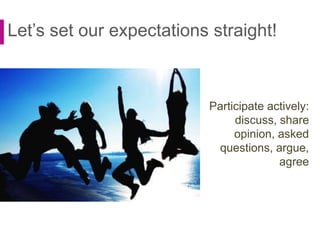
Let’s set our expectations straight!
Participate actively:
discuss, share
opinion, asked
questions, argue,
agree
Let’s set our expectations straight!
Be updated with current news & events
• Start using social media actively
• Start writing
Class blog
• Each week, 3-4 people will write one short
article (300 words max) and publish it on the
class blog
• Others are obliged to comment – constructive
feedback, please.
• Topic will be discussed & decided together.
• Besides weekly writing, the class blog will be
used as a platform to share weekly materials,
case studies, etc.
Let’s do it together!

Session 1 - Intro & Course Overview

  • 1.
    PR Media Production Session1: Introduction & Course Overview
  • 2.
  • 3.
    What the heckdoes PR do?? • The post it exercise
  • 5.
    What PR reallydoes… Chartered Institute of PR (UK) • Program planning – analyzing problems and opportunities, defining goals, recommending and planning activities and measuring results. Liaising with management and clients throughout. • Writing & editing – shareholder reports, annual reports, press releases, film scripts, articles and features, speeches, booklets, newsletters.
  • 6.
    What PR reallydoes • Media relations – developing & maintaining good working contact with the media. This involves applying knowledge of how local and national papers, magazines, radio & TV work as well as the special interests of journalists. • Corporate identity – developing and maintaining an organization’s identity via corporate advertising, presenting the company’s name and reputation rather than its products • Speaking – communicating effectively with individuals and groups including meetings, presentations and platform participation.
  • 7.
    What PR reallydoes • Production – brochures, reports, film and multi-media programs are important means of communication. Coordination of studio or location photography. Sound knowledge of techniques for supervision is necessary. • Special events – news conferences, exhibitions, facility celebrations, open days, competitions and award programs are all used to gain the attention of specific groups. • Research and evaluation – The first activity undertaken by a PR practitioner is usually analysis and fact gathering. A PR program should be evaluated as a continuing process and measurement is used to decide future strategy.
  • 8.
    Essential skills forpr person ABILITY TO: • Analyze management needs • Counsel management • Identify causes of problems, analyze future trends and predict their consequences • Research into public opinion, attitudes and expectations and advise on necessary action • Plan, organize and coordinate tasks • Monitor and follow up • Set goals and objectives • Motivate & influence others • Write & edit press releases and reports • Work effectively with journalists • Identify major social issues affecting organizations & to resolve conflict
  • 9.
    And each withtheir own nature, dynamics, In PR, there are...… stakeholders media platform channel Differe nt
  • 10.
    We’ll dive into... • The Old vs. The New Rules of PR • What is story telling & why is it important • Why good content matters • Understanding your ‘buyers’ • How to build awareness internally & externally • Grasping social media • Why blogging
  • 11.
    and also into... • Website concepting • News release & New media room • Creating video & audio content • Developing & managing PR strategy • Industry’s best practices • Managing overall PR campaign from a PR professional
  • 12.
    Let’s set ourexpectations straight! Participate actively: discuss, share opinion, asked questions, argue, agree
  • 13.
    Let’s set ourexpectations straight! Be updated with current news & events • Start using social media actively • Start writing
  • 14.
    Class blog • Eachweek, 3-4 people will write one short article (300 words max) and publish it on the class blog • Others are obliged to comment – constructive feedback, please. • Topic will be discussed & decided together. • Besides weekly writing, the class blog will be used as a platform to share weekly materials, case studies, etc.
  • 15.
    Let’s do ittogether!

Editor's Notes

  • #2 Before we talk about the course itself, let’s go back a little bit to the bigger question. What is PR?
  • #5 Why do you want to study PR? Why do you want to be a PR person? What makes you think that working in PR is the thing for you? Is there anyone who inspire you?
  • #8 So with those things that a PR professional does… what skills do you think we need to have?
  • #9 Source: CIPR
  • #12 So, with those