


BUSINESS AND WORK
IMPROVEMENT COURSE
(BWIC)
Cheekee J. Gonzales
Bureau of Workers with Special Concerns, DOLE
Session 1: Introduction
Let’s get to know each other
ADJECTIVE GAME
 Each participant must think of an adjective that
begins with the first letter of their names (Katrina –
Kissable)
 Participants would then take turns in introducing
themselves and acting out the chosen adjective.
Let’s get to know each other
COAT OF ARMS
 Make four quadrants on the given bond paper. On each
quadrant, draw or write your answers to the
corresponding questions below:
 What are your greatest achievement(s)?
 How do you see yourself at the present?
 How do you see yourself in the future (5 years)?
 What are your unforgettable failure(s)?
Let’s group ourselves!
 Each participant will be given a piece of a broken heart
 Write down your name on your selected piece of heart
 Mingle around and try to look for the other pieces of the
broken heart to make it whole again
 Once done, this will be your permanent grouping for the
duration of the training
 Give your group a name
House Rules
 No lates – AM session starts at 8:30, PM session starts at 1:30
(there will be penalties for late comers)
 Mobile/cellular phones should be in silent mode at all times
 Everybody should participate; questions are welcome
 Each group will have daily assignments:
Daily recap
Unfreezing exercises
Time management for AM and PM sessions
House Rules
 At the end of each day, all participants are required to
do an evaluation – be honest with your feedback –
constructive criticisms are appreciated
 No certificate of attendance for those who will not be
able to complete the 5-day training
Session 1.1: Program
Overview and Levelling
of Expectations
What will happen in the next 5 days?
 Lecture/technical inputs
 Experiential and action learning exercises
 Day 1 – Overview
 Day 2 – Introduction
 Day 3 – Sessions on Organizational Management, Marketing
and Production
 Day 4 – Sessions on Financial Management, Occupational
Safety and Health and Productivity
 Day 5 – Sessions on SWOT Analysis, Problem Analysis and
Action Planning
What is BWIC?
 Training module that aims to strengthen the entrepreneurial
capacities of DOLE Livelihood beneficiaries in:
Managing the operations of their projects
Instituting improvements that would lead to productivity
enhancement and working conditions improvement
Levelling of expectations
 What do you expect to gain in this training?
 What do you expect from the trainers?
 What do you expect from the co-participants?
 What do you expect not what to happen in this
training?
Session 1.2:
Entrepreneurship and
Economic Development
BAKIT TAYO MAHIRAP?
Poverty is deep and widespread
 Deeply rooted in rural societies, particularly
predominantly agricultural areas;
 More than a quarter of our people live in rural areas
in extreme poverty
 In 2012 survey, poverty incidence (magnitude of
poor population/total population) was at 25.2%
 In the 1st semester of 2014, poverty incidence went
up to 25.8
Traditional explanations of poverty
• Why did Japan and Singapore become
affluent despite all these limitations?
Limited natural resources; lacking in
essential basic resources
Traditional explanations of poverty
• Why did China turn to capitalist economic system
and became the 2nd largest economy next to US?
Capitalist economic system, bureaucratic
system stifles economic growth
Traditional explanations of poverty
• Singapore and Malaysia are near the equator – why
they developed so fast?
• Why is Vietnam one of the fast-rising economies in
ASEAN?
• Why is Panama turning itself as most economically
prosperous and dynamic society in Latin America?
Tropical climate, make people naturally
lazy and easygoing
We accommodate poverty
Poor people have
no strong urge to
improve their
situations
Accommodation is
wisdom – it gives
them peace of
mind
Fatalism – “blessed
are the poor”, “the
poor will always be
with us”…principal
world religions
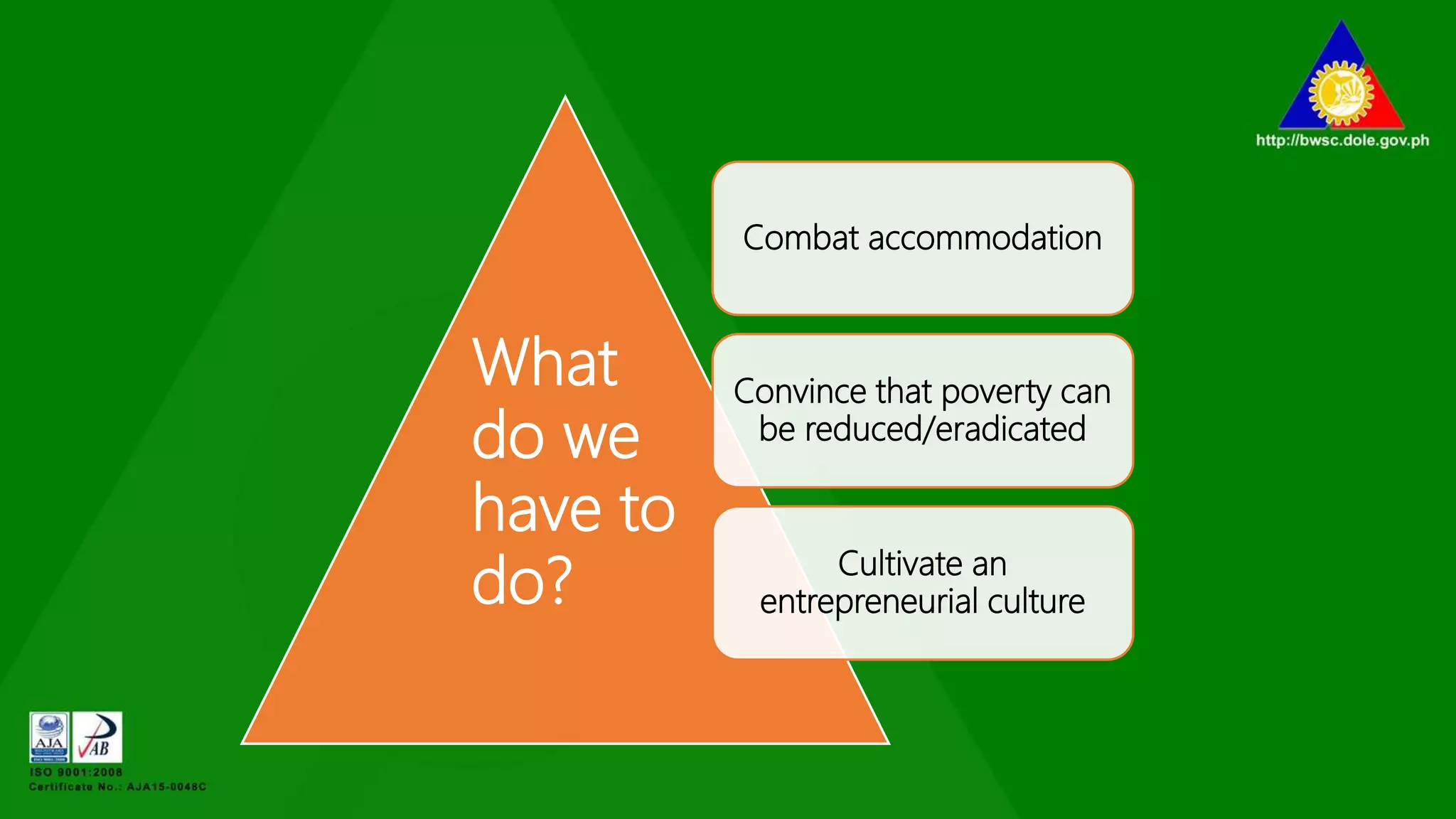
Combat accommodation
Convince that poverty can
be reduced/eradicated
Cultivate an
entrepreneurial culture
What
do we
have to
do?
WHAT IS ENTREPRENEURSHIP?
► Creation of new enterprises and that the entrepreneur is
the founder.
► Entrepreneurship is a phenomenon where changes were
driven by through the innovation and improvement of
the entrepreneurs.*
► Entrepreneurship is vital to stimulate economic growth
and employment opportunities.
WHO ARE THE ENTREPRENEURS?
 People who create their own earnings and opportunities
in the form of business, contract work or free-lance
activities
Someone who actually searches for change, responds to
it, and exploits change as an opportunity*.
 Entrepreneur is an individual who can discover new
opportunities and utilize it for the betterment of not only
for him/herself but also for the entire community
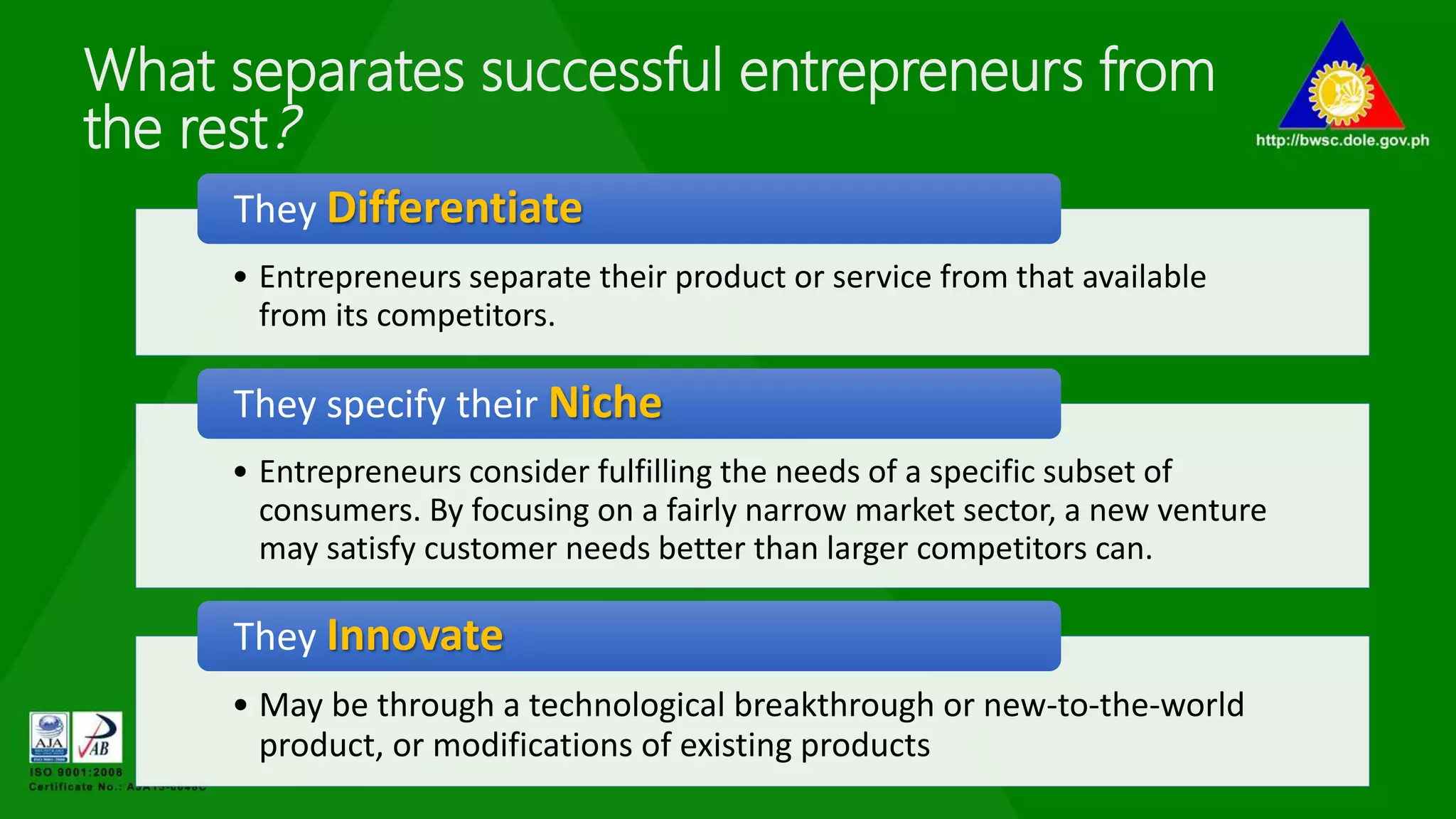
What separates successful entrepreneurs from
the rest?
• Entrepreneurs separate their product or service from that available
from its competitors.
They Differentiate
• Entrepreneurs consider fulfilling the needs of a specific subset of
consumers. By focusing on a fairly narrow market sector, a new venture
may satisfy customer needs better than larger competitors can.
They specify their Niche
• May be through a technological breakthrough or new-to-the-world
product, or modifications of existing products
They Innovate
WHY BECOME AN ENTREPRENEUR?
 Entrepreneurs are autonomous of their own.
 Entrepreneurship offers a sense of fulfillment
through achieving significant financial rewards or
providing services to others.
 Entrepreneurs help the local economy.
 Entrepreneurs create jobs for the community.
In the Philippines
 99.60 percent of business enterprises are MSMEs
 91.30 percent (846,817) of which are micro-enterprises
 Entrepreneurship development is one of the key thrusts of
the government towards development
 Entrepreneurship plays a major role towards our goal of
achieving national development and nation building.
Pagsusuri sa Kakayahan
ng Samahan sa
Pagnenegosyo:
Taglay ba ninyo ang mga
katangian at kakayahang
kailangan sa pagiging
negosyante?
Pagsusuri sa Samahan
1. Pagtukoy at paghanap ng mga oportunidad (Opportunity
Seeking)
 Nakikita ba ninyo ang mga dumarating na oportunidad?
 Gumagawa ba kayo ng aksyon para matugunan ang mga ito?
 Nakakakita ba kayo ng di-pangkaraniwang oportunidad upang
magkaroon ng puhunan, kagamitan o puwesto?
 Madali ba kayong makahanap ng tulong o assistance sa
pagnenegosyo?
Pagsusuri sa Samahan
2. Pagpupursigi (Persistence)
 Patuloy ba kayong gumagawa ng paraan upang
malutas ang mga problema?
 Nagagawa ba ninyong magsipag, magpumilit at
magsakripisyo upang matapos ang isang gawain?
 Pinaninindigan ba ninyo ang sariling desisyon at
paniniwala sa kabila ng batikos at kabiguan?
Pagsusuri sa Samahan
3. Pagpapahalaga sa pangako at pagiging responsable
(Commitment)
 Pinapanagutan ba ninyo ang mga problemang
kinakaharap?
 Handa ka ba kayong makipagtulungan sa iyong
mga kasamahan sa pagtatrabaho para makatupad
sa ipinangako sa customer?
 Nagsusumikap ba kayo upang masiyahan ang mga
customer?
Pagsusuri sa Samahan
4. Kakayahang makipagsapalaran (Risk-taking)
 Kung napag-isipan ninyo na ang isang bagay,
malakas ba ang inyong loob na makipagsapalaran
para dito?
 Pipiliin ninyo ba ang katamtaman lamang na
pakikipagsapalaran (moderate risk-taking) o parang
pakikipagsugal (high risk-taking)
Pagsusuri sa Samahan
5. Pagtiyak sa mataas na kalidad ng produkto o
serbisyo (Values efficiency and quality)
 Lagi ba ninyong sinisikap na mapaigi pa ang
iyong gawa?
 Kapag may ginagawa kayong isang bagay,
sinisikap ba ninyo na laging pagandahin ito sa
abot ng iyong makakaya?
Pagsusuri sa Samahan
6. Paggawa ng plano (Goal setting)
 Nakagagawa ba kayo ng malinaw na plano para
sa malapit na hinaharap (short-term planning)?
 Nakagagawa ba kayo ng malinaw na plano para
sa malayong hinaharap (long-term planning)?
Pagsusuri sa Samahan
7. Pagkalap ng impormasyon (Information-seeking)
 Kaya ninyo bang mangalap ng impormasyon
tungkol sa iyong mga customer, supplier at
kakumpetensya?
 Kumukuha ba kayo ng impormasyon mula sa iyong
mga kakilala, kamag-anak, kaibigan at iba pang
mga contact?
Pagsusuri sa Samahan
8. Masistemang pagpaplano at pagsubaybay sa
negosyo (Systematic planning and monitoring)
 Nakabubuo ba kayo ng malinaw na mga
hakbangin patungo sa katuparan ng iyong mga
hangarin?
 Nasusubaybayan ninyo ba ang pagsulong ng
iyong negosyo?
 Handa ba kayong magpalit ng istratehiya kung
kinakailangan?
Pagsusuri sa Samahan
9. Paghihikayat at pag-aaruga sa mga connection
(Persuasion and Networking)
 Kaya ba ninyong manghikayat ng ibang tao?
 Nagagamit ba ninyo ang iyong mga kaibigan, kamag-
anak, kasamahan at iba pang mga connection upang
makuha ang iyong gusto?
Pagsusuri sa Samahan
10. Tiwala sa sarili (Self-confidence)
 May tiwala ba kayo sa iyong kakayahan na
makatapos ng isang mahirap na gawain o
humarap sa mabigat na problema?
Thank you!

Session 1: Business Work Improvement Course (Introduction)

  • 1.
    BUSINESS AND WORK IMPROVEMENTCOURSE (BWIC) Cheekee J. Gonzales Bureau of Workers with Special Concerns, DOLE
  • 2.
  • 3.
    Let’s get toknow each other ADJECTIVE GAME  Each participant must think of an adjective that begins with the first letter of their names (Katrina – Kissable)  Participants would then take turns in introducing themselves and acting out the chosen adjective.
  • 4.
    Let’s get toknow each other COAT OF ARMS  Make four quadrants on the given bond paper. On each quadrant, draw or write your answers to the corresponding questions below:  What are your greatest achievement(s)?  How do you see yourself at the present?  How do you see yourself in the future (5 years)?  What are your unforgettable failure(s)?
  • 5.
    Let’s group ourselves! Each participant will be given a piece of a broken heart  Write down your name on your selected piece of heart  Mingle around and try to look for the other pieces of the broken heart to make it whole again  Once done, this will be your permanent grouping for the duration of the training  Give your group a name
  • 6.
    House Rules  Nolates – AM session starts at 8:30, PM session starts at 1:30 (there will be penalties for late comers)  Mobile/cellular phones should be in silent mode at all times  Everybody should participate; questions are welcome  Each group will have daily assignments: Daily recap Unfreezing exercises Time management for AM and PM sessions
  • 7.
    House Rules  Atthe end of each day, all participants are required to do an evaluation – be honest with your feedback – constructive criticisms are appreciated  No certificate of attendance for those who will not be able to complete the 5-day training
  • 8.
    Session 1.1: Program Overviewand Levelling of Expectations
  • 9.
    What will happenin the next 5 days?  Lecture/technical inputs  Experiential and action learning exercises  Day 1 – Overview  Day 2 – Introduction  Day 3 – Sessions on Organizational Management, Marketing and Production  Day 4 – Sessions on Financial Management, Occupational Safety and Health and Productivity  Day 5 – Sessions on SWOT Analysis, Problem Analysis and Action Planning
  • 10.
    What is BWIC? Training module that aims to strengthen the entrepreneurial capacities of DOLE Livelihood beneficiaries in: Managing the operations of their projects Instituting improvements that would lead to productivity enhancement and working conditions improvement
  • 11.
    Levelling of expectations What do you expect to gain in this training?  What do you expect from the trainers?  What do you expect from the co-participants?  What do you expect not what to happen in this training?
  • 12.
  • 13.
  • 14.
    Poverty is deepand widespread  Deeply rooted in rural societies, particularly predominantly agricultural areas;  More than a quarter of our people live in rural areas in extreme poverty  In 2012 survey, poverty incidence (magnitude of poor population/total population) was at 25.2%  In the 1st semester of 2014, poverty incidence went up to 25.8
  • 15.
    Traditional explanations ofpoverty • Why did Japan and Singapore become affluent despite all these limitations? Limited natural resources; lacking in essential basic resources
  • 16.
    Traditional explanations ofpoverty • Why did China turn to capitalist economic system and became the 2nd largest economy next to US? Capitalist economic system, bureaucratic system stifles economic growth
  • 17.
    Traditional explanations ofpoverty • Singapore and Malaysia are near the equator – why they developed so fast? • Why is Vietnam one of the fast-rising economies in ASEAN? • Why is Panama turning itself as most economically prosperous and dynamic society in Latin America? Tropical climate, make people naturally lazy and easygoing
  • 18.
    We accommodate poverty Poorpeople have no strong urge to improve their situations Accommodation is wisdom – it gives them peace of mind Fatalism – “blessed are the poor”, “the poor will always be with us”…principal world religions
  • 19.
    Combat accommodation Convince thatpoverty can be reduced/eradicated Cultivate an entrepreneurial culture What do we have to do?
  • 20.
    WHAT IS ENTREPRENEURSHIP? ►Creation of new enterprises and that the entrepreneur is the founder. ► Entrepreneurship is a phenomenon where changes were driven by through the innovation and improvement of the entrepreneurs.* ► Entrepreneurship is vital to stimulate economic growth and employment opportunities.
  • 21.
    WHO ARE THEENTREPRENEURS?  People who create their own earnings and opportunities in the form of business, contract work or free-lance activities Someone who actually searches for change, responds to it, and exploits change as an opportunity*.  Entrepreneur is an individual who can discover new opportunities and utilize it for the betterment of not only for him/herself but also for the entire community
  • 22.
    What separates successfulentrepreneurs from the rest? • Entrepreneurs separate their product or service from that available from its competitors. They Differentiate • Entrepreneurs consider fulfilling the needs of a specific subset of consumers. By focusing on a fairly narrow market sector, a new venture may satisfy customer needs better than larger competitors can. They specify their Niche • May be through a technological breakthrough or new-to-the-world product, or modifications of existing products They Innovate
  • 23.
    WHY BECOME ANENTREPRENEUR?  Entrepreneurs are autonomous of their own.  Entrepreneurship offers a sense of fulfillment through achieving significant financial rewards or providing services to others.  Entrepreneurs help the local economy.  Entrepreneurs create jobs for the community.
  • 24.
    In the Philippines 99.60 percent of business enterprises are MSMEs  91.30 percent (846,817) of which are micro-enterprises  Entrepreneurship development is one of the key thrusts of the government towards development  Entrepreneurship plays a major role towards our goal of achieving national development and nation building.
  • 25.
    Pagsusuri sa Kakayahan ngSamahan sa Pagnenegosyo: Taglay ba ninyo ang mga katangian at kakayahang kailangan sa pagiging negosyante?
  • 26.
    Pagsusuri sa Samahan 1.Pagtukoy at paghanap ng mga oportunidad (Opportunity Seeking)  Nakikita ba ninyo ang mga dumarating na oportunidad?  Gumagawa ba kayo ng aksyon para matugunan ang mga ito?  Nakakakita ba kayo ng di-pangkaraniwang oportunidad upang magkaroon ng puhunan, kagamitan o puwesto?  Madali ba kayong makahanap ng tulong o assistance sa pagnenegosyo?
  • 27.
    Pagsusuri sa Samahan 2.Pagpupursigi (Persistence)  Patuloy ba kayong gumagawa ng paraan upang malutas ang mga problema?  Nagagawa ba ninyong magsipag, magpumilit at magsakripisyo upang matapos ang isang gawain?  Pinaninindigan ba ninyo ang sariling desisyon at paniniwala sa kabila ng batikos at kabiguan?
  • 28.
    Pagsusuri sa Samahan 3.Pagpapahalaga sa pangako at pagiging responsable (Commitment)  Pinapanagutan ba ninyo ang mga problemang kinakaharap?  Handa ka ba kayong makipagtulungan sa iyong mga kasamahan sa pagtatrabaho para makatupad sa ipinangako sa customer?  Nagsusumikap ba kayo upang masiyahan ang mga customer?
  • 29.
    Pagsusuri sa Samahan 4.Kakayahang makipagsapalaran (Risk-taking)  Kung napag-isipan ninyo na ang isang bagay, malakas ba ang inyong loob na makipagsapalaran para dito?  Pipiliin ninyo ba ang katamtaman lamang na pakikipagsapalaran (moderate risk-taking) o parang pakikipagsugal (high risk-taking)
  • 30.
    Pagsusuri sa Samahan 5.Pagtiyak sa mataas na kalidad ng produkto o serbisyo (Values efficiency and quality)  Lagi ba ninyong sinisikap na mapaigi pa ang iyong gawa?  Kapag may ginagawa kayong isang bagay, sinisikap ba ninyo na laging pagandahin ito sa abot ng iyong makakaya?
  • 31.
    Pagsusuri sa Samahan 6.Paggawa ng plano (Goal setting)  Nakagagawa ba kayo ng malinaw na plano para sa malapit na hinaharap (short-term planning)?  Nakagagawa ba kayo ng malinaw na plano para sa malayong hinaharap (long-term planning)?
  • 32.
    Pagsusuri sa Samahan 7.Pagkalap ng impormasyon (Information-seeking)  Kaya ninyo bang mangalap ng impormasyon tungkol sa iyong mga customer, supplier at kakumpetensya?  Kumukuha ba kayo ng impormasyon mula sa iyong mga kakilala, kamag-anak, kaibigan at iba pang mga contact?
  • 33.
    Pagsusuri sa Samahan 8.Masistemang pagpaplano at pagsubaybay sa negosyo (Systematic planning and monitoring)  Nakabubuo ba kayo ng malinaw na mga hakbangin patungo sa katuparan ng iyong mga hangarin?  Nasusubaybayan ninyo ba ang pagsulong ng iyong negosyo?  Handa ba kayong magpalit ng istratehiya kung kinakailangan?
  • 34.
    Pagsusuri sa Samahan 9.Paghihikayat at pag-aaruga sa mga connection (Persuasion and Networking)  Kaya ba ninyong manghikayat ng ibang tao?  Nagagamit ba ninyo ang iyong mga kaibigan, kamag- anak, kasamahan at iba pang mga connection upang makuha ang iyong gusto?
  • 35.
    Pagsusuri sa Samahan 10.Tiwala sa sarili (Self-confidence)  May tiwala ba kayo sa iyong kakayahan na makatapos ng isang mahirap na gawain o humarap sa mabigat na problema?
  • 36.

Editor's Notes

  • #21 *Joseph Schumpeter defined Entrepreneurship as “Creative Destruction”.
  • #22 *Peter Drucker