DIPLOMADO DE INGLES 
NIVEL III 
ISC. Meztli Valeriano Orozco
UNIDAD I 
PAST TENSE
● En inglés para hablar en pasado empleamos 
dos tipos de verbos: 
● Verbos regulares 
● Verbos irregulares
Verbos Regulares 
● Son los verbos acabados en "ed", por ejemplo: 
I worked -> Yo trabajé 
I studied -> Yo estudié 
● Para formarlos bastará con agregar la 
terminación “ed” al infinitivo del verbo
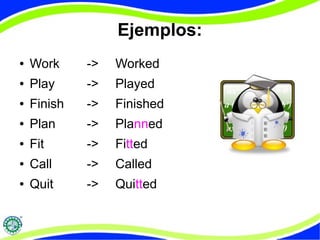
Ejemplos: 
● Work -> Worked 
● Play -> Played 
● Finish -> Finished 
● Plan -> Planned 
● Fit -> Fitted 
● Call -> Called 
● Quit -> Quitted
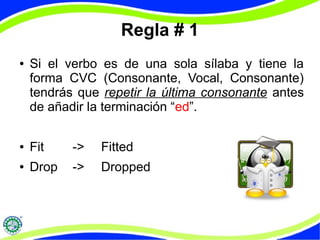
Regla # 1 
● Si el verbo es de una sola sílaba y tiene la 
forma CVC (Consonante, Vocal, Consonante) 
tendrás que repetir la última consonante antes 
de añadir la terminación “ed”. 
● Fit -> Fitted 
● Drop -> Dropped
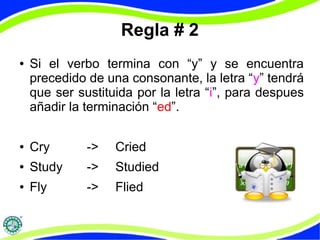
Regla # 2 
● Si el verbo termina con “y” y se encuentra 
precedido de una consonante, la letra “y” tendrá 
que ser sustituida por la letra “i”, para despues 
añadir la terminación “ed”. 
● Cry -> Cried 
● Study -> Studied 
● Fly -> Flied
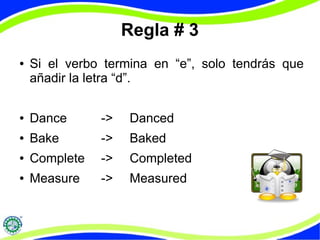
Regla # 3 
● Si el verbo termina en “e”, solo tendrás que 
añadir la letra “d”. 
● Dance -> Danced 
● Bake -> Baked 
● Complete -> Completed 
● Measure -> Measured
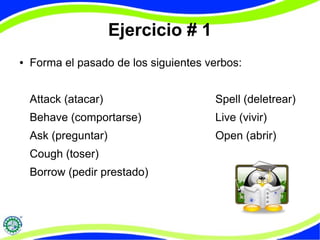
Ejercicio # 1 
● Forma el pasado de los siguientes verbos: 
Attack (atacar) Spell (deletrear) 
Behave (comportarse) Live (vivir) 
Ask (preguntar) Open (abrir) 
Cough (toser) 
Borrow (pedir prestado)
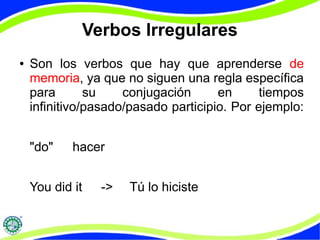
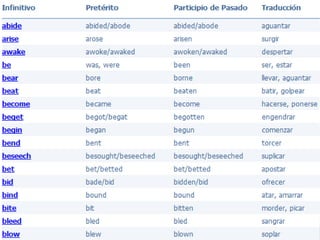
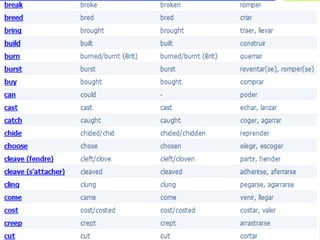
Verbos Irregulares 
● Son los verbos que hay que aprenderse de 
memoria, ya que no siguen una regla específica 
para su conjugación en tiempos 
infinitivo/pasado/pasado participio. Por ejemplo: 
"do" hacer 
You did it -> Tú lo hiciste
Estructura del Pasado Simple 
+ Verbo en Pasado + C 
Ana cried for his boyfriend 
They studied for the quiz
¿Cuando usamos el Tiempo 
Pasado? 
● We use the past simple to talk about actions 
and states which we see as completed in the 
past.
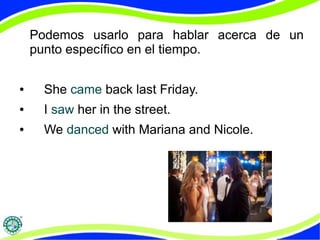
Podemos usarlo para hablar acerca de un 
punto específico en el tiempo. 
● She came back last Friday. 
● I saw her in the street. 
● We danced with Mariana and Nicole.
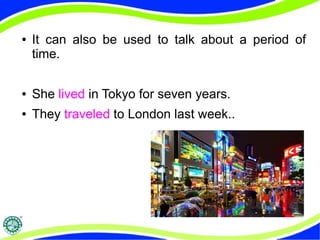
● It can also be used to talk about a period of 
time. 
● She lived in Tokyo for seven years. 
● They traveled to London last week..
Encontrarás que el pasado simple emplea “time 
expressions” como estas: 
● Yesterday 
● three weeks ago 
● last year 
● in 2002 
● from March to June 
● for a long time 
● for 6 weeks 
● in the 1980s 
● in the last century 
● in the past
Negando en Pasado 
+ did not / didn't + verbo en + C. 
Infinitivo 
● Willfred didn't eat pasta for 5 weeks 
● Luis and Paco didn't leave the band. 
● We didn't sleep since the attack.
Recuerda 
● Para negar y preguntar en pasado se utiliza el 
verbo auxiliar "did" para todas las personas. 
● El verbo "did" es un verbo auxiliar (no significa 
hacer) y, por tanto, NUNCA debe utilizarse 
conjuntamente con el verbo "to be". 
● Por ejemplo: No se dice: "Didn't are."
Conjugando al Verbo “to be” 
Presente 
● I am 
● You are 
● He / She / It is 
● We are 
● You are 
● They are 
Pasado 
● was 
● were 
● was 
● were 
● were 
● were
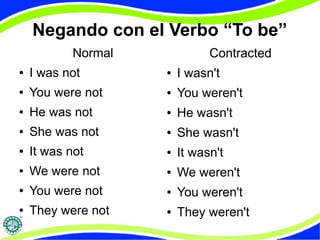
Negando con el Verbo “To be” 
Normal 
● I was not 
● You were not 
● He was not 
● She was not 
● It was not 
● We were not 
● You were not 
● They were not 
Contracted 
● I wasn't 
● You weren't 
● He wasn't 
● She wasn't 
● It wasn't 
● We weren't 
● You weren't 
● They weren't
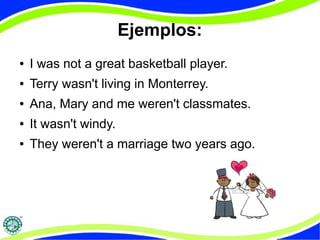
Ejemplos: 
● I was not a great basketball player. 
● Terry wasn't living in Monterrey. 
● Ana, Mary and me weren't classmates. 
● It wasn't windy. 
● They weren't a marriage two years ago.
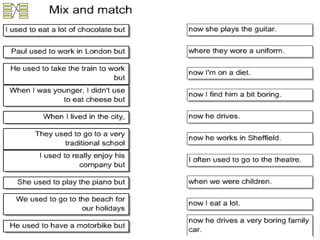
USED TO
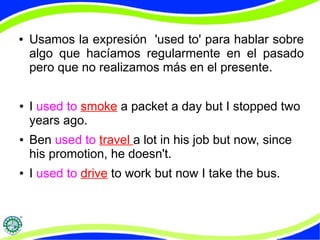
● Usamos la expresión 'used to' para hablar sobre 
algo que hacíamos regularmente en el pasado 
pero que no realizamos más en el presente. 
● I used to smoke a packet a day but I stopped two 
years ago. 
● Ben used to travel a lot in his job but now, since 
his promotion, he doesn't. 
● I used to drive to work but now I take the bus.
Estructura 
+ used to + verbo + C. 
infinitivo 
● I used to go to the gym 
● Ana used to play hockey 
● They used to go out to dinner
Tambien lo utilizamos para hablar de algo que 
fue verdad pero que ya no lo es más. 
● There used to be a cinema in the town but now 
there isn't. 
● She used to have really long hair but she's had 
it all cut off. 
● I didn't use to like him but now I do.
También se usa 'to be used to doing' para decir 
que algo es normal o usual. 
● I'm used to living on my own. I've done it for 
quite a long time. 
● Hans has lived in England for over a year, so he 
is used to driving on the left now. 
● They've always lived in hot countries, so they 
aren't used to dealing the cold weather.
Usamos 'to get used to doing' para hablar sobre 
algo a lo que nos estamos acostumbrando. 
● She has started working nights and is still 
getting used to sleeping during the day. 
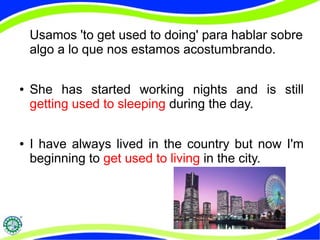
● I have always lived in the country but now I'm 
beginning to get used to living in the city.
Expressions of Quantity
● Son colocadas después de los nombres y 
expresan que tanto ('how much' or 'how many') 
existe sobre algo. 
● Algunas expresiones de cantidad solo son 
usadas con uncountables nouns y otros solo 
con countable nouns. 
● Otras expresiones de cantidad son usadas con 
ambos, ya sea contable o no contable
Much – Not Countables 
Se utiliza con nombres no-contables en 
oraciones negativas y preguntas. 
● How much homework do we get? 
● How much money do I need? 
● How much milk do you want? 
● Is there much sugar in my tea?
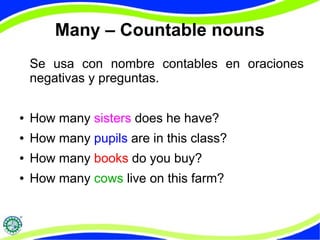
Many – Countable nouns 
Se usa con nombre contables en oraciones 
negativas y preguntas. 
● How many sisters does he have? 
● How many pupils are in this class? 
● How many books do you buy? 
● How many cows live on this farm?
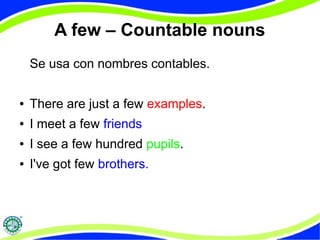
A few – Countable nouns 
Se usa con nombres contables. 
● There are just a few examples. 
● I meet a few friends 
● I see a few hundred pupils. 
● I've got few brothers.
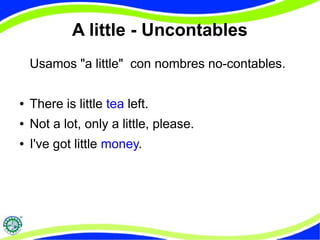
A little - Uncontables 
Usamos "a little" con nombres no-contables. 
● There is little tea left. 
● Not a lot, only a little, please. 
● I've got little money.
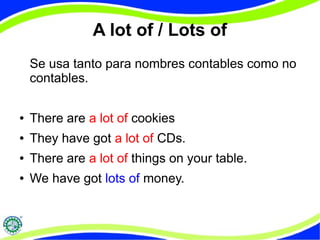
A lot of / Lots of 
Se usa tanto para nombres contables como no 
contables. 
● There are a lot of cookies 
● They have got a lot of CDs. 
● There are a lot of things on your table. 
● We have got lots of money.

Sesion 1-Verbos regulares e Irregulares

  • 1.
    DIPLOMADO DE INGLES NIVEL III ISC. Meztli Valeriano Orozco
  • 2.
  • 3.
    ● En ingléspara hablar en pasado empleamos dos tipos de verbos: ● Verbos regulares ● Verbos irregulares
  • 4.
    Verbos Regulares ●Son los verbos acabados en "ed", por ejemplo: I worked -> Yo trabajé I studied -> Yo estudié ● Para formarlos bastará con agregar la terminación “ed” al infinitivo del verbo
  • 5.
    Ejemplos: ● Work-> Worked ● Play -> Played ● Finish -> Finished ● Plan -> Planned ● Fit -> Fitted ● Call -> Called ● Quit -> Quitted
  • 6.
    Regla # 1 ● Si el verbo es de una sola sílaba y tiene la forma CVC (Consonante, Vocal, Consonante) tendrás que repetir la última consonante antes de añadir la terminación “ed”. ● Fit -> Fitted ● Drop -> Dropped
  • 7.
    Regla # 2 ● Si el verbo termina con “y” y se encuentra precedido de una consonante, la letra “y” tendrá que ser sustituida por la letra “i”, para despues añadir la terminación “ed”. ● Cry -> Cried ● Study -> Studied ● Fly -> Flied
  • 8.
    Regla # 3 ● Si el verbo termina en “e”, solo tendrás que añadir la letra “d”. ● Dance -> Danced ● Bake -> Baked ● Complete -> Completed ● Measure -> Measured
  • 9.
    Ejercicio # 1 ● Forma el pasado de los siguientes verbos: Attack (atacar) Spell (deletrear) Behave (comportarse) Live (vivir) Ask (preguntar) Open (abrir) Cough (toser) Borrow (pedir prestado)
  • 10.
    Verbos Irregulares ●Son los verbos que hay que aprenderse de memoria, ya que no siguen una regla específica para su conjugación en tiempos infinitivo/pasado/pasado participio. Por ejemplo: "do" hacer You did it -> Tú lo hiciste
  • 13.
    Estructura del PasadoSimple + Verbo en Pasado + C Ana cried for his boyfriend They studied for the quiz
  • 14.
    ¿Cuando usamos elTiempo Pasado? ● We use the past simple to talk about actions and states which we see as completed in the past.
  • 15.
    Podemos usarlo parahablar acerca de un punto específico en el tiempo. ● She came back last Friday. ● I saw her in the street. ● We danced with Mariana and Nicole.
  • 16.
    ● It canalso be used to talk about a period of time. ● She lived in Tokyo for seven years. ● They traveled to London last week..
  • 17.
    Encontrarás que elpasado simple emplea “time expressions” como estas: ● Yesterday ● three weeks ago ● last year ● in 2002 ● from March to June ● for a long time ● for 6 weeks ● in the 1980s ● in the last century ● in the past
  • 18.
    Negando en Pasado + did not / didn't + verbo en + C. Infinitivo ● Willfred didn't eat pasta for 5 weeks ● Luis and Paco didn't leave the band. ● We didn't sleep since the attack.
  • 19.
    Recuerda ● Paranegar y preguntar en pasado se utiliza el verbo auxiliar "did" para todas las personas. ● El verbo "did" es un verbo auxiliar (no significa hacer) y, por tanto, NUNCA debe utilizarse conjuntamente con el verbo "to be". ● Por ejemplo: No se dice: "Didn't are."
  • 20.
    Conjugando al Verbo“to be” Presente ● I am ● You are ● He / She / It is ● We are ● You are ● They are Pasado ● was ● were ● was ● were ● were ● were
  • 21.
    Negando con elVerbo “To be” Normal ● I was not ● You were not ● He was not ● She was not ● It was not ● We were not ● You were not ● They were not Contracted ● I wasn't ● You weren't ● He wasn't ● She wasn't ● It wasn't ● We weren't ● You weren't ● They weren't
  • 22.
    Ejemplos: ● Iwas not a great basketball player. ● Terry wasn't living in Monterrey. ● Ana, Mary and me weren't classmates. ● It wasn't windy. ● They weren't a marriage two years ago.
  • 23.
  • 24.
    ● Usamos laexpresión 'used to' para hablar sobre algo que hacíamos regularmente en el pasado pero que no realizamos más en el presente. ● I used to smoke a packet a day but I stopped two years ago. ● Ben used to travel a lot in his job but now, since his promotion, he doesn't. ● I used to drive to work but now I take the bus.
  • 25.
    Estructura + usedto + verbo + C. infinitivo ● I used to go to the gym ● Ana used to play hockey ● They used to go out to dinner
  • 26.
    Tambien lo utilizamospara hablar de algo que fue verdad pero que ya no lo es más. ● There used to be a cinema in the town but now there isn't. ● She used to have really long hair but she's had it all cut off. ● I didn't use to like him but now I do.
  • 27.
    También se usa'to be used to doing' para decir que algo es normal o usual. ● I'm used to living on my own. I've done it for quite a long time. ● Hans has lived in England for over a year, so he is used to driving on the left now. ● They've always lived in hot countries, so they aren't used to dealing the cold weather.
  • 28.
    Usamos 'to getused to doing' para hablar sobre algo a lo que nos estamos acostumbrando. ● She has started working nights and is still getting used to sleeping during the day. ● I have always lived in the country but now I'm beginning to get used to living in the city.
  • 30.
  • 31.
    ● Son colocadasdespués de los nombres y expresan que tanto ('how much' or 'how many') existe sobre algo. ● Algunas expresiones de cantidad solo son usadas con uncountables nouns y otros solo con countable nouns. ● Otras expresiones de cantidad son usadas con ambos, ya sea contable o no contable
  • 32.
    Much – NotCountables Se utiliza con nombres no-contables en oraciones negativas y preguntas. ● How much homework do we get? ● How much money do I need? ● How much milk do you want? ● Is there much sugar in my tea?
  • 33.
    Many – Countablenouns Se usa con nombre contables en oraciones negativas y preguntas. ● How many sisters does he have? ● How many pupils are in this class? ● How many books do you buy? ● How many cows live on this farm?
  • 34.
    A few –Countable nouns Se usa con nombres contables. ● There are just a few examples. ● I meet a few friends ● I see a few hundred pupils. ● I've got few brothers.
  • 35.
    A little -Uncontables Usamos "a little" con nombres no-contables. ● There is little tea left. ● Not a lot, only a little, please. ● I've got little money.
  • 36.
    A lot of/ Lots of Se usa tanto para nombres contables como no contables. ● There are a lot of cookies ● They have got a lot of CDs. ● There are a lot of things on your table. ● We have got lots of money.