K.J. SOMAIYA POLYTECHNIC
SERVO VOLTAGE STABILIZER
AUTHORS
1. Harsh Gosalia
2. Ravina waradkar
3. Jinal Panchal
ABSTRACT
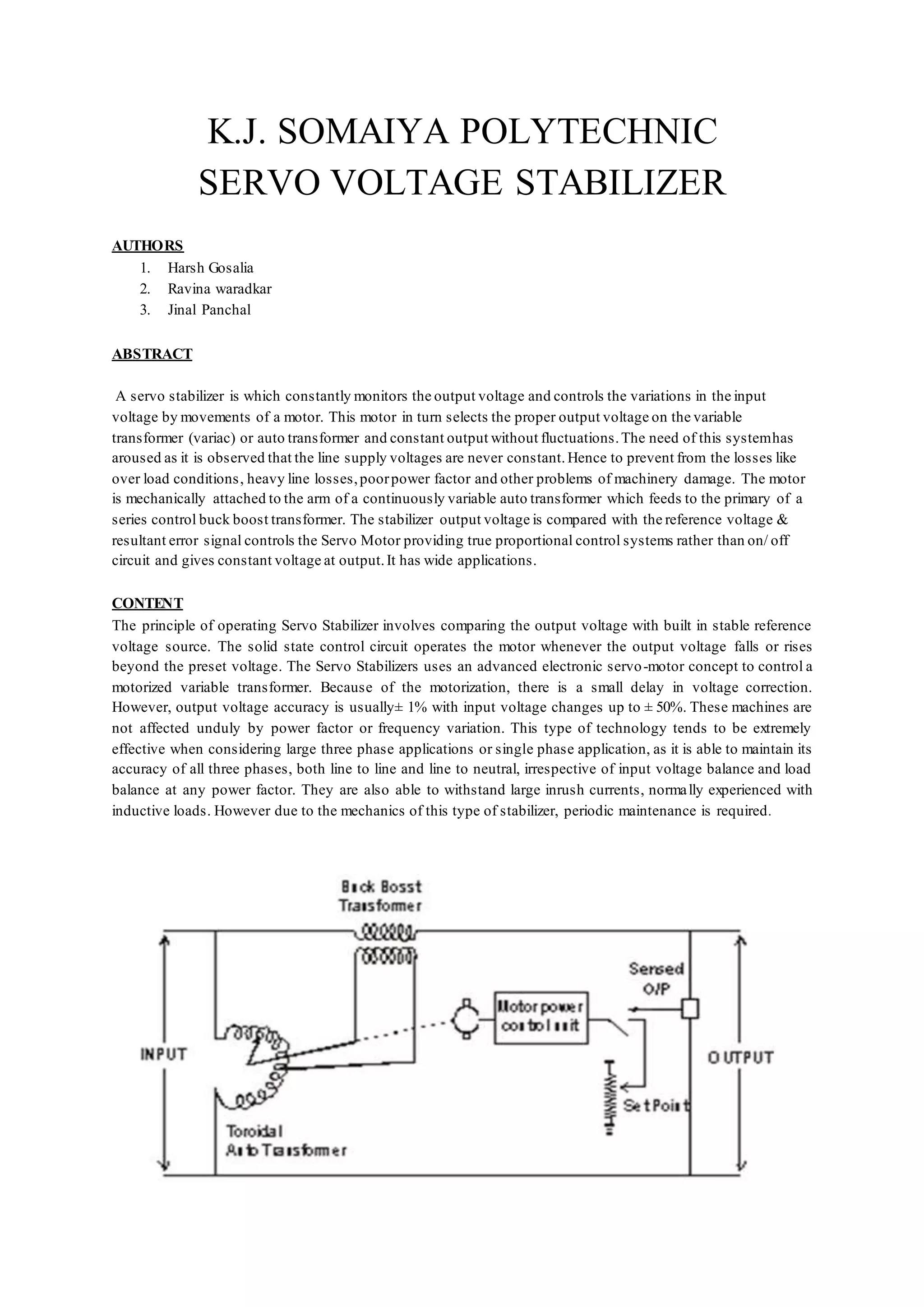
A servo stabilizer is which constantly monitors the output voltage and controls the variations in the input
voltage by movements of a motor. This motor in turn selects the proper output voltage on the variable
transformer (variac) or auto transformer and constant output without fluctuations.The need of this systemhas
aroused as it is observed that the line supply voltages are never constant.Hence to prevent from the losses like
over load conditions, heavy line losses,poorpower factor and other problems of machinery damage. The motor
is mechanically attached to the arm of a continuously variable auto transformer which feeds to the primary of a
series control buck boost transformer. The stabilizer output voltage is compared with the reference voltage &
resultant error signal controls the Servo Motor providing true proportional control systems rather than on/ off
circuit and gives constant voltage at output.It has wide applications.
CONTENT
The principle of operating Servo Stabilizer involves comparing the output voltage with built in stable reference
voltage source. The solid state control circuit operates the motor whenever the output voltage falls or rises
beyond the preset voltage. The Servo Stabilizers uses an advanced electronic servo-motor concept to control a
motorized variable transformer. Because of the motorization, there is a small delay in voltage correction.
However, output voltage accuracy is usually± 1% with input voltage changes up to ± 50%. These machines are
not affected unduly by power factor or frequency variation. This type of technology tends to be extremely
effective when considering large three phase applications or single phase application, as it is able to maintain its
accuracy of all three phases, both line to line and line to neutral, irrespective of input voltage balance and load
balance at any power factor. They are also able to withstand large inrush currents, normally experienced with
inductive loads. However due to the mechanics of this type of stabilizer, periodic maintenance is required.
A servo voltage stabilizer continuously senses and monitors the voltage. Wheneverthe output voltage differs
from the desired voltage, it generates control signal to automatically adjust the output to the desired value. A
servo voltage stabilizer uses a servo motor mechanism and continuously adjusts the output voltage.
The essentialparts of a Servo Voltage Transformer are –
1. Auto Transformer
2. Buck boost transformer
3. Servo Motor
4. Error amplifier
Auto transformer
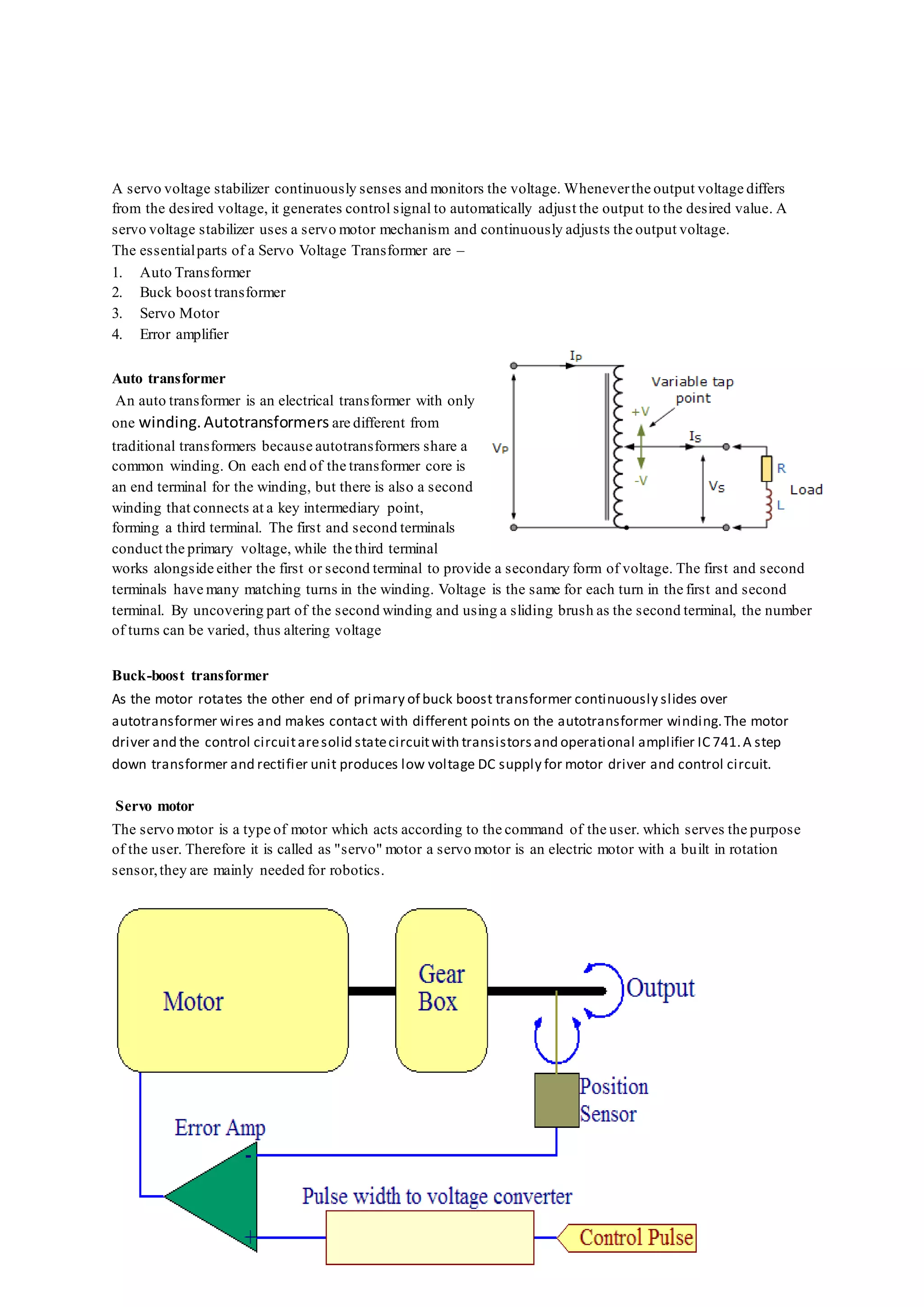
An auto transformer is an electrical transformer with only
one winding.Autotransformers are different from
traditional transformers because autotransformers share a
common winding. On each end of the transformer core is
an end terminal for the winding, but there is also a second
winding that connects at a key intermediary point,
forming a third terminal. The first and second terminals
conduct the primary voltage, while the third terminal
works alongside either the first or second terminal to provide a secondary form of voltage. The first and second
terminals have many matching turns in the winding. Voltage is the same for each turn in the first and second
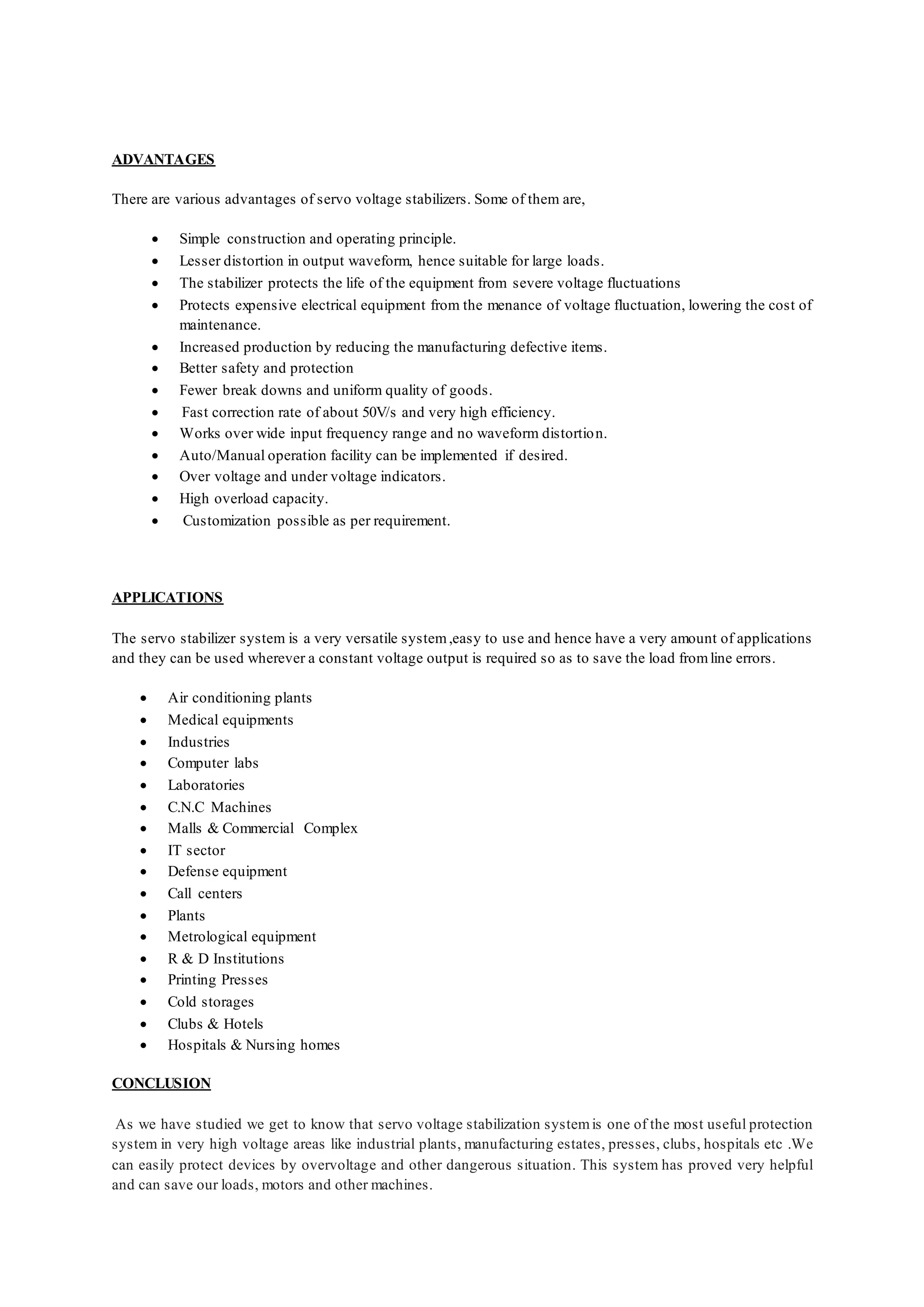
terminal. By uncovering part of the second winding and using a sliding brush as the second terminal, the number
of turns can be varied, thus altering voltage
Buck-boost transformer
As the motor rotates the other end of primary of buck boost transformer continuously slides over
autotransformer wires and makes contact with different points on the autotransformer winding.The motor
driver and the control circuitaresolid statecircuitwith transistorsand operational amplifier IC 741.A step
down transformer and rectifier unit produces low voltage DC supply for motor driver and control circuit.
Servo motor
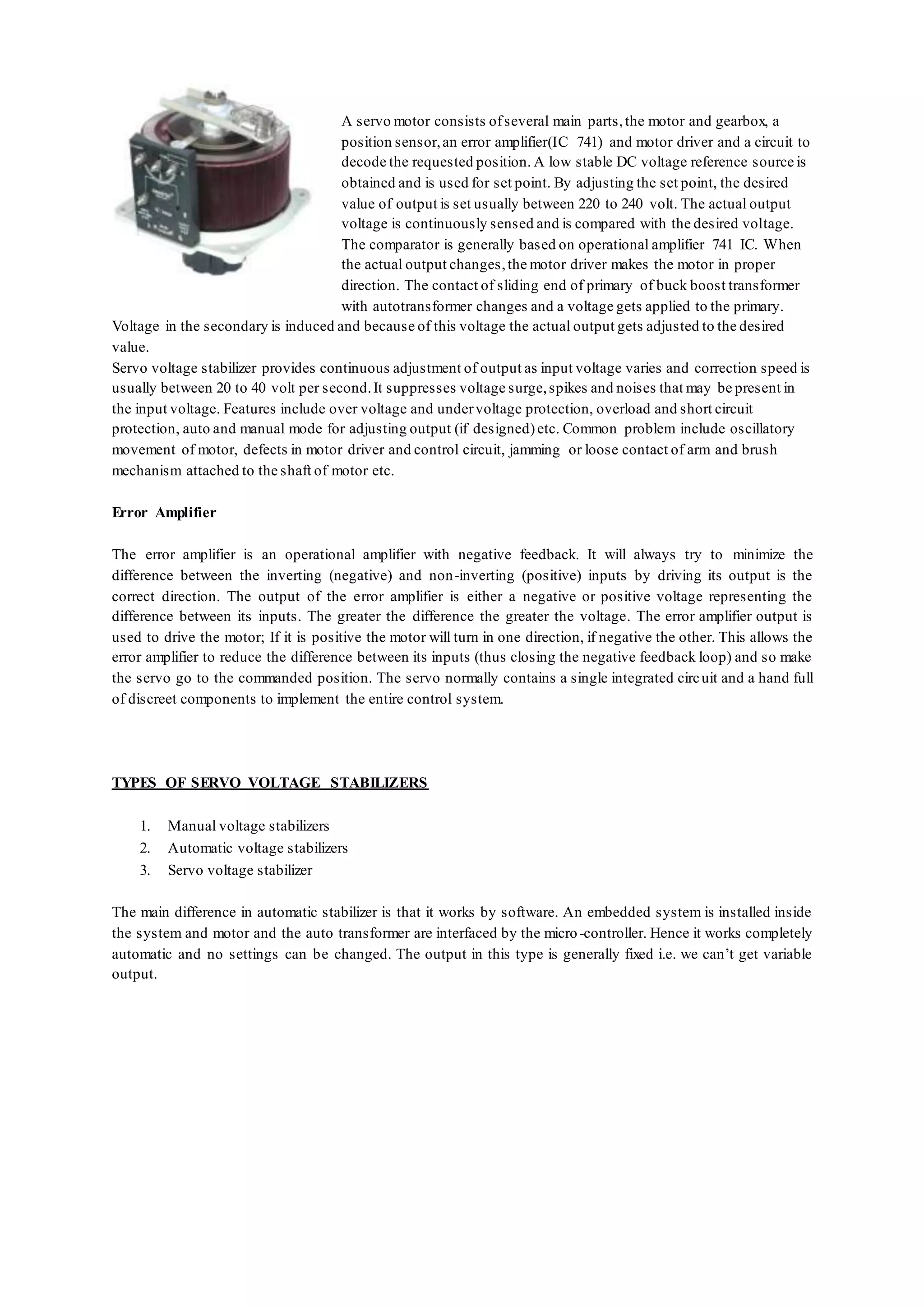
The servo motor is a type of motor which acts according to the command of the user. which serves the purpose
of the user. Therefore it is called as "servo" motor a servo motor is an electric motor with a built in rotation
sensor,they are mainly needed for robotics.
A servo motor consists ofseveral main parts,the motor and gearbox, a
position sensor,an error amplifier(IC 741) and motor driver and a circuit to
decode the requested position. A low stable DC voltage reference source is
obtained and is used for set point. By adjusting the set point, the desired
value of output is set usually between 220 to 240 volt. The actual output
voltage is continuously sensed and is compared with the desired voltage.
The comparator is generally based on operational amplifier 741 IC. When
the actual output changes,the motor driver makes the motor in proper
direction. The contact of sliding end of primary of buck boost transformer
with autotransformer changes and a voltage gets applied to the primary.
Voltage in the secondary is induced and because of this voltage the actual output gets adjusted to the desired
value.
Servo voltage stabilizer provides continuous adjustment of output as input voltage varies and correction speed is
usually between 20 to 40 volt per second.It suppresses voltage surge,spikes and noises that may be present in
the input voltage. Features include over voltage and undervoltage protection, overload and short circuit
protection, auto and manual mode for adjusting output (if designed)etc. Common problem include oscillatory
movement of motor, defects in motor driver and control circuit, jamming or loose contact of arm and brush
mechanism attached to the shaft of motor etc.
Error Amplifier
The error amplifier is an operational amplifier with negative feedback. It will always try to minimize the
difference between the inverting (negative) and non-inverting (positive) inputs by driving its output is the
correct direction. The output of the error amplifier is either a negative or positive voltage representing the
difference between its inputs. The greater the difference the greater the voltage. The error amplifier output is
used to drive the motor; If it is positive the motor will turn in one direction, if negative the other. This allows the
error amplifier to reduce the difference between its inputs (thus closing the negative feedback loop) and so make
the servo go to the commanded position. The servo normally contains a single integrated circuit and a hand full
of discreet components to implement the entire control system.
TYPES OF SERVO VOLTAGE STABILIZERS
1. Manual voltage stabilizers
2. Automatic voltage stabilizers
3. Servo voltage stabilizer
The main difference in automatic stabilizer is that it works by software. An embedded system is installed inside
the system and motor and the auto transformer are interfaced by the micro-controller. Hence it works completely
automatic and no settings can be changed. The output in this type is generally fixed i.e. we can’t get variable
output.
ADVANTAGES
There are various advantages of servo voltage stabilizers. Some of them are,
 Simple construction and operating principle.
 Lesser distortion in output waveform, hence suitable for large loads.
 The stabilizer protects the life of the equipment from severe voltage fluctuations
 Protects expensive electrical equipment from the menance of voltage fluctuation, lowering the cost of
maintenance.
 Increased production by reducing the manufacturing defective items.
 Better safety and protection
 Fewer break downs and uniform quality of goods.
 Fast correction rate of about 50V/s and very high efficiency.
 Works over wide input frequency range and no waveform distortion.
 Auto/Manual operation facility can be implemented if desired.
 Over voltage and under voltage indicators.
 High overload capacity.
 Customization possible as per requirement.
APPLICATIONS
The servo stabilizer system is a very versatile system,easy to use and hence have a very amount of applications
and they can be used wherever a constant voltage output is required so as to save the load fromline errors.
 Air conditioning plants
 Medical equipments
 Industries
 Computer labs
 Laboratories
 C.N.C Machines
 Malls & Commercial Complex
 IT sector
 Defense equipment
 Call centers
 Plants
 Metrological equipment
 R & D Institutions
 Printing Presses
 Cold storages
 Clubs & Hotels
 Hospitals & Nursing homes
CONCLUSION
As we have studied we get to know that servo voltage stabilization systemis one of the most useful protection
system in very high voltage areas like industrial plants, manufacturing estates, presses, clubs, hospitals etc .We
can easily protect devices by overvoltage and other dangerous situation. This system has proved very helpful
and can save our loads, motors and other machines.
REFERENCES
1. Yahoo Answers
2. Wikipedia
3. Electronicstutorials.com
4. Virdi electric works
5. Autoronica
6. Cosmostat
7. International Journal of applied electronics Research
8. Project Report
Servo voltage stabilization

Servo voltage stabilization

  • 1.
    K.J. SOMAIYA POLYTECHNIC SERVOVOLTAGE STABILIZER AUTHORS 1. Harsh Gosalia 2. Ravina waradkar 3. Jinal Panchal ABSTRACT A servo stabilizer is which constantly monitors the output voltage and controls the variations in the input voltage by movements of a motor. This motor in turn selects the proper output voltage on the variable transformer (variac) or auto transformer and constant output without fluctuations.The need of this systemhas aroused as it is observed that the line supply voltages are never constant.Hence to prevent from the losses like over load conditions, heavy line losses,poorpower factor and other problems of machinery damage. The motor is mechanically attached to the arm of a continuously variable auto transformer which feeds to the primary of a series control buck boost transformer. The stabilizer output voltage is compared with the reference voltage & resultant error signal controls the Servo Motor providing true proportional control systems rather than on/ off circuit and gives constant voltage at output.It has wide applications. CONTENT The principle of operating Servo Stabilizer involves comparing the output voltage with built in stable reference voltage source. The solid state control circuit operates the motor whenever the output voltage falls or rises beyond the preset voltage. The Servo Stabilizers uses an advanced electronic servo-motor concept to control a motorized variable transformer. Because of the motorization, there is a small delay in voltage correction. However, output voltage accuracy is usually± 1% with input voltage changes up to ± 50%. These machines are not affected unduly by power factor or frequency variation. This type of technology tends to be extremely effective when considering large three phase applications or single phase application, as it is able to maintain its accuracy of all three phases, both line to line and line to neutral, irrespective of input voltage balance and load balance at any power factor. They are also able to withstand large inrush currents, normally experienced with inductive loads. However due to the mechanics of this type of stabilizer, periodic maintenance is required.
  • 2.
    A servo voltagestabilizer continuously senses and monitors the voltage. Wheneverthe output voltage differs from the desired voltage, it generates control signal to automatically adjust the output to the desired value. A servo voltage stabilizer uses a servo motor mechanism and continuously adjusts the output voltage. The essentialparts of a Servo Voltage Transformer are – 1. Auto Transformer 2. Buck boost transformer 3. Servo Motor 4. Error amplifier Auto transformer An auto transformer is an electrical transformer with only one winding.Autotransformers are different from traditional transformers because autotransformers share a common winding. On each end of the transformer core is an end terminal for the winding, but there is also a second winding that connects at a key intermediary point, forming a third terminal. The first and second terminals conduct the primary voltage, while the third terminal works alongside either the first or second terminal to provide a secondary form of voltage. The first and second terminals have many matching turns in the winding. Voltage is the same for each turn in the first and second terminal. By uncovering part of the second winding and using a sliding brush as the second terminal, the number of turns can be varied, thus altering voltage Buck-boost transformer As the motor rotates the other end of primary of buck boost transformer continuously slides over autotransformer wires and makes contact with different points on the autotransformer winding.The motor driver and the control circuitaresolid statecircuitwith transistorsand operational amplifier IC 741.A step down transformer and rectifier unit produces low voltage DC supply for motor driver and control circuit. Servo motor The servo motor is a type of motor which acts according to the command of the user. which serves the purpose of the user. Therefore it is called as "servo" motor a servo motor is an electric motor with a built in rotation sensor,they are mainly needed for robotics.
  • 3.
    A servo motorconsists ofseveral main parts,the motor and gearbox, a position sensor,an error amplifier(IC 741) and motor driver and a circuit to decode the requested position. A low stable DC voltage reference source is obtained and is used for set point. By adjusting the set point, the desired value of output is set usually between 220 to 240 volt. The actual output voltage is continuously sensed and is compared with the desired voltage. The comparator is generally based on operational amplifier 741 IC. When the actual output changes,the motor driver makes the motor in proper direction. The contact of sliding end of primary of buck boost transformer with autotransformer changes and a voltage gets applied to the primary. Voltage in the secondary is induced and because of this voltage the actual output gets adjusted to the desired value. Servo voltage stabilizer provides continuous adjustment of output as input voltage varies and correction speed is usually between 20 to 40 volt per second.It suppresses voltage surge,spikes and noises that may be present in the input voltage. Features include over voltage and undervoltage protection, overload and short circuit protection, auto and manual mode for adjusting output (if designed)etc. Common problem include oscillatory movement of motor, defects in motor driver and control circuit, jamming or loose contact of arm and brush mechanism attached to the shaft of motor etc. Error Amplifier The error amplifier is an operational amplifier with negative feedback. It will always try to minimize the difference between the inverting (negative) and non-inverting (positive) inputs by driving its output is the correct direction. The output of the error amplifier is either a negative or positive voltage representing the difference between its inputs. The greater the difference the greater the voltage. The error amplifier output is used to drive the motor; If it is positive the motor will turn in one direction, if negative the other. This allows the error amplifier to reduce the difference between its inputs (thus closing the negative feedback loop) and so make the servo go to the commanded position. The servo normally contains a single integrated circuit and a hand full of discreet components to implement the entire control system. TYPES OF SERVO VOLTAGE STABILIZERS 1. Manual voltage stabilizers 2. Automatic voltage stabilizers 3. Servo voltage stabilizer The main difference in automatic stabilizer is that it works by software. An embedded system is installed inside the system and motor and the auto transformer are interfaced by the micro-controller. Hence it works completely automatic and no settings can be changed. The output in this type is generally fixed i.e. we can’t get variable output.
  • 4.
    ADVANTAGES There are variousadvantages of servo voltage stabilizers. Some of them are,  Simple construction and operating principle.  Lesser distortion in output waveform, hence suitable for large loads.  The stabilizer protects the life of the equipment from severe voltage fluctuations  Protects expensive electrical equipment from the menance of voltage fluctuation, lowering the cost of maintenance.  Increased production by reducing the manufacturing defective items.  Better safety and protection  Fewer break downs and uniform quality of goods.  Fast correction rate of about 50V/s and very high efficiency.  Works over wide input frequency range and no waveform distortion.  Auto/Manual operation facility can be implemented if desired.  Over voltage and under voltage indicators.  High overload capacity.  Customization possible as per requirement. APPLICATIONS The servo stabilizer system is a very versatile system,easy to use and hence have a very amount of applications and they can be used wherever a constant voltage output is required so as to save the load fromline errors.  Air conditioning plants  Medical equipments  Industries  Computer labs  Laboratories  C.N.C Machines  Malls & Commercial Complex  IT sector  Defense equipment  Call centers  Plants  Metrological equipment  R & D Institutions  Printing Presses  Cold storages  Clubs & Hotels  Hospitals & Nursing homes CONCLUSION As we have studied we get to know that servo voltage stabilization systemis one of the most useful protection system in very high voltage areas like industrial plants, manufacturing estates, presses, clubs, hospitals etc .We can easily protect devices by overvoltage and other dangerous situation. This system has proved very helpful and can save our loads, motors and other machines.
  • 5.
    REFERENCES 1. Yahoo Answers 2.Wikipedia 3. Electronicstutorials.com 4. Virdi electric works 5. Autoronica 6. Cosmostat 7. International Journal of applied electronics Research 8. Project Report