SESSION – 2
By→ Anuj Kumar Singh
Servlet Life Cycle
1. A servlet life cycle can be defined as the entire process from its
creation till the destruction.
2. The following are the paths followed by a servlet.
a. The servlet is initialized by calling the init() method.
b. The servlet calls service() method to process a client's request.
c. The servlet is terminated by calling the destroy() method.
d. Finally, servlet is garbage collected by the garbage collector of the
JVM.
1. The init() Method :
a. The init method is called only once. It is called only when the
servlet is created, and not called for any user requests afterwards.
So, it is used for one-time initializations.
b. The servlet is normally created when a user first invokes a URL
corresponding to the servlet, but you can also specify that the
servlet be loaded when the server is first started.
c. When a user invokes a servlet, a single instance of each servlet
gets created, with each user request resulting in a new thread that
is handed off to doGet or doPost as appropriate. The init() method
simply creates or loads some data that will be used throughout the
life of the servlet.
d. public void init() throws ServletException { // Initialization code... }
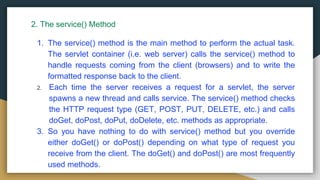
2. The service() Method
1. The service() method is the main method to perform the actual task.
The servlet container (i.e. web server) calls the service() method to
handle requests coming from the client (browsers) and to write the
formatted response back to the client.
2. Each time the server receives a request for a servlet, the server
spawns a new thread and calls service. The service() method checks
the HTTP request type (GET, POST, PUT, DELETE, etc.) and calls
doGet, doPost, doPut, doDelete, etc. methods as appropriate.
3. So you have nothing to do with service() method but you override
either doGet() or doPost() depending on what type of request you
receive from the client. The doGet() and doPost() are most frequently
used methods.
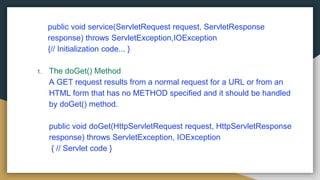
public void service(ServletRequest request, ServletResponse
response) throws ServletException,IOException
{// Initialization code... }
1. The doGet() Method
A GET request results from a normal request for a URL or from an
HTML form that has no METHOD specified and it should be handled
by doGet() method.
public void doGet(HttpServletRequest request, HttpServletResponse
response) throws ServletException, IOException
{ // Servlet code }
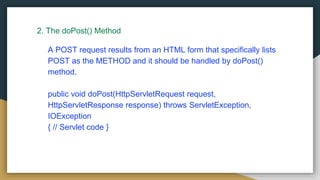
2. The doPost() Method
A POST request results from an HTML form that specifically lists
POST as the METHOD and it should be handled by doPost()
method.
public void doPost(HttpServletRequest request,
HttpServletResponse response) throws ServletException,
IOException
{ // Servlet code }
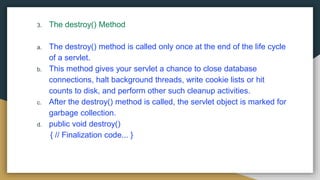
3. The destroy() Method
a. The destroy() method is called only once at the end of the life cycle
of a servlet.
b. This method gives your servlet a chance to close database
connections, halt background threads, write cookie lists or hit
counts to disk, and perform other such cleanup activities.
c. After the destroy() method is called, the servlet object is marked for
garbage collection.
d. public void destroy()
{ // Finalization code... }
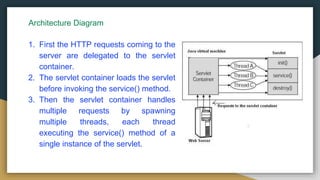
Architecture Diagram
1. First the HTTP requests coming to the
server are delegated to the servlet
container.
2. The servlet container loads the servlet
before invoking the service() method.
3. Then the servlet container handles
multiple requests by spawning
multiple threads, each thread
executing the service() method of a
single instance of the servlet.
How Servlet works?
1. It is important to learn how servlet works for understanding the
servlet well. Here, we are going to get the internal detail about the
first servlet program.
2. The server checks if the servlet is requested for the first time.
3. If yes, web container does the following tasks:
a. loads the servlet class.
b. instantiates the servlet class.
c. calls the init method passing the ServletConfig object
4. else
calls the service method passing request and response objects
5. The web container calls the destroy method when it needs to
remove the servlet such as at time of stopping server or undeploying
the project.
How web container handles the servlet request?
1. The web container is responsible to handle the request. Let's see
how it handles the request.
2. maps the request with the servlet in the web.xml file.
3. creates request and response objects for this request
4. calls the service method on the thread
5. The public service method internally calls the protected service
method
6. The protected service method calls the doGet method depending
on the type of request.
7. The doGet method generates the response and it is passed to the
client.
8. After sending the response, the web container deletes the request
and response objects. The thread is contained in the thread pool or
deleted depends on the server implementation.
Servlet   session 2

Servlet session 2

  • 1.
    SESSION – 2 By→Anuj Kumar Singh
  • 2.
    Servlet Life Cycle 1.A servlet life cycle can be defined as the entire process from its creation till the destruction. 2. The following are the paths followed by a servlet. a. The servlet is initialized by calling the init() method. b. The servlet calls service() method to process a client's request. c. The servlet is terminated by calling the destroy() method. d. Finally, servlet is garbage collected by the garbage collector of the JVM.
  • 3.
    1. The init()Method : a. The init method is called only once. It is called only when the servlet is created, and not called for any user requests afterwards. So, it is used for one-time initializations. b. The servlet is normally created when a user first invokes a URL corresponding to the servlet, but you can also specify that the servlet be loaded when the server is first started. c. When a user invokes a servlet, a single instance of each servlet gets created, with each user request resulting in a new thread that is handed off to doGet or doPost as appropriate. The init() method simply creates or loads some data that will be used throughout the life of the servlet. d. public void init() throws ServletException { // Initialization code... }
  • 4.
    2. The service()Method 1. The service() method is the main method to perform the actual task. The servlet container (i.e. web server) calls the service() method to handle requests coming from the client (browsers) and to write the formatted response back to the client. 2. Each time the server receives a request for a servlet, the server spawns a new thread and calls service. The service() method checks the HTTP request type (GET, POST, PUT, DELETE, etc.) and calls doGet, doPost, doPut, doDelete, etc. methods as appropriate. 3. So you have nothing to do with service() method but you override either doGet() or doPost() depending on what type of request you receive from the client. The doGet() and doPost() are most frequently used methods.
  • 5.
    public void service(ServletRequestrequest, ServletResponse response) throws ServletException,IOException {// Initialization code... } 1. The doGet() Method A GET request results from a normal request for a URL or from an HTML form that has no METHOD specified and it should be handled by doGet() method. public void doGet(HttpServletRequest request, HttpServletResponse response) throws ServletException, IOException { // Servlet code }
  • 6.
    2. The doPost()Method A POST request results from an HTML form that specifically lists POST as the METHOD and it should be handled by doPost() method. public void doPost(HttpServletRequest request, HttpServletResponse response) throws ServletException, IOException { // Servlet code }
  • 7.
    3. The destroy()Method a. The destroy() method is called only once at the end of the life cycle of a servlet. b. This method gives your servlet a chance to close database connections, halt background threads, write cookie lists or hit counts to disk, and perform other such cleanup activities. c. After the destroy() method is called, the servlet object is marked for garbage collection. d. public void destroy() { // Finalization code... }
  • 8.
    Architecture Diagram 1. Firstthe HTTP requests coming to the server are delegated to the servlet container. 2. The servlet container loads the servlet before invoking the service() method. 3. Then the servlet container handles multiple requests by spawning multiple threads, each thread executing the service() method of a single instance of the servlet.
  • 9.
    How Servlet works? 1.It is important to learn how servlet works for understanding the servlet well. Here, we are going to get the internal detail about the first servlet program. 2. The server checks if the servlet is requested for the first time. 3. If yes, web container does the following tasks: a. loads the servlet class. b. instantiates the servlet class. c. calls the init method passing the ServletConfig object 4. else calls the service method passing request and response objects 5. The web container calls the destroy method when it needs to remove the servlet such as at time of stopping server or undeploying the project.
  • 10.
    How web containerhandles the servlet request? 1. The web container is responsible to handle the request. Let's see how it handles the request. 2. maps the request with the servlet in the web.xml file. 3. creates request and response objects for this request 4. calls the service method on the thread 5. The public service method internally calls the protected service method 6. The protected service method calls the doGet method depending on the type of request. 7. The doGet method generates the response and it is passed to the client. 8. After sending the response, the web container deletes the request and response objects. The thread is contained in the thread pool or deleted depends on the server implementation.