Introduction to Servlet
Dept. of B. Voc.(Software Development and System Administration)
St. Joseph’s College(Autonomous)
Trichy-02
By
Dr. J. Ronald Martin
Introduction to Servlet : Dept. of B. Voc. (SD&SA) 1
 Servlet is a java program that runs inside JVM on the web
server.
 It is used for developing dynamic web applications.
Servlet
Introduction to Servlet : Dept. of B.Voc SD&SA 2
Life Cycle of Servlet
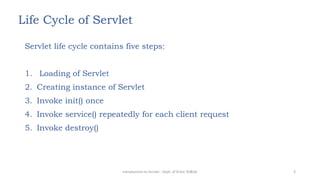
Servlet life cycle contains five steps:
1. Loading of Servlet
2. Creating instance of Servlet
3. Invoke init() once
4. Invoke service() repeatedly for each client request
5. Invoke destroy()
Introduction to Servlet : Dept. of B.Voc SD&SA 3
Step 1: Loading of Servlet
When the web server (e.g. Apache Tomcat) starts up, the servlet container
deploy and loads all the servlets.
Step 2: Creating instance of Servlet
Once all the Servlet classes loaded, the servlet container creates instances
of each servlet class. Servlet container creates only once instance per
servlet class and all the requests to the servlet are executed on the same
servlet instance.
Step 3: Invoke init() method
Once all the servlet classes are instantiated, the init() method is invoked
for each instantiated servlet.
Introduction to Servlet : Dept. of B.Voc SD&SA 4
Step 4: Invoke service() method
Each time the web server receives a request for servlet, it spawns a new
thread that calls service() method.
If the servlet is GenericServlet then the request is served by the service()
method itself,
if the servlet is HttpServlet then service() method receives the request and
dispatches it to the correct handler method based on the type of request.
Step 5: Invoke destroy() method
When servlet container shuts down(this usually happens when we stop
the web server), it unloads all the servlets and calls destroy() method for
each initialized servlets.
Introduction to Servlet : Dept. of B.Voc SD&SA 5
Architecture Diagram:
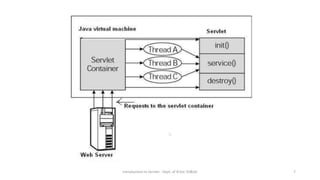
The following figure depicts a typical servlet life-cycle scenario.
First the HTTP requests coming to the server are delegated to the
servlet container.
The servlet container loads the servlet before invoking the service()
method.
Then the servlet container handles multiple requests by spawning
multiple threads, each thread executing the service() method of a
single instance of the servlet.
Introduction to Servlet : Dept. of B.Voc SD&SA 6
Introduction to Servlet : Dept. of B.Voc SD&SA 7
How Servlet Works?
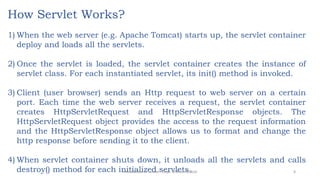
1) When the web server (e.g. Apache Tomcat) starts up, the servlet container
deploy and loads all the servlets.
2) Once the servlet is loaded, the servlet container creates the instance of
servlet class. For each instantiated servlet, its init() method is invoked.
3) Client (user browser) sends an Http request to web server on a certain
port. Each time the web server receives a request, the servlet container
creates HttpServletRequest and HttpServletResponse objects. The
HttpServletRequest object provides the access to the request information
and the HttpServletResponse object allows us to format and change the
http response before sending it to the client.
4) When servlet container shuts down, it unloads all the servlets and calls
destroy() method for each initialized servlets.
Introduction to Servlet : Dept. of B.Voc SD&SA 8
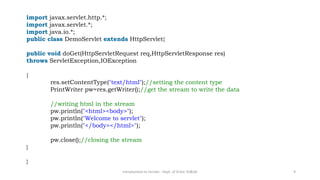
import javax.servlet.http.*;
import javax.servlet.*;
import java.io.*;
public class DemoServlet extends HttpServlet{
public void doGet(HttpServletRequest req,HttpServletResponse res)
throws ServletException,IOException
{
res.setContentType("text/html");//setting the content type
PrintWriter pw=res.getWriter();//get the stream to write the data
//writing html in the stream
pw.println("<html><body>");
pw.println("Welcome to servlet");
pw.println("</body></html>");
pw.close();//closing the stream
}
}
Introduction to Servlet : Dept. of B.Voc SD&SA 9

Introduction to Servlet.pptx

  • 1.
    Introduction to Servlet Dept.of B. Voc.(Software Development and System Administration) St. Joseph’s College(Autonomous) Trichy-02 By Dr. J. Ronald Martin Introduction to Servlet : Dept. of B. Voc. (SD&SA) 1
  • 2.
     Servlet isa java program that runs inside JVM on the web server.  It is used for developing dynamic web applications. Servlet Introduction to Servlet : Dept. of B.Voc SD&SA 2
  • 3.
    Life Cycle ofServlet Servlet life cycle contains five steps: 1. Loading of Servlet 2. Creating instance of Servlet 3. Invoke init() once 4. Invoke service() repeatedly for each client request 5. Invoke destroy() Introduction to Servlet : Dept. of B.Voc SD&SA 3
  • 4.
    Step 1: Loadingof Servlet When the web server (e.g. Apache Tomcat) starts up, the servlet container deploy and loads all the servlets. Step 2: Creating instance of Servlet Once all the Servlet classes loaded, the servlet container creates instances of each servlet class. Servlet container creates only once instance per servlet class and all the requests to the servlet are executed on the same servlet instance. Step 3: Invoke init() method Once all the servlet classes are instantiated, the init() method is invoked for each instantiated servlet. Introduction to Servlet : Dept. of B.Voc SD&SA 4
  • 5.
    Step 4: Invokeservice() method Each time the web server receives a request for servlet, it spawns a new thread that calls service() method. If the servlet is GenericServlet then the request is served by the service() method itself, if the servlet is HttpServlet then service() method receives the request and dispatches it to the correct handler method based on the type of request. Step 5: Invoke destroy() method When servlet container shuts down(this usually happens when we stop the web server), it unloads all the servlets and calls destroy() method for each initialized servlets. Introduction to Servlet : Dept. of B.Voc SD&SA 5
  • 6.
    Architecture Diagram: The followingfigure depicts a typical servlet life-cycle scenario. First the HTTP requests coming to the server are delegated to the servlet container. The servlet container loads the servlet before invoking the service() method. Then the servlet container handles multiple requests by spawning multiple threads, each thread executing the service() method of a single instance of the servlet. Introduction to Servlet : Dept. of B.Voc SD&SA 6
  • 7.
    Introduction to Servlet: Dept. of B.Voc SD&SA 7
  • 8.
    How Servlet Works? 1)When the web server (e.g. Apache Tomcat) starts up, the servlet container deploy and loads all the servlets. 2) Once the servlet is loaded, the servlet container creates the instance of servlet class. For each instantiated servlet, its init() method is invoked. 3) Client (user browser) sends an Http request to web server on a certain port. Each time the web server receives a request, the servlet container creates HttpServletRequest and HttpServletResponse objects. The HttpServletRequest object provides the access to the request information and the HttpServletResponse object allows us to format and change the http response before sending it to the client. 4) When servlet container shuts down, it unloads all the servlets and calls destroy() method for each initialized servlets. Introduction to Servlet : Dept. of B.Voc SD&SA 8
  • 9.
    import javax.servlet.http.*; import javax.servlet.*; importjava.io.*; public class DemoServlet extends HttpServlet{ public void doGet(HttpServletRequest req,HttpServletResponse res) throws ServletException,IOException { res.setContentType("text/html");//setting the content type PrintWriter pw=res.getWriter();//get the stream to write the data //writing html in the stream pw.println("<html><body>"); pw.println("Welcome to servlet"); pw.println("</body></html>"); pw.close();//closing the stream } } Introduction to Servlet : Dept. of B.Voc SD&SA 9