Products and Chemical Leasing: Selling Services instead of Goods [email_address] © 2011 EHS manager
Products and Chemical Leasing: ...is a service-oriented business model that shifts the focus from increasing sales volumes of  chemicals *)  towards a value-based approach. The producer mainly sells the functions performed by the chemical and functional units are the main basis for payment (# pieces cleaned, amount of area coated, catalytic reactivity, etc.) Within ChL business models, the responsibility of the producer and service-provider is extended and may include the management of the entire life cycle * Note: this not only complies for chemicals but also for other raw materials as for instance food, water, electronics , etc. Definition UNIDO © 2011 EHS manager
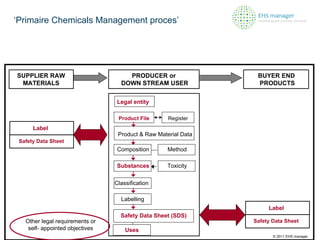
‘ Primaire Chemicals Management proces’ SUPPLIER RAW MATERIALS BUYER END  PRODUCTS PRODUCER or  DOWN STREAM USER Legal entity Product & Raw Material Data Product File Register Other legal requirements or self- appointed objectives Classification Labelling Safety Data Sheet (SDS) Safety Data Sheet Label Safety Data Sheet Label Composition Substances Toxicity Method Uses © 2011 EHS manager
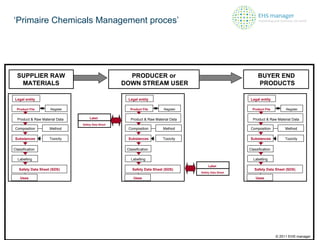
‘ Primaire Chemicals Management proces’ SUPPLIER RAW MATERIALS BUYER END  PRODUCTS PRODUCER or  DOWN STREAM USER Safety Data Sheet Label © 2011 EHS manager Safety Data Sheet Label Legal entity Product & Raw Material Data Product File Register Classification Labelling Safety Data Sheet (SDS) Composition Substances Toxicity Method Uses Legal entity Product & Raw Material Data Product File Register Classification Labelling Safety Data Sheet (SDS) Composition Substances Toxicity Method Uses Legal entity Product & Raw Material Data Product File Register Classification Labelling Safety Data Sheet (SDS) Composition Substances Toxicity Method Uses
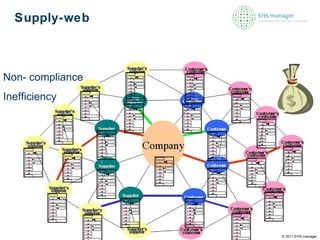
Supply-web Table 1 standard fees Non- compliance Inefficiency © 2011 EHS manager Legal entity Product & Raw Material Data Product File Register Classification Labelling Safety Data Sheet (SDS) Composition Substances Toxicity Method Uses Legal entity Product & Raw Material Data Product File Register Classification Labelling Safety Data Sheet (SDS) Composition Substances Toxicity Method Uses Legal entity Product & Raw Material Data Product File Register Classification Labelling Safety Data Sheet (SDS) Composition Substances Toxicity Method Uses Legal entity Product & Raw Material Data Product File Register Classification Labelling Safety Data Sheet (SDS) Composition Substances Toxicity Method Uses Legal entity Product & Raw Material Data Product File Register Classification Labelling Safety Data Sheet (SDS) Composition Substances Toxicity Method Uses Legal entity Product & Raw Material Data Product File Register Classification Labelling Safety Data Sheet (SDS) Composition Substances Toxicity Method Uses Legal entity Product & Raw Material Data Product File Register Classification Labelling Safety Data Sheet (SDS) Composition Substances Toxicity Method Uses Legal entity Product & Raw Material Data Product File Register Classification Labelling Safety Data Sheet (SDS) Composition Substances Toxicity Method Uses Legal entity Product & Raw Material Data Product File Register Classification Labelling Safety Data Sheet (SDS) Composition Substances Toxicity Method Uses Legal entity Product & Raw Material Data Product File Register Classification Labelling Safety Data Sheet (SDS) Composition Substances Toxicity Method Uses Legal entity Product & Raw Material Data Product File Register Classification Labelling Safety Data Sheet (SDS) Composition Substances Toxicity Method Uses Legal entity Product & Raw Material Data Product File Register Classification Labelling Safety Data Sheet (SDS) Composition Substances Toxicity Method Uses Legal entity Product & Raw Material Data Product File Register Classification Labelling Safety Data Sheet (SDS) Composition Substances Toxicity Method Uses Legal entity Product & Raw Material Data Product File Register Classification Labelling Safety Data Sheet (SDS) Composition Substances Toxicity Method Uses Legal entity Product & Raw Material Data Product File Register Classification Labelling Safety Data Sheet (SDS) Composition Substances Toxicity Method Uses Legal entity Product & Raw Material Data Product File Register Classification Labelling Safety Data Sheet (SDS) Composition Substances Toxicity Method Uses Legal entity Product & Raw Material Data Product File Register Classification Labelling Safety Data Sheet (SDS) Composition Substances Toxicity Method Uses Legal entity Product & Raw Material Data Product File Register Classification Labelling Safety Data Sheet (SDS) Composition Substances Toxicity Method Uses Legal entity Product & Raw Material Data Product File Register Classification Labelling Safety Data Sheet (SDS) Composition Substances Toxicity Method Uses Legal entity Product & Raw Material Data Product File Register Classification Labelling Safety Data Sheet (SDS) Composition Substances Toxicity Method Uses Legal entity Product & Raw Material Data Product File Register Classification Labelling Safety Data Sheet (SDS) Composition Substances Toxicity Method Uses Legal entity Product & Raw Material Data Product File Register Classification Labelling Safety Data Sheet (SDS) Composition Substances Toxicity Method Uses Legal entity Product & Raw Material Data Product File Register Classification Labelling Safety Data Sheet (SDS) Composition Substances Toxicity Method Uses
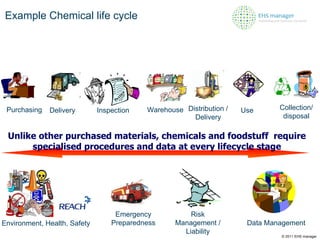
Example  Chemical life cycle Environment, Health, Safety Emergency Preparedness Risk  Management /  Liability Delivery Purchasing Inspection Warehouse Distribution / Delivery Use Collection/ disposal Data Management Unlike other purchased materials, chemicals and foodstuff  require specialised procedures and data at every lifecycle stage © 2011 EHS manager
A strategic, long-term contract to provide chemicals  and  services to manage the ‘chemical lifecycle’ Goes beyond selling and delivering product to optimising processes and systems for reduced cost and risk  Low cost, high performance expert system designed for continuous improvement Aligns incentives for efficiency improvements that reduce chemical volume and costs: From ‘more is more’ to ‘less is more’ Contractual performance and savings guarantees Chemicals Management Services (CMS) © 2011 EHS manager
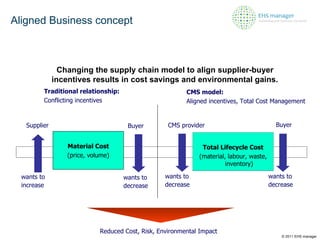
Aligned Business concept Changing the supply chain model to align supplier-buyer incentives results in cost savings and environmental gains . Reduced Cost, Risk, Environmental Impact Traditional relationship: Conflicting incentives Material Cost (price, volume) Supplier wants to increase Buyer wants to decrease CMS model: Aligned incentives, Total Cost Management CMS provider wants to  decrease Buyer wants to  decrease Total Lifecycle Cost (material,  labour , waste, inventory) © 2011 EHS manager
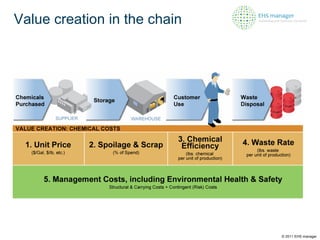
Value creation in the chain © 2011 EHS manager
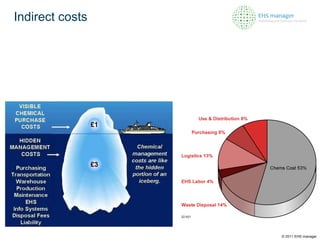
Indirect costs © 2011 EHS manager
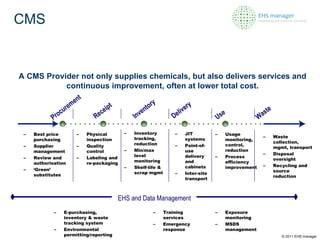
CMS A CMS Provider not only supplies chemicals, but also delivers services and continuous improvement, often at lower total cost. Best price purchasing Supplier management  Review and authorisation ‘ Green’ substitutes Physical inspection Quality control Labeling and re-packaging Inventory tracking, reduction Min/max level monitoring Shelf-life & scrap mgmt JIT systems Point-of-use delivery and cabinets Inter-site transport Usage monitoring, control, reduction Process efficiency improvement Waste collection, mgmt, transport Disposal oversight  Recycling and source reduction EHS and Data Management Procurement Receipt  Inventory Delivery Use Waste E-purchasing, inventory & waste tracking system Environmental permitting/reporting Training services Emergency response Exposure monitoring MSDS  management © 2011 EHS manager
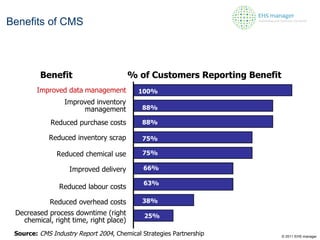
Benefits of CMS Improved data   management Reduced purchase costs Improved inventory management Improved delivery Reduced inventory scrap Reduced labour costs Reduced overhead costs Decreased process downtime (right chemical, right time, right place) Benefit  % of Customers Reporting Benefit Source:   CMS Industry Report 2004 , Chemical Strategies Partnership Reduced chemical use 100% 88% 75% 75% 66% 63% 38% 25% 88% © 2011 EHS manager 25 38 63 63 75 75 88 88 100
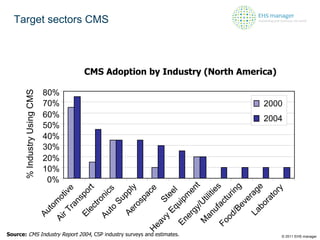
Target sectors CMS Source:   CMS Industry Report 2004 , CSP industry surveys and estimates. CMS Adoption by Industry (North America) %  Industry Using CMS © 2011 EHS manager 0% 10% 20% 30% 40% 50% 60% 70% 80% Automotive  Air Transport  Electronics  Auto Supply  Aerospace  Steel  Heavy Equipment Energy/Utilities  Manufacturing  Food/Beverage  Laboratory  2000 2004
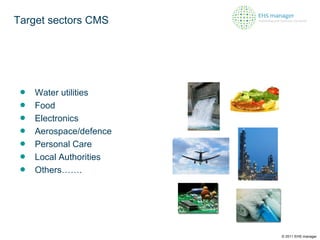
Target sectors CMS Water utilities Food Electronics Aerospace/defence Personal Care Local Authorities Others……. © 2011 EHS manager
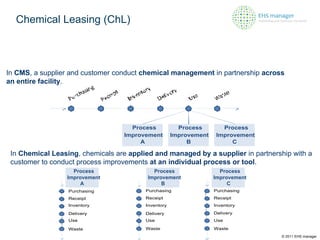
Chemical Leasing (ChL) In  CMS , a supplier and customer conduct  chemical management  in partnership  across an entire facility . In  Chemical Leasing ,   chemicals are  applied and managed by a supplier  in partnership with a customer to conduct process improvements  at an individual process or tool . © 2011 EHS manager
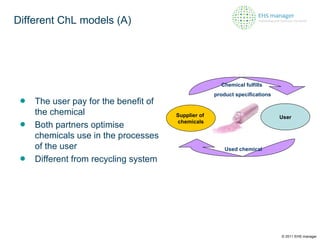
Different ChL models (A) Supplier of  chemicals User Chemical fulfills  product specifications Used chemical The user pay for the benefit of the chemical Both partners optimise chemicals use in the processes of the user Different from recycling system © 2011 EHS manager
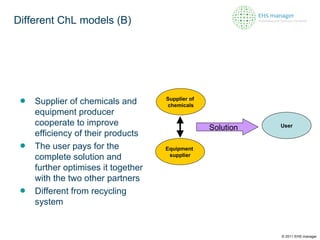
Different ChL models (B) Supplier of  chemicals User Supplier of chemicals and equipment producer cooperate to improve efficiency of their products The user pays for the complete solution and further optimises it together with the two other partners Different from recycling system Equipment  supplier Solution © 2011 EHS manager
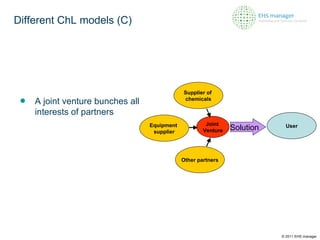
Different ChL models (C) Supplier of  chemicals User A joint venture bunches all interests of partners Equipment  supplier Solution Other partners Joint  Venture © 2011 EHS manager
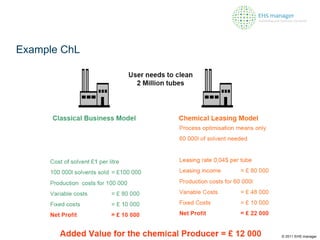
Example ChL © 2011 EHS manager
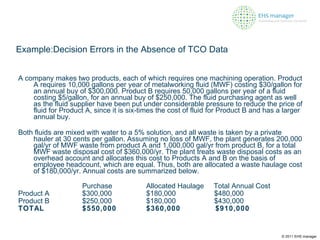
Example: Decision Errors in the Absence of TCO Data   A company makes two products, each of which requires one machining operation. Product A requires 10,000 gallons per year of metalworking fluid (MWF) costing $30/gallon for an annual buy of $300,000. Product B requires 50,000 gallons per year of a fluid costing $5/gallon, for an annual buy of $250,000. The fluid purchasing agent as well as the fluid supplier have been put under considerable pressure to reduce the price of fluid for Product A, since it is six-times the cost of fluid for Product B and has a larger annual buy. Both fluids are mixed with water to a 5% solution, and all waste is taken by a private hauler at 30 cents per gallon. Assuming no loss of MWF, the plant generates 200,000 gal/yr of MWF waste from product A and 1,000,000 gal/yr from product B, for a total MWF waste disposal cost of $360,000/yr. The plant treats waste disposal costs as an overhead account and allocates this cost to Products A and B on the basis of employee headcount, which are equal. Thus, both are allocated a waste haulage cost of $180,000/yr. Annual costs are summarized below. Purchase Allocated Haulage  Total Annual Cost Product A  $300,000  $180,000    $480,000 Product B  $250,000  $180,000    $430,000 TOTAL  $550,000  $360,000    $910,000 © 2011 EHS manager
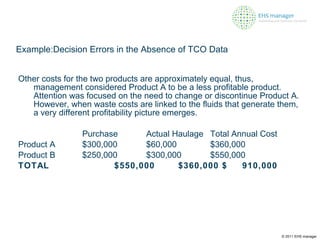
Example: Decision Errors in the Absence of TCO Data   Other costs for the two products are approximately equal, thus, management considered Product A to be a less profitable product. Attention was focused on the need to change or discontinue Product A. However, when waste costs are linked to the fluids that generate them, a very different profitability picture emerges. Purchase  Actual Haulage  Total Annual Cost Product A  $300,000  $60,000  $360,000 Product B  $250,000  $300,000  $550,000 TOTAL  $550,000  $360,000 $ 910,000 © 2011 EHS manager
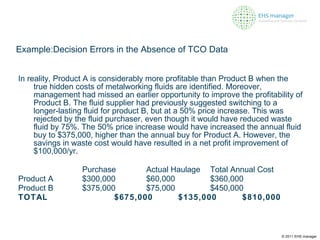
Example: Decision Errors in the Absence of TCO Data   In reality, Product A is considerably more profitable than Product B when the true hidden costs of metalworking fluids are identified. Moreover, management had missed an earlier opportunity to improve the profitability of Product B. The fluid supplier had previously suggested switching to a longer-lasting fluid for product B, but at a 50% price increase. This was rejected by the fluid purchaser, even though it would have reduced waste fluid by 75%. The 50% price increase would have increased the annual fluid buy to $375,000, higher than the annual buy for Product A. However, the savings in waste cost would have resulted in a net profit improvement of $100,000/yr. Purchase  Actual Haulage  Total Annual Cost Product A  $300,000  $60,000  $360,000 Product B  $375,000  $75,000  $450,000 TOTAL  $675,000  $135,000  $810,000 © 2011 EHS manager
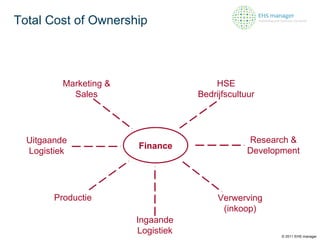
Total Cost of Ownership Primaire  CM proces HSE Bedrijfscultuur Marketing & Sales Productie Verwerving (inkoop) Ingaande Logistiek Research & Development Uitgaande Logistiek Finance © 2011 EHS manager
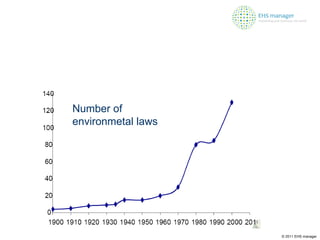
Number of environmetal laws © 2011 EHS manager
Discussion Does Chemical Leasing work for me as a business model to aid substitution? What are the strengths and weaknesses of the model for me? © 2011 EHS manager
The Austrian experience 4,000 Austrian companies (mainly SMEs) would basically qualify for the application of such models Cutting today's annual use of 153,000 tonnes of chemicals by one third – 53,000 tons per year that would not have to be used nor paid for, not result into emissions nor waste On average, the users of these new business models can expect cost savings of up to 15%  Six implementation projects covering a wide range of applications and technologies have been or are being implemented in Austria – many more through UNIDO’s activities – sponsored by the Austrian government © 2011 EHS manager
Pilot findings – the positives Under most chemical leasing agreements suppliers sent staff to end users site to manage the service This allowed end users to focus on core skills, reduce liability and risk while increasing legal compliance and worker safety Some reported improved product quality Suppliers reported that the model made them more competitive when tendering for new business That it improved client relationships and stimulated innovation In some cases old technology was replaced with more efficient, better designed kit that may not have been economical under the old business model © 2011 EHS manager
Pilot findings – the barriers It is not an easy sales job: Persuading customers to abandon well-functioning production methods and operations.  Requires significant investment in time and effort Requires a culture of openness between supplier and buyer Suppliers need to assume more responsibility Buyers concerned about being dependent on one supplier TRUST © 2011 EHS manager
Conclusion Pilot findings in short: Many of the businesses that took part in the pilots say the process was challenging   All said they would implement it again Dutch authorities are setting up a “beyond REACH” programme which will look into chemical leasing Pilots are planned by the German environmental protection agency Austria is strengthening its subsidy programme  UNIDO’s cleaner production programme continues to give its support to projects in developing countries Worldwide chemical leasing award has been launched to help identify further case studies and examples (total prize money – 20,000 Euros!) REACH? © 2011 EHS manager
Main problems for implementation of ChL Find right partners Confidence between partners Quality Assurance Lack of insight in the economic drivers for both supplier as well as customer. Fair contracts that meet expectations Private law: provisions compared to purchase contract in conventional business model.  Administrative law: compliance, what and who? © 2011 EHS manager
Interested? EHS manager can provide you with these services! [email_address] www.ehsmanager.nl Tel.  +31 (0)6 8100 0708  Florimont 2 (Slot Haverleij)  5221 LX  ‘s-Hertogenbosch © 2011 EHS manager
Thank you for your attention © 2011 EHS manager

Services Instead Of Goods

  • 1.
    Products and ChemicalLeasing: Selling Services instead of Goods [email_address] © 2011 EHS manager
  • 2.
    Products and ChemicalLeasing: ...is a service-oriented business model that shifts the focus from increasing sales volumes of chemicals *) towards a value-based approach. The producer mainly sells the functions performed by the chemical and functional units are the main basis for payment (# pieces cleaned, amount of area coated, catalytic reactivity, etc.) Within ChL business models, the responsibility of the producer and service-provider is extended and may include the management of the entire life cycle * Note: this not only complies for chemicals but also for other raw materials as for instance food, water, electronics , etc. Definition UNIDO © 2011 EHS manager
  • 3.
    ‘ Primaire ChemicalsManagement proces’ SUPPLIER RAW MATERIALS BUYER END PRODUCTS PRODUCER or DOWN STREAM USER Legal entity Product & Raw Material Data Product File Register Other legal requirements or self- appointed objectives Classification Labelling Safety Data Sheet (SDS) Safety Data Sheet Label Safety Data Sheet Label Composition Substances Toxicity Method Uses © 2011 EHS manager
  • 4.
    ‘ Primaire ChemicalsManagement proces’ SUPPLIER RAW MATERIALS BUYER END PRODUCTS PRODUCER or DOWN STREAM USER Safety Data Sheet Label © 2011 EHS manager Safety Data Sheet Label Legal entity Product & Raw Material Data Product File Register Classification Labelling Safety Data Sheet (SDS) Composition Substances Toxicity Method Uses Legal entity Product & Raw Material Data Product File Register Classification Labelling Safety Data Sheet (SDS) Composition Substances Toxicity Method Uses Legal entity Product & Raw Material Data Product File Register Classification Labelling Safety Data Sheet (SDS) Composition Substances Toxicity Method Uses
  • 5.
    Supply-web Table 1standard fees Non- compliance Inefficiency © 2011 EHS manager Legal entity Product & Raw Material Data Product File Register Classification Labelling Safety Data Sheet (SDS) Composition Substances Toxicity Method Uses Legal entity Product & Raw Material Data Product File Register Classification Labelling Safety Data Sheet (SDS) Composition Substances Toxicity Method Uses Legal entity Product & Raw Material Data Product File Register Classification Labelling Safety Data Sheet (SDS) Composition Substances Toxicity Method Uses Legal entity Product & Raw Material Data Product File Register Classification Labelling Safety Data Sheet (SDS) Composition Substances Toxicity Method Uses Legal entity Product & Raw Material Data Product File Register Classification Labelling Safety Data Sheet (SDS) Composition Substances Toxicity Method Uses Legal entity Product & Raw Material Data Product File Register Classification Labelling Safety Data Sheet (SDS) Composition Substances Toxicity Method Uses Legal entity Product & Raw Material Data Product File Register Classification Labelling Safety Data Sheet (SDS) Composition Substances Toxicity Method Uses Legal entity Product & Raw Material Data Product File Register Classification Labelling Safety Data Sheet (SDS) Composition Substances Toxicity Method Uses Legal entity Product & Raw Material Data Product File Register Classification Labelling Safety Data Sheet (SDS) Composition Substances Toxicity Method Uses Legal entity Product & Raw Material Data Product File Register Classification Labelling Safety Data Sheet (SDS) Composition Substances Toxicity Method Uses Legal entity Product & Raw Material Data Product File Register Classification Labelling Safety Data Sheet (SDS) Composition Substances Toxicity Method Uses Legal entity Product & Raw Material Data Product File Register Classification Labelling Safety Data Sheet (SDS) Composition Substances Toxicity Method Uses Legal entity Product & Raw Material Data Product File Register Classification Labelling Safety Data Sheet (SDS) Composition Substances Toxicity Method Uses Legal entity Product & Raw Material Data Product File Register Classification Labelling Safety Data Sheet (SDS) Composition Substances Toxicity Method Uses Legal entity Product & Raw Material Data Product File Register Classification Labelling Safety Data Sheet (SDS) Composition Substances Toxicity Method Uses Legal entity Product & Raw Material Data Product File Register Classification Labelling Safety Data Sheet (SDS) Composition Substances Toxicity Method Uses Legal entity Product & Raw Material Data Product File Register Classification Labelling Safety Data Sheet (SDS) Composition Substances Toxicity Method Uses Legal entity Product & Raw Material Data Product File Register Classification Labelling Safety Data Sheet (SDS) Composition Substances Toxicity Method Uses Legal entity Product & Raw Material Data Product File Register Classification Labelling Safety Data Sheet (SDS) Composition Substances Toxicity Method Uses Legal entity Product & Raw Material Data Product File Register Classification Labelling Safety Data Sheet (SDS) Composition Substances Toxicity Method Uses Legal entity Product & Raw Material Data Product File Register Classification Labelling Safety Data Sheet (SDS) Composition Substances Toxicity Method Uses Legal entity Product & Raw Material Data Product File Register Classification Labelling Safety Data Sheet (SDS) Composition Substances Toxicity Method Uses Legal entity Product & Raw Material Data Product File Register Classification Labelling Safety Data Sheet (SDS) Composition Substances Toxicity Method Uses
  • 6.
    Example Chemicallife cycle Environment, Health, Safety Emergency Preparedness Risk Management / Liability Delivery Purchasing Inspection Warehouse Distribution / Delivery Use Collection/ disposal Data Management Unlike other purchased materials, chemicals and foodstuff require specialised procedures and data at every lifecycle stage © 2011 EHS manager
  • 7.
    A strategic, long-termcontract to provide chemicals and services to manage the ‘chemical lifecycle’ Goes beyond selling and delivering product to optimising processes and systems for reduced cost and risk Low cost, high performance expert system designed for continuous improvement Aligns incentives for efficiency improvements that reduce chemical volume and costs: From ‘more is more’ to ‘less is more’ Contractual performance and savings guarantees Chemicals Management Services (CMS) © 2011 EHS manager
  • 8.
    Aligned Business conceptChanging the supply chain model to align supplier-buyer incentives results in cost savings and environmental gains . Reduced Cost, Risk, Environmental Impact Traditional relationship: Conflicting incentives Material Cost (price, volume) Supplier wants to increase Buyer wants to decrease CMS model: Aligned incentives, Total Cost Management CMS provider wants to decrease Buyer wants to decrease Total Lifecycle Cost (material, labour , waste, inventory) © 2011 EHS manager
  • 9.
    Value creation inthe chain © 2011 EHS manager
  • 10.
    Indirect costs ©2011 EHS manager
  • 11.
    CMS A CMSProvider not only supplies chemicals, but also delivers services and continuous improvement, often at lower total cost. Best price purchasing Supplier management Review and authorisation ‘ Green’ substitutes Physical inspection Quality control Labeling and re-packaging Inventory tracking, reduction Min/max level monitoring Shelf-life & scrap mgmt JIT systems Point-of-use delivery and cabinets Inter-site transport Usage monitoring, control, reduction Process efficiency improvement Waste collection, mgmt, transport Disposal oversight Recycling and source reduction EHS and Data Management Procurement Receipt Inventory Delivery Use Waste E-purchasing, inventory & waste tracking system Environmental permitting/reporting Training services Emergency response Exposure monitoring MSDS management © 2011 EHS manager
  • 12.
    Benefits of CMSImproved data management Reduced purchase costs Improved inventory management Improved delivery Reduced inventory scrap Reduced labour costs Reduced overhead costs Decreased process downtime (right chemical, right time, right place) Benefit % of Customers Reporting Benefit Source: CMS Industry Report 2004 , Chemical Strategies Partnership Reduced chemical use 100% 88% 75% 75% 66% 63% 38% 25% 88% © 2011 EHS manager 25 38 63 63 75 75 88 88 100
  • 13.
    Target sectors CMSSource: CMS Industry Report 2004 , CSP industry surveys and estimates. CMS Adoption by Industry (North America) % Industry Using CMS © 2011 EHS manager 0% 10% 20% 30% 40% 50% 60% 70% 80% Automotive Air Transport Electronics Auto Supply Aerospace Steel Heavy Equipment Energy/Utilities Manufacturing Food/Beverage Laboratory 2000 2004
  • 14.
    Target sectors CMSWater utilities Food Electronics Aerospace/defence Personal Care Local Authorities Others……. © 2011 EHS manager
  • 15.
    Chemical Leasing (ChL)In CMS , a supplier and customer conduct chemical management in partnership across an entire facility . In Chemical Leasing , chemicals are applied and managed by a supplier in partnership with a customer to conduct process improvements at an individual process or tool . © 2011 EHS manager
  • 16.
    Different ChL models(A) Supplier of chemicals User Chemical fulfills product specifications Used chemical The user pay for the benefit of the chemical Both partners optimise chemicals use in the processes of the user Different from recycling system © 2011 EHS manager
  • 17.
    Different ChL models(B) Supplier of chemicals User Supplier of chemicals and equipment producer cooperate to improve efficiency of their products The user pays for the complete solution and further optimises it together with the two other partners Different from recycling system Equipment supplier Solution © 2011 EHS manager
  • 18.
    Different ChL models(C) Supplier of chemicals User A joint venture bunches all interests of partners Equipment supplier Solution Other partners Joint Venture © 2011 EHS manager
  • 19.
    Example ChL ©2011 EHS manager
  • 20.
    Example: Decision Errorsin the Absence of TCO Data A company makes two products, each of which requires one machining operation. Product A requires 10,000 gallons per year of metalworking fluid (MWF) costing $30/gallon for an annual buy of $300,000. Product B requires 50,000 gallons per year of a fluid costing $5/gallon, for an annual buy of $250,000. The fluid purchasing agent as well as the fluid supplier have been put under considerable pressure to reduce the price of fluid for Product A, since it is six-times the cost of fluid for Product B and has a larger annual buy. Both fluids are mixed with water to a 5% solution, and all waste is taken by a private hauler at 30 cents per gallon. Assuming no loss of MWF, the plant generates 200,000 gal/yr of MWF waste from product A and 1,000,000 gal/yr from product B, for a total MWF waste disposal cost of $360,000/yr. The plant treats waste disposal costs as an overhead account and allocates this cost to Products A and B on the basis of employee headcount, which are equal. Thus, both are allocated a waste haulage cost of $180,000/yr. Annual costs are summarized below. Purchase Allocated Haulage Total Annual Cost Product A $300,000 $180,000 $480,000 Product B $250,000 $180,000 $430,000 TOTAL $550,000 $360,000 $910,000 © 2011 EHS manager
  • 21.
    Example: Decision Errorsin the Absence of TCO Data Other costs for the two products are approximately equal, thus, management considered Product A to be a less profitable product. Attention was focused on the need to change or discontinue Product A. However, when waste costs are linked to the fluids that generate them, a very different profitability picture emerges. Purchase Actual Haulage Total Annual Cost Product A $300,000 $60,000 $360,000 Product B $250,000 $300,000 $550,000 TOTAL $550,000 $360,000 $ 910,000 © 2011 EHS manager
  • 22.
    Example: Decision Errorsin the Absence of TCO Data In reality, Product A is considerably more profitable than Product B when the true hidden costs of metalworking fluids are identified. Moreover, management had missed an earlier opportunity to improve the profitability of Product B. The fluid supplier had previously suggested switching to a longer-lasting fluid for product B, but at a 50% price increase. This was rejected by the fluid purchaser, even though it would have reduced waste fluid by 75%. The 50% price increase would have increased the annual fluid buy to $375,000, higher than the annual buy for Product A. However, the savings in waste cost would have resulted in a net profit improvement of $100,000/yr. Purchase Actual Haulage Total Annual Cost Product A $300,000 $60,000 $360,000 Product B $375,000 $75,000 $450,000 TOTAL $675,000 $135,000 $810,000 © 2011 EHS manager
  • 23.
    Total Cost ofOwnership Primaire CM proces HSE Bedrijfscultuur Marketing & Sales Productie Verwerving (inkoop) Ingaande Logistiek Research & Development Uitgaande Logistiek Finance © 2011 EHS manager
  • 24.
    Number of environmetallaws © 2011 EHS manager
  • 25.
    Discussion Does ChemicalLeasing work for me as a business model to aid substitution? What are the strengths and weaknesses of the model for me? © 2011 EHS manager
  • 26.
    The Austrian experience4,000 Austrian companies (mainly SMEs) would basically qualify for the application of such models Cutting today's annual use of 153,000 tonnes of chemicals by one third – 53,000 tons per year that would not have to be used nor paid for, not result into emissions nor waste On average, the users of these new business models can expect cost savings of up to 15% Six implementation projects covering a wide range of applications and technologies have been or are being implemented in Austria – many more through UNIDO’s activities – sponsored by the Austrian government © 2011 EHS manager
  • 27.
    Pilot findings –the positives Under most chemical leasing agreements suppliers sent staff to end users site to manage the service This allowed end users to focus on core skills, reduce liability and risk while increasing legal compliance and worker safety Some reported improved product quality Suppliers reported that the model made them more competitive when tendering for new business That it improved client relationships and stimulated innovation In some cases old technology was replaced with more efficient, better designed kit that may not have been economical under the old business model © 2011 EHS manager
  • 28.
    Pilot findings –the barriers It is not an easy sales job: Persuading customers to abandon well-functioning production methods and operations. Requires significant investment in time and effort Requires a culture of openness between supplier and buyer Suppliers need to assume more responsibility Buyers concerned about being dependent on one supplier TRUST © 2011 EHS manager
  • 29.
    Conclusion Pilot findingsin short: Many of the businesses that took part in the pilots say the process was challenging All said they would implement it again Dutch authorities are setting up a “beyond REACH” programme which will look into chemical leasing Pilots are planned by the German environmental protection agency Austria is strengthening its subsidy programme UNIDO’s cleaner production programme continues to give its support to projects in developing countries Worldwide chemical leasing award has been launched to help identify further case studies and examples (total prize money – 20,000 Euros!) REACH? © 2011 EHS manager
  • 30.
    Main problems forimplementation of ChL Find right partners Confidence between partners Quality Assurance Lack of insight in the economic drivers for both supplier as well as customer. Fair contracts that meet expectations Private law: provisions compared to purchase contract in conventional business model. Administrative law: compliance, what and who? © 2011 EHS manager
  • 31.
    Interested? EHS managercan provide you with these services! [email_address] www.ehsmanager.nl Tel.  +31 (0)6 8100 0708 Florimont 2 (Slot Haverleij) 5221 LX ‘s-Hertogenbosch © 2011 EHS manager
  • 32.
    Thank you foryour attention © 2011 EHS manager