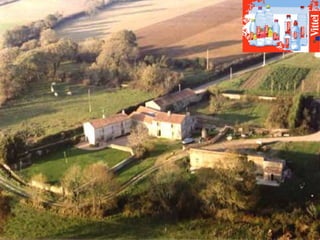


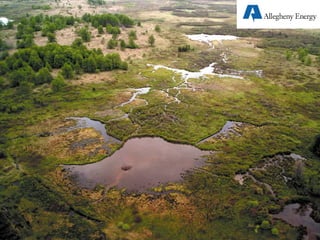
What do these stories have in common? Companies facing unexpected risks or novel opportunities  arising from their dependence and impact on ecosystems
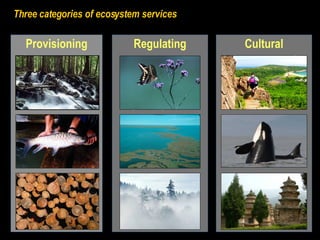
Regulating Benefits obtained from control of natural processes by ecosystems Cultural Nonmaterial benefits obtained from ecosystems Provisioning Goods or products obtained from ecosystems Three categories of ecosystem services
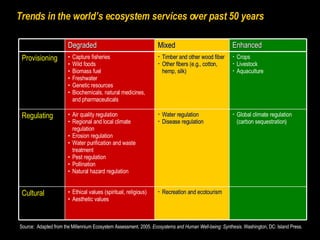
Trends in the world’s ecosystem services over past 50 years Source:  Adapted from the Millennium Ecosystem Assessment. 2005.  Ecosystems and Human Well-being: Synthesis.  Washington, DC: Island Press. Recreation and ecotourism Ethical values (spiritual, religious) Aesthetic values Cultural Global climate regulation (carbon sequestration) Water regulation Disease regulation Air quality regulation Regional and local climate regulation Erosion regulation Water purification and waste treatment Pest regulation Pollination Natural hazard regulation Regulating Crops Livestock Aquaculture Timber and other wood fiber Other fibers (e.g., cotton, hemp, silk) Capture fisheries Wild foods Biomass fuel Freshwater Genetic resources Biochemicals, natural medicines, and pharmaceuticals Provisioning Enhanced Mixed Degraded
The Corporate Ecosystem Services Review  Structured methodology that helps managers proactively  develop strategies to manage business risks and opportunities  arising from their company’s dependence and impact on ecosystems
Business benefits Strengthen existing approaches to environmental management Identify business risks and opportunities Anticipate new markets and government policies Improve stakeholder relationships Demonstrate leadership in corporate sustainability
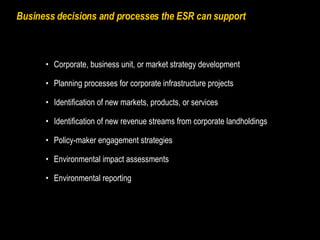
Business decisions and processes the ESR can support Corporate, business unit, or market strategy development  Planning processes for corporate infrastructure projects Identification of new markets, products, or services Identification of new revenue streams from corporate landholdings Policy-maker engagement strategies Environmental impact assessments Environmental reporting
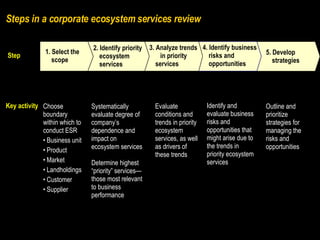
Steps in a corporate ecosystem services review Key activity Step Outline and prioritize strategies for managing the risks and opportunities 5. Develop strategies Identify and evaluate business risks and opportunities that might arise due to the trends in priority ecosystem services 4. Identify business risks and opportunities Evaluate conditions and trends in priority ecosystem services, as well as drivers of these trends 3. Analyze trends  in priority services Systematically evaluate degree of company’s dependence and impact on ecosystem services Determine highest “priority” services—those most relevant to business performance 2. Identify priority ecosystem services Choose boundary within which to conduct ESR Business unit Product Market Landholdings Customer Supplier 1. Select the scope
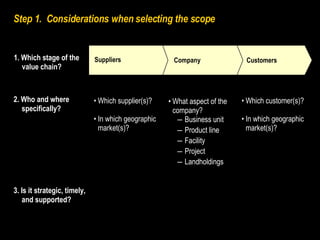
Step 1.  Considerations when selecting the scope 3. Is it strategic, timely, and supported? 1. Which stage of the value chain?  Customers Company Suppliers Which customer(s)? In which geographic market(s)? What aspect of the company? Business unit Product line Facility Project Landholdings Which supplier(s)? In which geographic market(s)? 2. Who and where specifically?
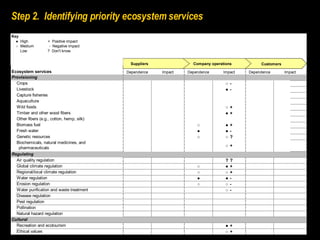
Step 2.  Identifying priority ecosystem services
Step 3.  Ecosystem service trends and drivers framework 1. Condition and trends in the  ecosystem service Supply and demand Quantity and quality Present and future 2. Direct drivers Changes in land use and land cover Overconsumption Climate change Pollution Invasive, non-native species Other 4. Activities of others Who How Where To what degree 5. Indirect drivers Governmental Demographic Economic Technological Cultural and religious 3. Company activities How Where To what degree
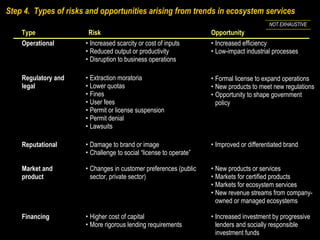
Step 4.  Types of risks and opportunities arising from trends in ecosystem services Type Risk Opportunity NOT EXHAUSTIVE Operational Increased scarcity or cost of inputs Reduced output or productivity Disruption to business operations Increased efficiency Low-impact industrial processes Regulatory and legal Extraction moratoria Lower quotas Fines User fees Permit or license suspension Permit denial Lawsuits Formal license to expand operations New products to meet new regulations Opportunity to shape government policy Reputational Damage to brand or image Challenge to social “license to operate” Improved or differentiated brand Market and product Changes in customer preferences (public sector, private sector) New products or services Markets for certified products Markets for ecosystem services New revenue streams from company-owned or managed ecosystems Financing Higher cost of capital More rigorous lending requirements Increased investment by progressive lenders and socially responsible investment funds
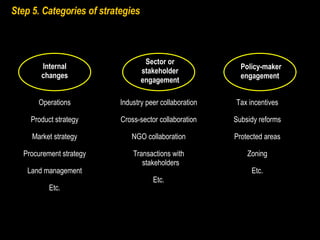
Step 5. Categories of strategies Internal changes Sector or stakeholder engagement Policy-maker engagement Operations Product strategy Market strategy Procurement strategy Land management Etc. Industry peer collaboration Cross-sector collaboration NGO collaboration Transactions with stakeholders Etc. Tax incentives Subsidy reforms Protected areas Zoning Etc.
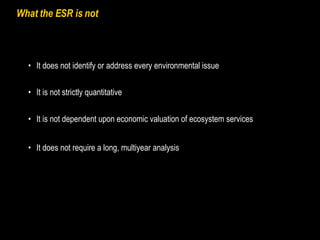
What the ESR is not It is not dependent upon economic valuation of ecosystem services It does not identify or address every environmental issue It is not strictly quantitative It does not require a long, multiyear analysis
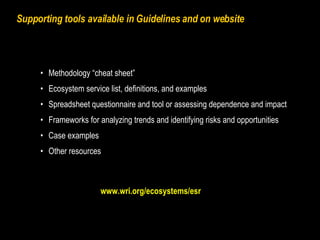
Supporting tools available in Guidelines and on website Methodology “cheat sheet” Ecosystem service list, definitions, and examples Spreadsheet questionnaire and tool or assessing dependence and impact Frameworks for analyzing trends and identifying risks and opportunities Case examples Other resources www.wri.org/ecosystems/esr

Corporate Ecosystem Services Review

  • 1.
  • 2.
  • 3.
  • 4.
  • 5.
  • 6.
    What do thesestories have in common? Companies facing unexpected risks or novel opportunities arising from their dependence and impact on ecosystems
  • 7.
    Regulating Benefits obtainedfrom control of natural processes by ecosystems Cultural Nonmaterial benefits obtained from ecosystems Provisioning Goods or products obtained from ecosystems Three categories of ecosystem services
  • 8.
    Trends in theworld’s ecosystem services over past 50 years Source: Adapted from the Millennium Ecosystem Assessment. 2005. Ecosystems and Human Well-being: Synthesis. Washington, DC: Island Press. Recreation and ecotourism Ethical values (spiritual, religious) Aesthetic values Cultural Global climate regulation (carbon sequestration) Water regulation Disease regulation Air quality regulation Regional and local climate regulation Erosion regulation Water purification and waste treatment Pest regulation Pollination Natural hazard regulation Regulating Crops Livestock Aquaculture Timber and other wood fiber Other fibers (e.g., cotton, hemp, silk) Capture fisheries Wild foods Biomass fuel Freshwater Genetic resources Biochemicals, natural medicines, and pharmaceuticals Provisioning Enhanced Mixed Degraded
  • 9.
    The Corporate EcosystemServices Review Structured methodology that helps managers proactively develop strategies to manage business risks and opportunities arising from their company’s dependence and impact on ecosystems
  • 10.
    Business benefits Strengthenexisting approaches to environmental management Identify business risks and opportunities Anticipate new markets and government policies Improve stakeholder relationships Demonstrate leadership in corporate sustainability
  • 11.
    Business decisions andprocesses the ESR can support Corporate, business unit, or market strategy development Planning processes for corporate infrastructure projects Identification of new markets, products, or services Identification of new revenue streams from corporate landholdings Policy-maker engagement strategies Environmental impact assessments Environmental reporting
  • 12.
    Steps in acorporate ecosystem services review Key activity Step Outline and prioritize strategies for managing the risks and opportunities 5. Develop strategies Identify and evaluate business risks and opportunities that might arise due to the trends in priority ecosystem services 4. Identify business risks and opportunities Evaluate conditions and trends in priority ecosystem services, as well as drivers of these trends 3. Analyze trends in priority services Systematically evaluate degree of company’s dependence and impact on ecosystem services Determine highest “priority” services—those most relevant to business performance 2. Identify priority ecosystem services Choose boundary within which to conduct ESR Business unit Product Market Landholdings Customer Supplier 1. Select the scope
  • 13.
    Step 1. Considerations when selecting the scope 3. Is it strategic, timely, and supported? 1. Which stage of the value chain? Customers Company Suppliers Which customer(s)? In which geographic market(s)? What aspect of the company? Business unit Product line Facility Project Landholdings Which supplier(s)? In which geographic market(s)? 2. Who and where specifically?
  • 14.
    Step 2. Identifying priority ecosystem services
  • 15.
    Step 3. Ecosystem service trends and drivers framework 1. Condition and trends in the ecosystem service Supply and demand Quantity and quality Present and future 2. Direct drivers Changes in land use and land cover Overconsumption Climate change Pollution Invasive, non-native species Other 4. Activities of others Who How Where To what degree 5. Indirect drivers Governmental Demographic Economic Technological Cultural and religious 3. Company activities How Where To what degree
  • 16.
    Step 4. Types of risks and opportunities arising from trends in ecosystem services Type Risk Opportunity NOT EXHAUSTIVE Operational Increased scarcity or cost of inputs Reduced output or productivity Disruption to business operations Increased efficiency Low-impact industrial processes Regulatory and legal Extraction moratoria Lower quotas Fines User fees Permit or license suspension Permit denial Lawsuits Formal license to expand operations New products to meet new regulations Opportunity to shape government policy Reputational Damage to brand or image Challenge to social “license to operate” Improved or differentiated brand Market and product Changes in customer preferences (public sector, private sector) New products or services Markets for certified products Markets for ecosystem services New revenue streams from company-owned or managed ecosystems Financing Higher cost of capital More rigorous lending requirements Increased investment by progressive lenders and socially responsible investment funds
  • 17.
    Step 5. Categoriesof strategies Internal changes Sector or stakeholder engagement Policy-maker engagement Operations Product strategy Market strategy Procurement strategy Land management Etc. Industry peer collaboration Cross-sector collaboration NGO collaboration Transactions with stakeholders Etc. Tax incentives Subsidy reforms Protected areas Zoning Etc.
  • 18.
    What the ESRis not It is not dependent upon economic valuation of ecosystem services It does not identify or address every environmental issue It is not strictly quantitative It does not require a long, multiyear analysis
  • 19.
    Supporting tools availablein Guidelines and on website Methodology “cheat sheet” Ecosystem service list, definitions, and examples Spreadsheet questionnaire and tool or assessing dependence and impact Frameworks for analyzing trends and identifying risks and opportunities Case examples Other resources www.wri.org/ecosystems/esr

Editor's Notes

  • #2 This presentation is designed to help business managers introduce the Corporate Ecosystem Services Review to colleagues. It is designed to complement The Corporate Ecosystem Services Review guidelines, which are available at www.wri.org/ecosystems/esr