

Fundamentals of
Continuous Integration
Testing
Presented By Cygnet Infotech Pvt. Ltd.
Continuous Integration
 Continuous Integration aims at minimizing Integration
time to enable quicker time-to-market.
 The continuous cycle of Code->Build->Test->Deploy is
followed to enable high-quality and bug-free releases.
 Most integration bugs are identified and fixed on a
regular basis to avoid last-minute delays.
 The working code is committed frequently so roll-back is
easy in case of major new defects.
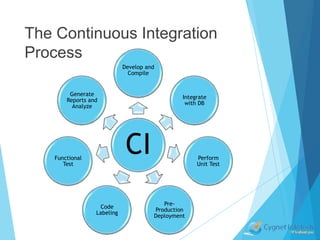
The Continuous Integration
Process
CI
Develop and
Compile
Integrate
with DB
Perform
Unit Test
Pre-
Production
Deployment
Code
Labeling
Functional
Test
Generate
Reports and
Analyze
Continuous Testing
 By applying a lean workflow, continuous testing can be
implemented.
 It is best to select continuous testing tools based on the
development language and nature of the application.
 The tool will watch the code for changes and
automatically runs the tests after compilation. Then the
tools will provide feedback through a notification system.
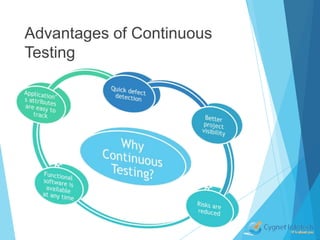
Advantages of Continuous
Testing
Automated Continuous
Regression Testing
 Regression defects might become the hardest to fix if
they are not identified and isolated at an earliest.
 Continuous Regression tests are automatically run in the
background of an application to provide rapid feedback
on defects and failures.
 The code is well-tested so that the number of regression
defects are minimized.
 Some automated test tools capture the changes in
application to evolve and monitor effectively.
Continuous Performance
Testing
 Even when the functionality is tested on a regular basis,
performance might be neglected leading to application
failure after deployment.
 It is essential to carry out continuous performance testing
so that the application can be studied for:
 Reponses times
 Changes in Speed
 Consistency
 Changes in Reaction Time
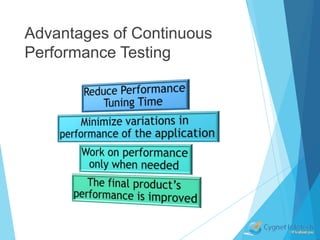
Advantages of Continuous
Performance Testing
Continuous Load Testing
 It is important to follow continuous load testing to make
the application ready for use.
 Making it an iterative process of Plan-> Test->Analyze-
>Fix will help tweaking and tuning effective.
 Continuous load testing helps reuse test cases and
establish clear performance related goals.
 Load testing must start with small incremental scenarios,
and the finally become one whole package.
Continuous Scalability Testing
 Building a bridge and then testing it for extension is not very
productive. Similarly getting an application on track without
testing it as to how much more it can take is a failure.
 With continuous scalability testing, you can find out and
improve the below attributes of your application:
 Throughput
 Network Usage
 CPU Memory Usage
 Continuous Scalability Testing helps reduce business risks
and quick identification of application’s performance
attributes.
To Summarize
 While continuous integration development process can help
deliver a high-quality software in short time, it cannot be
rendered complete without implementing continuous testing.
 The overall Continuous Integration process helps reduce
assumptions and assures a healthy software throughout.
 With better project visibility brought in by CI, effective time-
critical business decisions can be made.
 Finally when Continuous Testing based on Continuous
Integration is implemented, the confidence on the end-
product/application is high.
About Cygnet Infotech
 We are a global IT services & solutions provider.
 We provide custom software development services across
technologies and domains to our clients in 24 countries.
 We are ISO 9001, ISO 27001 and CMMi Level III Certified
Enterprise QA & Software
Testing
 We provide following testing services
 Functional Testing
 Performance Testing
 Load Testing
 Automated Testing
 Security Testing
 Mobile Testing
Contact Us
 Email: info@cygnet-infotech.com
 Twitter: @cygnetinfotech
 Skype: cygnet-infotech-pvt-ltd
For Test Automation of Web and Cloud
Applications, use TestingWhiz
Visit www.testing-whiz.com

Continuous integration testing fundamentals

  • 1.
  • 2.
    Continuous Integration  ContinuousIntegration aims at minimizing Integration time to enable quicker time-to-market.  The continuous cycle of Code->Build->Test->Deploy is followed to enable high-quality and bug-free releases.  Most integration bugs are identified and fixed on a regular basis to avoid last-minute delays.  The working code is committed frequently so roll-back is easy in case of major new defects.
  • 3.
    The Continuous Integration Process CI Developand Compile Integrate with DB Perform Unit Test Pre- Production Deployment Code Labeling Functional Test Generate Reports and Analyze
  • 4.
    Continuous Testing  Byapplying a lean workflow, continuous testing can be implemented.  It is best to select continuous testing tools based on the development language and nature of the application.  The tool will watch the code for changes and automatically runs the tests after compilation. Then the tools will provide feedback through a notification system.
  • 5.
  • 6.
    Automated Continuous Regression Testing Regression defects might become the hardest to fix if they are not identified and isolated at an earliest.  Continuous Regression tests are automatically run in the background of an application to provide rapid feedback on defects and failures.  The code is well-tested so that the number of regression defects are minimized.  Some automated test tools capture the changes in application to evolve and monitor effectively.
  • 7.
    Continuous Performance Testing  Evenwhen the functionality is tested on a regular basis, performance might be neglected leading to application failure after deployment.  It is essential to carry out continuous performance testing so that the application can be studied for:  Reponses times  Changes in Speed  Consistency  Changes in Reaction Time
  • 8.
  • 9.
    Continuous Load Testing It is important to follow continuous load testing to make the application ready for use.  Making it an iterative process of Plan-> Test->Analyze- >Fix will help tweaking and tuning effective.  Continuous load testing helps reuse test cases and establish clear performance related goals.  Load testing must start with small incremental scenarios, and the finally become one whole package.
  • 10.
    Continuous Scalability Testing Building a bridge and then testing it for extension is not very productive. Similarly getting an application on track without testing it as to how much more it can take is a failure.  With continuous scalability testing, you can find out and improve the below attributes of your application:  Throughput  Network Usage  CPU Memory Usage  Continuous Scalability Testing helps reduce business risks and quick identification of application’s performance attributes.
  • 11.
    To Summarize  Whilecontinuous integration development process can help deliver a high-quality software in short time, it cannot be rendered complete without implementing continuous testing.  The overall Continuous Integration process helps reduce assumptions and assures a healthy software throughout.  With better project visibility brought in by CI, effective time- critical business decisions can be made.  Finally when Continuous Testing based on Continuous Integration is implemented, the confidence on the end- product/application is high.
  • 12.
    About Cygnet Infotech We are a global IT services & solutions provider.  We provide custom software development services across technologies and domains to our clients in 24 countries.  We are ISO 9001, ISO 27001 and CMMi Level III Certified
  • 13.
    Enterprise QA &Software Testing  We provide following testing services  Functional Testing  Performance Testing  Load Testing  Automated Testing  Security Testing  Mobile Testing
  • 14.
    Contact Us  Email:info@cygnet-infotech.com  Twitter: @cygnetinfotech  Skype: cygnet-infotech-pvt-ltd For Test Automation of Web and Cloud Applications, use TestingWhiz Visit www.testing-whiz.com