FACULTY OF SOCIAL EDUCATION
PUBLIC SERVICE MANAGEMENT
ANICETAS IGNOTAS
ANICETAS@IGNOTAS.LT
MD HREDOY MESHA
HREDOY.MESHA@STUD.LEU.LT
18-03-2018
*SERVICE MANAGEMENT*
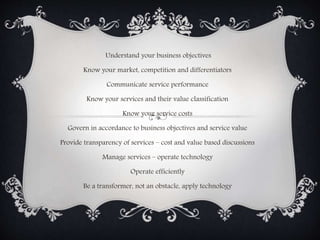
Understand your business objectives
Know your market, competition and differentiators
Communicate service performance
Know your services and their value classification
Know your service costs
Govern in accordance to business objectives and service value
Provide transparency of services – cost and value based discussions
Manage services – operate technology
Operate efficiently
Be a transformer, not an obstacle, apply technology
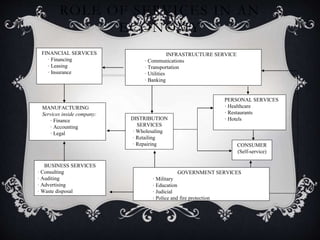
ROLE OF SERVICES IN AN
ECONOMY
MANUFACTURING
Services inside company:
· Finance
· Accounting
· Legal
INFRASTRUCTURE SERVICE
· Communications
· Transportation
· Utilities
· Banking
PERSONAL SERVICES
· Healthcare
· Restaurants
· Hotels
CONSUMER
(Self-service)
GOVERNMENT SERVICES
· Military
· Education
· Judicial
· Police and fire protection
DISTRIBUTION
SERVICES
· Wholesaling
· Retailing
· Repairing
FINANCIAL SERVICES
· Financing
· Leasing
· Insurance
BUSINESS SERVICES
· Consulting
· Auditing
· Advertising
· Waste disposal
CHANGING DEMOGRAPHICS
Aging of the population
Two-income families
Growth in number of single people
Home as sanctuary
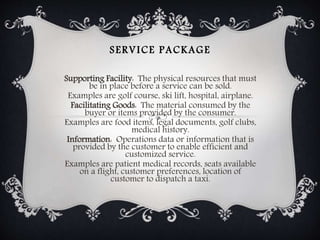
SERVICE PACKAGE
Supporting Facility: The physical resources that must
be in place before a service can be sold.
Examples are golf course, ski lift, hospital, airplane.
Facilitating Goods: The material consumed by the
buyer or items provided by the consumer.
Examples are food items, legal documents, golf clubs,
medical history.
Information: Operations data or information that is
provided by the customer to enable efficient and
customized service.
Examples are patient medical records, seats available
on a flight, customer preferences, location of
customer to dispatch a taxi.
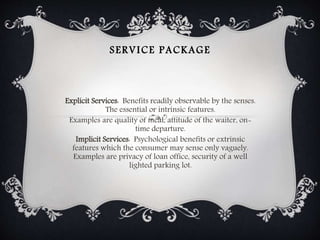
SERVICE PACKAGE
Explicit Services: Benefits readily observable by the senses.
The essential or intrinsic features.
Examples are quality of meal, attitude of the waiter, on-
time departure.
Implicit Services: Psychological benefits or extrinsic
features which the consumer may sense only vaguely.
Examples are privacy of loan office, security of a well
lighted parking lot.
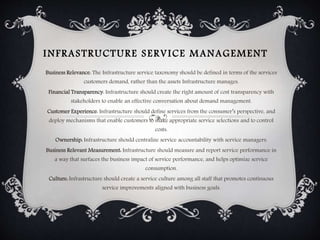
INFRASTRUCTURE SERVICE MANAGEMENT
Business Relevance: The Infrastructure service taxonomy should be defined in terms of the services
customers demand, rather than the assets Infrastructure manages.
Financial Transparency: Infrastructure should create the right amount of cost transparency with
stakeholders to enable an effective conversation about demand management.
Customer Experience: Infrastructure should define services from the consumer’s perspective, and
deploy mechanisms that enable customers to make appropriate service selections and to control
costs.
Ownership: Infrastructure should centralize service accountability with service managers.
Business Relevant Measurement: Infrastructure should measure and report service performance in
a way that surfaces the business impact of service performance, and helps optimize service
consumption.
Culture: Infrastructure should create a service culture among all staff that promotes continuous
service improvements aligned with business goals.
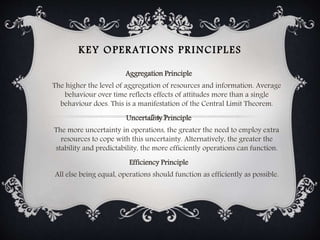
KEY OPERATIONS PRINCIPLES
Aggregation Principle
The higher the level of aggregation of resources and information. Average
behaviour over time reflects effects of attitudes more than a single
behaviour does. This is a manifestation of the Central Limit Theorem.
Uncertainty Principle
The more uncertainty in operations, the greater the need to employ extra
resources to cope with this uncertainty. Alternatively, the greater the
stability and predictability, the more efficiently operations can function.
Efficiency Principle
All else being equal, operations should function as efficiently as possible.
DI STINCTIVE CHARACTERISTICS OF SERVICES
Customer participation in the service process: attention to facility
design, opportunities for co-production, concern for customer
and employee behavior
Simultaneity: process and outcomes are coupled, customer-facing
activities cannot be inventoried, increased importance of
matching capacity to demand
Perishability: opportunity loss of idle capacity, capacity utilization
is a significant managerial challenge due to variable customer
demand and lack of inventory for absorbing fluctuations
Intangibility: customers cannot assess quality a priori, importance
of reputation
Heterogeneity: customer involvement in delivery process results
in variation in service from customer to customer
OBJECTIVES OF SERVICE MANAGEMENT
• To build and maintain effective, productive relationships with
customers
• To define and agree with customers the required levels of services in
a way that customers understand.
• To manage the performance of services to ensure agreed levels are
achieved and that customers are happy with what they receive.
• To ensure systems are in place to improve continually service levels if
the organization wants it and the cost is justified and affordable.
OBJECTIVES OF SERVICE MANAGEMENT
Training
Service people may have quite a collection of specialized training and certifications on specific equipment.
Tracking these with a spreadsheet or other matrix gives you a road map for identifying holes in a worker's
qualifications, and serves as an aid for developing personal development goals. Include non-service-related
items such as personal protective equipment training and other applicable health and safety items. Many of
these may be mandatory under federal and state workplace regulations.
Skills
Skills differ from training in that they represent the application of training and the aptitude of the employee.
Some service people may be excellent trouble-shooters, while others are better with the nuts and bolts of a
repair. Setting objectives for skills may be more challenging to quantify. Use employee self-evaluations to aid
realistic goals for improvement. While you will have impressions of each worker's strengths and weaknesses,
knowing where they feel least comfortable will target objectives with realistic outcomes.
OBJECTIVES OF SERVICE MANAGEMENT
Personnel Performance
Service delivery performance is typically measured in time. Routine maintenance tasks generally have a time
component for a technician of average ability. Many maintenance manuals give a time expectation as part of
various procedures. Use these as a basis for performance objectives, so your staff know what is expected for
any particular job. Equipment uptime is another measure of both the effectiveness of routine maintenance
and your department's skill at responding quickly to emergency repairs.
Department Goals
Managing employees and establishing objectives for them is driven by the goal of strong departmental
performance. Your department's performance goals may be established for you by your supervisor. In
addition to internal performance goals such as those set for his staff, a service delivery manager can expect
objectives based on customer satisfaction, cost savings, new systems and project implementation. Some
service providers have upsells, such as toner and other consumables for copiers, so your position may have
sales performance goals as well.
OBJECTIVES OF SERVICE MANAGEMENT
Designing Features
Effective service delivery managers design and implement new systems to make services user-friendly,
competitive and relevant to clients. This typically involves analyzing the workplace to detect services that
need improvement. For example, a service delivery manager working in a bank that experiences long
queues may advise the bank to adopt mobile banking systems so customers can transact from their homes
and offices. The manager also reviews existing services and makes suitable adjustments to enhance
efficiency.
Building Relationships
Establishing and maintaining strong relationships with clients, suppliers and business partners is key to
improving customer satisfaction. If you work in a hospital as a service delivery manager, for instance,
maintaining positive working relationships with drug and medical equipment suppliers can make a
difference during a shortage or financial crisis. These suppliers can deliver goods to your facility on a short
notice and even expect payment on a later date. This helps ensure continued service delivery to your
customers.
OBJECTIVES OF SERVICE MANAGEMENT
Keeping Records
Organizations that have good record management practices often achieve their goals in enhancing accountability
and efficiency. As an effective service delivery manager, you can focus on keeping accurate records of customer
complaints, sales, supplies and meeting minutes. This can help you keep track and manage all information that
can improve service quality. For example, if you work in a supermarket, keeping quality records of product sales
can help you detect when specific products are running out of stock so you can order more.
Motivating Colleagues
Working with a skilled team increases your chances of achieving your career goals and objectives. A smart service
delivery manager prioritizes the welfare of his team and ensures members are in high morale. To do this, you can
begin by sharing your vision with your team and letting them contribute in setting the department’s goals. If your
team isn’t meeting its targets, show your trust and belief in them by, for instance, organizing training programs to
enhance their technical abilities. A good service delivery manager treats his colleagues with respect and provides
opportunities for career advancement.

Service management

  • 1.
    FACULTY OF SOCIALEDUCATION PUBLIC SERVICE MANAGEMENT ANICETAS IGNOTAS ANICETAS@IGNOTAS.LT MD HREDOY MESHA HREDOY.MESHA@STUD.LEU.LT 18-03-2018 *SERVICE MANAGEMENT*
  • 3.
    Understand your businessobjectives Know your market, competition and differentiators Communicate service performance Know your services and their value classification Know your service costs Govern in accordance to business objectives and service value Provide transparency of services – cost and value based discussions Manage services – operate technology Operate efficiently Be a transformer, not an obstacle, apply technology
  • 4.
    ROLE OF SERVICESIN AN ECONOMY MANUFACTURING Services inside company: · Finance · Accounting · Legal INFRASTRUCTURE SERVICE · Communications · Transportation · Utilities · Banking PERSONAL SERVICES · Healthcare · Restaurants · Hotels CONSUMER (Self-service) GOVERNMENT SERVICES · Military · Education · Judicial · Police and fire protection DISTRIBUTION SERVICES · Wholesaling · Retailing · Repairing FINANCIAL SERVICES · Financing · Leasing · Insurance BUSINESS SERVICES · Consulting · Auditing · Advertising · Waste disposal
  • 5.
    CHANGING DEMOGRAPHICS Aging ofthe population Two-income families Growth in number of single people Home as sanctuary
  • 6.
    SERVICE PACKAGE Supporting Facility:The physical resources that must be in place before a service can be sold. Examples are golf course, ski lift, hospital, airplane. Facilitating Goods: The material consumed by the buyer or items provided by the consumer. Examples are food items, legal documents, golf clubs, medical history. Information: Operations data or information that is provided by the customer to enable efficient and customized service. Examples are patient medical records, seats available on a flight, customer preferences, location of customer to dispatch a taxi.
  • 7.
    SERVICE PACKAGE Explicit Services:Benefits readily observable by the senses. The essential or intrinsic features. Examples are quality of meal, attitude of the waiter, on- time departure. Implicit Services: Psychological benefits or extrinsic features which the consumer may sense only vaguely. Examples are privacy of loan office, security of a well lighted parking lot.
  • 8.
    INFRASTRUCTURE SERVICE MANAGEMENT BusinessRelevance: The Infrastructure service taxonomy should be defined in terms of the services customers demand, rather than the assets Infrastructure manages. Financial Transparency: Infrastructure should create the right amount of cost transparency with stakeholders to enable an effective conversation about demand management. Customer Experience: Infrastructure should define services from the consumer’s perspective, and deploy mechanisms that enable customers to make appropriate service selections and to control costs. Ownership: Infrastructure should centralize service accountability with service managers. Business Relevant Measurement: Infrastructure should measure and report service performance in a way that surfaces the business impact of service performance, and helps optimize service consumption. Culture: Infrastructure should create a service culture among all staff that promotes continuous service improvements aligned with business goals.
  • 9.
    KEY OPERATIONS PRINCIPLES AggregationPrinciple The higher the level of aggregation of resources and information. Average behaviour over time reflects effects of attitudes more than a single behaviour does. This is a manifestation of the Central Limit Theorem. Uncertainty Principle The more uncertainty in operations, the greater the need to employ extra resources to cope with this uncertainty. Alternatively, the greater the stability and predictability, the more efficiently operations can function. Efficiency Principle All else being equal, operations should function as efficiently as possible.
  • 10.
    DI STINCTIVE CHARACTERISTICSOF SERVICES Customer participation in the service process: attention to facility design, opportunities for co-production, concern for customer and employee behavior Simultaneity: process and outcomes are coupled, customer-facing activities cannot be inventoried, increased importance of matching capacity to demand Perishability: opportunity loss of idle capacity, capacity utilization is a significant managerial challenge due to variable customer demand and lack of inventory for absorbing fluctuations Intangibility: customers cannot assess quality a priori, importance of reputation Heterogeneity: customer involvement in delivery process results in variation in service from customer to customer
  • 12.
    OBJECTIVES OF SERVICEMANAGEMENT • To build and maintain effective, productive relationships with customers • To define and agree with customers the required levels of services in a way that customers understand. • To manage the performance of services to ensure agreed levels are achieved and that customers are happy with what they receive. • To ensure systems are in place to improve continually service levels if the organization wants it and the cost is justified and affordable.
  • 13.
    OBJECTIVES OF SERVICEMANAGEMENT Training Service people may have quite a collection of specialized training and certifications on specific equipment. Tracking these with a spreadsheet or other matrix gives you a road map for identifying holes in a worker's qualifications, and serves as an aid for developing personal development goals. Include non-service-related items such as personal protective equipment training and other applicable health and safety items. Many of these may be mandatory under federal and state workplace regulations. Skills Skills differ from training in that they represent the application of training and the aptitude of the employee. Some service people may be excellent trouble-shooters, while others are better with the nuts and bolts of a repair. Setting objectives for skills may be more challenging to quantify. Use employee self-evaluations to aid realistic goals for improvement. While you will have impressions of each worker's strengths and weaknesses, knowing where they feel least comfortable will target objectives with realistic outcomes.
  • 14.
    OBJECTIVES OF SERVICEMANAGEMENT Personnel Performance Service delivery performance is typically measured in time. Routine maintenance tasks generally have a time component for a technician of average ability. Many maintenance manuals give a time expectation as part of various procedures. Use these as a basis for performance objectives, so your staff know what is expected for any particular job. Equipment uptime is another measure of both the effectiveness of routine maintenance and your department's skill at responding quickly to emergency repairs. Department Goals Managing employees and establishing objectives for them is driven by the goal of strong departmental performance. Your department's performance goals may be established for you by your supervisor. In addition to internal performance goals such as those set for his staff, a service delivery manager can expect objectives based on customer satisfaction, cost savings, new systems and project implementation. Some service providers have upsells, such as toner and other consumables for copiers, so your position may have sales performance goals as well.
  • 15.
    OBJECTIVES OF SERVICEMANAGEMENT Designing Features Effective service delivery managers design and implement new systems to make services user-friendly, competitive and relevant to clients. This typically involves analyzing the workplace to detect services that need improvement. For example, a service delivery manager working in a bank that experiences long queues may advise the bank to adopt mobile banking systems so customers can transact from their homes and offices. The manager also reviews existing services and makes suitable adjustments to enhance efficiency. Building Relationships Establishing and maintaining strong relationships with clients, suppliers and business partners is key to improving customer satisfaction. If you work in a hospital as a service delivery manager, for instance, maintaining positive working relationships with drug and medical equipment suppliers can make a difference during a shortage or financial crisis. These suppliers can deliver goods to your facility on a short notice and even expect payment on a later date. This helps ensure continued service delivery to your customers.
  • 16.
    OBJECTIVES OF SERVICEMANAGEMENT Keeping Records Organizations that have good record management practices often achieve their goals in enhancing accountability and efficiency. As an effective service delivery manager, you can focus on keeping accurate records of customer complaints, sales, supplies and meeting minutes. This can help you keep track and manage all information that can improve service quality. For example, if you work in a supermarket, keeping quality records of product sales can help you detect when specific products are running out of stock so you can order more. Motivating Colleagues Working with a skilled team increases your chances of achieving your career goals and objectives. A smart service delivery manager prioritizes the welfare of his team and ensures members are in high morale. To do this, you can begin by sharing your vision with your team and letting them contribute in setting the department’s goals. If your team isn’t meeting its targets, show your trust and belief in them by, for instance, organizing training programs to enhance their technical abilities. A good service delivery manager treats his colleagues with respect and provides opportunities for career advancement.