Understanding equity access and use in
early-stage ventures
A report for Innovate UK and the Department of Business and Trade
Stephen Roper and Robyn Owen
Available at:
https://www.enterpriseresearch.ac.uk/publications/understanding-equity-access-and-use-in-ear
ly-stage-ventures/
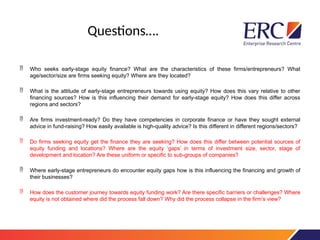
Questions….
 Who seeks early-stage equity finance? What are the characteristics of these firms/entrepreneurs? What
age/sector/size are firms seeking equity? Where are they located?
 What is the attitude of early-stage entrepreneurs towards using equity? How does this vary relative to other
financing sources? How is this influencing their demand for early-stage equity? How does this differ across
regions and sectors?
 Are firms investment-ready? Do they have competencies in corporate finance or have they sought external
advice in fund-raising? How easily available is high-quality advice? Is this different in different regions/sectors?
 Do firms seeking equity get the finance they are seeking? How does this differ between potential sources of
equity funding and locations? Where are the equity ‘gaps’ in terms of investment size, sector, stage of
development and location? Are these uniform or specific to sub-groups of companies?
 Where early-stage entrepreneurs do encounter equity gaps how is this influencing the financing and growth of
their businesses?
 How does the customer journey towards equity funding work? Are there specific barriers or challenges? Where
equity is not obtained where did the process fall down? Why did the process collapse in the firm’s view?
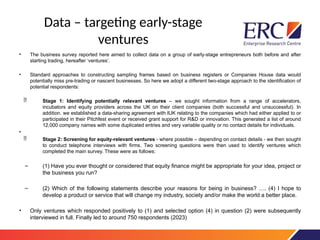
Data – targeting early-stage
ventures
• The business survey reported here aimed to collect data on a group of early-stage entrepreneurs both before and after
starting trading, hereafter ‘ventures’.
• Standard approaches to constructing sampling frames based on business registers or Companies House data would
potentially miss pre-trading or nascent businesses. So here we adopt a different two-stage approach to the identification of
potential respondents:
 Stage 1: Identifying potentially relevant ventures – we sought information from a range of accelerators,
incubators and equity providers across the UK on their client companies (both successful and unsuccessful). In
addition. we established a data-sharing agreement with IUK relating to the companies which had either applied to or
participated in their Pitchfest event or received grant support for R&D or innovation. This generated a list of around
12,000 company names with some duplicated entries and very variable quality or no contact details for individuals.
•
 Stage 2: Screening for equity-relevant ventures - where possible – depending on contact details - we then sought
to conduct telephone interviews with firms. Two screening questions were then used to identify ventures which
completed the main survey. These were as follows:
– (1) Have you ever thought or considered that equity finance might be appropriate for your idea, project or
the business you run?
– (2) Which of the following statements describe your reasons for being in business? …. (4) I hope to
develop a product or service that will change my industry, society and/or make the world a better place.
• Only ventures which responded positively to (1) and selected option (4) in question (2) were subsequently
interviewed in full. Finally led to around 750 respondents (2023)
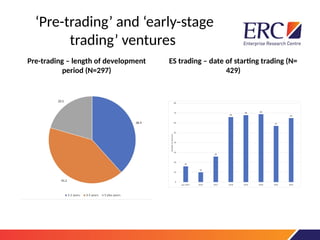
‘Pre-trading’ and ‘early-stage
trading’ ventures
Pre-trading – length of development
period (N=297)
ES trading – date of starting trading (N=
429)
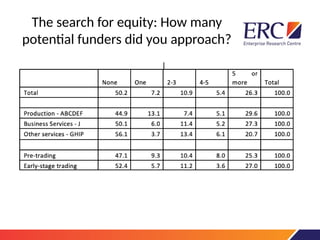
The search for equity: How many
potential funders did you approach?
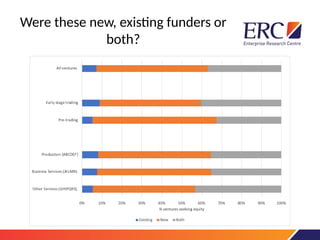
Were these new, existing funders or
both?
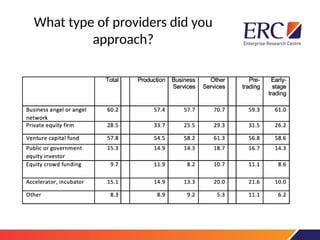
What type of providers did you
approach?
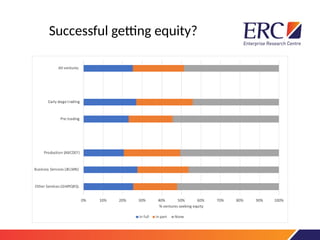
Successful getting equity?
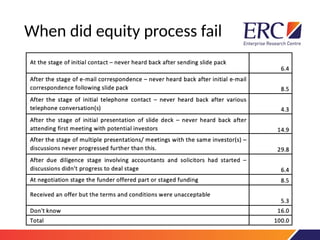
When did equity process fail
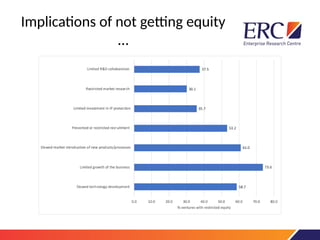
Implications of not getting equity
…
Implications and next steps
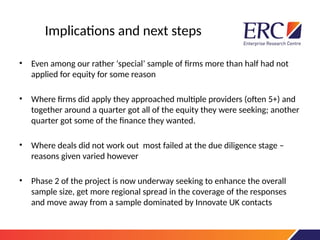
• Even among our rather ‘special’ sample of firms more than half had not
applied for equity for some reason
• Where firms did apply they approached multiple providers (often 5+) and
together around a quarter got all of the equity they were seeking; another
quarter got some of the finance they wanted.
• Where deals did not work out most failed at the due diligence stage –
reasons given varied however
• Phase 2 of the project is now underway seeking to enhance the overall
sample size, get more regional spread in the coverage of the responses
and move away from a sample dominated by Innovate UK contacts
Innovation in smaller firms –
recent evidence from the ISNS
Stephen Roper and Ully Yanita Nafizah
August 2024
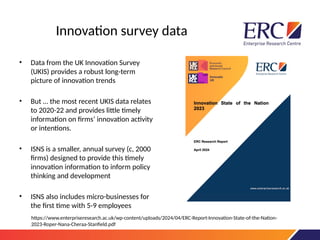
Innovation survey data
• Data from the UK Innovation Survey
(UKIS) provides a robust long-term
picture of innovation trends
• But … the most recent UKIS data relates
to 2020-22 and provides little timely
information on firms’ innovation activity
or intentions.
• ISNS is a smaller, annual survey (c, 2000
firms) designed to provide this timely
innovation information to inform policy
thinking and development
• ISNS also includes micro-businesses for
the first time with 5-9 employees
https://www.enterpriseresearch.ac.uk/wp-content/uploads/2024/04/ERC-Report-Innovation-State-of-the-Nation-
2023-Roper-Nana-Cheraa-Stanfield.pdf
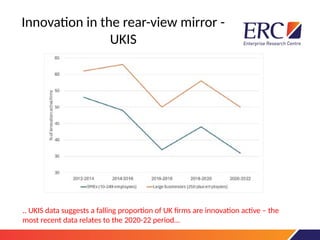
Innovation in the rear-view mirror -
UKIS
.. UKIS data suggests a falling proportion of UK firms are innovation active – the
most recent data relates to the 2020-22 period…
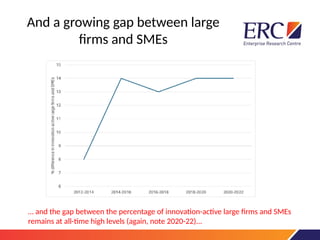
And a growing gap between large
firms and SMEs
… and the gap between the percentage of innovation-active large firms and SMEs
remains at all-time high levels (again, note 2020-22)...
About the ISNS data
• Sampling frames were obtained from commercial list brokers. Firms were
included in the survey if they had more than five employees and were not
part of the public sector or a not-for-profit company.
• ISNS data for each firm was provided by a management team member
responsible for product or service development aspects.
• ISNS 2023 covered 2,018 firms, and data was collected between 14
November 2022 and 28 February 2023 (c 1200 interviews, 800 on-line).
• ISNS 2024 survey covered 2,001 firms and was undertaken between 1st
February 2024 and 22nd
May 2024 (c 1200 interviews, 800 on-line).
• In the analysis, observations are weighted by size and sector to provide
representative coverage of the UK, sectors and sizebands.
Proportion of Firms Making Product
or Service Changes
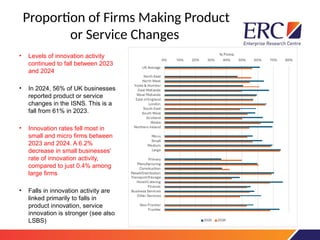
• Levels of innovation activity
continued to fall between 2023
and 2024
• In 2024, 56% of UK businesses
reported product or service
changes in the ISNS. This is a
fall from 61% in 2023.
• Innovation rates fell most in
small and micro firms between
2023 and 2024. A 6.2%
decrease in small businesses'
rate of innovation activity,
compared to just 0.4% among
large firms
• Falls in innovation activity are
linked primarily to falls in
product innovation, service
innovation is stronger (see also
LSBS)
Proportion of Firms undertaking
R&D and innovation investment
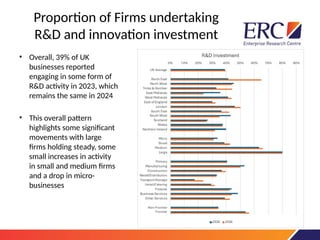
• Overall, 39% of UK
businesses reported
engaging in some form of
R&D activity in 2023, which
remains the same in 2024
• This overall pattern
highlights some significant
movements with large
firms holding steady, some
small increases in activity
in small and medium firms
and a drop in micro-
businesses
Funding innovation
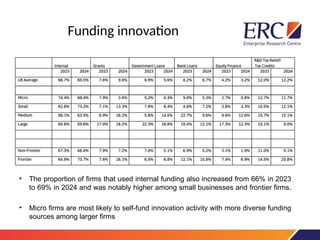
• The proportion of firms that used internal funding also increased from 66% in 2023
to 69% in 2024 and was notably higher among small businesses and frontier firms.
• Micro firms are most likely to self-fund innovation activity with more diverse funding
sources among larger firms
Collaboration for innovation
(% of innovators)
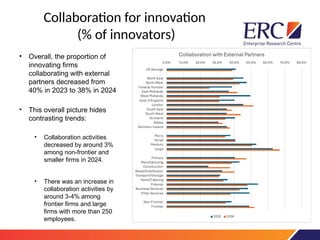
• Overall, the proportion of
innovating firms
collaborating with external
partners decreased from
40% in 2023 to 38% in 2024
• This overall picture hides
contrasting trends:
• Collaboration activities
decreased by around 3%
among non-frontier and
smaller firms in 2024.
• There was an increase in
collaboration activities by
around 3-4% among
frontier firms and large
firms with more than 250
employees.
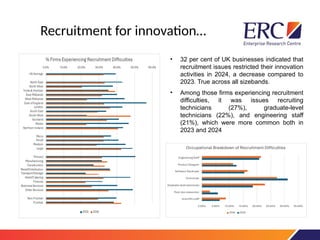
Recruitment for innovation…
• 32 per cent of UK businesses indicated that
recruitment issues restricted their innovation
activities in 2024, a decrease compared to
2023. True across all sizebands.
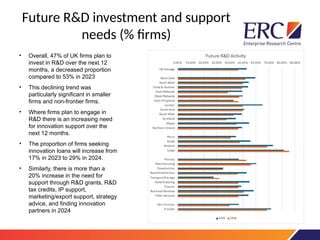
• Among those firms experiencing recruitment
difficulties, it was issues recruiting
technicians (27%), graduate-level
technicians (22%), and engineering staff
(21%), which were more common both in
2023 and 2024
Future R&D investment and support
needs (% firms)
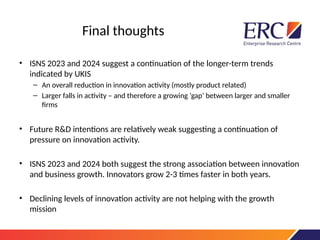
• Overall, 47% of UK firms plan to
invest in R&D over the next 12
months, a decreased proportion
compared to 53% in 2023
• This declining trend was
particularly significant in smaller
firms and non-frontier firms.
• Where firms plan to engage in
R&D there is an increasing need
for innovation support over the
next 12 months.
• The proportion of firms seeking
innovation loans will increase from
17% in 2023 to 29% in 2024.
• Similarly, there is more than a
20% increase in the need for
support through R&D grants, R&D
tax credits, IP support,
marketing/export support, strategy
advice, and finding innovation
partners in 2024
Final thoughts
• ISNS 2023 and 2024 suggest a continuation of the longer-term trends
indicated by UKIS
– An overall reduction in innovation activity (mostly product related)
– Larger falls in activity – and therefore a growing ‘gap’ between larger and smaller
firms
• Future R&D intentions are relatively weak suggesting a continuation of
pressure on innovation activity.
• ISNS 2023 and 2024 both suggest the strong association between innovation
and business growth. Innovators grow 2-3 times faster in both years.
• Declining levels of innovation activity are not helping with the growth
mission
ISNS publications
• ISNS 2023
• Innovation state of the Nation Survey 2023
• Innovation in Micro-Businesses: Evidence from the Innovation State of the
Nation 2023
• Missing Links. Assessing the innovation implications of smaller firms’ limite
d collaboration for innovation.
• How Well Do Barriers and Enablers Predict Regional Innovation? Evidence fr
om the Innovation State of the Nation 2023
• ISNS 2023 and 2024 – report coming soon!
Workplace mental health &
wellbeing and productivity
Maria Wishart, Stephen Roper, Vicki Belt
Workplace mental health in
the UK
• 18.5 million working days lost due to MH sickness absence (ONS,
2023)
• 300,000 people leave their jobs each year because of a MH issue
(Stevenson & Farmer, 2017)
• Firm-level impacts:
• Absenteeism (the time workers spend off work due to ill-health)
• Presenteeism (workers being at work but not performing as expected because
of ill-health, or working beyond contracted hours)
• Staff turnover (the need to replace workers who leave employment due to ill-
health)
• Costs of mental health issues to UK business estimated at £56bn/yr
(Deloitte, 2022)
• Calls to put psychological safety on the same footing as physical
safety (BITC, 2023)
Mental health and well-being
practices, outcomes and
productivity: A causal analysis
Background:
• 3-year ESRC-funded interdisciplinary study
• University College Cork and the University of
Nottingham
Research foci:
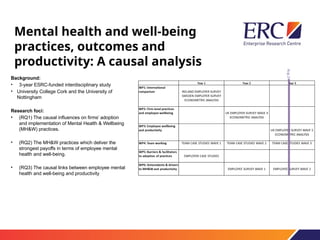
• (RQ1) The causal influences on firms’ adoption
and implementation of Mental Health & Wellbeing
(MH&W) practices.
• (RQ2) The MH&W practices which deliver the
strongest payoffs in terms of employee mental
health and well-being.
• (RQ3) The causal links between employee mental
health and well-being and productivity
Aug
24
Insight 1: International
comparisons (2023)
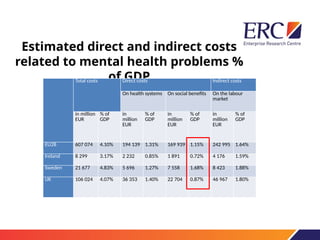
Estimated direct and indirect costs
related to mental health problems %
of GDP
Total costs Direct costs Indirect costs
On health systems On social benefits On the labour
market
in million
EUR
% of
GDP
in
million
EUR
% of
GDP
in
million
EUR
% of
GDP
in
million
EUR
% of
GDP
EU28 607 074 4.10% 194 139 1.31% 169 939 1.15% 242 995 1.64%
Ireland 8 299 3.17% 2 232 0.85% 1 891 0.72% 4 176 1.59%
Sweden 21 677 4.83% 5 696 1.27% 7 558 1.68% 8 423 1.88%
UK 106 024 4.07% 36 353 1.40% 22 704 0.87% 46 967 1.80%
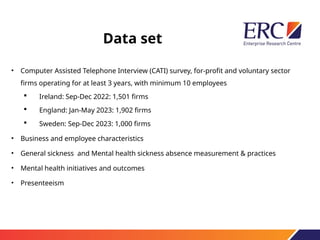
Data set
• Computer Assisted Telephone Interview (CATI) survey, for-profit and voluntary sector
firms operating for at least 3 years, with minimum 10 employees
 Ireland: Sep-Dec 2022: 1,501 firms
 England: Jan-May 2023: 1,902 firms
 Sweden: Sep-Dec 2023: 1,000 firms
• Business and employee characteristics
• General sickness and Mental health sickness absence measurement & practices
• Mental health initiatives and outcomes
• Presenteeism
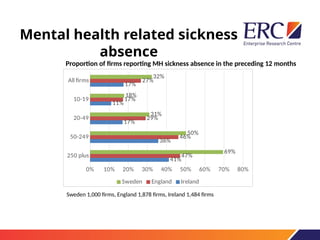
Mental health related sickness
absence
250 plus
50-249
20-49
10-19
All firms
0% 10% 20% 30% 40% 50% 60% 70% 80%
41%
36%
17%
11%
17%
47%
46%
29%
17%
27%
69%
50%
31%
18%
32%
Sweden England Ireland
Proportion of firms reporting MH sickness absence in the preceding 12 months
Sweden 1,000 firms, England 1,878 firms, Ireland 1,484 firms
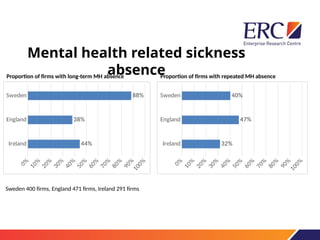
Mental health related sickness
absence
Ireland
England
Sweden
0%
10%
20%
30%
40%
50%
60%
70%
80%
90%
100%
32%
47%
40%
Proportion of firms with long-term MH absence Proportion of firms with repeated MH absence
Ireland
England
Sweden
0%
10%
20%
30%
40%
50%
60%
70%
80%
90%
100%
44%
38%
88%
Sweden 400 firms, England 471 firms, Ireland 291 firms
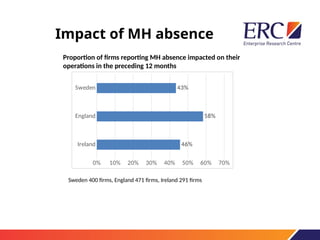
Impact of MH absence
Proportion of firms reporting MH absence impacted on their
operations in the preceding 12 months
Sweden 400 firms, England 471 firms, Ireland 291 firms
Ireland
England
Sweden
0% 10% 20% 30% 40% 50% 60% 70%
46%
58%
43%
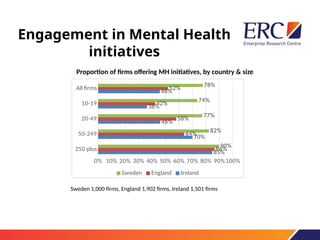
Engagement in Mental Health
initiatives
250 plus
50-249
20-49
10-19
All firms
0% 10% 20% 30% 40% 50% 60% 70% 80% 90%100%
85%
70%
46%
36%
46%
86%
64%
58%
42%
52%
90%
82%
77%
74%
78%
Sweden England Ireland
Proportion of firms offering MH initiatives, by country & size
Sweden 1,000 firms, England 1,902 firms, Ireland 1,501 firms
Insight 2: Workplace well-being in the UK
2024
A longitudinal dataset
• Computer Assisted Telephone Interview (CATI) survey
• For-profit and voluntary sector firms (not govt. or public sector) operating for at least 3
years, with a minimum 10 employees, in East & West Midlands
• Wave 1: Jan-March 2020 (Pre-Covid): 1,899 firms
• Wave 2: Jan-April 2021: 1,551 firms
• Wave 3: Jan-April 2022: 1,904 firms
• Wave 4: Jan-May 2023: 1,902 firms
• Wave 5: Jan-April 2025: 1,901 firms
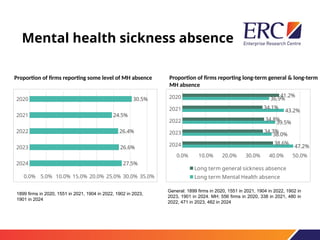
Mental health sickness absence
2024
2023
2022
2021
2020
0.0% 5.0% 10.0% 15.0% 20.0% 25.0% 30.0% 35.0%
27.5%
26.6%
26.4%
24.5%
30.5%
2024
2023
2022
2021
2020
0.0% 10.0% 20.0% 30.0% 40.0% 50.0%
47.2%
38.0%
39.5%
43.2%
36.9%
38.6%
34.3%
34.8%
34.1%
41.2%
Long term general sickness absence
Long term Mental Health absence
Proportion of firms reporting some level of MH absence Proportion of firms reporting long-term general & long-term
MH absence
1899 firms in 2020, 1551 in 2021, 1904 in 2022, 1902 in 2023,
1901 in 2024
General: 1899 firms in 2020, 1551 in 2021, 1904 in 2022, 1902 in
2023, 1901 in 2024. MH: 556 firms in 2020, 338 in 2021, 480 in
2022, 471 in 2023, 482 in 2024
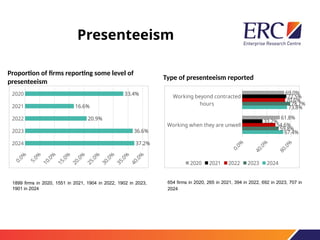
Presenteeism
2024
2023
2022
2021
2020
37.2%
36.6%
20.9%
16.6%
33.4%
Working when they are unwell
Working beyond contracted
hours
67.4%
73.8%
59.8%
78.7%
54.6%
70.6%
33.2%
72.5%
61.8%
69.0%
2020 2021 2022 2023 2024
1899 firms in 2020, 1551 in 2021, 1904 in 2022, 1902 in 2023,
1901 in 2024
654 firms in 2020, 265 in 2021, 394 in 2022, 692 in 2023, 707 in
2024
Type of presenteeism reported
Proportion of firms reporting some level of
presenteeism
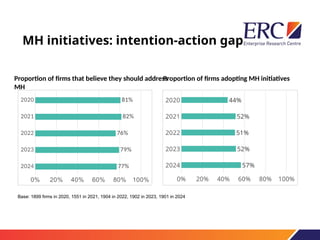
MH initiatives: intention-action gap
2024
2023
2022
2021
2020
0% 20% 40% 60% 80% 100%
57%
52%
51%
52%
44%
2024
2023
2022
2021
2020
0% 20% 40% 60% 80% 100%
77%
79%
76%
82%
81%
Proportion of firms that believe they should address
MH
Proportion of firms adopting MH initiatives
Base: 1899 firms in 2020, 1551 in 2021, 1904 in 2022, 1902 in 2023, 1901 in 2024
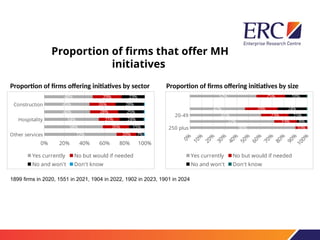
Proportion of firms that offer MH
initiatives
Other services
Hospitality
Construction
0% 20% 40% 60% 80% 100%
72%
58%
54%
46%
45%
48%
20%
26%
21%
28%
26%
29%
7%
15%
24%
25%
28%
23%
Yes currently No but would if needed
No and won't Don't know
250 plus
20-49
0%
10%
20%
30%
40%
50%
60%
70%
80%
90%
100%
90%
72%
61%
47%
57%
10%
19%
23%
28%
25%
8%
15%
24%
18%
Yes currently No but would if needed
No and won't Don't know
Proportion of firms offering initiatives by sector Proportion of firms offering initiatives by size
1899 firms in 2020, 1551 in 2021, 1904 in 2022, 1902 in 2023, 1901 in 2024
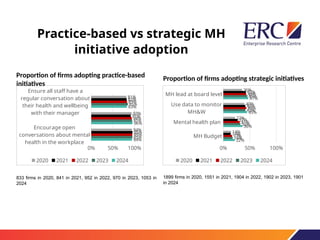
Practice-based vs strategic MH
initiative adoption
Proportion of firms adopting practice-based
initiatives
Proportion of firms adopting strategic initiatives
Encourage open
conversations about mental
health in the workplace
Ensure all staff have a
regular conversation about
their health and wellbeing
with their manager
0% 50% 100%
94%
96%
83%
95%
95%
85%
95%
94%
83%
95%
91%
82%
94%
93%
81%
2020 2021 2022 2023 2024
MH Budget
Mental health plan
Use data to monitor
MH&W
MH lead at board level
0% 50% 100%
22%
36%
45%
47%
18%
32%
42%
45%
17%
31%
43%
43%
14%
27%
42%
42%
14%
22%
40%
36%
2020 2021 2022 2023 2024
1899 firms in 2020, 1551 in 2021, 1904 in 2022, 1902 in 2023, 1901
in 2024
833 firms in 2020, 841 in 2021, 952 in 2022, 970 in 2023, 1053 in
2024
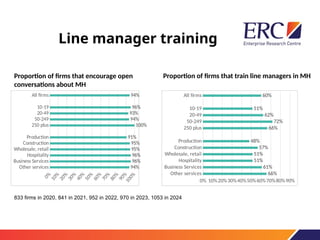
Line manager training
Proportion of firms that encourage open
conversations about MH
Proportion of firms that train line managers in MH
Other services
Business Services
Hospitality
Wholesale, retail
Construction
Production
250 plus
50-249
20-49
10-19
All firms
0% 10%20%30%40%50%60%70%80%90%
66%
61%
51%
51%
57%
48%
66%
72%
62%
51%
60%
Other services
Business Services
Hospitality
Wholesale, retail
Construction
Production
250 plus
50-249
20-49
10-19
All firms
94%
96%
96%
95%
95%
91%
100%
94%
93%
96%
94%
833 firms in 2020, 841 in 2021, 952 in 2022, 970 in 2023, 1053 in 2024
Qualitative insights from
English firms
Line managers’ experiences of managing workplace mental health
issues
• Exploration of the ways in which line managers experience, and cope with, the
management of mental health issues in their staff
• 22 semi-structured interviews with managers from a range of UK private & voluntary
sector organisations, lasting 30 to 45 minutes
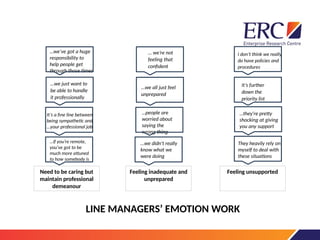
Need to be caring but
maintain professional
demeanour
Feeling inadequate and
unprepared
Feeling unsupported
…we didn't really
know what we
were doing
…people are
worried about
saying the
wrong thing
...we all just feel
unprepared
… we’re not
feeling that
confident
They heavily rely on
myself to deal with
these situations
…they're pretty
shocking at giving
you any support
It’s further
down the
priority list
I don’t think we really
do have policies and
procedures
…if you’re remote,
you’ve got to be
much more attuned
to how somebody is
It’s a fine line between
being sympathetic and
…your professional job
…we just want to
be able to handle
it professionally
…we’ve got a huge
responsibility to
help people get
through those times
LINE MANAGERS’ EMOTION WORK
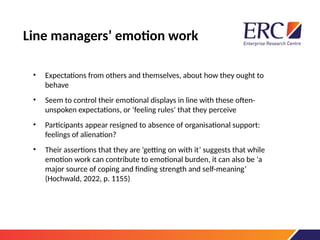
Line managers’ emotion work
• Expectations from others and themselves, about how they ought to
behave
• Seem to control their emotional displays in line with these often-
unspoken expectations, or ‘feeling rules’ that they perceive
• Participants appear resigned to absence of organisational support:
feelings of alienation?
• Their assertions that they are ‘getting on with it’ suggests that while
emotion work can contribute to emotional burden, it can also be ‘a
major source of coping and finding strength and self-meaning’
(Hochwald, 2022, p. 1155)
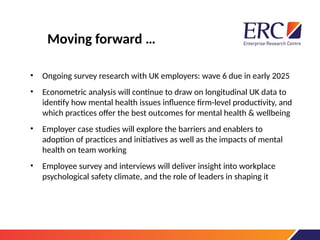
Moving forward …
• Ongoing survey research with UK employers: wave 6 due in early 2025
• Econometric analysis will continue to draw on longitudinal UK data to
identify how mental health issues influence firm-level productivity, and
which practices offer the best outcomes for mental health & wellbeing
• Employer case studies will explore the barriers and enablers to
adoption of practices and initiatives as well as the impacts of mental
health on team working
• Employee survey and interviews will deliver insight into workplace
psychological safety climate, and the role of leaders in shaping it
Smaller firms and net zero
innovation
Anastasia Ri, Effie Kesidou, Halima Jibril, Kevin Mole, Stephen
Roper
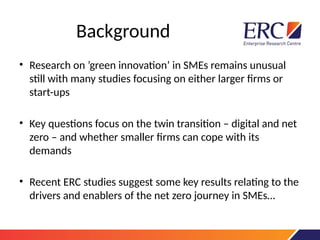
Background
• Research on ’green innovation’ in SMEs remains unusual
still with many studies focusing on either larger firms or
start-ups
• Key questions focus on the twin transition – digital and net
zero – and whether smaller firms can cope with its
demands
• Recent ERC studies suggest some key results relating to the
drivers and enablers of the net zero journey in SMEs…
Evaluating the Trade-offs Between Digitalization
and Net Zero Innovation in SMEs
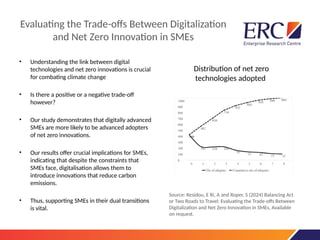
• Understanding the link between digital
technologies and net zero innovations is crucial
for combating climate change
• Is there a positive or a negative trade-off
however?
• Our study demonstrates that digitally advanced
SMEs are more likely to be advanced adopters
of net zero innovations.
• Our results offer crucial implications for SMEs,
indicating that despite the constraints that
SMEs face, digitalisation allows them to
introduce innovations that reduce carbon
emissions.
• Thus, supporting SMEs in their dual transitions
is vital.
Distribution of net zero
technologies adopted
Source: Kesidou, E Ri, A and Roper, S (2024) Balancing Act
or Two Roads to Travel: Evaluating the Trade-offs Between
Digitalization and Net Zero Innovation in SMEs, Available
on request.
Understanding the Drivers of Eco-
innovation Intensity in SMEs
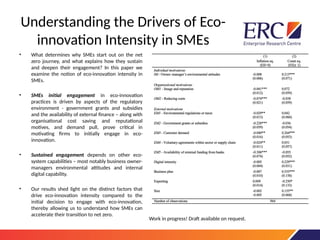
• What determines why SMEs start out on the net
zero journey, and what explains how they sustain
and deepen their engagement? In this paper we
examine the notion of eco-innovation intensity in
SMEs.
• SMEs initial engagement in eco-innovation
practices is driven by aspects of the regulatory
environment - government grants and subsidies
and the availability of external finance – along with
organisational cost saving and reputational
motives, and demand pull, prove critical in
motivating firms to initially engage in eco-
innovation.
• Sustained engagement depends on other eco-
system capabilities – most notably business owner-
managers environmental attitudes and internal
digital capability.
• Our results shed light on the distinct factors that
drive eco-innovation intensity compared to the
initial decision to engage with eco-innovation,
thereby allowing us to understand how SMEs can
accelerate their transition to net zero.
Work in progress! Draft available on request.
Sustainability goals and innovation
– micro-businesses
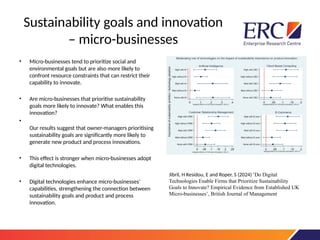
• Micro-businesses tend to prioritize social and
environmental goals but are also more likely to
confront resource constraints that can restrict their
capability to innovate.
• Are micro-businesses that prioritise sustainability
goals more likely to innovate? What enables this
innovation?
•
Our results suggest that owner-managers prioritising
sustainability goals are significantly more likely to
generate new product and process innovations.
• This effect is stronger when micro-businesses adopt
digital technologies.
• Digital technologies enhance micro-businesses'
capabilities, strengthening the connection between
sustainability goals and product and process
innovation.
Jibril, H Kesidou, E and Roper, S (2024) ‘Do Digital
Technologies Enable Firms that Prioritize Sustainability
Goals to Innovate? Empirical Evidence from Established UK
Micro-businesses’, British Journal of Management
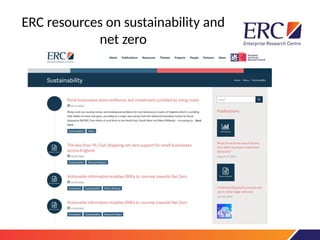
ERC resources on sustainability and
net zero

BBB Teach In presentation- August 2024 2024

  • 1.
    Understanding equity accessand use in early-stage ventures A report for Innovate UK and the Department of Business and Trade Stephen Roper and Robyn Owen Available at: https://www.enterpriseresearch.ac.uk/publications/understanding-equity-access-and-use-in-ear ly-stage-ventures/
  • 2.
    Questions….  Who seeksearly-stage equity finance? What are the characteristics of these firms/entrepreneurs? What age/sector/size are firms seeking equity? Where are they located?  What is the attitude of early-stage entrepreneurs towards using equity? How does this vary relative to other financing sources? How is this influencing their demand for early-stage equity? How does this differ across regions and sectors?  Are firms investment-ready? Do they have competencies in corporate finance or have they sought external advice in fund-raising? How easily available is high-quality advice? Is this different in different regions/sectors?  Do firms seeking equity get the finance they are seeking? How does this differ between potential sources of equity funding and locations? Where are the equity ‘gaps’ in terms of investment size, sector, stage of development and location? Are these uniform or specific to sub-groups of companies?  Where early-stage entrepreneurs do encounter equity gaps how is this influencing the financing and growth of their businesses?  How does the customer journey towards equity funding work? Are there specific barriers or challenges? Where equity is not obtained where did the process fall down? Why did the process collapse in the firm’s view?
  • 3.
    Data – targetingearly-stage ventures • The business survey reported here aimed to collect data on a group of early-stage entrepreneurs both before and after starting trading, hereafter ‘ventures’. • Standard approaches to constructing sampling frames based on business registers or Companies House data would potentially miss pre-trading or nascent businesses. So here we adopt a different two-stage approach to the identification of potential respondents:  Stage 1: Identifying potentially relevant ventures – we sought information from a range of accelerators, incubators and equity providers across the UK on their client companies (both successful and unsuccessful). In addition. we established a data-sharing agreement with IUK relating to the companies which had either applied to or participated in their Pitchfest event or received grant support for R&D or innovation. This generated a list of around 12,000 company names with some duplicated entries and very variable quality or no contact details for individuals. •  Stage 2: Screening for equity-relevant ventures - where possible – depending on contact details - we then sought to conduct telephone interviews with firms. Two screening questions were then used to identify ventures which completed the main survey. These were as follows: – (1) Have you ever thought or considered that equity finance might be appropriate for your idea, project or the business you run? – (2) Which of the following statements describe your reasons for being in business? …. (4) I hope to develop a product or service that will change my industry, society and/or make the world a better place. • Only ventures which responded positively to (1) and selected option (4) in question (2) were subsequently interviewed in full. Finally led to around 750 respondents (2023)
  • 4.
    ‘Pre-trading’ and ‘early-stage trading’ventures Pre-trading – length of development period (N=297) ES trading – date of starting trading (N= 429)
  • 5.
    The search forequity: How many potential funders did you approach?
  • 6.
    Were these new,existing funders or both?
  • 7.
    What type ofproviders did you approach?
  • 8.
  • 9.
    When did equityprocess fail
  • 10.
    Implications of notgetting equity …
  • 11.
    Implications and nextsteps • Even among our rather ‘special’ sample of firms more than half had not applied for equity for some reason • Where firms did apply they approached multiple providers (often 5+) and together around a quarter got all of the equity they were seeking; another quarter got some of the finance they wanted. • Where deals did not work out most failed at the due diligence stage – reasons given varied however • Phase 2 of the project is now underway seeking to enhance the overall sample size, get more regional spread in the coverage of the responses and move away from a sample dominated by Innovate UK contacts
  • 12.
    Innovation in smallerfirms – recent evidence from the ISNS Stephen Roper and Ully Yanita Nafizah August 2024
  • 13.
    Innovation survey data •Data from the UK Innovation Survey (UKIS) provides a robust long-term picture of innovation trends • But … the most recent UKIS data relates to 2020-22 and provides little timely information on firms’ innovation activity or intentions. • ISNS is a smaller, annual survey (c, 2000 firms) designed to provide this timely innovation information to inform policy thinking and development • ISNS also includes micro-businesses for the first time with 5-9 employees https://www.enterpriseresearch.ac.uk/wp-content/uploads/2024/04/ERC-Report-Innovation-State-of-the-Nation- 2023-Roper-Nana-Cheraa-Stanfield.pdf
  • 14.
    Innovation in therear-view mirror - UKIS .. UKIS data suggests a falling proportion of UK firms are innovation active – the most recent data relates to the 2020-22 period…
  • 15.
    And a growinggap between large firms and SMEs … and the gap between the percentage of innovation-active large firms and SMEs remains at all-time high levels (again, note 2020-22)...
  • 16.
    About the ISNSdata • Sampling frames were obtained from commercial list brokers. Firms were included in the survey if they had more than five employees and were not part of the public sector or a not-for-profit company. • ISNS data for each firm was provided by a management team member responsible for product or service development aspects. • ISNS 2023 covered 2,018 firms, and data was collected between 14 November 2022 and 28 February 2023 (c 1200 interviews, 800 on-line). • ISNS 2024 survey covered 2,001 firms and was undertaken between 1st February 2024 and 22nd May 2024 (c 1200 interviews, 800 on-line). • In the analysis, observations are weighted by size and sector to provide representative coverage of the UK, sectors and sizebands.
  • 17.
    Proportion of FirmsMaking Product or Service Changes • Levels of innovation activity continued to fall between 2023 and 2024 • In 2024, 56% of UK businesses reported product or service changes in the ISNS. This is a fall from 61% in 2023. • Innovation rates fell most in small and micro firms between 2023 and 2024. A 6.2% decrease in small businesses' rate of innovation activity, compared to just 0.4% among large firms • Falls in innovation activity are linked primarily to falls in product innovation, service innovation is stronger (see also LSBS)
  • 18.
    Proportion of Firmsundertaking R&D and innovation investment • Overall, 39% of UK businesses reported engaging in some form of R&D activity in 2023, which remains the same in 2024 • This overall pattern highlights some significant movements with large firms holding steady, some small increases in activity in small and medium firms and a drop in micro- businesses
  • 19.
    Funding innovation • Theproportion of firms that used internal funding also increased from 66% in 2023 to 69% in 2024 and was notably higher among small businesses and frontier firms. • Micro firms are most likely to self-fund innovation activity with more diverse funding sources among larger firms
  • 20.
    Collaboration for innovation (%of innovators) • Overall, the proportion of innovating firms collaborating with external partners decreased from 40% in 2023 to 38% in 2024 • This overall picture hides contrasting trends: • Collaboration activities decreased by around 3% among non-frontier and smaller firms in 2024. • There was an increase in collaboration activities by around 3-4% among frontier firms and large firms with more than 250 employees.
  • 21.
    Recruitment for innovation… •32 per cent of UK businesses indicated that recruitment issues restricted their innovation activities in 2024, a decrease compared to 2023. True across all sizebands. • Among those firms experiencing recruitment difficulties, it was issues recruiting technicians (27%), graduate-level technicians (22%), and engineering staff (21%), which were more common both in 2023 and 2024
  • 22.
    Future R&D investmentand support needs (% firms) • Overall, 47% of UK firms plan to invest in R&D over the next 12 months, a decreased proportion compared to 53% in 2023 • This declining trend was particularly significant in smaller firms and non-frontier firms. • Where firms plan to engage in R&D there is an increasing need for innovation support over the next 12 months. • The proportion of firms seeking innovation loans will increase from 17% in 2023 to 29% in 2024. • Similarly, there is more than a 20% increase in the need for support through R&D grants, R&D tax credits, IP support, marketing/export support, strategy advice, and finding innovation partners in 2024
  • 23.
    Final thoughts • ISNS2023 and 2024 suggest a continuation of the longer-term trends indicated by UKIS – An overall reduction in innovation activity (mostly product related) – Larger falls in activity – and therefore a growing ‘gap’ between larger and smaller firms • Future R&D intentions are relatively weak suggesting a continuation of pressure on innovation activity. • ISNS 2023 and 2024 both suggest the strong association between innovation and business growth. Innovators grow 2-3 times faster in both years. • Declining levels of innovation activity are not helping with the growth mission
  • 24.
    ISNS publications • ISNS2023 • Innovation state of the Nation Survey 2023 • Innovation in Micro-Businesses: Evidence from the Innovation State of the Nation 2023 • Missing Links. Assessing the innovation implications of smaller firms’ limite d collaboration for innovation. • How Well Do Barriers and Enablers Predict Regional Innovation? Evidence fr om the Innovation State of the Nation 2023 • ISNS 2023 and 2024 – report coming soon!
  • 25.
    Workplace mental health& wellbeing and productivity Maria Wishart, Stephen Roper, Vicki Belt
  • 26.
    Workplace mental healthin the UK • 18.5 million working days lost due to MH sickness absence (ONS, 2023) • 300,000 people leave their jobs each year because of a MH issue (Stevenson & Farmer, 2017) • Firm-level impacts: • Absenteeism (the time workers spend off work due to ill-health) • Presenteeism (workers being at work but not performing as expected because of ill-health, or working beyond contracted hours) • Staff turnover (the need to replace workers who leave employment due to ill- health) • Costs of mental health issues to UK business estimated at £56bn/yr (Deloitte, 2022) • Calls to put psychological safety on the same footing as physical safety (BITC, 2023)
  • 27.
    Mental health andwell-being practices, outcomes and productivity: A causal analysis Background: • 3-year ESRC-funded interdisciplinary study • University College Cork and the University of Nottingham Research foci: • (RQ1) The causal influences on firms’ adoption and implementation of Mental Health & Wellbeing (MH&W) practices. • (RQ2) The MH&W practices which deliver the strongest payoffs in terms of employee mental health and well-being. • (RQ3) The causal links between employee mental health and well-being and productivity Aug 24
  • 28.
  • 29.
    Estimated direct andindirect costs related to mental health problems % of GDP Total costs Direct costs Indirect costs On health systems On social benefits On the labour market in million EUR % of GDP in million EUR % of GDP in million EUR % of GDP in million EUR % of GDP EU28 607 074 4.10% 194 139 1.31% 169 939 1.15% 242 995 1.64% Ireland 8 299 3.17% 2 232 0.85% 1 891 0.72% 4 176 1.59% Sweden 21 677 4.83% 5 696 1.27% 7 558 1.68% 8 423 1.88% UK 106 024 4.07% 36 353 1.40% 22 704 0.87% 46 967 1.80%
  • 30.
    Data set • ComputerAssisted Telephone Interview (CATI) survey, for-profit and voluntary sector firms operating for at least 3 years, with minimum 10 employees  Ireland: Sep-Dec 2022: 1,501 firms  England: Jan-May 2023: 1,902 firms  Sweden: Sep-Dec 2023: 1,000 firms • Business and employee characteristics • General sickness and Mental health sickness absence measurement & practices • Mental health initiatives and outcomes • Presenteeism
  • 31.
    Mental health relatedsickness absence 250 plus 50-249 20-49 10-19 All firms 0% 10% 20% 30% 40% 50% 60% 70% 80% 41% 36% 17% 11% 17% 47% 46% 29% 17% 27% 69% 50% 31% 18% 32% Sweden England Ireland Proportion of firms reporting MH sickness absence in the preceding 12 months Sweden 1,000 firms, England 1,878 firms, Ireland 1,484 firms
  • 32.
    Mental health relatedsickness absence Ireland England Sweden 0% 10% 20% 30% 40% 50% 60% 70% 80% 90% 100% 32% 47% 40% Proportion of firms with long-term MH absence Proportion of firms with repeated MH absence Ireland England Sweden 0% 10% 20% 30% 40% 50% 60% 70% 80% 90% 100% 44% 38% 88% Sweden 400 firms, England 471 firms, Ireland 291 firms
  • 33.
    Impact of MHabsence Proportion of firms reporting MH absence impacted on their operations in the preceding 12 months Sweden 400 firms, England 471 firms, Ireland 291 firms Ireland England Sweden 0% 10% 20% 30% 40% 50% 60% 70% 46% 58% 43%
  • 34.
    Engagement in MentalHealth initiatives 250 plus 50-249 20-49 10-19 All firms 0% 10% 20% 30% 40% 50% 60% 70% 80% 90%100% 85% 70% 46% 36% 46% 86% 64% 58% 42% 52% 90% 82% 77% 74% 78% Sweden England Ireland Proportion of firms offering MH initiatives, by country & size Sweden 1,000 firms, England 1,902 firms, Ireland 1,501 firms
  • 35.
    Insight 2: Workplacewell-being in the UK 2024
  • 36.
    A longitudinal dataset •Computer Assisted Telephone Interview (CATI) survey • For-profit and voluntary sector firms (not govt. or public sector) operating for at least 3 years, with a minimum 10 employees, in East & West Midlands • Wave 1: Jan-March 2020 (Pre-Covid): 1,899 firms • Wave 2: Jan-April 2021: 1,551 firms • Wave 3: Jan-April 2022: 1,904 firms • Wave 4: Jan-May 2023: 1,902 firms • Wave 5: Jan-April 2025: 1,901 firms
  • 37.
    Mental health sicknessabsence 2024 2023 2022 2021 2020 0.0% 5.0% 10.0% 15.0% 20.0% 25.0% 30.0% 35.0% 27.5% 26.6% 26.4% 24.5% 30.5% 2024 2023 2022 2021 2020 0.0% 10.0% 20.0% 30.0% 40.0% 50.0% 47.2% 38.0% 39.5% 43.2% 36.9% 38.6% 34.3% 34.8% 34.1% 41.2% Long term general sickness absence Long term Mental Health absence Proportion of firms reporting some level of MH absence Proportion of firms reporting long-term general & long-term MH absence 1899 firms in 2020, 1551 in 2021, 1904 in 2022, 1902 in 2023, 1901 in 2024 General: 1899 firms in 2020, 1551 in 2021, 1904 in 2022, 1902 in 2023, 1901 in 2024. MH: 556 firms in 2020, 338 in 2021, 480 in 2022, 471 in 2023, 482 in 2024
  • 38.
    Presenteeism 2024 2023 2022 2021 2020 37.2% 36.6% 20.9% 16.6% 33.4% Working when theyare unwell Working beyond contracted hours 67.4% 73.8% 59.8% 78.7% 54.6% 70.6% 33.2% 72.5% 61.8% 69.0% 2020 2021 2022 2023 2024 1899 firms in 2020, 1551 in 2021, 1904 in 2022, 1902 in 2023, 1901 in 2024 654 firms in 2020, 265 in 2021, 394 in 2022, 692 in 2023, 707 in 2024 Type of presenteeism reported Proportion of firms reporting some level of presenteeism
  • 39.
    MH initiatives: intention-actiongap 2024 2023 2022 2021 2020 0% 20% 40% 60% 80% 100% 57% 52% 51% 52% 44% 2024 2023 2022 2021 2020 0% 20% 40% 60% 80% 100% 77% 79% 76% 82% 81% Proportion of firms that believe they should address MH Proportion of firms adopting MH initiatives Base: 1899 firms in 2020, 1551 in 2021, 1904 in 2022, 1902 in 2023, 1901 in 2024
  • 40.
    Proportion of firmsthat offer MH initiatives Other services Hospitality Construction 0% 20% 40% 60% 80% 100% 72% 58% 54% 46% 45% 48% 20% 26% 21% 28% 26% 29% 7% 15% 24% 25% 28% 23% Yes currently No but would if needed No and won't Don't know 250 plus 20-49 0% 10% 20% 30% 40% 50% 60% 70% 80% 90% 100% 90% 72% 61% 47% 57% 10% 19% 23% 28% 25% 8% 15% 24% 18% Yes currently No but would if needed No and won't Don't know Proportion of firms offering initiatives by sector Proportion of firms offering initiatives by size 1899 firms in 2020, 1551 in 2021, 1904 in 2022, 1902 in 2023, 1901 in 2024
  • 41.
    Practice-based vs strategicMH initiative adoption Proportion of firms adopting practice-based initiatives Proportion of firms adopting strategic initiatives Encourage open conversations about mental health in the workplace Ensure all staff have a regular conversation about their health and wellbeing with their manager 0% 50% 100% 94% 96% 83% 95% 95% 85% 95% 94% 83% 95% 91% 82% 94% 93% 81% 2020 2021 2022 2023 2024 MH Budget Mental health plan Use data to monitor MH&W MH lead at board level 0% 50% 100% 22% 36% 45% 47% 18% 32% 42% 45% 17% 31% 43% 43% 14% 27% 42% 42% 14% 22% 40% 36% 2020 2021 2022 2023 2024 1899 firms in 2020, 1551 in 2021, 1904 in 2022, 1902 in 2023, 1901 in 2024 833 firms in 2020, 841 in 2021, 952 in 2022, 970 in 2023, 1053 in 2024
  • 42.
    Line manager training Proportionof firms that encourage open conversations about MH Proportion of firms that train line managers in MH Other services Business Services Hospitality Wholesale, retail Construction Production 250 plus 50-249 20-49 10-19 All firms 0% 10%20%30%40%50%60%70%80%90% 66% 61% 51% 51% 57% 48% 66% 72% 62% 51% 60% Other services Business Services Hospitality Wholesale, retail Construction Production 250 plus 50-249 20-49 10-19 All firms 94% 96% 96% 95% 95% 91% 100% 94% 93% 96% 94% 833 firms in 2020, 841 in 2021, 952 in 2022, 970 in 2023, 1053 in 2024
  • 43.
    Qualitative insights from Englishfirms Line managers’ experiences of managing workplace mental health issues • Exploration of the ways in which line managers experience, and cope with, the management of mental health issues in their staff • 22 semi-structured interviews with managers from a range of UK private & voluntary sector organisations, lasting 30 to 45 minutes
  • 44.
    Need to becaring but maintain professional demeanour Feeling inadequate and unprepared Feeling unsupported …we didn't really know what we were doing …people are worried about saying the wrong thing ...we all just feel unprepared … we’re not feeling that confident They heavily rely on myself to deal with these situations …they're pretty shocking at giving you any support It’s further down the priority list I don’t think we really do have policies and procedures …if you’re remote, you’ve got to be much more attuned to how somebody is It’s a fine line between being sympathetic and …your professional job …we just want to be able to handle it professionally …we’ve got a huge responsibility to help people get through those times LINE MANAGERS’ EMOTION WORK
  • 45.
    Line managers’ emotionwork • Expectations from others and themselves, about how they ought to behave • Seem to control their emotional displays in line with these often- unspoken expectations, or ‘feeling rules’ that they perceive • Participants appear resigned to absence of organisational support: feelings of alienation? • Their assertions that they are ‘getting on with it’ suggests that while emotion work can contribute to emotional burden, it can also be ‘a major source of coping and finding strength and self-meaning’ (Hochwald, 2022, p. 1155)
  • 46.
    Moving forward … •Ongoing survey research with UK employers: wave 6 due in early 2025 • Econometric analysis will continue to draw on longitudinal UK data to identify how mental health issues influence firm-level productivity, and which practices offer the best outcomes for mental health & wellbeing • Employer case studies will explore the barriers and enablers to adoption of practices and initiatives as well as the impacts of mental health on team working • Employee survey and interviews will deliver insight into workplace psychological safety climate, and the role of leaders in shaping it
  • 48.
    Smaller firms andnet zero innovation Anastasia Ri, Effie Kesidou, Halima Jibril, Kevin Mole, Stephen Roper
  • 49.
    Background • Research on’green innovation’ in SMEs remains unusual still with many studies focusing on either larger firms or start-ups • Key questions focus on the twin transition – digital and net zero – and whether smaller firms can cope with its demands • Recent ERC studies suggest some key results relating to the drivers and enablers of the net zero journey in SMEs…
  • 50.
    Evaluating the Trade-offsBetween Digitalization and Net Zero Innovation in SMEs • Understanding the link between digital technologies and net zero innovations is crucial for combating climate change • Is there a positive or a negative trade-off however? • Our study demonstrates that digitally advanced SMEs are more likely to be advanced adopters of net zero innovations. • Our results offer crucial implications for SMEs, indicating that despite the constraints that SMEs face, digitalisation allows them to introduce innovations that reduce carbon emissions. • Thus, supporting SMEs in their dual transitions is vital. Distribution of net zero technologies adopted Source: Kesidou, E Ri, A and Roper, S (2024) Balancing Act or Two Roads to Travel: Evaluating the Trade-offs Between Digitalization and Net Zero Innovation in SMEs, Available on request.
  • 51.
    Understanding the Driversof Eco- innovation Intensity in SMEs • What determines why SMEs start out on the net zero journey, and what explains how they sustain and deepen their engagement? In this paper we examine the notion of eco-innovation intensity in SMEs. • SMEs initial engagement in eco-innovation practices is driven by aspects of the regulatory environment - government grants and subsidies and the availability of external finance – along with organisational cost saving and reputational motives, and demand pull, prove critical in motivating firms to initially engage in eco- innovation. • Sustained engagement depends on other eco- system capabilities – most notably business owner- managers environmental attitudes and internal digital capability. • Our results shed light on the distinct factors that drive eco-innovation intensity compared to the initial decision to engage with eco-innovation, thereby allowing us to understand how SMEs can accelerate their transition to net zero. Work in progress! Draft available on request.
  • 52.
    Sustainability goals andinnovation – micro-businesses • Micro-businesses tend to prioritize social and environmental goals but are also more likely to confront resource constraints that can restrict their capability to innovate. • Are micro-businesses that prioritise sustainability goals more likely to innovate? What enables this innovation? • Our results suggest that owner-managers prioritising sustainability goals are significantly more likely to generate new product and process innovations. • This effect is stronger when micro-businesses adopt digital technologies. • Digital technologies enhance micro-businesses' capabilities, strengthening the connection between sustainability goals and product and process innovation. Jibril, H Kesidou, E and Roper, S (2024) ‘Do Digital Technologies Enable Firms that Prioritize Sustainability Goals to Innovate? Empirical Evidence from Established UK Micro-businesses’, British Journal of Management
  • 53.
    ERC resources onsustainability and net zero