SERENDIB HOTEL
Geoffrey Bawa
Geographical Location.
Geographical Conditions.
• The main island nation of Sri Lanka, itself
known as Sri Lanka (formerly called
Ceylon, Lanka-dvipa, Simhala-dvipa,
etc.), is a South Asian island in the Indian
Ocean, southeast of the Indian
subcontinent, in a strategic location near
major Indian Ocean sea lanes.
• Coordinates - 7°N 81°E / 7°N 81°E / 7; 81
• Its terrain is mostly low, flat to rolling
plain, with mountains in the south-
central interior. The highest point is
Pidurutalagala at 2,524.13 m.
Climatic Conditions.
• Tropical and quite hot.
• The country enjoys monsoons
almost all throughout the year
,due to, winds arriving from
various sides of the island.
Monsoon pattern is called ‘Four
Seasoned’.
• Temperature
• The average yearly temperature for
the country as a whole ranges from
28 to 30 °C (82.4 to 86.0 °F).
• Day and night temperatures may vary
by 4 to 7 °C (7.2 to 12.6 °F).
• January is the coolest month,
especially in the highlands, where
overnight temperatures may fall to
5 °C (41 °F).
Geoffrey Bawa
• Deshamanya Geoffrey Manning
Bawa, is the most renowned Sri
Lankan architect.
• Bawa's architecture is at one with
the land: inside and outside blend
seamlessly, and it is designed for the
maximum pleasure of its
inhabitants.
• He was influenced by colonial and
traditional Ceylonese (Sri Lankan)
architecture, and the role of water
in it, but rejected both the idea of
regionalism and the imposition of
preconceived forms onto a site.
Philosophy
• A building can only be understood by moving around and
through it and by experiencing the modulation and feel the
spaces one moves through- from the outside into verandah,
than rooms, passages, courtyards.
• Architecture cannot be totally explained but must be
experienced.
- Geoffrey Bawa
Philosophy
• Highly personal in his
approach, evoking the
pleasures of the senses that
go hand in hand with the
climate, landscape, and
culture of ancient Ceylon(Sri
Lanka).
• Brings together an
appreciation of the Western
humanist tradition in
architecture with needs and
lifestyles of his own country.
• The principal force behind
‘TROPICAL MODERNISM’.
Philosophy
1. Respected the site and context.
2. Buildings had a play of light and shade.
3. Flow of spaces.
4. Fused vernacular architecture with the modern
concepts to satiate the needs of the urban population.
5. Used salvaged artifacts.
6. Roof forms as elements.
7. Waterbody –an essential part of bawa’s architecture.
His Works
• Lunuganga, Bawa's house.
• University of Ruhuna
• Seema Malaka
• Serendib Hotel, Bentota (1967–1970)
• Parliament of Sri Lanka
• Sunethra Bandaranaike House
• Kandalama Hotel
• Kanangara House
• Institute for Integral Education
• Offices for Banque Indosuez
SERENDIB HOTEL
SERENDIB HOTEL
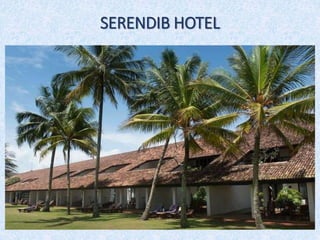
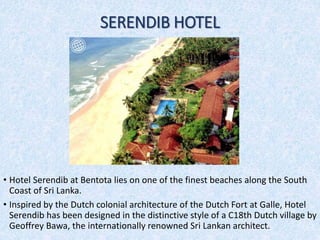
• Hotel Serendib at Bentota lies on one of the finest beaches along the South
Coast of Sri Lanka.
• Inspired by the Dutch colonial architecture of the Dutch Fort at Galle, Hotel
Serendib has been designed in the distinctive style of a C18th Dutch village by
Geoffrey Bawa, the internationally renowned Sri Lankan architect.
The Structure.
• The plan consists of two long parallel buildings enclosing a string
of courtyards, the building on the street side containing offices,
kitchens and service spaces, while that facing the sea contains two
floors of accommodation flanking a central dining room.
The Structure.
• A series of longitudinal strata
was established between the
railway track and the ocean: the
street, the porte cochère, the
service wall, the garden, the
access corridors, the lines of
bedroom cells, the private
verandahs, the coconut grove
and the beach.
• A single cross-axis pierces these
strata like a skewer, proceeding
from the porte cochère across
the central courtyard past a
peacock pen to the reception
desk and continuing along one
side of the restaurant and
beyond through the trees to the
edge of the ocean.
The Structure.
• The original building has forty-four
rooms, twenty on the ground floor
and twenty-four above, the lower
rooms opening into small courtyards
with covered verandahs beyond,
while the upper rooms open onto
balconies.
• All were designed to function without
air conditioning and fitted with
timber lattice louvres to encourage
cross-ventilation.
• All traditional building techniques
and materials were used like-
• Clay roof tiles,
• Timber trusses,
• Lime plastered walls,
• Terracotta floorings,
• Stone flooring.
The Courtyards.
The Courtyards.
The Restaurant.
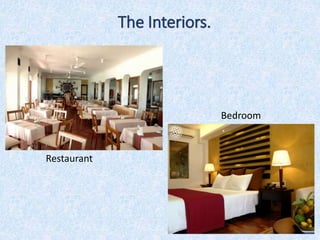
• A simple restaurant spills out onto the lawns, where open sitting
areas are protected by triangular sails of orange and brown canvas
stretched between the trunks of palm trees.
• The original design proposed roofs of coconut thatch and floors of
raked sand, but the complete building employs roofs of clay tile on
cement sheeting with terracotta floors.
The Swimming Pool
The Swimming Pool
The Courtyards.
• Provided with tropical trees and grass with beautiful openings,
creates dramatic effect.
• As these courtyards are open to sky, natural ventilation and
illumination is achieved.
• Also prevents heat from entering into the structure.
The Roofs.
• The voids in the roof become an
eminent part of this structure.
• Bawa believes the ‘Roof forms are
important element of design in a
structure’.
• These voids serves purposes such as -
• Balconies for upper floor rooms.
• Creative shadow and light effect for
lower floor.
• The coconut trees planted in the
front, and the voids created to the
west prevents excessive sunlight and
heat from entering into the structure.
The Verandahs.
The Interiors.
The Staircase.
The Corridors.
The Interiors.
Restaurant
Bedroom
Bibliography
• http://en.wikipedia.org/wiki/Architecture_of_Sri_Lanka
• http://sebastianposingis.photoshelter.com/gallery/The-
Serendip-Hotel/G0000wqYUk0fp_nc/C0000xIEsjdPRv40
• http://architorture-cyfu.blogspot.in/2010_09_01_archive.html
• https://books.google.co.in/books?id=XQgsHhwxRksC&pg=PA212
&lpg=PA212&dq=Serendib+Hotel+,+Bentota+architecture&sourc
e=bl&ots=8Uwu3Fnxp6&sig=7KgdeRGVSJBkzsQS-
7Zbqhjh1Kw&hl=en&sa=X&ved=0ahUKEwiCmv23-
KDPAhXCp48KHRuYCvMQ6AEIWTAN#v=onepage&q=Serendib%2
0Hotel%20%2C%20Bentota%20architecture&f=false
Serendib hotel (passive abroad)

Serendib hotel (passive abroad)

  • 1.
  • 2.
  • 3.
    Geographical Conditions. • Themain island nation of Sri Lanka, itself known as Sri Lanka (formerly called Ceylon, Lanka-dvipa, Simhala-dvipa, etc.), is a South Asian island in the Indian Ocean, southeast of the Indian subcontinent, in a strategic location near major Indian Ocean sea lanes. • Coordinates - 7°N 81°E / 7°N 81°E / 7; 81 • Its terrain is mostly low, flat to rolling plain, with mountains in the south- central interior. The highest point is Pidurutalagala at 2,524.13 m.
  • 4.
    Climatic Conditions. • Tropicaland quite hot. • The country enjoys monsoons almost all throughout the year ,due to, winds arriving from various sides of the island. Monsoon pattern is called ‘Four Seasoned’. • Temperature • The average yearly temperature for the country as a whole ranges from 28 to 30 °C (82.4 to 86.0 °F). • Day and night temperatures may vary by 4 to 7 °C (7.2 to 12.6 °F). • January is the coolest month, especially in the highlands, where overnight temperatures may fall to 5 °C (41 °F).
  • 5.
    Geoffrey Bawa • DeshamanyaGeoffrey Manning Bawa, is the most renowned Sri Lankan architect. • Bawa's architecture is at one with the land: inside and outside blend seamlessly, and it is designed for the maximum pleasure of its inhabitants. • He was influenced by colonial and traditional Ceylonese (Sri Lankan) architecture, and the role of water in it, but rejected both the idea of regionalism and the imposition of preconceived forms onto a site.
  • 6.
    Philosophy • A buildingcan only be understood by moving around and through it and by experiencing the modulation and feel the spaces one moves through- from the outside into verandah, than rooms, passages, courtyards. • Architecture cannot be totally explained but must be experienced. - Geoffrey Bawa
  • 7.
    Philosophy • Highly personalin his approach, evoking the pleasures of the senses that go hand in hand with the climate, landscape, and culture of ancient Ceylon(Sri Lanka). • Brings together an appreciation of the Western humanist tradition in architecture with needs and lifestyles of his own country. • The principal force behind ‘TROPICAL MODERNISM’.
  • 8.
    Philosophy 1. Respected thesite and context. 2. Buildings had a play of light and shade. 3. Flow of spaces. 4. Fused vernacular architecture with the modern concepts to satiate the needs of the urban population. 5. Used salvaged artifacts. 6. Roof forms as elements. 7. Waterbody –an essential part of bawa’s architecture.
  • 9.
    His Works • Lunuganga,Bawa's house. • University of Ruhuna • Seema Malaka • Serendib Hotel, Bentota (1967–1970) • Parliament of Sri Lanka • Sunethra Bandaranaike House • Kandalama Hotel • Kanangara House • Institute for Integral Education • Offices for Banque Indosuez
  • 10.
  • 11.
    SERENDIB HOTEL • HotelSerendib at Bentota lies on one of the finest beaches along the South Coast of Sri Lanka. • Inspired by the Dutch colonial architecture of the Dutch Fort at Galle, Hotel Serendib has been designed in the distinctive style of a C18th Dutch village by Geoffrey Bawa, the internationally renowned Sri Lankan architect.
  • 12.
    The Structure. • Theplan consists of two long parallel buildings enclosing a string of courtyards, the building on the street side containing offices, kitchens and service spaces, while that facing the sea contains two floors of accommodation flanking a central dining room.
  • 13.
    The Structure. • Aseries of longitudinal strata was established between the railway track and the ocean: the street, the porte cochère, the service wall, the garden, the access corridors, the lines of bedroom cells, the private verandahs, the coconut grove and the beach. • A single cross-axis pierces these strata like a skewer, proceeding from the porte cochère across the central courtyard past a peacock pen to the reception desk and continuing along one side of the restaurant and beyond through the trees to the edge of the ocean.
  • 14.
    The Structure. • Theoriginal building has forty-four rooms, twenty on the ground floor and twenty-four above, the lower rooms opening into small courtyards with covered verandahs beyond, while the upper rooms open onto balconies. • All were designed to function without air conditioning and fitted with timber lattice louvres to encourage cross-ventilation. • All traditional building techniques and materials were used like- • Clay roof tiles, • Timber trusses, • Lime plastered walls, • Terracotta floorings, • Stone flooring.
  • 15.
  • 16.
  • 17.
    The Restaurant. • Asimple restaurant spills out onto the lawns, where open sitting areas are protected by triangular sails of orange and brown canvas stretched between the trunks of palm trees. • The original design proposed roofs of coconut thatch and floors of raked sand, but the complete building employs roofs of clay tile on cement sheeting with terracotta floors.
  • 18.
  • 19.
  • 20.
    The Courtyards. • Providedwith tropical trees and grass with beautiful openings, creates dramatic effect. • As these courtyards are open to sky, natural ventilation and illumination is achieved. • Also prevents heat from entering into the structure.
  • 21.
    The Roofs. • Thevoids in the roof become an eminent part of this structure. • Bawa believes the ‘Roof forms are important element of design in a structure’. • These voids serves purposes such as - • Balconies for upper floor rooms. • Creative shadow and light effect for lower floor. • The coconut trees planted in the front, and the voids created to the west prevents excessive sunlight and heat from entering into the structure.
  • 22.
  • 23.
  • 24.
  • 25.
  • 26.
  • 27.
    Bibliography • http://en.wikipedia.org/wiki/Architecture_of_Sri_Lanka • http://sebastianposingis.photoshelter.com/gallery/The- Serendip-Hotel/G0000wqYUk0fp_nc/C0000xIEsjdPRv40 •http://architorture-cyfu.blogspot.in/2010_09_01_archive.html • https://books.google.co.in/books?id=XQgsHhwxRksC&pg=PA212 &lpg=PA212&dq=Serendib+Hotel+,+Bentota+architecture&sourc e=bl&ots=8Uwu3Fnxp6&sig=7KgdeRGVSJBkzsQS- 7Zbqhjh1Kw&hl=en&sa=X&ved=0ahUKEwiCmv23- KDPAhXCp48KHRuYCvMQ6AEIWTAN#v=onepage&q=Serendib%2 0Hotel%20%2C%20Bentota%20architecture&f=false